eCommerce Business Strategies
UpekhaVandebona
upe.vand@gmail.com
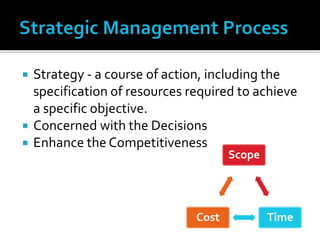
 Strategy - a course of action, including the
specification of resources required to achieve
a specific objective.
 Concerned with the Decisions
 Enhance the Competitiveness
Scope
TimeCost
 “Based on current performance in
marketplace”
 “Defines how we will meet our objectives”
 “Sets allocation of resources to meet goals”
 “Selects preferred strategic options to compete
within a market”
 “Provides a long-term plan for the
development of the organization”
 Missed Opportunities
 Inappropriate Direction
 Isolation of information in different systems.
 Resource wastage
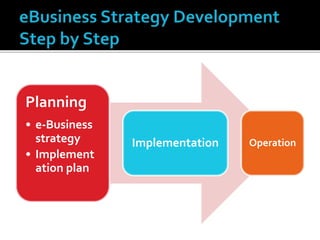
Planning
• e-Business
strategy
• Implement
ation plan
Implementation Operation
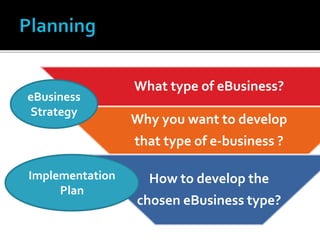
What type of eBusiness?
Why you want to develop
that type of e-business ?
How to develop the
chosen eBusiness type?
eBusiness
Strategy
Implementation
Plan
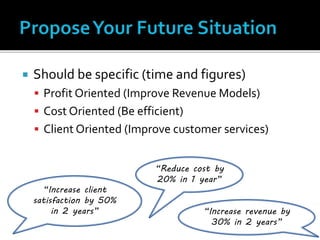
 Should be specific (time and figures)
 Profit Oriented (Improve Revenue Models)
 Cost Oriented (Be efficient)
 Client Oriented (Improve customer services)
“Increase revenue by
30% in 2 years”
“Reduce cost by
20% in 1 year”
“Increase client
satisfaction by 50%
in 2 years”
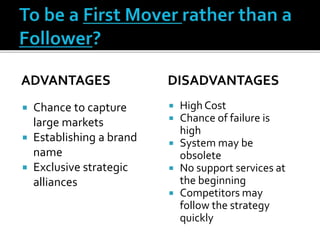
ADVANTAGES
 Chance to capture
large markets
 Establishing a brand
name
 Exclusive strategic
alliances
DISADVANTAGES
 High Cost
 Chance of failure is
high
 System may be
obsolete
 No support services at
the beginning
 Competitors may
follow the strategy
quickly
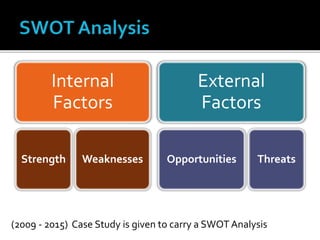
Internal
Factors
Strength Weaknesses
External
Factors
Opportunities Threats
(2009 - 2015) Case Study is given to carry a SWOT Analysis
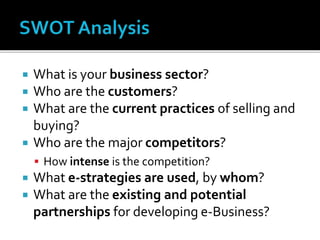
 What is your business sector?
 Who are the customers?
 What are the current practices of selling and
buying?
 Who are the major competitors?
 How intense is the competition?
 What e-strategies are used, by whom?
 What are the existing and potential
partnerships for developing e-Business?
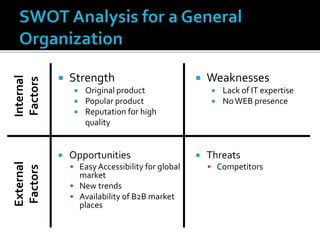
 Opportunities
 EasyAccessibility for global
market
 New trends
 Availability of B2B market
places
 Threats
 Competitors
 Strength
 Original product
 Popular product
 Reputation for high
quality
 Weaknesses
 Lack of IT expertise
 NoWEB presence
Internal
Factors
External
Factors
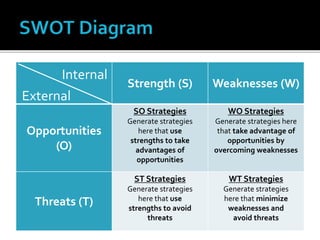
Strength (S) Weaknesses (W)
Opportunities
(O)
SO Strategies
Generate strategies
here that use
strengths to take
advantages of
opportunities
WO Strategies
Generate strategies here
that take advantage of
opportunities by
overcoming weaknesses
Threats (T)
ST Strategies
Generate strategies
here that use
strengths to avoid
threats
WT Strategies
Generate strategies
here that minimize
weaknesses and
avoid threats
Internal
External
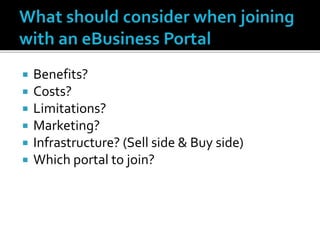
 Benefits?
 Costs?
 Limitations?
 Marketing?
 Infrastructure? (Sell side & Buy side)
 Which portal to join?
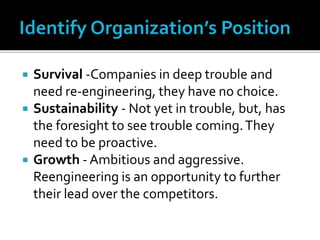
 Survival -Companies in deep trouble and
need re-engineering, they have no choice.
 Sustainability - Not yet in trouble, but, has
the foresight to see trouble coming.They
need to be proactive.
 Growth - Ambitious and aggressive.
Reengineering is an opportunity to further
their lead over the competitors.
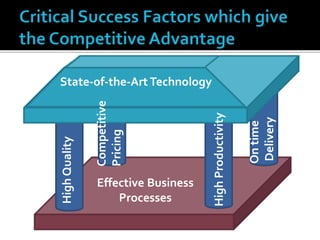
Effective Business
Processes
HighQuality
Ontime
Delivery
Competitive
Pricing
HighProductivity
State-of-the-Art Technology
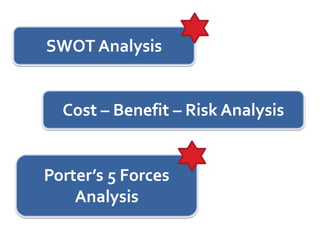
SWOT Analysis
Cost – Benefit – Risk Analysis
Porter’s 5 Forces
Analysis
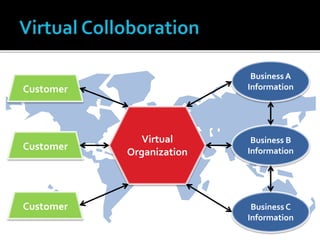
Business A
Information
Business B
Information
Business C
Information
Virtual
Organization
Customer
Customer
Customer
 When a small company plans to import or export
products for the first time they often face a range of
complicated procedures, regulations, legislation and
other barriers.
 Small companies with 5-10 employees do not have the
resources to support a dedicated foreign trade
department
 As a result, many SMEs feels trading internationally is
very discouraging.
 They may be forced to use an external consultant (very
expensive) or lose a potentially valuable business
opportunity.
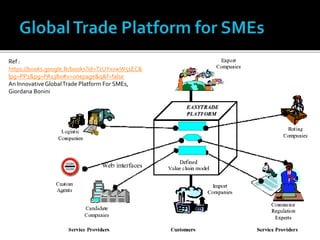
An Innovative Global Trade Platform For SMEs, Giordana Bonin
Ref :
https://books.google.lk/books?id=TzUYxvwW51EC&
lpg=PP1&pg=PA1380#v=onepage&q&f=false
An Innovative GlobalTrade Platform For SMEs,
Giordana Bonini
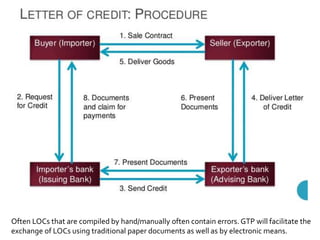
Often LOCs that are compiled by hand/manually often contain errors. GTP will facilitate the
exchange of LOCs using traditional paper documents as well as by electronic means.
 System architecture is based on modules that
will allow a range of actors from the foreign
trade value chain to integrate with the portal.
 Involving different types of users such as import and
export companies, banks and other foreign trade
sector operators
 The service providers (transport and logistics
companies, credit institutions, insurance companies,
lawyers/legal consultants, foreign trade advisors,
inspection institutions, forwarding agents, customs
offices/agents, public authorities, financial
institutions, etc.) can dynamically integrate to the
platform through on-line interactive web tools.
 Allows participant companies that use any kind of
application software to be easily integrated with the
system. (From web services which uses XML)
 High level of flexibility where features can be either be
partly or wholly used.
 Well organized portal and contents are clear and
precise.
 Provide effective support to companies who wish to
trade internationally.
 The main characteristic of this managerial software is
the integration into a unique technological platform
of all the actors involved in the import/export cycle.
 It is an innovative web based portal dedicated to foreign
trade
 Provides solutions to the major problems faced by
organizations when they are carrying out import/export
transactions.
 GTP is for SMEs who intend to start or expand
international trade activities by guiding them through
the stages of importing or exporting a product and
highlighting any relevant regulations and taxes that
apply.
 It allows organizations (SMEs) to manage and carry out
their B2B transactions on the Internet
 It is a easy to use support tool to improve
SMEs foreign trade activities because it fully
integrate the foreign trade value chain.
 Through a user-friendly interfaces, the portal
supplies both the types of SMEs; who wish to
start trading internationally as well as those
who want to enter new markets.
 Includes the business processes involved in the
import-export cycle.
 This web based portal supports the SMEs to manage
the whole import/export process by integrating all the
steps from order to payment to delivery.
 Deal with all the information regarding taxation
calculations and details of service providers necessary
to carryout a foreign trade transaction.
 It also includes order confirmation, price
determination, digital transfer of documents,
agreement of the transaction’s terms and conditions,
and selection of service providers.
 Should be based on state of the art technologies
as well as intelligent technologies.
 Should incorporate all the necessary security
features to achieve data protection, integrity
and security.
 It should not be just a simple marketplace.
 Should be easy to use to retrieve information,
especially by non expert users such like SMEs.
 Should include following major functional areas;
 marketing, legal, informatics, international payment
and logistics.
 Offer buyer/seller contacts and related
information to obtain the best available
offer.
 Intelligent systems that highlights the most
competitive service providers
 Calculate total price for a product when it
arrives at the export destination taking into
account charges such as insurance, freight,
import taxes, port fees.
 Users can obtain export advice on the tax,
customs duties, legal and administrative
requirements for a specific product depending
on the country of origin and destination.
 The exporter/importer can select relevant
delivery and payment terms.
 Facilities to negotiate and manage different payment
methods and manage foreign exchange.
 Produce and manage all the necessary transport
documents
 Easily manage shipment requests
 Could provide number of value added
features(negotiation and consultancy) that
will attract and retain SMEs and allow
suppliers to gain market access and reduce
transactions costs by ensuring the
transparency and security of international
transactions.
 Additional facilities include such as e-learning
facility to learn the process, foreign trade
related discussion forums.
 Facilities to overcome language barrier
 Support from an online export guide
containing export assistance, operational
tools, financing, information sources and
commercial information about potential
foreign customers.
 Consultancy support to help organizations
overcome the key barriers which prevent
them from entering to the international
markets.
 Need high security environment both physical & digital.
 Digital security mechanisms should be properly in place
(protocols [HTTPS/ SSL], encrypted information
transmission, password protection, user id system, digital
signatures and acquire necessary digital certificates.)
 CIA Features in Digital Security
 Confidentiality – ensure that information is not accessed by
unauthorized parties
 Integrity – ensure that information is not altered by
unauthorized people in a way not detectable by authorized users
 Authentication – ensure that users are the people they claim to
be
 Security is an important issue for the successful
implementation of the portal.
 To guarantee the maximum level of trust, the
system should take the necessary measures to
ensure both high performance and system
protection.
 Digital signatures and proper mechanisms to allow
users to manage and exchange electronic documents.
(in order to certify the validity, the authenticity and
the ownership of any document transmitted over the
platform)
 Security of the sensitive data
 The SMEs get virtual participate in bigger global
market. Could be a global provider easily.
 No marketing needed individually
 Improve the competitiveness of exporters involved in
foreign trade
 Facilitate exporters to create and publish their
product catalogue online, thus increasing their
company visibility.
 With dashboards which display current customer
order status, new orders, new quotation requests,
previous orders.. etc., exporters can easily get an
overview of their business performance.
 One stop shop concept
 Users can obtain a list of approved suppliers as well as
competitive service providers who can provide the
necessary export services such as shipping, hauliers,
insurance, etc.
 Importers can request a price quotation for the
displayed products and once the offer request is
received, exporters can generate a counter offer
through the portal.
 Facility to posting an offer and carry out the
international sale contract in a coordinated manner
which conforms with international legislation.
 Costs Savings
 Portal provide the most competitive quote from a
range of service providers.
 Portal simplifies the international trade process.
 Reduction in the risk related to the loss or delay
documents
 Savings in customs costs because goods will remain in
customs for a shorter period of time.
 Time Savings
 Enable users to speed up the exchange of documents
and streamline their foreign trade business processes.
 Reduction of errors
 Platform supports the secure integrated and coordinated
management of documents necessary for the execution of
any foreign trade transaction.
 The system ensures the authenticity and accuracy of every
document exchanged online.
 In particular users will be able to create, amend and
change LOCs online, thus reducing the costs of using
external consultants to prepare and dispatch such
documents.
 Another major benefit is achieved in the reduction of
errors in LOCs missing documents or delays in presenting
the correct paperwork which were often experienced by
importers and exporters.
 GTP will provide an important contribution
because it meets a large number of identified
user needs and provides a complete export
service to SMEs
 Provide importers/ exporters with the
contacts and references to obtain the best
available offer and to better integrate the
value chain of their import/export operation.
2014, 2013, 2011, 2009 – 2. a) Illustrate and describe
the benefits of the following eBusiness models to
the manufacturer/seller and the customer
separately.
i. GlobalTrade Platform for SMEs
(20 Marks)

eCommerce Business Strategies

  • 1.
  • 2.
     Strategy -a course of action, including the specification of resources required to achieve a specific objective.  Concerned with the Decisions  Enhance the Competitiveness Scope TimeCost
  • 3.
     “Based oncurrent performance in marketplace”  “Defines how we will meet our objectives”  “Sets allocation of resources to meet goals”  “Selects preferred strategic options to compete within a market”  “Provides a long-term plan for the development of the organization”
  • 4.
     Missed Opportunities Inappropriate Direction  Isolation of information in different systems.  Resource wastage
  • 5.
  • 6.
    What type ofeBusiness? Why you want to develop that type of e-business ? How to develop the chosen eBusiness type? eBusiness Strategy Implementation Plan
  • 7.
     Should bespecific (time and figures)  Profit Oriented (Improve Revenue Models)  Cost Oriented (Be efficient)  Client Oriented (Improve customer services) “Increase revenue by 30% in 2 years” “Reduce cost by 20% in 1 year” “Increase client satisfaction by 50% in 2 years”
  • 8.
    ADVANTAGES  Chance tocapture large markets  Establishing a brand name  Exclusive strategic alliances DISADVANTAGES  High Cost  Chance of failure is high  System may be obsolete  No support services at the beginning  Competitors may follow the strategy quickly
  • 9.
  • 10.
     What isyour business sector?  Who are the customers?  What are the current practices of selling and buying?  Who are the major competitors?  How intense is the competition?  What e-strategies are used, by whom?  What are the existing and potential partnerships for developing e-Business?
  • 11.
     Opportunities  EasyAccessibilityfor global market  New trends  Availability of B2B market places  Threats  Competitors  Strength  Original product  Popular product  Reputation for high quality  Weaknesses  Lack of IT expertise  NoWEB presence Internal Factors External Factors
  • 12.
    Strength (S) Weaknesses(W) Opportunities (O) SO Strategies Generate strategies here that use strengths to take advantages of opportunities WO Strategies Generate strategies here that take advantage of opportunities by overcoming weaknesses Threats (T) ST Strategies Generate strategies here that use strengths to avoid threats WT Strategies Generate strategies here that minimize weaknesses and avoid threats Internal External
  • 13.
     Benefits?  Costs? Limitations?  Marketing?  Infrastructure? (Sell side & Buy side)  Which portal to join?
  • 14.
     Survival -Companiesin deep trouble and need re-engineering, they have no choice.  Sustainability - Not yet in trouble, but, has the foresight to see trouble coming.They need to be proactive.  Growth - Ambitious and aggressive. Reengineering is an opportunity to further their lead over the competitors.
  • 15.
  • 16.
    SWOT Analysis Cost –Benefit – Risk Analysis Porter’s 5 Forces Analysis
  • 17.
    Business A Information Business B Information BusinessC Information Virtual Organization Customer Customer Customer
  • 18.
     When asmall company plans to import or export products for the first time they often face a range of complicated procedures, regulations, legislation and other barriers.  Small companies with 5-10 employees do not have the resources to support a dedicated foreign trade department  As a result, many SMEs feels trading internationally is very discouraging.  They may be forced to use an external consultant (very expensive) or lose a potentially valuable business opportunity.
  • 19.
    An Innovative GlobalTrade Platform For SMEs, Giordana Bonin Ref : https://books.google.lk/books?id=TzUYxvwW51EC& lpg=PP1&pg=PA1380#v=onepage&q&f=false An Innovative GlobalTrade Platform For SMEs, Giordana Bonini
  • 20.
    Often LOCs thatare compiled by hand/manually often contain errors. GTP will facilitate the exchange of LOCs using traditional paper documents as well as by electronic means.
  • 21.
     System architectureis based on modules that will allow a range of actors from the foreign trade value chain to integrate with the portal.  Involving different types of users such as import and export companies, banks and other foreign trade sector operators  The service providers (transport and logistics companies, credit institutions, insurance companies, lawyers/legal consultants, foreign trade advisors, inspection institutions, forwarding agents, customs offices/agents, public authorities, financial institutions, etc.) can dynamically integrate to the platform through on-line interactive web tools.
  • 22.
     Allows participantcompanies that use any kind of application software to be easily integrated with the system. (From web services which uses XML)  High level of flexibility where features can be either be partly or wholly used.  Well organized portal and contents are clear and precise.  Provide effective support to companies who wish to trade internationally.  The main characteristic of this managerial software is the integration into a unique technological platform of all the actors involved in the import/export cycle.
  • 23.
     It isan innovative web based portal dedicated to foreign trade  Provides solutions to the major problems faced by organizations when they are carrying out import/export transactions.  GTP is for SMEs who intend to start or expand international trade activities by guiding them through the stages of importing or exporting a product and highlighting any relevant regulations and taxes that apply.  It allows organizations (SMEs) to manage and carry out their B2B transactions on the Internet
  • 24.
     It isa easy to use support tool to improve SMEs foreign trade activities because it fully integrate the foreign trade value chain.  Through a user-friendly interfaces, the portal supplies both the types of SMEs; who wish to start trading internationally as well as those who want to enter new markets.
  • 25.
     Includes thebusiness processes involved in the import-export cycle.  This web based portal supports the SMEs to manage the whole import/export process by integrating all the steps from order to payment to delivery.  Deal with all the information regarding taxation calculations and details of service providers necessary to carryout a foreign trade transaction.  It also includes order confirmation, price determination, digital transfer of documents, agreement of the transaction’s terms and conditions, and selection of service providers.
  • 26.
     Should bebased on state of the art technologies as well as intelligent technologies.  Should incorporate all the necessary security features to achieve data protection, integrity and security.  It should not be just a simple marketplace.  Should be easy to use to retrieve information, especially by non expert users such like SMEs.  Should include following major functional areas;  marketing, legal, informatics, international payment and logistics.
  • 27.
     Offer buyer/sellercontacts and related information to obtain the best available offer.  Intelligent systems that highlights the most competitive service providers  Calculate total price for a product when it arrives at the export destination taking into account charges such as insurance, freight, import taxes, port fees.
  • 28.
     Users canobtain export advice on the tax, customs duties, legal and administrative requirements for a specific product depending on the country of origin and destination.  The exporter/importer can select relevant delivery and payment terms.  Facilities to negotiate and manage different payment methods and manage foreign exchange.  Produce and manage all the necessary transport documents  Easily manage shipment requests
  • 29.
     Could providenumber of value added features(negotiation and consultancy) that will attract and retain SMEs and allow suppliers to gain market access and reduce transactions costs by ensuring the transparency and security of international transactions.  Additional facilities include such as e-learning facility to learn the process, foreign trade related discussion forums.
  • 30.
     Facilities toovercome language barrier  Support from an online export guide containing export assistance, operational tools, financing, information sources and commercial information about potential foreign customers.  Consultancy support to help organizations overcome the key barriers which prevent them from entering to the international markets.
  • 31.
     Need highsecurity environment both physical & digital.  Digital security mechanisms should be properly in place (protocols [HTTPS/ SSL], encrypted information transmission, password protection, user id system, digital signatures and acquire necessary digital certificates.)  CIA Features in Digital Security  Confidentiality – ensure that information is not accessed by unauthorized parties  Integrity – ensure that information is not altered by unauthorized people in a way not detectable by authorized users  Authentication – ensure that users are the people they claim to be
  • 32.
     Security isan important issue for the successful implementation of the portal.  To guarantee the maximum level of trust, the system should take the necessary measures to ensure both high performance and system protection.  Digital signatures and proper mechanisms to allow users to manage and exchange electronic documents. (in order to certify the validity, the authenticity and the ownership of any document transmitted over the platform)  Security of the sensitive data
  • 33.
     The SMEsget virtual participate in bigger global market. Could be a global provider easily.  No marketing needed individually  Improve the competitiveness of exporters involved in foreign trade  Facilitate exporters to create and publish their product catalogue online, thus increasing their company visibility.  With dashboards which display current customer order status, new orders, new quotation requests, previous orders.. etc., exporters can easily get an overview of their business performance.
  • 34.
     One stopshop concept  Users can obtain a list of approved suppliers as well as competitive service providers who can provide the necessary export services such as shipping, hauliers, insurance, etc.  Importers can request a price quotation for the displayed products and once the offer request is received, exporters can generate a counter offer through the portal.  Facility to posting an offer and carry out the international sale contract in a coordinated manner which conforms with international legislation.
  • 35.
     Costs Savings Portal provide the most competitive quote from a range of service providers.  Portal simplifies the international trade process.  Reduction in the risk related to the loss or delay documents  Savings in customs costs because goods will remain in customs for a shorter period of time.  Time Savings  Enable users to speed up the exchange of documents and streamline their foreign trade business processes.
  • 36.
     Reduction oferrors  Platform supports the secure integrated and coordinated management of documents necessary for the execution of any foreign trade transaction.  The system ensures the authenticity and accuracy of every document exchanged online.  In particular users will be able to create, amend and change LOCs online, thus reducing the costs of using external consultants to prepare and dispatch such documents.  Another major benefit is achieved in the reduction of errors in LOCs missing documents or delays in presenting the correct paperwork which were often experienced by importers and exporters.
  • 37.
     GTP willprovide an important contribution because it meets a large number of identified user needs and provides a complete export service to SMEs  Provide importers/ exporters with the contacts and references to obtain the best available offer and to better integrate the value chain of their import/export operation.
  • 38.
    2014, 2013, 2011,2009 – 2. a) Illustrate and describe the benefits of the following eBusiness models to the manufacturer/seller and the customer separately. i. GlobalTrade Platform for SMEs (20 Marks)

Editor's Notes

  • #3 Before jumping into the e-strategy fundamentals, let us see what is meant by the strategic management. The strategic management process is concerned with the decisions organizations make about their future direction. the development and implementation of strategies which will enhance the competitiveness. Strategy can be explained as a course of action, including the specification of resources required to achieve a specific objective. Transforming the organization into an e business in order to provide more business value to the corporation and its shareholders has been an integral part of the strategy of many contemporary organizations.
  • #4 These typical quotes summarizing the essence of strategy
  • #5 Now think about the implications if e-business strategy is not clearly defined. Missed opportunities and from lack of evaluation of opportunities or insufficient resourcing of e-business initiatives. These will result in more savvy competitors gaining a competitive advantage; • Inappropriate direction of e-business strategy (poorly defined objectives, for example with the wrong emphasis on buy-side, sell-side or internal process support); • Limited integration of e-business at a technical level resulting in silos of information in different systems; • Resource wastage through duplication of e-business development in different functions and limited sharing of best practice. For instance, each business unit or region may develop a separate web site with different suppliers without achieving economies of scale
  • #7 Issues in e-Business Strategy • E-Business Awareness / Owner commitment • Senior managers tend to: – Know the whole spectrum of business – Possess knowledge and authority to lead – the e-business adoption
  • #8 Revenue model – Properly planned revenue model is a critical success factor – Revenues from sales depend on customer acquisition cost and advertisement – Must be figured into the analysis • Costs – Implementation and operation costs • Recover the investment – Should be able to recover the investment in up to 3 years
  • #9 Cost of developing an initiative is usually very high System may be obsolete as compared to second wave arrivals No support services are available at the beginning Reality Shows
  • #14 Positing a notice(offer) that you need this, then would there be proposals.
  • #21  Small and Medium Enterprises
  • #22 Rating companies : (credit rating agency) – Advises whether it is good to invest on that certain company/country
  • #24 (certification organizations, goods and credit insurance companies, Chamber of Commerce - a local association to promote and protect the interests of the business community in a particular place. )
  • #34 Security is an important factor to consider.
  • #37 Hauliers - a person or firm that transports goods by lorry