Presentation
On
“Digital Payment System”
-Mr.BharatH. Hajare
As buying and selling activities in business are moving from face
to face trading, mail order, and telephone order to electronic
commerce over open networks such as Internet. Digital Funds
Transfer over financial networks is logically safe; securing
payments over open networks between business servers and
consumer workstations pose challenges of a new element. This
article reviews the position of the art in payment technologies.
ABSTRACT
➢Digital payment system
➢ Digital payment models
➢ Security Requirements
➢ Availability & Reliability
➢ Which payment system is better for transaction whether it is
Online or offline payment system
➢ Online & Offline payment systems
➢ Advantages and Disadvantages
KEYWORDS
Digital payment system is an integral part of digital commerce. It define digital
payment is an economic exchange that take place online between consumer
and seller. The get in touch with of this exchange is usually some form of
electronic financial instrument. That is backed by a bank or a mediator, or by
legal tender. There are three interesting attention among financial organization
in electronic payment-decreasing technology cost, reduced operational and
processing cost and increasing online commerce. In this article, we attempt to
provide an overview of electronic payment systems focusing on issues related
to their security.
INTRODUCTION
A digital payment system is a way of making transaction/payment
through a digital media. That is making payment by the use of
‘plastic money’ and ‘e-money’ i.e. online payment services
providing by banks. The banker and customer, both are use the
digital media to send and receive the money, without the use of
physical cash or cheque.
MEANING
➢To understand the concept of digital payment system.
➢ It is use to understand the concept of security.
➢ To study buyer preference to wards payment access with
respect to charges and risks.
➢ To understand the charges in respect of payment access.
➢ To analyze the risks involved in digital payment system.
OBJECTIVES OF THE STUDY
➢NEFT (National Electronic Fund Transfer)
➢ RTGS(Real Time Gross Settlement)
➢ Net Banking (Mobile Banking)
➢ E-Payment (Electronic Payment)
➢ CTS Clearing System ( Cheque Truncation System)
➢ Master Card
METHODOLOGY
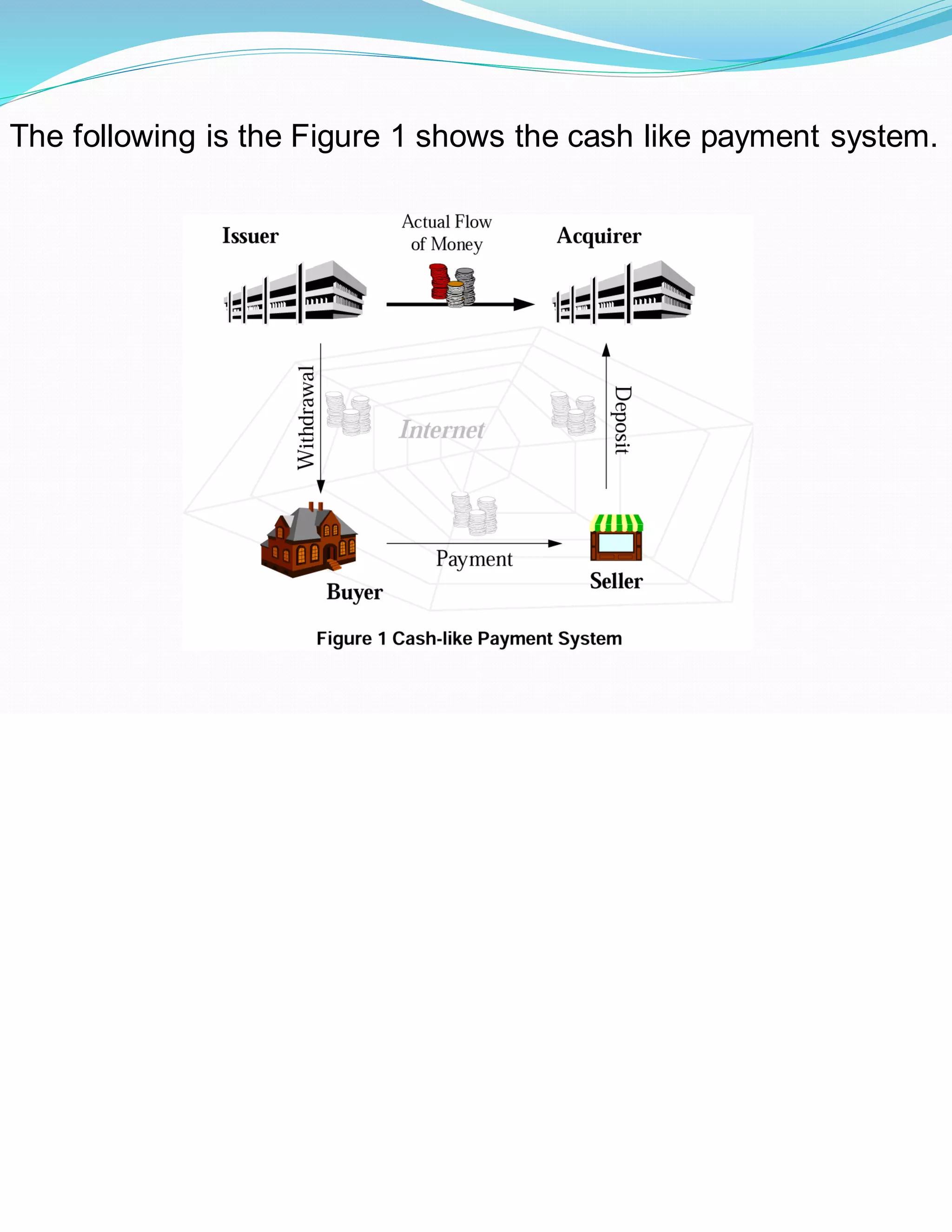
Commerce always involves a buyer and seller who exchange money for
goods/services, and at least one financial organization which links “bits” to
“money”. In most existing payment systems, the latter role is divided into two
parts: an issuer (used by the customer) and an acquirer (used by the payee).
Digital payment from spender to receiver is implemented by a flow of real
money from the spender via the issuer and acquirer to the receiver. In prepaid
cash like payment system, a certain amount of money is taken away from the
payer (for example, by debiting that amount from the senders bank account)
earlier than a purchase is made. This amount of money can be used for
expenditure later. Card-based digital purse, digital cash as well as
(certified/guaranteed) bank cheques falls in this category.
ELECTRONIC PAYMENT
MODELS
The following is the Figure 1 shows the cash like payment system.
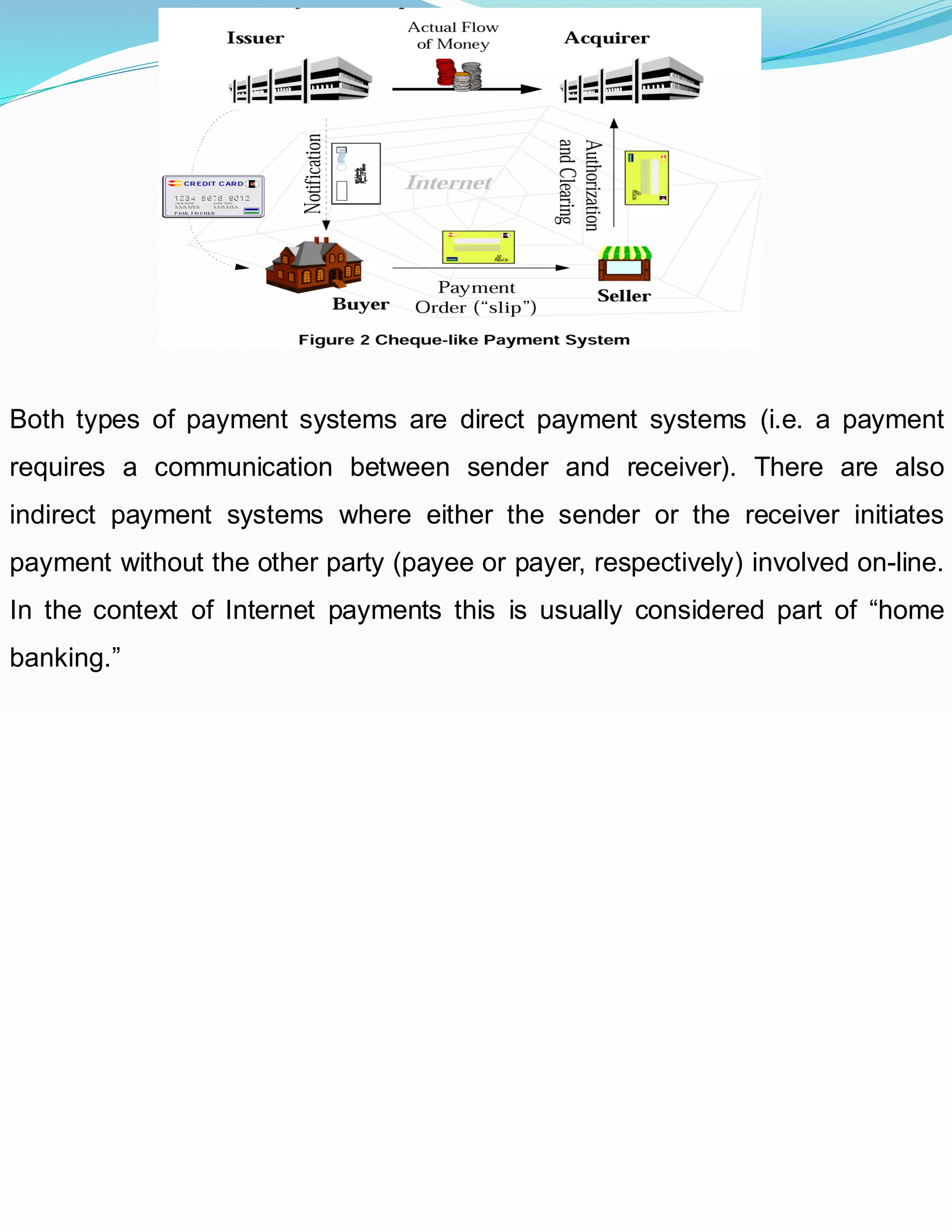
In pay-now payment systems, the payer’s account is debited at the time of
payment. ATM card based systems (such as the European EC-Direct system,
etc) fall into this category. In pay-later (credit) payment systems, the payee’s
bank account is credited the amount of sale before the payer’s account is
debited. Credit card systems fall into this category. From a practice point of
view, pay-now and pay later systems belong to the same class. Typical flows of
these systems are shown in Figure 2. As a payment is always done by transfer
some sort of “form” from sender to receiver (cheque, credit card slip, etc.) we
call these systems cheque-like.
Both types of payment systems are direct payment systems (i.e. a payment
requires a communication between sender and receiver). There are also
indirect payment systems where either the sender or the receiver initiates
payment without the other party (payee or payer, respectively) involved on-line.
In the context of Internet payments this is usually considered part of “home
banking.”
There are 3 essential security requirements for safe digital
payments are:
➢Integrity: Transaction must not be tampered or interfered.
➢Privacy: Transaction must be kept private and inviolable in
the sense that eavesdroppers cannot understand the message
content.
➢Confidentiality: The digital commerce environment must
ensure that all message traffic is confidential.
SECURITY REQUIREMENT
➢ All parties are interested in being able to make or receive payments
whenever necessary.
➢Payment transaction must be atomic: they occur entirely or not at all, but
never hang in an unknown or inconsistent state. No sender would accept a
loss of money (the loss of a significant amount, in any case) due to a network
crash, or because the receivers server crashed.
➢Availability and reliability presume that the original networking services and all
software And hardware components are sufficiently responsible. Recovery from
crash failures requires some sort of stable storage at all parties and specific
resynchronization protocol.
AVAILABILITY AND RELIABILITY
An online payment system is an Internet based way of processing
financial transactions. It allows to accepting the expenses over the
websites or any other Internet connections, such as direct
database connections between retail provisions and their supplier
a common method of maintaining just in time inventories.
1. ON-LINE PAYMENT SYSTEMS
➢Safe method: A digital payment business offers to additional security
to their customers.
➢Fast: The online payment system takes very less time for tractions.
➢Record: In the digital payment system / internet billing, a customer can
keep their payment records.
➢Accepted: Debit card, credit card, smart card are widely used method of
digital payment.
➢Accessible: The digital payments enable those to available to
customer 24*7 service. Customer can use at any time at anywhere.
ADVANTAGES
➢Fraud: Credit and debit card fraud are very common scam
that targets the individual person.
➢Identity Robbery: An individual person are required to
enter their personal details, the risk of identity robbery is more.
DISADVANTAGES
An offline payment system there is no need of internet connection
for processing financial transactions. It allows to accepting the
expenditures over the banks only or face to face transaction. It is
also known as credit card transaction. It is a payment method that
used to credit card.
2. OFFLINE PAYMENT SYSTEM
➢Trusted: Traditional/off-line method of payments such as
cash and cheques are widely used by retailers and businessman.
➢Direct: In the off-line payment system there is no any use of
internet connections.
➢Transparent: In the off-line payment method, payments are
directly transferred in to accounts.
➢Monitoring: These expenses are easily monitored as they
are directly received by retailers in most cases, for example postal
payments.
ADVANTAGES
➢Limited: It is restacked to the banking hours (working time)
depositing & withdrawing of money.
➢Unsafe: Some time offline payment system do not having
strong security for the accounts.
➢ Here we are comparing the both payment system online and
offline payment system. Online payment system is better than the
offline payment system. Because of online payment system takes
less time for transaction and customer can use anywhere at any
time. So it is better than the offline payment system.
✓Here we are comparing the both payment system online and
offline payment system. Online payment system is better than the
offline payment system. Because of online payment system takes
less time for transaction and customer can use anywhere at any
time. So it is better than the offline payment system.
DISADVANTAGES
➢ This high level summary is future to make clear that the
technology necessary for secure digital payment systems already
exists. Achieve security for all parties, including perfect
intractability of the customer. Digital payment system is necessary
for modern generation.
CONCLUSION
REFERENCE
➢N. Asokan, Phil Janson, Michael Steiner, Michael Waidner IBM
Research Division Zurich Research Laboratory, CH-8803
Ruschlikon, Switzerland {aso,pj,sti,wmi}@zurich.ibm.com
➢ Ravi Kalakota & Andrew B. Whinston
Digital payment system

Digital payment system

  • 1.
  • 2.
    As buying andselling activities in business are moving from face to face trading, mail order, and telephone order to electronic commerce over open networks such as Internet. Digital Funds Transfer over financial networks is logically safe; securing payments over open networks between business servers and consumer workstations pose challenges of a new element. This article reviews the position of the art in payment technologies. ABSTRACT
  • 3.
    ➢Digital payment system ➢Digital payment models ➢ Security Requirements ➢ Availability & Reliability ➢ Which payment system is better for transaction whether it is Online or offline payment system ➢ Online & Offline payment systems ➢ Advantages and Disadvantages KEYWORDS
  • 4.
    Digital payment systemis an integral part of digital commerce. It define digital payment is an economic exchange that take place online between consumer and seller. The get in touch with of this exchange is usually some form of electronic financial instrument. That is backed by a bank or a mediator, or by legal tender. There are three interesting attention among financial organization in electronic payment-decreasing technology cost, reduced operational and processing cost and increasing online commerce. In this article, we attempt to provide an overview of electronic payment systems focusing on issues related to their security. INTRODUCTION
  • 5.
    A digital paymentsystem is a way of making transaction/payment through a digital media. That is making payment by the use of ‘plastic money’ and ‘e-money’ i.e. online payment services providing by banks. The banker and customer, both are use the digital media to send and receive the money, without the use of physical cash or cheque. MEANING
  • 6.
    ➢To understand theconcept of digital payment system. ➢ It is use to understand the concept of security. ➢ To study buyer preference to wards payment access with respect to charges and risks. ➢ To understand the charges in respect of payment access. ➢ To analyze the risks involved in digital payment system. OBJECTIVES OF THE STUDY
  • 7.
    ➢NEFT (National ElectronicFund Transfer) ➢ RTGS(Real Time Gross Settlement) ➢ Net Banking (Mobile Banking) ➢ E-Payment (Electronic Payment) ➢ CTS Clearing System ( Cheque Truncation System) ➢ Master Card METHODOLOGY
  • 8.
    Commerce always involvesa buyer and seller who exchange money for goods/services, and at least one financial organization which links “bits” to “money”. In most existing payment systems, the latter role is divided into two parts: an issuer (used by the customer) and an acquirer (used by the payee). Digital payment from spender to receiver is implemented by a flow of real money from the spender via the issuer and acquirer to the receiver. In prepaid cash like payment system, a certain amount of money is taken away from the payer (for example, by debiting that amount from the senders bank account) earlier than a purchase is made. This amount of money can be used for expenditure later. Card-based digital purse, digital cash as well as (certified/guaranteed) bank cheques falls in this category. ELECTRONIC PAYMENT MODELS
  • 9.
    The following isthe Figure 1 shows the cash like payment system.
  • 10.
    In pay-now paymentsystems, the payer’s account is debited at the time of payment. ATM card based systems (such as the European EC-Direct system, etc) fall into this category. In pay-later (credit) payment systems, the payee’s bank account is credited the amount of sale before the payer’s account is debited. Credit card systems fall into this category. From a practice point of view, pay-now and pay later systems belong to the same class. Typical flows of these systems are shown in Figure 2. As a payment is always done by transfer some sort of “form” from sender to receiver (cheque, credit card slip, etc.) we call these systems cheque-like.
  • 11.
    Both types ofpayment systems are direct payment systems (i.e. a payment requires a communication between sender and receiver). There are also indirect payment systems where either the sender or the receiver initiates payment without the other party (payee or payer, respectively) involved on-line. In the context of Internet payments this is usually considered part of “home banking.”
  • 12.
    There are 3essential security requirements for safe digital payments are: ➢Integrity: Transaction must not be tampered or interfered. ➢Privacy: Transaction must be kept private and inviolable in the sense that eavesdroppers cannot understand the message content. ➢Confidentiality: The digital commerce environment must ensure that all message traffic is confidential. SECURITY REQUIREMENT
  • 13.
    ➢ All partiesare interested in being able to make or receive payments whenever necessary. ➢Payment transaction must be atomic: they occur entirely or not at all, but never hang in an unknown or inconsistent state. No sender would accept a loss of money (the loss of a significant amount, in any case) due to a network crash, or because the receivers server crashed. ➢Availability and reliability presume that the original networking services and all software And hardware components are sufficiently responsible. Recovery from crash failures requires some sort of stable storage at all parties and specific resynchronization protocol. AVAILABILITY AND RELIABILITY
  • 15.
    An online paymentsystem is an Internet based way of processing financial transactions. It allows to accepting the expenses over the websites or any other Internet connections, such as direct database connections between retail provisions and their supplier a common method of maintaining just in time inventories. 1. ON-LINE PAYMENT SYSTEMS
  • 16.
    ➢Safe method: Adigital payment business offers to additional security to their customers. ➢Fast: The online payment system takes very less time for tractions. ➢Record: In the digital payment system / internet billing, a customer can keep their payment records. ➢Accepted: Debit card, credit card, smart card are widely used method of digital payment. ➢Accessible: The digital payments enable those to available to customer 24*7 service. Customer can use at any time at anywhere. ADVANTAGES
  • 17.
    ➢Fraud: Credit anddebit card fraud are very common scam that targets the individual person. ➢Identity Robbery: An individual person are required to enter their personal details, the risk of identity robbery is more. DISADVANTAGES
  • 18.
    An offline paymentsystem there is no need of internet connection for processing financial transactions. It allows to accepting the expenditures over the banks only or face to face transaction. It is also known as credit card transaction. It is a payment method that used to credit card. 2. OFFLINE PAYMENT SYSTEM
  • 19.
    ➢Trusted: Traditional/off-line methodof payments such as cash and cheques are widely used by retailers and businessman. ➢Direct: In the off-line payment system there is no any use of internet connections. ➢Transparent: In the off-line payment method, payments are directly transferred in to accounts. ➢Monitoring: These expenses are easily monitored as they are directly received by retailers in most cases, for example postal payments. ADVANTAGES
  • 20.
    ➢Limited: It isrestacked to the banking hours (working time) depositing & withdrawing of money. ➢Unsafe: Some time offline payment system do not having strong security for the accounts. ➢ Here we are comparing the both payment system online and offline payment system. Online payment system is better than the offline payment system. Because of online payment system takes less time for transaction and customer can use anywhere at any time. So it is better than the offline payment system. ✓Here we are comparing the both payment system online and offline payment system. Online payment system is better than the offline payment system. Because of online payment system takes less time for transaction and customer can use anywhere at any time. So it is better than the offline payment system. DISADVANTAGES
  • 21.
    ➢ This highlevel summary is future to make clear that the technology necessary for secure digital payment systems already exists. Achieve security for all parties, including perfect intractability of the customer. Digital payment system is necessary for modern generation. CONCLUSION
  • 22.
    REFERENCE ➢N. Asokan, PhilJanson, Michael Steiner, Michael Waidner IBM Research Division Zurich Research Laboratory, CH-8803 Ruschlikon, Switzerland {aso,pj,sti,wmi}@zurich.ibm.com ➢ Ravi Kalakota & Andrew B. Whinston