INVINCIBLES
• Sovan Kundu

• Dinesh Iyer
• Prathamesh Parulekar
• Sukhveer Singh Rana
• Surbhi Singh
• Upasana Sunamudi
E-COMMERCE INFRASTRUCTURE
India’s First and Largest Managed Marketplace
ABOUT
• Founded in July 2011 in Silicon Valley, ShopClues.com is India's first and the largest managed
marketplace – a subsidiary of Clues Network, Inc,.

Business Model:
ShopClues works on a zero-inventory marketplace model where sellers can display their product
catalogues. Besides helping merchants reach out to a larger customer base, ShopClues also claims

to increase their (merchants) business by providing a number of business management tools and
marketing and decision-enabling analytics.
INTRODUCTION
• E-commerce
infrastructure
hardware, software, and networks.

requires

a

variety

of

• The key infrastructures that are needed to support EC applications are
networks, Web servers, Web server support and software, electronic
catalogs, Web page design, and Internet access components.
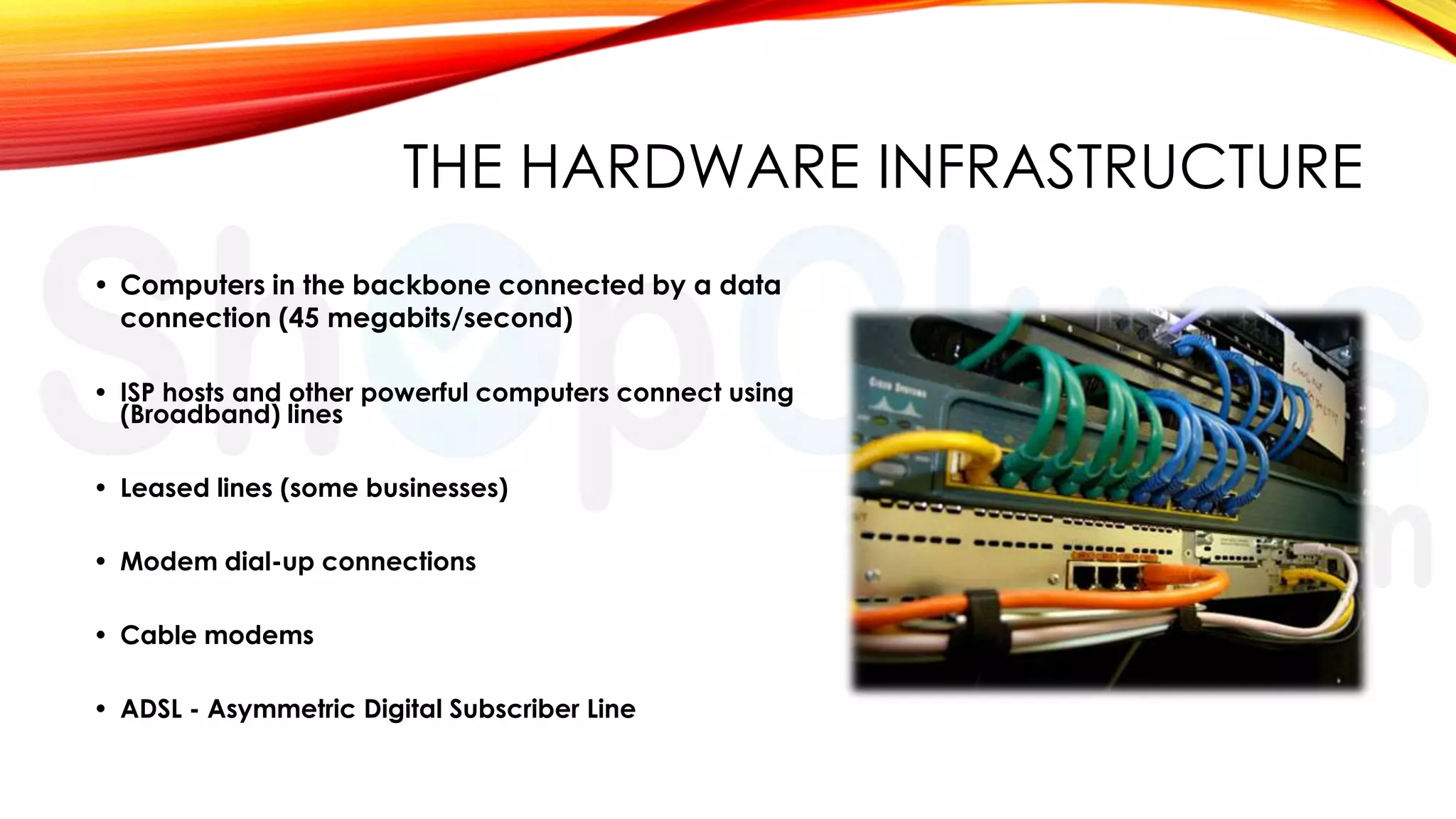
THE HARDWARE INFRASTRUCTURE
• Computers in the backbone connected by a data
connection (45 megabits/second)
• ISP hosts and other powerful computers connect using
(Broadband) lines
• Leased lines (some businesses)
• Modem dial-up connections
• Cable modems
• ADSL - Asymmetric Digital Subscriber Line
WEB STORE REQUIREMENTS
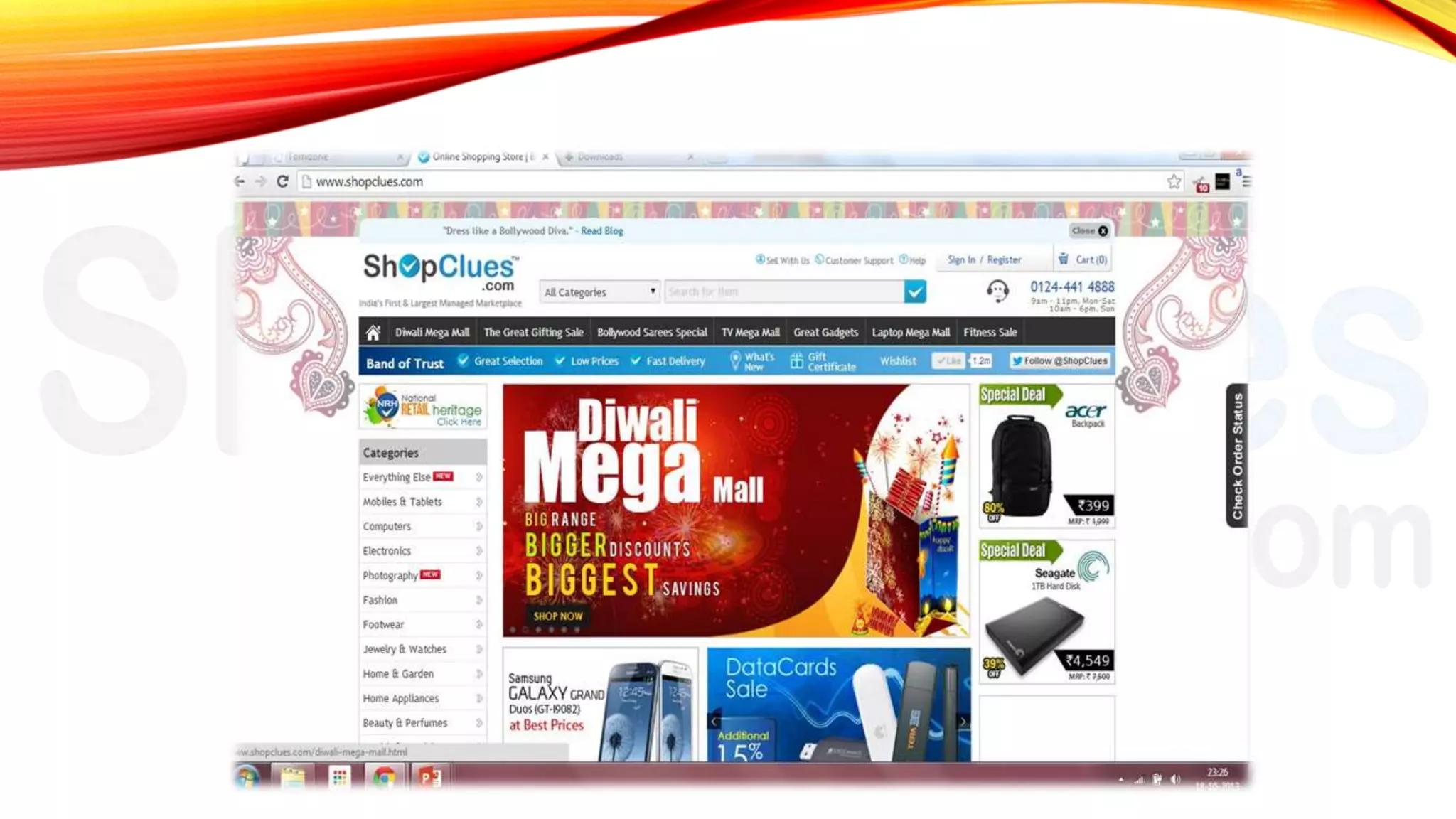
• An organization's first venture into EC is the development of a Web site and the
creation of a presence on the Internet.
• E-commerce transactions must be executable worldwide, without any delay or
mistake.
• On a very basic website, an organization provides information about itself, its
products and its services.
• A more developed Web site will allow some interactions, such as sending an e-mail
to request for the information or schedule an appointment, or ordering.
• Good designs can be very rewarding.
• Outsourcing Web page designs should be carefully evaluated because of the high
cost.

• The company can register its Web site within a domain name as well as registering it
with the major Web search engines.
• A good web site must have a fast catalog search engine, special discounts, credit
card and other payments, and shipping alternatives so that it can attract new
customers.
• It must offer customer support via help menus, tutorials, and list of FAQs.
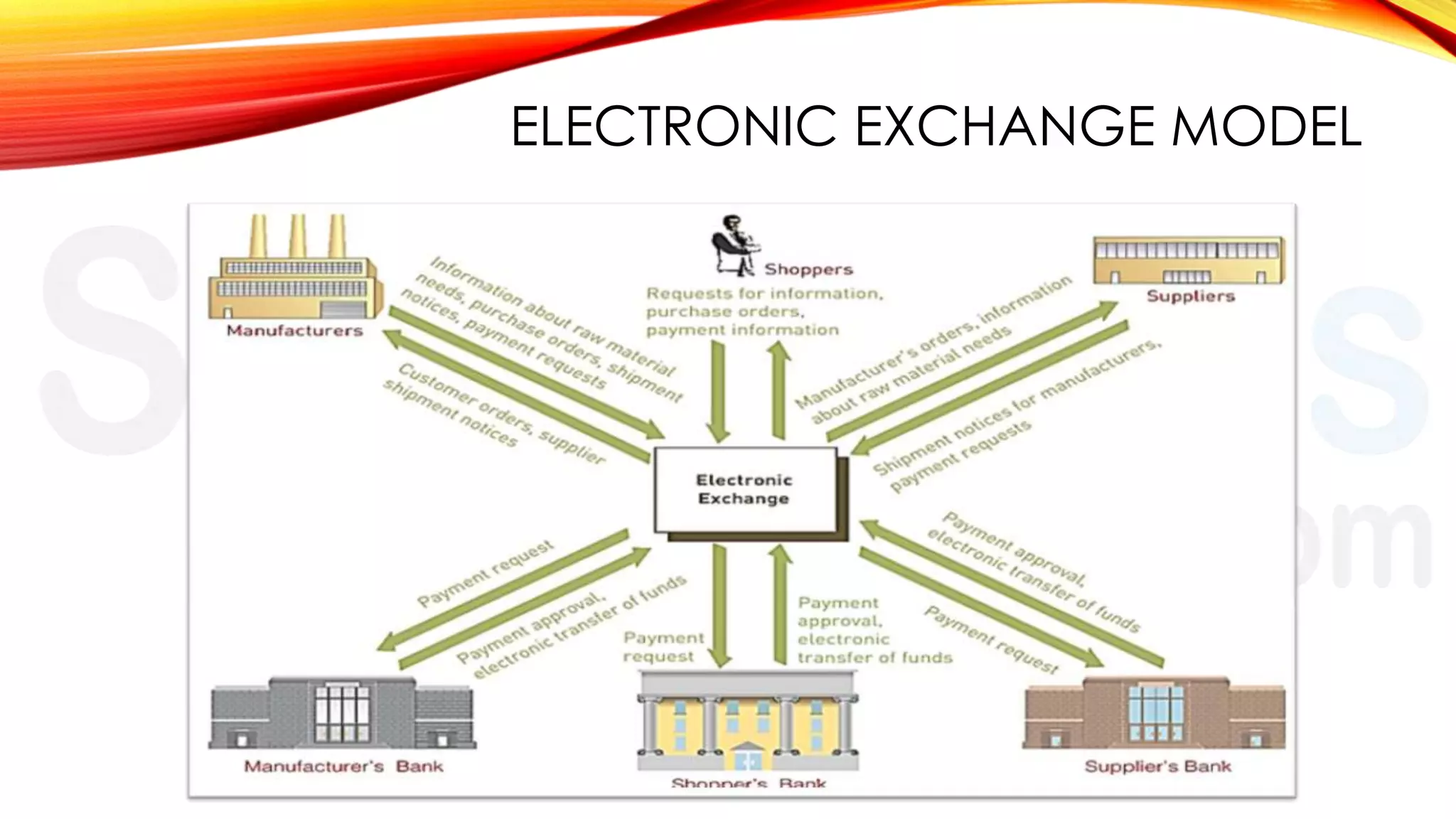
ELECTRONIC EXCHANGE MODEL
ELECTRONIC PAYMENTS
• Payments are an integral part of doing business, whether in the traditional way or online.
• In most cases, traditional payment systems are not effective for EC (using cash, writing a
check, sending a money order have several limitations in EC) .
• Usually in e-commerce, payments between buyers and sellers can take place
electronically.
• Special electronic payments have been developed to handle ways of paying for goods
electronically on the Internet.

• These include EFT (Electronic Fund Transfer), electronic checks, electronic credit cards,
electronic wallets.
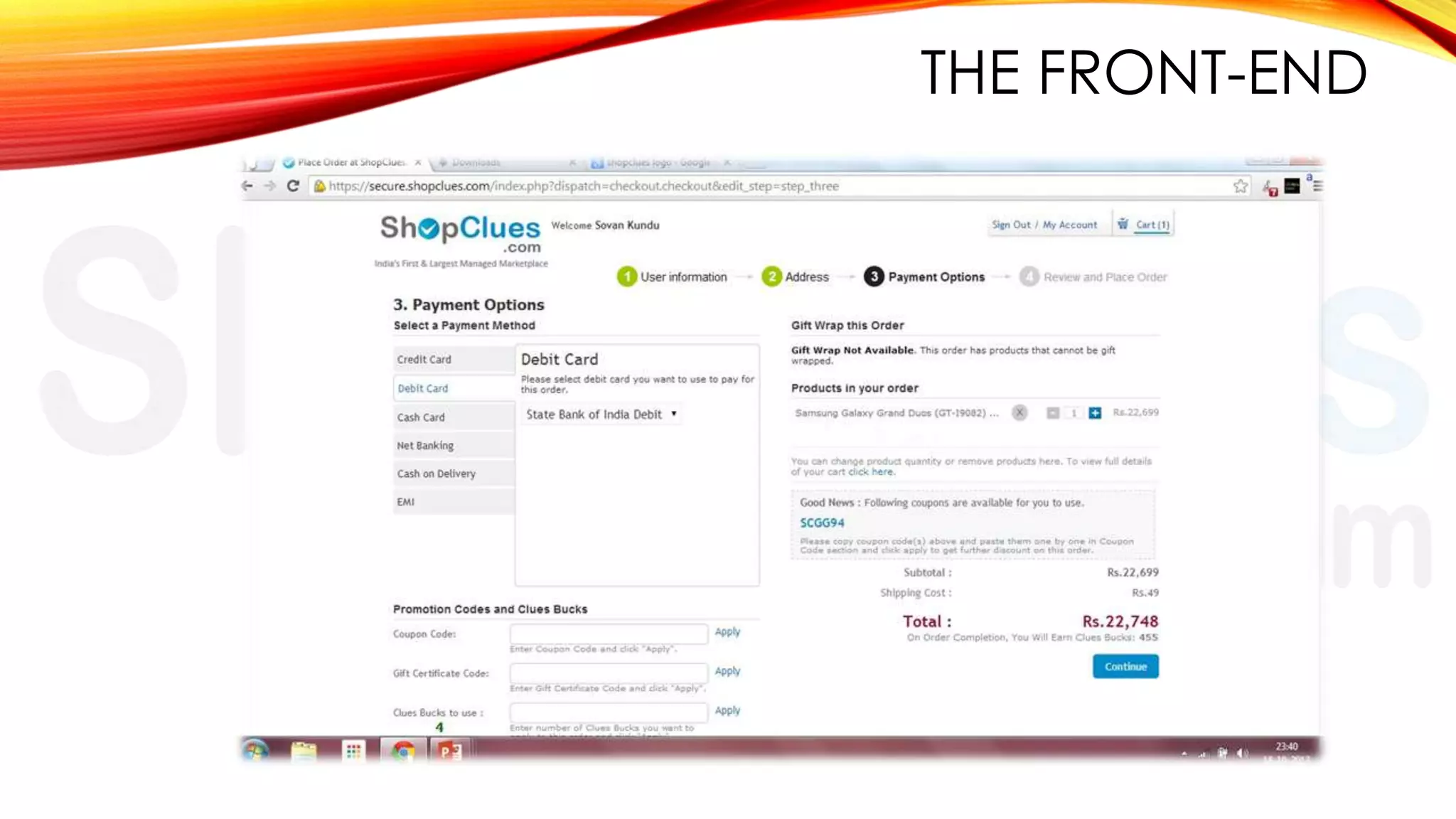
THE FRONT-END
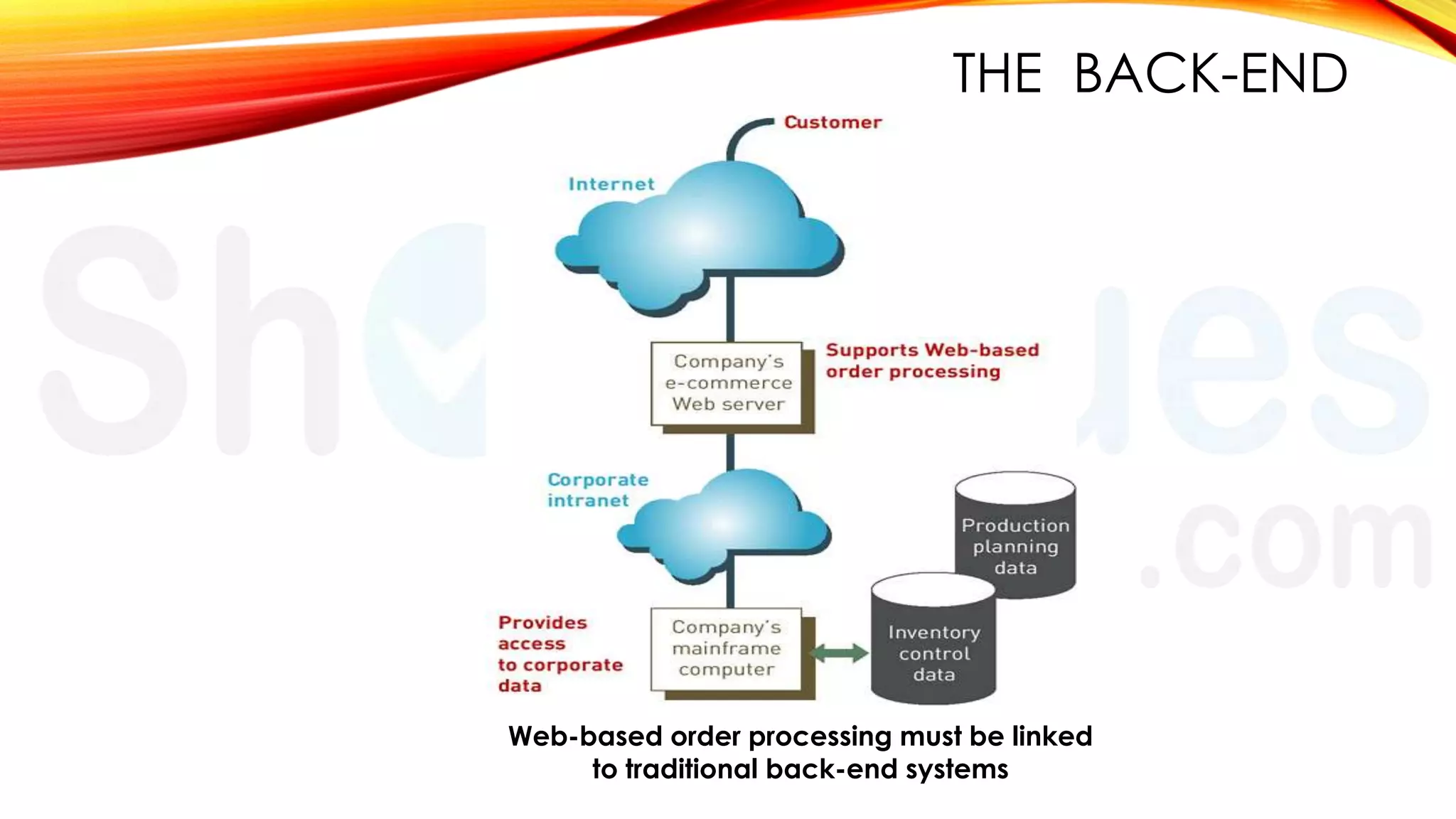
THE BACK-END

Web-based order processing must be linked
to traditional back-end systems
ENCRYPTION
• It is a process of making messages indecipherable.
• Only those recipients with an authorized key to the coding can retrieve the data.
• For example, the word “WEB” might be coded as:
ABQ8iF 1 73 Rjbj / 83 ds 1 22 m 3 3 SP 5 Qqm2z.
• Every letter and every number in the encrypted data would have similarly complex
coding, which may include as many as 128 characters for each letter or number for
security.
SECURITY
• Authentication methods
• Something you know: passwords
• Something you have: smart card
• Something you are: biometrics

• Firewalls, proxy servers, intrusion detection
• Denial of service (DOS) attacks, viruses, worms
ELECTRONIC CREDIT CARDS
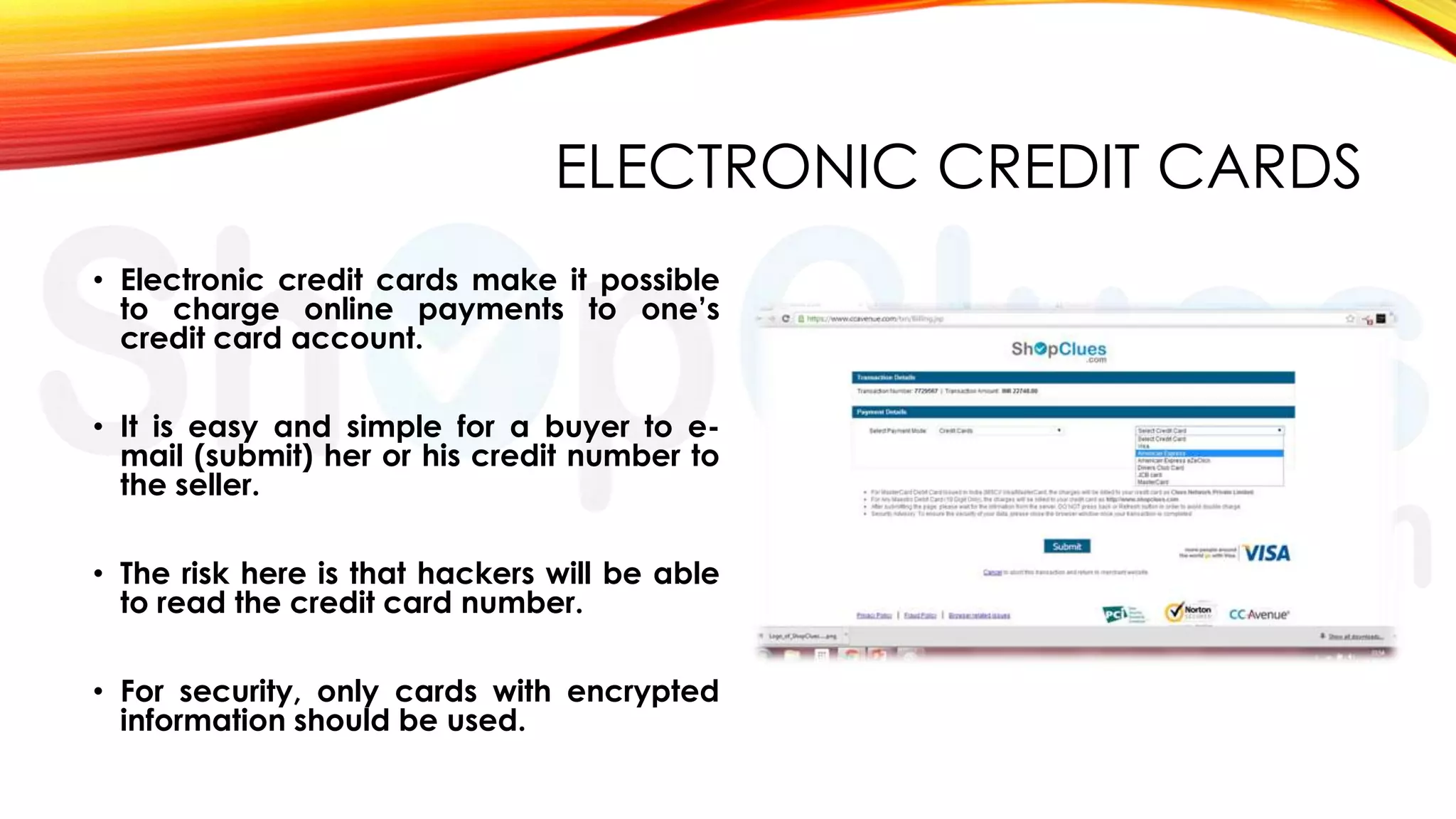
• Electronic credit cards make it possible
to charge online payments to one’s
credit card account.
• It is easy and simple for a buyer to email (submit) her or his credit number to
the seller.
• The risk here is that hackers will be able
to read the credit card number.
• For security, only cards with encrypted
information should be used.
ELECTRONIC FUND TRANSFER (EFT)
• Electronic transfer of money using telecommunications networks.
• EFT is fast.

• Handle daily large volume of financial transactions.
• EFT-based ATMs are available in shopping centers and business areas.
ELECTRONIC WALLETS
• Eliminating entry amd storage of information on a merchant’s server.
• One-click shopping.

• Credit card companies like Visa and Master card offer e-wallet services, as
do Yahoo!, America Online (called Quick Checkout) and Microsoft
(Passport).
M-COMMERCE
• Until recently, almost all e-commerce transactions took place over wired networks.
• Cell phones and other wireless handheld digital appliances are Internet enabled.

• The use of handheld wireless devices for purchasing goods and services has been
termed mobile commerce or m-commerce i.e.; conduct of e-commerce via
wireless devices.
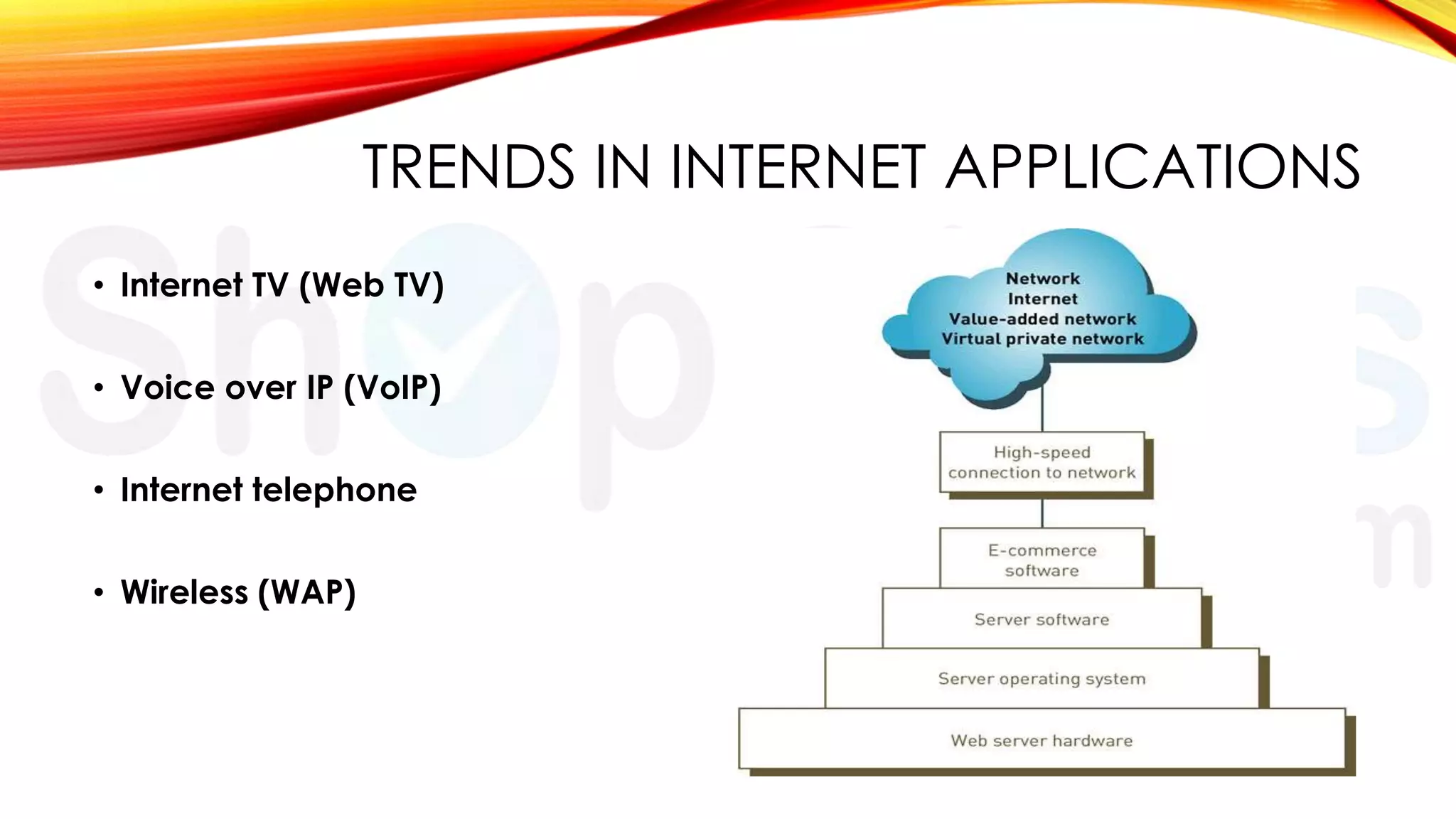
TRENDS IN INTERNET APPLICATIONS
• Internet TV (Web TV)
• Voice over IP (VoIP)

• Internet telephone
• Wireless (WAP)
IT SERVICES
• Infrastructure-as-a-service (IaaS) a cloud service where the enterprise uses a payas-you-go infrastructure from a service provider, offers a highly attractive, costeffective solution that benefits both parties.
• Software-as-a-service (SaaS) enables an enterprise application to be run on a
multitenant platform and delivered using Internet protocol to any device.
• Platform-as-a-service (PaaS) provides a platform to create and run applications in a
preproduction environment.
INFERENECE
• A robust interface as a part of infrastructure attracts more customers. Thirdparty UI tools like Whoopix, Woocommerce and Magento offers attractive UI
models.
• Cloud
computing
looks
to
be
the
future.
Companies
like
Amazon, Google, GoDaddy.com, Cisco & Microsoft are providing cloud
based system to most of the E-Commerce business. Shopclues.com being
powered by GoDaddy.com.

• With Cisco, D-link, Alcatel-Lucent & Juniper investing hugely in IT hardware
infrastructure, the future of E-Commerce industry looks bright.
Thank You !

E commerce infrastructure

  • 1.
    INVINCIBLES • Sovan Kundu •Dinesh Iyer • Prathamesh Parulekar • Sukhveer Singh Rana • Surbhi Singh • Upasana Sunamudi
  • 2.
    E-COMMERCE INFRASTRUCTURE India’s Firstand Largest Managed Marketplace
  • 3.
    ABOUT • Founded inJuly 2011 in Silicon Valley, ShopClues.com is India's first and the largest managed marketplace – a subsidiary of Clues Network, Inc,. Business Model: ShopClues works on a zero-inventory marketplace model where sellers can display their product catalogues. Besides helping merchants reach out to a larger customer base, ShopClues also claims to increase their (merchants) business by providing a number of business management tools and marketing and decision-enabling analytics.
  • 4.
    INTRODUCTION • E-commerce infrastructure hardware, software,and networks. requires a variety of • The key infrastructures that are needed to support EC applications are networks, Web servers, Web server support and software, electronic catalogs, Web page design, and Internet access components.
  • 5.
    THE HARDWARE INFRASTRUCTURE •Computers in the backbone connected by a data connection (45 megabits/second) • ISP hosts and other powerful computers connect using (Broadband) lines • Leased lines (some businesses) • Modem dial-up connections • Cable modems • ADSL - Asymmetric Digital Subscriber Line
  • 6.
    WEB STORE REQUIREMENTS •An organization's first venture into EC is the development of a Web site and the creation of a presence on the Internet. • E-commerce transactions must be executable worldwide, without any delay or mistake. • On a very basic website, an organization provides information about itself, its products and its services. • A more developed Web site will allow some interactions, such as sending an e-mail to request for the information or schedule an appointment, or ordering.
  • 8.
    • Good designscan be very rewarding. • Outsourcing Web page designs should be carefully evaluated because of the high cost. • The company can register its Web site within a domain name as well as registering it with the major Web search engines. • A good web site must have a fast catalog search engine, special discounts, credit card and other payments, and shipping alternatives so that it can attract new customers. • It must offer customer support via help menus, tutorials, and list of FAQs.
  • 9.
  • 10.
    ELECTRONIC PAYMENTS • Paymentsare an integral part of doing business, whether in the traditional way or online. • In most cases, traditional payment systems are not effective for EC (using cash, writing a check, sending a money order have several limitations in EC) . • Usually in e-commerce, payments between buyers and sellers can take place electronically. • Special electronic payments have been developed to handle ways of paying for goods electronically on the Internet. • These include EFT (Electronic Fund Transfer), electronic checks, electronic credit cards, electronic wallets.
  • 11.
  • 12.
    THE BACK-END Web-based orderprocessing must be linked to traditional back-end systems
  • 13.
    ENCRYPTION • It isa process of making messages indecipherable. • Only those recipients with an authorized key to the coding can retrieve the data. • For example, the word “WEB” might be coded as: ABQ8iF 1 73 Rjbj / 83 ds 1 22 m 3 3 SP 5 Qqm2z. • Every letter and every number in the encrypted data would have similarly complex coding, which may include as many as 128 characters for each letter or number for security.
  • 14.
    SECURITY • Authentication methods •Something you know: passwords • Something you have: smart card • Something you are: biometrics • Firewalls, proxy servers, intrusion detection • Denial of service (DOS) attacks, viruses, worms
  • 15.
    ELECTRONIC CREDIT CARDS •Electronic credit cards make it possible to charge online payments to one’s credit card account. • It is easy and simple for a buyer to email (submit) her or his credit number to the seller. • The risk here is that hackers will be able to read the credit card number. • For security, only cards with encrypted information should be used.
  • 16.
    ELECTRONIC FUND TRANSFER(EFT) • Electronic transfer of money using telecommunications networks. • EFT is fast. • Handle daily large volume of financial transactions. • EFT-based ATMs are available in shopping centers and business areas.
  • 17.
    ELECTRONIC WALLETS • Eliminatingentry amd storage of information on a merchant’s server. • One-click shopping. • Credit card companies like Visa and Master card offer e-wallet services, as do Yahoo!, America Online (called Quick Checkout) and Microsoft (Passport).
  • 18.
    M-COMMERCE • Until recently,almost all e-commerce transactions took place over wired networks. • Cell phones and other wireless handheld digital appliances are Internet enabled. • The use of handheld wireless devices for purchasing goods and services has been termed mobile commerce or m-commerce i.e.; conduct of e-commerce via wireless devices.
  • 19.
    TRENDS IN INTERNETAPPLICATIONS • Internet TV (Web TV) • Voice over IP (VoIP) • Internet telephone • Wireless (WAP)
  • 20.
    IT SERVICES • Infrastructure-as-a-service(IaaS) a cloud service where the enterprise uses a payas-you-go infrastructure from a service provider, offers a highly attractive, costeffective solution that benefits both parties. • Software-as-a-service (SaaS) enables an enterprise application to be run on a multitenant platform and delivered using Internet protocol to any device. • Platform-as-a-service (PaaS) provides a platform to create and run applications in a preproduction environment.
  • 21.
    INFERENECE • A robustinterface as a part of infrastructure attracts more customers. Thirdparty UI tools like Whoopix, Woocommerce and Magento offers attractive UI models. • Cloud computing looks to be the future. Companies like Amazon, Google, GoDaddy.com, Cisco & Microsoft are providing cloud based system to most of the E-Commerce business. Shopclues.com being powered by GoDaddy.com. • With Cisco, D-link, Alcatel-Lucent & Juniper investing hugely in IT hardware infrastructure, the future of E-Commerce industry looks bright.
  • 22.