What does Customer Relationship
Management (CRM) mean?
• CRM is a strategy by which
companies optimize profitability
through enhanced customer
satisfaction.
• CRM is about automating and
enhancing the customer centric
business processes of Sales,
Marketing, and Service.
• CRM also focuses on added customer loyalty that
directly affects the organization’s bottom line.
CRM works to ensure that all customer-interfacing organizational
functions (i.e., sales, marketing, technical support) are efficient and
synchronized, ensuring that former and potential customers are
adequately and appropriately served.
The most critical purpose of CRM is to manage each instance of the
company’s customer interaction. CRM manages, stores and
disseminates customer information with many built-in tools that can
be applied to raw data pertaining to a customer or any given category
of customer. For example, data may be analyzed to segregate
customers according to demographic, occupation and age, etc.
CRM plays a vital role in an organization’s marketing and research
departments. For example, if data indicates that a majority of customers
are from Texas, a sales and marketing department can customize
strategies for that state. These and other data-mining efforts may show
trends to help businesses make better strategic decisions, utilizing
technology wisely to serve the needs and wants of customers.
The goals of CRM
Using existing relationships to grow revenue
Using integrated information for excellent service
Introducing consistent, replicable channel processes
and procedures
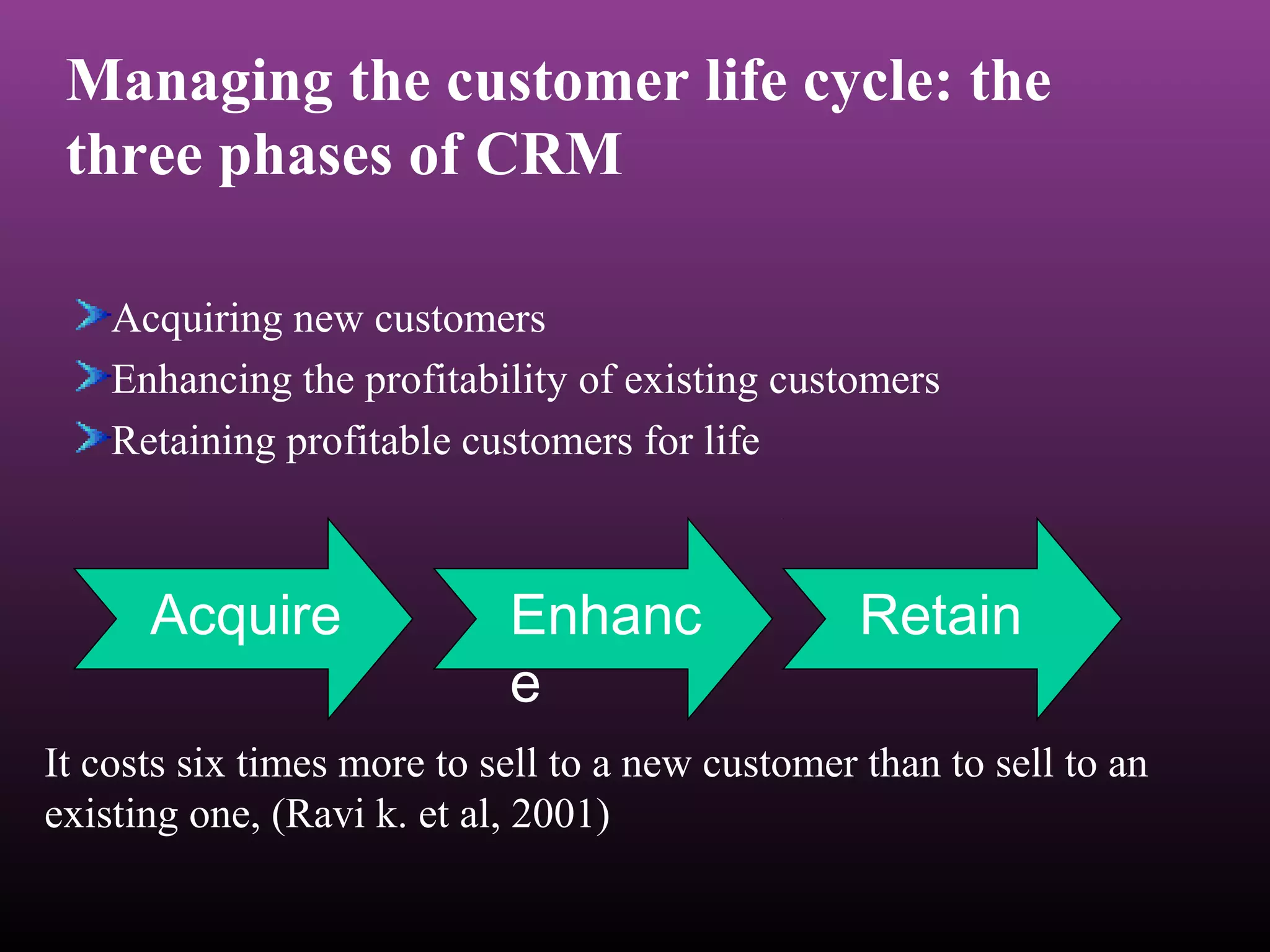
Managing the customer life cycle: the
three phases of CRM
Acquiring new customers
Enhancing the profitability of existing customers
Retaining profitable customers for life
Acquire Enhanc
e
Retain
It costs six times more to sell to a new customer than to sell to an
existing one, (Ravi k. et al, 2001)
Today’s Customers
• Are sophisticated.
• Are price sensitive.
• Are demanding.
• Live time-compressed lives.
• Want their needs met.
• Want their products fast with
greater convenience.
Today’s companies are:
• Are digital companies.
• Flatten (less hierarchy).
• Location Independent.
• Flexibility.
• Low transaction and
coordinating cost.
• Using strong IT infrastructure
(Enterprise software, hardware,
Internet, LAN,WAN etc....).
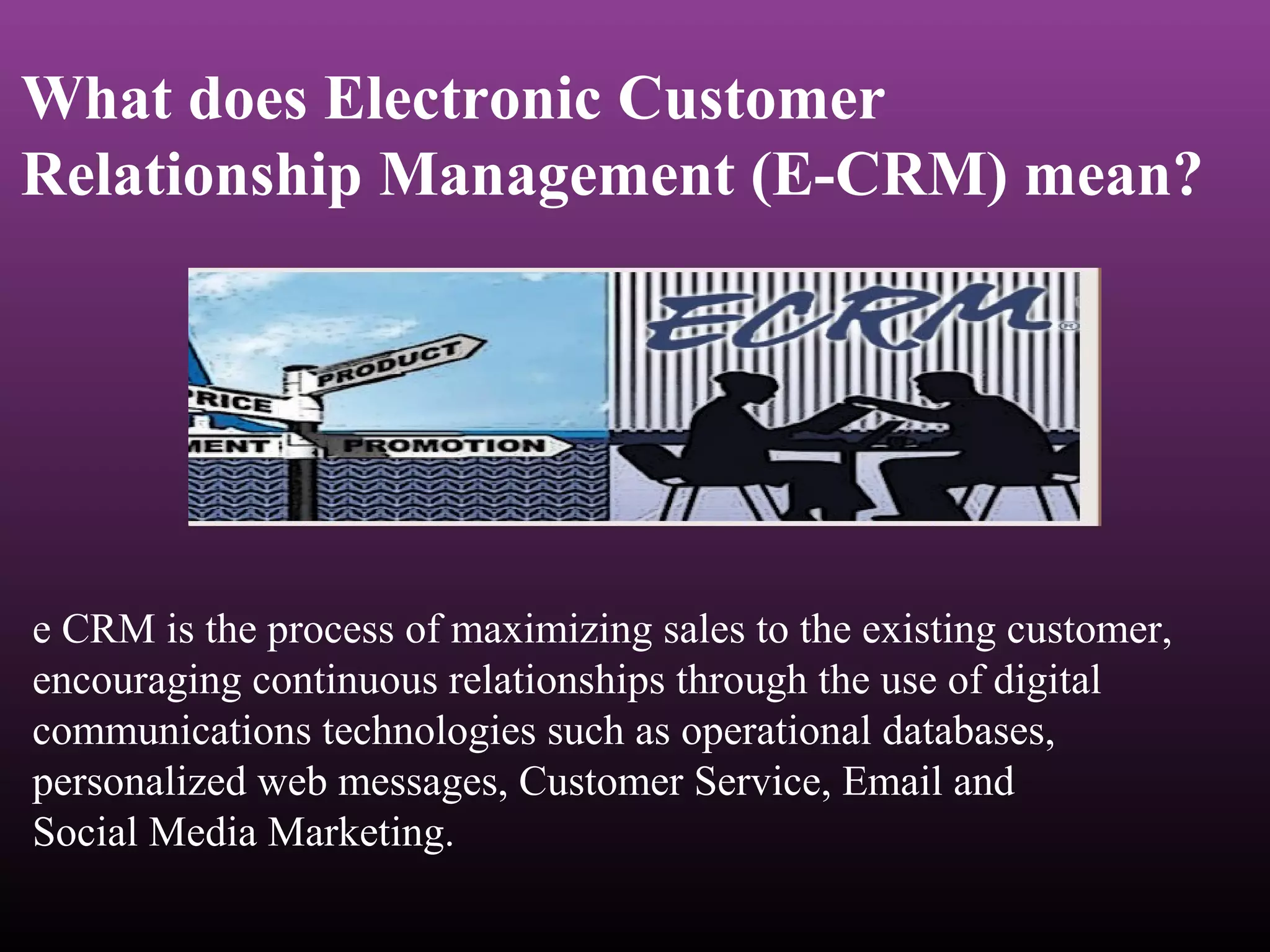
What does Electronic Customer
Relationship Management (E-CRM) mean?
e CRM is the process of maximizing sales to the existing customer,
encouraging continuous relationships through the use of digital
communications technologies such as operational databases,
personalized web messages, Customer Service, Email and
Social Media Marketing.
ECRM is the customer focused management of the whole
eBusiness relationship with each customer, in order to measure,
create and increase income and reduce costs for each customer &
segment and thus to generate greater positive lifetime value.
Put simply, eCRM means
CRMdatabase access via the Web. It
means Intranet access for internal users,
extranet access for business partners and
customers and of course, Internet access
for themarket at large.
• e-CRM expands the traditional CRM techniques by integrating
new electronic channels, such as Web, wireless, and voice
technologies and combines it with e-business applications into the
overall enterprise CRM strategy.
Traditional CRM + Internet = e-CRM
Electronic customer relationship management provides an avenue for
interactions between a business, its customers and its employees
through Web-based technologies. The process combines software,
hardware, processes and management’s commitments geared toward
supporting enterprise-wide CRM business strategies
Electronic customer relationship management (E-CRM) is the
application of Internet-based technologies such as emails, websites,
chat rooms, forums and other channels to achieve CRM objectives.
It is a well-structured and coordinated process of CRM that
automates the processes in marketing, sales and customer service.
An effective E-CRM increases the efficiency of the processes as
well as improves the interactions with customers and enables
businesses to customize products and services that meet the
customers’ individual needs.
A typical E-CRM strategy involves collecting customer
information, transaction history and product information, click
stream and contents information. It then analyzes the customer
characteristics to give a transactional analysis consisting of the
customer's profile and transactional history, and an activity analysis
consisting of exploratory activities showing the customer's
navigation, shopping cart, shopping pattern and more.
Electronic customer relationship management is motivated by easy
Internet access through various platforms and devices such as
laptops, mobile devices, desktop PCs and TV sets. It is not software,
however, but rather the utilization of Web-based technologies to
interact, understand and ensure customer satisfaction
An effective E-CRM system tracks a customer’s history through
multiple channels in real time, creates and maintains an analytical
database, and optimizes a customer’s relation in the three aspects
of attraction, expansion and maintenance.
Businesses that strategize and implement an E-CRM solution are
able to align their processes around technology to effectively
deliver seamless, high-quality customer experience across all
channels. Customers have the power to help themselves through
online personalized services that are made available on demand.
The Internet provides a simple and ideal medium where
customers can get information from websites, buy products and
find answers using FAQ sections, forums or chat rooms.
The benefits of E-CRM include the following:
•Improved customer relations, service and support
•Matching the customers' behavior with suitable offers
•Increased customer satisfaction and loyalty
•Greater efficiency and cost reduction
•Increased business revenue
Differences between CRM and eCRM
CRM uses phone, fax and retail store for contacting customers
while eCRM uses wireless, PDA technology, internet and
email.
The design of CRM system is related to job products and functions
while the design of eCRM system is related to customer needs.
The maintenance of CRM is very expensive while the
maintenance of eCRM is less expensive and requires only less
time.
Why is there a need for
satisfied customers?
Cost up five to six times more
to get new customers.
They buy more.
Take less time.
Bring in new customers.
Less price sensitive.
Great advertisers.
Dissatisfied customers tell others, as many as 20 others about
there experience.
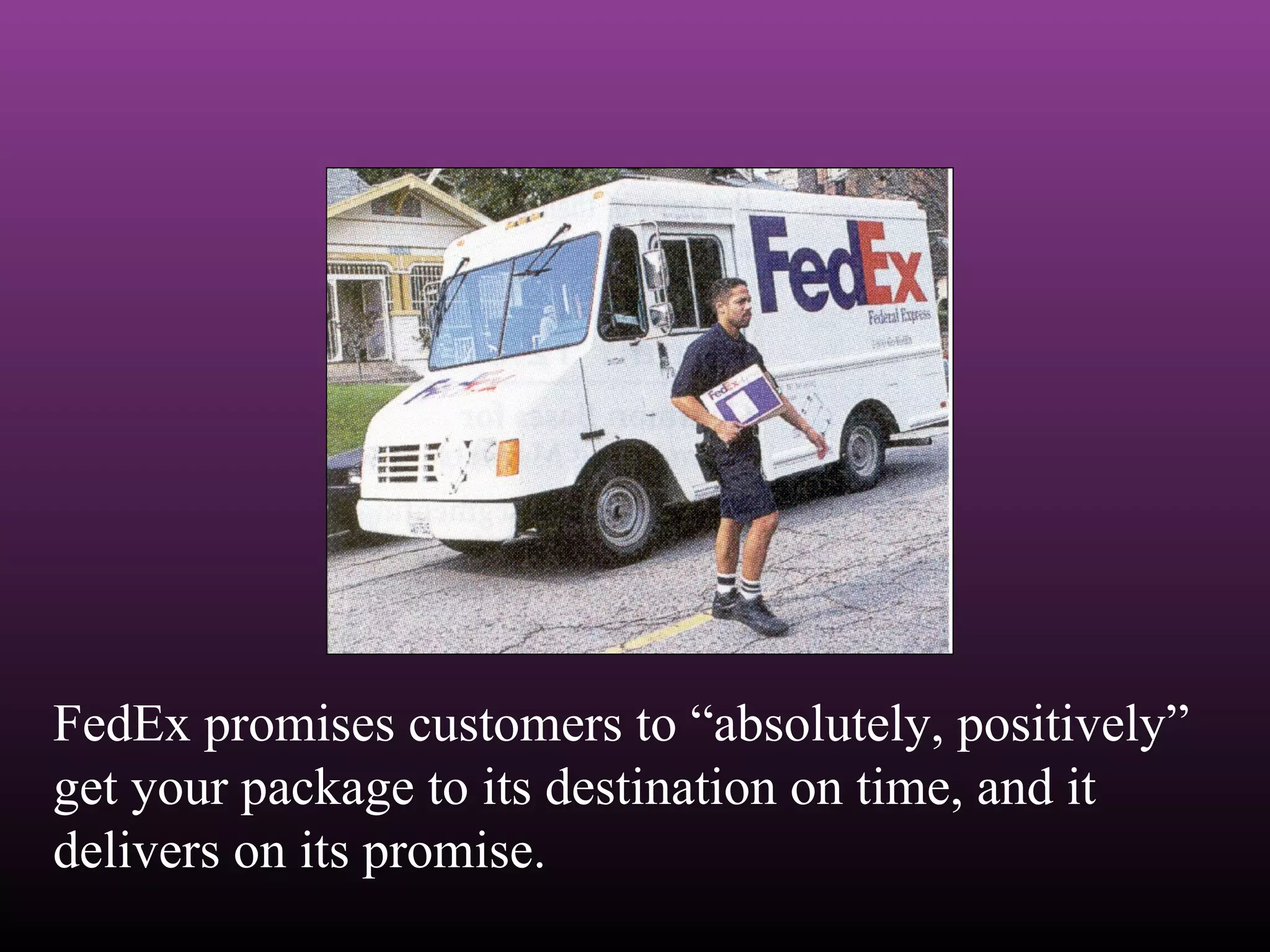
FedEx promises customers to “absolutely, positively”
get your package to its destination on time, and it
delivers on its promise.
• Are you getting new customers?
• Are good customers leaving?
• What are you doing to keep customers loyal?
Measuring Customer Satisfaction
Response time, this should be targeted from 24 to 48 hours at most.
Security and privacy, (secure payments, information).
Return Policy, this will increase customer trust and loyalty. Ease return
products of service will make customer more satisfaction.
 Navigability, Easy to navigate the firm Web site
Quality assurance, every thing must work properly
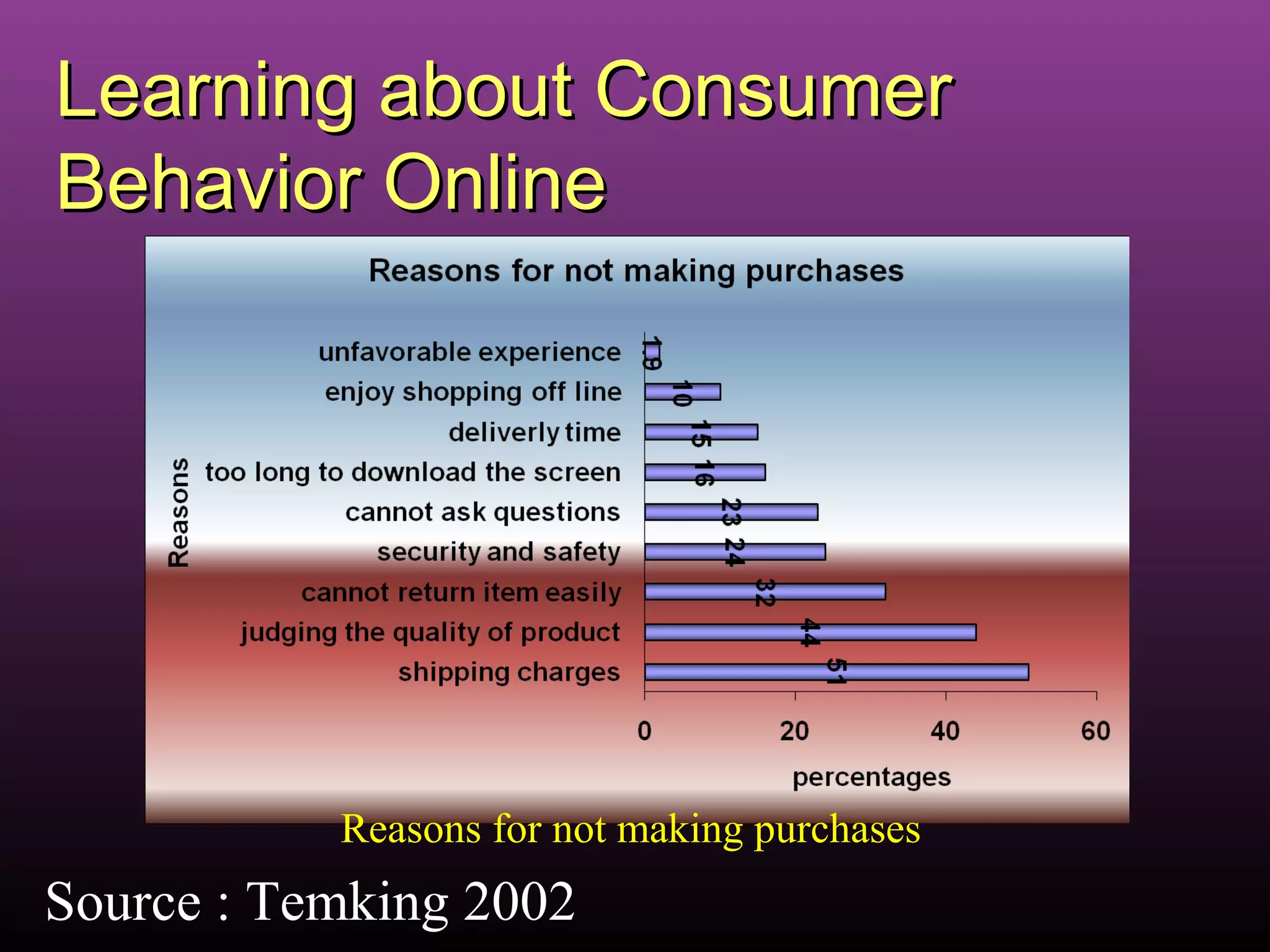
Learning about ConsumerLearning about Consumer
Behavior OnlineBehavior Online
Source : Temking 2002
Reasons for not making purchases
Electronic Customer Relationship Management (E-CRM)

Electronic Customer Relationship Management (E-CRM)

  • 2.
    What does CustomerRelationship Management (CRM) mean? • CRM is a strategy by which companies optimize profitability through enhanced customer satisfaction. • CRM is about automating and enhancing the customer centric business processes of Sales, Marketing, and Service. • CRM also focuses on added customer loyalty that directly affects the organization’s bottom line.
  • 3.
    CRM works toensure that all customer-interfacing organizational functions (i.e., sales, marketing, technical support) are efficient and synchronized, ensuring that former and potential customers are adequately and appropriately served. The most critical purpose of CRM is to manage each instance of the company’s customer interaction. CRM manages, stores and disseminates customer information with many built-in tools that can be applied to raw data pertaining to a customer or any given category of customer. For example, data may be analyzed to segregate customers according to demographic, occupation and age, etc. CRM plays a vital role in an organization’s marketing and research departments. For example, if data indicates that a majority of customers are from Texas, a sales and marketing department can customize strategies for that state. These and other data-mining efforts may show trends to help businesses make better strategic decisions, utilizing technology wisely to serve the needs and wants of customers.
  • 4.
    The goals ofCRM Using existing relationships to grow revenue Using integrated information for excellent service Introducing consistent, replicable channel processes and procedures
  • 5.
    Managing the customerlife cycle: the three phases of CRM Acquiring new customers Enhancing the profitability of existing customers Retaining profitable customers for life Acquire Enhanc e Retain It costs six times more to sell to a new customer than to sell to an existing one, (Ravi k. et al, 2001)
  • 6.
    Today’s Customers • Aresophisticated. • Are price sensitive. • Are demanding. • Live time-compressed lives. • Want their needs met. • Want their products fast with greater convenience.
  • 7.
    Today’s companies are: •Are digital companies. • Flatten (less hierarchy). • Location Independent. • Flexibility. • Low transaction and coordinating cost. • Using strong IT infrastructure (Enterprise software, hardware, Internet, LAN,WAN etc....).
  • 8.
    What does ElectronicCustomer Relationship Management (E-CRM) mean? e CRM is the process of maximizing sales to the existing customer, encouraging continuous relationships through the use of digital communications technologies such as operational databases, personalized web messages, Customer Service, Email and Social Media Marketing.
  • 9.
    ECRM is thecustomer focused management of the whole eBusiness relationship with each customer, in order to measure, create and increase income and reduce costs for each customer & segment and thus to generate greater positive lifetime value. Put simply, eCRM means CRMdatabase access via the Web. It means Intranet access for internal users, extranet access for business partners and customers and of course, Internet access for themarket at large.
  • 10.
    • e-CRM expandsthe traditional CRM techniques by integrating new electronic channels, such as Web, wireless, and voice technologies and combines it with e-business applications into the overall enterprise CRM strategy. Traditional CRM + Internet = e-CRM
  • 11.
    Electronic customer relationshipmanagement provides an avenue for interactions between a business, its customers and its employees through Web-based technologies. The process combines software, hardware, processes and management’s commitments geared toward supporting enterprise-wide CRM business strategies Electronic customer relationship management (E-CRM) is the application of Internet-based technologies such as emails, websites, chat rooms, forums and other channels to achieve CRM objectives. It is a well-structured and coordinated process of CRM that automates the processes in marketing, sales and customer service. An effective E-CRM increases the efficiency of the processes as well as improves the interactions with customers and enables businesses to customize products and services that meet the customers’ individual needs.
  • 12.
    A typical E-CRMstrategy involves collecting customer information, transaction history and product information, click stream and contents information. It then analyzes the customer characteristics to give a transactional analysis consisting of the customer's profile and transactional history, and an activity analysis consisting of exploratory activities showing the customer's navigation, shopping cart, shopping pattern and more. Electronic customer relationship management is motivated by easy Internet access through various platforms and devices such as laptops, mobile devices, desktop PCs and TV sets. It is not software, however, but rather the utilization of Web-based technologies to interact, understand and ensure customer satisfaction An effective E-CRM system tracks a customer’s history through multiple channels in real time, creates and maintains an analytical database, and optimizes a customer’s relation in the three aspects of attraction, expansion and maintenance.
  • 13.
    Businesses that strategizeand implement an E-CRM solution are able to align their processes around technology to effectively deliver seamless, high-quality customer experience across all channels. Customers have the power to help themselves through online personalized services that are made available on demand. The Internet provides a simple and ideal medium where customers can get information from websites, buy products and find answers using FAQ sections, forums or chat rooms. The benefits of E-CRM include the following: •Improved customer relations, service and support •Matching the customers' behavior with suitable offers •Increased customer satisfaction and loyalty •Greater efficiency and cost reduction •Increased business revenue
  • 14.
    Differences between CRMand eCRM CRM uses phone, fax and retail store for contacting customers while eCRM uses wireless, PDA technology, internet and email. The design of CRM system is related to job products and functions while the design of eCRM system is related to customer needs. The maintenance of CRM is very expensive while the maintenance of eCRM is less expensive and requires only less time.
  • 15.
    Why is therea need for satisfied customers? Cost up five to six times more to get new customers. They buy more. Take less time. Bring in new customers. Less price sensitive. Great advertisers. Dissatisfied customers tell others, as many as 20 others about there experience.
  • 16.
    FedEx promises customersto “absolutely, positively” get your package to its destination on time, and it delivers on its promise.
  • 17.
    • Are yougetting new customers? • Are good customers leaving? • What are you doing to keep customers loyal? Measuring Customer Satisfaction Response time, this should be targeted from 24 to 48 hours at most. Security and privacy, (secure payments, information). Return Policy, this will increase customer trust and loyalty. Ease return products of service will make customer more satisfaction.  Navigability, Easy to navigate the firm Web site Quality assurance, every thing must work properly
  • 18.
    Learning about ConsumerLearningabout Consumer Behavior OnlineBehavior Online Source : Temking 2002 Reasons for not making purchases

Editor's Notes

  • #3 Customer centric is a way of doing business with your customer in a way that provides a positive customer experience before and after the sale in order to drive repeat business, customer loyalty and profits. 
  • #10 Extranet - an intranet that can be partially accessed by authorized outside users, enabling businesses to exchange information over the Internet securely.