E- Business
Ninth Edition
Chapter 4
E-Business Revenue Models
1
E- Business, Ninth Edition 2
Learning Objectives
In this chapter, you will learn about:
• Revenue models
• How some companies move from one revenue
model to another to achieve success
• Revenue strategy issues that companies face when
selling on the Web
• Creating an effective business presence on the Web
• Web site usability
• Communicating effectively with customers on the
Web
E- Business, Ninth Edition 3
Revenue Models
• Web business revenue-generating models
– Web catalog
– Digital content
– Advertising-supported
– Advertising-subscription mixed
– Fee-based
• Can work for both sale types
– Business-to-consumer (B2C)
– Business-to-business (B2B)
• Can use same revenue model for both types of sales
E- Business, Ninth Edition 4
Web Catalog Revenue Models
• Adapted from mail-order (catalog) model
– Seller establishes brand image
– Printed information mailed to prospective buyers
• Orders placed by mail or toll-free telephone number
• Expands traditional model
– Replaces or supplements print catalogs
– Offers flexibility
• Orders placed through Web site or telephone
• Payments made though Web site, telephone, or mail
– Creates additional sales outlet for existing companies
E- Business, Ninth Edition 5
Web Catalog Revenue Models (cont’d.)
• Computers and consumer electronics
– Leading computer manufacturers
• Sell a full range of products on the Web
– Dell allows product configuration flexibility
• Creates value
– Crutchfield
• Expanded successful mail-order catalog operations to
include Web sites
– Best Buy, J&R Music World, Radio Shack
• Web sites sell same products as in stores
6
Web Catalog Revenue Models (cont’d.)
• Computers and consumer electronics (cont’d.)
– Marketing channel
• Pathway to customers
– Advantage of having several marketing channels
• Reach more customers at less cost
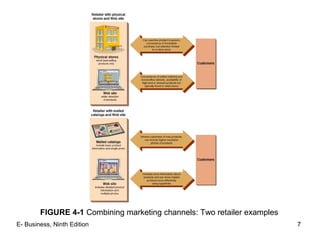
– Can combine marketing channels
• Example: in-store online ordering
• Example: mail catalogs with reference to retailer’s Web
site
6E- Business, Ninth Edition
7
FIGURE 4-1 Combining marketing channels: Two retailer examples
7E- Business, Ninth Edition
E- Business, Ninth Edition 8
Web Catalog Revenue Models (cont’d.)
• Books, music, and videos
– Most visible electronic commerce examples
– Amazon.com Web-only retailer originally sold books
• Evolved into general retailer
– Barnes & Noble, Blackwell’s, Books-A-Million,
Powell’s Books
• All adopted Web catalog revenue model
– CDnow Web-only online music store
• CD Universe copied CDnow approach
– Tower Records, Sam Goody retail stores
• Created Web sites to compete with CDnow
Web Catalog Revenue Models (cont’d.)
• Luxury goods
– Difficult to sell online
• Customers want to see product in person or touch
– Vera Wang and Versace
• Web sites provide information
• Shopper purchases at physical store
• Heavy use of graphics and animation
– Evian Web site
• Presents information in a visually stunning way
E- Business, Ninth Edition 9
Web Catalog Revenue Models (cont’d.)
• Clothing retailers
– Many adapted catalog sales model to Web
– Display clothing photos categorized by type
• Prices, sizes, colors, tailoring details
– Want customers to examine clothing online
• Place orders through Web site
– Lands’ End online Web shopping assistance
• Lands’ End Live (1999)
• Online text chat and call-back feature
• Ability to push Web pages to customer’s browser
E- Business, Ninth Edition 10
E- Business, Ninth Edition 11
Web Catalog Revenue Models (cont’d.)
• Clothing retailers (cont’d.)
– Lands’ End personal shopper agent (more recent)
• Learns preferences and makes suggestions
– My Virtual Model (customers try clothes)
• Graphic image built from customer measurements
– Another feature allows:
• Two shoppers using different computers to
simultaneously browse Web site together
• Only one of the shoppers can purchase items
• Either shopper can select items to view
• Selected items appear in both Web browsers
12
Web Catalog Revenue Models (cont’d.)
• Clothing retailers (cont’d.)
– Online overstocks stores
• Reach more people than physical outlet stores
– Problem: varying computer monitor color settings
• Solution: send fabric swatch on request
• Solution: offer generous return policies
12E- Business, Ninth Edition
E- Business, Ninth Edition 13
Web Catalog Revenue Models (cont’d.)
• Flowers and gifts (gift retailers)
– 1-800-Flowers
• Online extension to successful telephone business
• Competes with online-only florists
– Godiva offers business gift plans
– Hickory Farms and Mrs. Fields Cookies
• Offer familiar name brands on the Web
– Harry and David
• Original Web site for informational purposes
• Promoted catalog business and added online ordering
feature
Web Catalog Revenue Models (cont’d.)
• General discounters
– Buy.com and Overstock.com
• Borrowed Wal-Mart and discount club sales model
• Sell merchandise at extremely low prices
– Traditional discount retailers (Costco, Kmart, Target,
Wal-Mart)
• Slow to implement online sales on their Web sites
• Had huge investments in physical stores
• Did not understand online retailing world
• Now use the Web catalog revenue model in their
successful online sales operations
E- Business, Ninth Edition 14
E- Business, Ninth Edition 15
Digital Content Subscription Revenue
Models
• Firms owning written information or information
rights
– Embrace the Web as a highly efficient distribution
mechanism
– Use the digital content revenue model
• Sell subscriptions for access to information they own
• Legal content
– LexisNexis: offers variety of information services
– Lexis.com: offers original legal information product
16
Digital Content Subscription Revenue
Models (cont’d.)
• Academic research content
– ProQuest: digital copies of academic publications
• Business content
– Dow Jones newspaper publisher subscriptions
• Sold digitized newspaper, magazine, and journal
content subscriptions
• Factiva: online content management and integration
service
• Technical content
– Association for Computer Machinery (ACM): digital
library
16E- Business, Ninth Edition
E- Business, Ninth Edition 17
Advertising-Supported Revenue
Models
• Used by United States broadcast network television
– Provides free programming and advertising
messages
• Supports network operations sufficiently
• Problem: measuring and charging site visitor views
– Stickiness
• Keeping visitors at site and attracting repeat visitors
• Exposed to more advertising in a sticky site
• Problem: obtaining large advertiser interest
– Requires demographic information collection
• Characteristics set used to group visitors
E- Business, Ninth Edition 18
Advertising-Supported Revenue
Models (cont’d.)
• Can obtain large advertiser interest by:
– Using a specialized information Web site
• Draw a specialized audience certain advertisers want to
reach
– Examples:
• The Huffington Post and the Drudge Report
• HowStuffWorks
19
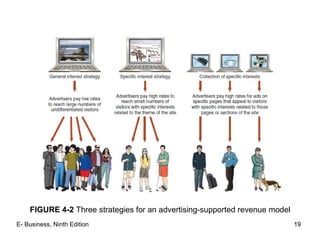
FIGURE 4-2 Three strategies for an advertising-supported revenue model
19E- Business, Ninth Edition
20
Advertising-Supported Revenue
Models (cont’d.)
• Web portals (portal)
– Site used as a launching point to enter the Web
• Almost always includes a Web directory or search
engine
• Often includes other features
– Web directories
• Listing of hyperlinks to Web pages
– Yahoo!: one of the first
• Presents search term triggered advertising on each
page
20E- Business, Ninth Edition
21
Advertising-Supported Revenue
Models (cont’d.)
• Web portals (cont’d.)
– Portal sites using general interest strategy
• AOL, Excite, Google, Bing
– Portal sites not using general interest strategy
• Help visitors find information within a specific
knowledge domain
• Advertisers pay more
• Example: C-NET
– Travel sites
• Successful as advertising-supported online businesses
• Example: Kayak
21E- Business, Ninth Edition
E- Business, Ninth Edition 22
Advertising-Supported Revenue
Models (cont’d.)
• Newspaper and magazine publishers
– Sell advertising to cover Web site costs
– Internet Public Library Online Newspapers page
• Provides links to worldwide newspaper sites
– Local shopping news, alternative press newspapers
• Easier transition to advertising-supported Web revenue
model
– Newspaper’s Web presence
• Provides greater exposure and advertising audience
• Diverts sales from the print edition (difficult to measure)
• Operating costs not covered by advertising revenue
E- Business, Ninth Edition 23
Advertising-Supported Revenue
Models (cont’d.)
• Targeted classified advertising sites
– Can command higher rates than general advertising
– Original version
• Newspaper classified advertising
– Growth of classified advertising Web sites
• Very bad for newspapers
• Example: craigslist
– Web employment advertising
• Most successful targeted classified advertising category
• Examples: CareerBuilder.com, The Ladders and
Guru.com, Monster.com
E- Business, Ninth Edition 24
Advertising-Supported Revenue
Models (cont’d.)
• Targeted classified advertising sites (cont’d.)
– Used vehicle sites
• AutoTrader.com, CycleTrader.com, BoatTrader.com
• Accept paid advertising to sell cars, motorcycles, boats
– Product sites with dedicated following (VetteFinders)
• Successful by catering to small audiences
– Potential classified advertising sites
• Any site selling products useful to buyer after initial use
• Musicians Buy-Line, ComicLink.com, The Golf
Classifieds
E- Business, Ninth Edition 25
Advertising-Subscription Mixed
Revenue Models
• Subscribers pay fee and accept advertising
– Typically less advertising compared to advertising-
supported sites
• Web sites offer different degrees of success
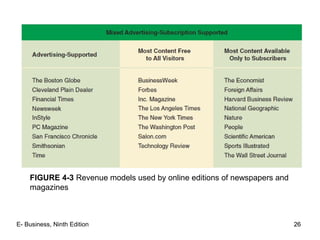
– The New York Times (today)
• Bulk of revenue derived from advertising
– The Wall Street Journal (mixed model)
• Subscription revenue weighted more heavily
26
FIGURE 4-3 Revenue models used by online editions of newspapers and
magazines
26E- Business, Ninth Edition
E- Business, Ninth Edition 27
Advertising-Subscription Mixed
Revenue Models (cont’d.)
• ESPN
– Leverages brand name from cable television business
– Sells advertising, offers free information
– Mixed model includes advertising and subscription
revenue (collects Insider subscriber revenue)
• Consumers Union (ConsumerReports.org)
– Purely a subscription-supported site
– Not-for-profit organization with no advertising
– Free information
• Attracts subscribers and fulfills mission
E- Business, Ninth Edition 28
Fee-for-Transaction Revenue Models
• Service fee charged
– Based on transaction number or size
• Web site offers visitor transaction information
– Personal service formerly provided by a human agent
• Value chain
– Disintermediation
• Intermediary (human agent) removed
– Reintermediation
• New intermediary (fee-for-transaction Web site)
introduced
E- Business, Ninth Edition 29
Fee-for-Transaction Revenue Models
(cont’d.)
• Travel
– Travel agency revenue model: receive fee for
facilitating a transaction
• Travel agent adds information consolidation and
filtering value
– Computers also good at information consolidation and
filtering
• Travel agents have long used networked computers:
Sabre Travel Network
– Internet provided a new way to do business online
30
Fee-for-Transaction Revenue Models
(cont’d.)
• Travel (cont’d.)
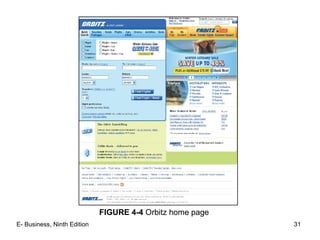
– Web-based travel agencies were new entrants
• Examples: Travelocity, Expedia, Hotels.com, Hotel
Discount Reservations, Orbitz
• Generate advertising revenue from ads placed on travel
information pages
– Traditional travel agents: squeezed out
• Surviving agencies charge a flat fee
– Smaller travel agents specialize (cruises, hotels)
• May use a reintermediation strategy
(WaveHunters.com)
30E- Business, Ninth Edition
E- Business, Ninth Edition 31
FIGURE 4-4 Orbitz home page
E- Business, Ninth Edition 32
Fee-for-Transaction Revenue Models
(cont’d.)
• Automobile sales
– Web sites implement the fee-for-transaction revenue
model differently
– CarsDirect.com model
• Customers select specific car, site determines price
and finds local dealer
– Autoweb.com and Autobytel model
• Locate local dealers, car sells at small premium over
dealer’s nominal cost
– Car salesperson: disintermediated
– Web site: new intermediary (reintermediation)
E- Business, Ninth Edition 33
Fee-for-Transaction Revenue Models
(cont’d.)
• Stockbrokers
– Original full-line brokers charged relatively high
commissions
• Provided advice
– 1970s: deregulation resulted in discount brokers
• Web-based brokerage firms: E*TRADE and Datek
• Web allowed investment advice, fast trade execution
online
34
Fee-for-Transaction Revenue Models
(cont’d.)
• Stockbrokers (cont’d.)
– 1990s: discount brokers faced competition from
online firms
• Discount brokers and full-line brokers opened new
stock trading and information Web sites
– Online brokers offer transaction cost reductions
– Traditional stockbrokers: disintermediated
34E- Business, Ninth Edition
E- Business, Ninth Edition 35
Fee-for-Transaction Revenue Models
(cont’d.)
• Insurance brokers
– Quotesmith offered Internet policy price quotes
directly to public (1996)
• Independent insurance agents: disintermediated
– Insurance policy information, comparisons, sales sites
• InsWeb, Answer Financial, Insurance.com
– Progressive Web site
• Provides quotes for competitors’ products too
– The General (General Automobile Insurance
Services) Web site
• Offers comfortable, anonymous experience
E- Business, Ninth Edition 36
Fee-for-Transaction Revenue Models
(cont’d.)
• Event tickets
– Web allows event promoters to sell tickets from one
virtual location to customers worldwide
– Online agencies earn a fee on every ticket sold
• Ticketmaster, Tickets.com, TicketWeb
– Web created secondary ticket market (StubHub,
TicketsNow)
• Brokers connecting ticket owners with buyers
• Earn fees on tickets resold for others, buy ticket blocks
– Web created easy-to-find central marketplace,
facilitating buyer-seller negotiations
E- Business, Ninth Edition 37
Fee-for-Transaction Revenue Models
(cont’d.)
• Real estate and mortgage loans
– Web sites provide all traditional broker services
• Coldwell Banker, Prudential
– National Association of Realtors Web site
• Realtor.com
– 2008 financial crisis
• Dramatically reduced number of mortgage brokers in
business
– Successful online mortgage brokers
• Ditech and E-LOAN
E- Business, Ninth Edition 38
Fee-for-Transaction Revenue Models
(cont’d.)
• Online banking and financial services
– No physical product
• Easy to offer on Web
– Web financial transactions concerns
• Trust and reliability of financial institution
– Solutions
• Use existing bank’s identification and reputation
• Start online bank not affiliated with existing bank (First
Internet Bank of Indiana)
• Use different name (Bank One used Wingspan)
– Approach was not successful
39
Fee-for-Transaction Revenue Models
(cont’d.)
• Online banking and financial services (cont’d.)
– Additional barriers preventing a more rapid rate of
growth
• Lack of bill presentment features
• Lack of account aggregation tools
– By 2012:
• Industry analysts expect most banks (online and
traditional) will offer aggregation services
39E- Business, Ninth Edition
E- Business, Ninth Edition 40
Fee-for-Transaction Revenue Models
(cont’d.)
• Online music
– Recording industry: slow to embrace online
distribution
• Feared digital copying
– Large online music stores
• Revenue from fee-for-transaction model
• Some sites offer subscription plans
– Complicating issues
• Stores offer limited number of digital music files
• Stores promote their own music file format
• Artists and recording companies invoke limits
41
Fee-for-Transaction Revenue Models
(cont’d.)
• Online music (cont’d.)
– Complicating issues (cont’d.)
• Buyers required to download and install Digital Rights
Management (DRM) software
• Varying restrictions confusing to consumers
– Online music market industry failed to embrace the
network effect gained by adopting one standard file
format
41E- Business, Ninth Edition
42
Fee-for-Transaction Revenue Models
(cont’d.)
• Online music (cont’d.)
– Some stores sold audio in a generally compatible file
format with no copying restrictions
• Mondomix MP3 and Smithsonian Folkways
• Music not produced by major recording companies
– Solutions
• Adopt one standard file format, no copying restrictions,
DRM-free MP3 format (Amazon in 2007)
– By 2012: 80 percent of all music will be sold online
42E- Business, Ninth Edition
E- Business, Ninth Edition 43
Fee-for-Transaction Revenue Models
(cont’d.)
• Online video
– Issues hampering prior sales
• Large file size
• Fear of online sales impairing other sales types
• Inability to play on variety of devices
– Overcoming the issues
• New technologies improving delivery
• Companies incorporating online distribution into
revenue strategy
• Delivery allowed on multiple devices
– Through standard Web browser
44
• Electronic books
– Forms of digital audio books
• CDs (originally) and various types of digital files
• Audible sells subscriptions
– Allows monthly download of a certain number of
books
• Pricing is per book
• Amazon.com
– Offers books, newspapers, magazines, other digital
format items
• Delivered directly to its line of Kindle readers
Fee-for-Transaction Revenue Models
(cont’d.)
44E- Business, Ninth Edition
E- Business, Ninth Edition 45
Fee-for-Service Revenue Models
• Companies offer Web service
– Fee based on service value
• Not a broker service
• Not based on transactions-processed number or size
• Online games
– Sales revenue source
• Advertising (older concept), pay-to-play for premium
games, subscription fees
– Average game player is 35 years old, playing
computer or video games for 12 years
E- Business, Ninth Edition 46
Fee-for-Service Revenue Models
(cont’d.)
• Professional services
– Limited Web use
• State laws prohibit extension of practice
• Patients may set appointments, receive online
consultation
– Major concern
• Patient privacy
– Law on the Web site
• Legal consultations to United Kingdom residents
– Martindale.com
• Online version of Martindale-Hubbell lawyer directory
• Professional services (cont’d.)
– CPA Directory
• United States accounting professionals site
– General health information
• RealAge, Dr. Andrew Weil’s Self Healing, WebMD
– Significant barrier
• Patient diagnosis difficult without physical examination
– Some physicians beginning to offer online
consultations
• For ongoing, established relationship patients
Fee-for-Service Revenue Models
(cont’d.)
47E- Business, Ninth Edition
Free for Many, Fee for a Few
• Economics of manufacturing
– Different for physical and digital products
– Unit cost high percentage of physical products
– Unit cost very small for digital products
• Leads to a different revenue model
– Offer basic product to many for free
– Charge a fee to some for differentiated products
• Examples: Yahoo e-mail accounts, bakery: free cookies
48E- Business, Ninth Edition
E- Business, Ninth Edition 49
Revenue Models in Transition
• Companies must change revenue model
– To meet needs of new and changing Web users
• Some companies created e-commerce Web sites
– Needed many years to grow large enough to become
profitable (CNN and ESPN)
• Some companies changed model or went out of
business
– Due to lengthy unprofitable growth phases
E- Business, Ninth Edition 50
Subscription to Advertising-Supported
Model
• Slate magazine
– Upscale news and current events
• Success expectations were high
– Experienced writers and editors
– Acclaim for incisive reporting and excellent writing
• Initial revenue source
– Annual subscription did not cover operating costs
• Now an advertising-supported site
– Part of the Bing portal
• Value to Microsoft: increase the portal’s stickiness
E- Business, Ninth Edition 51
Advertising-Supported to Advertising-
Subscription Mixed Model
• Salon.com
– Acclaimed for innovative content
• Initial revenue source
– Advertising-supported site
– Needed additional money to continue operations
• Now offers optional subscription version
– Annual fee for Salon premium
• Free of advertising
• Additional content
• Downloadable content
E- Business, Ninth Edition 52
Advertising-Supported to Fee-for-
Services Model
• Xdrive Technologies: offered free disk storage
• Initial revenue source (1999): advertising-supported
– Targeted e-mail advertising
– Did not cover operating costs
• 2005: bought by AOL
– Switched to a subscription-supported model
– Xdrive frequently adjusted its monthly fee downward
– AOL closed the service in 2009
• Successful companies: fee based on storage
amount used
E- Business, Ninth Edition 53
Advertising-Supported to Subscription
Model
• Northern Light search engine includes own
database
– Results include Web site links and abstracts of its
owned content
– Initial revenue source
• Combination of the advertising-supported model plus a
fee-based information access service
• Advertising revenue: insufficient to cover service
– Converted to a new subscription-supported revenue
model
• Mainly large corporate clients
• Individual monthly billing option for articles accessed
E- Business, Ninth Edition 54
Multiple Transitions
• Encyclopedia Britannica
– Initial Web offerings (1994)
• Britannica Internet Guide
• Encyclopedia Britannica Online
– Initial revenue source
• Paid subscription site had low subscription sales
– Converted to free advertiser-supported site (1999)
• Advertising revenues declined
– 2001: returned to mixed model with subscription plan
and free content
– Value added: sells reputation and the expertise
E- Business, Ninth Edition 55
Revenue Strategy Issues
• Topics:
– Web revenue models implementation issues
– Dealing with the issues
Channel Conflict and Cannibalization
• Channel conflict (cannibalization)
– Company Web site sales activities interfere with
existing sales outlets
– Levis Web site and Maytag
• Web sites no longer sell products
• Sites now provide product, retail distributor information
– Eddie Bauer
• Online purchases returnable at retail stores
• Required compensation and bonus plans adjustments
to support Web site
• Channel Cooperation made it successful
E- Business, Ninth Edition 56
E- Business, Ninth Edition 57
Strategic Alliances
• Strategic alliance
– Two or more companies join forces
• Undertake activity over long time period
• Yodlee account aggregation services provider
– Yodlee concentrates on developing the technology
and services
– Banks provide the customers
• Amazon.com
– Joined with Target, CDnow, ToysRUs
• ToysRUs and Amazon suing each other
E- Business, Ninth Edition 58
Creating an Effective Web Presence
• Organization’s presence
– Public image conveyed to stakeholders
– Usually not important
• Until growth reaches significant size
– Stakeholders
• Customers, suppliers, employees, stockholders,
neighbors, general public
• Effective Web presence
– Critical even for smallest and newest Web operating
firms
Identifying Web Presence Goals
• Business physical space
– Focus: very specific objectives
• Not image driven
• Must satisfy many business needs
• Often fails to convey a good presence
• Web business site
– Intentionally creates distinctive presences
– Good Web site design provides:
• Effective image-creation features
• Effective image-enhancing features
E- Business, Ninth Edition 59
E- Business, Ninth Edition 60
Identifying Web Presence Goals
(cont’d.)
• Web business site objectives:
– Attracting Web site visitors
– Keeping visitors to stay and explore
– Convincing visitors to follow site’s links to obtain
information
– Creating an impression consistent with the
organization’s desired image
– Building a trusting relationship with visitors
– Reinforcing positive images about the organization
– Encouraging visitors to return to the site
61
Identifying Web Presence Goals
(cont’d.)
• Making Web presence consistent with brand image
– Different firms establish different Web presence goals
– Coca Cola Web site pages
• Usually include trusted corporate image (Coke bottle)
• Image: traditional position as a trusted classic
– Pepsi Web site pages
• Usually filled with hyperlinks to activities and product-
related promotions
• Image: upstart product favored by younger generation
61E- Business, Ninth Edition
62
Identifying Web Presence Goals
(cont’d.)
• Matching site design to function
– Volkswagen of America site
• Accomplishes important functions for the company
• Provides links to detailed Volkswagen model
information, links to a dealer locator page, links to
information about the company, a link to a set of
shopping tools
– Volkswagen’s home page
• Meets the needs of most visitors quickly and effectively
– Volkswagen site enhances company image by
providing useful information to customers online
62E- Business, Ninth Edition
E- Business, Ninth Edition 63
FIGURE 4-5 Volkswagen of America home page
Identifying Web Presence Goals
(cont’d.)
• Not-for-profit organizations
– Web presence effort key goals:
• Image enhancement and information dissemination
– Successful site key elements
• Integrate information dissemination with fund-raising
• Provide two-way contact channel
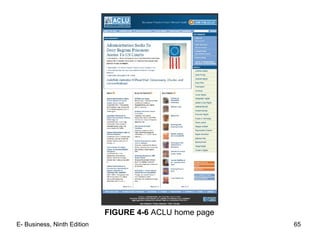
– American Civil Liberties Union (ACLU)
• Serves many different constituencies
– Web sites used to stay in touch with existing
stakeholders, identify new opportunities for serving
them
E- Business, Ninth Edition 64
E- Business, Ninth Edition 65
FIGURE 4-6 ACLU home page
E- Business, Ninth Edition 66
Web Site Usability
• Current Web presences
– Few businesses accomplish all goals
– Most fail to provide visitors sufficient interactive
contact opportunities
– Improving Web presence
• Make site accessible to more people
• Make site easier to use
• Make site encourage visitors’ trust
• Make site develop feelings of loyalty toward the
organization
How the Web Is Different
• Simple mid-1990s Web sites
– Conveyed basic business information
– No market research conducted
• Web objectives achievement
– Failed due to no understanding for Web presence-
building media
• Web sites designed to create an organization’s
presence:
– Contain links to standard information set
– Success dependent on how this information offered
E- Business, Ninth Edition 67
E- Business, Ninth Edition 68
Meeting the Needs of Web Site Visitors
• Successful Web businesses:
– Realize every visitor is a potential customer (partner)
• Web presence is an important concern
– Know visitor characteristic variations
• Understand that the visitor is at the site for a reason
• Varied motivations of Web site visitors
– Why visitors arrive at Web sites
• Learning about company products or services
• Buying products or services
• Obtaining warranty, service, repair policy information
E- Business, Ninth Edition 69
Meeting the Needs of Web Site Visitors
(cont’d.)
• Varied motivations of Web site visitors (cont’d.)
– Why visitors arrive at Web sites (cont’d.)
• Obtaining general company information
• Obtaining financial information
• Identifying people
• Obtaining contact information
• Following a link into the site while searching for
information about a related product, service, or topic
– Challenge to meet all motivations
• Visitors arrive with different needs, experience, and
expectation levels
E- Business, Ninth Edition 70
Meeting the Needs of Web Site Visitors
(cont’d.)
• Making Web sites accessible
– Build interface flexibility options:
• Frame use
• Text-only version
• Selection of smaller graphic images
• Specification of streaming media connection type
• Choice among information attributes
– Controversial Web site design issues
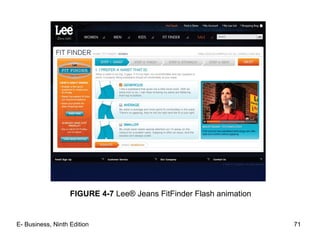
• Adobe Flash software use
– Some tasks lend themselves to animated Web pages
E- Business, Ninth Edition 71
FIGURE 4-7 Lee® Jeans FitFinder Flash animation
E- Business, Ninth Edition 72
Meeting the Needs of Web Site Visitors
(cont’d.)
• Making Web sites accessible (cont’d.)
– Offer multiple information formats
– Consider goals in Web site construction
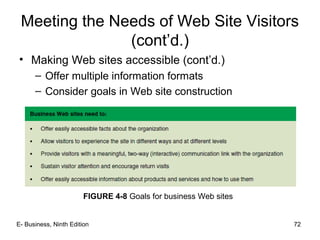
FIGURE 4-8 Goals for business Web sites
E- Business, Ninth Edition 73
Trust and Loyalty
• Creates relationship value
• Good service leads to seller trust
– Delivery, order handling, help selecting product, after-
sale support
• Satisfactory service builds customer loyalty
• Customer service in electronic commerce sites
– Problem
• Lack integration between call centers and Web sites
• Poor e-mail responsiveness
E- Business, Ninth Edition 74
Rating Electronic Commerce Web Sites
• Companies routinely review electronic commerce
Web sites for:
– Usability, customer service, other factors
– Sell the gathered information directly to the
companies operating the Web sites
• Include suggestions for improvements
• BizRate.com posts ratings
– Provides comparison shopping service
– Compiles ratings by conducting surveys of sites’
customers
E- Business, Ninth Edition 75
Usability Testing
• Importance
– Helps meet Web site goals
– Avoids Web site frustration
• Customers leave site without buying anything
– Simple site usability changes
• Include telephone contact information
• Staff a call center
– Learn about visitor needs by conducting focus groups
– Usability testing cost
• Low compared to Web site design costs
E- Business, Ninth Edition 76
Customer-Centric Web Site Design
• Important part of successful electronic business
operation
• Focus on meeting all site visitors’ needs
• Customer-centric approach
– Putting customer at center of all site designs
• Follow guidelines and recommendations
• Make visitors’ Web experiences more efficient,
effective, memorable
• Webby Awards site
– Examples of good Web site design
E- Business, Ninth Edition 77
Connecting with Customers
• Important element of a corporate Web presence
• Identify and reach out to customers
E- Business, Ninth Edition 78
The Nature of Communication on the
Web
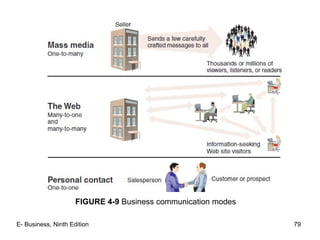
• Communication modes
– Personal contact (prospecting) model
• Employees individually search for, qualify, contact
potential customers
– Mass media
• Deliver messages by broadcasting
– Addressable media
• Advertising efforts directed to known addressee
• Internet medium
– Occupies central space in medium choice continuum
E- Business, Ninth Edition 79
FIGURE 4-9 Business communication modes
E- Business, Ninth Edition 80
Summary
• Six main Web revenue models
– Models work differently
– Different business types use different models
– Companies change models as they learn more about:
• Customers, business environment
• Channel conflict and cannibalization challenges
– One approach: channel cooperation
• Effective Web presence delivers customer value
– Web site visitors arrive with a variety of expectations,
prior knowledge, skill levels, technology
• Web communication fits in between personal
contact and mass media

revenue models

  • 1.
    E- Business Ninth Edition Chapter4 E-Business Revenue Models 1
  • 2.
    E- Business, NinthEdition 2 Learning Objectives In this chapter, you will learn about: • Revenue models • How some companies move from one revenue model to another to achieve success • Revenue strategy issues that companies face when selling on the Web • Creating an effective business presence on the Web • Web site usability • Communicating effectively with customers on the Web
  • 3.
    E- Business, NinthEdition 3 Revenue Models • Web business revenue-generating models – Web catalog – Digital content – Advertising-supported – Advertising-subscription mixed – Fee-based • Can work for both sale types – Business-to-consumer (B2C) – Business-to-business (B2B) • Can use same revenue model for both types of sales
  • 4.
    E- Business, NinthEdition 4 Web Catalog Revenue Models • Adapted from mail-order (catalog) model – Seller establishes brand image – Printed information mailed to prospective buyers • Orders placed by mail or toll-free telephone number • Expands traditional model – Replaces or supplements print catalogs – Offers flexibility • Orders placed through Web site or telephone • Payments made though Web site, telephone, or mail – Creates additional sales outlet for existing companies
  • 5.
    E- Business, NinthEdition 5 Web Catalog Revenue Models (cont’d.) • Computers and consumer electronics – Leading computer manufacturers • Sell a full range of products on the Web – Dell allows product configuration flexibility • Creates value – Crutchfield • Expanded successful mail-order catalog operations to include Web sites – Best Buy, J&R Music World, Radio Shack • Web sites sell same products as in stores
  • 6.
    6 Web Catalog RevenueModels (cont’d.) • Computers and consumer electronics (cont’d.) – Marketing channel • Pathway to customers – Advantage of having several marketing channels • Reach more customers at less cost – Can combine marketing channels • Example: in-store online ordering • Example: mail catalogs with reference to retailer’s Web site 6E- Business, Ninth Edition
  • 7.
    7 FIGURE 4-1 Combiningmarketing channels: Two retailer examples 7E- Business, Ninth Edition
  • 8.
    E- Business, NinthEdition 8 Web Catalog Revenue Models (cont’d.) • Books, music, and videos – Most visible electronic commerce examples – Amazon.com Web-only retailer originally sold books • Evolved into general retailer – Barnes & Noble, Blackwell’s, Books-A-Million, Powell’s Books • All adopted Web catalog revenue model – CDnow Web-only online music store • CD Universe copied CDnow approach – Tower Records, Sam Goody retail stores • Created Web sites to compete with CDnow
  • 9.
    Web Catalog RevenueModels (cont’d.) • Luxury goods – Difficult to sell online • Customers want to see product in person or touch – Vera Wang and Versace • Web sites provide information • Shopper purchases at physical store • Heavy use of graphics and animation – Evian Web site • Presents information in a visually stunning way E- Business, Ninth Edition 9
  • 10.
    Web Catalog RevenueModels (cont’d.) • Clothing retailers – Many adapted catalog sales model to Web – Display clothing photos categorized by type • Prices, sizes, colors, tailoring details – Want customers to examine clothing online • Place orders through Web site – Lands’ End online Web shopping assistance • Lands’ End Live (1999) • Online text chat and call-back feature • Ability to push Web pages to customer’s browser E- Business, Ninth Edition 10
  • 11.
    E- Business, NinthEdition 11 Web Catalog Revenue Models (cont’d.) • Clothing retailers (cont’d.) – Lands’ End personal shopper agent (more recent) • Learns preferences and makes suggestions – My Virtual Model (customers try clothes) • Graphic image built from customer measurements – Another feature allows: • Two shoppers using different computers to simultaneously browse Web site together • Only one of the shoppers can purchase items • Either shopper can select items to view • Selected items appear in both Web browsers
  • 12.
    12 Web Catalog RevenueModels (cont’d.) • Clothing retailers (cont’d.) – Online overstocks stores • Reach more people than physical outlet stores – Problem: varying computer monitor color settings • Solution: send fabric swatch on request • Solution: offer generous return policies 12E- Business, Ninth Edition
  • 13.
    E- Business, NinthEdition 13 Web Catalog Revenue Models (cont’d.) • Flowers and gifts (gift retailers) – 1-800-Flowers • Online extension to successful telephone business • Competes with online-only florists – Godiva offers business gift plans – Hickory Farms and Mrs. Fields Cookies • Offer familiar name brands on the Web – Harry and David • Original Web site for informational purposes • Promoted catalog business and added online ordering feature
  • 14.
    Web Catalog RevenueModels (cont’d.) • General discounters – Buy.com and Overstock.com • Borrowed Wal-Mart and discount club sales model • Sell merchandise at extremely low prices – Traditional discount retailers (Costco, Kmart, Target, Wal-Mart) • Slow to implement online sales on their Web sites • Had huge investments in physical stores • Did not understand online retailing world • Now use the Web catalog revenue model in their successful online sales operations E- Business, Ninth Edition 14
  • 15.
    E- Business, NinthEdition 15 Digital Content Subscription Revenue Models • Firms owning written information or information rights – Embrace the Web as a highly efficient distribution mechanism – Use the digital content revenue model • Sell subscriptions for access to information they own • Legal content – LexisNexis: offers variety of information services – Lexis.com: offers original legal information product
  • 16.
    16 Digital Content SubscriptionRevenue Models (cont’d.) • Academic research content – ProQuest: digital copies of academic publications • Business content – Dow Jones newspaper publisher subscriptions • Sold digitized newspaper, magazine, and journal content subscriptions • Factiva: online content management and integration service • Technical content – Association for Computer Machinery (ACM): digital library 16E- Business, Ninth Edition
  • 17.
    E- Business, NinthEdition 17 Advertising-Supported Revenue Models • Used by United States broadcast network television – Provides free programming and advertising messages • Supports network operations sufficiently • Problem: measuring and charging site visitor views – Stickiness • Keeping visitors at site and attracting repeat visitors • Exposed to more advertising in a sticky site • Problem: obtaining large advertiser interest – Requires demographic information collection • Characteristics set used to group visitors
  • 18.
    E- Business, NinthEdition 18 Advertising-Supported Revenue Models (cont’d.) • Can obtain large advertiser interest by: – Using a specialized information Web site • Draw a specialized audience certain advertisers want to reach – Examples: • The Huffington Post and the Drudge Report • HowStuffWorks
  • 19.
    19 FIGURE 4-2 Threestrategies for an advertising-supported revenue model 19E- Business, Ninth Edition
  • 20.
    20 Advertising-Supported Revenue Models (cont’d.) •Web portals (portal) – Site used as a launching point to enter the Web • Almost always includes a Web directory or search engine • Often includes other features – Web directories • Listing of hyperlinks to Web pages – Yahoo!: one of the first • Presents search term triggered advertising on each page 20E- Business, Ninth Edition
  • 21.
    21 Advertising-Supported Revenue Models (cont’d.) •Web portals (cont’d.) – Portal sites using general interest strategy • AOL, Excite, Google, Bing – Portal sites not using general interest strategy • Help visitors find information within a specific knowledge domain • Advertisers pay more • Example: C-NET – Travel sites • Successful as advertising-supported online businesses • Example: Kayak 21E- Business, Ninth Edition
  • 22.
    E- Business, NinthEdition 22 Advertising-Supported Revenue Models (cont’d.) • Newspaper and magazine publishers – Sell advertising to cover Web site costs – Internet Public Library Online Newspapers page • Provides links to worldwide newspaper sites – Local shopping news, alternative press newspapers • Easier transition to advertising-supported Web revenue model – Newspaper’s Web presence • Provides greater exposure and advertising audience • Diverts sales from the print edition (difficult to measure) • Operating costs not covered by advertising revenue
  • 23.
    E- Business, NinthEdition 23 Advertising-Supported Revenue Models (cont’d.) • Targeted classified advertising sites – Can command higher rates than general advertising – Original version • Newspaper classified advertising – Growth of classified advertising Web sites • Very bad for newspapers • Example: craigslist – Web employment advertising • Most successful targeted classified advertising category • Examples: CareerBuilder.com, The Ladders and Guru.com, Monster.com
  • 24.
    E- Business, NinthEdition 24 Advertising-Supported Revenue Models (cont’d.) • Targeted classified advertising sites (cont’d.) – Used vehicle sites • AutoTrader.com, CycleTrader.com, BoatTrader.com • Accept paid advertising to sell cars, motorcycles, boats – Product sites with dedicated following (VetteFinders) • Successful by catering to small audiences – Potential classified advertising sites • Any site selling products useful to buyer after initial use • Musicians Buy-Line, ComicLink.com, The Golf Classifieds
  • 25.
    E- Business, NinthEdition 25 Advertising-Subscription Mixed Revenue Models • Subscribers pay fee and accept advertising – Typically less advertising compared to advertising- supported sites • Web sites offer different degrees of success – The New York Times (today) • Bulk of revenue derived from advertising – The Wall Street Journal (mixed model) • Subscription revenue weighted more heavily
  • 26.
    26 FIGURE 4-3 Revenuemodels used by online editions of newspapers and magazines 26E- Business, Ninth Edition
  • 27.
    E- Business, NinthEdition 27 Advertising-Subscription Mixed Revenue Models (cont’d.) • ESPN – Leverages brand name from cable television business – Sells advertising, offers free information – Mixed model includes advertising and subscription revenue (collects Insider subscriber revenue) • Consumers Union (ConsumerReports.org) – Purely a subscription-supported site – Not-for-profit organization with no advertising – Free information • Attracts subscribers and fulfills mission
  • 28.
    E- Business, NinthEdition 28 Fee-for-Transaction Revenue Models • Service fee charged – Based on transaction number or size • Web site offers visitor transaction information – Personal service formerly provided by a human agent • Value chain – Disintermediation • Intermediary (human agent) removed – Reintermediation • New intermediary (fee-for-transaction Web site) introduced
  • 29.
    E- Business, NinthEdition 29 Fee-for-Transaction Revenue Models (cont’d.) • Travel – Travel agency revenue model: receive fee for facilitating a transaction • Travel agent adds information consolidation and filtering value – Computers also good at information consolidation and filtering • Travel agents have long used networked computers: Sabre Travel Network – Internet provided a new way to do business online
  • 30.
    30 Fee-for-Transaction Revenue Models (cont’d.) •Travel (cont’d.) – Web-based travel agencies were new entrants • Examples: Travelocity, Expedia, Hotels.com, Hotel Discount Reservations, Orbitz • Generate advertising revenue from ads placed on travel information pages – Traditional travel agents: squeezed out • Surviving agencies charge a flat fee – Smaller travel agents specialize (cruises, hotels) • May use a reintermediation strategy (WaveHunters.com) 30E- Business, Ninth Edition
  • 31.
    E- Business, NinthEdition 31 FIGURE 4-4 Orbitz home page
  • 32.
    E- Business, NinthEdition 32 Fee-for-Transaction Revenue Models (cont’d.) • Automobile sales – Web sites implement the fee-for-transaction revenue model differently – CarsDirect.com model • Customers select specific car, site determines price and finds local dealer – Autoweb.com and Autobytel model • Locate local dealers, car sells at small premium over dealer’s nominal cost – Car salesperson: disintermediated – Web site: new intermediary (reintermediation)
  • 33.
    E- Business, NinthEdition 33 Fee-for-Transaction Revenue Models (cont’d.) • Stockbrokers – Original full-line brokers charged relatively high commissions • Provided advice – 1970s: deregulation resulted in discount brokers • Web-based brokerage firms: E*TRADE and Datek • Web allowed investment advice, fast trade execution online
  • 34.
    34 Fee-for-Transaction Revenue Models (cont’d.) •Stockbrokers (cont’d.) – 1990s: discount brokers faced competition from online firms • Discount brokers and full-line brokers opened new stock trading and information Web sites – Online brokers offer transaction cost reductions – Traditional stockbrokers: disintermediated 34E- Business, Ninth Edition
  • 35.
    E- Business, NinthEdition 35 Fee-for-Transaction Revenue Models (cont’d.) • Insurance brokers – Quotesmith offered Internet policy price quotes directly to public (1996) • Independent insurance agents: disintermediated – Insurance policy information, comparisons, sales sites • InsWeb, Answer Financial, Insurance.com – Progressive Web site • Provides quotes for competitors’ products too – The General (General Automobile Insurance Services) Web site • Offers comfortable, anonymous experience
  • 36.
    E- Business, NinthEdition 36 Fee-for-Transaction Revenue Models (cont’d.) • Event tickets – Web allows event promoters to sell tickets from one virtual location to customers worldwide – Online agencies earn a fee on every ticket sold • Ticketmaster, Tickets.com, TicketWeb – Web created secondary ticket market (StubHub, TicketsNow) • Brokers connecting ticket owners with buyers • Earn fees on tickets resold for others, buy ticket blocks – Web created easy-to-find central marketplace, facilitating buyer-seller negotiations
  • 37.
    E- Business, NinthEdition 37 Fee-for-Transaction Revenue Models (cont’d.) • Real estate and mortgage loans – Web sites provide all traditional broker services • Coldwell Banker, Prudential – National Association of Realtors Web site • Realtor.com – 2008 financial crisis • Dramatically reduced number of mortgage brokers in business – Successful online mortgage brokers • Ditech and E-LOAN
  • 38.
    E- Business, NinthEdition 38 Fee-for-Transaction Revenue Models (cont’d.) • Online banking and financial services – No physical product • Easy to offer on Web – Web financial transactions concerns • Trust and reliability of financial institution – Solutions • Use existing bank’s identification and reputation • Start online bank not affiliated with existing bank (First Internet Bank of Indiana) • Use different name (Bank One used Wingspan) – Approach was not successful
  • 39.
    39 Fee-for-Transaction Revenue Models (cont’d.) •Online banking and financial services (cont’d.) – Additional barriers preventing a more rapid rate of growth • Lack of bill presentment features • Lack of account aggregation tools – By 2012: • Industry analysts expect most banks (online and traditional) will offer aggregation services 39E- Business, Ninth Edition
  • 40.
    E- Business, NinthEdition 40 Fee-for-Transaction Revenue Models (cont’d.) • Online music – Recording industry: slow to embrace online distribution • Feared digital copying – Large online music stores • Revenue from fee-for-transaction model • Some sites offer subscription plans – Complicating issues • Stores offer limited number of digital music files • Stores promote their own music file format • Artists and recording companies invoke limits
  • 41.
    41 Fee-for-Transaction Revenue Models (cont’d.) •Online music (cont’d.) – Complicating issues (cont’d.) • Buyers required to download and install Digital Rights Management (DRM) software • Varying restrictions confusing to consumers – Online music market industry failed to embrace the network effect gained by adopting one standard file format 41E- Business, Ninth Edition
  • 42.
    42 Fee-for-Transaction Revenue Models (cont’d.) •Online music (cont’d.) – Some stores sold audio in a generally compatible file format with no copying restrictions • Mondomix MP3 and Smithsonian Folkways • Music not produced by major recording companies – Solutions • Adopt one standard file format, no copying restrictions, DRM-free MP3 format (Amazon in 2007) – By 2012: 80 percent of all music will be sold online 42E- Business, Ninth Edition
  • 43.
    E- Business, NinthEdition 43 Fee-for-Transaction Revenue Models (cont’d.) • Online video – Issues hampering prior sales • Large file size • Fear of online sales impairing other sales types • Inability to play on variety of devices – Overcoming the issues • New technologies improving delivery • Companies incorporating online distribution into revenue strategy • Delivery allowed on multiple devices – Through standard Web browser
  • 44.
    44 • Electronic books –Forms of digital audio books • CDs (originally) and various types of digital files • Audible sells subscriptions – Allows monthly download of a certain number of books • Pricing is per book • Amazon.com – Offers books, newspapers, magazines, other digital format items • Delivered directly to its line of Kindle readers Fee-for-Transaction Revenue Models (cont’d.) 44E- Business, Ninth Edition
  • 45.
    E- Business, NinthEdition 45 Fee-for-Service Revenue Models • Companies offer Web service – Fee based on service value • Not a broker service • Not based on transactions-processed number or size • Online games – Sales revenue source • Advertising (older concept), pay-to-play for premium games, subscription fees – Average game player is 35 years old, playing computer or video games for 12 years
  • 46.
    E- Business, NinthEdition 46 Fee-for-Service Revenue Models (cont’d.) • Professional services – Limited Web use • State laws prohibit extension of practice • Patients may set appointments, receive online consultation – Major concern • Patient privacy – Law on the Web site • Legal consultations to United Kingdom residents – Martindale.com • Online version of Martindale-Hubbell lawyer directory
  • 47.
    • Professional services(cont’d.) – CPA Directory • United States accounting professionals site – General health information • RealAge, Dr. Andrew Weil’s Self Healing, WebMD – Significant barrier • Patient diagnosis difficult without physical examination – Some physicians beginning to offer online consultations • For ongoing, established relationship patients Fee-for-Service Revenue Models (cont’d.) 47E- Business, Ninth Edition
  • 48.
    Free for Many,Fee for a Few • Economics of manufacturing – Different for physical and digital products – Unit cost high percentage of physical products – Unit cost very small for digital products • Leads to a different revenue model – Offer basic product to many for free – Charge a fee to some for differentiated products • Examples: Yahoo e-mail accounts, bakery: free cookies 48E- Business, Ninth Edition
  • 49.
    E- Business, NinthEdition 49 Revenue Models in Transition • Companies must change revenue model – To meet needs of new and changing Web users • Some companies created e-commerce Web sites – Needed many years to grow large enough to become profitable (CNN and ESPN) • Some companies changed model or went out of business – Due to lengthy unprofitable growth phases
  • 50.
    E- Business, NinthEdition 50 Subscription to Advertising-Supported Model • Slate magazine – Upscale news and current events • Success expectations were high – Experienced writers and editors – Acclaim for incisive reporting and excellent writing • Initial revenue source – Annual subscription did not cover operating costs • Now an advertising-supported site – Part of the Bing portal • Value to Microsoft: increase the portal’s stickiness
  • 51.
    E- Business, NinthEdition 51 Advertising-Supported to Advertising- Subscription Mixed Model • Salon.com – Acclaimed for innovative content • Initial revenue source – Advertising-supported site – Needed additional money to continue operations • Now offers optional subscription version – Annual fee for Salon premium • Free of advertising • Additional content • Downloadable content
  • 52.
    E- Business, NinthEdition 52 Advertising-Supported to Fee-for- Services Model • Xdrive Technologies: offered free disk storage • Initial revenue source (1999): advertising-supported – Targeted e-mail advertising – Did not cover operating costs • 2005: bought by AOL – Switched to a subscription-supported model – Xdrive frequently adjusted its monthly fee downward – AOL closed the service in 2009 • Successful companies: fee based on storage amount used
  • 53.
    E- Business, NinthEdition 53 Advertising-Supported to Subscription Model • Northern Light search engine includes own database – Results include Web site links and abstracts of its owned content – Initial revenue source • Combination of the advertising-supported model plus a fee-based information access service • Advertising revenue: insufficient to cover service – Converted to a new subscription-supported revenue model • Mainly large corporate clients • Individual monthly billing option for articles accessed
  • 54.
    E- Business, NinthEdition 54 Multiple Transitions • Encyclopedia Britannica – Initial Web offerings (1994) • Britannica Internet Guide • Encyclopedia Britannica Online – Initial revenue source • Paid subscription site had low subscription sales – Converted to free advertiser-supported site (1999) • Advertising revenues declined – 2001: returned to mixed model with subscription plan and free content – Value added: sells reputation and the expertise
  • 55.
    E- Business, NinthEdition 55 Revenue Strategy Issues • Topics: – Web revenue models implementation issues – Dealing with the issues
  • 56.
    Channel Conflict andCannibalization • Channel conflict (cannibalization) – Company Web site sales activities interfere with existing sales outlets – Levis Web site and Maytag • Web sites no longer sell products • Sites now provide product, retail distributor information – Eddie Bauer • Online purchases returnable at retail stores • Required compensation and bonus plans adjustments to support Web site • Channel Cooperation made it successful E- Business, Ninth Edition 56
  • 57.
    E- Business, NinthEdition 57 Strategic Alliances • Strategic alliance – Two or more companies join forces • Undertake activity over long time period • Yodlee account aggregation services provider – Yodlee concentrates on developing the technology and services – Banks provide the customers • Amazon.com – Joined with Target, CDnow, ToysRUs • ToysRUs and Amazon suing each other
  • 58.
    E- Business, NinthEdition 58 Creating an Effective Web Presence • Organization’s presence – Public image conveyed to stakeholders – Usually not important • Until growth reaches significant size – Stakeholders • Customers, suppliers, employees, stockholders, neighbors, general public • Effective Web presence – Critical even for smallest and newest Web operating firms
  • 59.
    Identifying Web PresenceGoals • Business physical space – Focus: very specific objectives • Not image driven • Must satisfy many business needs • Often fails to convey a good presence • Web business site – Intentionally creates distinctive presences – Good Web site design provides: • Effective image-creation features • Effective image-enhancing features E- Business, Ninth Edition 59
  • 60.
    E- Business, NinthEdition 60 Identifying Web Presence Goals (cont’d.) • Web business site objectives: – Attracting Web site visitors – Keeping visitors to stay and explore – Convincing visitors to follow site’s links to obtain information – Creating an impression consistent with the organization’s desired image – Building a trusting relationship with visitors – Reinforcing positive images about the organization – Encouraging visitors to return to the site
  • 61.
    61 Identifying Web PresenceGoals (cont’d.) • Making Web presence consistent with brand image – Different firms establish different Web presence goals – Coca Cola Web site pages • Usually include trusted corporate image (Coke bottle) • Image: traditional position as a trusted classic – Pepsi Web site pages • Usually filled with hyperlinks to activities and product- related promotions • Image: upstart product favored by younger generation 61E- Business, Ninth Edition
  • 62.
    62 Identifying Web PresenceGoals (cont’d.) • Matching site design to function – Volkswagen of America site • Accomplishes important functions for the company • Provides links to detailed Volkswagen model information, links to a dealer locator page, links to information about the company, a link to a set of shopping tools – Volkswagen’s home page • Meets the needs of most visitors quickly and effectively – Volkswagen site enhances company image by providing useful information to customers online 62E- Business, Ninth Edition
  • 63.
    E- Business, NinthEdition 63 FIGURE 4-5 Volkswagen of America home page
  • 64.
    Identifying Web PresenceGoals (cont’d.) • Not-for-profit organizations – Web presence effort key goals: • Image enhancement and information dissemination – Successful site key elements • Integrate information dissemination with fund-raising • Provide two-way contact channel – American Civil Liberties Union (ACLU) • Serves many different constituencies – Web sites used to stay in touch with existing stakeholders, identify new opportunities for serving them E- Business, Ninth Edition 64
  • 65.
    E- Business, NinthEdition 65 FIGURE 4-6 ACLU home page
  • 66.
    E- Business, NinthEdition 66 Web Site Usability • Current Web presences – Few businesses accomplish all goals – Most fail to provide visitors sufficient interactive contact opportunities – Improving Web presence • Make site accessible to more people • Make site easier to use • Make site encourage visitors’ trust • Make site develop feelings of loyalty toward the organization
  • 67.
    How the WebIs Different • Simple mid-1990s Web sites – Conveyed basic business information – No market research conducted • Web objectives achievement – Failed due to no understanding for Web presence- building media • Web sites designed to create an organization’s presence: – Contain links to standard information set – Success dependent on how this information offered E- Business, Ninth Edition 67
  • 68.
    E- Business, NinthEdition 68 Meeting the Needs of Web Site Visitors • Successful Web businesses: – Realize every visitor is a potential customer (partner) • Web presence is an important concern – Know visitor characteristic variations • Understand that the visitor is at the site for a reason • Varied motivations of Web site visitors – Why visitors arrive at Web sites • Learning about company products or services • Buying products or services • Obtaining warranty, service, repair policy information
  • 69.
    E- Business, NinthEdition 69 Meeting the Needs of Web Site Visitors (cont’d.) • Varied motivations of Web site visitors (cont’d.) – Why visitors arrive at Web sites (cont’d.) • Obtaining general company information • Obtaining financial information • Identifying people • Obtaining contact information • Following a link into the site while searching for information about a related product, service, or topic – Challenge to meet all motivations • Visitors arrive with different needs, experience, and expectation levels
  • 70.
    E- Business, NinthEdition 70 Meeting the Needs of Web Site Visitors (cont’d.) • Making Web sites accessible – Build interface flexibility options: • Frame use • Text-only version • Selection of smaller graphic images • Specification of streaming media connection type • Choice among information attributes – Controversial Web site design issues • Adobe Flash software use – Some tasks lend themselves to animated Web pages
  • 71.
    E- Business, NinthEdition 71 FIGURE 4-7 Lee® Jeans FitFinder Flash animation
  • 72.
    E- Business, NinthEdition 72 Meeting the Needs of Web Site Visitors (cont’d.) • Making Web sites accessible (cont’d.) – Offer multiple information formats – Consider goals in Web site construction FIGURE 4-8 Goals for business Web sites
  • 73.
    E- Business, NinthEdition 73 Trust and Loyalty • Creates relationship value • Good service leads to seller trust – Delivery, order handling, help selecting product, after- sale support • Satisfactory service builds customer loyalty • Customer service in electronic commerce sites – Problem • Lack integration between call centers and Web sites • Poor e-mail responsiveness
  • 74.
    E- Business, NinthEdition 74 Rating Electronic Commerce Web Sites • Companies routinely review electronic commerce Web sites for: – Usability, customer service, other factors – Sell the gathered information directly to the companies operating the Web sites • Include suggestions for improvements • BizRate.com posts ratings – Provides comparison shopping service – Compiles ratings by conducting surveys of sites’ customers
  • 75.
    E- Business, NinthEdition 75 Usability Testing • Importance – Helps meet Web site goals – Avoids Web site frustration • Customers leave site without buying anything – Simple site usability changes • Include telephone contact information • Staff a call center – Learn about visitor needs by conducting focus groups – Usability testing cost • Low compared to Web site design costs
  • 76.
    E- Business, NinthEdition 76 Customer-Centric Web Site Design • Important part of successful electronic business operation • Focus on meeting all site visitors’ needs • Customer-centric approach – Putting customer at center of all site designs • Follow guidelines and recommendations • Make visitors’ Web experiences more efficient, effective, memorable • Webby Awards site – Examples of good Web site design
  • 77.
    E- Business, NinthEdition 77 Connecting with Customers • Important element of a corporate Web presence • Identify and reach out to customers
  • 78.
    E- Business, NinthEdition 78 The Nature of Communication on the Web • Communication modes – Personal contact (prospecting) model • Employees individually search for, qualify, contact potential customers – Mass media • Deliver messages by broadcasting – Addressable media • Advertising efforts directed to known addressee • Internet medium – Occupies central space in medium choice continuum
  • 79.
    E- Business, NinthEdition 79 FIGURE 4-9 Business communication modes
  • 80.
    E- Business, NinthEdition 80 Summary • Six main Web revenue models – Models work differently – Different business types use different models – Companies change models as they learn more about: • Customers, business environment • Channel conflict and cannibalization challenges – One approach: channel cooperation • Effective Web presence delivers customer value – Web site visitors arrive with a variety of expectations, prior knowledge, skill levels, technology • Web communication fits in between personal contact and mass media