Business-to-Business Electronic Commerce
B2B Electronic Commerce Business Business “ Buyer” “ Supplier” Commerce between businesses that is conducted electronically or in  collaboration among business communities  over the internet. Buzz words: B2B exchanges, internet exchanges, electronic markets, e-marketplaces, e-hubs or e-procurement systems. B2B Market C ontent  C ommunity  C ommerce Transaction Process
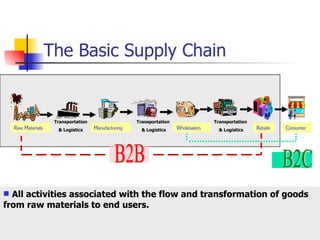
The Basic Supply Chain B2C B2B R aw  M aterials M anufacturing W holesalers R etails C onsumer Transportation  & Logistics Transportation  & Logistics Transportation  & Logistics All activities associated with the flow and transformation of goods from raw materials to end users.
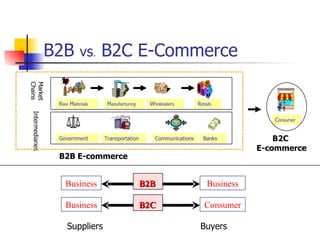
B2B  vs .  B2C E-Commerce R aw  M aterials M anufacturing W holesalers R etails C onsumer Market Chains Government Transportation Communications Banks Intermediaries B2C  E-commerce B2B E-commerce Business Business B2B Business Consumer B2C Suppliers Buyers
B2B EC Benefits Buyer Benefits Reduced procurement process costs Reduced inventory costs More choices and better pricing. Efficient logistics  Lower cycle times Supplier Benefits Lower sales and marketing cost Reaching new customers: generating new revenue Reduce the process costs of order management Better customer support Overall :  Increased market efficiency Greater market intelligence
E- Procurement Schlumberger:  The world largest oil service company <Internal Portion>:  Intranet: ERP Commerce One’s buyer site procurement software Step 1: employee act as own purchasing agents by using a simple-to-use catalog. Step 2: system automatically issues a requisition Step 3: procurement department for approval purchase order <External Portion>:  Internet MarketSite: Internet marketplace for B2B transaction Step 4: connect to hundred of suppliers by using a single-open system
E- Procurement Benefits Benefits for Schlumberger reduce training cost gain discounts from vendors reduce the transaction costs reduce the amount of time people spent ordering and comparing prices. The system is cheaper to operate then EDI.  It reduce overall procurement cycle
Why this topic is important The market is large and expanding B2B is 80-90% of e-commerce B2B e-commerce changes business processes (usually for the better!) Automates of supply chains It has changed the way we do business.  Great benefits for both buyer and supplier sides, as well as the overall economy.
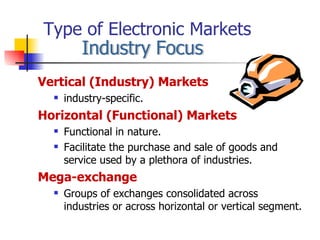
Type of Electronic Markets Vertical (Industry) Markets industry-specific. Horizontal (Functional) Markets Functional in nature. Facilitate the purchase and sale of goods and service used by a plethora of industries.  Mega-exchange Groups of exchanges consolidated across industries or across horizontal or vertical segment. Industry Focus
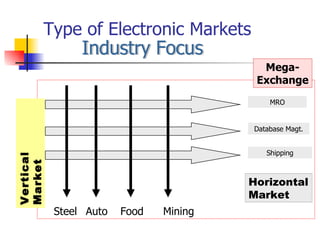
Type of Electronic Markets Industry Focus Database Magt. MRO Shipping Steel Food Auto Mining Mega-Exchange Vertical Market Horizontal Market
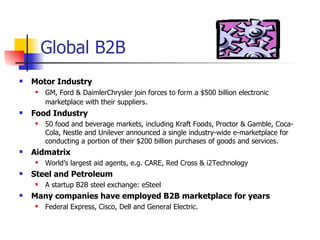
Global B2B Motor Industry GM, Ford & DaimlerChrysler join forces to form a $500 billion electronic marketplace with their suppliers . Food Industry 50 food and beverage markets, including Kraft Foods, Proctor & Gamble, Coca-Cola, Nestle and Unilever announced a single industry-wide e-marketplace for conducting a portion of their $200 billion purchases of goods and services.  Aidmatrix World’s largest aid agents, e.g. CARE, Red Cross & i2Technology Steel and Petroleum A startup B2B steel exchange: eSteel Many companies have employed B2B marketplace for years  Federal Express, Cisco, Dell and General Electric.
B2B in Australia corProcure Exchange   14 companies e.g. AMP, Amcor, ANZ, Australia Post, BHP, Coles Myer, Coca-Cola Amatil, Westfarmers, Fosters, Qantas, Telestra, etc $8 billion in annual buying.  Cyberlynx Procurement Services  6 companies form different Industries e.g. Commonwealth Bank, Woolworth, AAPT, Lion Nathan Telestra’s new e-marketplace Qantas, American Express, National Australia Bank, Citibank with SAP.com BHP : corProcure.com & eSteel.com Coles Myer : corProcure.com & Global Net-Xchange. B2bBuyer.com.au a free-form buying exchange targed at small business
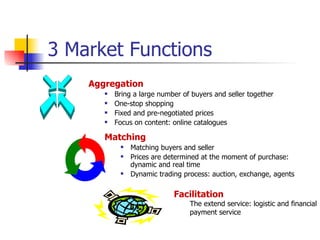
3 Market Functions Aggregation Bring a large number of buyers and seller together One-stop shopping Fixed and pre-negotiated prices Focus on content: online catalogues Matching Matching buyers and seller Prices are determined at the moment of purchase: dynamic and real time Dynamic trading process: auction, exchange, agents Facilitation The extend service: logistic and financial payment service
Key Entities of B2B EC Selling company :  marketing management Buying company :  procurement management Electronic intermediary :  an optional third party services provider Delivere r:  shipping for JIT delivery Network platform :  internet, intranet, extranet Protocols & Communication :  EDI, agents Back-end info systems :  Intranet, ERP systems, accounting, DBMS, etc.
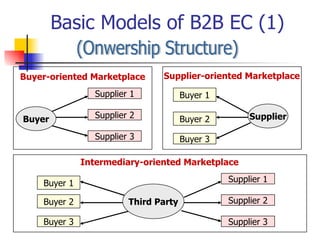
Basic Models of B2B EC (1) Buyer-oriented Marketplace (Onwership Structure) Supplier 1 Supplier 3 Supplier 2 Buyer 1 Buyer 3 Buyer 2 Supplier-oriented Marketplace Supplier 1 Supplier 3 Supplier 2 Buyer 1 Buyer 3 Buyer 2 Intermediary-oriented Marketplace Buyer Third Party Supplier
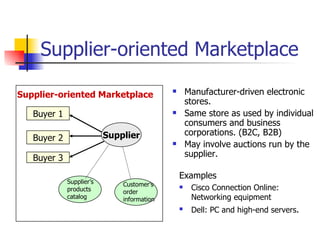
Supplier-oriented Marketplace  Manufacturer-driven electronic stores. Same store as used by individual consumers and business corporations. (B2C, B2B) May involve auctions run by the supplier. Buyer 1 Buyer 3 Buyer 2 Supplier-oriented Marketplace Supplier Examples Cisco Connection Online: Networking equipment Dell: PC and high-end servers . Supplier’s products catalog Customer’s order information
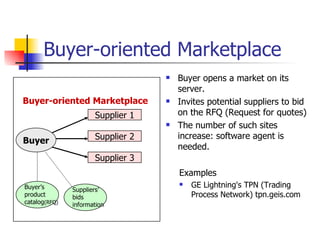
Buyer-oriented Marketplace Buyer opens a market on its server. Invites potential suppliers to bid on the RFQ (Request for quotes) The number of such sites increase: software agent is needed. Supplier 1 Supplier 3 Supplier 2 Buyer Buyer-oriented Marketplace Examples GE Lightning's TPN (Trading Process Network) tpn.geis.com Buyer’s product catalog (RFQ) Suppliers’ bids information
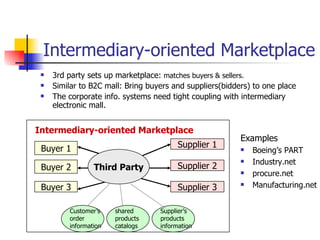
Intermediary-oriented Marketplace   3rd party sets up marketplace:  matches buyers & sellers. Similar to B2C mall: Bring buyers and suppliers(bidders) to one place The corporate info. systems need tight coupling with intermediary electronic mall. Supplier 1 Supplier 3 Supplier 2 Buyer 1 Buyer 3 Buyer 2 Intermediary-oriented Marketplace Third Party Examples Boeing’s PART Industry.net procure.net Manufacturing.net shared products catalogs Customer’s order information Supplier’s products information
Models of B2B EC (2) (Other Business Models) Virtual Corporation (B Networked 2 Bs) :  It is an organization composed of several business partners sharing costs and resources for the purpose of producing a product or services. G oals: excellence, utilization, opportunism Networking (HQ 2 Subsidiaries) :  procurement management Online Service to Business : Travel services Real estate Electronic payments E-autions
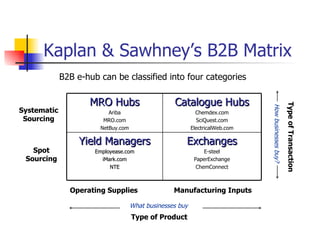
Kaplan & Sawhney’s B2B Matrix What businesses buy Operating Supplies Manufacturing Inputs Systematic Sourcing Spot Sourcing How businesses buy? B2B e-hub can be classified into four categories   Type of Product Type of Transaction Exchanges E-steel PaperExchange ChemConnect Yield Managers Employease.com iMark.com NTE Catalogue Hubs Chemdex.com SciQuest.com ElectricalWeb.com MRO Hubs Ariba MRO.com NetBuy.com
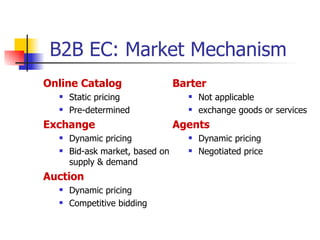
B2B EC: Market Mechanism Online Catalog Static pricing Pre-determined Exchange Dynamic pricing Bid-ask market, based on supply & demand Auction Dynamic pricing Competitive bidding Barter Not applicable exchange goods or services Agents Dynamic pricing Negotiated price
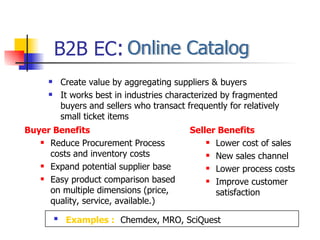
B2B EC : Online Catalog Buyer Benefits Reduce Procurement Process costs and inventory costs Expand potential supplier base Easy product comparison based on multiple dimensions (price, quality, service, available.) Seller Benefits Lower cost of sales New sales channel Lower process costs Improve customer satisfaction Create value by aggregating suppliers & buyers It works best in industries characterized by fragmented buyers and sellers who transact frequently for relatively small ticket items Examples :   Chemdex, MRO, SciQuest
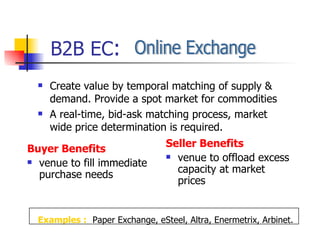
Buyer Benefits venue to fill immediate purchase needs Seller Benefits venue to offload excess capacity at market prices Create value by temporal matching of supply & demand. Provide a spot market for commodities A real-time, bid-ask matching process, market wide price determination is required. B2B EC : Online Exchange Examples :   Paper Exchange, eSteel, Altra, Enermetrix, Arbinet.
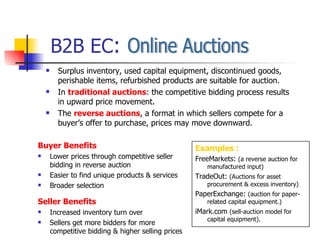
B2B EC : Online Auctions Buyer Benefits Lower prices through competitive seller bidding in reverse auction Easier to find unique products & services Broader selection Seller Benefits Increased inventory turn over Sellers get more bidders for more competitive bidding & higher selling prices Surplus inventory, used capital equipment, discontinued goods, perishable items, refurbished products are suitable for auction. In  traditional auctions : the competitive bidding process results in upward price movement. The  reverse auctions , a format in which sellers compete for a buyer’s offer to purchase, prices may move downward. Examples : FreeMarkets:  (a reverse auction for manufactured input) TradeOut:  (Auctions for asset procurement & excess inventory) PaperExchange:  (auction for paper-related capital equipment.) iMark.com  (sell-auction model for capital equipment).
Creates value by matching 2 parties that possess reciprocal assets within an asset class or across asset classes. Benefits Enable firms to barter excess supplies of components or products that would have otherwise been sold for  low prices. B2B EC : Online Bartering Examples :   FastParts Inc. and FairMarket Inc. operate thriving exchanges where computer electronics companies swap excess parts. .
Shopbots :  shopping agents that automatically search the Internet to obtain information about prices and other attributes of goods and services. Pricebots :  retailers also use it to check each other’s prices. The Internet is moving toward an open, friction-free marketplace in which software agents will manage the buying and selling of goods B2B EC : Software Agents
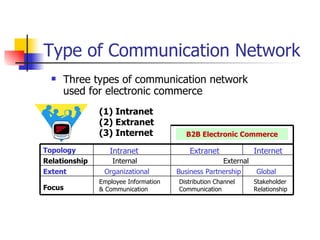
Three types of communication network used for electronic commerce Type of Communication Network Distribution Channel Communication Stakeholder Relationship B2B Electronic Commerce Topology Relationship Extent Focus Organizational Extranet Internet Global Internal External Intranet Employee Information & Communication Business Partnership (1) Intranet  (2) Extranet (3) Internet
Communication Networks: Provide employees access to B2B activities Provide access from B2B activities to the back-end applications. Support knowledge management functions/communities of practice Intranets
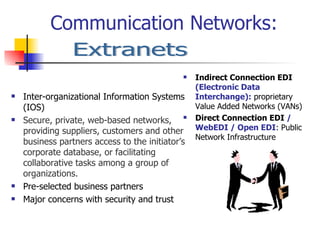
Communication Networks: Inter-organizational Information Systems (IOS) Secure, private, web-based networks, providing suppliers, customers and other business partners access to the initiator’s corporate database, or facilitating collaborative tasks among a group of organizations. Pre-selected business partners Major concerns with security and trust Indirect Connection EDI  (Electronic Data Interchange):  proprietary Value Added Networks (VANs) Direct Connection EDI  / WebEDI / Open EDI : Public Network Infrastructure Extranets
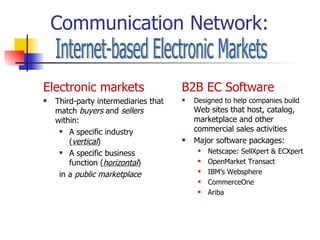
Communication Network: Electronic markets Third-party intermediaries that match  buyers  and  sellers  within: A specific industry ( vertical ) A specific business function ( horizontal ) in a  public marketplace Internet-based Electronic Markets B2B EC Software   Designed to help companies build  Web sites that host, catalog, marketplace and other commercial sales activities Major software packages: Netscape: SellXpert & ECXpert OpenMarket Transact IBM’s Websphere CommerceOne Ariba
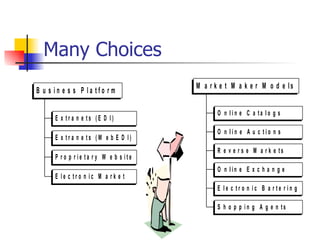
Many Choices
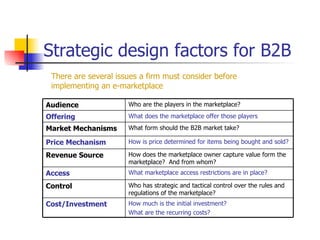
Strategic design factors for B2B There are several issues a firm must consider before implementing an e-marketplace How is price determined for items being bought and sold? Price Mechanism How does the marketplace owner capture value form the marketplace?  And from whom? Revenue Source How much is the initial investment? What are the recurring costs? Cost/Investment Who has strategic and tactical control over the rules and regulations of the marketplace? Control What marketplace access restrictions are in place? Access What form should the B2B market take? Market Mechanisms  What does the marketplace offer those players Offering Who are the players in the marketplace? Audience
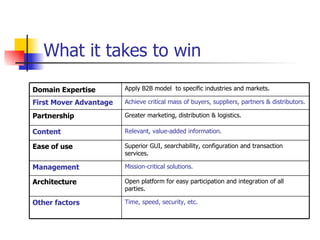
What it takes to win Relevant, value-added information. Content Superior GUI, searchability, configuration and transaction services. Ease of use Time, speed, security, etc. Other factors Open platform for easy participation and integration of all parties. Architecture Mission-critical solutions. Management  Greater marketing, distribution & logistics. Partnership  Achieve critical mass of buyers, suppliers, partners & distributors. First Mover Advantage Apply B2B model  to specific industries and markets. Domain Expertise
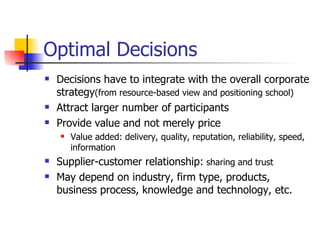
Optimal Decisions Decisions have to integrate with the overall corporate strategy (from resource-based view and positioning school) Attract larger number of participants  Provide value and not merely price  Value added: delivery, quality, reputation, reliability, speed, information Supplier-customer relationship:  sharing and trust May depend on industry, firm type, products, business process, knowledge and technology, etc.

Business to Business Electronic Commerce

  • 1.
  • 2.
    B2B Electronic CommerceBusiness Business “ Buyer” “ Supplier” Commerce between businesses that is conducted electronically or in collaboration among business communities over the internet. Buzz words: B2B exchanges, internet exchanges, electronic markets, e-marketplaces, e-hubs or e-procurement systems. B2B Market C ontent C ommunity C ommerce Transaction Process
  • 3.
    The Basic SupplyChain B2C B2B R aw M aterials M anufacturing W holesalers R etails C onsumer Transportation & Logistics Transportation & Logistics Transportation & Logistics All activities associated with the flow and transformation of goods from raw materials to end users.
  • 4.
    B2B vs. B2C E-Commerce R aw M aterials M anufacturing W holesalers R etails C onsumer Market Chains Government Transportation Communications Banks Intermediaries B2C E-commerce B2B E-commerce Business Business B2B Business Consumer B2C Suppliers Buyers
  • 5.
    B2B EC BenefitsBuyer Benefits Reduced procurement process costs Reduced inventory costs More choices and better pricing. Efficient logistics Lower cycle times Supplier Benefits Lower sales and marketing cost Reaching new customers: generating new revenue Reduce the process costs of order management Better customer support Overall : Increased market efficiency Greater market intelligence
  • 6.
    E- Procurement Schlumberger: The world largest oil service company <Internal Portion>: Intranet: ERP Commerce One’s buyer site procurement software Step 1: employee act as own purchasing agents by using a simple-to-use catalog. Step 2: system automatically issues a requisition Step 3: procurement department for approval purchase order <External Portion>: Internet MarketSite: Internet marketplace for B2B transaction Step 4: connect to hundred of suppliers by using a single-open system
  • 7.
    E- Procurement BenefitsBenefits for Schlumberger reduce training cost gain discounts from vendors reduce the transaction costs reduce the amount of time people spent ordering and comparing prices. The system is cheaper to operate then EDI. It reduce overall procurement cycle
  • 8.
    Why this topicis important The market is large and expanding B2B is 80-90% of e-commerce B2B e-commerce changes business processes (usually for the better!) Automates of supply chains It has changed the way we do business. Great benefits for both buyer and supplier sides, as well as the overall economy.
  • 9.
    Type of ElectronicMarkets Vertical (Industry) Markets industry-specific. Horizontal (Functional) Markets Functional in nature. Facilitate the purchase and sale of goods and service used by a plethora of industries. Mega-exchange Groups of exchanges consolidated across industries or across horizontal or vertical segment. Industry Focus
  • 10.
    Type of ElectronicMarkets Industry Focus Database Magt. MRO Shipping Steel Food Auto Mining Mega-Exchange Vertical Market Horizontal Market
  • 11.
    Global B2B MotorIndustry GM, Ford & DaimlerChrysler join forces to form a $500 billion electronic marketplace with their suppliers . Food Industry 50 food and beverage markets, including Kraft Foods, Proctor & Gamble, Coca-Cola, Nestle and Unilever announced a single industry-wide e-marketplace for conducting a portion of their $200 billion purchases of goods and services. Aidmatrix World’s largest aid agents, e.g. CARE, Red Cross & i2Technology Steel and Petroleum A startup B2B steel exchange: eSteel Many companies have employed B2B marketplace for years Federal Express, Cisco, Dell and General Electric.
  • 12.
    B2B in AustraliacorProcure Exchange 14 companies e.g. AMP, Amcor, ANZ, Australia Post, BHP, Coles Myer, Coca-Cola Amatil, Westfarmers, Fosters, Qantas, Telestra, etc $8 billion in annual buying. Cyberlynx Procurement Services 6 companies form different Industries e.g. Commonwealth Bank, Woolworth, AAPT, Lion Nathan Telestra’s new e-marketplace Qantas, American Express, National Australia Bank, Citibank with SAP.com BHP : corProcure.com & eSteel.com Coles Myer : corProcure.com & Global Net-Xchange. B2bBuyer.com.au a free-form buying exchange targed at small business
  • 13.
    3 Market FunctionsAggregation Bring a large number of buyers and seller together One-stop shopping Fixed and pre-negotiated prices Focus on content: online catalogues Matching Matching buyers and seller Prices are determined at the moment of purchase: dynamic and real time Dynamic trading process: auction, exchange, agents Facilitation The extend service: logistic and financial payment service
  • 14.
    Key Entities ofB2B EC Selling company : marketing management Buying company : procurement management Electronic intermediary : an optional third party services provider Delivere r: shipping for JIT delivery Network platform : internet, intranet, extranet Protocols & Communication : EDI, agents Back-end info systems : Intranet, ERP systems, accounting, DBMS, etc.
  • 15.
    Basic Models ofB2B EC (1) Buyer-oriented Marketplace (Onwership Structure) Supplier 1 Supplier 3 Supplier 2 Buyer 1 Buyer 3 Buyer 2 Supplier-oriented Marketplace Supplier 1 Supplier 3 Supplier 2 Buyer 1 Buyer 3 Buyer 2 Intermediary-oriented Marketplace Buyer Third Party Supplier
  • 16.
    Supplier-oriented Marketplace Manufacturer-driven electronic stores. Same store as used by individual consumers and business corporations. (B2C, B2B) May involve auctions run by the supplier. Buyer 1 Buyer 3 Buyer 2 Supplier-oriented Marketplace Supplier Examples Cisco Connection Online: Networking equipment Dell: PC and high-end servers . Supplier’s products catalog Customer’s order information
  • 17.
    Buyer-oriented Marketplace Buyeropens a market on its server. Invites potential suppliers to bid on the RFQ (Request for quotes) The number of such sites increase: software agent is needed. Supplier 1 Supplier 3 Supplier 2 Buyer Buyer-oriented Marketplace Examples GE Lightning's TPN (Trading Process Network) tpn.geis.com Buyer’s product catalog (RFQ) Suppliers’ bids information
  • 18.
    Intermediary-oriented Marketplace 3rd party sets up marketplace: matches buyers & sellers. Similar to B2C mall: Bring buyers and suppliers(bidders) to one place The corporate info. systems need tight coupling with intermediary electronic mall. Supplier 1 Supplier 3 Supplier 2 Buyer 1 Buyer 3 Buyer 2 Intermediary-oriented Marketplace Third Party Examples Boeing’s PART Industry.net procure.net Manufacturing.net shared products catalogs Customer’s order information Supplier’s products information
  • 19.
    Models of B2BEC (2) (Other Business Models) Virtual Corporation (B Networked 2 Bs) : It is an organization composed of several business partners sharing costs and resources for the purpose of producing a product or services. G oals: excellence, utilization, opportunism Networking (HQ 2 Subsidiaries) : procurement management Online Service to Business : Travel services Real estate Electronic payments E-autions
  • 20.
    Kaplan & Sawhney’sB2B Matrix What businesses buy Operating Supplies Manufacturing Inputs Systematic Sourcing Spot Sourcing How businesses buy? B2B e-hub can be classified into four categories Type of Product Type of Transaction Exchanges E-steel PaperExchange ChemConnect Yield Managers Employease.com iMark.com NTE Catalogue Hubs Chemdex.com SciQuest.com ElectricalWeb.com MRO Hubs Ariba MRO.com NetBuy.com
  • 21.
    B2B EC: MarketMechanism Online Catalog Static pricing Pre-determined Exchange Dynamic pricing Bid-ask market, based on supply & demand Auction Dynamic pricing Competitive bidding Barter Not applicable exchange goods or services Agents Dynamic pricing Negotiated price
  • 22.
    B2B EC :Online Catalog Buyer Benefits Reduce Procurement Process costs and inventory costs Expand potential supplier base Easy product comparison based on multiple dimensions (price, quality, service, available.) Seller Benefits Lower cost of sales New sales channel Lower process costs Improve customer satisfaction Create value by aggregating suppliers & buyers It works best in industries characterized by fragmented buyers and sellers who transact frequently for relatively small ticket items Examples : Chemdex, MRO, SciQuest
  • 23.
    Buyer Benefits venueto fill immediate purchase needs Seller Benefits venue to offload excess capacity at market prices Create value by temporal matching of supply & demand. Provide a spot market for commodities A real-time, bid-ask matching process, market wide price determination is required. B2B EC : Online Exchange Examples : Paper Exchange, eSteel, Altra, Enermetrix, Arbinet.
  • 24.
    B2B EC :Online Auctions Buyer Benefits Lower prices through competitive seller bidding in reverse auction Easier to find unique products & services Broader selection Seller Benefits Increased inventory turn over Sellers get more bidders for more competitive bidding & higher selling prices Surplus inventory, used capital equipment, discontinued goods, perishable items, refurbished products are suitable for auction. In traditional auctions : the competitive bidding process results in upward price movement. The reverse auctions , a format in which sellers compete for a buyer’s offer to purchase, prices may move downward. Examples : FreeMarkets: (a reverse auction for manufactured input) TradeOut: (Auctions for asset procurement & excess inventory) PaperExchange: (auction for paper-related capital equipment.) iMark.com (sell-auction model for capital equipment).
  • 25.
    Creates value bymatching 2 parties that possess reciprocal assets within an asset class or across asset classes. Benefits Enable firms to barter excess supplies of components or products that would have otherwise been sold for low prices. B2B EC : Online Bartering Examples : FastParts Inc. and FairMarket Inc. operate thriving exchanges where computer electronics companies swap excess parts. .
  • 26.
    Shopbots : shopping agents that automatically search the Internet to obtain information about prices and other attributes of goods and services. Pricebots : retailers also use it to check each other’s prices. The Internet is moving toward an open, friction-free marketplace in which software agents will manage the buying and selling of goods B2B EC : Software Agents
  • 27.
    Three types ofcommunication network used for electronic commerce Type of Communication Network Distribution Channel Communication Stakeholder Relationship B2B Electronic Commerce Topology Relationship Extent Focus Organizational Extranet Internet Global Internal External Intranet Employee Information & Communication Business Partnership (1) Intranet (2) Extranet (3) Internet
  • 28.
    Communication Networks: Provideemployees access to B2B activities Provide access from B2B activities to the back-end applications. Support knowledge management functions/communities of practice Intranets
  • 29.
    Communication Networks: Inter-organizationalInformation Systems (IOS) Secure, private, web-based networks, providing suppliers, customers and other business partners access to the initiator’s corporate database, or facilitating collaborative tasks among a group of organizations. Pre-selected business partners Major concerns with security and trust Indirect Connection EDI (Electronic Data Interchange): proprietary Value Added Networks (VANs) Direct Connection EDI / WebEDI / Open EDI : Public Network Infrastructure Extranets
  • 30.
    Communication Network: Electronicmarkets Third-party intermediaries that match buyers and sellers within: A specific industry ( vertical ) A specific business function ( horizontal ) in a public marketplace Internet-based Electronic Markets B2B EC Software Designed to help companies build Web sites that host, catalog, marketplace and other commercial sales activities Major software packages: Netscape: SellXpert & ECXpert OpenMarket Transact IBM’s Websphere CommerceOne Ariba
  • 31.
  • 32.
    Strategic design factorsfor B2B There are several issues a firm must consider before implementing an e-marketplace How is price determined for items being bought and sold? Price Mechanism How does the marketplace owner capture value form the marketplace? And from whom? Revenue Source How much is the initial investment? What are the recurring costs? Cost/Investment Who has strategic and tactical control over the rules and regulations of the marketplace? Control What marketplace access restrictions are in place? Access What form should the B2B market take? Market Mechanisms What does the marketplace offer those players Offering Who are the players in the marketplace? Audience
  • 33.
    What it takesto win Relevant, value-added information. Content Superior GUI, searchability, configuration and transaction services. Ease of use Time, speed, security, etc. Other factors Open platform for easy participation and integration of all parties. Architecture Mission-critical solutions. Management Greater marketing, distribution & logistics. Partnership Achieve critical mass of buyers, suppliers, partners & distributors. First Mover Advantage Apply B2B model to specific industries and markets. Domain Expertise
  • 34.
    Optimal Decisions Decisionshave to integrate with the overall corporate strategy (from resource-based view and positioning school) Attract larger number of participants Provide value and not merely price Value added: delivery, quality, reputation, reliability, speed, information Supplier-customer relationship: sharing and trust May depend on industry, firm type, products, business process, knowledge and technology, etc.