Online Mktg – Consumer Behavior
© Ramakrishna Kongalla,
Assistant Professor
Indian Institute of Tourism & Travel Management
(An Organization of Ministry of Tourism, Govt. of India)
R'tist @ Tourism
Consumer Behavior
• Types Of Markets - Consumer & Business
• Consumer Market
– Purchasers and household members who intend to consume or benefit
from the purchased products and do not buy products to make products.
• Buying Behavior
– The decision processes and acts of people involved in buying
and using products.
• Consumer Buying Behavior
– The decision processes and purchasing activities of people
who purchase products for personal or household use and
not for business purposes.
R'tist @ Tourism
R'tist @ Tourism
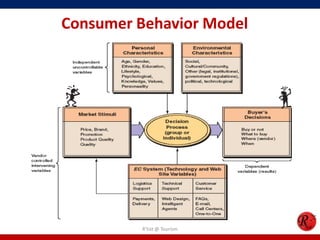
Consumer Behavior Model
• Level Of Involvement
– An individual’s intensity of interest in a product and the
importance of the product for that person.
• Levels Of Involvement
 Enduring
 Situational
R'tist @ Tourism
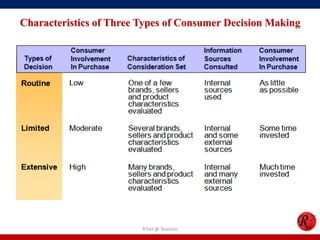
Characteristics of Three Types of Consumer Decision Making
R'tist @ Tourism
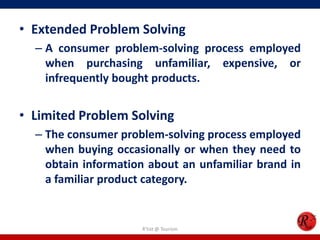
• Extended Problem Solving
– A consumer problem-solving process employed
when purchasing unfamiliar, expensive, or
infrequently bought products.
• Limited Problem Solving
– The consumer problem-solving process employed
when buying occasionally or when they need to
obtain information about an unfamiliar brand in
a familiar product category.
R'tist @ Tourism
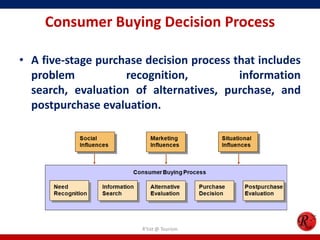
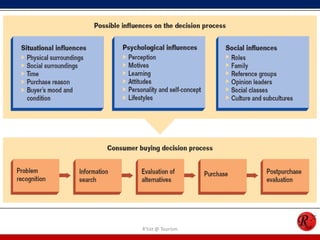
Consumer Buying Decision Process
• A five-stage purchase decision process that includes
problem recognition, information
search, evaluation of alternatives, purchase, and
postpurchase evaluation.
R'tist @ Tourism
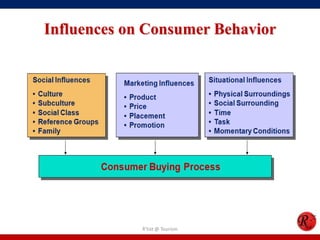
Influences on Consumer Behavior
R'tist @ Tourism
R'tist @ Tourism
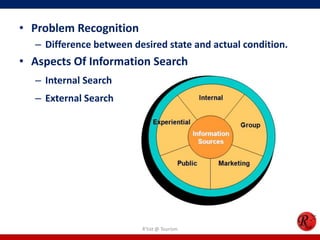
• Problem Recognition
– Difference between desired state and actual condition.
• Aspects Of Information Search
– Internal Search
– External Search
R'tist @ Tourism
• Internal Search
– An information search in which buyers search
their memories for information about their
products that might solve their problem.
• External Search
– An information search in which buyers seek
information from sources other than memory.
R'tist @ Tourism
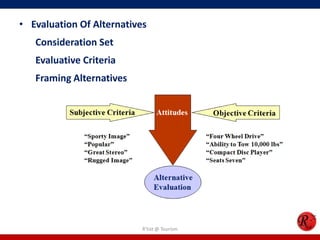
• Evaluation Of Alternatives
 Consideration Set
 Evaluative Criteria
 Framing Alternatives
R'tist @ Tourism
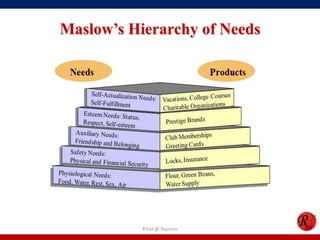
Maslow’s Hierarchy of Needs
R'tist @ Tourism
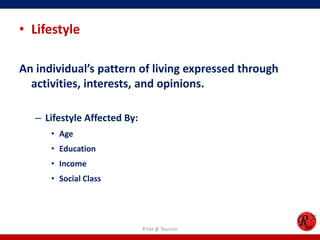
• Lifestyle
An individual’s pattern of living expressed through
activities, interests, and opinions.
– Lifestyle Affected By:
• Age
• Education
• Income
• Social Class
R'tist @ Tourism
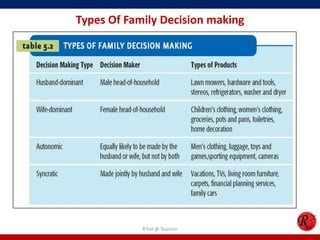
Types Of Family Decision making
R'tist @ Tourism
R'tist @ Tourism
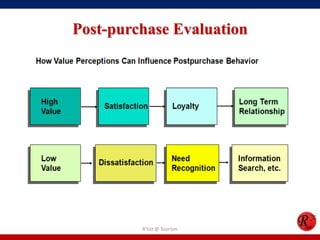
Post-purchase Evaluation
R'tist @ Tourism
Types of Online Shoppers
• Time-starved consumers: Usually found in a house
with two sources of income. They are willing to pay
higher prices or costs more to save time shopping, no
matter whether they like it or not on-line buying
experience.
• Shopping avoiders :Do not like shopping and may use the
Internet just to avoid the crowd, queue or traffic congestion.
• New technologist:
– Usually young people and comfortable with technology, online shopping
because "it's cool".
• Time-sensitive materialist atau click-and-mortar consumers:
– Only use the Internet to view the products they prefer to make
purchases from traditional stores for taking security or other reasons.
R'tist @ Tourism
• Traditionals : Just like a traditional store. Probably not going to
do shopping online.
• Hunter-gatherers: 20 percent of the total number of on-line
customers. Like to compare prices and find the best prices.
• Brand loyalists: Purchase online for a particular brand as it gets
more benefits.
• Single shoppers: 16 percent of the total number of on-line
customers. Liked the Internet not only for shopping but also for
banking, communication, playing games, news and other
activities.
R'tist @ Tourism
Online Purchase Decision Aids
• Shopping Portals:
– comprehensive portals
• linked to many different vendors
• comparison shopping sites
• there is a comparison tool
– niche oriented
• have specialized in a product(cattoys.com)
• there is a referral fee quotation
• there is a portal that has a formal relationship
with partners
R'tist @ Tourism
• Shopbots (Shopping robot) dan Agent (Shopping
agent):
• A review tools (Scout) Web to customers who specify
the search criteria. Different Shopbots using different
search methods.
• Zdnet.com/computershopper – computer
• Office.com – office furniture
• Business Rating Sites:
• Enhance the rating of the various types of e-tailer and
online products based on many criteria.
• Gomez.com
• Bizrate.com
R'tist @ Tourism
• Trust Verification Sites:
• Works to assess and confirm whether a given e-tailer
is reliable or not. For example, TRUSTe, BBBOnLine,
Secure ASSURE and Ernst & Young. TRUSTe Stamp
available on e-tailer Web site reflect the credit. E-
tailer has to pay to TRUSTe to use such stamps.
• Other Shopping Tools:
– Escrow services- 3rd party to assure quality
– Communities of consumers
R'tist @ Tourism
Learning about Consumer Behavior Online
• A Model of Consumer Behavior Online
– The purpose of a consumer behavior model is to
help vendors understand how a consumer makes
a purchasing decision
• Independent (or uncontrollable) variables – personal
characteristics and environmental characteristics
• Intervening or moderating variables – market stimuli
and EC systems (vendor-controlled)
• Dependent variables – buyers’ decisions
R'tist @ Tourism
– Personal Characteristics
• Higher education and/or income levels are
associated with more online shopping.
• More experience people have with Internet
shopping, the more likely they are to spend more
money online.
• Most-cited reasons people do not purchase:
– Shipping charges (51%)
– Difficulty in judging the quality of product (44%)
– Cannot return items easily (32%)
– Credit card safety (24%)
R'tist @ Tourism
– Environmental Characteristics
• Social – people are influenced by family members,
friends, coworkers, and trends. Of importance are
Internet communities, discussion groups.
• Cultural/community – where people live influence
what they buy. Rural shoppers differ from urban
shoppers, Europe shoppers differ from Asian
shoppers.
R'tist @ Tourism
The Consumer Decision-Making Process
• Roles people play in the decision-making process:
– Initiator – the person who suggests a product/service
– Influencer – a person whose advice influence purchasing
decision
– Decider – the person who makes the buying decision
– Buyer – the person who makes an actual purchase
– User – the person who consumes or uses a product/service
R'tist @ Tourism
Online Consumer decision making models:
• Generic Purchasing-Decision Model
– Consists of five phases:
• Need identification – consumer convinced the need of a
product/service
• Information search – on various alternatives to satisfy
the need
• Evaluation of alternatives – a set of criteria is developed
to help evaluation and comparison
• Purchase and delivery – payment, purchase warranties
• After purchase evaluation – customer service and
evaluation of usefulness
R'tist @ Tourism
Web Purchasing Model
• Each of the phases of the purchasing model can be
supported by Consumer Decision Support System
facilities and Internet and Web facilities.
• CDSS facilities support the specific decisions in the
process.
• EC technologies provide necessary mechanisms
and enhance communication and collaboration.
R'tist @ Tourism
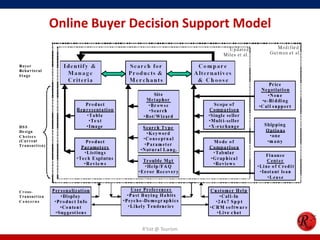
Online Buyer Decision Support Model
R'tist @ Tourism
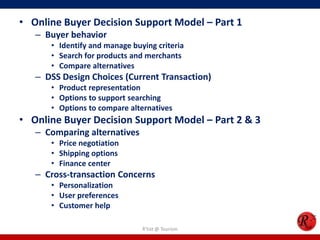
• Online Buyer Decision Support Model – Part 1
– Buyer behavior
• Identify and manage buying criteria
• Search for products and merchants
• Compare alternatives
– DSS Design Choices (Current Transaction)
• Product representation
• Options to support searching
• Options to compare alternatives
• Online Buyer Decision Support Model – Part 2 & 3
– Comparing alternatives
• Price negotiation
• Shipping options
• Finance center
– Cross-transaction Concerns
• Personalization
• User preferences
• Customer help
R'tist @ Tourism
Online versus traditional consumer
• Technology adoption
– Online consumer is best predicted by Internet self-
efficacy, followed by perceived financial benefits.
• Convenience and Decision Support
– Online consumer only desire is convenience and timesaving.
– Depth and breadth of information available on the Internet
meets the consumer’s need of information to make purchase
decision.
• Market dynamics
– More alternatives can be considered online because of lower
search costs and greater availability of information.
– Online consumers becoming less price conscious over time.
R'tist @ Tourism
• Loyalty and trust
– The ability to customize products/services and transactional
environment online is far beyond the capability of traditional
store.
– Consumer loyalty to access competitor’s site is only a click
away.
– Trust for online consumer is an expectation based on past
performance, a strategy to reduce uncertainty, a willingness to
rely on an exchanging partner, and a perception of reliability.
• Products Vs services
– Products are tangible and services are intangible in traditional
commerce but both products and services are intangible online.
– Online shopping consumers concern about risk for products
than services, more concern about perceived ease of use for
services rather than products.
R'tist @ Tourism
• Loyalty and trust
– The ability to customize products/services and transactional
environment online is far beyond the capability of traditional
store.
– Consumer loyalty to access competitor’s site is only a click away.
– Trust for online consumer is an expectation based on past
performance, a strategy to reduce uncertainty, a willingness to
rely on an exchanging partner, and a perception of reliability.
• Products versus services
– Products are tangible and services are intangible in traditional
commerce but both products and services are intangible online.
– Online shopping consumers concern about risk for products than
services, more concern about perceived ease of use for services
rather than products.
R'tist @ Tourism
• Site design
– The impact of the shop window are correlated to the impact of a
site’s home page but the impact of store layout versus site layout
has some differences.
– Thus, more study is needed to examine what design elements
affect online consumer behavior.
• Empowerment, persuasion and entertainment
– The ability to shop worldwide at anytime from virtually any
location with the availability of real-time product and competitor
information increase consumer’s sense of freedom and power.
– Personalized welcome pages and tailored recommendations list
provide customers with a powerful feeling of discovery.
– Online consumers can react to persuasive media more often than
a human at selling.
– Online shopping is also a form of entertainment and/or social
interaction.
R'tist @ Tourism
Thank You…!!!
©Ramakrishna Kongalla
e-mail: artist.ramakrishna@gmail.com
R'tist @ Tourism

Consumer Behavior

  • 1.
    Online Mktg –Consumer Behavior © Ramakrishna Kongalla, Assistant Professor Indian Institute of Tourism & Travel Management (An Organization of Ministry of Tourism, Govt. of India) R'tist @ Tourism
  • 2.
    Consumer Behavior • TypesOf Markets - Consumer & Business • Consumer Market – Purchasers and household members who intend to consume or benefit from the purchased products and do not buy products to make products. • Buying Behavior – The decision processes and acts of people involved in buying and using products. • Consumer Buying Behavior – The decision processes and purchasing activities of people who purchase products for personal or household use and not for business purposes. R'tist @ Tourism
  • 3.
  • 4.
    • Level OfInvolvement – An individual’s intensity of interest in a product and the importance of the product for that person. • Levels Of Involvement  Enduring  Situational R'tist @ Tourism
  • 5.
    Characteristics of ThreeTypes of Consumer Decision Making R'tist @ Tourism
  • 6.
    • Extended ProblemSolving – A consumer problem-solving process employed when purchasing unfamiliar, expensive, or infrequently bought products. • Limited Problem Solving – The consumer problem-solving process employed when buying occasionally or when they need to obtain information about an unfamiliar brand in a familiar product category. R'tist @ Tourism
  • 7.
    Consumer Buying DecisionProcess • A five-stage purchase decision process that includes problem recognition, information search, evaluation of alternatives, purchase, and postpurchase evaluation. R'tist @ Tourism
  • 8.
    Influences on ConsumerBehavior R'tist @ Tourism
  • 9.
  • 10.
    • Problem Recognition –Difference between desired state and actual condition. • Aspects Of Information Search – Internal Search – External Search R'tist @ Tourism
  • 11.
    • Internal Search –An information search in which buyers search their memories for information about their products that might solve their problem. • External Search – An information search in which buyers seek information from sources other than memory. R'tist @ Tourism
  • 12.
    • Evaluation OfAlternatives  Consideration Set  Evaluative Criteria  Framing Alternatives R'tist @ Tourism
  • 13.
    Maslow’s Hierarchy ofNeeds R'tist @ Tourism
  • 14.
    • Lifestyle An individual’spattern of living expressed through activities, interests, and opinions. – Lifestyle Affected By: • Age • Education • Income • Social Class R'tist @ Tourism
  • 15.
    Types Of FamilyDecision making R'tist @ Tourism
  • 16.
  • 17.
  • 18.
    Types of OnlineShoppers • Time-starved consumers: Usually found in a house with two sources of income. They are willing to pay higher prices or costs more to save time shopping, no matter whether they like it or not on-line buying experience. • Shopping avoiders :Do not like shopping and may use the Internet just to avoid the crowd, queue or traffic congestion. • New technologist: – Usually young people and comfortable with technology, online shopping because "it's cool". • Time-sensitive materialist atau click-and-mortar consumers: – Only use the Internet to view the products they prefer to make purchases from traditional stores for taking security or other reasons. R'tist @ Tourism
  • 19.
    • Traditionals :Just like a traditional store. Probably not going to do shopping online. • Hunter-gatherers: 20 percent of the total number of on-line customers. Like to compare prices and find the best prices. • Brand loyalists: Purchase online for a particular brand as it gets more benefits. • Single shoppers: 16 percent of the total number of on-line customers. Liked the Internet not only for shopping but also for banking, communication, playing games, news and other activities. R'tist @ Tourism
  • 20.
    Online Purchase DecisionAids • Shopping Portals: – comprehensive portals • linked to many different vendors • comparison shopping sites • there is a comparison tool – niche oriented • have specialized in a product(cattoys.com) • there is a referral fee quotation • there is a portal that has a formal relationship with partners R'tist @ Tourism
  • 21.
    • Shopbots (Shoppingrobot) dan Agent (Shopping agent): • A review tools (Scout) Web to customers who specify the search criteria. Different Shopbots using different search methods. • Zdnet.com/computershopper – computer • Office.com – office furniture • Business Rating Sites: • Enhance the rating of the various types of e-tailer and online products based on many criteria. • Gomez.com • Bizrate.com R'tist @ Tourism
  • 22.
    • Trust VerificationSites: • Works to assess and confirm whether a given e-tailer is reliable or not. For example, TRUSTe, BBBOnLine, Secure ASSURE and Ernst & Young. TRUSTe Stamp available on e-tailer Web site reflect the credit. E- tailer has to pay to TRUSTe to use such stamps. • Other Shopping Tools: – Escrow services- 3rd party to assure quality – Communities of consumers R'tist @ Tourism
  • 23.
    Learning about ConsumerBehavior Online • A Model of Consumer Behavior Online – The purpose of a consumer behavior model is to help vendors understand how a consumer makes a purchasing decision • Independent (or uncontrollable) variables – personal characteristics and environmental characteristics • Intervening or moderating variables – market stimuli and EC systems (vendor-controlled) • Dependent variables – buyers’ decisions R'tist @ Tourism
  • 24.
    – Personal Characteristics •Higher education and/or income levels are associated with more online shopping. • More experience people have with Internet shopping, the more likely they are to spend more money online. • Most-cited reasons people do not purchase: – Shipping charges (51%) – Difficulty in judging the quality of product (44%) – Cannot return items easily (32%) – Credit card safety (24%) R'tist @ Tourism
  • 25.
    – Environmental Characteristics •Social – people are influenced by family members, friends, coworkers, and trends. Of importance are Internet communities, discussion groups. • Cultural/community – where people live influence what they buy. Rural shoppers differ from urban shoppers, Europe shoppers differ from Asian shoppers. R'tist @ Tourism
  • 26.
    The Consumer Decision-MakingProcess • Roles people play in the decision-making process: – Initiator – the person who suggests a product/service – Influencer – a person whose advice influence purchasing decision – Decider – the person who makes the buying decision – Buyer – the person who makes an actual purchase – User – the person who consumes or uses a product/service R'tist @ Tourism
  • 27.
    Online Consumer decisionmaking models: • Generic Purchasing-Decision Model – Consists of five phases: • Need identification – consumer convinced the need of a product/service • Information search – on various alternatives to satisfy the need • Evaluation of alternatives – a set of criteria is developed to help evaluation and comparison • Purchase and delivery – payment, purchase warranties • After purchase evaluation – customer service and evaluation of usefulness R'tist @ Tourism
  • 28.
    Web Purchasing Model •Each of the phases of the purchasing model can be supported by Consumer Decision Support System facilities and Internet and Web facilities. • CDSS facilities support the specific decisions in the process. • EC technologies provide necessary mechanisms and enhance communication and collaboration. R'tist @ Tourism
  • 29.
    Online Buyer DecisionSupport Model R'tist @ Tourism
  • 30.
    • Online BuyerDecision Support Model – Part 1 – Buyer behavior • Identify and manage buying criteria • Search for products and merchants • Compare alternatives – DSS Design Choices (Current Transaction) • Product representation • Options to support searching • Options to compare alternatives • Online Buyer Decision Support Model – Part 2 & 3 – Comparing alternatives • Price negotiation • Shipping options • Finance center – Cross-transaction Concerns • Personalization • User preferences • Customer help R'tist @ Tourism
  • 31.
    Online versus traditionalconsumer • Technology adoption – Online consumer is best predicted by Internet self- efficacy, followed by perceived financial benefits. • Convenience and Decision Support – Online consumer only desire is convenience and timesaving. – Depth and breadth of information available on the Internet meets the consumer’s need of information to make purchase decision. • Market dynamics – More alternatives can be considered online because of lower search costs and greater availability of information. – Online consumers becoming less price conscious over time. R'tist @ Tourism
  • 32.
    • Loyalty andtrust – The ability to customize products/services and transactional environment online is far beyond the capability of traditional store. – Consumer loyalty to access competitor’s site is only a click away. – Trust for online consumer is an expectation based on past performance, a strategy to reduce uncertainty, a willingness to rely on an exchanging partner, and a perception of reliability. • Products Vs services – Products are tangible and services are intangible in traditional commerce but both products and services are intangible online. – Online shopping consumers concern about risk for products than services, more concern about perceived ease of use for services rather than products. R'tist @ Tourism
  • 33.
    • Loyalty andtrust – The ability to customize products/services and transactional environment online is far beyond the capability of traditional store. – Consumer loyalty to access competitor’s site is only a click away. – Trust for online consumer is an expectation based on past performance, a strategy to reduce uncertainty, a willingness to rely on an exchanging partner, and a perception of reliability. • Products versus services – Products are tangible and services are intangible in traditional commerce but both products and services are intangible online. – Online shopping consumers concern about risk for products than services, more concern about perceived ease of use for services rather than products. R'tist @ Tourism
  • 34.
    • Site design –The impact of the shop window are correlated to the impact of a site’s home page but the impact of store layout versus site layout has some differences. – Thus, more study is needed to examine what design elements affect online consumer behavior. • Empowerment, persuasion and entertainment – The ability to shop worldwide at anytime from virtually any location with the availability of real-time product and competitor information increase consumer’s sense of freedom and power. – Personalized welcome pages and tailored recommendations list provide customers with a powerful feeling of discovery. – Online consumers can react to persuasive media more often than a human at selling. – Online shopping is also a form of entertainment and/or social interaction. R'tist @ Tourism
  • 35.
    Thank You…!!! ©Ramakrishna Kongalla e-mail:artist.ramakrishna@gmail.com R'tist @ Tourism