By:-  Shyna
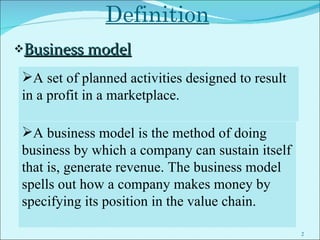
Definition Business model A business model is the method of doing business by which a company can sustain itself that is, generate revenue. The business model spells out how a company makes money by specifying its position in the value chain. A set of planned activities designed to result in a profit in a marketplace.
Definition Cont
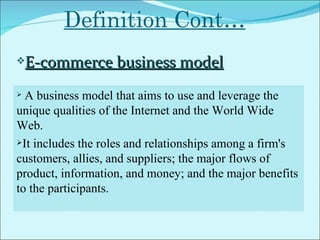
 It includes the roles and relationships among a firm's customers, allies, and suppliers; the major flows of product, information, and money; and the major benefits to the participants. E-commerce business model A business model that aims to use and leverage the unique qualities of the Internet and the World Wide Web.
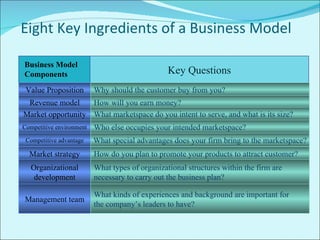
Eight Key Ingredients of a Business Model Key Questions Business Model  Components Value Proposition Why should the customer buy from you? Revenue model How will you earn money? Market opportunity What marketspace do you intent to serve, and what is its size? Competitive environment Who else occupies your intended marketspace? Competitive advantage What special advantages does your firm bring to the marketspace? Market strategy How do you plan to promote your products to attract customer? Organizational development What types of organizational structures within the firm are necessary to carry out the business plan? Management team What kinds of experiences and background are important for  the company’s leaders to have?
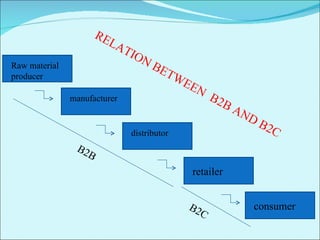
RELATION BETWEEN  B2B AND B2C Raw material producer manufacturer distributor retailer consumer B2B B2C
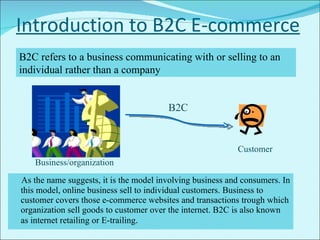
Introduction to B2C E-commerce As the name suggests, it is the model involving business and consumers. In this model, online business sell to individual customers. Business to customer covers those e-commerce websites and transactions trough which organization sell goods to customer over the internet. B2C is also known as internet retailing or E-trailing .  B2C refers to a business communicating with or selling to an individual rather than a company Business/organization Customer B2C
Introduction to B2C E-commerce (Cont
) This category has expanded greatly in the late 1990s with the growth of public access to the Internet.  The business-to-consumer category includes electronic shopping, information searching (e.g. railway timetables) but also interactive games delivered over the Internet.  Popular items sold using B2C model are airline tickets, books, computers, videotapes, music CDs,toys ,music, health and beauty products, jewellery etc..
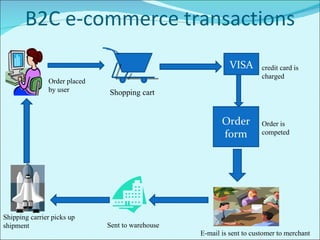
B2C e-commerce transactions VISA Order form Order placed by user Shopping cart credit card is charged Order is competed E-mail is sent to customer to merchant Sent to warehouse Shipping carrier picks up shipment
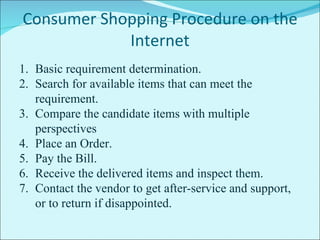
Consumer Shopping Procedure on the Internet Basic requirement determination. Search for available items that can meet the requirement. Compare the candidate items with multiple perspectives Place an Order. Pay the Bill. Receive the delivered items and inspect them. Contact the vendor to get after-service and support, or to return if disappointed.
 
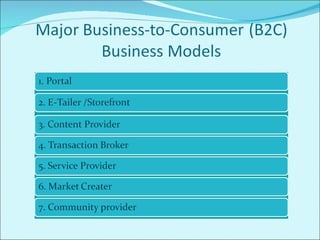
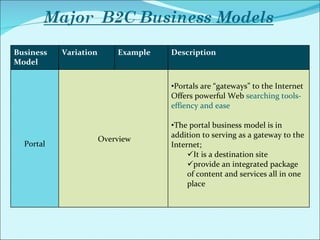
Business Model Variation Example Description Portal Overview Portals are “gateways” to the Internet  Offers powerful  Web  search ing  tools -effiency and ease T he portal business model is in addition to serving as a gateway to the Internet; It is a destination site provide an integrated package  of content and services all in one place
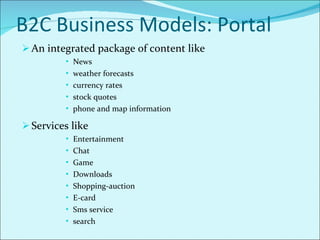
B2C Business Models: Portal An integrated package of content  like  News   weather forecasts currency rates stock quotes  phone and map information   Services  like Entertainment Chat Game Downloads Shopping-auction E-card Sms service search
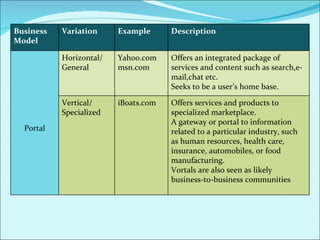
Business Model Variation Example Description Portal Horizontal/ General Yahoo.com msn.com Offers an integrated package of services and content such as search,e-mail,chat etc. Seeks to be a user’s home base. Vertical/ Specialized iBoats.com Offers services and products to specialized marketplace. A  gateway or portal to information related to a particular industry, such as  human resources,  health care, insurance, automobiles, or food manufacturing.  Vortals are also seen as likely business-to-business communities
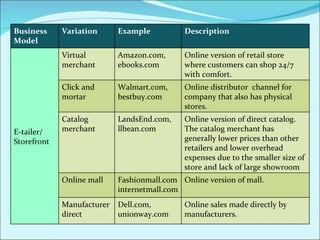
Business Model Variation Example Description E-tailer/ Storefront Virtual merchant Amazon.com, ebooks.com Online version of retail store where customers can shop 24/7  with comfort. Click and mortar Walmart.com, bestbuy.com Online distributor  channel for company that also has physical stores. Catalog merchant LandsEnd.com, llbean.com Online version of direct catalog. The catalog merchant has generally lower prices than other retailers and lower overhead expenses due to the smaller size of store and lack of large showroom space. Online mall Fashionmall.com internetmall.com Online version of mall. Manufacturer direct Dell.com, unionway.com Online sales made directly by manufacturers.
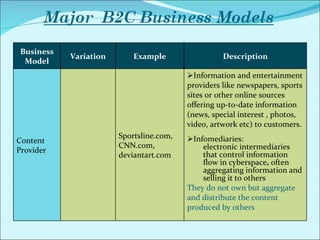
Business Model Variation Example Description Content Provider Sportsline.com, CNN.com, deviantart.com Information and entertainment providers like newspapers, sports sites or other online sources offering up-to-date information (news, special interest ,   photos,   video, artwork  et c) to customers. Infomediaries: electronic   intermediaries   that   control   information   flow   in   cyberspace ,  often   aggregating   information   and   selling   it   to   others They do not own but aggregate and distribute the content produced by others
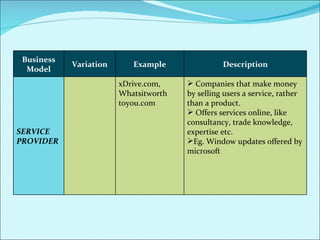
Business Model Variation Example Description SERVICE PROVIDER xDrive.com, Whatsitworth toyou.com Companies that make money by selling users a service, rather than a product. Offers services online , like consultancy, trade knowledge, expertise  etc. Eg. Window updates offered by microsoft
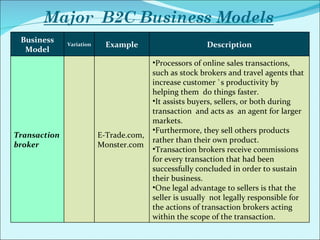
Business Model Variation Example Description Transaction broker E-Trade.com, Monster.com Processors of online sales transactions, such as stock brokers and travel agents that increase customer `s productivity by helping them  do things faster. It assists buyers, sellers, or both during  transaction  and acts as  an agent for larger markets.  Furthermore, they sell others products rather than their own product.  Transaction brokers receive commissions for every transaction that had been successfully concluded in order to sustain their business. One legal advantage to sellers is that the seller is usually  not legally responsible for the actions of transaction brokers acting within the scope of the transaction.
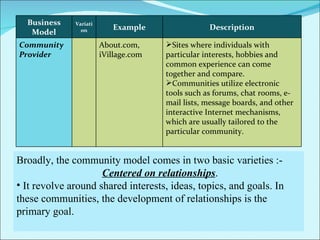
Broadly, the community model comes in two basic varieties :- Centered on relationships . It revolve around shared interests, ideas, topics, and goals. In these communities, the development of relationships is the primary goal.  Business Model Variation Example Description Community Provider About.com, iVillage.com Sites where individuals with particular interests, hobbies and common experience can come together and compare. Communities utilize electronic tools such as forums, chat rooms, e-mail lists, message boards, and other interactive Internet mechanisms, which are usually tailored to the particular community.
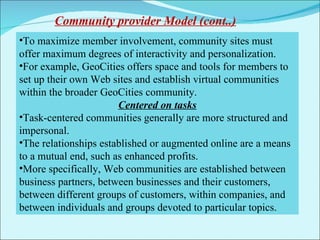
To maximize member involvement, community sites must offer maximum degrees of interactivity and personalization. For example, GeoCities offers space and tools for members to set up their own Web sites and establish virtual communities within the broader GeoCities community.  Centered on tasks Task-centered communities generally are more structured and impersonal.  The relationships established or augmented online are a means to a mutual end, such as enhanced profits. More specifically, Web communities are established between business partners, between businesses and their customers, between different groups of customers, within companies, and between individuals and groups devoted to particular topics. Community provider Model (cont..)
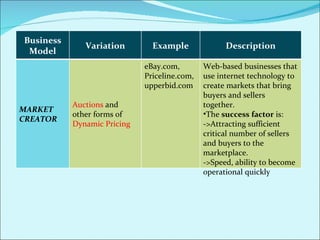
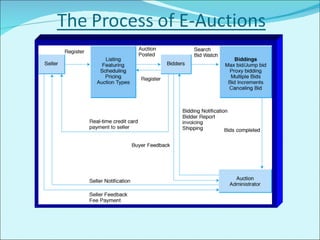
Business Model Variation Example Description MARKET CREATOR Auctions  and other forms of  Dynamic Pricing eBay.com, Priceline.com, upperbid.com Web-based businesses that use internet technology to create markets that bring buyers and sellers together. The  success   factor  is:  ->A ttracting sufficient critical number of sellers and buyers to the marketplace . -> Speed, ability to become operational quickly
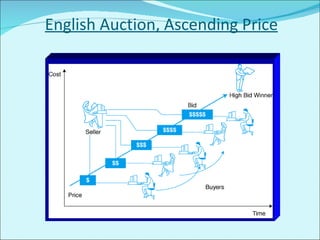
English Auctions The bidders announce their bids until no higher bid is forthcoming ‘ going . . . going . . . gone!’ Ascending-price auctions Typically set a closing time in advance Minimum bid plus a reserve price Dutch Auctions Bidding starts at a high price and drops until a bidder accepts the price Descending price auctions Auction and dynamic pricing models
English Auction, Ascending Price
Sealed-Bid Auctions Bidders submit their bids independently and are usually prohibited from sharing information with each other First-price sealed-bid auction The winner pays his amount Second-price sealed-bid auction The winner pays one increment over the second-highest bid received. Double Auctions Buyers and sellers submit bids to an auctioneer The auctioneer matches the seller’s offers to the buyer’s offer E.g. New York Stock Exchange
Comparison-Pricing Model Allows customers to poll a variety of merchants and find a desired product/service at the lowest price Mysimon.com Uses intelligent-agent technology  Offers discussion groups, customer ratings, and comparison shopping Demand-Sensitive Pricing Model Group purchasing Individual buyers to shop in large groups to obtain group discount The more people who buy a product in a single purchase, the lower the cost per person becomes Mercata.com, mobshop.com, demandline.com
 
Capabilities and functionalities of B2C Model With the conduction of business on the internet ,the role and importance of electronic markets has been increasing. It  lets increase the efficiency of business performance . Some of the capabilities which an electronic marketplace has, which speak of their potential are- Instantaneous communication  It helps in quick communication between the various participants of business systems. It also helps to reduce “Time to Market”. Global Access the products and services offered through the electronic markets have global reach and give access to larger and new markets.
Customization Electronic markets allows to customize or configure goods according to user’s need . Increased Availability Since e-commerce provide access to company’s site 24/7 so there is much greater availability of products. De-intermediation  It helps in elimination the middleman, offering simplified electronic distribution and product differentiation based on customer choice. Collaboration They facilitate automation of transactions between electronic enterprises and support real time exchange of information and thus enable collaborative processing.
Thanks

B2C Business models

  • 1.
  • 2.
    Definition Business modelA business model is the method of doing business by which a company can sustain itself that is, generate revenue. The business model spells out how a company makes money by specifying its position in the value chain. A set of planned activities designed to result in a profit in a marketplace.
  • 3.
    Definition Cont
 Itincludes the roles and relationships among a firm's customers, allies, and suppliers; the major flows of product, information, and money; and the major benefits to the participants. E-commerce business model A business model that aims to use and leverage the unique qualities of the Internet and the World Wide Web.
  • 4.
    Eight Key Ingredientsof a Business Model Key Questions Business Model Components Value Proposition Why should the customer buy from you? Revenue model How will you earn money? Market opportunity What marketspace do you intent to serve, and what is its size? Competitive environment Who else occupies your intended marketspace? Competitive advantage What special advantages does your firm bring to the marketspace? Market strategy How do you plan to promote your products to attract customer? Organizational development What types of organizational structures within the firm are necessary to carry out the business plan? Management team What kinds of experiences and background are important for the company’s leaders to have?
  • 5.
    RELATION BETWEEN B2B AND B2C Raw material producer manufacturer distributor retailer consumer B2B B2C
  • 6.
    Introduction to B2CE-commerce As the name suggests, it is the model involving business and consumers. In this model, online business sell to individual customers. Business to customer covers those e-commerce websites and transactions trough which organization sell goods to customer over the internet. B2C is also known as internet retailing or E-trailing . B2C refers to a business communicating with or selling to an individual rather than a company Business/organization Customer B2C
  • 7.
    Introduction to B2CE-commerce (Cont
) This category has expanded greatly in the late 1990s with the growth of public access to the Internet. The business-to-consumer category includes electronic shopping, information searching (e.g. railway timetables) but also interactive games delivered over the Internet. Popular items sold using B2C model are airline tickets, books, computers, videotapes, music CDs,toys ,music, health and beauty products, jewellery etc..
  • 8.
    B2C e-commerce transactionsVISA Order form Order placed by user Shopping cart credit card is charged Order is competed E-mail is sent to customer to merchant Sent to warehouse Shipping carrier picks up shipment
  • 9.
    Consumer Shopping Procedureon the Internet Basic requirement determination. Search for available items that can meet the requirement. Compare the candidate items with multiple perspectives Place an Order. Pay the Bill. Receive the delivered items and inspect them. Contact the vendor to get after-service and support, or to return if disappointed.
  • 10.
  • 11.
    Business Model VariationExample Description Portal Overview Portals are “gateways” to the Internet Offers powerful Web search ing tools -effiency and ease T he portal business model is in addition to serving as a gateway to the Internet; It is a destination site provide an integrated package of content and services all in one place
  • 12.
    B2C Business Models:Portal An integrated package of content like News weather forecasts currency rates stock quotes phone and map information Services like Entertainment Chat Game Downloads Shopping-auction E-card Sms service search
  • 13.
    Business Model VariationExample Description Portal Horizontal/ General Yahoo.com msn.com Offers an integrated package of services and content such as search,e-mail,chat etc. Seeks to be a user’s home base. Vertical/ Specialized iBoats.com Offers services and products to specialized marketplace. A gateway or portal to information related to a particular industry, such as human resources, health care, insurance, automobiles, or food manufacturing. Vortals are also seen as likely business-to-business communities
  • 14.
    Business Model VariationExample Description E-tailer/ Storefront Virtual merchant Amazon.com, ebooks.com Online version of retail store where customers can shop 24/7 with comfort. Click and mortar Walmart.com, bestbuy.com Online distributor channel for company that also has physical stores. Catalog merchant LandsEnd.com, llbean.com Online version of direct catalog. The catalog merchant has generally lower prices than other retailers and lower overhead expenses due to the smaller size of store and lack of large showroom space. Online mall Fashionmall.com internetmall.com Online version of mall. Manufacturer direct Dell.com, unionway.com Online sales made directly by manufacturers.
  • 15.
    Business Model VariationExample Description Content Provider Sportsline.com, CNN.com, deviantart.com Information and entertainment providers like newspapers, sports sites or other online sources offering up-to-date information (news, special interest , photos, video, artwork et c) to customers. Infomediaries: electronic intermediaries that control information flow in cyberspace , often aggregating information and selling it to others They do not own but aggregate and distribute the content produced by others
  • 16.
    Business Model VariationExample Description SERVICE PROVIDER xDrive.com, Whatsitworth toyou.com Companies that make money by selling users a service, rather than a product. Offers services online , like consultancy, trade knowledge, expertise etc. Eg. Window updates offered by microsoft
  • 17.
    Business Model VariationExample Description Transaction broker E-Trade.com, Monster.com Processors of online sales transactions, such as stock brokers and travel agents that increase customer `s productivity by helping them do things faster. It assists buyers, sellers, or both during transaction and acts as an agent for larger markets. Furthermore, they sell others products rather than their own product. Transaction brokers receive commissions for every transaction that had been successfully concluded in order to sustain their business. One legal advantage to sellers is that the seller is usually not legally responsible for the actions of transaction brokers acting within the scope of the transaction.
  • 18.
    Broadly, the communitymodel comes in two basic varieties :- Centered on relationships . It revolve around shared interests, ideas, topics, and goals. In these communities, the development of relationships is the primary goal. Business Model Variation Example Description Community Provider About.com, iVillage.com Sites where individuals with particular interests, hobbies and common experience can come together and compare. Communities utilize electronic tools such as forums, chat rooms, e-mail lists, message boards, and other interactive Internet mechanisms, which are usually tailored to the particular community.
  • 19.
    To maximize memberinvolvement, community sites must offer maximum degrees of interactivity and personalization. For example, GeoCities offers space and tools for members to set up their own Web sites and establish virtual communities within the broader GeoCities community. Centered on tasks Task-centered communities generally are more structured and impersonal. The relationships established or augmented online are a means to a mutual end, such as enhanced profits. More specifically, Web communities are established between business partners, between businesses and their customers, between different groups of customers, within companies, and between individuals and groups devoted to particular topics. Community provider Model (cont..)
  • 20.
    Business Model VariationExample Description MARKET CREATOR Auctions and other forms of Dynamic Pricing eBay.com, Priceline.com, upperbid.com Web-based businesses that use internet technology to create markets that bring buyers and sellers together. The success factor is: ->A ttracting sufficient critical number of sellers and buyers to the marketplace . -> Speed, ability to become operational quickly
  • 21.
    English Auctions Thebidders announce their bids until no higher bid is forthcoming ‘ going . . . going . . . gone!’ Ascending-price auctions Typically set a closing time in advance Minimum bid plus a reserve price Dutch Auctions Bidding starts at a high price and drops until a bidder accepts the price Descending price auctions Auction and dynamic pricing models
  • 22.
  • 23.
    Sealed-Bid Auctions Bidderssubmit their bids independently and are usually prohibited from sharing information with each other First-price sealed-bid auction The winner pays his amount Second-price sealed-bid auction The winner pays one increment over the second-highest bid received. Double Auctions Buyers and sellers submit bids to an auctioneer The auctioneer matches the seller’s offers to the buyer’s offer E.g. New York Stock Exchange
  • 24.
    Comparison-Pricing Model Allowscustomers to poll a variety of merchants and find a desired product/service at the lowest price Mysimon.com Uses intelligent-agent technology Offers discussion groups, customer ratings, and comparison shopping Demand-Sensitive Pricing Model Group purchasing Individual buyers to shop in large groups to obtain group discount The more people who buy a product in a single purchase, the lower the cost per person becomes Mercata.com, mobshop.com, demandline.com
  • 25.
  • 26.
    Capabilities and functionalitiesof B2C Model With the conduction of business on the internet ,the role and importance of electronic markets has been increasing. It lets increase the efficiency of business performance . Some of the capabilities which an electronic marketplace has, which speak of their potential are- Instantaneous communication It helps in quick communication between the various participants of business systems. It also helps to reduce “Time to Market”. Global Access the products and services offered through the electronic markets have global reach and give access to larger and new markets.
  • 27.
    Customization Electronic marketsallows to customize or configure goods according to user’s need . Increased Availability Since e-commerce provide access to company’s site 24/7 so there is much greater availability of products. De-intermediation It helps in elimination the middleman, offering simplified electronic distribution and product differentiation based on customer choice. Collaboration They facilitate automation of transactions between electronic enterprises and support real time exchange of information and thus enable collaborative processing.
  • 28.