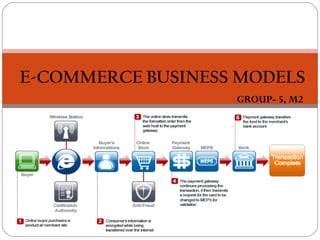
E-COMMERCE BUSINESS MODELS
                   GROUP- 5, M2
INTRODUCTION

 A business model is a method of doing business by which a company can generate
  revenue to sustain itself. Organizations must define and execute a strategy to be
  successful in e-commerce.

 A business model that aims to use and leverage the unique qualities of the Internet
  and the World Wide Web is called E-Business Model.

 The components that are contained within a business model address all functions of a
  business, including such factors as the expenses, revenues, operating strategies,
  corporate structure, and sales and marketing procedures. (A company’s policy,
  operations, technology and ideology define its business model)
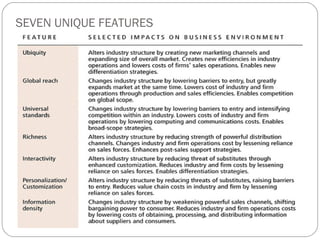
SEVEN UNIQUE FEATURES
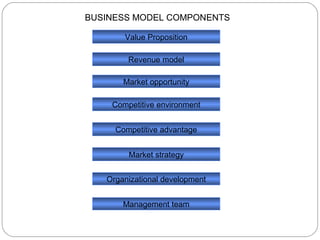
BUSINESS MODEL COMPONENTS

       Value Proposition

        Revenue model

       Market opportunity

    Competitive environment


     Competitive advantage


        Market strategy


   Organizational development


       Management team
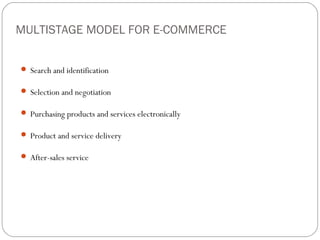
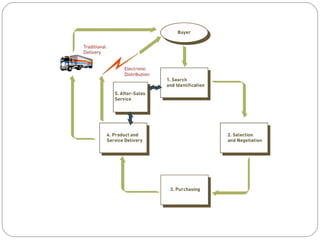
MULTISTAGE MODEL FOR E-COMMERCE


 Search and identification

 Selection and negotiation

 Purchasing products and services electronically

 Product and service delivery

 After-sales service
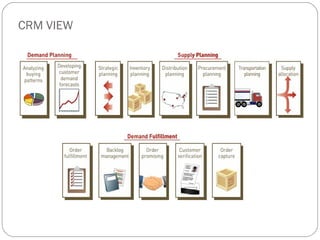
CRM VIEW
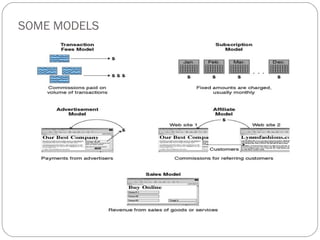
SOME MODELS
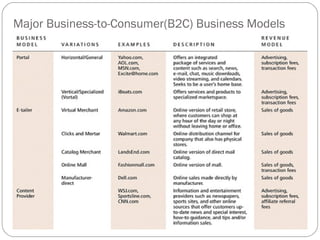
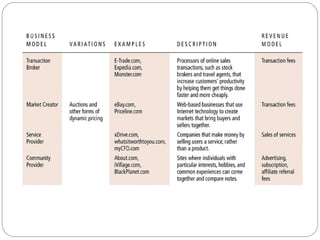
Major Business-to-Consumer(B2C) Business Models
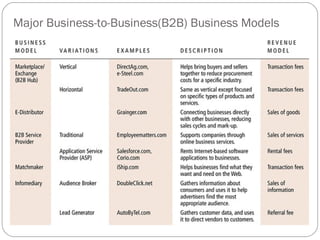
Major Business-to-Business(B2B) Business Models
QUERIES IF ANY


 THANK YOU…

E-Commerce PPT

  • 1.
  • 2.
    INTRODUCTION  A businessmodel is a method of doing business by which a company can generate revenue to sustain itself. Organizations must define and execute a strategy to be successful in e-commerce.  A business model that aims to use and leverage the unique qualities of the Internet and the World Wide Web is called E-Business Model.  The components that are contained within a business model address all functions of a business, including such factors as the expenses, revenues, operating strategies, corporate structure, and sales and marketing procedures. (A company’s policy, operations, technology and ideology define its business model)
  • 3.
  • 4.
    BUSINESS MODEL COMPONENTS Value Proposition Revenue model Market opportunity Competitive environment Competitive advantage Market strategy Organizational development Management team
  • 5.
    MULTISTAGE MODEL FORE-COMMERCE  Search and identification  Selection and negotiation  Purchasing products and services electronically  Product and service delivery  After-sales service
  • 7.
  • 8.
  • 9.
  • 11.
  • 12.
    QUERIES IF ANY THANK YOU…