
ACCOUNTING INFORMATION SYSTEM & E-
COMMERCE
LECTURE 1-ECOMMERCE
CHAPTER 1: THE REVOLUTION IS
JUST BEGINNING
By
Habib Ullah Qamar
MSCS,MBA(HRM)
LEARNING OBJECTIVE
 Define e-commerce and describe how it differs from e-
business.
 Identify and describe the unique features of e-
commerce technology and discuss their business
significance.
 Describe the major types of e-commerce.
 Understand the evolution of e-commerce from its early
years to today.
 Identify the factors that will define the future of e-
commerce.
 Describe the major themes underlying the study of e-
commerce.
 Identify the major academic disciplines contributing to
e-commerce.
RECOMMENDED BOOKS / RESOURCES
 http://www.theITeducation.com/
 Wikipedia.org
 E-Commerce by Kenneth C. Loudon, Carol Traver :
2014 version
 http://slideshare.net/habibullahqamar/
LETS START
E-Commerce
INTRODUCTION
 What is social media
 What are popular social media
 Facebook
 Twitter
 Pinterest
 Success story of Pinterest (2009)
 Fastest web to get 10million
 In 2014 more than 50 millions
 Third most visited website
 In 2012 started monetize using business
 For business now it’s a communication tool
 For consumers its an inspiration and aspiration source
HISTORY OF ECOMMERCE
 1994: it did not exist
 2013: around 155 million American consumers are
expected to spend about $419 billion, and
businesses more than $4.8 trillion, purchasing
goods and services online or via a mobile device.
 A similar story has occurred throughout the world.
And in this short period of time, e-commerce has
been reinvented not just once, but twice.
 The early years of e-commerce, during the late
1990s, were a period of business vision, inspiration,
and experimentation.
HISTORY OF ECOMMERCE
 There followed a period of retrenchment and
reevaluation, which led to the stock market crash of
2000–2001, with the value of e-commerce,
telecommunications, and other technology stocks
plummeting.
 After the bubble burst, many people were quick to
write off e-commerce. But they were wrong. The
surviving firms refined and honed their business
models, ultimately leading to models that actually
produced profits. Between 2002–2008, retail e-
commerce grew at more than 25% per year.
HISTORY OF ECOMMERCE
 Today, we are in the middle of yet another
transition:
 A new and vibrant social, mobile, and local model of
e-commerce growing alongside the more traditional
e-commerce retail sales model exemplified by
Amazon.
 Social network sites such as Face-book, Twitter,
YouTube, and Pinterest, which enable users to
distribute their own content have rocketed to
prominence.
 Encouraged by the explosive growth in
smartphones such as iPhones and Androids, tablet
computers, and ultra-lightweight laptops
SELF LEARNING QUESTION
 How E-commerce trends changes business,
technology and Society?
WHAT IS E-COMMERCE?
 “the use of the Internet, the World Wide Web
(Web), and mobile apps to transact business”.
 The terms Internet and Web are actually two very
different things.
 The Internet is a worldwide network of computer
networks, and the Web is one of the Internet’s most
popular services, providing access to billions of
Web pages.
 An app (short-hand for application) is a software
application. The term is typically used when
referring to mobile applications.
 The professional literature sometimes refers to e-
commerce as “digital commerce”
THE DIFFERENCE BETWEEN E-COMMERCE AND
E-BUSINESS
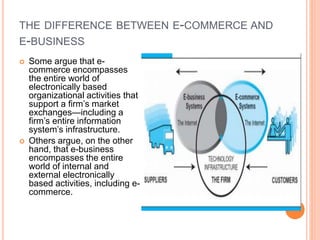
 Some argue that e-
commerce encompasses
the entire world of
electronically based
organizational activities that
support a firm’s market
exchanges—including a
firm’s entire information
system’s infrastructure.
 Others argue, on the other
hand, that e-business
encompasses the entire
world of internal and
external electronically
based activities, including e-
commerce.
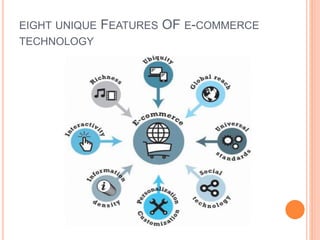
EIGHT UNIQUE FEATURES OF E-COMMERCE
TECHNOLOGY
EIGHT UNIQUE FEATURES OF E-COMMERCE
TECHNOLOGY
 Ubiquity : In traditional commerce, a marketplace
is a physical place you visit in order to transact. E-
commerce, in contrast, is characterized by its
ubiquity : it is available just about everywhere, at all
times. It liberates the market from being restricted
to a physical space and makes it possible to shop
from your desktop, at home, at work, or even from
your car, using mobile e-commerce.
 A marketplace extended beyond traditional
boundaries and removed from a temporal and
geographic location. From a consumer point of
view, ubiquity reduces transaction costs.
EIGHT UNIQUE FEATURES OF E-COMMERCE
TECHNOLOGY
 Global Reach : E-commerce technology permits
commercial transactions to cross cultural, regional,
and national boundaries far more conveniently and
cost-effectively than is true in traditional commerce. Now
market size for e-commerce merchants is roughly equal
to the size of the world’s online population.
 Universal standards: Technical standards of the
Internet for conducting e-commerce are universal
standards and they are shared by all nations around the
world. In contrast, most traditional commerce
technologies differ from one nation to the next. For
instance, television and radio standards differ around
the world, as does cell phone technology.
 Lower Market entry cost, price discovery is simple
EIGHT UNIQUE FEATURES OF E-COMMERCE
TECHNOLOGY
 Richness: Information richness refers to the complexity
and content of a message (Evans and Wurster, 1999).
Traditional markets, national sales forces, and small
retail stores have great richness: they are able to
provide personal, face-to-face service using aural and
visual cues when making a sale. The Internet has the
potential for offering considerably more information
richness than traditional media such as printing
presses, radio, and television because it is interactive
and can adjust the message to individual users.
 Chatting with an online sales person, for instance,
comes very close to the customer experience in small
retail shop.
EIGHT UNIQUE FEATURES OF E-COMMERCE
TECHNOLOGY
 Interactivity : Unlike any of the commercial
technologies of the twentieth century, with the possible
exception of the telephone, e-commerce technologies
allow for interactivity, meaning they enable two-way
communication between merchant and consumer and
among consumers.
 Information density : E-commerce technologies vastly
increase information density—the total amount and
quality of information available to all market participants,
consumers, and merchants alike. E-commerce
technologies reduce information collection, storage,
processing, and communication costs and increase the
currency, accuracy, and timeliness of information making
information more useful and important than ever
EIGHT UNIQUE FEATURES OF E-COMMERCE
TECHNOLOGY
 Personalization/customization : the targeting of
marketing messages to specific individuals by adjusting
the message to a person’s name, interests, and past
purchases. customization—changing the delivered
product or service based on a user’s preferences or
prior behavior. Given the interactive nature of e-
commerce technology, much information about the
consumer can be gathered in the marketplace at the
moment of purchase.
 Social technology: user content generation and social
networking In a way quite different from all previous
technologies, e-commerce technologies have evolved to
be much more social by allowing users to create and
share content with a worldwide community.
RESOURCES
 E-Commerce by Kenneth C. Loudon, Carol Traver :
2014 version : Chapter 1
 www.Wikipedia.org
 http://www.businessdictionary.com/
 http://theITeducation.com/

Lecture 1 e-cmmerce , an introduction

  • 1.
    ACCOUNTING INFORMATION SYSTEM& E- COMMERCE LECTURE 1-ECOMMERCE CHAPTER 1: THE REVOLUTION IS JUST BEGINNING By Habib Ullah Qamar MSCS,MBA(HRM)
  • 2.
    LEARNING OBJECTIVE  Definee-commerce and describe how it differs from e- business.  Identify and describe the unique features of e- commerce technology and discuss their business significance.  Describe the major types of e-commerce.  Understand the evolution of e-commerce from its early years to today.  Identify the factors that will define the future of e- commerce.  Describe the major themes underlying the study of e- commerce.  Identify the major academic disciplines contributing to e-commerce.
  • 3.
    RECOMMENDED BOOKS /RESOURCES  http://www.theITeducation.com/  Wikipedia.org  E-Commerce by Kenneth C. Loudon, Carol Traver : 2014 version  http://slideshare.net/habibullahqamar/
  • 4.
  • 5.
    INTRODUCTION  What issocial media  What are popular social media  Facebook  Twitter  Pinterest  Success story of Pinterest (2009)  Fastest web to get 10million  In 2014 more than 50 millions  Third most visited website  In 2012 started monetize using business  For business now it’s a communication tool  For consumers its an inspiration and aspiration source
  • 6.
    HISTORY OF ECOMMERCE 1994: it did not exist  2013: around 155 million American consumers are expected to spend about $419 billion, and businesses more than $4.8 trillion, purchasing goods and services online or via a mobile device.  A similar story has occurred throughout the world. And in this short period of time, e-commerce has been reinvented not just once, but twice.  The early years of e-commerce, during the late 1990s, were a period of business vision, inspiration, and experimentation.
  • 7.
    HISTORY OF ECOMMERCE There followed a period of retrenchment and reevaluation, which led to the stock market crash of 2000–2001, with the value of e-commerce, telecommunications, and other technology stocks plummeting.  After the bubble burst, many people were quick to write off e-commerce. But they were wrong. The surviving firms refined and honed their business models, ultimately leading to models that actually produced profits. Between 2002–2008, retail e- commerce grew at more than 25% per year.
  • 8.
    HISTORY OF ECOMMERCE Today, we are in the middle of yet another transition:  A new and vibrant social, mobile, and local model of e-commerce growing alongside the more traditional e-commerce retail sales model exemplified by Amazon.  Social network sites such as Face-book, Twitter, YouTube, and Pinterest, which enable users to distribute their own content have rocketed to prominence.  Encouraged by the explosive growth in smartphones such as iPhones and Androids, tablet computers, and ultra-lightweight laptops
  • 9.
    SELF LEARNING QUESTION How E-commerce trends changes business, technology and Society?
  • 10.
    WHAT IS E-COMMERCE? “the use of the Internet, the World Wide Web (Web), and mobile apps to transact business”.  The terms Internet and Web are actually two very different things.  The Internet is a worldwide network of computer networks, and the Web is one of the Internet’s most popular services, providing access to billions of Web pages.  An app (short-hand for application) is a software application. The term is typically used when referring to mobile applications.  The professional literature sometimes refers to e- commerce as “digital commerce”
  • 11.
    THE DIFFERENCE BETWEENE-COMMERCE AND E-BUSINESS  Some argue that e- commerce encompasses the entire world of electronically based organizational activities that support a firm’s market exchanges—including a firm’s entire information system’s infrastructure.  Others argue, on the other hand, that e-business encompasses the entire world of internal and external electronically based activities, including e- commerce.
  • 12.
    EIGHT UNIQUE FEATURESOF E-COMMERCE TECHNOLOGY
  • 13.
    EIGHT UNIQUE FEATURESOF E-COMMERCE TECHNOLOGY  Ubiquity : In traditional commerce, a marketplace is a physical place you visit in order to transact. E- commerce, in contrast, is characterized by its ubiquity : it is available just about everywhere, at all times. It liberates the market from being restricted to a physical space and makes it possible to shop from your desktop, at home, at work, or even from your car, using mobile e-commerce.  A marketplace extended beyond traditional boundaries and removed from a temporal and geographic location. From a consumer point of view, ubiquity reduces transaction costs.
  • 14.
    EIGHT UNIQUE FEATURESOF E-COMMERCE TECHNOLOGY  Global Reach : E-commerce technology permits commercial transactions to cross cultural, regional, and national boundaries far more conveniently and cost-effectively than is true in traditional commerce. Now market size for e-commerce merchants is roughly equal to the size of the world’s online population.  Universal standards: Technical standards of the Internet for conducting e-commerce are universal standards and they are shared by all nations around the world. In contrast, most traditional commerce technologies differ from one nation to the next. For instance, television and radio standards differ around the world, as does cell phone technology.  Lower Market entry cost, price discovery is simple
  • 15.
    EIGHT UNIQUE FEATURESOF E-COMMERCE TECHNOLOGY  Richness: Information richness refers to the complexity and content of a message (Evans and Wurster, 1999). Traditional markets, national sales forces, and small retail stores have great richness: they are able to provide personal, face-to-face service using aural and visual cues when making a sale. The Internet has the potential for offering considerably more information richness than traditional media such as printing presses, radio, and television because it is interactive and can adjust the message to individual users.  Chatting with an online sales person, for instance, comes very close to the customer experience in small retail shop.
  • 16.
    EIGHT UNIQUE FEATURESOF E-COMMERCE TECHNOLOGY  Interactivity : Unlike any of the commercial technologies of the twentieth century, with the possible exception of the telephone, e-commerce technologies allow for interactivity, meaning they enable two-way communication between merchant and consumer and among consumers.  Information density : E-commerce technologies vastly increase information density—the total amount and quality of information available to all market participants, consumers, and merchants alike. E-commerce technologies reduce information collection, storage, processing, and communication costs and increase the currency, accuracy, and timeliness of information making information more useful and important than ever
  • 17.
    EIGHT UNIQUE FEATURESOF E-COMMERCE TECHNOLOGY  Personalization/customization : the targeting of marketing messages to specific individuals by adjusting the message to a person’s name, interests, and past purchases. customization—changing the delivered product or service based on a user’s preferences or prior behavior. Given the interactive nature of e- commerce technology, much information about the consumer can be gathered in the marketplace at the moment of purchase.  Social technology: user content generation and social networking In a way quite different from all previous technologies, e-commerce technologies have evolved to be much more social by allowing users to create and share content with a worldwide community.
  • 18.
    RESOURCES  E-Commerce byKenneth C. Loudon, Carol Traver : 2014 version : Chapter 1  www.Wikipedia.org  http://www.businessdictionary.com/  http://theITeducation.com/