Uptake and
distribution of
Inhalational
Anesthetics
-Dr. Prakash. G.
Moderators:
-Dr. Ashok Kumar Saxena,
-Dr. Chhavi Sharma
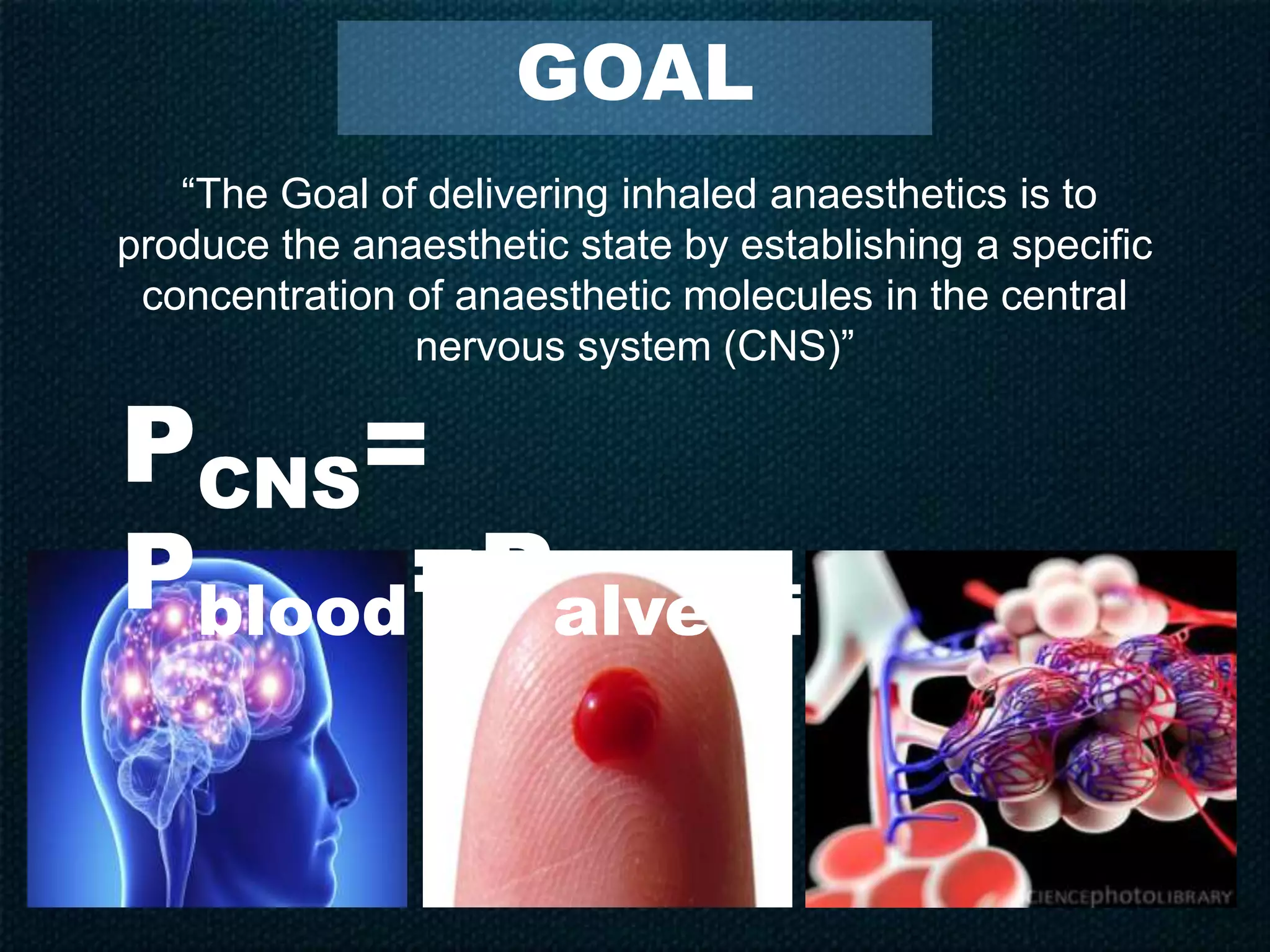
PCNS=
Pblood=Palveoli
GOAL
“The Goal of delivering inhaled anaesthetics is to
produce the anaesthetic state by establishing a specific
concentration of anaesthetic molecules in the central
nervous system (CNS)”
PCNS=
Pblood=Palveoli
PCNS=
Pblood=Palveoli
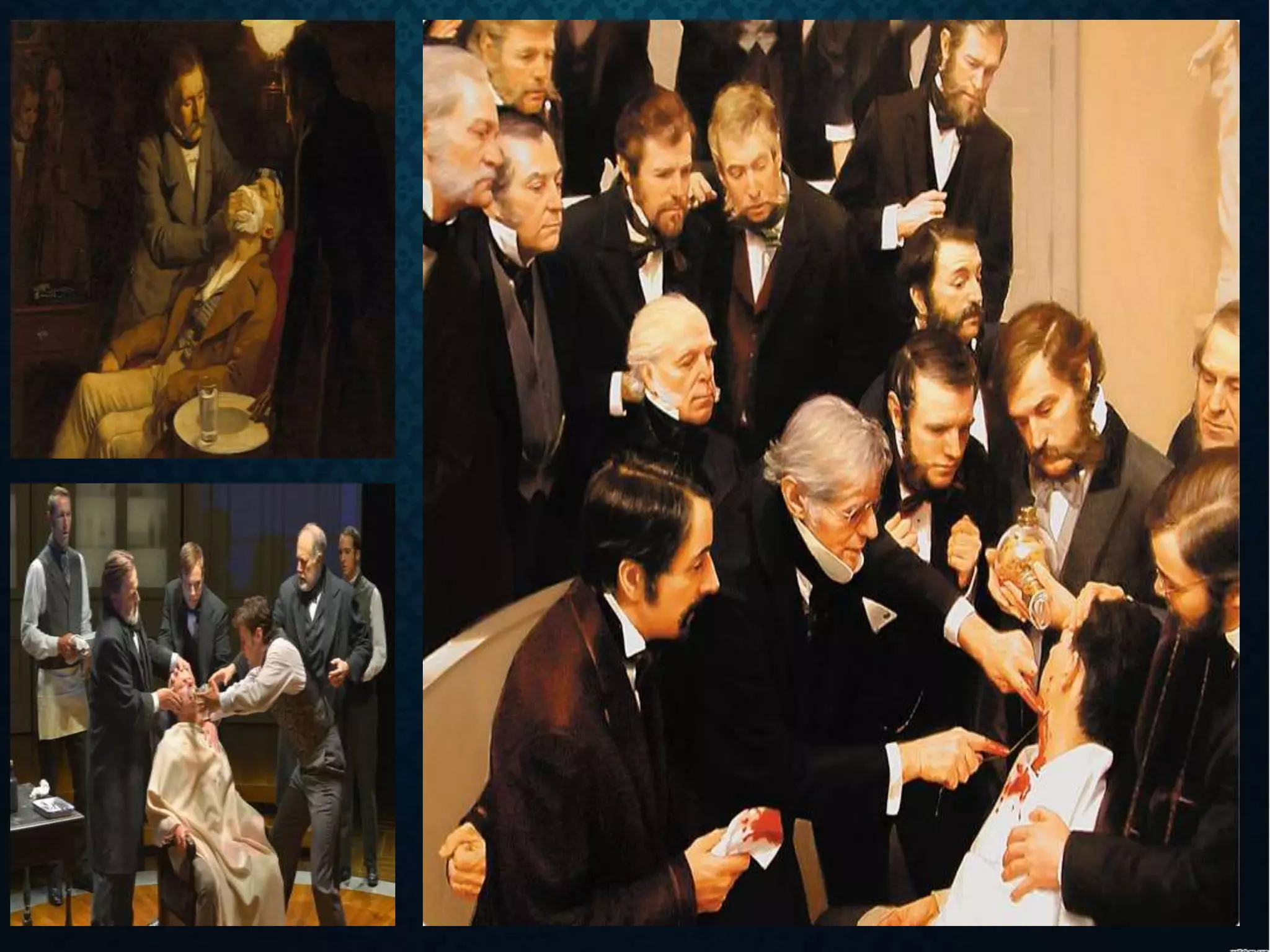
• The first reports of the use of inhalation anaesthetics such as ether
(1846), chloroform (1847), and nitrous oxide (1844) began to
emerge in the 1840s.
• search for better inhalation agents began with fluorinated ethers
and hydrocarbons
• Since then halothane (1956) and enflurane (1966) have passed
through common usage but have been largely replaced.
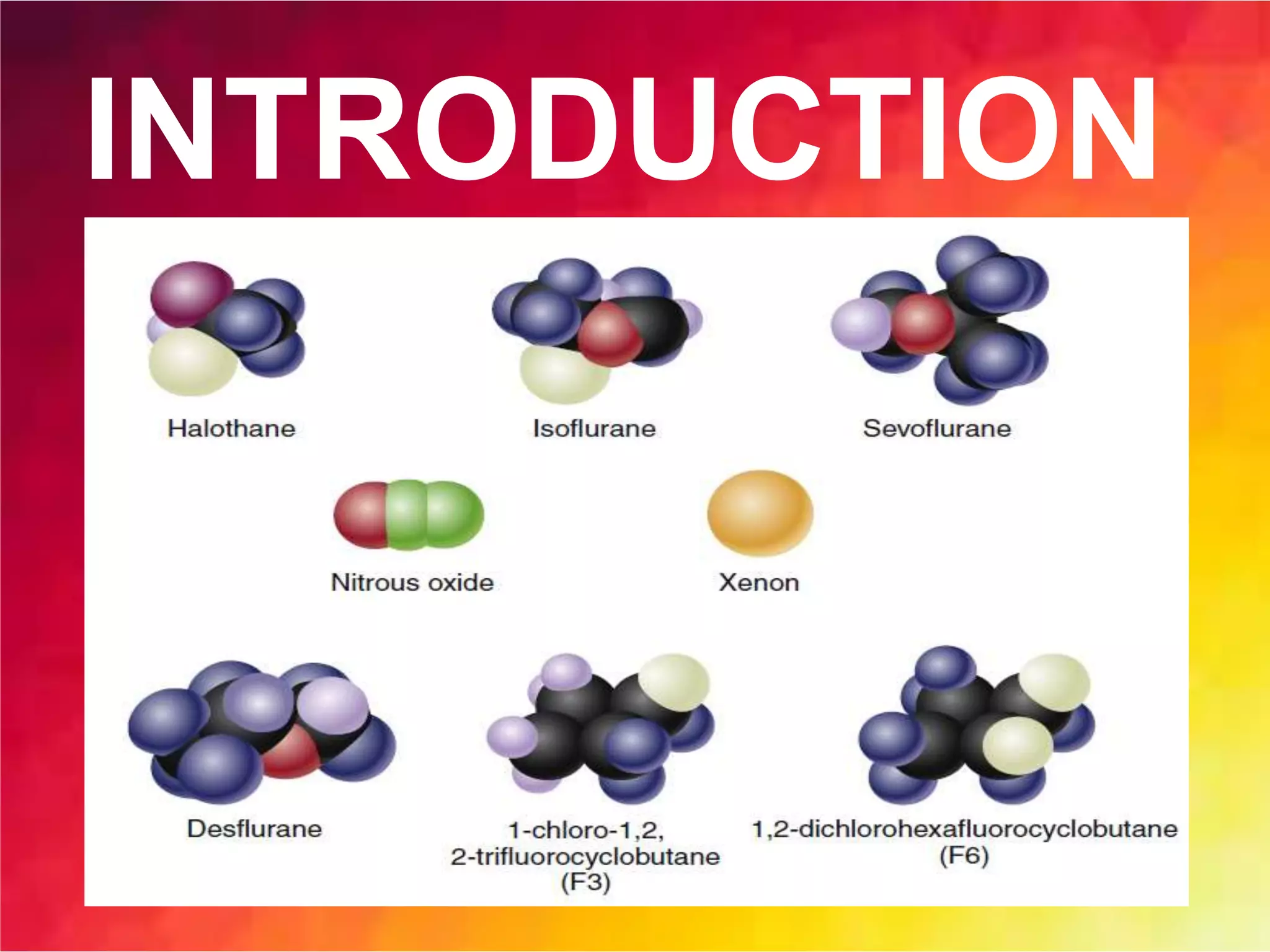
• The inhalation agents used in modern practice include the
nonflammable, potent hydrocarbons ; isoflurane (1969 ),
sevoflurane (1981 ), and desflurane ( 1990) and the gas nitrous
oxide (N2O).
• The noble gas xenon has impressive anaesthetic properties, but
production costs preclude its widespread use
INTRODUCTION
Inhalation anesthetics are one of the most
common drugs used for GA
Only a fraction of a volatile anesthetic to the
inspired oxygen results in a state of
unconsciousness and amnesia.
When combined with intravenous
adjuvants, a balanced technique is
achieved
Ease of administration and the clinician’s
ability to reliably monitor their effects with
both clinical signs and end tidal
concentrations.
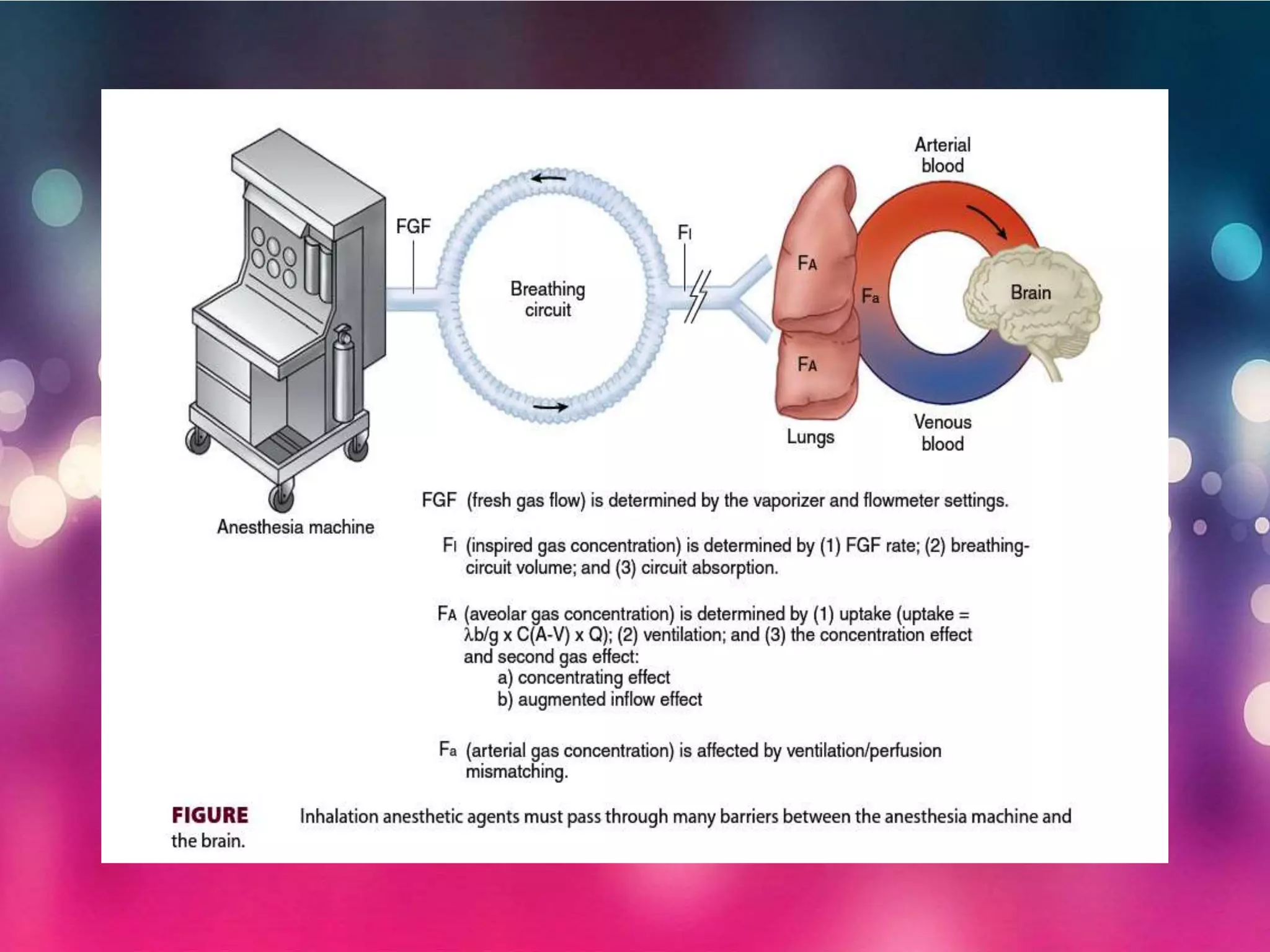
Inhalational Anesthetic agents must pass through
various barriers between the anesthesia
machine and the brain
FA
MAC
FD
FI
Ventilation
FA/FI
Time
constant
Concentration and
second gas effects
λB/G
CO
PA - PV
VRG
λT/B
Tissue blood flow
[Parterial - PTissue]
Time
constant
Brain Partial
pressure drives
depth of
anesthesia
Equilibrates
Optimal delivery of systemic drugs via inhalation requires a full understanding:-
• Factors influencing how gas-phase compounds
move into and out of various body tissues
• How they are metabolized (pharmacokinetics)
• How their metabolism affect tissue functions.
Theories of anesthetic action
Unitary hypothesis of Narcosis (Claude Bernard
1870): postulated a common mechanism of action for
anesthetic agents at molecular level.
Meyer-Overton Hypothesis: a strong correlation
between anaesthetic potency and solubility in olive oil,
theorizing that anaesthetic agents act non-specifically
on the hydrophobic, lipid components of cells (1899 -
1901)
Critical volume hypothesis: Anesthetic binding
expand neuronal membrane phospholipid bilayer
beyond critical amount, altering membrane function.
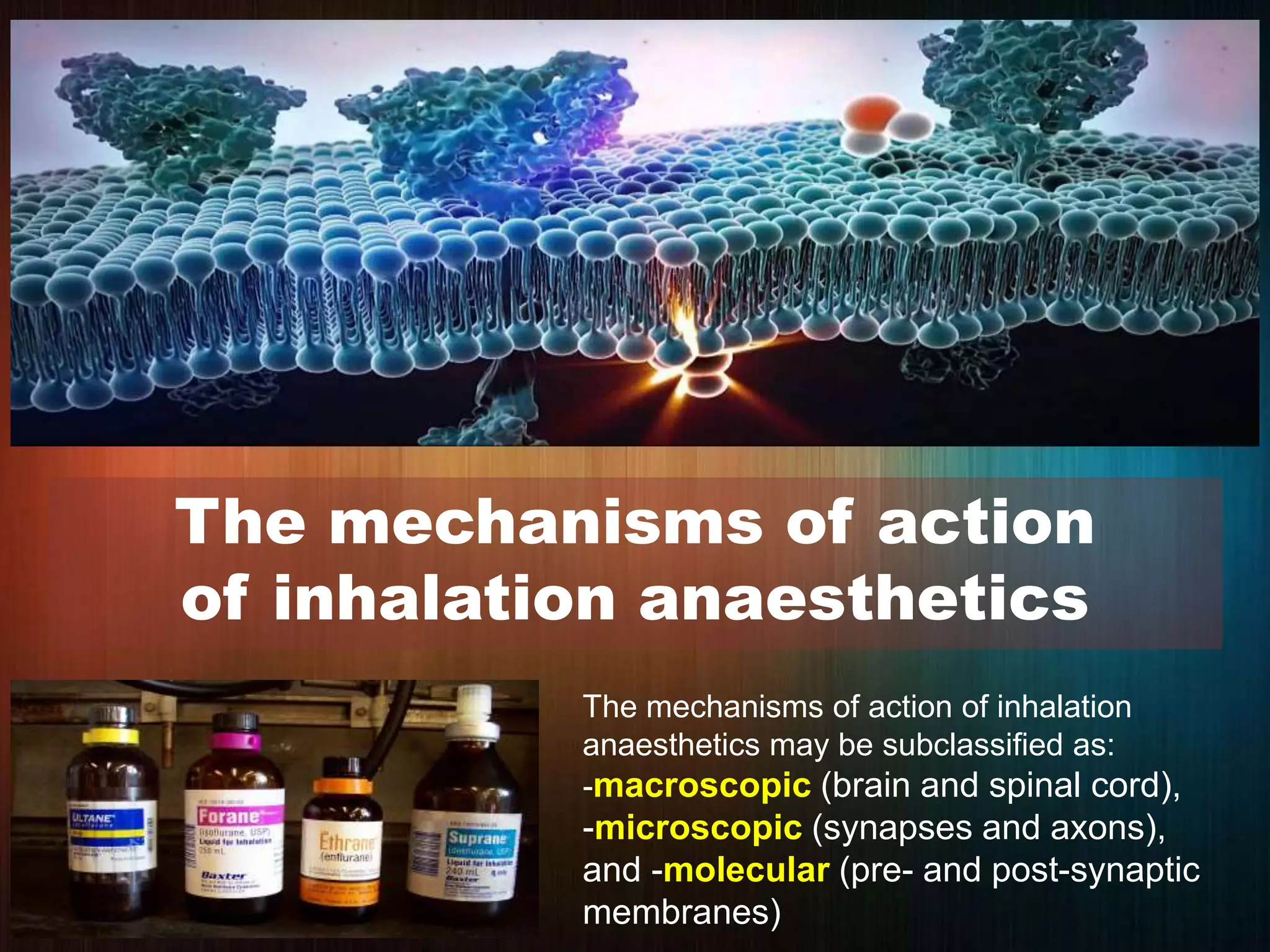
The mechanisms of action of inhalation
anaesthetics may be subclassified as:
-macroscopic (brain and spinal cord),
-microscopic (synapses and axons),
and -molecular (pre- and post-synaptic
membranes)
The mechanisms of action
of inhalation anaesthetics
Macroscopic
• IA decrease transmission of noxious afferent information
ascending from the spinal cord to the cerebral cortex via the
thalamus, thereby decreasing supraspinal arousal.
• inhibition of spinal efferent neuronal activity reducing movement
response to pain.
• Hypnosis and amnesia, on the other hand, are mediated at the
supraspinal level.
Synaptic
Molecular
• IA inhibit excitatory presynaptic channel activity mediated by
neuronal nicotinic, serotonergic, and glutaminergic receptors.
• IA augment the inhibitory post-synaptic channel activity mediated
by GABA(A) and glycine receptors.
• The combined effect is to reduce neuronal and synaptic
transmission.
• IA prolong the GABAA receptor-mediated inhibitory Cl2 current,
thereby inhibiting post-synaptic neuronal excitability.
• IA enhance the activity of two-pore domain potassium
channels, leading to hyperpolarization of the plasma
membrane, thereby influencing the likelihood of neuronal action
potential generation and potentially explaining their anaesthetic
effects
Pharmacokinetics of
Inhalational Anesthetics
Factors affecting the uptake and release
of inhalation anaesthetic agents
• Alveolar concentration of inhalation agents
– Inspired concentration
• Fresh gas flow
• Breathing system volume
• Circuit absorption.
– Alveolar ventilation
– Functional residual capacity
• Drug uptake from the lungs
Solubility (blood–gas partition coefficient)
Pulmonary alveolar blood flow (cardiac output)
Alveolar–venous partial pressure gradient
Second gas effect
Factors Affecting Inspired gas
concentration (Fi)
1) Fresh Gas Flow rate:
↑ FGF → ↑ speed of induction &
recovery.
2) Volume of breathing circuit
(apparatus dead space):
increase ↑volume → slower
induction (dilution of anesthetic
gases.)
3) Absorption by the breathing
circuit: rubber tubing absorbs ˃
plastic & silicon.
Alveolar ventilation: Increased alveolar
ventilation results in faster increase in
alveolar partial pressure by constantly
replacing the inhalation agent taken up by
the pulmonary blood flow.
Functional residual capacity (FRC): A
larger FRC dilutes the inspired
concentration of gas resulting initially in a
lower alveolar partial pressure and
therefore slower onset of anaesthesia.
Fresh Gas flow &
Time Constant ( ṯ )
Concentration in the circuit (FI) will rise according to
first-order kinetics:
Fi = FFGO ( 1 - e -T/ṯ )
Where:-
FFGO - is the fraction of inspired anesthetic in the
gas leaving the fresh gas outlet (the vapourizer
setting)
T - is time.
ṯ - is a time constant.
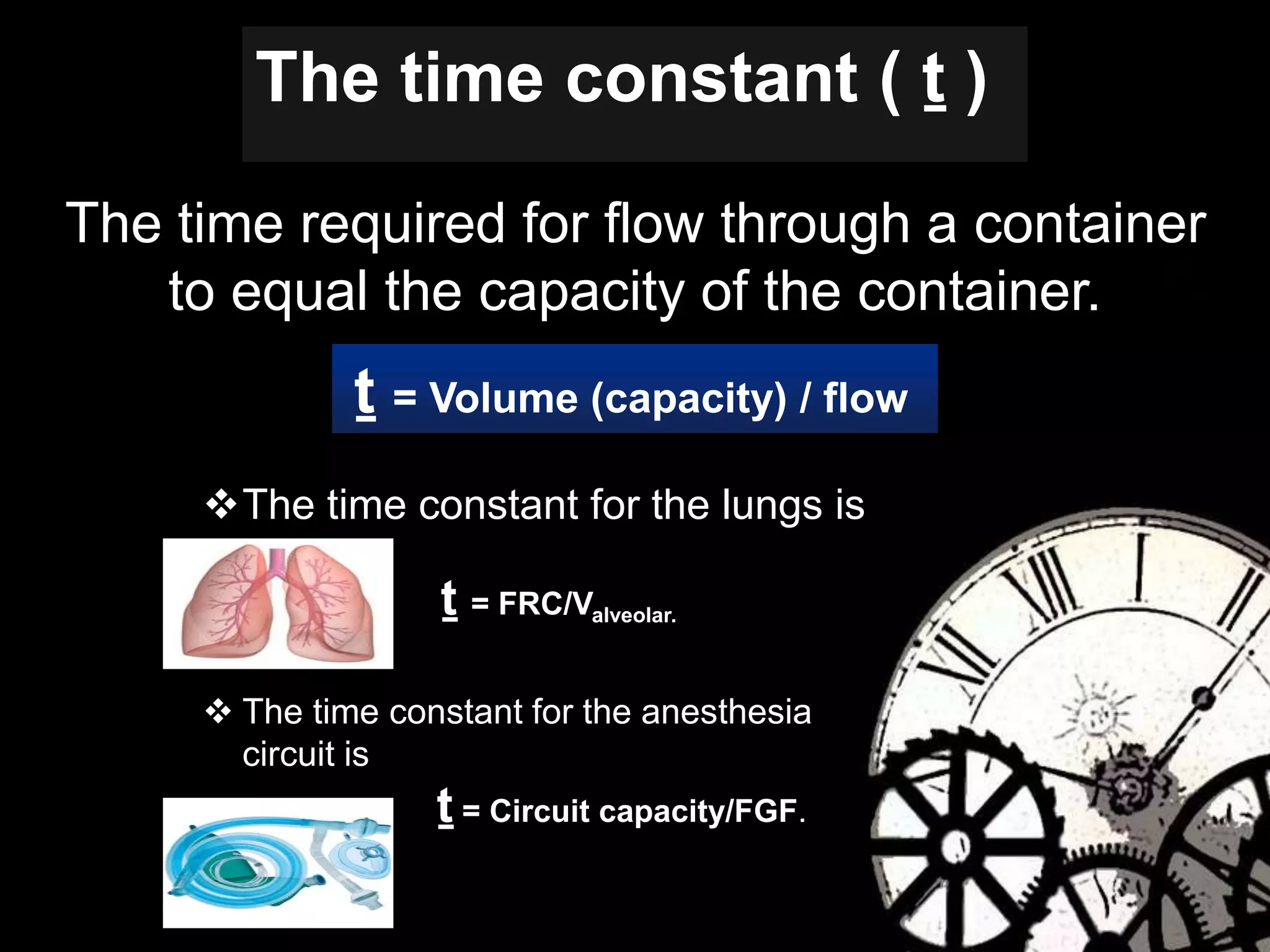
The time required for flow through a container
to equal the capacity of the container.
The time constant ( ṯ )
ṯ = Volume (capacity) / flow
The time constant for the lungs is
ṯ = FRC/Valveolar.
 The time constant for the anesthesia
circuit is
ṯ = Circuit capacity/FGF.
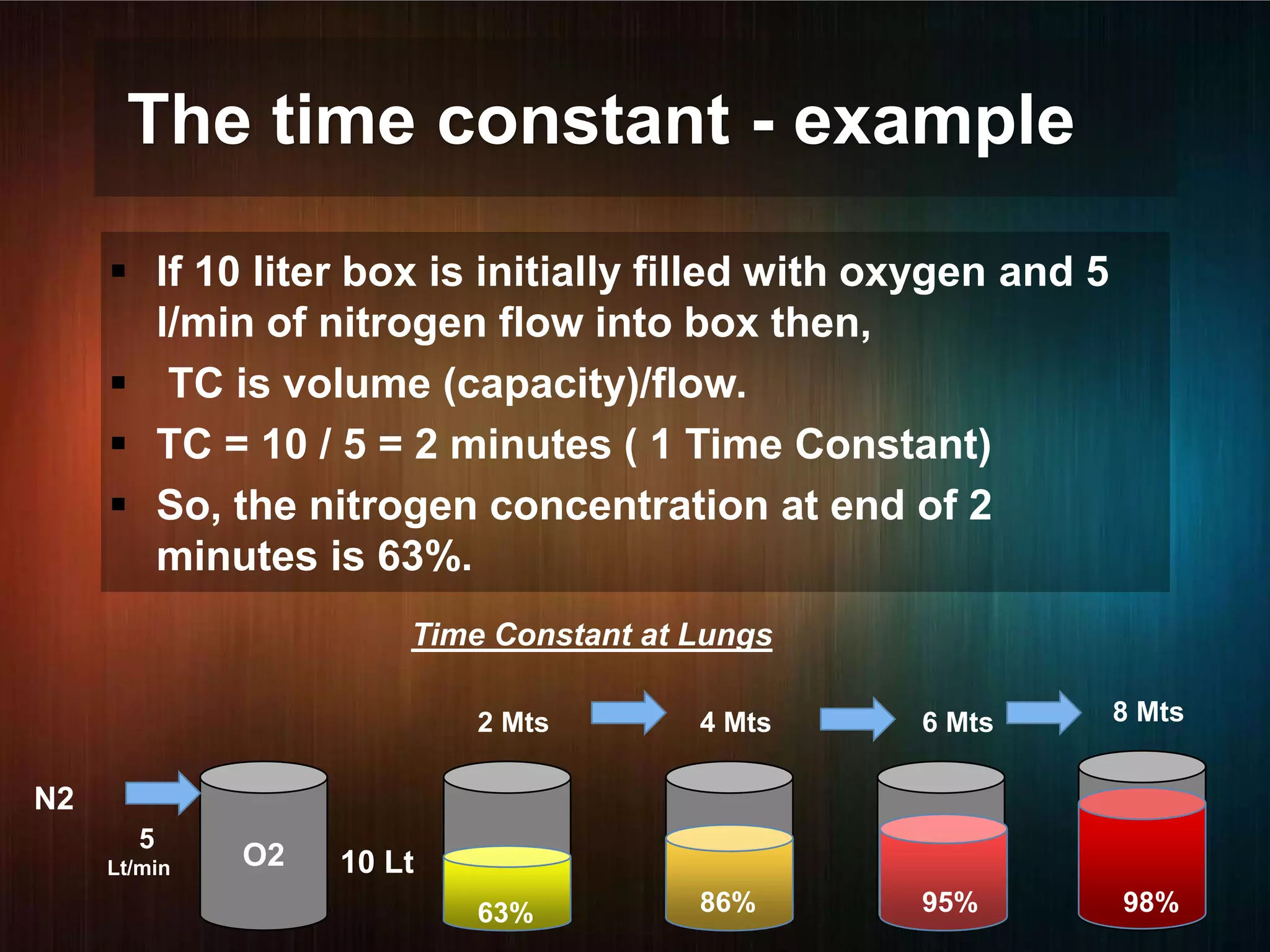
The time constant - example
 If 10 liter box is initially filled with oxygen and 5
l/min of nitrogen flow into box then,
 TC is volume (capacity)/flow.
 TC = 10 / 5 = 2 minutes ( 1 Time Constant)
 So, the nitrogen concentration at end of 2
minutes is 63%.
O2 10 Lt
5
Lt/min
2 Mts 4 Mts 6 Mts 8 Mts
63% 86% 95% 98%
N2
Time Constant at Lungs
Factors affecting alveolar
concentration (FA)
1.Uptake
2.Ventilation
3.Concentration effect
& Second Gas effect
Factors affecting alveolar
concentration (FA)
1.Uptake
If no uptake : FA would rapidly approach Fi.
But, anesthetic are taken up by pulmonary circulation
FA < Fi FA/ Fi < 1.0
Factors affecting uptake:
a) Solubility (Partition Coefficient, λ)
b) Cardiac output (Q)
c) Alveolar-to - Venous partial pressure diff (PA- PV)
U Lung = λB/G x Q x (PA-Pvenous)
Barometric pressure
 Solubility is defined in terms of the partition coefficient
 Partition coefficient is the ratio of the amount of
substance present in one phase compared with
another, the two phases being of equal volume and in
equilibrium
 [λB/G = CB /CG ]
Solubility Capacity of blood & tissue
longer it takes to saturate at given rate
Slower the rate of rise of FA/ Fi
Partition coefficients at 37˚C
Agent blood-gas brain-blood muscle-blood fat-blood
N2O 0.47 1.1 1.2 2.3
Halothane 2.5 1.9 3.4 51
Isoflurane 1.4 1.6 2.9 45
Desflurane 0.45 1.3 2.0 27
Sevoflurane 0.65 1.7 3.1 48
λb/g Isoflurane 1.4: at equilibrium ( Partial Pressure) the
conc. of Isoflurane in blood is 1.4 times its conc. in gas
(alveolar) phase.
or
Each ml of blood holds 1.4 times as much Isoflurane as 1
ml of alveolar gas does.
*Do not indicate partial pressure in blood is 1.4 times
that in alveoli
No net diffusion when
partial pressures are
equal.
Isoflurane blood / gas partition coefficient = 1.4
Blood has 14 molecules of
Isoflurane/ml
Gas has 10 molecules of
Isoflurane/ml
b) Cardiac output
c) Alveolar-to-venous partial pressure
diff.
(PA - PV)
 Gradient depends on tissue uptake
 Tissue uptake depends on tissue solubility,
tissue blood flow, partial pressure diff betⁿ
arterial blood & tissue
Characteristics Vessel rich
group
Muscle Fat
% of body wt. 10 50 25
% of C.O. 75 19 6
Perfusion (ml/min/100g) 75 3 3
Relative solubility 1 1 20
Vessel rich group (VRG):
• Brain, heart, liver, kidney & spinal cord
• Perfusion is 75ml/min/100gm.
• Small vol. of tissue (10% of body mass) relative
to perfusion (75% of C.O)
• Time constant for anesthetic equilibration
between these organs, only few minutes
Muscle group:
• Next compartment to equilibrate
• 40% of body mass ( perfusion is 3ml/min/100gm)
• 10-15% of CO, so uptake is slower
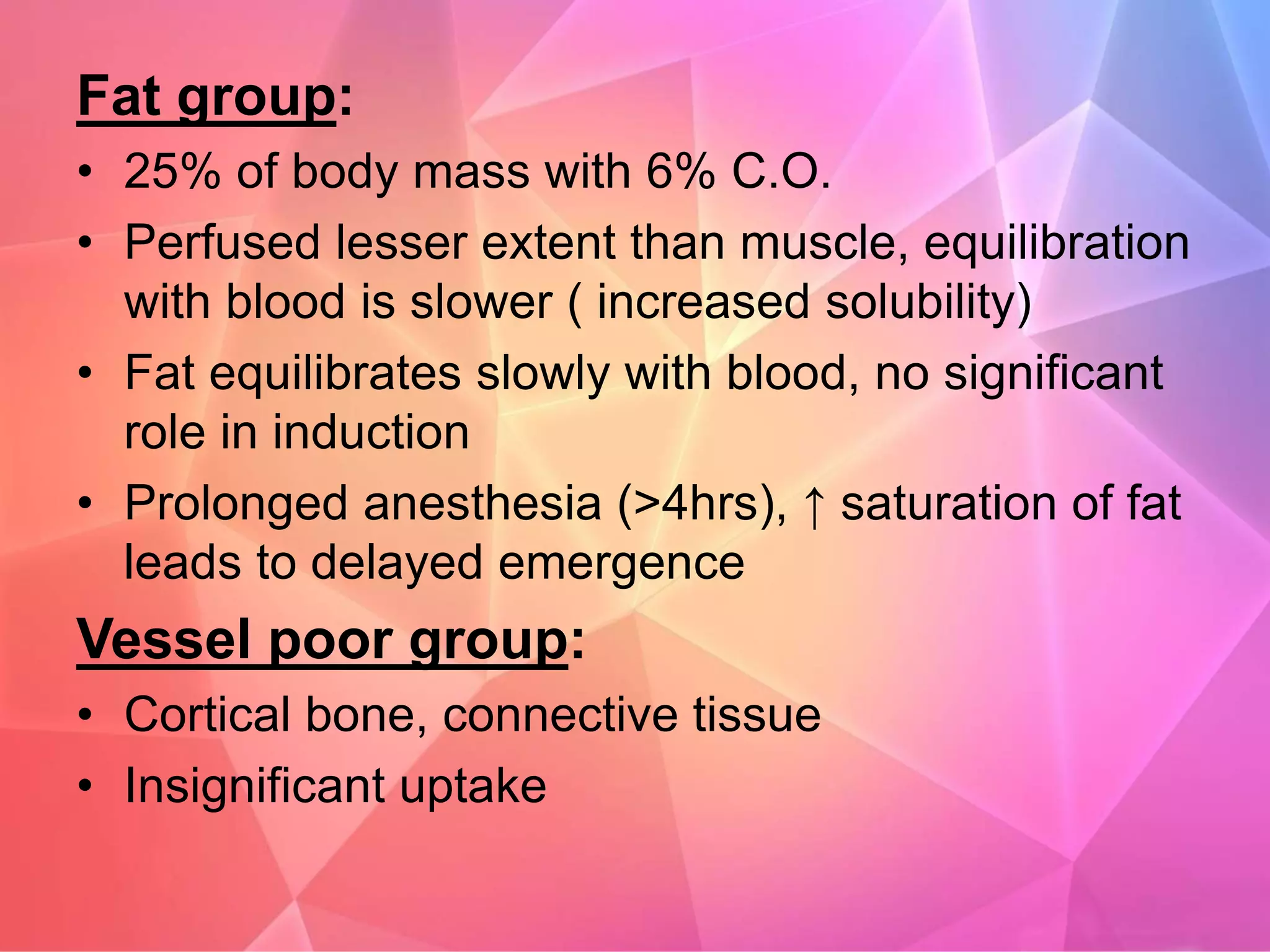
Fat group:
• 25% of body mass with 6% C.O.
• Perfused lesser extent than muscle, equilibration
with blood is slower ( increased solubility)
• Fat equilibrates slowly with blood, no significant
role in induction
• Prolonged anesthesia (>4hrs), ↑ saturation of fat
leads to delayed emergence
Vessel poor group:
• Cortical bone, connective tissue
• Insignificant uptake
Factors affecting alveolar
concentration (FA)
1.Uptake
2.Ventilation
3.Concentration effect
& Second Gas effect
2. Ventilation
Factors affecting alveolar
concentration (FA)
1.Uptake
2.Ventilation
3.Concentration effect
& Second Gas effect
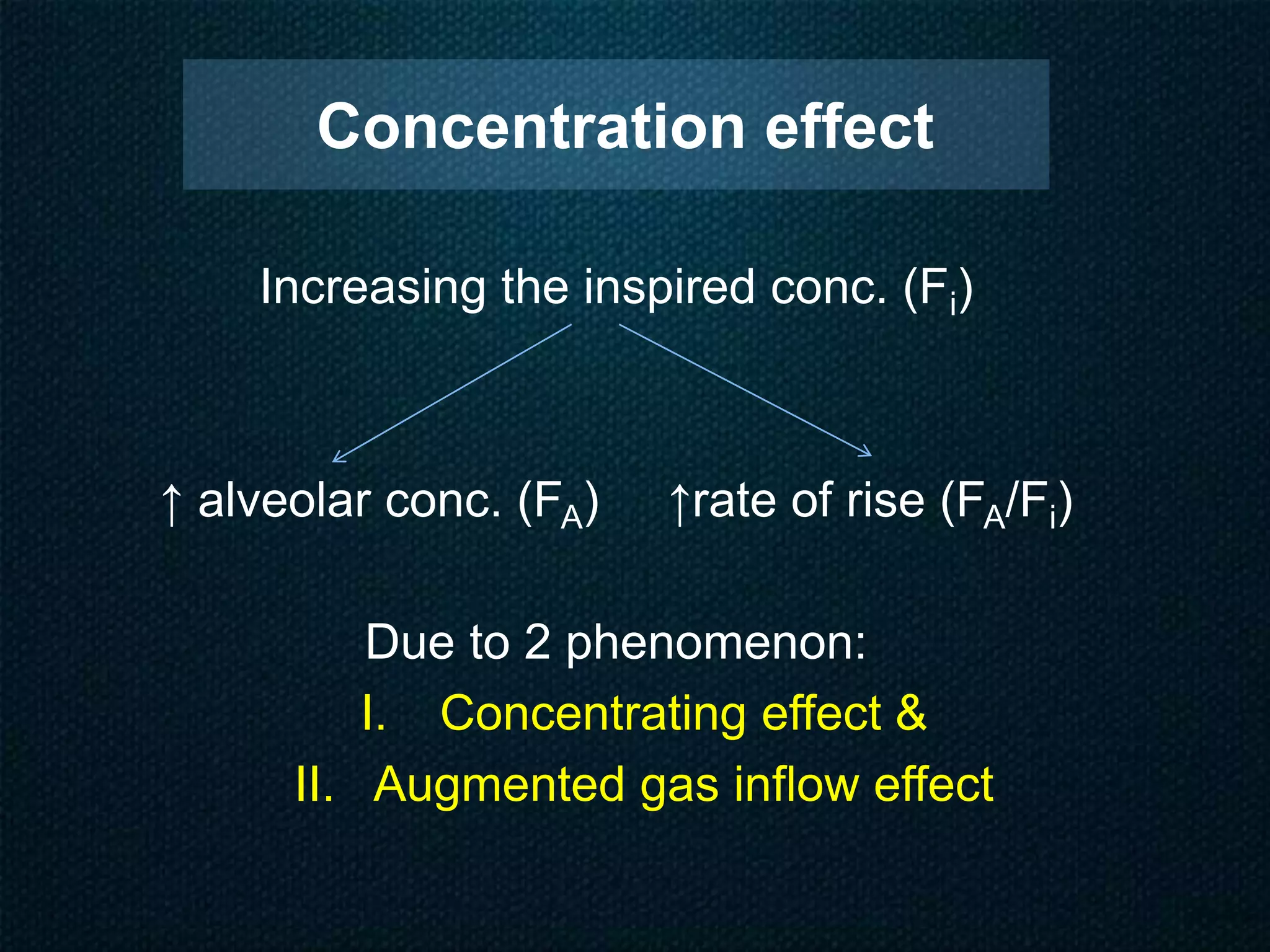
Concentration effect
Increasing the inspired conc. (Fi)
↑ alveolar conc. (FA) ↑rate of rise (FA/Fi)
Due to 2 phenomenon:
I. Concentrating effect &
II. Augmented gas inflow effect
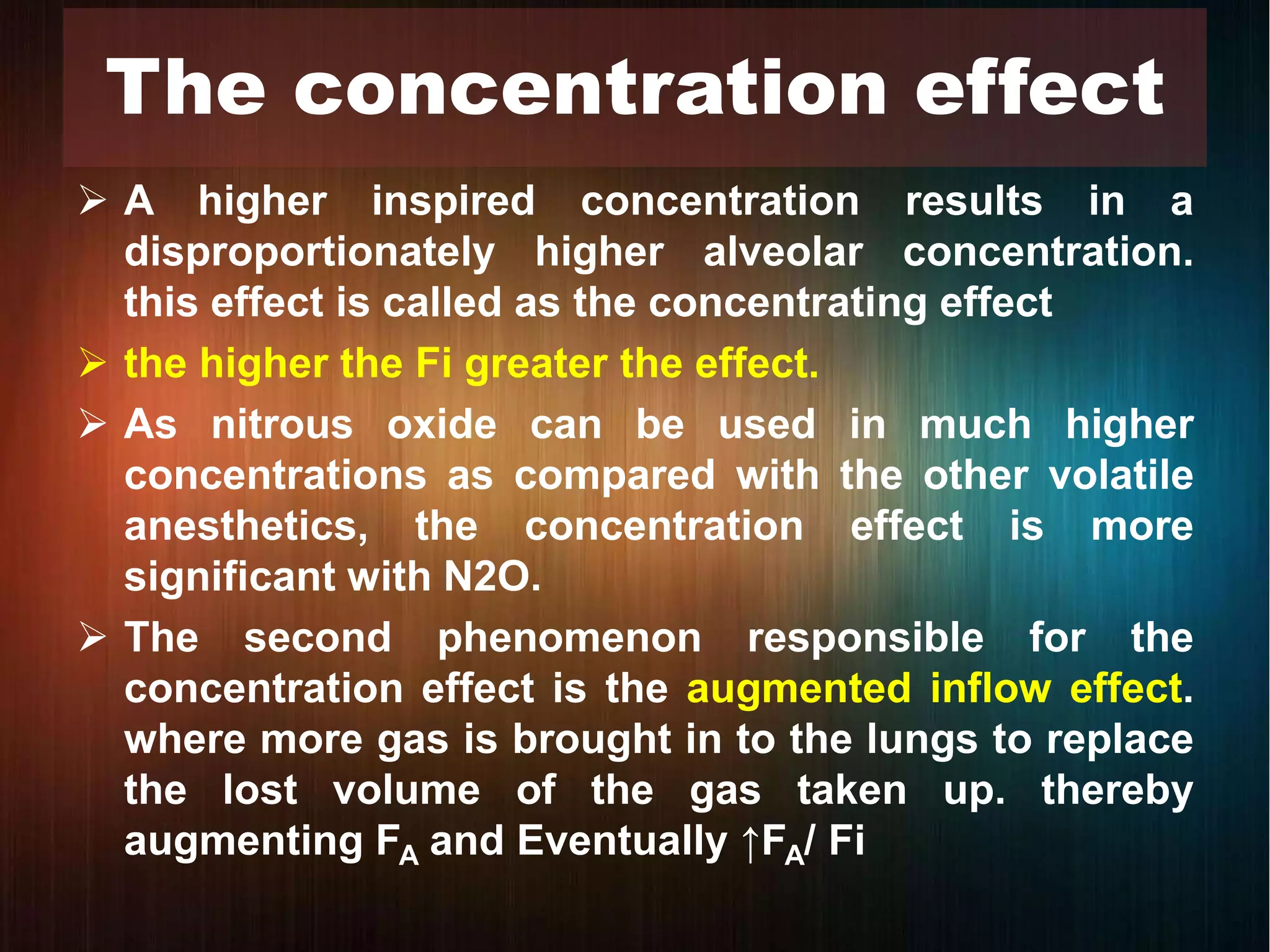
 A higher inspired concentration results in a
disproportionately higher alveolar concentration.
this effect is called as the concentrating effect
 the higher the Fi greater the effect.
 As nitrous oxide can be used in much higher
concentrations as compared with the other volatile
anesthetics, the concentration effect is more
significant with N2O.
 The second phenomenon responsible for the
concentration effect is the augmented inflow effect.
where more gas is brought in to the lungs to replace
the lost volume of the gas taken up. thereby
augmenting FA and Eventually ↑FA/ Fi
The concentration effect
• A high concentration of nitrous oxide will augment not
only its own uptake, but theoretically that of a
concurrently administered volatile anaesthetic.
• the concentration effect of one gas upon another is
called the second gas effect. (applies to the effects of
nitrous oxide on the uptake of another gas):
• Analogous to the concentration effect, but relates instead
to the use of a potent agent concurrently with a second
gas present in large quantity (usually nitrous oxide.)
The second gas effect
The second gas effect........
The higher the inspired concentration of the second gas
(nitrous oxide), the more rapid the rise in alveolar
concentration.
Explanations:
– a. The concentrating effect: As the second gas (nitrous) is taken
up in significant volumes, all remaining gases (including the
potent agent, which is the "first" gas) are concentrated in the
remaining volume.
– b. The ventilation effect: As the second gas is taken up in
significant volumes, additional fresh gas in brought into the
lungs. This increases Valveolar, which increases the rate of rise
of anesthetic concentration.
Factors affecting Fa
• Normally FA & Fa assumed to be equal
• But Fa< FA due to :
Venous admixture
Alveolar dead space
Non-uniform alveolar gas
distribution
V/Q mismatch
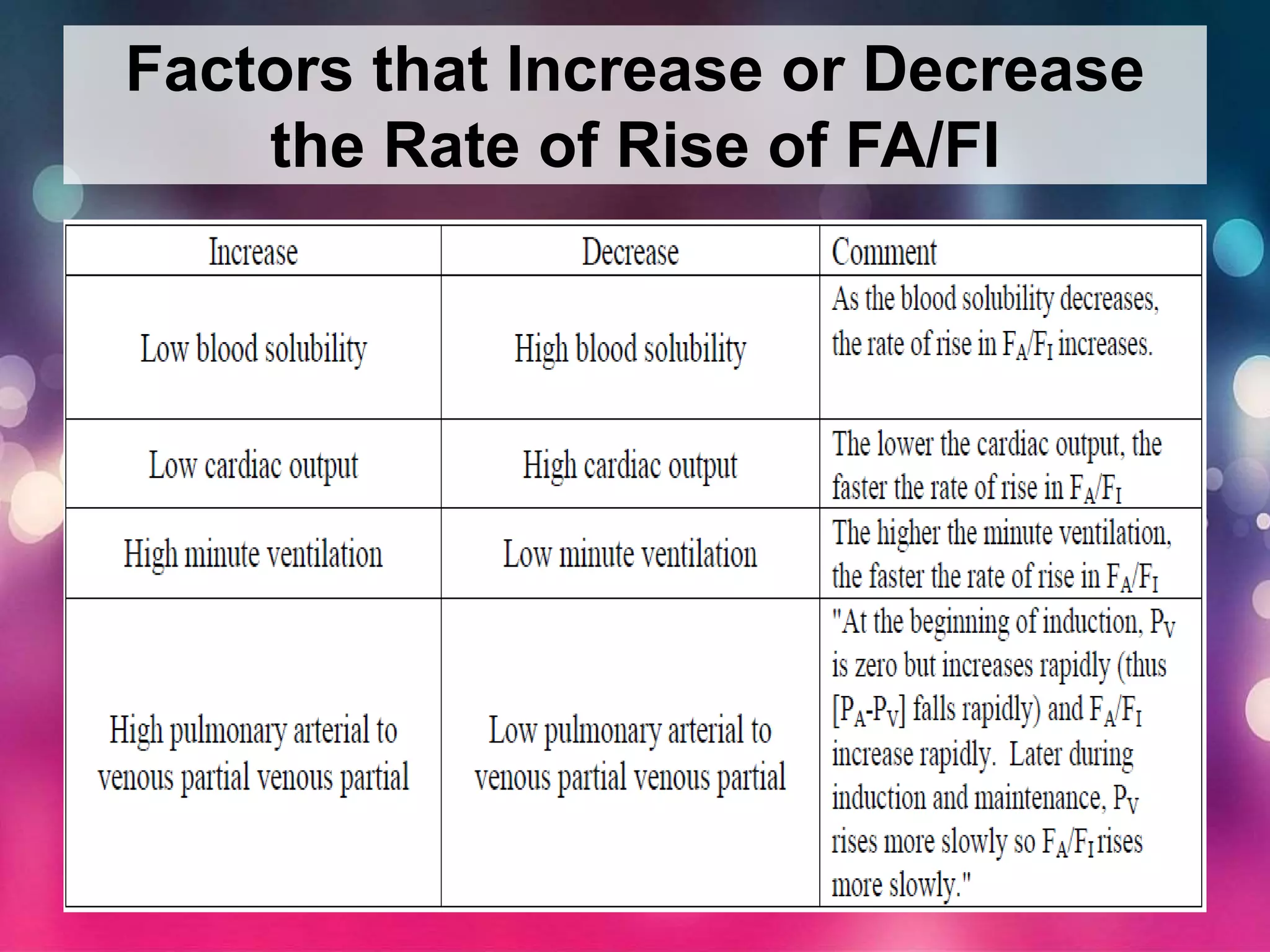
Factors that Increase or Decrease
the Rate of Rise of FA/FI
Elimination
Recovery or washout:
Expressed as FA/FA0
FA = fract of inspired conc.
FA0 = expired conc. at time 0 when anesthetic was
discontinued
Percutaneous &
visceral loss
Skin: very small
Visceral:
insignifant
Diffusion betⁿ
tissues
>4hrs: delay
emergence
(adipose tissue)
Exhalation &
Recovery
Depends on:
Solubility, C.O. &
MV
Fig: Elimination curves of low & high soluble anesthetics
• ↑solubility with longer duration, greater reservior of
anesthetic in the body (higher curve)
• This effect nearly absent with low soluble agents
Recovery from an inhalational
anesthetic
1. Increased solubility slows recovery
2. Increasing ventilation may help the
recovery from potent agents
3. Prolonged anaesthesia delays
recovery
4. There is no concentration effect on
emergence
Diffusion hypoxia or Fink effect or third gas effect
• During recovery from the anesthesia, when nitrous oxide is
discontinued – large concentration of nitrous oxide diffuses
back to the alveoli from the blood. This is due to low blood
solubility of nitrous oxide (N2O) and results in:
• Dilution of the inspired oxygen concentration and hypoxia.
• Dilution of inspired carbon-dioxide concentration and
subsequent decrease in arterial carbon dioxide
concentration leading to reduction in respiratory drive.
The risk persists only for initial 3-5 minutes of discontinuing
nitrous oxide. Therefore, it is appropriate to initiate recovery
with 100% oxygen inhalation. It is not of much consequence if
cardiopulmonary reserve is normal but may be dangerous if it
is low.
Minimal Alveolar
Concentration
(MAC)
Minimal Alveolar Concentration (MAC)
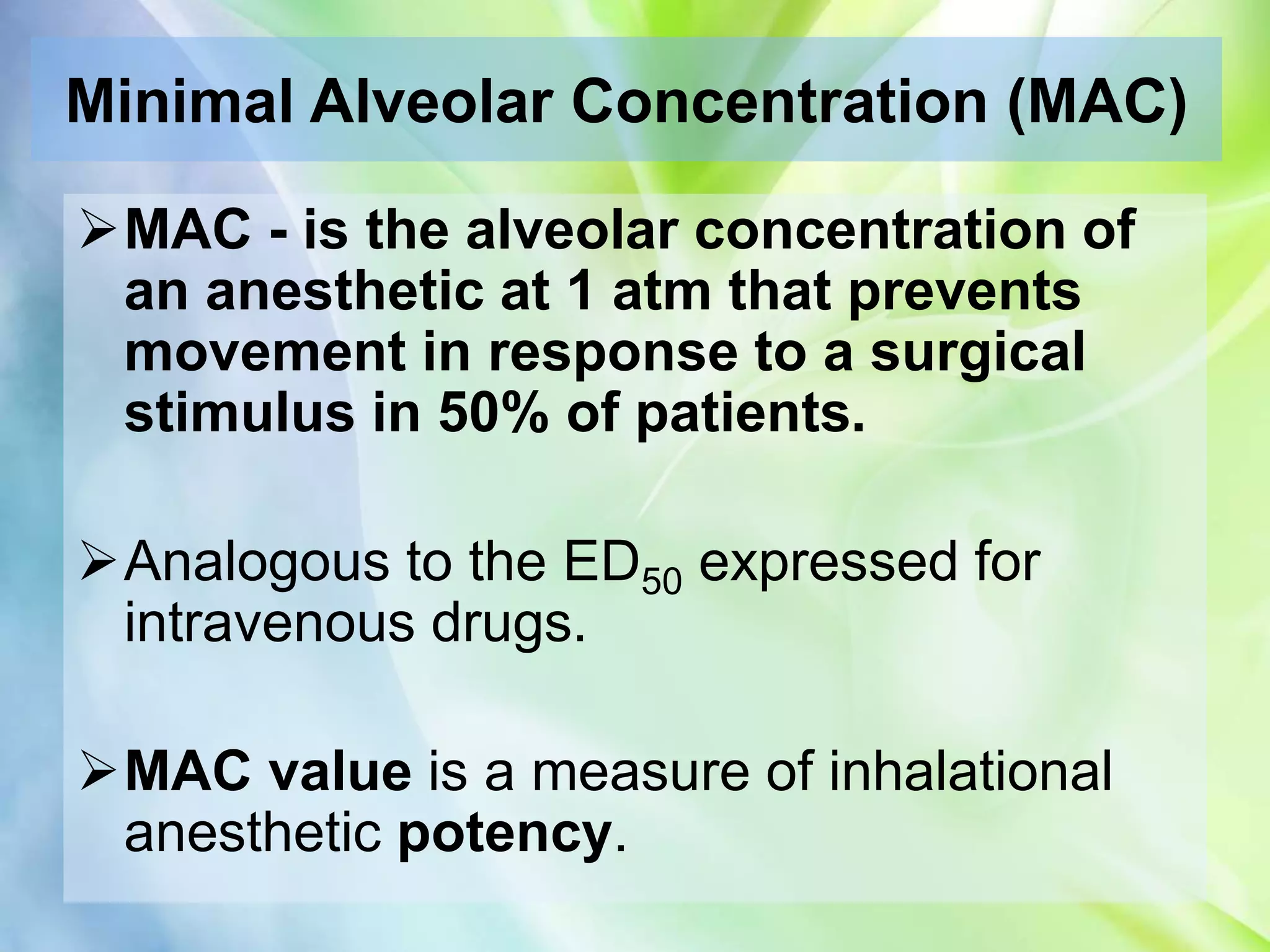
MAC - is the alveolar concentration of
an anesthetic at 1 atm that prevents
movement in response to a surgical
stimulus in 50% of patients.
Analogous to the ED50 expressed for
intravenous drugs.
MAC value is a measure of inhalational
anesthetic potency.
AGENT MAC POTENCY
Methoxy-flurane 0.16% Most potent
Halothane 0.74%
Isoflurane 1.17%
Enflurane 1.7%
Sevoflurane 2.05%
Desflurane 6.0%
Nitrous oxide 104% Least potent
The lower the MAC– the more potent the agent!
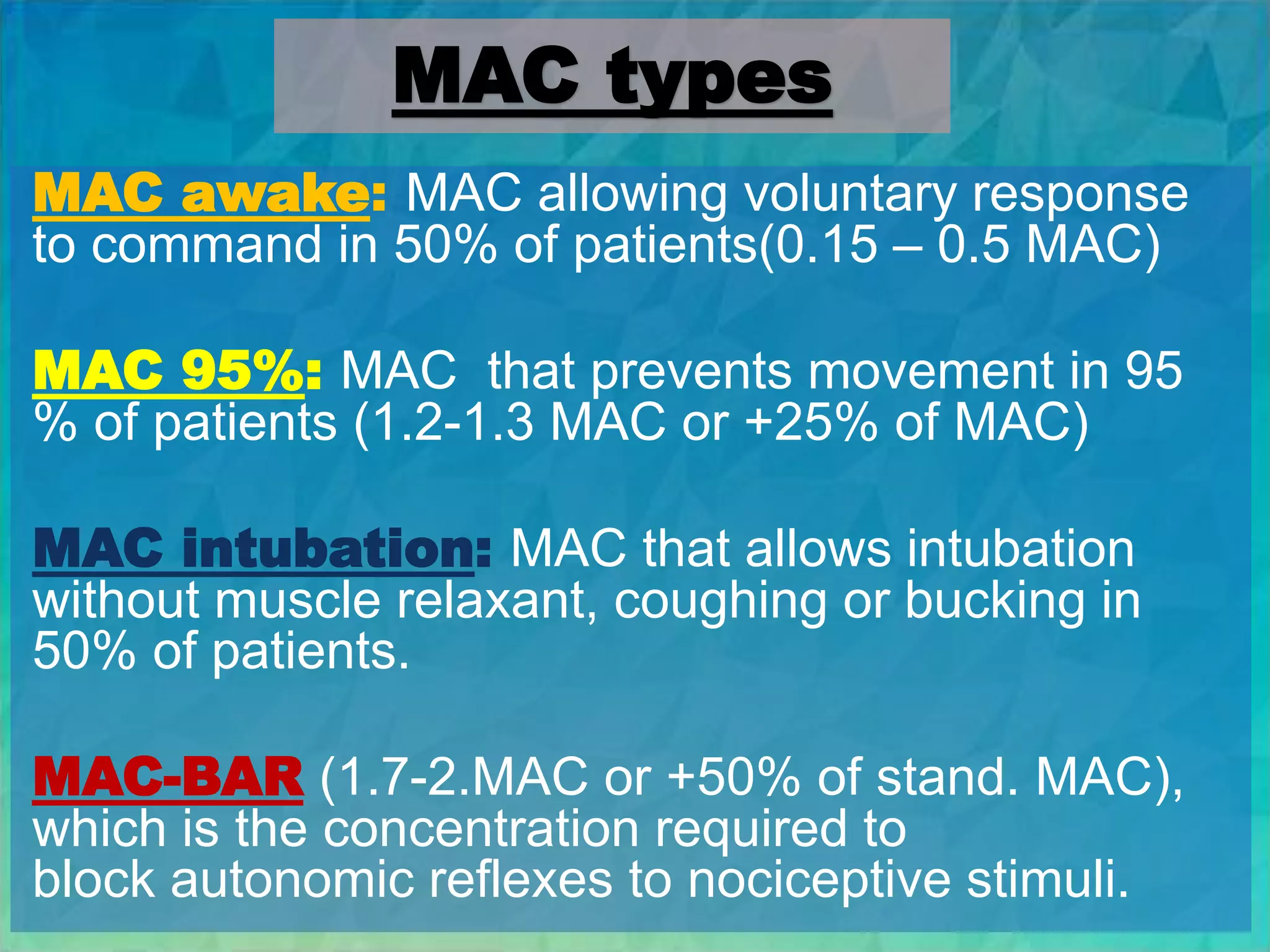
MAC types
MAC awake: MAC allowing voluntary response
to command in 50% of patients(0.15 – 0.5 MAC)
MAC 95%: MAC that prevents movement in 95
% of patients (1.2-1.3 MAC or +25% of MAC)
MAC intubation: MAC that allows intubation
without muscle relaxant, coughing or bucking in
50% of patients.
MAC-BAR (1.7-2.MAC or +50% of stand. MAC),
which is the concentration required to
block autonomic reflexes to nociceptive stimuli.
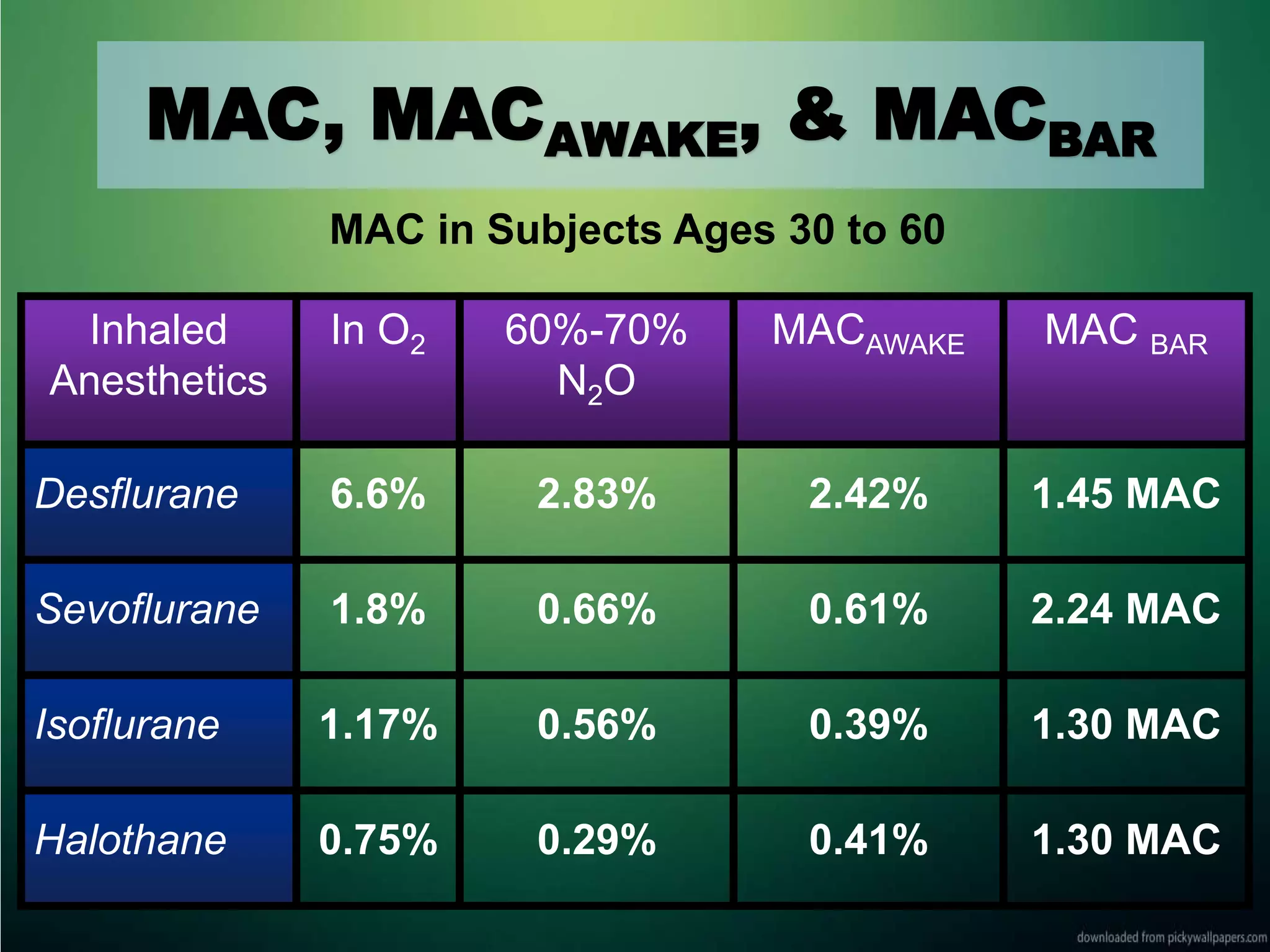
MAC, MACAWAKE, & MACBAR
MAC in Subjects Ages 30 to 60
Inhaled
Anesthetics
In O2 60%-70%
N2O
MACAWAKE MAC BAR
Desflurane 6.6% 2.83% 2.42% 1.45 MAC
Sevoflurane 1.8% 0.66% 0.61% 2.24 MAC
Isoflurane 1.17% 0.56% 0.39% 1.30 MAC
Halothane 0.75% 0.29% 0.41% 1.30 MAC
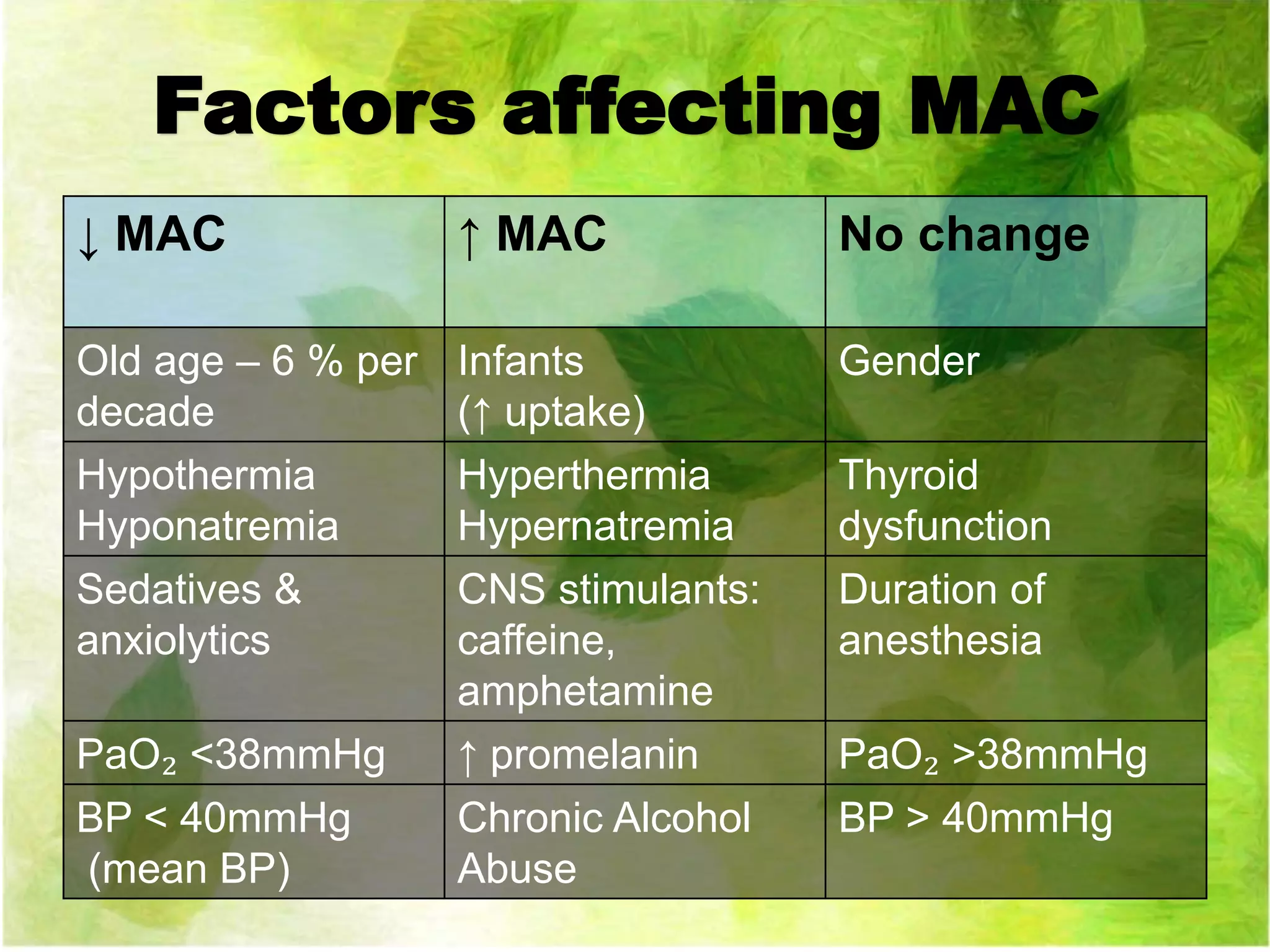
Factors affecting MAC
↓ MAC ↑ MAC No change
Old age – 6 % per
decade
Infants
(↑ uptake)
Gender
Hypothermia
Hyponatremia
Hyperthermia
Hypernatremia
Thyroid
dysfunction
Sedatives &
anxiolytics
CNS stimulants:
caffeine,
amphetamine
Duration of
anesthesia
PaO₂ <38mmHg ↑ promelanin PaO₂ >38mmHg
BP < 40mmHg
(mean BP)
Chronic Alcohol
Abuse
BP > 40mmHg
Question ?
A patient under anesthesia is
being ventilated with
. The monitor shows
the MAC value as 1.3%. How did
the monitor derive this MAC of
1.3% ?
Calculation of MAC
MAC N₂O = 104%,
Patient given 60%
N₂O
MAC Iso = 1.17%
patient given 0.8%
Iso
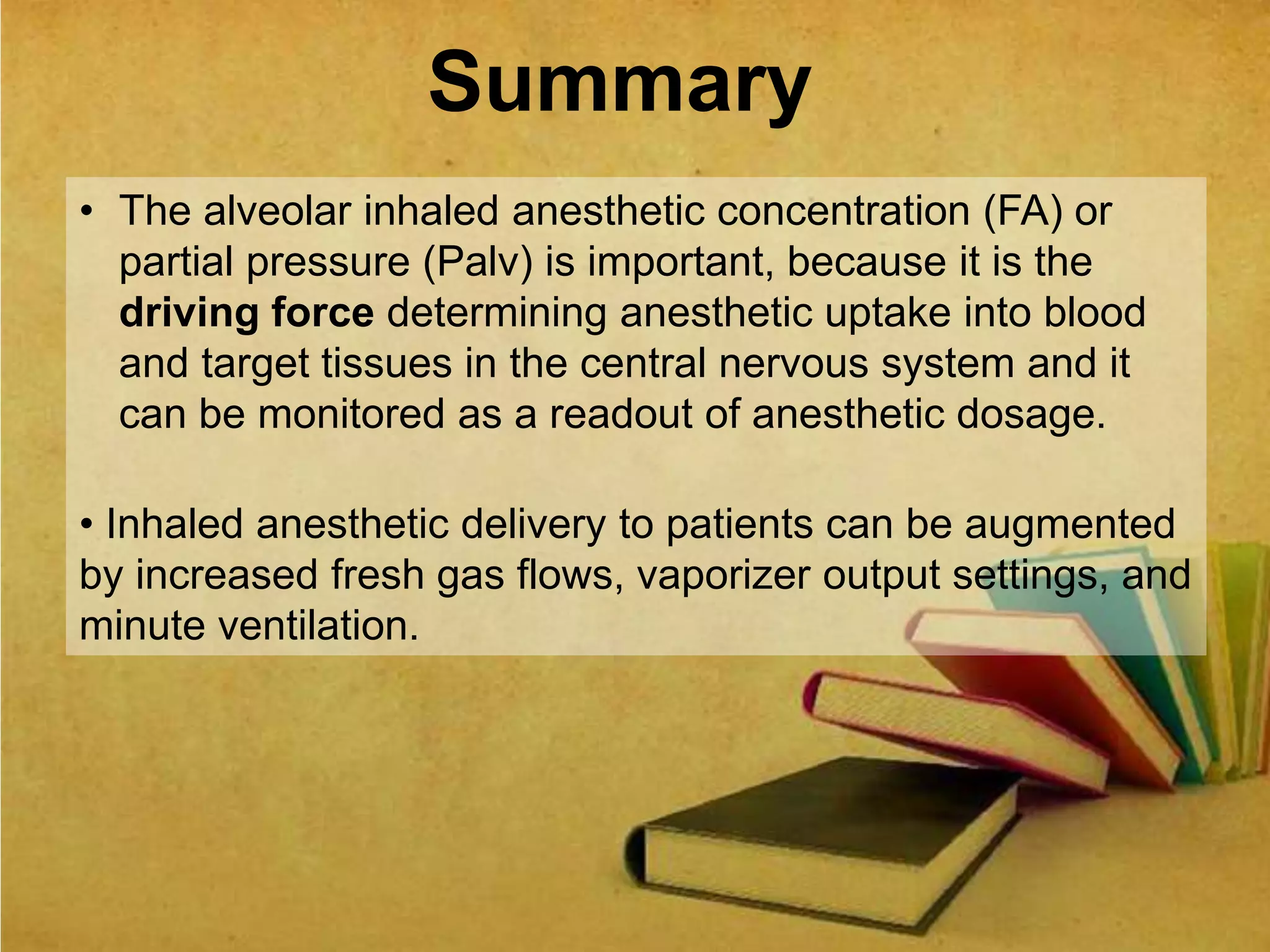
Summary
• The alveolar inhaled anesthetic concentration (FA) or
partial pressure (Palv) is important, because it is the
driving force determining anesthetic uptake into blood
and target tissues in the central nervous system and it
can be monitored as a readout of anesthetic dosage.
• Inhaled anesthetic delivery to patients can be augmented
by increased fresh gas flows, vaporizer output settings, and
minute ventilation.
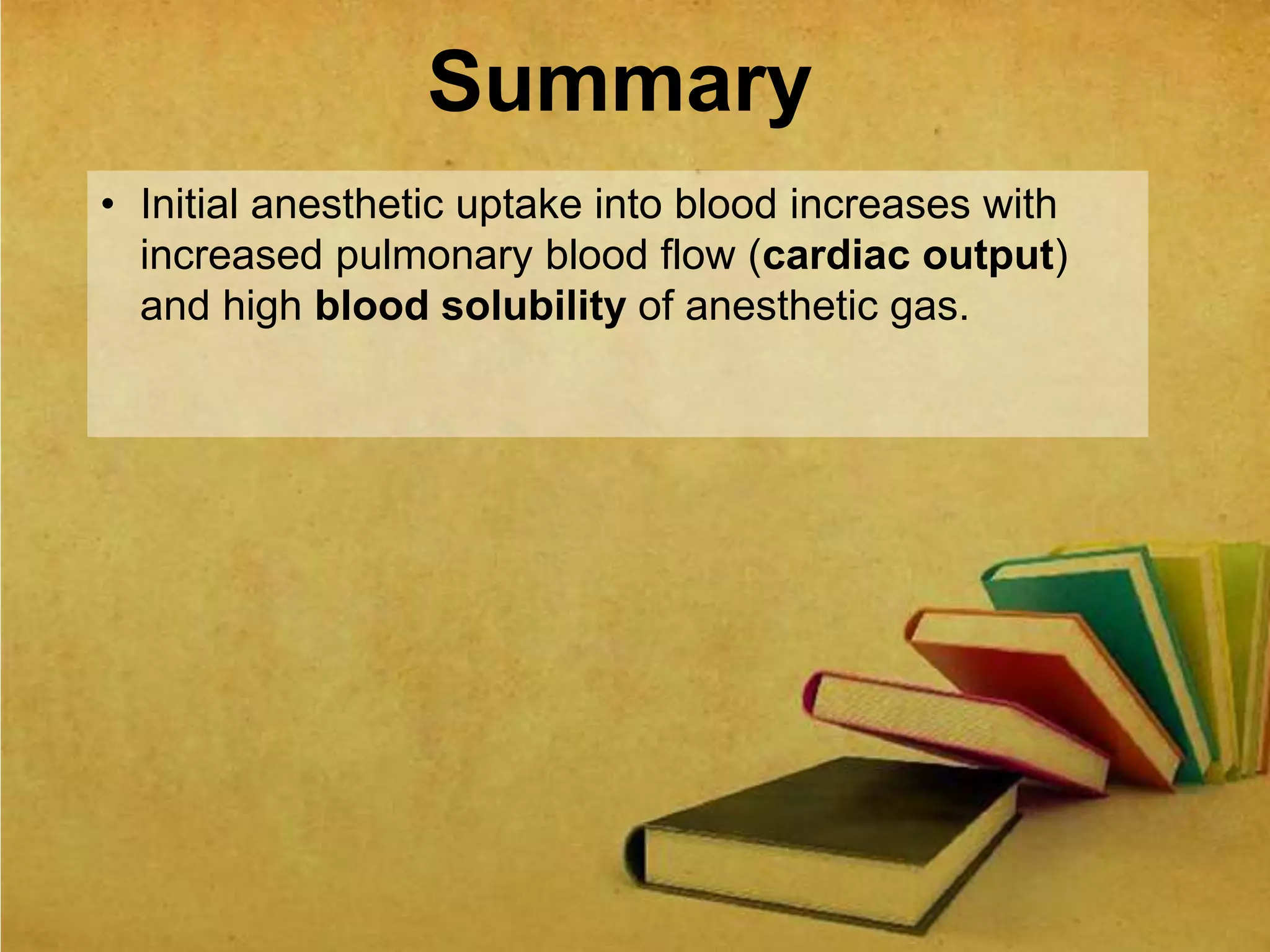
Summary
• Initial anesthetic uptake into blood increases with
increased pulmonary blood flow (cardiac output)
and high blood solubility of anesthetic gas.
Summary
• The higher the inspired anesthetic concentration, the less it then
diminishes because of uptake (the concentration effect). Changes in
alveolar volume result in a rapid initial uptake of N2O, which
sustains or increases concentrations of other alveolar gases (the
second gas effect).
• Factors that affect anesthetic uptake similarly affect pulmonary
clearance of anesthetics. Low soluble agents cause rapid induction
& rapid emergence from anesthesia
• MAC - is the alveolar concentration of an anesthetic at 1 atm that
prevents movement in response to a surgical stimulus in 50% of
patients.
• Wash out of N₂O can lower alveolar conc. of O₂ & CO₂, a
phenomenon called diffusion hypoxia
REFERENCES
• Miller RD. Miller’s Anesthesia. 8th ed.
• Paul G. Barash's Clinical anesthesia, 7th ed.
• Wylie and Churchill-Davidson's, A Practice of
Anesthesia, 7th ed.
• Morgan & Mikhail’s Clinical Anesthesiology,
5th ed.
• Stoelting RK, Stoelting'sPharmacology and
Physiology in Anesthetic Practice, 4th ed.
Uptake and distribution of inhaled anesthetic

Uptake and distribution of inhaled anesthetic

  • 1.
    Uptake and distribution of Inhalational Anesthetics -Dr.Prakash. G. Moderators: -Dr. Ashok Kumar Saxena, -Dr. Chhavi Sharma
  • 2.
    PCNS= Pblood=Palveoli GOAL “The Goal ofdelivering inhaled anaesthetics is to produce the anaesthetic state by establishing a specific concentration of anaesthetic molecules in the central nervous system (CNS)” PCNS= Pblood=Palveoli PCNS= Pblood=Palveoli
  • 5.
    • The firstreports of the use of inhalation anaesthetics such as ether (1846), chloroform (1847), and nitrous oxide (1844) began to emerge in the 1840s. • search for better inhalation agents began with fluorinated ethers and hydrocarbons • Since then halothane (1956) and enflurane (1966) have passed through common usage but have been largely replaced. • The inhalation agents used in modern practice include the nonflammable, potent hydrocarbons ; isoflurane (1969 ), sevoflurane (1981 ), and desflurane ( 1990) and the gas nitrous oxide (N2O). • The noble gas xenon has impressive anaesthetic properties, but production costs preclude its widespread use
  • 7.
  • 8.
    Inhalation anesthetics areone of the most common drugs used for GA Only a fraction of a volatile anesthetic to the inspired oxygen results in a state of unconsciousness and amnesia. When combined with intravenous adjuvants, a balanced technique is achieved Ease of administration and the clinician’s ability to reliably monitor their effects with both clinical signs and end tidal concentrations.
  • 9.
    Inhalational Anesthetic agentsmust pass through various barriers between the anesthesia machine and the brain
  • 10.
    FA MAC FD FI Ventilation FA/FI Time constant Concentration and second gaseffects λB/G CO PA - PV VRG λT/B Tissue blood flow [Parterial - PTissue] Time constant Brain Partial pressure drives depth of anesthesia Equilibrates
  • 12.
    Optimal delivery ofsystemic drugs via inhalation requires a full understanding:- • Factors influencing how gas-phase compounds move into and out of various body tissues • How they are metabolized (pharmacokinetics) • How their metabolism affect tissue functions.
  • 13.
    Theories of anestheticaction Unitary hypothesis of Narcosis (Claude Bernard 1870): postulated a common mechanism of action for anesthetic agents at molecular level. Meyer-Overton Hypothesis: a strong correlation between anaesthetic potency and solubility in olive oil, theorizing that anaesthetic agents act non-specifically on the hydrophobic, lipid components of cells (1899 - 1901) Critical volume hypothesis: Anesthetic binding expand neuronal membrane phospholipid bilayer beyond critical amount, altering membrane function.
  • 14.
    The mechanisms ofaction of inhalation anaesthetics may be subclassified as: -macroscopic (brain and spinal cord), -microscopic (synapses and axons), and -molecular (pre- and post-synaptic membranes) The mechanisms of action of inhalation anaesthetics
  • 15.
    Macroscopic • IA decreasetransmission of noxious afferent information ascending from the spinal cord to the cerebral cortex via the thalamus, thereby decreasing supraspinal arousal. • inhibition of spinal efferent neuronal activity reducing movement response to pain. • Hypnosis and amnesia, on the other hand, are mediated at the supraspinal level. Synaptic Molecular • IA inhibit excitatory presynaptic channel activity mediated by neuronal nicotinic, serotonergic, and glutaminergic receptors. • IA augment the inhibitory post-synaptic channel activity mediated by GABA(A) and glycine receptors. • The combined effect is to reduce neuronal and synaptic transmission. • IA prolong the GABAA receptor-mediated inhibitory Cl2 current, thereby inhibiting post-synaptic neuronal excitability. • IA enhance the activity of two-pore domain potassium channels, leading to hyperpolarization of the plasma membrane, thereby influencing the likelihood of neuronal action potential generation and potentially explaining their anaesthetic effects
  • 16.
  • 17.
    Factors affecting theuptake and release of inhalation anaesthetic agents • Alveolar concentration of inhalation agents – Inspired concentration • Fresh gas flow • Breathing system volume • Circuit absorption. – Alveolar ventilation – Functional residual capacity • Drug uptake from the lungs Solubility (blood–gas partition coefficient) Pulmonary alveolar blood flow (cardiac output) Alveolar–venous partial pressure gradient Second gas effect
  • 18.
    Factors Affecting Inspiredgas concentration (Fi) 1) Fresh Gas Flow rate: ↑ FGF → ↑ speed of induction & recovery. 2) Volume of breathing circuit (apparatus dead space): increase ↑volume → slower induction (dilution of anesthetic gases.) 3) Absorption by the breathing circuit: rubber tubing absorbs ˃ plastic & silicon.
  • 19.
    Alveolar ventilation: Increasedalveolar ventilation results in faster increase in alveolar partial pressure by constantly replacing the inhalation agent taken up by the pulmonary blood flow. Functional residual capacity (FRC): A larger FRC dilutes the inspired concentration of gas resulting initially in a lower alveolar partial pressure and therefore slower onset of anaesthesia.
  • 20.
    Fresh Gas flow& Time Constant ( ṯ )
  • 21.
    Concentration in thecircuit (FI) will rise according to first-order kinetics: Fi = FFGO ( 1 - e -T/ṯ ) Where:- FFGO - is the fraction of inspired anesthetic in the gas leaving the fresh gas outlet (the vapourizer setting) T - is time. ṯ - is a time constant.
  • 22.
    The time requiredfor flow through a container to equal the capacity of the container. The time constant ( ṯ ) ṯ = Volume (capacity) / flow The time constant for the lungs is ṯ = FRC/Valveolar.  The time constant for the anesthesia circuit is ṯ = Circuit capacity/FGF.
  • 23.
    The time constant- example  If 10 liter box is initially filled with oxygen and 5 l/min of nitrogen flow into box then,  TC is volume (capacity)/flow.  TC = 10 / 5 = 2 minutes ( 1 Time Constant)  So, the nitrogen concentration at end of 2 minutes is 63%. O2 10 Lt 5 Lt/min 2 Mts 4 Mts 6 Mts 8 Mts 63% 86% 95% 98% N2 Time Constant at Lungs
  • 24.
    Factors affecting alveolar concentration(FA) 1.Uptake 2.Ventilation 3.Concentration effect & Second Gas effect
  • 25.
  • 26.
    If no uptake: FA would rapidly approach Fi. But, anesthetic are taken up by pulmonary circulation FA < Fi FA/ Fi < 1.0 Factors affecting uptake: a) Solubility (Partition Coefficient, λ) b) Cardiac output (Q) c) Alveolar-to - Venous partial pressure diff (PA- PV) U Lung = λB/G x Q x (PA-Pvenous) Barometric pressure
  • 27.
     Solubility isdefined in terms of the partition coefficient  Partition coefficient is the ratio of the amount of substance present in one phase compared with another, the two phases being of equal volume and in equilibrium  [λB/G = CB /CG ] Solubility Capacity of blood & tissue longer it takes to saturate at given rate Slower the rate of rise of FA/ Fi
  • 28.
    Partition coefficients at37˚C Agent blood-gas brain-blood muscle-blood fat-blood N2O 0.47 1.1 1.2 2.3 Halothane 2.5 1.9 3.4 51 Isoflurane 1.4 1.6 2.9 45 Desflurane 0.45 1.3 2.0 27 Sevoflurane 0.65 1.7 3.1 48 λb/g Isoflurane 1.4: at equilibrium ( Partial Pressure) the conc. of Isoflurane in blood is 1.4 times its conc. in gas (alveolar) phase. or Each ml of blood holds 1.4 times as much Isoflurane as 1 ml of alveolar gas does. *Do not indicate partial pressure in blood is 1.4 times that in alveoli
  • 29.
    No net diffusionwhen partial pressures are equal. Isoflurane blood / gas partition coefficient = 1.4 Blood has 14 molecules of Isoflurane/ml Gas has 10 molecules of Isoflurane/ml
  • 30.
  • 31.
    c) Alveolar-to-venous partialpressure diff. (PA - PV)  Gradient depends on tissue uptake  Tissue uptake depends on tissue solubility, tissue blood flow, partial pressure diff betⁿ arterial blood & tissue Characteristics Vessel rich group Muscle Fat % of body wt. 10 50 25 % of C.O. 75 19 6 Perfusion (ml/min/100g) 75 3 3 Relative solubility 1 1 20
  • 32.
    Vessel rich group(VRG): • Brain, heart, liver, kidney & spinal cord • Perfusion is 75ml/min/100gm. • Small vol. of tissue (10% of body mass) relative to perfusion (75% of C.O) • Time constant for anesthetic equilibration between these organs, only few minutes Muscle group: • Next compartment to equilibrate • 40% of body mass ( perfusion is 3ml/min/100gm) • 10-15% of CO, so uptake is slower
  • 33.
    Fat group: • 25%of body mass with 6% C.O. • Perfused lesser extent than muscle, equilibration with blood is slower ( increased solubility) • Fat equilibrates slowly with blood, no significant role in induction • Prolonged anesthesia (>4hrs), ↑ saturation of fat leads to delayed emergence Vessel poor group: • Cortical bone, connective tissue • Insignificant uptake
  • 34.
    Factors affecting alveolar concentration(FA) 1.Uptake 2.Ventilation 3.Concentration effect & Second Gas effect
  • 35.
  • 36.
    Factors affecting alveolar concentration(FA) 1.Uptake 2.Ventilation 3.Concentration effect & Second Gas effect
  • 37.
    Concentration effect Increasing theinspired conc. (Fi) ↑ alveolar conc. (FA) ↑rate of rise (FA/Fi) Due to 2 phenomenon: I. Concentrating effect & II. Augmented gas inflow effect
  • 38.
     A higherinspired concentration results in a disproportionately higher alveolar concentration. this effect is called as the concentrating effect  the higher the Fi greater the effect.  As nitrous oxide can be used in much higher concentrations as compared with the other volatile anesthetics, the concentration effect is more significant with N2O.  The second phenomenon responsible for the concentration effect is the augmented inflow effect. where more gas is brought in to the lungs to replace the lost volume of the gas taken up. thereby augmenting FA and Eventually ↑FA/ Fi The concentration effect
  • 39.
    • A highconcentration of nitrous oxide will augment not only its own uptake, but theoretically that of a concurrently administered volatile anaesthetic. • the concentration effect of one gas upon another is called the second gas effect. (applies to the effects of nitrous oxide on the uptake of another gas): • Analogous to the concentration effect, but relates instead to the use of a potent agent concurrently with a second gas present in large quantity (usually nitrous oxide.) The second gas effect
  • 40.
    The second gaseffect........ The higher the inspired concentration of the second gas (nitrous oxide), the more rapid the rise in alveolar concentration. Explanations: – a. The concentrating effect: As the second gas (nitrous) is taken up in significant volumes, all remaining gases (including the potent agent, which is the "first" gas) are concentrated in the remaining volume. – b. The ventilation effect: As the second gas is taken up in significant volumes, additional fresh gas in brought into the lungs. This increases Valveolar, which increases the rate of rise of anesthetic concentration.
  • 42.
    Factors affecting Fa •Normally FA & Fa assumed to be equal • But Fa< FA due to : Venous admixture Alveolar dead space Non-uniform alveolar gas distribution V/Q mismatch
  • 43.
    Factors that Increaseor Decrease the Rate of Rise of FA/FI
  • 44.
    Elimination Recovery or washout: Expressedas FA/FA0 FA = fract of inspired conc. FA0 = expired conc. at time 0 when anesthetic was discontinued Percutaneous & visceral loss Skin: very small Visceral: insignifant Diffusion betⁿ tissues >4hrs: delay emergence (adipose tissue) Exhalation & Recovery Depends on: Solubility, C.O. & MV
  • 45.
    Fig: Elimination curvesof low & high soluble anesthetics • ↑solubility with longer duration, greater reservior of anesthetic in the body (higher curve) • This effect nearly absent with low soluble agents
  • 46.
    Recovery from aninhalational anesthetic 1. Increased solubility slows recovery 2. Increasing ventilation may help the recovery from potent agents 3. Prolonged anaesthesia delays recovery 4. There is no concentration effect on emergence
  • 47.
    Diffusion hypoxia orFink effect or third gas effect • During recovery from the anesthesia, when nitrous oxide is discontinued – large concentration of nitrous oxide diffuses back to the alveoli from the blood. This is due to low blood solubility of nitrous oxide (N2O) and results in: • Dilution of the inspired oxygen concentration and hypoxia. • Dilution of inspired carbon-dioxide concentration and subsequent decrease in arterial carbon dioxide concentration leading to reduction in respiratory drive. The risk persists only for initial 3-5 minutes of discontinuing nitrous oxide. Therefore, it is appropriate to initiate recovery with 100% oxygen inhalation. It is not of much consequence if cardiopulmonary reserve is normal but may be dangerous if it is low.
  • 48.
  • 49.
    Minimal Alveolar Concentration(MAC) MAC - is the alveolar concentration of an anesthetic at 1 atm that prevents movement in response to a surgical stimulus in 50% of patients. Analogous to the ED50 expressed for intravenous drugs. MAC value is a measure of inhalational anesthetic potency.
  • 50.
    AGENT MAC POTENCY Methoxy-flurane0.16% Most potent Halothane 0.74% Isoflurane 1.17% Enflurane 1.7% Sevoflurane 2.05% Desflurane 6.0% Nitrous oxide 104% Least potent The lower the MAC– the more potent the agent!
  • 51.
    MAC types MAC awake:MAC allowing voluntary response to command in 50% of patients(0.15 – 0.5 MAC) MAC 95%: MAC that prevents movement in 95 % of patients (1.2-1.3 MAC or +25% of MAC) MAC intubation: MAC that allows intubation without muscle relaxant, coughing or bucking in 50% of patients. MAC-BAR (1.7-2.MAC or +50% of stand. MAC), which is the concentration required to block autonomic reflexes to nociceptive stimuli.
  • 52.
    MAC, MACAWAKE, &MACBAR MAC in Subjects Ages 30 to 60 Inhaled Anesthetics In O2 60%-70% N2O MACAWAKE MAC BAR Desflurane 6.6% 2.83% 2.42% 1.45 MAC Sevoflurane 1.8% 0.66% 0.61% 2.24 MAC Isoflurane 1.17% 0.56% 0.39% 1.30 MAC Halothane 0.75% 0.29% 0.41% 1.30 MAC
  • 53.
    Factors affecting MAC ↓MAC ↑ MAC No change Old age – 6 % per decade Infants (↑ uptake) Gender Hypothermia Hyponatremia Hyperthermia Hypernatremia Thyroid dysfunction Sedatives & anxiolytics CNS stimulants: caffeine, amphetamine Duration of anesthesia PaO₂ <38mmHg ↑ promelanin PaO₂ >38mmHg BP < 40mmHg (mean BP) Chronic Alcohol Abuse BP > 40mmHg
  • 54.
    Question ? A patientunder anesthesia is being ventilated with . The monitor shows the MAC value as 1.3%. How did the monitor derive this MAC of 1.3% ?
  • 55.
    Calculation of MAC MACN₂O = 104%, Patient given 60% N₂O MAC Iso = 1.17% patient given 0.8% Iso
  • 57.
    Summary • The alveolarinhaled anesthetic concentration (FA) or partial pressure (Palv) is important, because it is the driving force determining anesthetic uptake into blood and target tissues in the central nervous system and it can be monitored as a readout of anesthetic dosage. • Inhaled anesthetic delivery to patients can be augmented by increased fresh gas flows, vaporizer output settings, and minute ventilation.
  • 58.
    Summary • Initial anestheticuptake into blood increases with increased pulmonary blood flow (cardiac output) and high blood solubility of anesthetic gas.
  • 59.
    Summary • The higherthe inspired anesthetic concentration, the less it then diminishes because of uptake (the concentration effect). Changes in alveolar volume result in a rapid initial uptake of N2O, which sustains or increases concentrations of other alveolar gases (the second gas effect). • Factors that affect anesthetic uptake similarly affect pulmonary clearance of anesthetics. Low soluble agents cause rapid induction & rapid emergence from anesthesia • MAC - is the alveolar concentration of an anesthetic at 1 atm that prevents movement in response to a surgical stimulus in 50% of patients. • Wash out of N₂O can lower alveolar conc. of O₂ & CO₂, a phenomenon called diffusion hypoxia
  • 60.
    REFERENCES • Miller RD.Miller’s Anesthesia. 8th ed. • Paul G. Barash's Clinical anesthesia, 7th ed. • Wylie and Churchill-Davidson's, A Practice of Anesthesia, 7th ed. • Morgan & Mikhail’s Clinical Anesthesiology, 5th ed. • Stoelting RK, Stoelting'sPharmacology and Physiology in Anesthetic Practice, 4th ed.