Neurophysiology and
anaesthesia
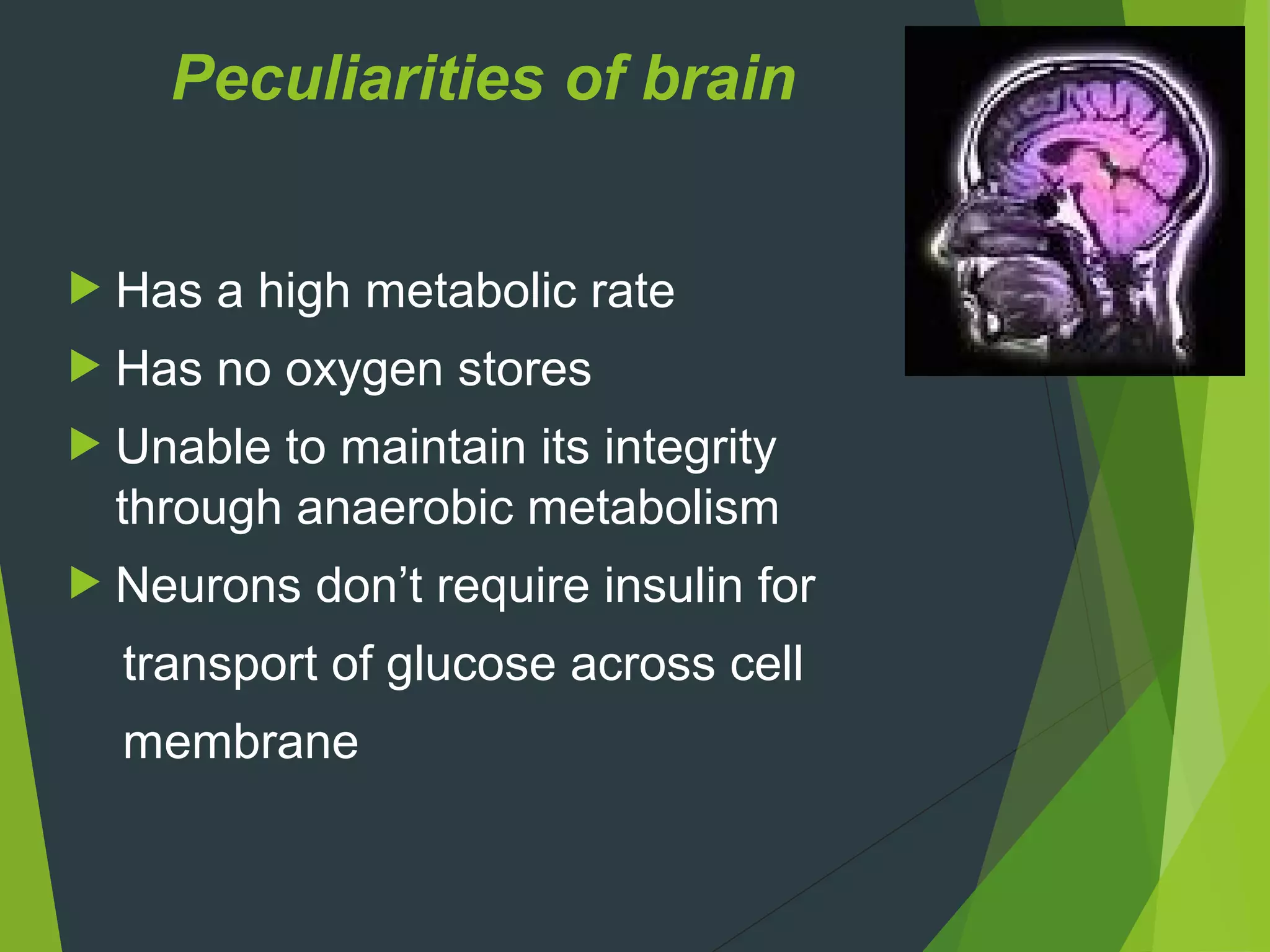
Peculiarities of brain
 Has a high metabolic rate
 Has no oxygen stores
 Unable to maintain its integrity
through anaerobic metabolism
 Neurons don’t require insulin for
transport of glucose across cell
membrane
Neurophysiology
 2% of body weight
 17%-20% of Cardiac output consumption at rest
 20% of inspired oxygen
 60% - for neuronal activity
 40% - to maintain cellular integrity
 CMR / CMRO2 - 3-3.8ml/100g/min
 50ml/min
 Cerebral glucose consumption - 5mg/100g/min
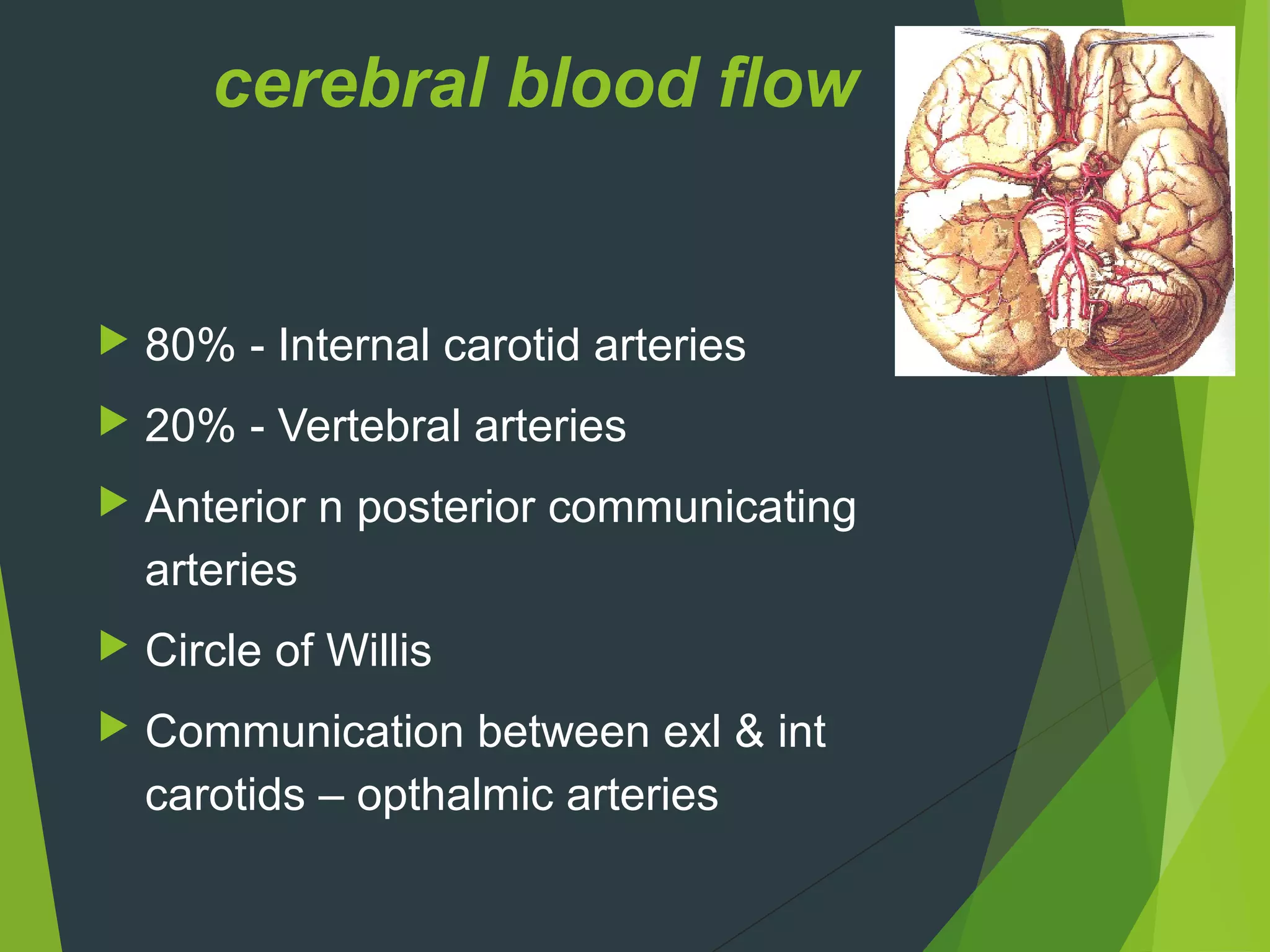
cerebral blood flow
 80% - Internal carotid arteries
 20% - Vertebral arteries
 Anterior n posterior communicating
arteries
 Circle of Willis
 Communication between exl & int
carotids – opthalmic arteries
Circle of willis
Physiology of CBF
 Parallels with metabolic activity
 Can vary from 10 – 300 ml/100g/min
 Average – 50ml/100g/min
 Gray matter – 80ml/100g/min
 White matter- 20ml/100g/min
 Total CBF- averages 750ml/min
 < 20-25ml/100g/min- ischemia
Cerebral blood flow
 Flow rates below 20-25ml/100g/min
slowing of EEG.
 Flow rates between 15-20ml/100g/min
flattening of EEG.
 Flow rates below 10ml/100g/min
irreversible brain damage.
FACTORS CONTROLLING CBF
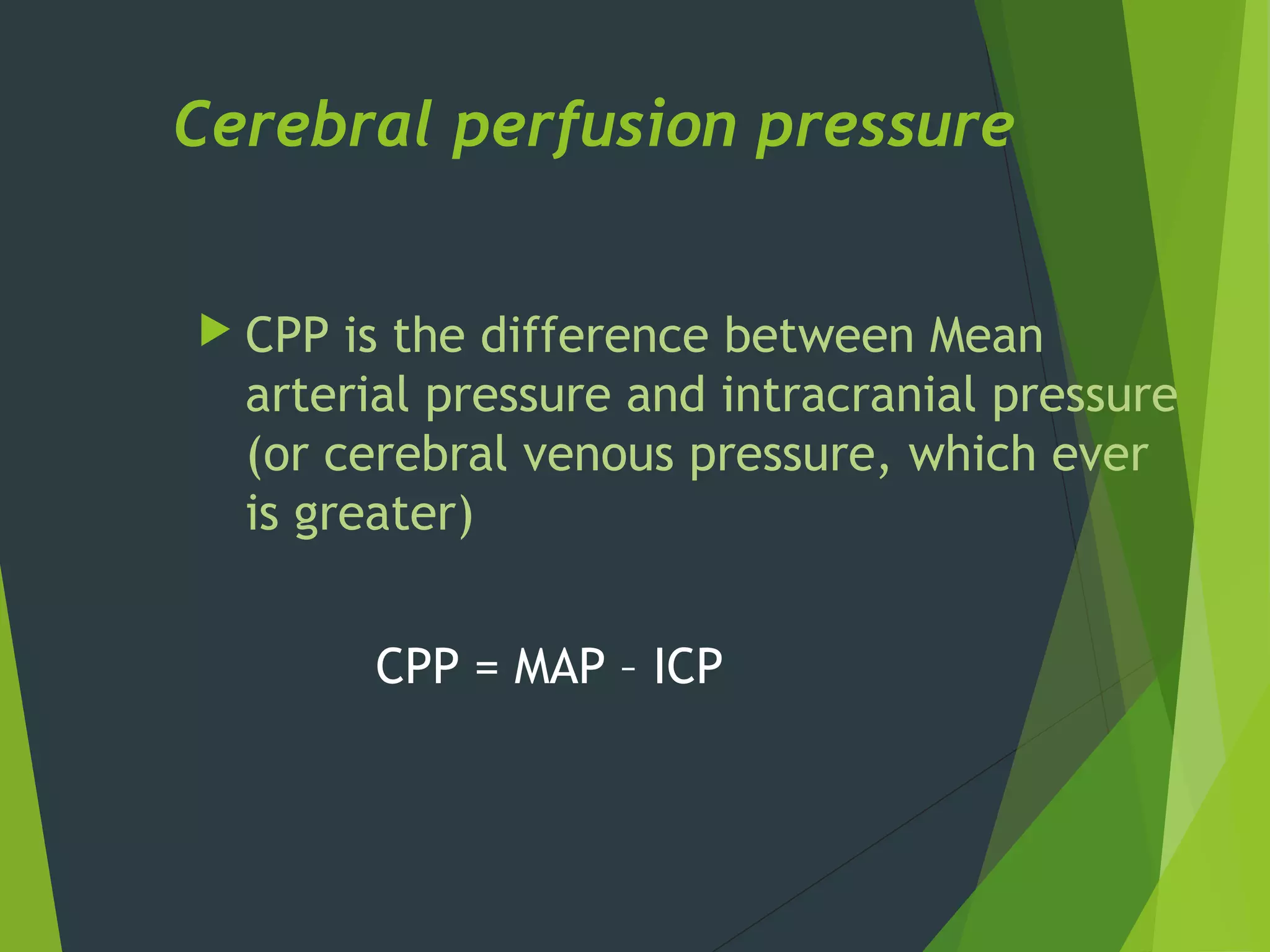
Cerebral perfusion pressure
 CPP is the difference between Mean
arterial pressure and intracranial pressure
(or cerebral venous pressure, which ever
is greater)
CPP = MAP – ICP
CPP = MAP - ICP
 Normal CPP – 80 to 100mmHg
 More dependent on MAP
 ICP > 30mmHg compromise CPP
 CPP
 < 50mmHg – slowing of EEG
 25 – 40 mmHg – flat EEG
 < 25 mmHg – irreversible brain damage
Cerebral auto regulation
Ability of the cerebral blood vessels to
alter their caliber in order to maintain a
constant flow in face of variations in
blood pressure
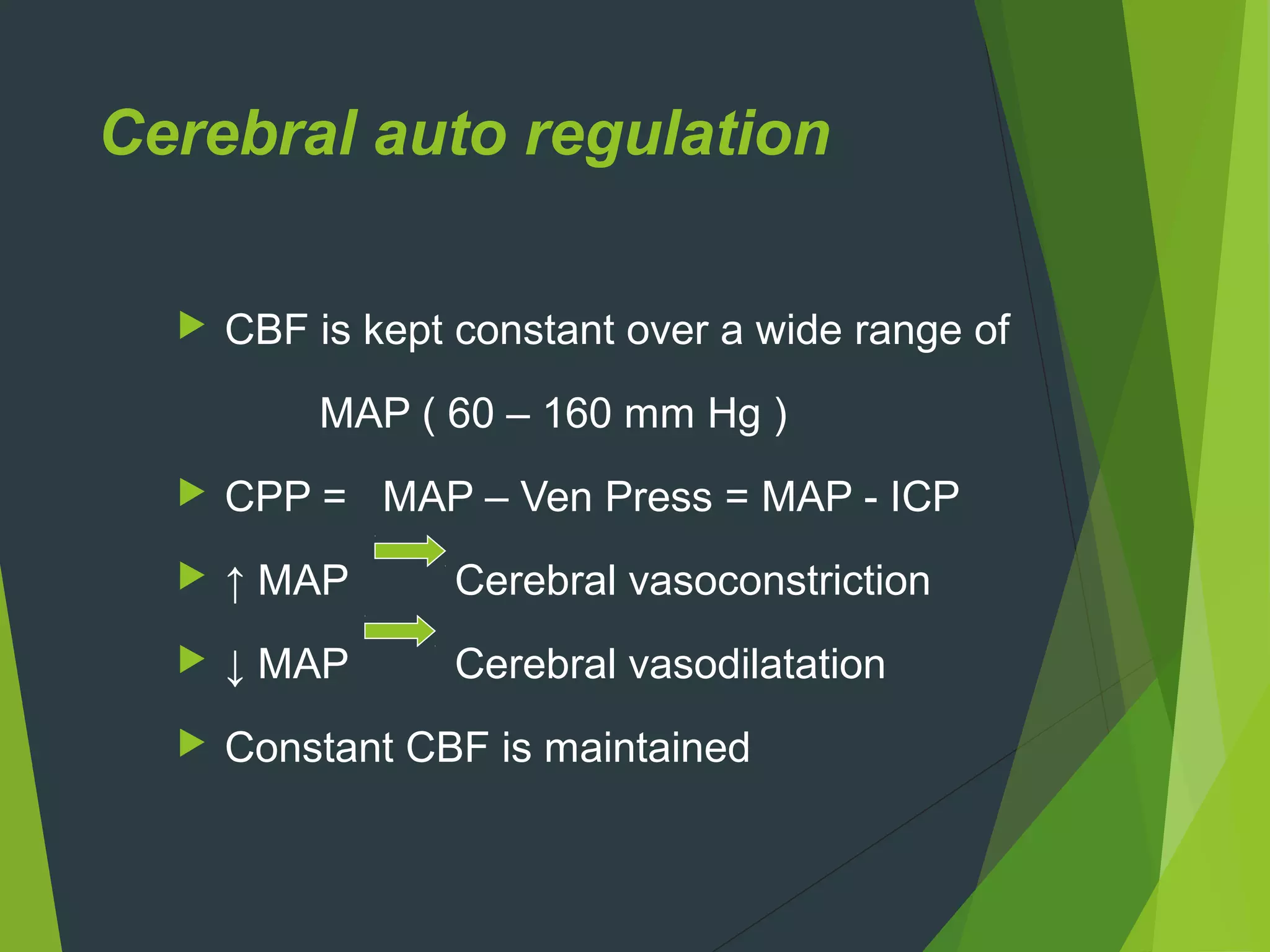
Cerebral auto regulation
 CBF is kept constant over a wide range of
MAP ( 60 – 160 mm Hg )
 CPP = MAP – Ven Press = MAP - ICP
 ↑ MAP Cerebral vasoconstriction
 ↓ MAP Cerebral vasodilatation
 Constant CBF is maintained
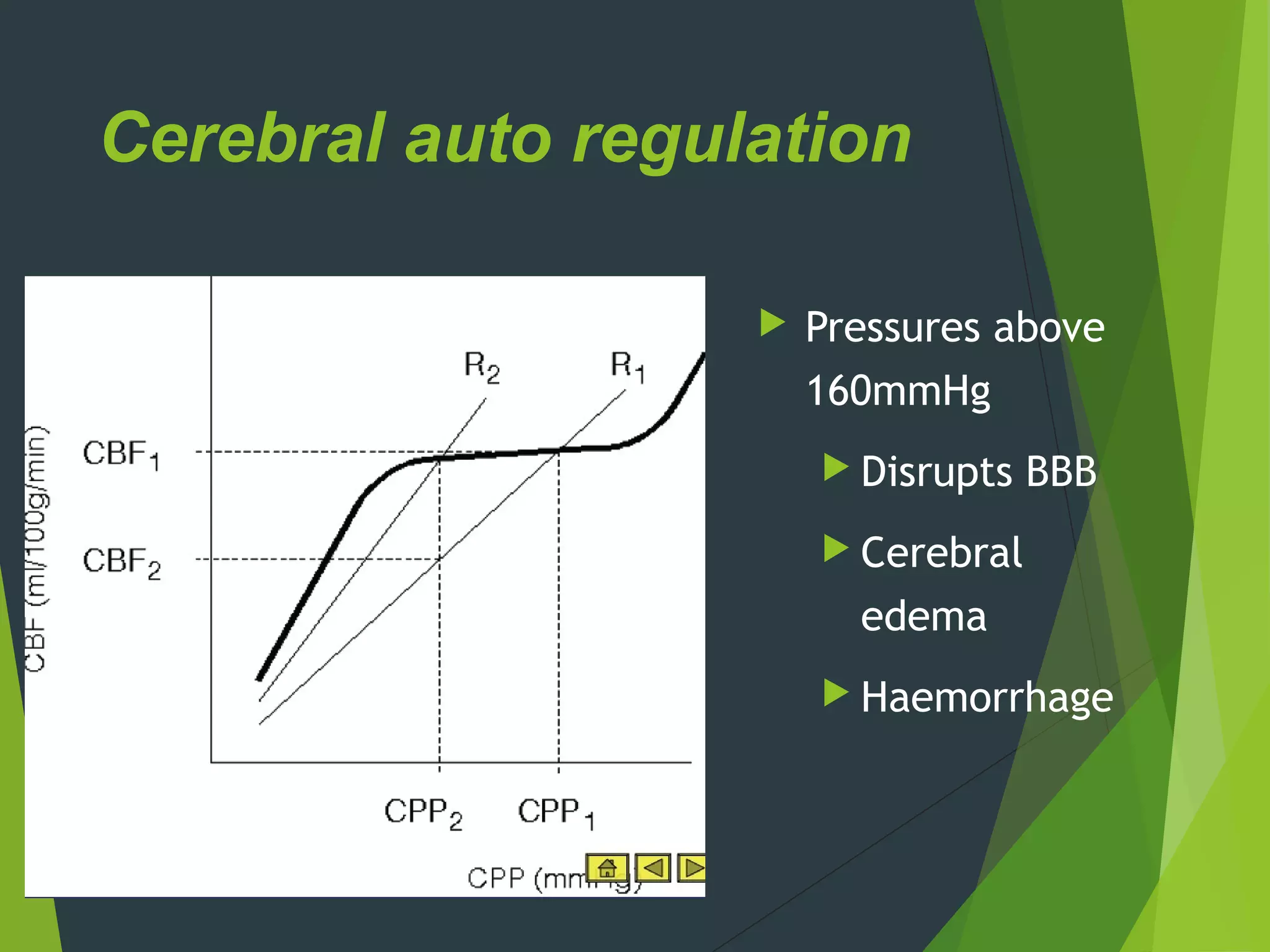
Cerebral auto regulation
 graph  Pressures above
160mmHg
 Disrupts BBB
 Cerebral
edema
 Haemorrhage
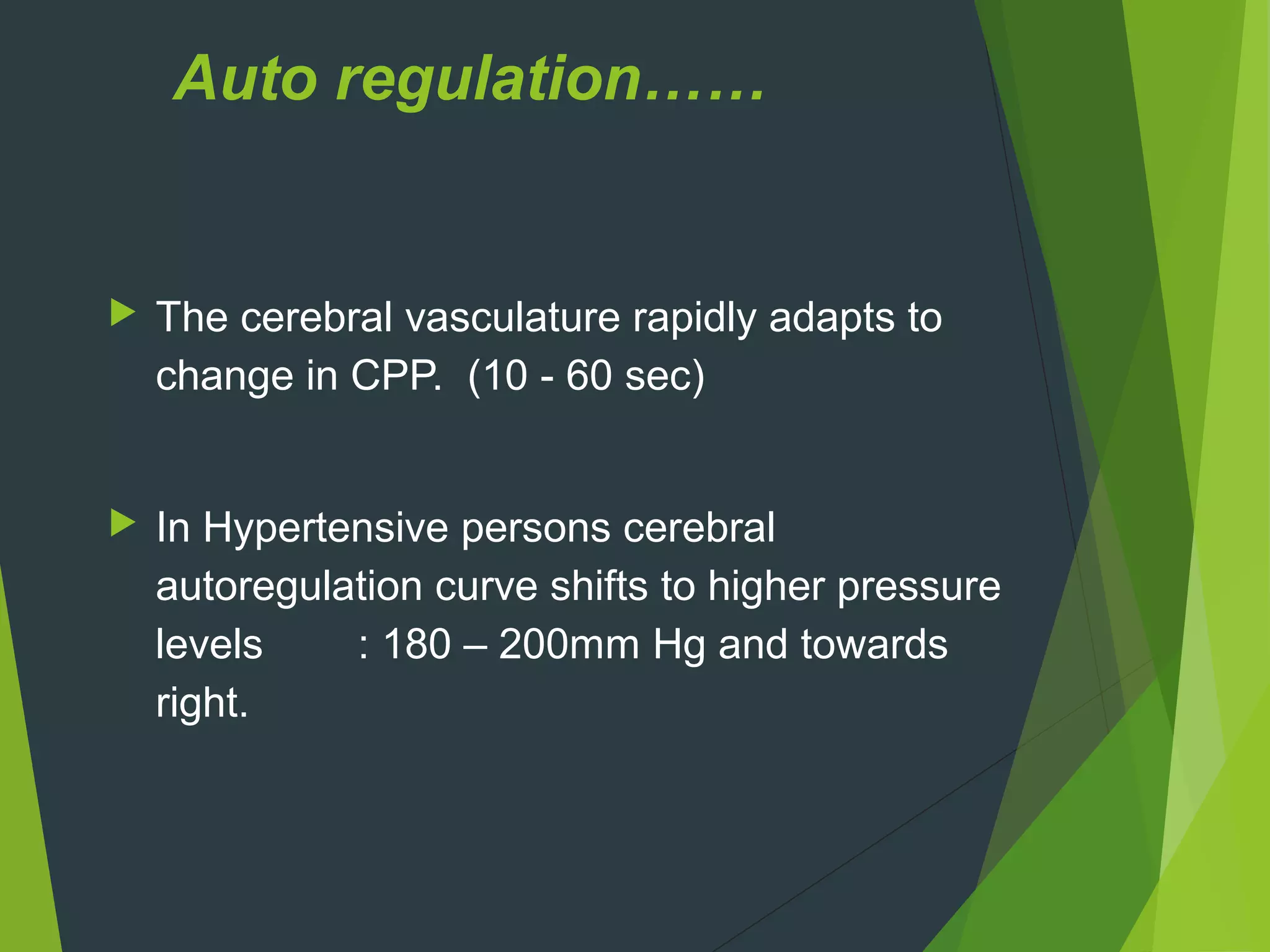
Auto regulation……
 The cerebral vasculature rapidly adapts to
change in CPP. (10 - 60 sec)
 In Hypertensive persons cerebral
autoregulation curve shifts to higher pressure
levels : 180 – 200mm Hg and towards
right.
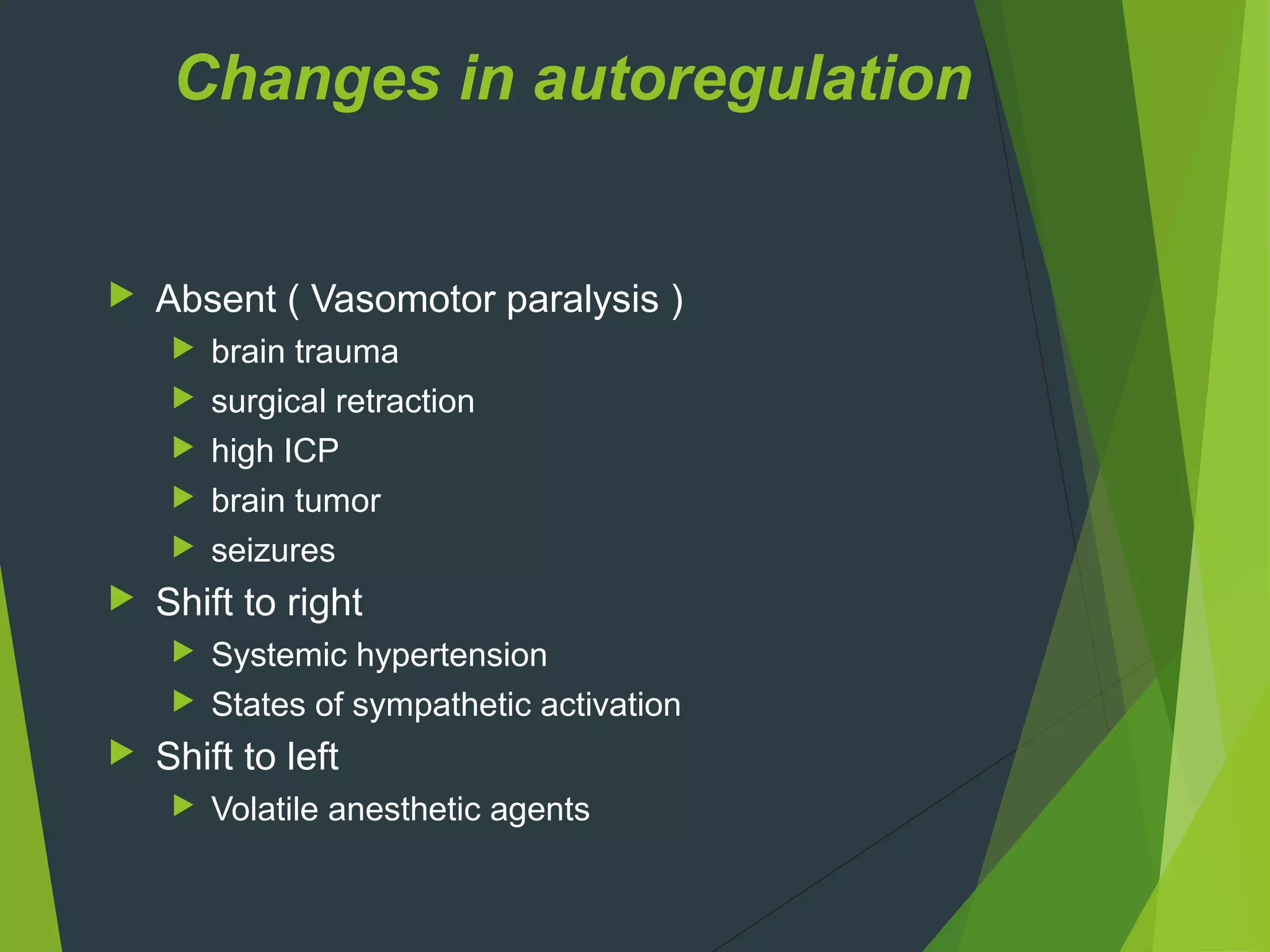
Changes in autoregulation
 Absent ( Vasomotor paralysis )
 brain trauma
 surgical retraction
 high ICP
 brain tumor
 seizures
 Shift to right
 Systemic hypertension
 States of sympathetic activation
 Shift to left
 Volatile anesthetic agents
FACTORS CONTROLLING CBF
 Intrinsic factors
 Myogenic
Regulation
 Metabolic
Regulation
 Neuronal
Regulation
 Hormonal
regulation
 Extrinsic factors
 Respiratory gas
 Arterial BP
 Hematocrit
 Temperature
Myogenic factors
 Is the intrinsic response of
smooth muscle cells in cerebral
arterioles to changes in MAP
 Protective mechanism against
excessive pressure fluctuation
at capillary level
Metabolic regulation
 Hydrogen ions
 potassium
 adenosine
 prostanoids
 ↑ CO2
 ↑ H+
 ↑ K+
 ↑ Adenosine
 EDRF / Nitric Oxide
Innervation
 The sympathetic fibers arise mainly from the
superior cervical ganglion
 The parasympathetic from the sphenopalatine
and otic ganglia
 Sensory fibers from the trigeminal ganglion
Neuronal regulation
 α-Adrenergic receptors in arterial smooth muscle
 Postganglionic sympathetic fibers release
noradrenaline
 Causes smooth muscle contraction and
arterial constriction
 Sympathetic innervation is responsible for
vascular tone
Sympathetic
 Large & Medium sized arteries
normally overridden by autoregulation
 Historically thought to have no role in cerebral
circulation
 Comes into play in states of excessive circulatory
activity / pathologic states
 Role in prevention of cerebral haemorrhage –
cerebral vasospasm
Hormonal regulation
 Adrenaline
 Vasopressin
 Angiotensin II
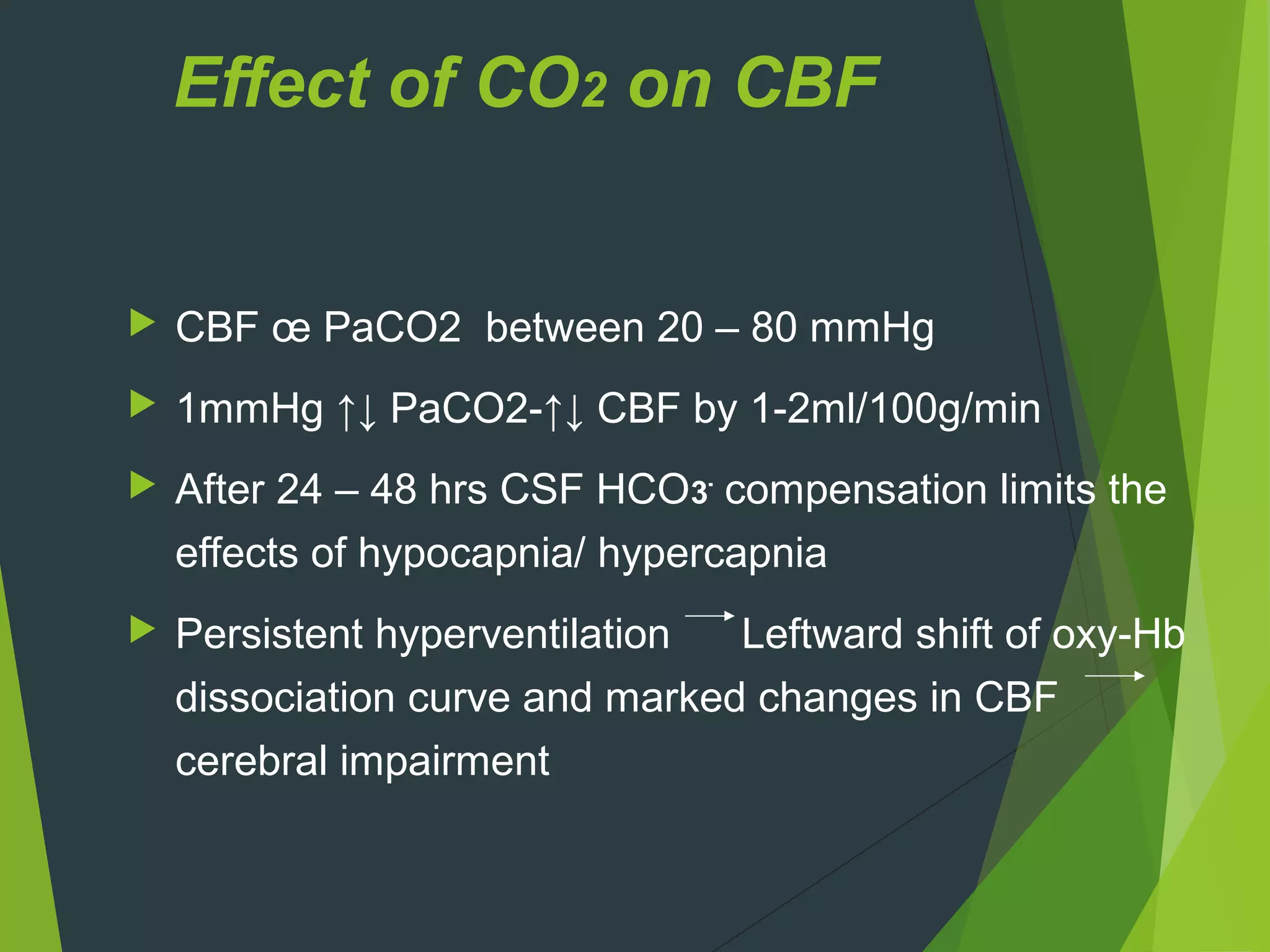
Effect of CO2 on CBF
 CBF œ PaCO2 between 20 – 80 mmHg
 1mmHg ↑↓ PaCO2-↑↓ CBF by 1-2ml/100g/min
 After 24 – 48 hrs CSF HCO3-
compensation limits the
effects of hypocapnia/ hypercapnia
 Persistent hyperventilation Leftward shift of oxy-Hb
dissociation curve and marked changes in CBF
cerebral impairment
Hypercarbia - CBF
 The relationship
between PaCO2
and CBF is sigmoid
 with plateaus below
25 mmHg and
above 75 mmHg.
 The slope is
approximately linear
Mechanism of CO2 on CBF
 The mechanism of CO2 induced changes in vessel caliber
 An increase in perivascular H+ concentration
 Associated NOS activation
 An increase in intracellular cGMP
 K+
efflux
 A reduction in intracellular Ca + +
resulting in dilation
 NOS inhibition attenuates the
 Cyclooxygenase inhibition CBF response to CO2
Effect of oxygen
 Hyperoxia – minimal decrease in CBF
 10%
 Severe hypoxia – PaO2 < 50mmHg
 Increases CBF
Haematocrit
 in haematocrit
viscosity CBF
 O2 carrying
capacity
 haematocrit
viscosity CBF
 Optimal haematocrit
– 30% to 34%
Temperature
 CBF changes 5- 7% per O
C
 Hypothermia CBF & CMR
 Pyrexia has reverse effect
Intracranial pressure
 “ICP means supra tentorial CSF pressure
measured in the lateral ventricles or over the
cerebral cortex and is normally less than
10mmHg.”
 Minor variations may occur depending on site
measurement but, in lateral recumbent position,
lumbar CSFpressure normally approximates
supratentorial pressure.
Intracranial pressure
MONRO-KELLIE DOCTRINEMONRO-KELLIE DOCTRINE
The cranial vault is a rigid structure with fixed
volume
Brain 80%
Blood 12%
CSF 8%
Any increase in one component must be offset by an
equivalent decrease in another to prevent rise in ICP
Intracranial pressure
ICP normally 10mmHg and less.
Intracranial elastance determined by
measuring the change in ICP in response to
change in intracranial volume
Initially increases in volume are initially
well compensated until it reaches a point
which further increase can cause rise in ICP
Intracranial elastance
Intracranial pressure
Major compensatory mechanisms include
a)Displacement of CSF from cranial to spinal
compartment
b)An increase in CSF resorption
c)Decrease in CSF production
d)Decrease in total cerebral blood volume
Applied aspects
 Effects of anesthetic drugs on CBF
 Volatile anesthetics
 Induction agents
 Anesthetic adjuncts
 Vasopressors
 Vasodilators
 Neuromuscular blocking agents
Volatile agents
 Volatile agents – dose dependent
dilatation of cerebral vessels
 Impair auto regulation
 Response to CO2 retained
 May increase cerebral blood volume
 May result in elevated ICP
 Halothane
 Has greatest effect on
CBF
 Con.> 1% - abolishes
auto regulation
 Generalized increase in
CBF
 At equivalent MAC CBF
up to 200%
 Prior hyperventilation
to be initiated
 Isoflurane
 CBF
 Auto regulation
maintained up to 1 MAC
 is > in sub cortical than
neocortical areas
 At equivalent MAC
CBF up to 20%
 Simultaneous
hyperventilation can
prevent in ICP
 Sevoflurane:
 CBF effects similar to isoflurane
 Produce slightly less vasodilation
 Auto regulation maintained up to 1.5 MAC
 Desflurane:
 CBF similar to isoflurane
 Autoregulation progressively abolished as dose
increases
 Nitrous Oxide:
 When administered on its own- increases both
CBF and metabolism.
 when added to a background of another
anesthetic, it increases CBF without changing
metabolism
 It is a direct acting and potent cerebral
vasodilator
IV induction agents
 Intravenous anesthetics reduce CBF in
a dose dependent fashion
 coupled to the reduction in metabolism
 Once maximal suppression of
metabolism occurs, no further reduction
in CBF occurs
Barbiturates
 Barbiturates maximal 50% reduction in CBF
and metabolism
 CO2 reactivity is maintained but is
quantitatively reduced compared to the awake
response
 Cerebral auto regulation maintained
intact
Propofol
 Propofol produces a coupled dose dependent
reduction in CMRO2 and CBF
 High doses vasodilator effect overcomes the
coupling & CBF increases
 Both CO2 responses and auto regulation are
maintained intact in the normal brain
 In head injured patients static auto regulation
may be impaired by high propofol infusion rates
Ketamine
 Dilates the cerebral vasculature and
increases CBF ( 50 – 60%)
 Increases in CBF, CBV, CSF volume can
increase ICP markedly in patients with
decreased IC compliance
Opioids
 Opioids at low doses produce very little effect
on CBF (provided CO2 is not allowed to rise)
 Auto regulation remains intact
 Some opioids in ICP
 BP vasodilatation to maintain CBF
 cerebral blood volume
 increase intracranial pressure.
Vasopressors
 With intact auto regulation & BBB
 in CBF occurs when
 MAP<50 -60mmHg
 MAP>150 – 160mmHg
 In the absence of auto regulation,
vasopressors CBF by direct effect on CPP.
Vasodilators
 In the absence of hypotension
 Cerebral vasodilatation
 CBF
 With Hypotension
 CBF is maintained or increased
 CBV & ICP in patients with IC
compliance
NMBD
 No direct effect on CBF
 Histamine releasing agents can cause
hypotension , CPP
 What is
 Luxury perfusion ?
 Intra cerebral steal ?
 Reverse steal phenomenon ?
Luxury perfusion
 The combination of a decrease in
CMRO2 and increase in CBF has
been termed luxury perfusion
 met. Demand met. Supply
Luxury perfusion…
 Seen in
Acute cerebral infarction
Vessels – max. dilated
Induced hypotension with isoflurane
Intracerebral Steal
 In a setting of focal ischemia ,
vasodilatation in a normal area
would shunt blood away from the
diseased area.
ischemic normal
Steal
 Seen in
 in PaCO2 in cerebral ischemia
 Volatile anesthetic agents
 Results in vasodilatation in normal areas
not in ischemic areas
Reverse Steal phenomenon
 Diversion or redistribution of blood
flow from normal to ischemic areas in
the brain is termed Reverse Steal /
Robin Hood phenomenon
ischemicnormal
Thank you

Neurophysiology and Neuroanaesthesia

  • 1.
  • 2.
    Peculiarities of brain Has a high metabolic rate  Has no oxygen stores  Unable to maintain its integrity through anaerobic metabolism  Neurons don’t require insulin for transport of glucose across cell membrane
  • 3.
    Neurophysiology  2% ofbody weight  17%-20% of Cardiac output consumption at rest  20% of inspired oxygen  60% - for neuronal activity  40% - to maintain cellular integrity  CMR / CMRO2 - 3-3.8ml/100g/min  50ml/min  Cerebral glucose consumption - 5mg/100g/min
  • 4.
    cerebral blood flow 80% - Internal carotid arteries  20% - Vertebral arteries  Anterior n posterior communicating arteries  Circle of Willis  Communication between exl & int carotids – opthalmic arteries
  • 5.
  • 6.
    Physiology of CBF Parallels with metabolic activity  Can vary from 10 – 300 ml/100g/min  Average – 50ml/100g/min  Gray matter – 80ml/100g/min  White matter- 20ml/100g/min  Total CBF- averages 750ml/min  < 20-25ml/100g/min- ischemia
  • 7.
    Cerebral blood flow Flow rates below 20-25ml/100g/min slowing of EEG.  Flow rates between 15-20ml/100g/min flattening of EEG.  Flow rates below 10ml/100g/min irreversible brain damage.
  • 8.
  • 9.
    Cerebral perfusion pressure CPP is the difference between Mean arterial pressure and intracranial pressure (or cerebral venous pressure, which ever is greater) CPP = MAP – ICP
  • 10.
    CPP = MAP- ICP  Normal CPP – 80 to 100mmHg  More dependent on MAP  ICP > 30mmHg compromise CPP  CPP  < 50mmHg – slowing of EEG  25 – 40 mmHg – flat EEG  < 25 mmHg – irreversible brain damage
  • 11.
    Cerebral auto regulation Abilityof the cerebral blood vessels to alter their caliber in order to maintain a constant flow in face of variations in blood pressure
  • 12.
    Cerebral auto regulation CBF is kept constant over a wide range of MAP ( 60 – 160 mm Hg )  CPP = MAP – Ven Press = MAP - ICP  ↑ MAP Cerebral vasoconstriction  ↓ MAP Cerebral vasodilatation  Constant CBF is maintained
  • 13.
    Cerebral auto regulation graph  Pressures above 160mmHg  Disrupts BBB  Cerebral edema  Haemorrhage
  • 14.
    Auto regulation……  Thecerebral vasculature rapidly adapts to change in CPP. (10 - 60 sec)  In Hypertensive persons cerebral autoregulation curve shifts to higher pressure levels : 180 – 200mm Hg and towards right.
  • 15.
    Changes in autoregulation Absent ( Vasomotor paralysis )  brain trauma  surgical retraction  high ICP  brain tumor  seizures  Shift to right  Systemic hypertension  States of sympathetic activation  Shift to left  Volatile anesthetic agents
  • 16.
    FACTORS CONTROLLING CBF Intrinsic factors  Myogenic Regulation  Metabolic Regulation  Neuronal Regulation  Hormonal regulation  Extrinsic factors  Respiratory gas  Arterial BP  Hematocrit  Temperature
  • 17.
    Myogenic factors  Isthe intrinsic response of smooth muscle cells in cerebral arterioles to changes in MAP  Protective mechanism against excessive pressure fluctuation at capillary level
  • 18.
    Metabolic regulation  Hydrogenions  potassium  adenosine  prostanoids  ↑ CO2  ↑ H+  ↑ K+  ↑ Adenosine  EDRF / Nitric Oxide
  • 19.
    Innervation  The sympatheticfibers arise mainly from the superior cervical ganglion  The parasympathetic from the sphenopalatine and otic ganglia  Sensory fibers from the trigeminal ganglion
  • 20.
    Neuronal regulation  α-Adrenergicreceptors in arterial smooth muscle  Postganglionic sympathetic fibers release noradrenaline  Causes smooth muscle contraction and arterial constriction  Sympathetic innervation is responsible for vascular tone
  • 21.
    Sympathetic  Large &Medium sized arteries normally overridden by autoregulation  Historically thought to have no role in cerebral circulation  Comes into play in states of excessive circulatory activity / pathologic states  Role in prevention of cerebral haemorrhage – cerebral vasospasm
  • 22.
    Hormonal regulation  Adrenaline Vasopressin  Angiotensin II
  • 23.
    Effect of CO2on CBF  CBF œ PaCO2 between 20 – 80 mmHg  1mmHg ↑↓ PaCO2-↑↓ CBF by 1-2ml/100g/min  After 24 – 48 hrs CSF HCO3- compensation limits the effects of hypocapnia/ hypercapnia  Persistent hyperventilation Leftward shift of oxy-Hb dissociation curve and marked changes in CBF cerebral impairment
  • 24.
    Hypercarbia - CBF The relationship between PaCO2 and CBF is sigmoid  with plateaus below 25 mmHg and above 75 mmHg.  The slope is approximately linear
  • 25.
    Mechanism of CO2on CBF  The mechanism of CO2 induced changes in vessel caliber  An increase in perivascular H+ concentration  Associated NOS activation  An increase in intracellular cGMP  K+ efflux  A reduction in intracellular Ca + + resulting in dilation  NOS inhibition attenuates the  Cyclooxygenase inhibition CBF response to CO2
  • 26.
    Effect of oxygen Hyperoxia – minimal decrease in CBF  10%  Severe hypoxia – PaO2 < 50mmHg  Increases CBF
  • 27.
    Haematocrit  in haematocrit viscosityCBF  O2 carrying capacity  haematocrit viscosity CBF  Optimal haematocrit – 30% to 34%
  • 28.
    Temperature  CBF changes5- 7% per O C  Hypothermia CBF & CMR  Pyrexia has reverse effect
  • 29.
    Intracranial pressure  “ICPmeans supra tentorial CSF pressure measured in the lateral ventricles or over the cerebral cortex and is normally less than 10mmHg.”  Minor variations may occur depending on site measurement but, in lateral recumbent position, lumbar CSFpressure normally approximates supratentorial pressure.
  • 30.
    Intracranial pressure MONRO-KELLIE DOCTRINEMONRO-KELLIEDOCTRINE The cranial vault is a rigid structure with fixed volume Brain 80% Blood 12% CSF 8% Any increase in one component must be offset by an equivalent decrease in another to prevent rise in ICP
  • 31.
    Intracranial pressure ICP normally10mmHg and less. Intracranial elastance determined by measuring the change in ICP in response to change in intracranial volume Initially increases in volume are initially well compensated until it reaches a point which further increase can cause rise in ICP
  • 32.
  • 33.
    Intracranial pressure Major compensatorymechanisms include a)Displacement of CSF from cranial to spinal compartment b)An increase in CSF resorption c)Decrease in CSF production d)Decrease in total cerebral blood volume
  • 34.
    Applied aspects  Effectsof anesthetic drugs on CBF  Volatile anesthetics  Induction agents  Anesthetic adjuncts  Vasopressors  Vasodilators  Neuromuscular blocking agents
  • 35.
    Volatile agents  Volatileagents – dose dependent dilatation of cerebral vessels  Impair auto regulation  Response to CO2 retained  May increase cerebral blood volume  May result in elevated ICP
  • 36.
     Halothane  Hasgreatest effect on CBF  Con.> 1% - abolishes auto regulation  Generalized increase in CBF  At equivalent MAC CBF up to 200%  Prior hyperventilation to be initiated  Isoflurane  CBF  Auto regulation maintained up to 1 MAC  is > in sub cortical than neocortical areas  At equivalent MAC CBF up to 20%  Simultaneous hyperventilation can prevent in ICP
  • 37.
     Sevoflurane:  CBFeffects similar to isoflurane  Produce slightly less vasodilation  Auto regulation maintained up to 1.5 MAC  Desflurane:  CBF similar to isoflurane  Autoregulation progressively abolished as dose increases
  • 38.
     Nitrous Oxide: When administered on its own- increases both CBF and metabolism.  when added to a background of another anesthetic, it increases CBF without changing metabolism  It is a direct acting and potent cerebral vasodilator
  • 39.
    IV induction agents Intravenous anesthetics reduce CBF in a dose dependent fashion  coupled to the reduction in metabolism  Once maximal suppression of metabolism occurs, no further reduction in CBF occurs
  • 40.
    Barbiturates  Barbiturates maximal50% reduction in CBF and metabolism  CO2 reactivity is maintained but is quantitatively reduced compared to the awake response  Cerebral auto regulation maintained intact
  • 41.
    Propofol  Propofol producesa coupled dose dependent reduction in CMRO2 and CBF  High doses vasodilator effect overcomes the coupling & CBF increases  Both CO2 responses and auto regulation are maintained intact in the normal brain  In head injured patients static auto regulation may be impaired by high propofol infusion rates
  • 42.
    Ketamine  Dilates thecerebral vasculature and increases CBF ( 50 – 60%)  Increases in CBF, CBV, CSF volume can increase ICP markedly in patients with decreased IC compliance
  • 43.
    Opioids  Opioids atlow doses produce very little effect on CBF (provided CO2 is not allowed to rise)  Auto regulation remains intact  Some opioids in ICP  BP vasodilatation to maintain CBF  cerebral blood volume  increase intracranial pressure.
  • 44.
    Vasopressors  With intactauto regulation & BBB  in CBF occurs when  MAP<50 -60mmHg  MAP>150 – 160mmHg  In the absence of auto regulation, vasopressors CBF by direct effect on CPP.
  • 45.
    Vasodilators  In theabsence of hypotension  Cerebral vasodilatation  CBF  With Hypotension  CBF is maintained or increased  CBV & ICP in patients with IC compliance
  • 46.
    NMBD  No directeffect on CBF  Histamine releasing agents can cause hypotension , CPP
  • 47.
     What is Luxury perfusion ?  Intra cerebral steal ?  Reverse steal phenomenon ?
  • 48.
    Luxury perfusion  Thecombination of a decrease in CMRO2 and increase in CBF has been termed luxury perfusion  met. Demand met. Supply
  • 49.
    Luxury perfusion…  Seenin Acute cerebral infarction Vessels – max. dilated Induced hypotension with isoflurane
  • 50.
    Intracerebral Steal  Ina setting of focal ischemia , vasodilatation in a normal area would shunt blood away from the diseased area. ischemic normal
  • 51.
    Steal  Seen in in PaCO2 in cerebral ischemia  Volatile anesthetic agents  Results in vasodilatation in normal areas not in ischemic areas
  • 53.
    Reverse Steal phenomenon Diversion or redistribution of blood flow from normal to ischemic areas in the brain is termed Reverse Steal / Robin Hood phenomenon ischemicnormal
  • 54.