In this chapter, you should be able to:
• Identify and label parts of the urinary system
• Describe the functions of parts of the urinary system
• Define excretion
• Describe dialysis
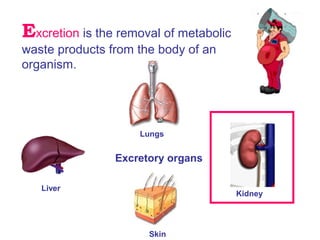
Excretion is the removal of metabolic
waste products from the body of an
organism.
Excretory organs
Lungs
Skin
Liver
Kidney
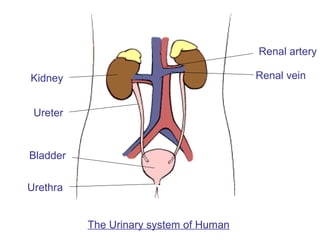
Bladder
Kidney
Ureter
Urethra
Renal artery
Renal vein
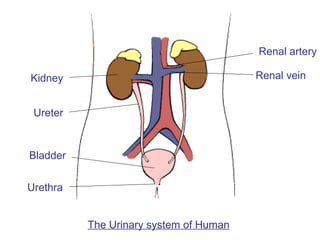
The Urinary system of Human
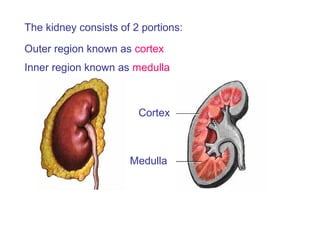
Medulla
Cortex
The kidney consists of 2 portions:
Outer region known as cortex
Inner region known as medulla
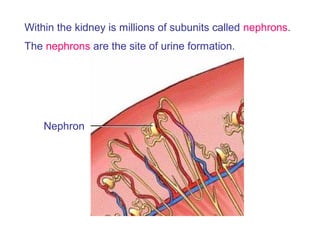
Nephron
Within the kidney is millions of subunits called nephrons.
The nephrons are the site of urine formation.
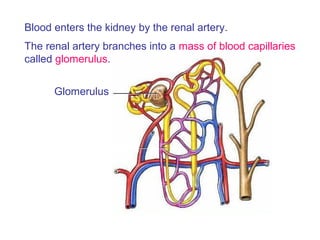
Glomerulus
Blood enters the kidney by the renal artery.
The renal artery branches into a mass of blood capillaries
called glomerulus.
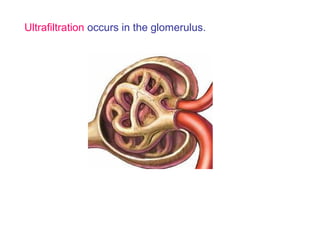
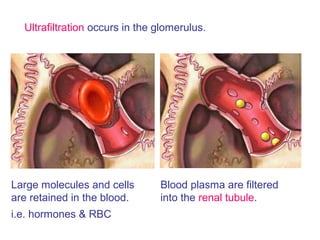
Ultrafiltration occurs in the glomerulus.
Large molecules and cells
are retained in the blood.
i.e. hormones & RBC
Blood plasma are filtered
into the renal tubule.
Glomerulus
Loop of Henlé
Renal tubule
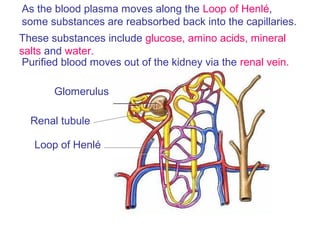
As the blood plasma moves along the Loop of Henlé,
some substances are reabsorbed back into the capillaries.
These substances include glucose, amino acids, mineral
salts and water.
Purified blood moves out of the kidney via the renal vein.
Glomerulus
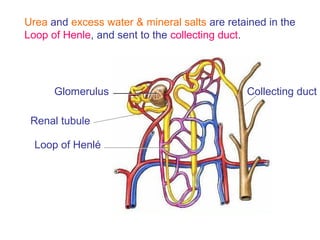
Urea and excess water & mineral salts are retained in the
Loop of Henle, and sent to the collecting duct.
Loop of Henlé
Renal tubule
Collecting duct
Bladder
Kidney
Ureter
Urethra
Renal artery
Renal vein
The Urinary system of Human
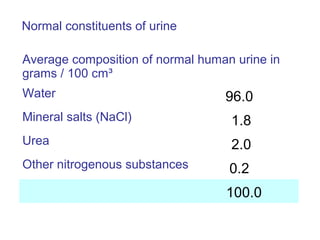
Normal constituents of urine
Average composition of normal human urine in
grams / 100 cm³
Water
Mineral salts (NaCl)
Urea
Other nitrogenous substances
96.0
1.8
2.0
0.2
100.0
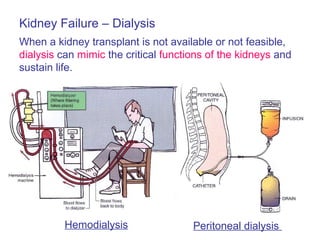
Kidney Failure – Dialysis
When a kidney transplant is not available or not feasible,
dialysis can mimic the critical functions of the kidneys and
sustain life.
Peritoneal dialysisHemodialysis
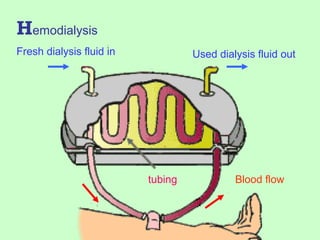
Hemodialysis
Fresh dialysis fluid in Used dialysis fluid out
Blood flowtubing
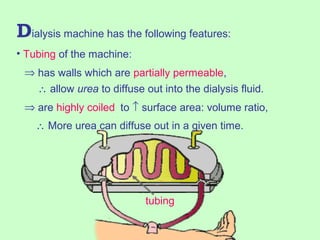
Dialysis machine has the following features:
• Tubing of the machine:
⇒ has walls which are partially permeable,
⇒ are highly coiled
∴ allow urea to diffuse out into the dialysis fluid.
∴ More urea can diffuse out in a given time.
tubing
to ↑ surface area: volume ratio,
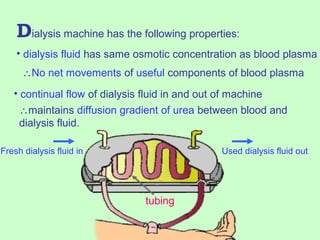
Dialysis machine has the following properties:
• dialysis fluid has same osmotic concentration as blood plasma
∴No net movements of useful components of blood plasma
Fresh dialysis fluid in Used dialysis fluid out
• continual flow of dialysis fluid in and out of machine
∴maintains diffusion gradient of urea between blood and
dialysis fluid.
tubing
http://www.clevelandclinic.org/nephrology/patient/dialysis.htm
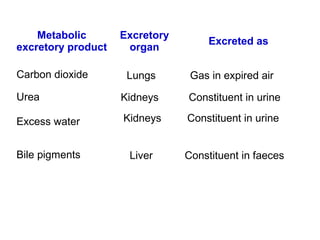
Metabolic
excretory product
Excretory
organ
Excreted as
Carbon dioxide
Urea
Excess water
Bile pigments
Lungs Gas in expired air
Kidneys Constituent in urine
Liver Constituent in faeces

Excretion

  • 1.
    In this chapter,you should be able to: • Identify and label parts of the urinary system • Describe the functions of parts of the urinary system • Define excretion • Describe dialysis
  • 2.
    Excretion is theremoval of metabolic waste products from the body of an organism. Excretory organs Lungs Skin Liver Kidney
  • 3.
  • 4.
    Medulla Cortex The kidney consistsof 2 portions: Outer region known as cortex Inner region known as medulla
  • 5.
    Nephron Within the kidneyis millions of subunits called nephrons. The nephrons are the site of urine formation.
  • 6.
    Glomerulus Blood enters thekidney by the renal artery. The renal artery branches into a mass of blood capillaries called glomerulus.
  • 7.
  • 8.
    Ultrafiltration occurs inthe glomerulus. Large molecules and cells are retained in the blood. i.e. hormones & RBC Blood plasma are filtered into the renal tubule.
  • 9.
    Glomerulus Loop of Henlé Renaltubule As the blood plasma moves along the Loop of Henlé, some substances are reabsorbed back into the capillaries. These substances include glucose, amino acids, mineral salts and water. Purified blood moves out of the kidney via the renal vein.
  • 10.
    Glomerulus Urea and excesswater & mineral salts are retained in the Loop of Henle, and sent to the collecting duct. Loop of Henlé Renal tubule Collecting duct
  • 11.
  • 12.
    Normal constituents ofurine Average composition of normal human urine in grams / 100 cm³ Water Mineral salts (NaCl) Urea Other nitrogenous substances 96.0 1.8 2.0 0.2 100.0
  • 13.
    Kidney Failure –Dialysis When a kidney transplant is not available or not feasible, dialysis can mimic the critical functions of the kidneys and sustain life. Peritoneal dialysisHemodialysis
  • 14.
    Hemodialysis Fresh dialysis fluidin Used dialysis fluid out Blood flowtubing
  • 15.
    Dialysis machine hasthe following features: • Tubing of the machine: ⇒ has walls which are partially permeable, ⇒ are highly coiled ∴ allow urea to diffuse out into the dialysis fluid. ∴ More urea can diffuse out in a given time. tubing to ↑ surface area: volume ratio,
  • 16.
    Dialysis machine hasthe following properties: • dialysis fluid has same osmotic concentration as blood plasma ∴No net movements of useful components of blood plasma Fresh dialysis fluid in Used dialysis fluid out • continual flow of dialysis fluid in and out of machine ∴maintains diffusion gradient of urea between blood and dialysis fluid. tubing
  • 17.
  • 18.
    Metabolic excretory product Excretory organ Excreted as Carbondioxide Urea Excess water Bile pigments Lungs Gas in expired air Kidneys Constituent in urine Kidneys Constituent in urine Liver Constituent in faeces