Energy and the ecosystem
B M Subramanya Swamy M.Sc. B.Ed.
CIE Co ordinator & Examination Officer
Kanaan Global School
Jakarta
Indonesia
subramanyaswamy1591978@gmail.com
Overview of the topic
1.Energy flow

•Producers/Consumers

2.Food chains and web

•Food chains
•Energy transfers
•Food web

3. Ecological pyramids

•Pyramid of numbers
•Pyramid of bio mass

4.Nutrient cycle

•Carbon cycle
• Ecology : Study of how organism interact with each other
& with their environment
• Environment – organism live
• Environment – divided into abiotic & biotic factor
• Abiotic factor-nonliving factor
• E.g. edaphic factor, climatic factor & topographical factor
• Biotic factor- living organism
• E g producer consumer decomposer
• Habitat – physical location in which an organism lives
Level of ecological organization
• Earth – lump of rock with a thin outer layer of soil, water & air.
• Organism occur near boundaries either between soil & air or water &
air
• Organism – studied at six different levels –
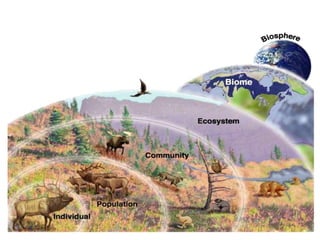
individual,population,community ecosystem, biome & biosphere
• Each species is made up of individual
• Guases competitive exclusion principle states- two species cannot
coexist unless there are significant difference in their ecologies. If 2
species attempt to occupy the same niche, they will compete with
each other until one is eliminated
• Niche – position of species occupied within its habitat.
• Niche includes physical space its interaction with other organism & its
effect on environment
• Individual – same species occupying a constitute a population
•
•

Different population in an area interact with each other. These collectively form a
community
Community – named after an obvious feature of the environment
– Pine forest community
– Woodland community
– Grassland community

• Different species of a community together with their non living
environment, constitute a ecosystem
• Ecosystem consists of 4 basic element
– Abiotic component
– Biotic component
– Energy & nutrient (support life in ecosystem)

• Ecosystem are open unit & part of a biome
• All the life are restricted to a rather narrow zone called the
biosphere
Energy flow
The main energy source on the earth is sun.
Solar energy can be tapped by the plants to
make food.
Recently we are also able to tap this energy
source using solar panels.
Producers / consumers
• Green plants store solar energy in
carbohydrates during photosynthesis.
• They change solar energy into chemical
energy to achieve this
• They are producers (autotrophs): capable of
producing their own food.
• Consumers (heterotrophs) feed on producers
as a source of food.
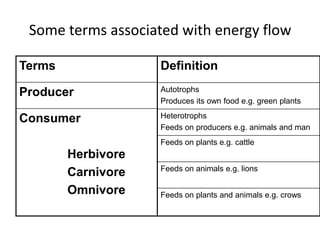
Some terms associated with energy flow
Terms

Definition

Producer

Autotrophs
Produces its own food e.g. green plants

Consumer

Heterotrophs
Feeds on producers e.g. animals and man

Feeds on plants e.g. cattle

Herbivore
Carnivore
Omnivore

Feeds on animals e.g. lions
Feeds on plants and animals e.g. crows
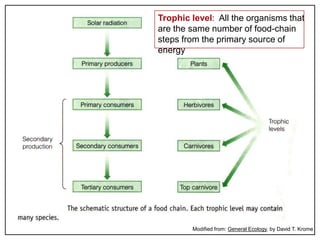
Trophic level: All the organisms that
are the same number of food-chain
steps from the primary source of
energy

Modified from: General Ecology, by David T. Krome
Foods chains and webs
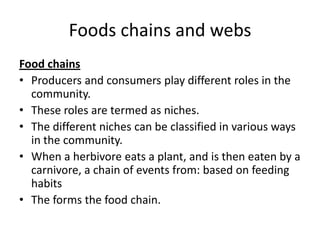
Food chains
• Producers and consumers play different roles in the
community.
• These roles are termed as niches.
• The different niches can be classified in various ways
in the community.
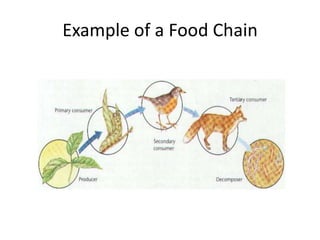
• When a herbivore eats a plant, and is then eaten by a
carnivore, a chain of events from: based on feeding
habits
• The forms the food chain.
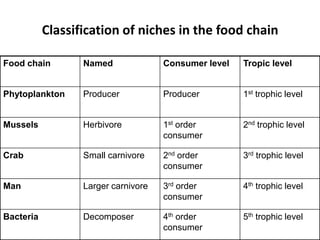
Classification of niches in the food chain
Food chain

Named

Consumer level

Tropic level

Phytoplankton

Producer

Producer

1st trophic level

Mussels

Herbivore

1st order
consumer

2nd trophic level

Crab

Small carnivore

2nd order
consumer

3rd trophic level

Man

Larger carnivore

3rd order
consumer

4th trophic level

Bacteria

Decomposer

4th order
consumer

5th trophic level
Energy transfers
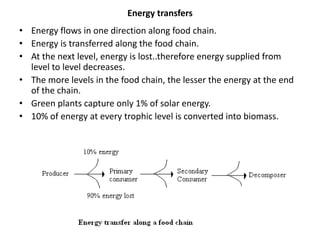
• Energy flows in one direction along food chain.
• Energy is transferred along the food chain.
• At the next level, energy is lost..therefore energy supplied from
level to level decreases.
• The more levels in the food chain, the lesser the energy at the end
of the chain.
• Green plants capture only 1% of solar energy.
• 10% of energy at every trophic level is converted into biomass.
Example of a Food Chain
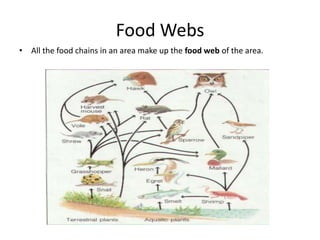
Food Webs
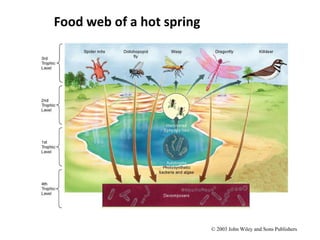
• All the food chains in an area make up the food web of the area.
Food web of a hot spring

© 2003 John Wiley and Sons Publishers
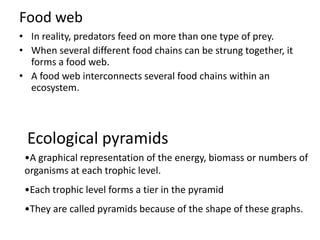
Food web
• In reality, predators feed on more than one type of prey.
• When several different food chains can be strung together, it
forms a food web.
• A food web interconnects several food chains within an
ecosystem.

Ecological pyramids
•A graphical representation of the energy, biomass or numbers of
organisms at each trophic level.
•Each trophic level forms a tier in the pyramid
•They are called pyramids because of the shape of these graphs.
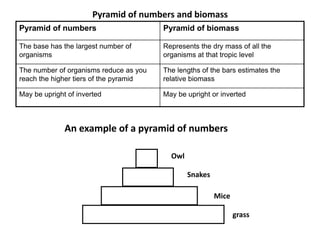
Pyramid of numbers and biomass
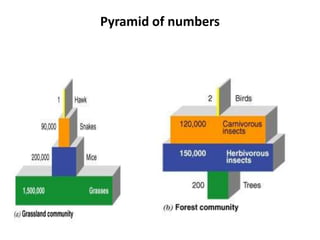
Pyramid of numbers

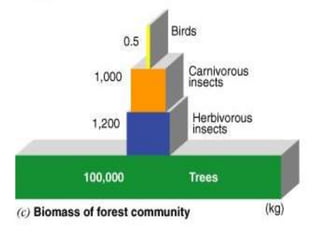
Pyramid of biomass

The base has the largest number of
organisms

Represents the dry mass of all the
organisms at that tropic level

The number of organisms reduce as you
reach the higher tiers of the pyramid

The lengths of the bars estimates the
relative biomass

May be upright of inverted

May be upright or inverted

An example of a pyramid of numbers
Owl
Snakes
Mice
grass
Pyramid of numbers
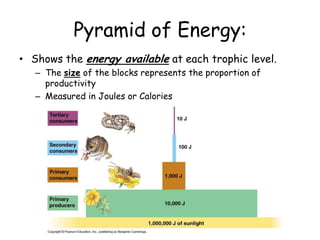
Pyramid of Energy:
• Shows the energy available at each trophic level.
– The size of the blocks represents the proportion of
productivity
– Measured in Joules or Calories
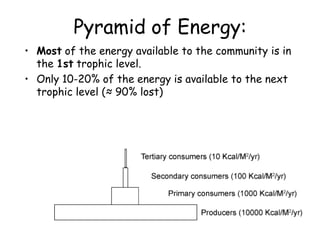
Pyramid of Energy:
• Most of the energy available to the community is in
the 1st trophic level.
• Only 10-20% of the energy is available to the next
trophic level (≈ 90% lost)
Nutrient cycle
• Nutrients in the environment exist in various forms.
• Energy cannot be recycled, but the nutrients can
• Carbon is repeatedly recycled within the environment
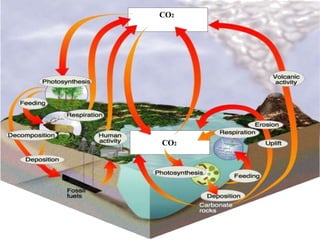
Carbon cycle
•Carbon dioxide occupies about 0.03% by volume of air.
•This amount is sufficient for all plants that photosynthesis
•CO2 is removed from the air by green plants.
•It is replaced through respiration and by the combustion of fossil fuels.
CO2

CO2
Nitrogen cycle
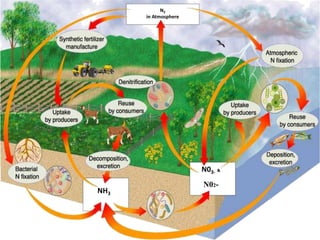
• Passage of nitrogen within an ecosystem
• Nitrogen cycle is more complex biogeochemical cycle
• Atmosphere contain 79% nitrogen gas but only few
micro organism can tap this reservoir.
• Nitrogen fixation – nitrogen fixing bacteria
• Bacteria free-living or living in root nodules of
leguminous plants
• Bacteria converts atmospheric nitrogen to nitrates
• Atmospheric nitrogen can also fixed by lightning
•

Denitrifying bacteria converts nitrates to nitrogen gas
– Bacteria are anaerobic
– Process is known as denitrification

•

Photosynthetic organisms make use of nitrates to form amino acids & protein,
which are in turn eaten by animals

•

Protein are broken down to amino acids in animals

•

Nitrogen in amino acids is excreted in the form of ammonia or urea

•

Decomposers breakdown protein molecules in dead animals and plants

•

Release nitrogen as ammonia or ammonium compounds- ammonification

•

E.g. putrefying bacteria

•
•

Ammonia or ammonium compounds to nitrites & nitrites to nitrates
Process is known as nitrification
N2
in Atmosphere

N03- &

NH3

N02-

Energy and the ecosystem IGCSE

  • 1.
    Energy and theecosystem B M Subramanya Swamy M.Sc. B.Ed. CIE Co ordinator & Examination Officer Kanaan Global School Jakarta Indonesia subramanyaswamy1591978@gmail.com
  • 2.
    Overview of thetopic 1.Energy flow •Producers/Consumers 2.Food chains and web •Food chains •Energy transfers •Food web 3. Ecological pyramids •Pyramid of numbers •Pyramid of bio mass 4.Nutrient cycle •Carbon cycle
  • 3.
    • Ecology :Study of how organism interact with each other & with their environment • Environment – organism live • Environment – divided into abiotic & biotic factor • Abiotic factor-nonliving factor • E.g. edaphic factor, climatic factor & topographical factor • Biotic factor- living organism • E g producer consumer decomposer • Habitat – physical location in which an organism lives
  • 4.
    Level of ecologicalorganization • Earth – lump of rock with a thin outer layer of soil, water & air. • Organism occur near boundaries either between soil & air or water & air • Organism – studied at six different levels – individual,population,community ecosystem, biome & biosphere • Each species is made up of individual • Guases competitive exclusion principle states- two species cannot coexist unless there are significant difference in their ecologies. If 2 species attempt to occupy the same niche, they will compete with each other until one is eliminated • Niche – position of species occupied within its habitat. • Niche includes physical space its interaction with other organism & its effect on environment • Individual – same species occupying a constitute a population
  • 5.
    • • Different population inan area interact with each other. These collectively form a community Community – named after an obvious feature of the environment – Pine forest community – Woodland community – Grassland community • Different species of a community together with their non living environment, constitute a ecosystem • Ecosystem consists of 4 basic element – Abiotic component – Biotic component – Energy & nutrient (support life in ecosystem) • Ecosystem are open unit & part of a biome • All the life are restricted to a rather narrow zone called the biosphere
  • 7.
    Energy flow The mainenergy source on the earth is sun. Solar energy can be tapped by the plants to make food. Recently we are also able to tap this energy source using solar panels.
  • 8.
    Producers / consumers •Green plants store solar energy in carbohydrates during photosynthesis. • They change solar energy into chemical energy to achieve this • They are producers (autotrophs): capable of producing their own food. • Consumers (heterotrophs) feed on producers as a source of food.
  • 9.
    Some terms associatedwith energy flow Terms Definition Producer Autotrophs Produces its own food e.g. green plants Consumer Heterotrophs Feeds on producers e.g. animals and man Feeds on plants e.g. cattle Herbivore Carnivore Omnivore Feeds on animals e.g. lions Feeds on plants and animals e.g. crows
  • 10.
    Trophic level: Allthe organisms that are the same number of food-chain steps from the primary source of energy Modified from: General Ecology, by David T. Krome
  • 11.
    Foods chains andwebs Food chains • Producers and consumers play different roles in the community. • These roles are termed as niches. • The different niches can be classified in various ways in the community. • When a herbivore eats a plant, and is then eaten by a carnivore, a chain of events from: based on feeding habits • The forms the food chain.
  • 12.
    Classification of nichesin the food chain Food chain Named Consumer level Tropic level Phytoplankton Producer Producer 1st trophic level Mussels Herbivore 1st order consumer 2nd trophic level Crab Small carnivore 2nd order consumer 3rd trophic level Man Larger carnivore 3rd order consumer 4th trophic level Bacteria Decomposer 4th order consumer 5th trophic level
  • 13.
    Energy transfers • Energyflows in one direction along food chain. • Energy is transferred along the food chain. • At the next level, energy is lost..therefore energy supplied from level to level decreases. • The more levels in the food chain, the lesser the energy at the end of the chain. • Green plants capture only 1% of solar energy. • 10% of energy at every trophic level is converted into biomass.
  • 14.
    Example of aFood Chain
  • 15.
    Food Webs • Allthe food chains in an area make up the food web of the area.
  • 16.
    Food web ofa hot spring © 2003 John Wiley and Sons Publishers
  • 17.
    Food web • Inreality, predators feed on more than one type of prey. • When several different food chains can be strung together, it forms a food web. • A food web interconnects several food chains within an ecosystem. Ecological pyramids •A graphical representation of the energy, biomass or numbers of organisms at each trophic level. •Each trophic level forms a tier in the pyramid •They are called pyramids because of the shape of these graphs.
  • 18.
    Pyramid of numbersand biomass Pyramid of numbers Pyramid of biomass The base has the largest number of organisms Represents the dry mass of all the organisms at that tropic level The number of organisms reduce as you reach the higher tiers of the pyramid The lengths of the bars estimates the relative biomass May be upright of inverted May be upright or inverted An example of a pyramid of numbers Owl Snakes Mice grass
  • 19.
  • 21.
    Pyramid of Energy: •Shows the energy available at each trophic level. – The size of the blocks represents the proportion of productivity – Measured in Joules or Calories
  • 22.
    Pyramid of Energy: •Most of the energy available to the community is in the 1st trophic level. • Only 10-20% of the energy is available to the next trophic level (≈ 90% lost)
  • 23.
    Nutrient cycle • Nutrientsin the environment exist in various forms. • Energy cannot be recycled, but the nutrients can • Carbon is repeatedly recycled within the environment Carbon cycle •Carbon dioxide occupies about 0.03% by volume of air. •This amount is sufficient for all plants that photosynthesis •CO2 is removed from the air by green plants. •It is replaced through respiration and by the combustion of fossil fuels.
  • 24.
  • 25.
    Nitrogen cycle • Passageof nitrogen within an ecosystem • Nitrogen cycle is more complex biogeochemical cycle • Atmosphere contain 79% nitrogen gas but only few micro organism can tap this reservoir. • Nitrogen fixation – nitrogen fixing bacteria • Bacteria free-living or living in root nodules of leguminous plants • Bacteria converts atmospheric nitrogen to nitrates • Atmospheric nitrogen can also fixed by lightning
  • 26.
    • Denitrifying bacteria convertsnitrates to nitrogen gas – Bacteria are anaerobic – Process is known as denitrification • Photosynthetic organisms make use of nitrates to form amino acids & protein, which are in turn eaten by animals • Protein are broken down to amino acids in animals • Nitrogen in amino acids is excreted in the form of ammonia or urea • Decomposers breakdown protein molecules in dead animals and plants • Release nitrogen as ammonia or ammonium compounds- ammonification • E.g. putrefying bacteria • • Ammonia or ammonium compounds to nitrites & nitrites to nitrates Process is known as nitrification
  • 27.