Chapter 7:
Nutrition in Plants
Do Plants Eat?
• Like humans, plants need food for
energy.
• Where does this food come from?
• It is through the food- making process
of Photosynthesis
What is Photosynthesis?
• Photosynthesis is the process in which light
energy is absorbed by chlorophyll and
converted into chemical energy. The chemical
energy is then used to synthesis
carbohydrates from carbon dioxide and water.
Oxygen is released in the process.
• The raw materials needed:
(1) Carbon Dioxide
: enters leaves by diffusion, via the stomata
found on the underside of the leaves.
(2) Water
: enters the plant through the roots and
transported to leaves via xylem vessel
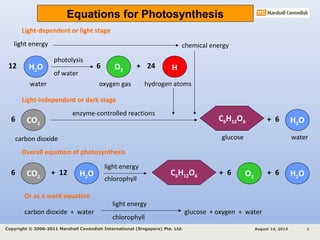
Equation of Photosynthesis
Carbon dioxide + Water Glucose + Oxygen + Water
Sunlight
Chlorophyll
Light-dependent or light stage
Light-independent or dark stage
light energy chemical energy
H2O12
photolysis
of water
O2
6 + 24 H
water oxygen gas hydrogen atoms
CO2
6 H2O6
watercarbon dioxide
enzyme-controlled reactions
C6H12O6
glucose
+
Overall equation of photosynthesis
CO2
6 + H2O12
light energy
chlorophyll
C6H12O6 + O2
6 H2O6+
Or as a word equation
carbon dioxide + water glucose + oxygen + water
light energy
chlorophyll
Equations for Photosynthesis
August 14, 2013Copyright © 2006-2011 Marshall Cavendish International (Singapore) Pte. Ltd. 6
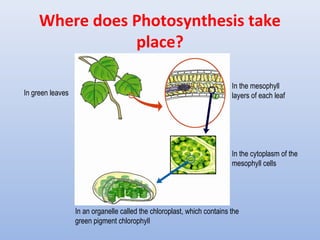
Where does Photosynthesis take
place?
In green leaves
In the mesophyll
layers of each leaf
In the cytoplasm of the
mesophyll cells
In an organelle called the chloroplast, which contains the
green pigment chlorophyll
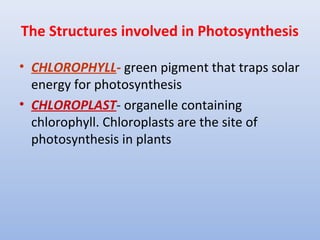
The Structures involved in Photosynthesis
• CHLOROPHYLL- green pigment that traps solar
energy for photosynthesis
• CHLOROPLAST- organelle containing
chlorophyll. Chloroplasts are the site of
photosynthesis in plants
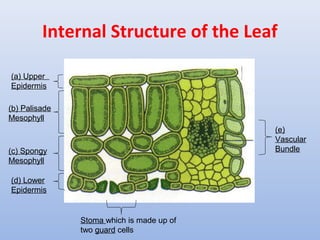
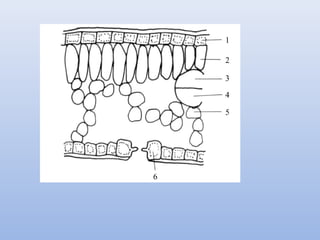
Internal Structure of the Leaf
(a) Upper
Epidermis
(b) Palisade
Mesophyll
(c) Spongy
Mesophyll
(d) Lower
Epidermis
Stoma which is made up of
two guard cells
(e)
Vascular
Bundle
A) Upper epidermis layer
– contains no chloroplasts  allows sunlight to
pass through easily to the palisade
mesophyll layer
– covered with a layer of cuticle  reduces
evaporation of water
– protects inner layer of cells
B) Palisade mesophyll layer
– Main site of photosynthesis  contains
most number of chloroplasts
– Palisade mesophyll cells are long and
cylindrical
– Cells are packed very closely to one another
– During photosynthesis, oxygen will be
produced
C) Spongy mesophyll layer
– also contains some chloroplasts but main
function is not for photosynthesis
– main site of gaseous exchange
– cells are loosely packed with intercellular air
spaces
– water will evaporate from surface of spongy
mesophyll cells into the air spaces
 water vapour in the air spaces will move out
of the stomata into surrounding air by
diffusion
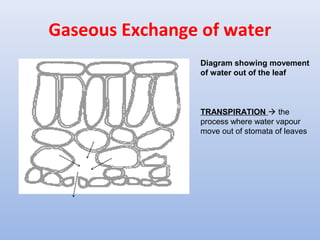
Gaseous Exchange of water
Diagram showing movement
of water out of the leaf
TRANSPIRATION  the
process where water vapour
move out of stomata of leaves
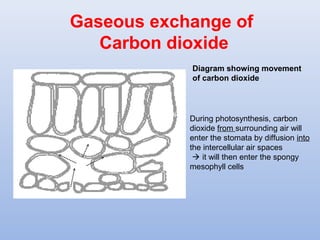
Diagram showing movement
of carbon dioxide
Gaseous exchange of
Carbon dioxide
During photosynthesis, carbon
dioxide from surrounding air will
enter the stomata by diffusion into
the intercellular air spaces
 it will then enter the spongy
mesophyll cells
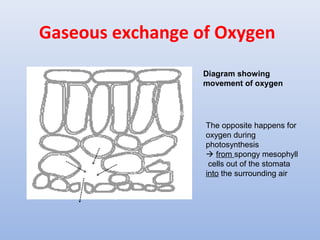
Gaseous exchange of Oxygen
Diagram showing
movement of oxygen
The opposite happens for
oxygen during
photosynthesis
 from spongy mesophyll
cells out of the stomata
into the surrounding air
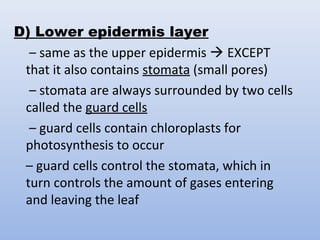
D) Lower epidermis layer
– same as the upper epidermis  EXCEPT
that it also contains stomata (small pores)
– stomata are always surrounded by two cells
called the guard cells
– guard cells contain chloroplasts for
photosynthesis to occur
– guard cells control the stomata, which in
turn controls the amount of gases entering
and leaving the leaf
(E) Vascular Bundle
Made up of the:
1) Xylem vessels (always on the top)
Function:
 transport water from the roots to the
palisade mesophyll cells for
photosynthesis to take place
- water in the palisade mesophyll cells will
ALSO move to the spongy mesophyll cells
to escape into the surrounding air
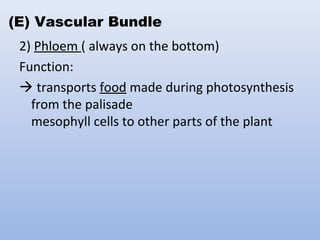
2) Phloem ( always on the bottom)
Function:
 transports food made during photosynthesis
from the palisade
mesophyll cells to other parts of the plant
(E) Vascular Bundle
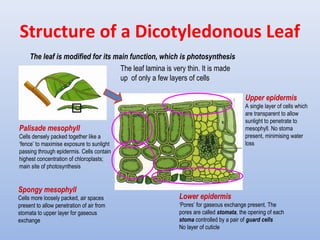
Structure of a Dicotyledonous Leaf
The leaf lamina is very thin. It is made
up of only a few layers of cells
Palisade mesophyll
Cells densely packed together like a
‘fence’ to maximise exposure to sunlight
passing through epidermis. Cells contain
highest concentration of chloroplasts;
main site of photosynthesis
Upper epidermis
A single layer of cells which
are transparent to allow
sunlight to penetrate to
mesophyll. No stoma
present, minimising water
loss
Spongy mesophyll
Cells more loosely packed, air spaces
present to allow penetration of air from
stomata to upper layer for gaseous
exchange
Lower epidermis
‘Pores’ for gaseous exchange present. The
pores are called stomata, the opening of each
stoma controlled by a pair of guard cells
No layer of cuticle
The leaf is modified for its main function, which is photosynthesis
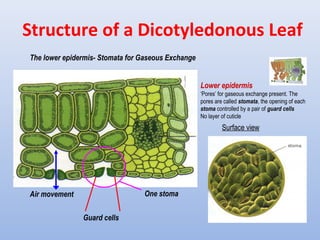
Structure of a Dicotyledonous Leaf
Lower epidermis
‘Pores’ for gaseous exchange present. The
pores are called stomata, the opening of each
stoma controlled by a pair of guard cells
No layer of cuticle
One stoma
Guard cells
Air movement
Surface view
The lower epidermis- Stomata for Gaseous Exchange
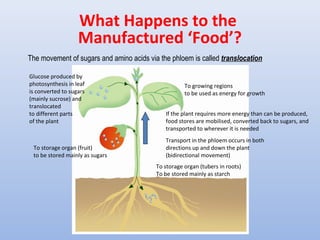
What Happens to the
Manufactured ‘Food’?
Glucose produced by
photosynthesis in leaf
is converted to sugars
(mainly sucrose) and
translocated
to different parts
of the plant
To growing regions
to be used as energy for growth
To storage organ (fruit)
to be stored mainly as sugars
To storage organ (tubers in roots)
To be stored mainly as starch
Transport in the phloem occurs in both
directions up and down the plant
(bidirectional movement)
If the plant requires more energy than can be produced,
food stores are mobilised, converted back to sugars, and
transported to wherever it is needed
The movement of sugars and amino acids via the phloem is called translocation
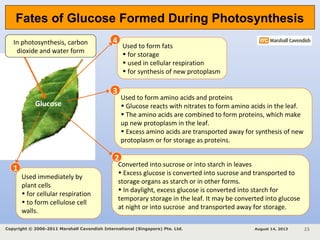
Glucose
In photosynthesis, carbon
dioxide and water form
Used immediately by
plant cells
• for cellular respiration
• to form cellulose cell
walls.
1
Converted into sucrose or into starch in leaves
• Excess glucose is converted into sucrose and transported to
storage organs as starch or in other forms.
• In daylight, excess glucose is converted into starch for
temporary storage in the leaf. It may be converted into glucose
at night or into sucrose and transported away for storage.
2
Used to form amino acids and proteins
• Glucose reacts with nitrates to form amino acids in the leaf.
• The amino acids are combined to form proteins, which make
up new protoplasm in the leaf.
• Excess amino acids are transported away for synthesis of new
protoplasm or for storage as proteins.
3
Used to form fats
• for storage
• used in cellular respiration
• for synthesis of new protoplasm
4
August 14, 2013Copyright © 2006-2011 Marshall Cavendish International (Singapore) Pte. Ltd. 23
Fates of Glucose Formed During Photosynthesis
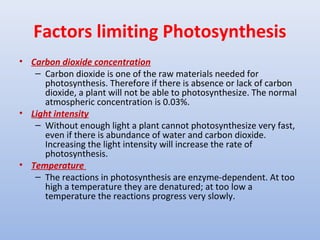
Factors limiting Photosynthesis
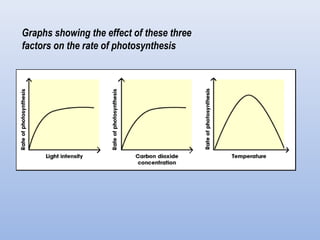
• Carbon dioxide concentration
– Carbon dioxide is one of the raw materials needed for
photosynthesis. Therefore if there is absence or lack of carbon
dioxide, a plant will not be able to photosynthesize. The normal
atmospheric concentration is 0.03%.
• Light intensity
– Without enough light a plant cannot photosynthesize very fast,
even if there is abundance of water and carbon dioxide.
Increasing the light intensity will increase the rate of
photosynthesis.
• Temperature
– The reactions in photosynthesis are enzyme-dependent. At too
high a temperature they are denatured; at too low a
temperature the reactions progress very slowly.
Graphs showing the effect of these three
factors on the rate of photosynthesis
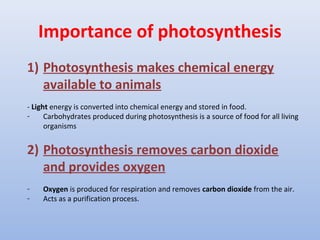
Importance of photosynthesis
1) Photosynthesis makes chemical energy
available to animals
- Light energy is converted into chemical energy and stored in food.
- Carbohydrates produced during photosynthesis is a source of food for all living
organisms
2) Photosynthesis removes carbon dioxide
and provides oxygen
- Oxygen is produced for respiration and removes carbon dioxide from the air.
- Acts as a purification process.
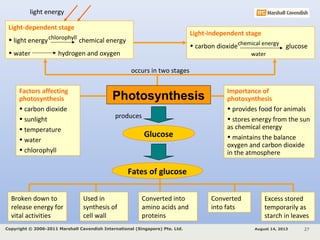
Light-dependent stage
• light energy chemical energy
• water hydrogen and oxygen
chlorophyll
Light-independent stage
• carbon dioxide glucosechemical energy
water
occurs in two stages
light energy
Photosynthesis
Factors affecting
photosynthesis
• carbon dioxide
• sunlight
• temperature
• water
• chlorophyll
Importance of
photosynthesis
• provides food for animals
• stores energy from the sun
as chemical energy
• maintains the balance
oxygen and carbon dioxide
in the atmosphere
Fates of glucose
Broken down to
release energy for
vital activities
Used in
synthesis of
cell wall
Converted into
amino acids and
proteins
Converted
into fats
Excess stored
temporarily as
starch in leaves
Glucose
produces
August 14, 2013Copyright © 2006-2011 Marshall Cavendish International (Singapore) Pte. Ltd. 27