PLANT NUTRITION
• 1. How Plants make their own food

• 2. How plants get nutrients

• 3. Photosyntesis

• 4. The distribution of elaborated sap

• 5. Plant respiration

• 6. Growth, movement and the perception of time.
1. How plants make their own food
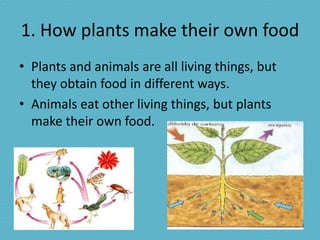
• Plants and animals are all living things, but
  they obtain food in different ways.
• Animals eat other living things, but plants
  make their own food.
1. How plants make their own food.
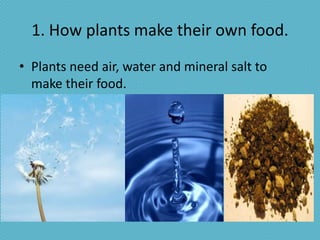
• Plants need air, water and mineral salt to
  make their food.
1. How plants make their own food.
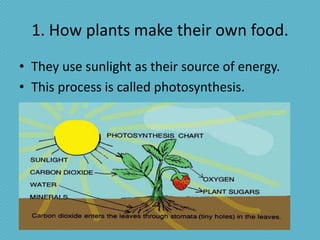
• They use sunlight as their source of energy.
• This process is called photosynthesis.
1. How plants make their own food.
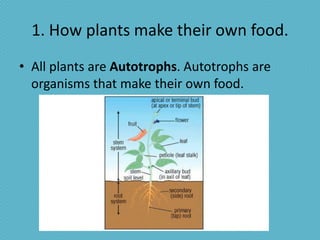
• All plants are Autotrophs. Autotrophs are
  organisms that make their own food.
2. How plants get nutrients.
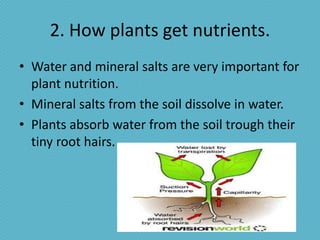
• Water and mineral salts are very important for
  plant nutrition.
• Mineral salts from the soil dissolve in water.
• Plants absorb water from the soil trough their
  tiny root hairs.
2. How plants get nutrients.
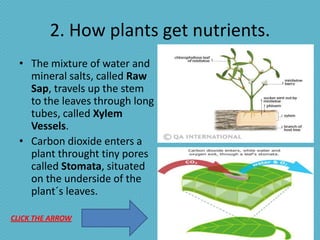
  • The mixture of water and
    mineral salts, called Raw
    Sap, travels up the stem
    to the leaves through long
    tubes, called Xylem
    Vessels.
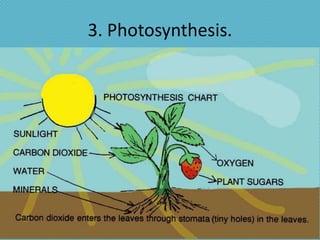
  • Carbon dioxide enters a
    plant throught tiny pores
    called Stomata, situated
    on the underside of the
    plant´s leaves.

CLICK THE ARROW
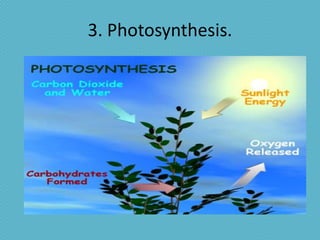
3. Photosynthesis.
3. Photosynthesis.
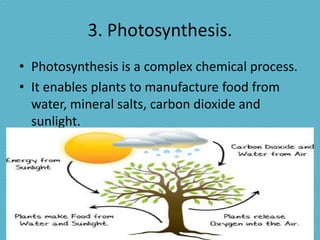
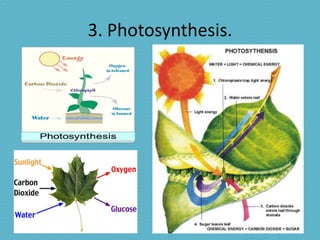
• Photosynthesis is a complex chemical process.
• It enables plants to manufacture food from
  water, mineral salts, carbon dioxide and
  sunlight.
3. Photosynthesis.
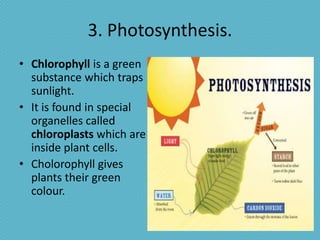
• Chlorophyll is a green
  substance which traps
  sunlight.
• It is found in special
  organelles called
  chloroplasts which are
  inside plant cells.
• Cholorophyll gives
  plants their green
  colour.
3. Photosynthesis.
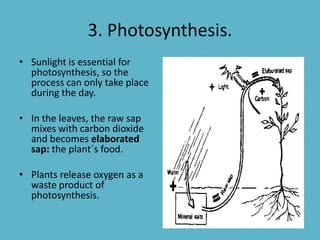
• Sunlight is essential for
  photosynthesis, so the
  process can only take place
  during the day.

• In the leaves, the raw sap
  mixes with carbon dioxide
  and becomes elaborated
  sap: the plant´s food.

• Plants release oxygen as a
  waste product of
  photosynthesis.
3. Photosynthesis.
3. Photosynthesis.
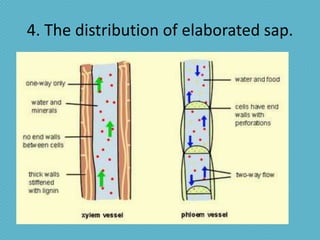
4. The distribution of elaborated sap.
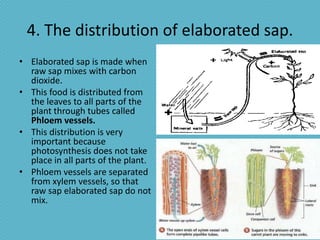
• Elaborated sap is made when
  raw sap mixes with carbon
  dioxide.
• This food is distributed from
  the leaves to all parts of the
  plant through tubes called
  Phloem vessels.
• This distribution is very
  important because
  photosynthesis does not take
  place in all parts of the plant.
• Phloem vessels are separated
  from xylem vessels, so that
  raw sap elaborated sap do not
  mix.
4. The distribution of elaborated sap.
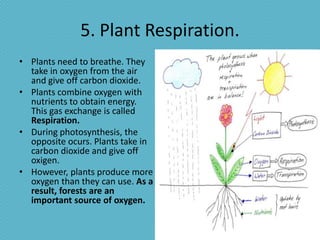
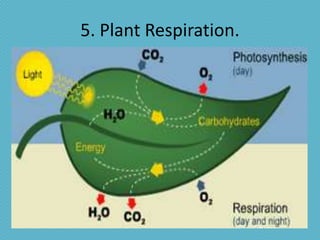
5. Plant Respiration.
• Plants need to breathe. They
  take in oxygen from the air
  and give off carbon dioxide.
• Plants combine oxygen with
  nutrients to obtain energy.
  This gas exchange is called
  Respiration.
• During photosynthesis, the
  opposite ocurs. Plants take in
  carbon dioxide and give off
  oxigen.
• However, plants produce more
  oxygen than they can use. As a
  result, forests are an
  important source of oxygen.
5. Plant Respiration.
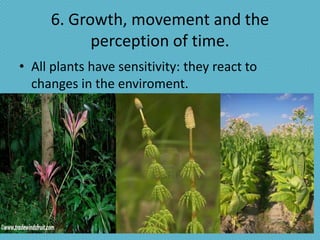
6. Growth, movement and the
           perception of time.
• All plants have sensitivity: they react to
  changes in the enviroment.
6. Growth, movement and the
                perception of time.
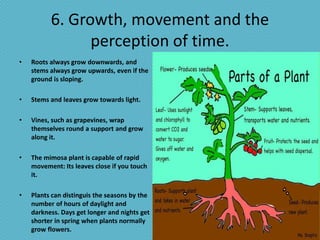
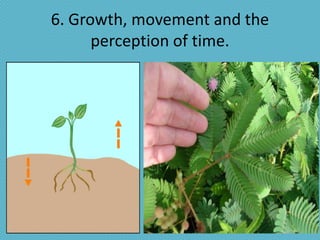
•   Roots always grow downwards, and
    stems always grow upwards, even if the
    ground is sloping.

•   Stems and leaves grow towards light.

•   Vines, such as grapevines, wrap
    themselves round a support and grow
    along it.

•   The mimosa plant is capable of rapid
    movement: Its leaves close if you touch
    it.

•   Plants can distinguis the seasons by the
    number of hours of daylight and
    darkness. Days get longer and nights get
    shorter in spring when plants normally
    grow flowers.
6. Growth, movement and the
      perception of time.
ANY QUESTIONS???
        FINALLY,
        WE ARE GOING
        TO SEE A
        VIDEO ABOUT
        PHOTOSYNTHESIS
           CLICK THE ARROW

Plant nutrition

  • 2.
    PLANT NUTRITION • 1.How Plants make their own food • 2. How plants get nutrients • 3. Photosyntesis • 4. The distribution of elaborated sap • 5. Plant respiration • 6. Growth, movement and the perception of time.
  • 3.
    1. How plantsmake their own food • Plants and animals are all living things, but they obtain food in different ways. • Animals eat other living things, but plants make their own food.
  • 4.
    1. How plantsmake their own food. • Plants need air, water and mineral salt to make their food.
  • 5.
    1. How plantsmake their own food. • They use sunlight as their source of energy. • This process is called photosynthesis.
  • 6.
    1. How plantsmake their own food. • All plants are Autotrophs. Autotrophs are organisms that make their own food.
  • 7.
    2. How plantsget nutrients. • Water and mineral salts are very important for plant nutrition. • Mineral salts from the soil dissolve in water. • Plants absorb water from the soil trough their tiny root hairs.
  • 8.
    2. How plantsget nutrients. • The mixture of water and mineral salts, called Raw Sap, travels up the stem to the leaves through long tubes, called Xylem Vessels. • Carbon dioxide enters a plant throught tiny pores called Stomata, situated on the underside of the plant´s leaves. CLICK THE ARROW
  • 9.
  • 10.
    3. Photosynthesis. • Photosynthesisis a complex chemical process. • It enables plants to manufacture food from water, mineral salts, carbon dioxide and sunlight.
  • 11.
    3. Photosynthesis. • Chlorophyllis a green substance which traps sunlight. • It is found in special organelles called chloroplasts which are inside plant cells. • Cholorophyll gives plants their green colour.
  • 12.
    3. Photosynthesis. • Sunlightis essential for photosynthesis, so the process can only take place during the day. • In the leaves, the raw sap mixes with carbon dioxide and becomes elaborated sap: the plant´s food. • Plants release oxygen as a waste product of photosynthesis.
  • 13.
  • 14.
  • 15.
    4. The distributionof elaborated sap. • Elaborated sap is made when raw sap mixes with carbon dioxide. • This food is distributed from the leaves to all parts of the plant through tubes called Phloem vessels. • This distribution is very important because photosynthesis does not take place in all parts of the plant. • Phloem vessels are separated from xylem vessels, so that raw sap elaborated sap do not mix.
  • 16.
    4. The distributionof elaborated sap.
  • 17.
    5. Plant Respiration. •Plants need to breathe. They take in oxygen from the air and give off carbon dioxide. • Plants combine oxygen with nutrients to obtain energy. This gas exchange is called Respiration. • During photosynthesis, the opposite ocurs. Plants take in carbon dioxide and give off oxigen. • However, plants produce more oxygen than they can use. As a result, forests are an important source of oxygen.
  • 18.
  • 19.
    6. Growth, movementand the perception of time. • All plants have sensitivity: they react to changes in the enviroment.
  • 20.
    6. Growth, movementand the perception of time. • Roots always grow downwards, and stems always grow upwards, even if the ground is sloping. • Stems and leaves grow towards light. • Vines, such as grapevines, wrap themselves round a support and grow along it. • The mimosa plant is capable of rapid movement: Its leaves close if you touch it. • Plants can distinguis the seasons by the number of hours of daylight and darkness. Days get longer and nights get shorter in spring when plants normally grow flowers.
  • 21.
    6. Growth, movementand the perception of time.
  • 22.
    ANY QUESTIONS??? FINALLY, WE ARE GOING TO SEE A VIDEO ABOUT PHOTOSYNTHESIS CLICK THE ARROW