ROYS ADAPTATION
MODEL
Prepared by:-
Mrs. D. Melba Sahaya Sweety
Msc Nursing
Pediatric Nursing Department
INTRODUCTION
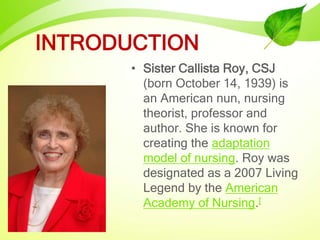
• Sister Callista Roy, CSJ
(born October 14, 1939) is
an American nun, nursing
theorist, professor and
author. She is known for
creating the adaptation
model of nursing. Roy was
designated as a 2007 Living
Legend by the American
Academy of Nursing.[
MAJOR CONCEPT &
DFINITION
PERSON
• Humans (as
individuals or in
groups) are
holistic,
adaptive
systems.
ENVIRONMENT
• Environment
consists of
internal and
external stimuli
that surround an
individual or
group
MAJOR CONCEPT & DFINITION
HEALTH
• It is a state and
process of being and
becoming integrated
as a whole person. It
is a reflection of
adaptation, that is the
interaction of the
person and the
environment.
NURSING
• It is the promotion
of adaptation for
individual and
groups in each of
four adaptive
modes , thus
contributing to
health, quality of
life and dying with
dignity.
ASSUMPTIONS
Scientific Assumptions
Philosophical Assumptions
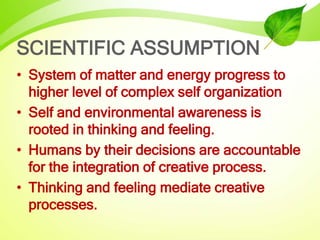
SCIENTIFIC ASSUMPTION
• System of matter and energy progress to
higher level of complex self organization
• Self and environmental awareness is
rooted in thinking and feeling.
• Humans by their decisions are accountable
for the integration of creative process.
• Thinking and feeling mediate creative
processes.
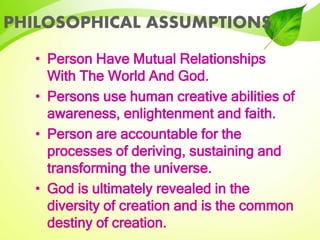
PHILOSOPHICAL ASSUMPTIONS
• Person Have Mutual Relationships
With The World And God.
• Persons use human creative abilities of
awareness, enlightenment and faith.
• Person are accountable for the
processes of deriving, sustaining and
transforming the universe.
• God is ultimately revealed in the
diversity of creation and is the common
destiny of creation.
TYPES OF STIMULI
[INPUT]
FOCAL
STIMULAI
CONTEXTUAL
STIMULAI
REIDUAL
STIMULI
• It is internal or external
stimuli most immediately
confronting the human
system
• They are all the other
stimuli present in the
situation that contribute
the effect of focal
stimuli
• Thy are environmental
factors within or without the
human systems which effect
in the current situation that
are unclear
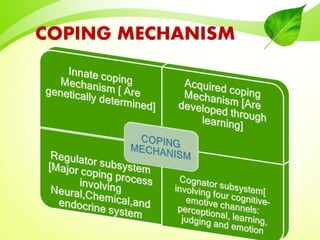
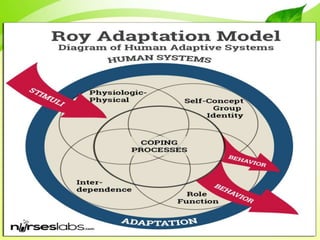
COPING MECHANISM
ADAPTIVE SYSTEM
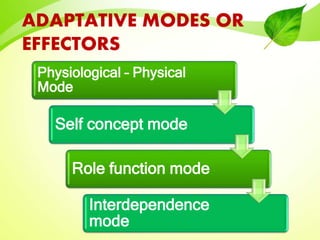
ADAPTATIVE MODES OR
EFFECTORS
Physiological – Physical
Mode
Self concept mode
Role function mode
Interdependence
mode
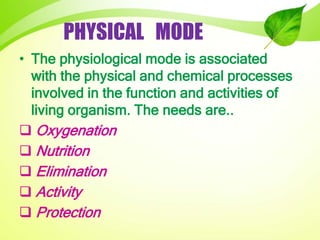
PHYSICAL MODE
• The physiological mode is associated
with the physical and chemical processes
involved in the function and activities of
living organism. The needs are..
 Oxygenation
 Nutrition
 Elimination
 Activity
 Protection
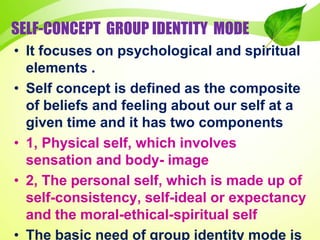
SELF-CONCEPT GROUP IDENTITY MODE
• It focuses on psychological and spiritual
elements .
• Self concept is defined as the composite
of beliefs and feeling about our self at a
given time and it has two components
• 1, Physical self, which involves
sensation and body- image
• 2, The personal self, which is made up of
self-consistency, self-ideal or expectancy
and the moral-ethical-spiritual self
• The basic need of group identity mode is
ROLE FUNCTION MODE
• The basic need of the role function is
social integrity . This mean the people
need to know who they are in relation
to others so that they can act. All
people have role in the society the
roles are divided in to Primary,
secondary and tertiary roles person
performs in society.
INTERDEPENDENCE MODE
• Interdependence is a social adaptive
mode it needs relational integrity or
feeling of security in nurturing
relationship
• Interdependence mean the close
relationship of people that involves
willingness and ability to love, respect
and value other and also accept and
respond to love, respect and value
given by others
OUTPUT
ADAPTIVE
RESPONSES
[Promote integrity in
terms of goals of
human being]
INEFFECTIVE
RESPONSES [are
those that do not
contribute to integrity
in terms of goals of
human system]
Nursing Roy's adaptation theory

Nursing Roy's adaptation theory

  • 1.
    ROYS ADAPTATION MODEL Prepared by:- Mrs.D. Melba Sahaya Sweety Msc Nursing Pediatric Nursing Department
  • 2.
    INTRODUCTION • Sister CallistaRoy, CSJ (born October 14, 1939) is an American nun, nursing theorist, professor and author. She is known for creating the adaptation model of nursing. Roy was designated as a 2007 Living Legend by the American Academy of Nursing.[
  • 3.
    MAJOR CONCEPT & DFINITION PERSON •Humans (as individuals or in groups) are holistic, adaptive systems. ENVIRONMENT • Environment consists of internal and external stimuli that surround an individual or group
  • 4.
    MAJOR CONCEPT &DFINITION HEALTH • It is a state and process of being and becoming integrated as a whole person. It is a reflection of adaptation, that is the interaction of the person and the environment. NURSING • It is the promotion of adaptation for individual and groups in each of four adaptive modes , thus contributing to health, quality of life and dying with dignity.
  • 5.
  • 6.
    SCIENTIFIC ASSUMPTION • Systemof matter and energy progress to higher level of complex self organization • Self and environmental awareness is rooted in thinking and feeling. • Humans by their decisions are accountable for the integration of creative process. • Thinking and feeling mediate creative processes.
  • 7.
    PHILOSOPHICAL ASSUMPTIONS • PersonHave Mutual Relationships With The World And God. • Persons use human creative abilities of awareness, enlightenment and faith. • Person are accountable for the processes of deriving, sustaining and transforming the universe. • God is ultimately revealed in the diversity of creation and is the common destiny of creation.
  • 9.
    TYPES OF STIMULI [INPUT] FOCAL STIMULAI CONTEXTUAL STIMULAI REIDUAL STIMULI •It is internal or external stimuli most immediately confronting the human system • They are all the other stimuli present in the situation that contribute the effect of focal stimuli • Thy are environmental factors within or without the human systems which effect in the current situation that are unclear
  • 10.
  • 11.
  • 12.
    ADAPTATIVE MODES OR EFFECTORS Physiological– Physical Mode Self concept mode Role function mode Interdependence mode
  • 13.
    PHYSICAL MODE • Thephysiological mode is associated with the physical and chemical processes involved in the function and activities of living organism. The needs are..  Oxygenation  Nutrition  Elimination  Activity  Protection
  • 14.
    SELF-CONCEPT GROUP IDENTITYMODE • It focuses on psychological and spiritual elements . • Self concept is defined as the composite of beliefs and feeling about our self at a given time and it has two components • 1, Physical self, which involves sensation and body- image • 2, The personal self, which is made up of self-consistency, self-ideal or expectancy and the moral-ethical-spiritual self • The basic need of group identity mode is
  • 15.
    ROLE FUNCTION MODE •The basic need of the role function is social integrity . This mean the people need to know who they are in relation to others so that they can act. All people have role in the society the roles are divided in to Primary, secondary and tertiary roles person performs in society.
  • 16.
    INTERDEPENDENCE MODE • Interdependenceis a social adaptive mode it needs relational integrity or feeling of security in nurturing relationship • Interdependence mean the close relationship of people that involves willingness and ability to love, respect and value other and also accept and respond to love, respect and value given by others
  • 17.
    OUTPUT ADAPTIVE RESPONSES [Promote integrity in termsof goals of human being] INEFFECTIVE RESPONSES [are those that do not contribute to integrity in terms of goals of human system]