
ROY’S
ADAPTATION
MODEL
BY
HARSHIKA TEMBHURNE
MSC 1ST YEAR
2021-2023
OBJECTIVES
At the end of the presentation learner will be able to :
● Introduction
● Describe biographical sketch of Callista Roy.
● Explain evolution of theory.
● Explain assumptions of the theory.
● Describe Roy's adaptation Model.
● Explain metaparadigm of RAM
● Describe Types of stimuli
● Elaborate applications of RAM
● Identify strength and weakness of RAM
● Describe application of theory in practice/education and research.
● Conclusion
● Bibliography
INTRODUCTION
• Nursing is establishing itself as a
scientific discipline.
• The nursing models provide the
basis for selecting knowledge to
be transmitted in nursing
education.
• It is the framework for nursing
practice and the direction for
nursing research.
01
BIOGRAPHICA
L SKETCH OF
CALLISTA
ROY
 Born on 14th Oct, 1939
 Bachelors of arts in Nursing
 Masters of science in nursing from
University of California, LosAngeles
1966
 Masters of arts (M.A.) in sociology.
 Associate professor and chairperson
of the department on nursing at
mount Saint Mary’s college until
1982.
 1983-1985 she was post doctoral
fellow at Robert Wood Johnson at
University of California, as a clinical
nurse scholar in neuroscience.
# Concept of the theory was developed when
Roy was graduate student.
# Challenged by another nurse theorist Dorothy
E.Johnson to develop a theory of nursing.
# Operationalizing in 1968
# Literature debut in 1970
# Model presentation in 1977
EVOLUTION OF THEORY
● Scientific Assumptions
● Philosophical Assumptions
● Assumption from Humanism
● Assumption based on Veritivity
ASSUMPTIO
NS
SCIENTIFIC
ASSUMPTIO
NS
• System of matter and energy .
• Self and environmental awareness
• Human decisions
• Thinking and feeling
• System relationship
• Person and the earth relationship
• Person and environment
transformation
• Integration of human and environment
PHILOSOPHICAL
ASSUMPTIONS
• Mutual assumptions
• Human meaning
• God is intimately revealed in the
diversity of creation
• Persons use human creative
abilities
• Persons are accountable for
sustaining and transforming the
universe
ASSUMPTIONS
OF HUMANISM
ASSUMPTION
BASED ON
VERITIVITY
Purposefulness of
human existence
Unity of purpose of
humankind
Activity and creativity
from common goods
Values and meaning of
life
• Creativity
• Purposefulness
• Holism
• Interpersonal Process
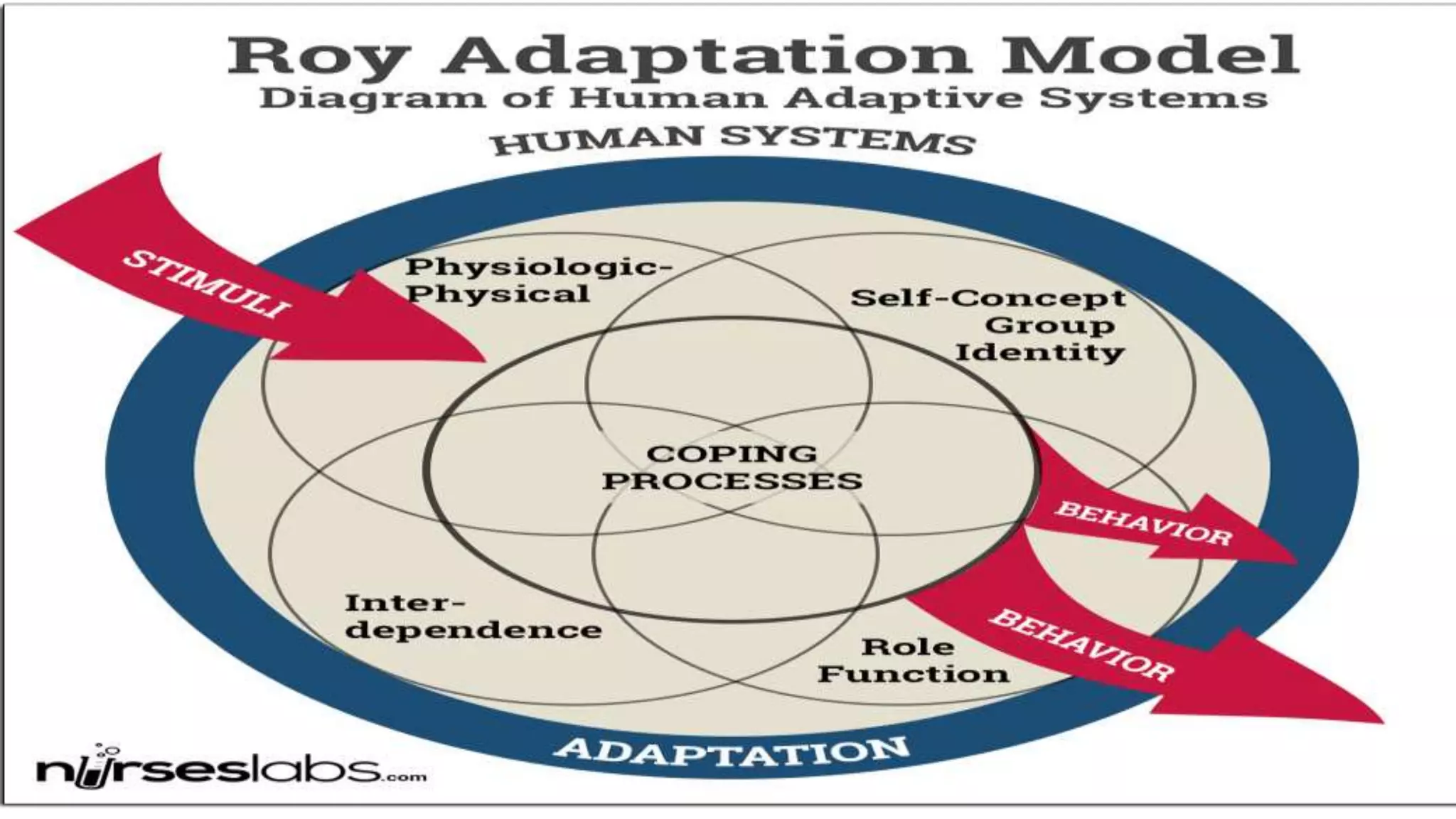
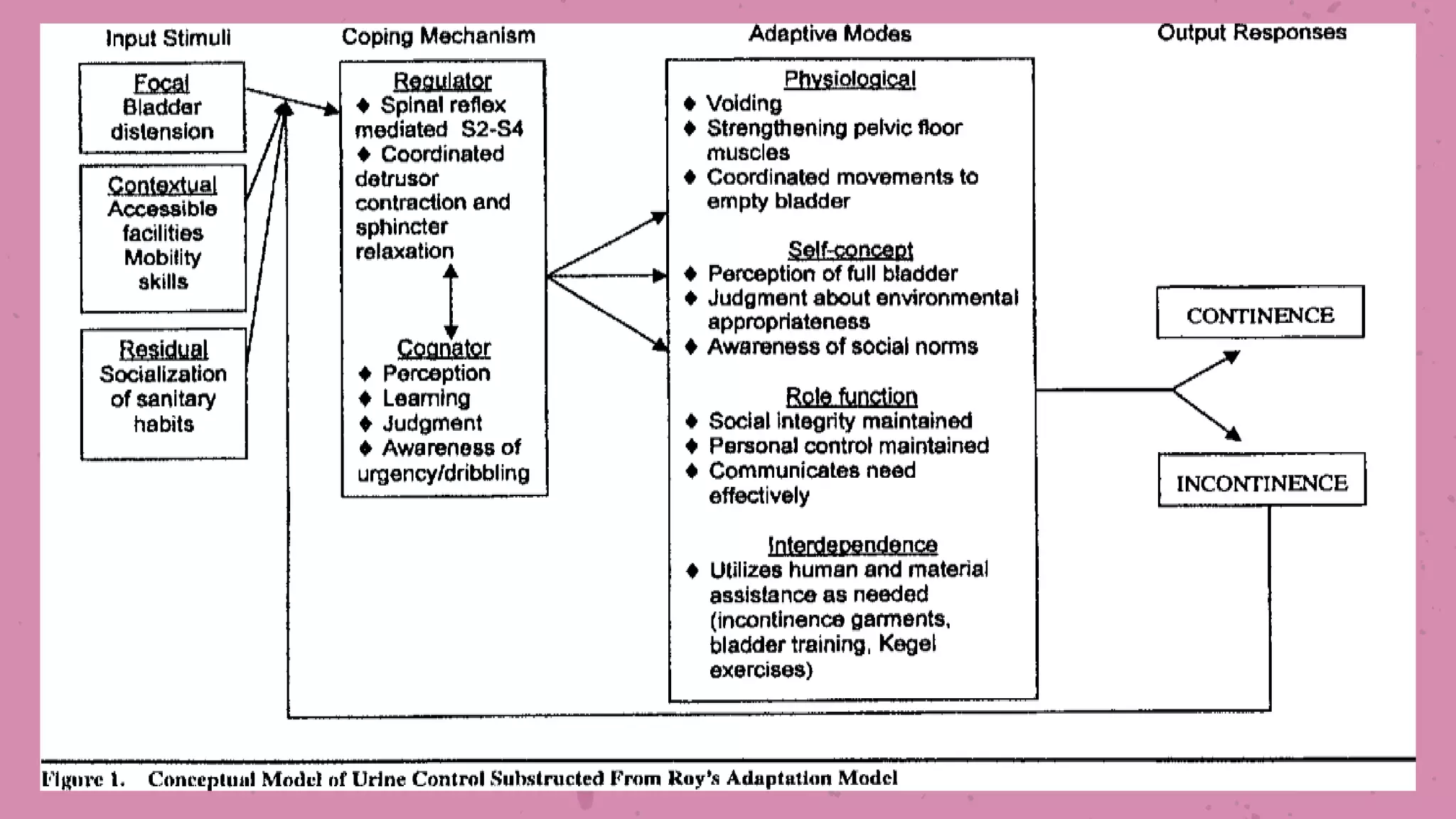
ROY’S ADAPTATION MODEL
(RAM)
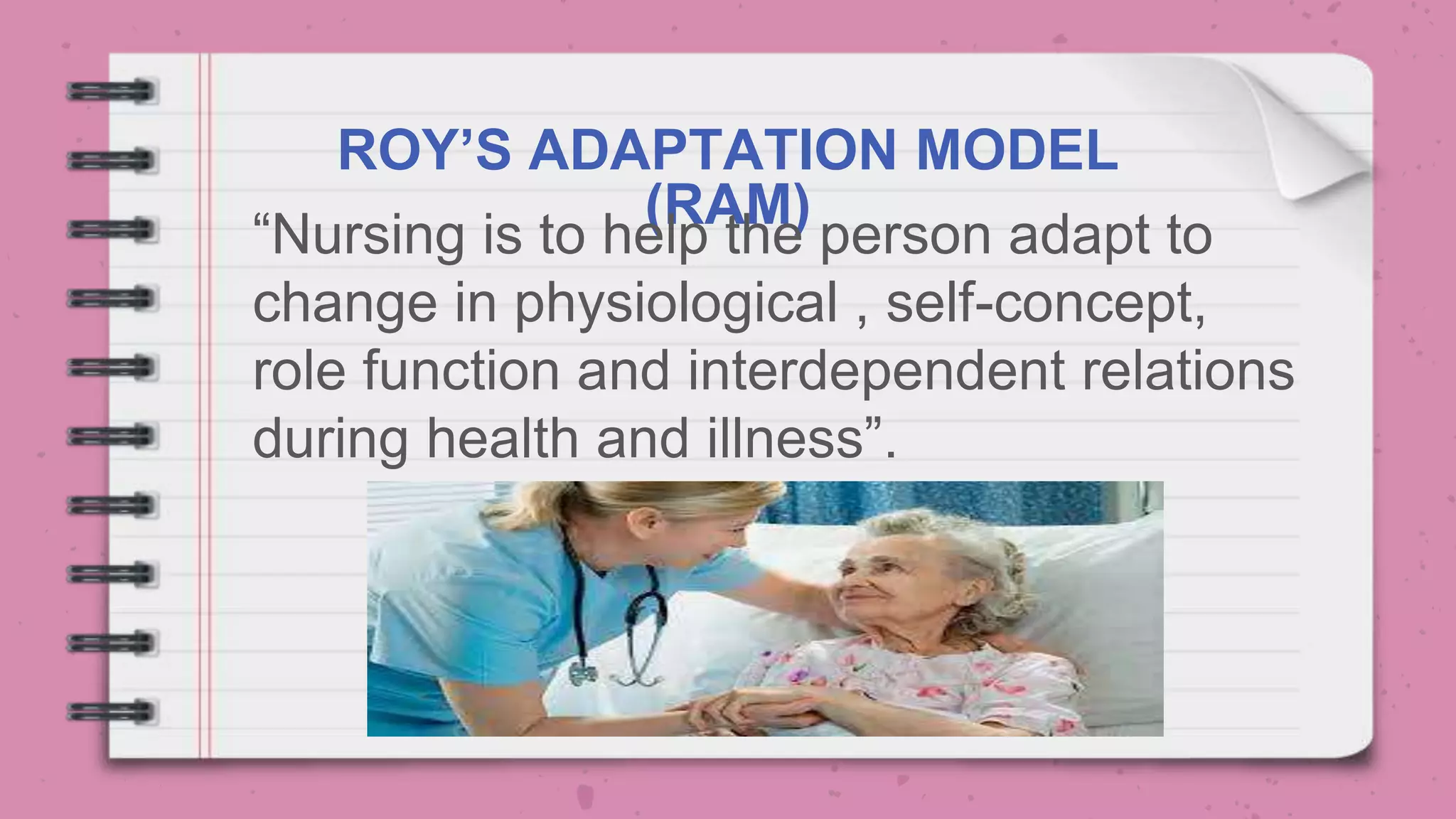
“Nursing is to help the person adapt to
change in physiological , self-concept,
role function and interdependent relations
during health and illness”.
METAPARADIGM OF
RAM
HEALTH :
.
HUMAN BEING :
• The person viewed as a adaptive system, their
health, and their environment
• Interchanging with the environment
• Person also refers to families, groups, communities
and the whole society.
ENVIRONMENT :
• All conditions, circumstances and influences that
surround and affect the development and behavior of
the person
• A change acts as a stimulating and causes adaptive
responses
• It is a process where he or she is striving to
achieve their maximum potential.
NURSING :
• Nursing acts to enhance the interaction of
the person with the environment to promote
adaptation.
TYPES OF
STIMULI
● FOCAL STIMULI:
Immediately confront the individual in a
particular situation. Focal stimuli for a family
include needs and changes within the family
members, among the environment.
● CONTEXTUAL STIMULI :
Are those other stimuli that influence the
situation.
● RESIDUAL STIMULI :
Include the individual’s beliefs or attitudes
that may influence the situation. Contextual and
residual stimuli for a family system include
nurturance, socialization and support.
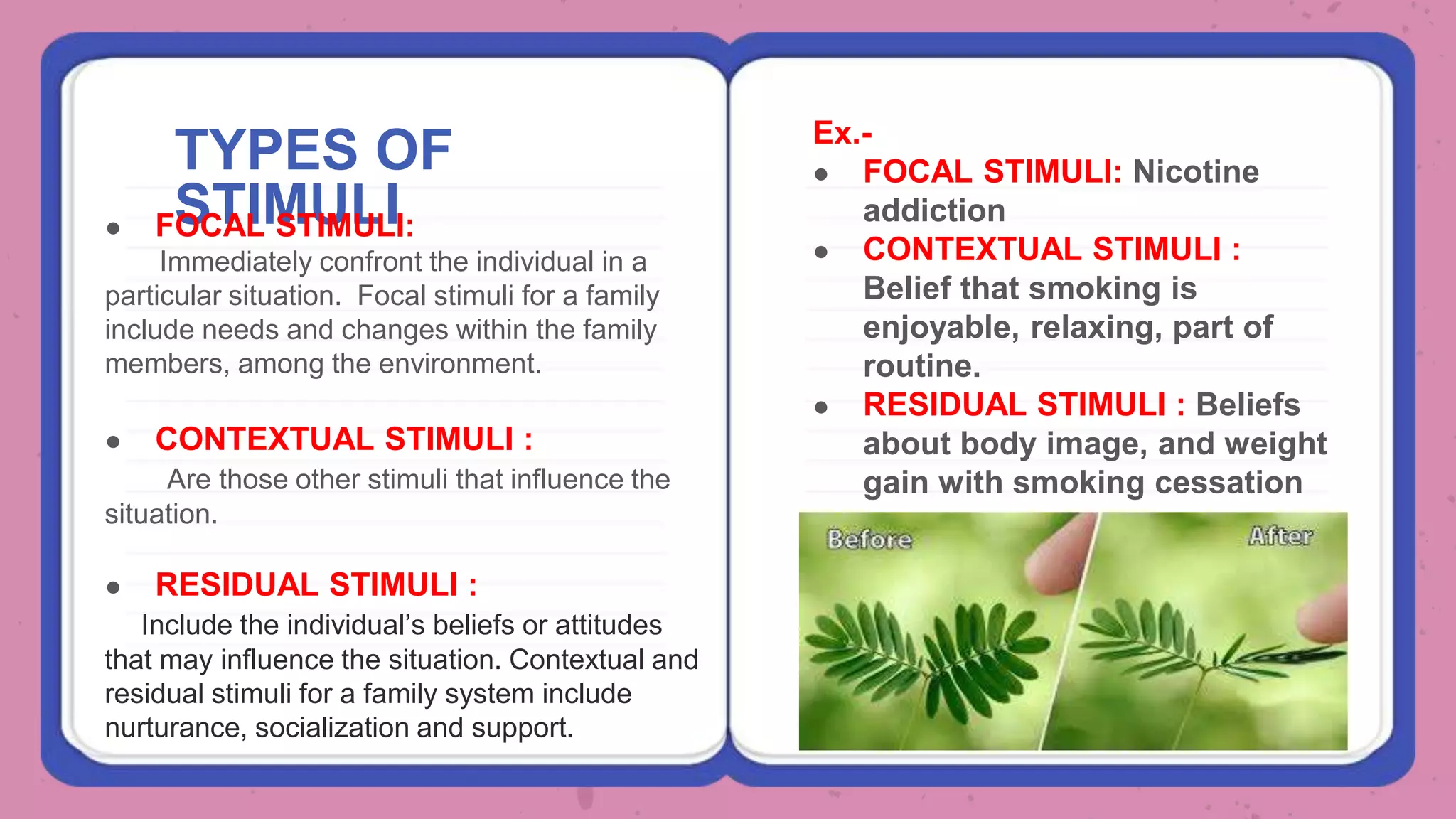
Ex.-
● FOCAL STIMULI: Nicotine
addiction
● CONTEXTUAL STIMULI :
Belief that smoking is
enjoyable, relaxing, part of
routine.
● RESIDUAL STIMULI : Beliefs
about body image, and weight
gain with smoking cessation
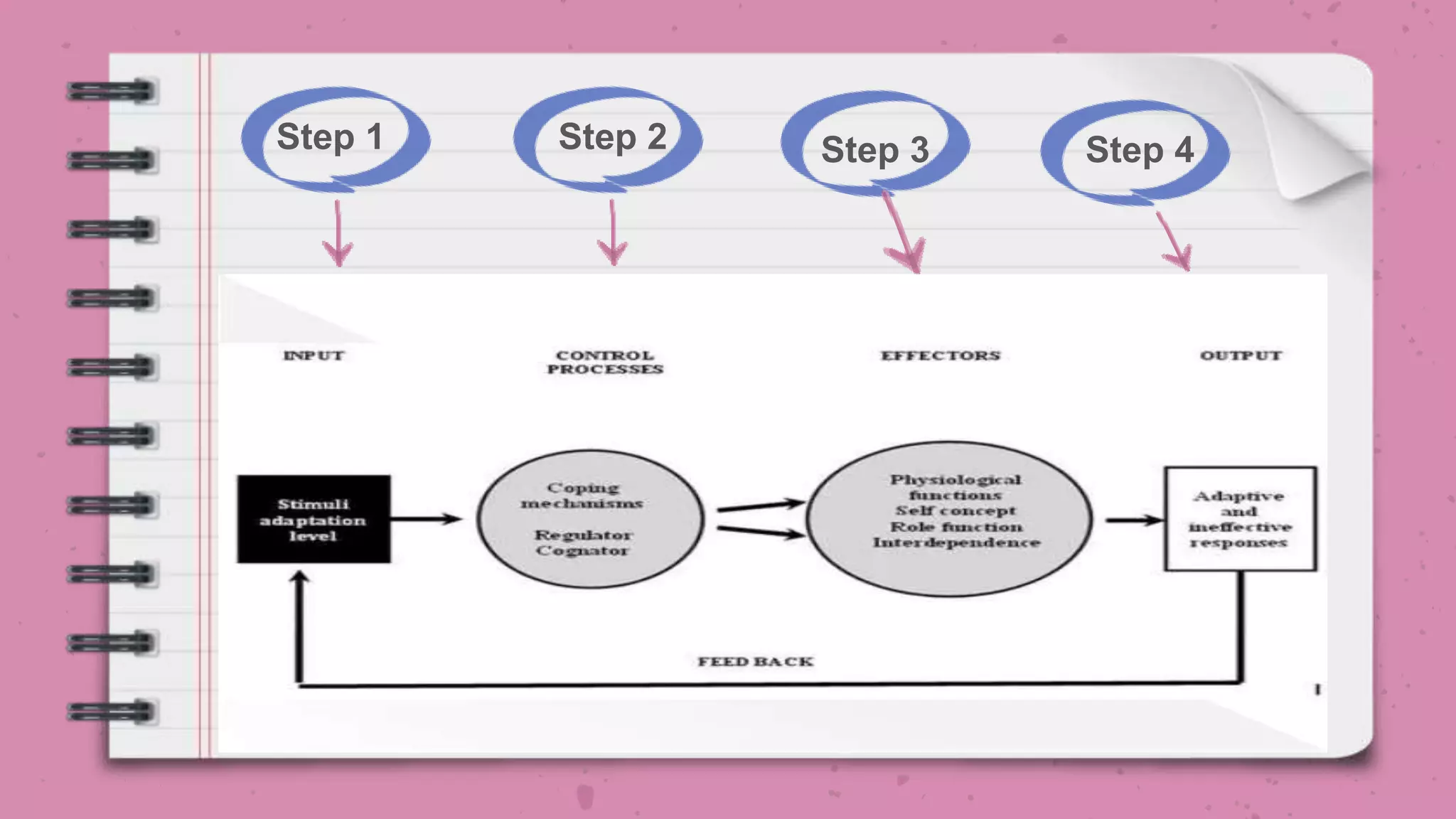
Coping Mechanism
● REGULATOR :
Primarily used as a mechanism to cope with
physiological stimuli.
● COGNATOR :
Used mainly as mechanism to cope with
psychological stimuli dealing primarily in area of cognition,
judgment and emotion.
ADAPTIVE
MODES OF
RAM
PHYSIOLOGICAL
MODE
Oxygenation, nutrition,
elimination, activity, rest,
and protection.
SELF CONCEPT
Psychological and
spiritual elements
ROLE FUNCTION
Primary, secondary and tertiary
roles person performs in
society
INTERDEPENDENCE
Coping mechanisms
arising from close
relationships
Step 1 Step 2 Step 3 Step 4
APPLICATION OF
RAM
TO PROMOTE BEHAVIOR :
●Served as a guide to assess each members
level of adaptation
●Identify actual or potential adaptation
problems
●Examining the stimuli that influence those
problems
●Management of stimuli to promote
adaptation.
IN EDUCATION :
• Nursing education
• Geriatrics Nurse-Practitioner
Program
• University and school of nursing
IN ADMINISTRATION :
• A nurse Philosophy
• Mission Statements
• Standards of Practice
• Job descriptions
• Planning and Appraisal
• Quality Monitoring
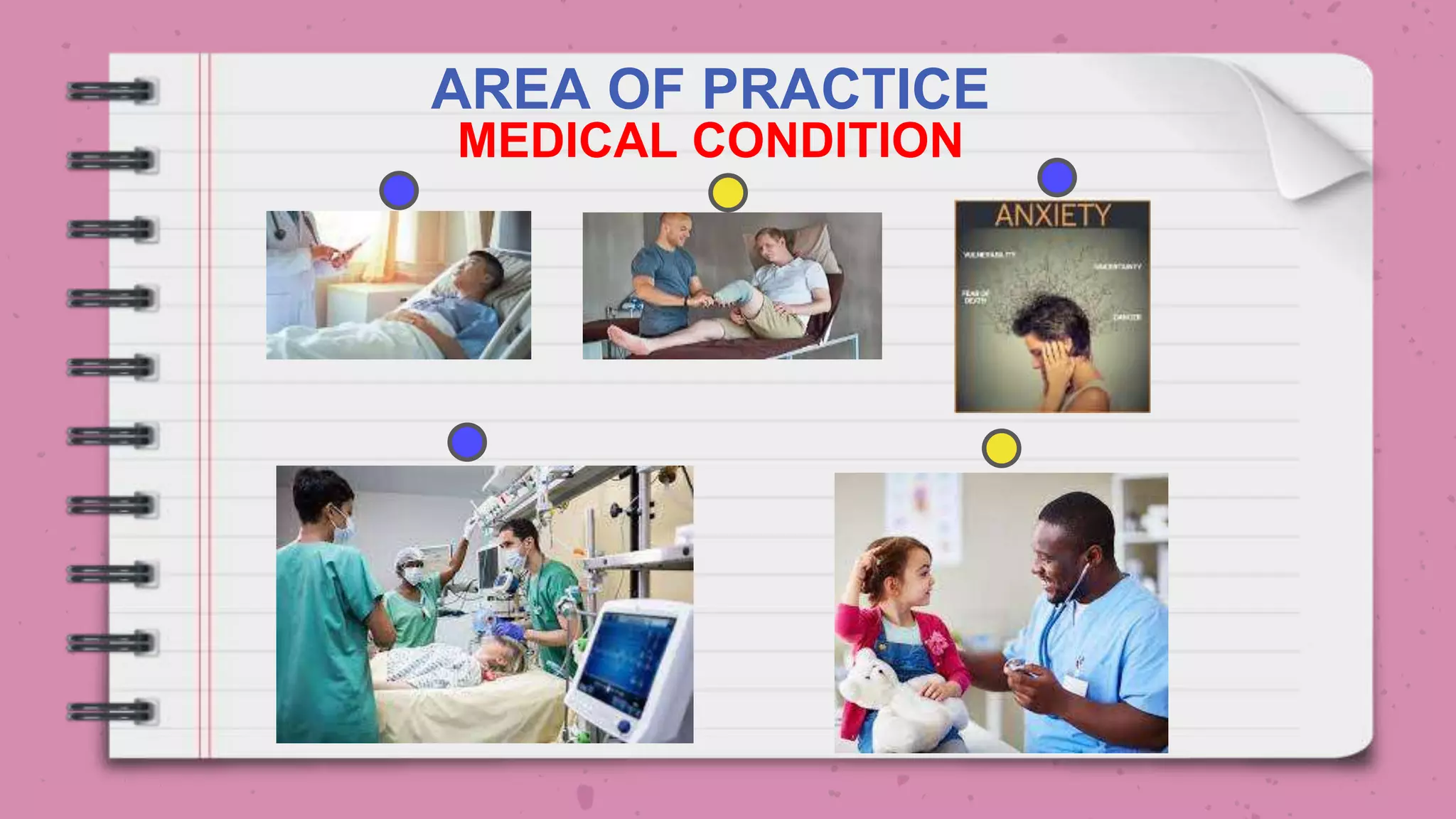
AREA OF PRACTICE
MEDICAL CONDITION
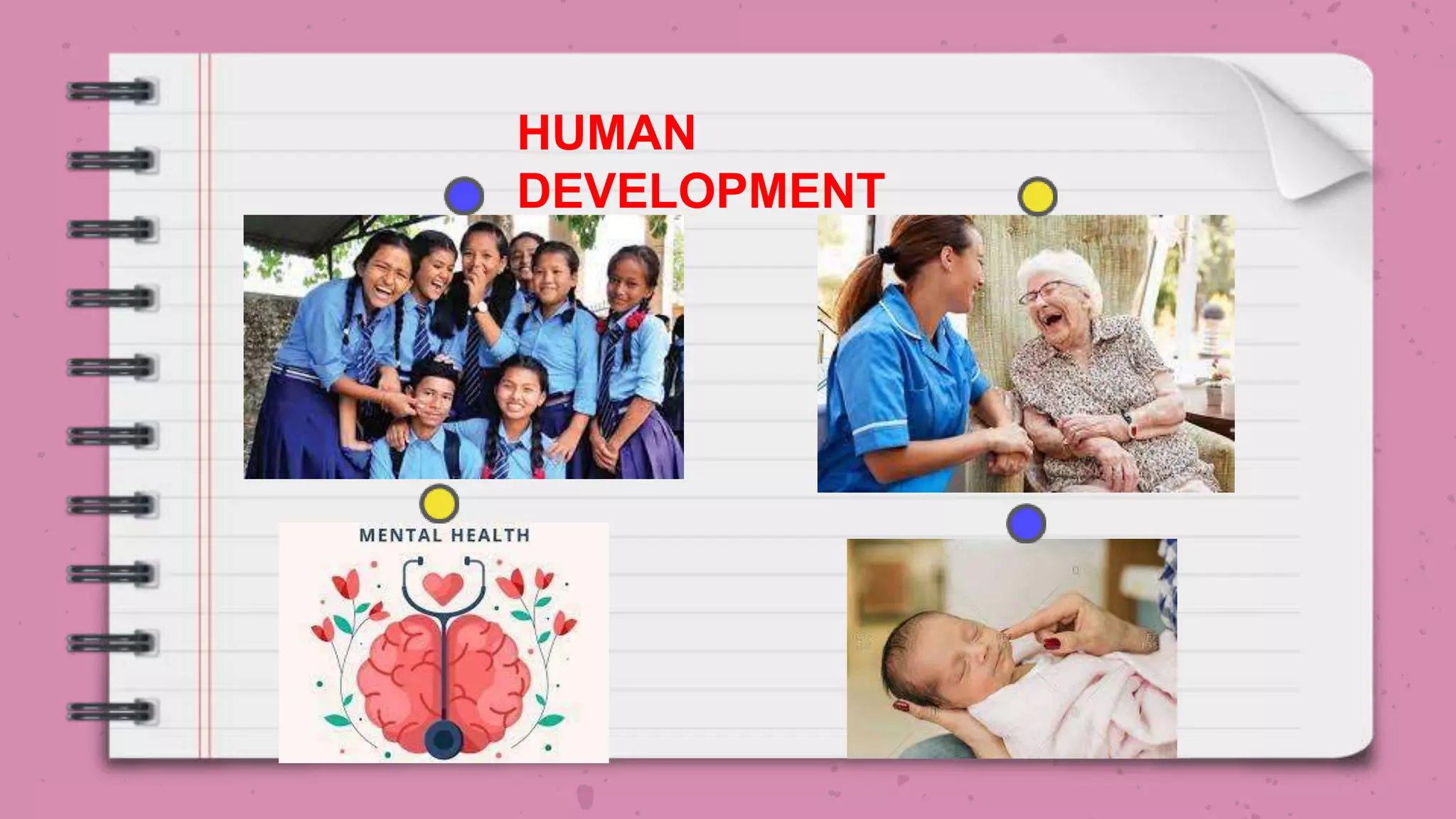
HUMAN
DEVELOPMENT
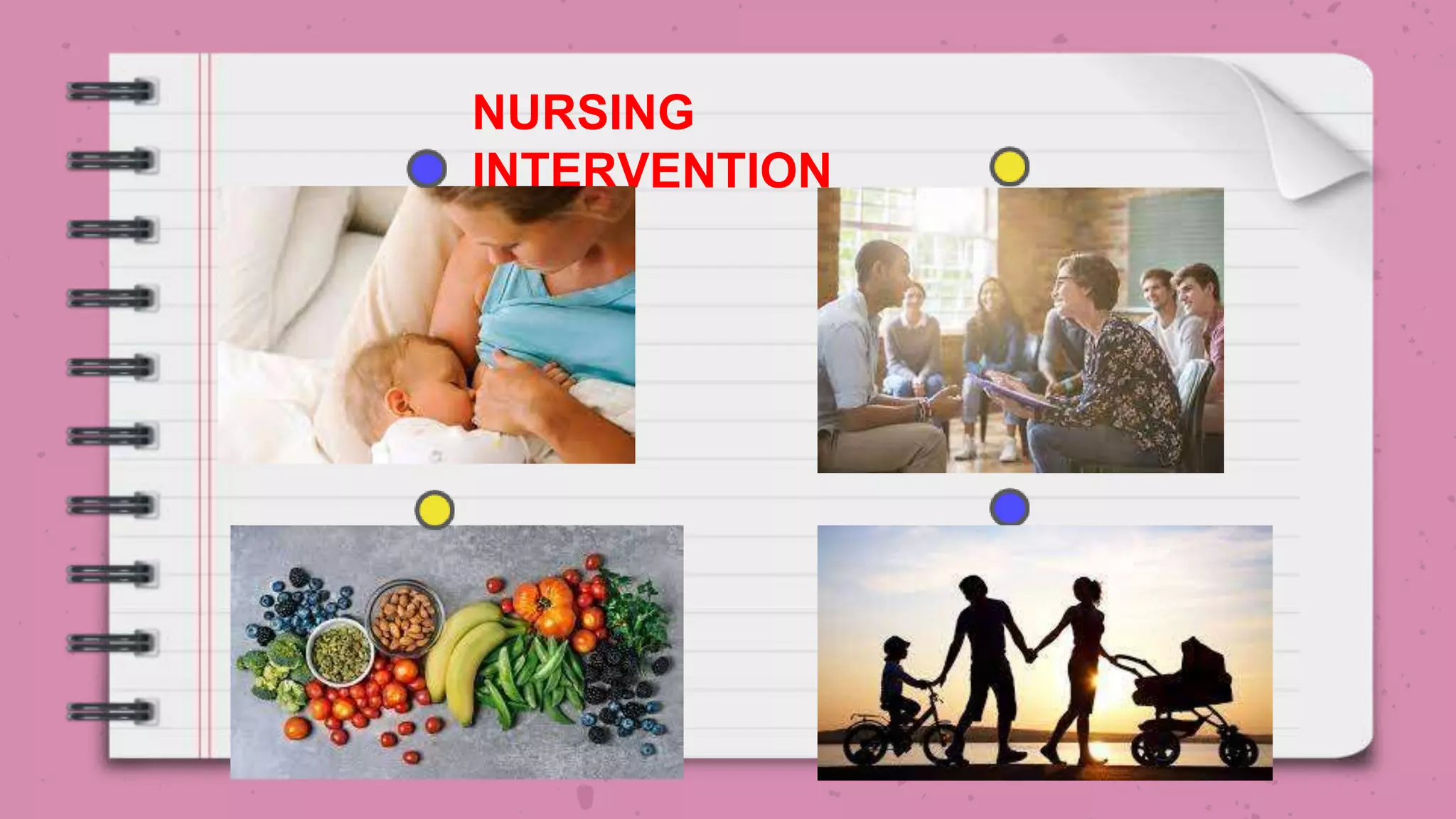
NURSING
INTERVENTION
CONCLUSION
RAM identifies essential concepts relevant to the nursing
profession. The human adaptive system is constantly
interacting with internal and external stimuli which affect
individual’s health. It is the responsibilities of nurse to
manipulate specific stimuli so as to help patient achieve
optimal health. It is useful to analyze groups, individuals
and societies. It is the responsibility of nurse to facilitate
adaption of group and persons so as to enhance their
welfare and well being.
BIBLIOGRAPHY
1. B.T. Basvanthappa, Roy's Adaptation Model Theory,
Nursing Theories, 1st Edition. New Delhi , Jaypee
Brothers Medical Publisher (p) Ltd;2007,Pg. No. : 205 to
224.
2. M.E. Parker, Roy's adaptation Model Theory, Nursing
theory and Nursing Practice, 2nd edition, New Delhi,
Jaypee Brothers Publication(p)Lts;2007.Pg. No. 48
3. Callista-Roy, Received From : www.slideshare.com
roys adaptation model.pptx

roys adaptation model.pptx

  • 1.
  • 2.
    OBJECTIVES At the endof the presentation learner will be able to : ● Introduction ● Describe biographical sketch of Callista Roy. ● Explain evolution of theory. ● Explain assumptions of the theory. ● Describe Roy's adaptation Model. ● Explain metaparadigm of RAM ● Describe Types of stimuli ● Elaborate applications of RAM ● Identify strength and weakness of RAM ● Describe application of theory in practice/education and research. ● Conclusion ● Bibliography
  • 3.
    INTRODUCTION • Nursing isestablishing itself as a scientific discipline. • The nursing models provide the basis for selecting knowledge to be transmitted in nursing education. • It is the framework for nursing practice and the direction for nursing research.
  • 4.
  • 5.
     Born on14th Oct, 1939  Bachelors of arts in Nursing  Masters of science in nursing from University of California, LosAngeles 1966  Masters of arts (M.A.) in sociology.  Associate professor and chairperson of the department on nursing at mount Saint Mary’s college until 1982.  1983-1985 she was post doctoral fellow at Robert Wood Johnson at University of California, as a clinical nurse scholar in neuroscience.
  • 6.
    # Concept ofthe theory was developed when Roy was graduate student. # Challenged by another nurse theorist Dorothy E.Johnson to develop a theory of nursing. # Operationalizing in 1968 # Literature debut in 1970 # Model presentation in 1977 EVOLUTION OF THEORY
  • 7.
    ● Scientific Assumptions ●Philosophical Assumptions ● Assumption from Humanism ● Assumption based on Veritivity ASSUMPTIO NS
  • 8.
    SCIENTIFIC ASSUMPTIO NS • System ofmatter and energy . • Self and environmental awareness • Human decisions • Thinking and feeling • System relationship • Person and the earth relationship • Person and environment transformation • Integration of human and environment PHILOSOPHICAL ASSUMPTIONS • Mutual assumptions • Human meaning • God is intimately revealed in the diversity of creation • Persons use human creative abilities • Persons are accountable for sustaining and transforming the universe
  • 9.
    ASSUMPTIONS OF HUMANISM ASSUMPTION BASED ON VERITIVITY Purposefulnessof human existence Unity of purpose of humankind Activity and creativity from common goods Values and meaning of life • Creativity • Purposefulness • Holism • Interpersonal Process
  • 10.
    ROY’S ADAPTATION MODEL (RAM) “Nursingis to help the person adapt to change in physiological , self-concept, role function and interdependent relations during health and illness”.
  • 11.
    METAPARADIGM OF RAM HEALTH : . HUMANBEING : • The person viewed as a adaptive system, their health, and their environment • Interchanging with the environment • Person also refers to families, groups, communities and the whole society. ENVIRONMENT : • All conditions, circumstances and influences that surround and affect the development and behavior of the person • A change acts as a stimulating and causes adaptive responses • It is a process where he or she is striving to achieve their maximum potential. NURSING : • Nursing acts to enhance the interaction of the person with the environment to promote adaptation.
  • 12.
    TYPES OF STIMULI ● FOCALSTIMULI: Immediately confront the individual in a particular situation. Focal stimuli for a family include needs and changes within the family members, among the environment. ● CONTEXTUAL STIMULI : Are those other stimuli that influence the situation. ● RESIDUAL STIMULI : Include the individual’s beliefs or attitudes that may influence the situation. Contextual and residual stimuli for a family system include nurturance, socialization and support. Ex.- ● FOCAL STIMULI: Nicotine addiction ● CONTEXTUAL STIMULI : Belief that smoking is enjoyable, relaxing, part of routine. ● RESIDUAL STIMULI : Beliefs about body image, and weight gain with smoking cessation
  • 13.
    Coping Mechanism ● REGULATOR: Primarily used as a mechanism to cope with physiological stimuli. ● COGNATOR : Used mainly as mechanism to cope with psychological stimuli dealing primarily in area of cognition, judgment and emotion.
  • 14.
  • 15.
    PHYSIOLOGICAL MODE Oxygenation, nutrition, elimination, activity,rest, and protection. SELF CONCEPT Psychological and spiritual elements
  • 16.
    ROLE FUNCTION Primary, secondaryand tertiary roles person performs in society INTERDEPENDENCE Coping mechanisms arising from close relationships
  • 17.
    Step 1 Step2 Step 3 Step 4
  • 20.
    APPLICATION OF RAM TO PROMOTEBEHAVIOR : ●Served as a guide to assess each members level of adaptation ●Identify actual or potential adaptation problems ●Examining the stimuli that influence those problems ●Management of stimuli to promote adaptation. IN EDUCATION : • Nursing education • Geriatrics Nurse-Practitioner Program • University and school of nursing IN ADMINISTRATION : • A nurse Philosophy • Mission Statements • Standards of Practice • Job descriptions • Planning and Appraisal • Quality Monitoring
  • 22.
  • 23.
  • 24.
  • 26.
    CONCLUSION RAM identifies essentialconcepts relevant to the nursing profession. The human adaptive system is constantly interacting with internal and external stimuli which affect individual’s health. It is the responsibilities of nurse to manipulate specific stimuli so as to help patient achieve optimal health. It is useful to analyze groups, individuals and societies. It is the responsibility of nurse to facilitate adaption of group and persons so as to enhance their welfare and well being.
  • 27.
    BIBLIOGRAPHY 1. B.T. Basvanthappa,Roy's Adaptation Model Theory, Nursing Theories, 1st Edition. New Delhi , Jaypee Brothers Medical Publisher (p) Ltd;2007,Pg. No. : 205 to 224. 2. M.E. Parker, Roy's adaptation Model Theory, Nursing theory and Nursing Practice, 2nd edition, New Delhi, Jaypee Brothers Publication(p)Lts;2007.Pg. No. 48 3. Callista-Roy, Received From : www.slideshare.com