NURSING THEORY MARTHA
ROGERS - THE SCIENCE OF
UNITARY HUMAN BEINGS
AJESH KUMAR
ASSISTANT PROFESSOR
M.M COLLEGE OF NURSING
M.M UNIVERSITY, MULLANA
PICTURE COURTESY
http://images.google.com
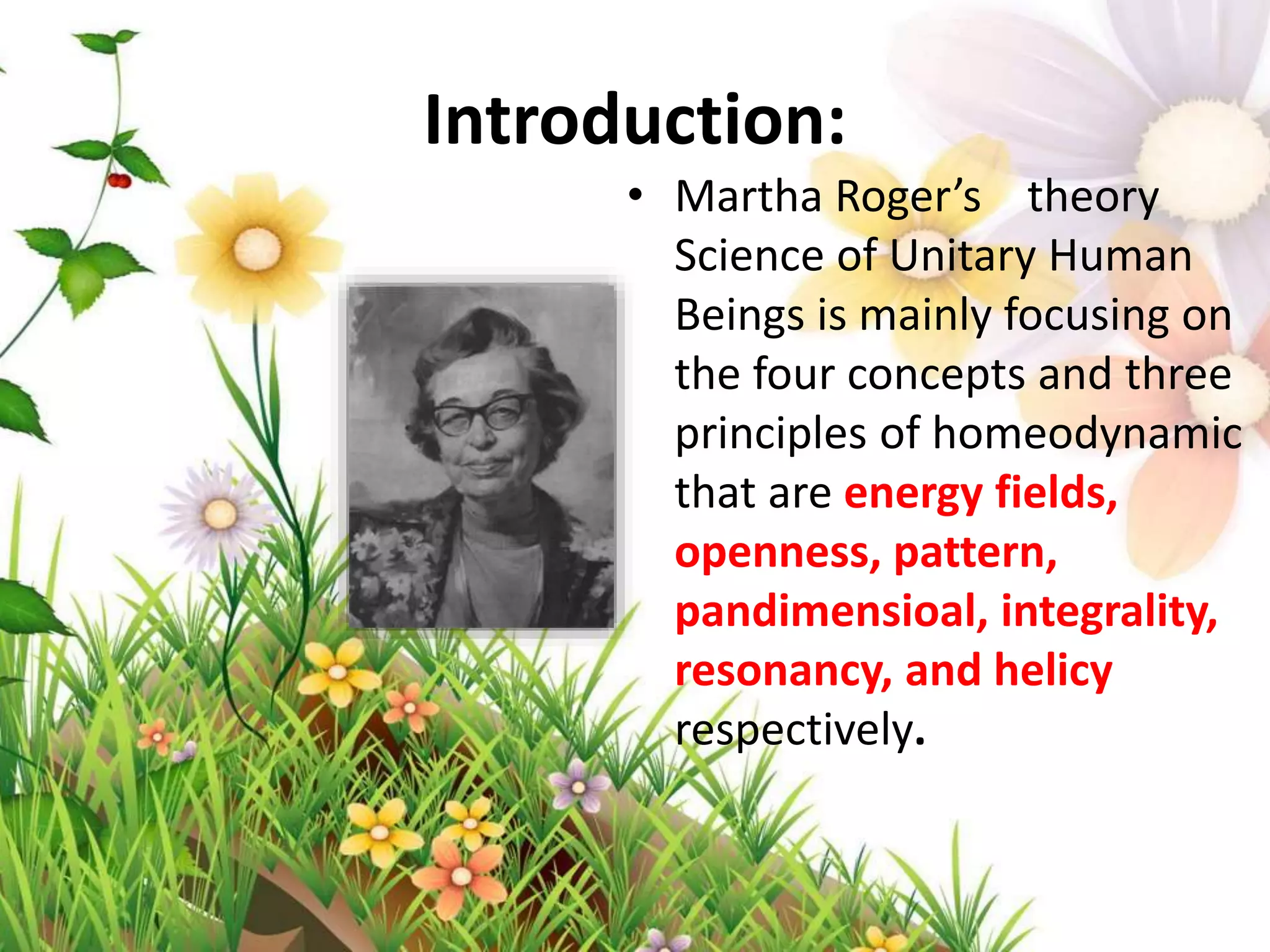
Introduction:
• Martha Roger’s theory
Science of Unitary Human
Beings is mainly focusing on
the four concepts and three
principles of homeodynamic
that are energy fields,
openness, pattern,
pandimensioal, integrality,
resonancy, and helicy
respectively.
Biography:
• She was born in Dallas, Texas May 12, 1914; sharing her
birthday with Florence Nightingale.
• Her family moved to Knoxville, Tennessee before she
turned one.
• As a young child she was very inquisitive to gain more and
more knowledge, she had passion of reading books
• In 1936 She attended nursing diploma programme at
Knoxville General Hospital
• She continued her schooling at George Peabody College
and completed Bachelors of Science in Public Health
Nursing in 1937.
• She worked as a Public Health Nurse for two years after
obtaining degree in Public Health Nursing.
Biography:
• After completeing her Masters in Public Health Nursing
from Teachers College Columbia University in 1946, she
started working as a public health nurse.
• She worked as director of Visiting Nurses Association in
Phoenix, Arizona.
• In 1951 she joined Johns Hopkins University, Baltimore
and completed Doctor of Science in 1954 while she
was working at Catholic University.
• After completing her Doctor of Science she served as
the Head of the Division of nursing at New York
University
• In 1963 she edited the second journal in Nursing i.e.
Nursing Science
Biography:
• An Introduction to the Theoretical Basis of
Nursing was the most famous work of Rogers
which was published in 1970.
• In 1975 she retired as Head of the Division of
nursing from New York University
• She joined Emeritus University in 1979 as a
Professor and continued to work on The
Science of Unitary Human Beings till the time
of her demise in March 13, 1994.
Assumptions:
• Human being is considered as whole which cannot be
viewed as subparts.
• The life process of human is irreparable and one way
i.e. from birth to death.
• Health and illness are the continuous expression of the
life process.
• The energy flows freely between the individual and
environment.
• Human being possesses the ability to think, imagine,
sense, feel, and can use language for expression.
• Human beings have the ability to adapt according to
the new changes in the environment.
Major Concepts:
Concepts:
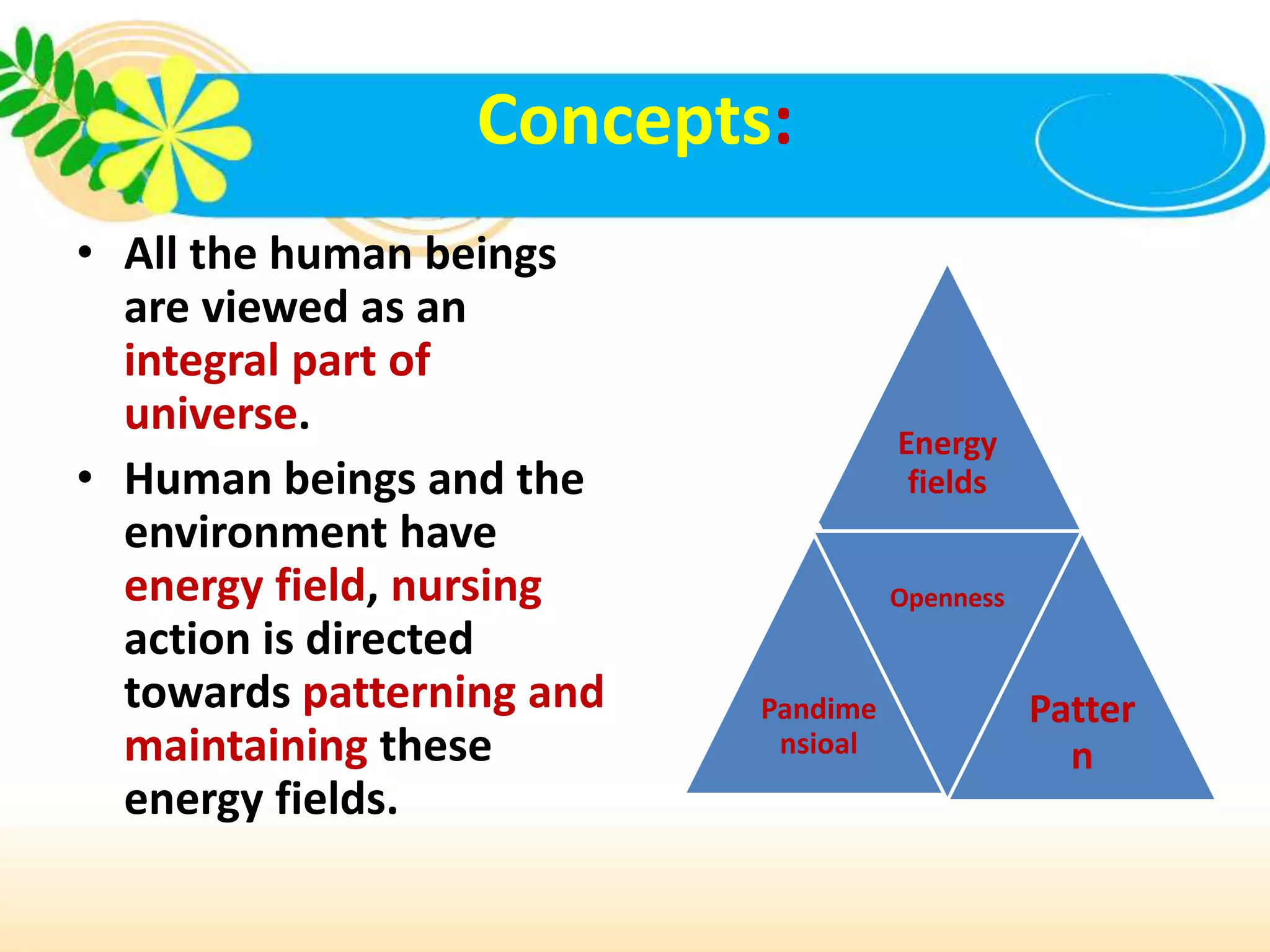
• All the human beings
are viewed as an
integral part of
universe.
• Human beings and the
environment have
energy field, nursing
action is directed
towards patterning and
maintaining these
energy fields.
Energy
fields
Pandime
nsioal
Openness
Patter
n
Energy fields:
• it is the inevitable part of life. Human and
environment both have energy field which is
open i.e. energy can freely flow between
human and environment.
Openness:
• there is no boundary or barrier that can
inhibit the flow of energy between human and
environment which leads to the continuous
movement or matter of energy.
Pattern:
• is the distinguishing character of the energy
field.
Pandimensioal:
• Undeviating field which is not constricted by
space or time, it is an infinite domain without
boundary.
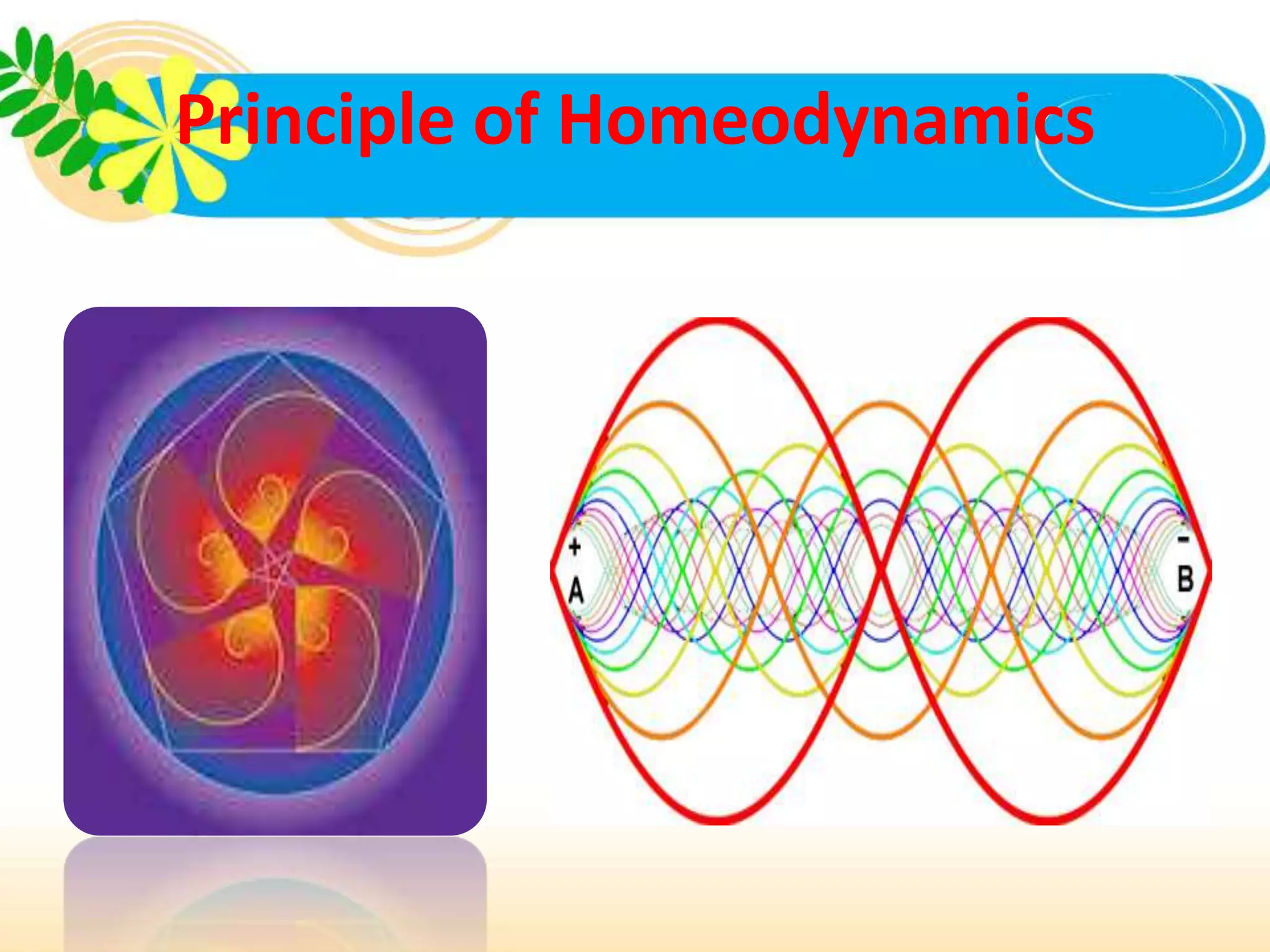
Principle of Homeodynamics
Principle of Homeodynamics:
• Homeodynamics refers to
the balance between the
dynamic life process and
environment.
• These principles help to
view human as unitary
human being. The three
separate principles are
integrality, resonancy, and
heliecy.
Principles of integrality:
• Energy fields are dynamic
and constantly interact with
the human and
environment, which affects
our environment and vice
versa.
• This is the principle on
which meditation and
humor works to produce a
positive environment.
Principles of resonancy:
• is an ordered arrangement of
rhythm characterizing both
human field and
environmental field
• Constant change in the way
or pattern of the energy field
from a lower to higher
frequency.
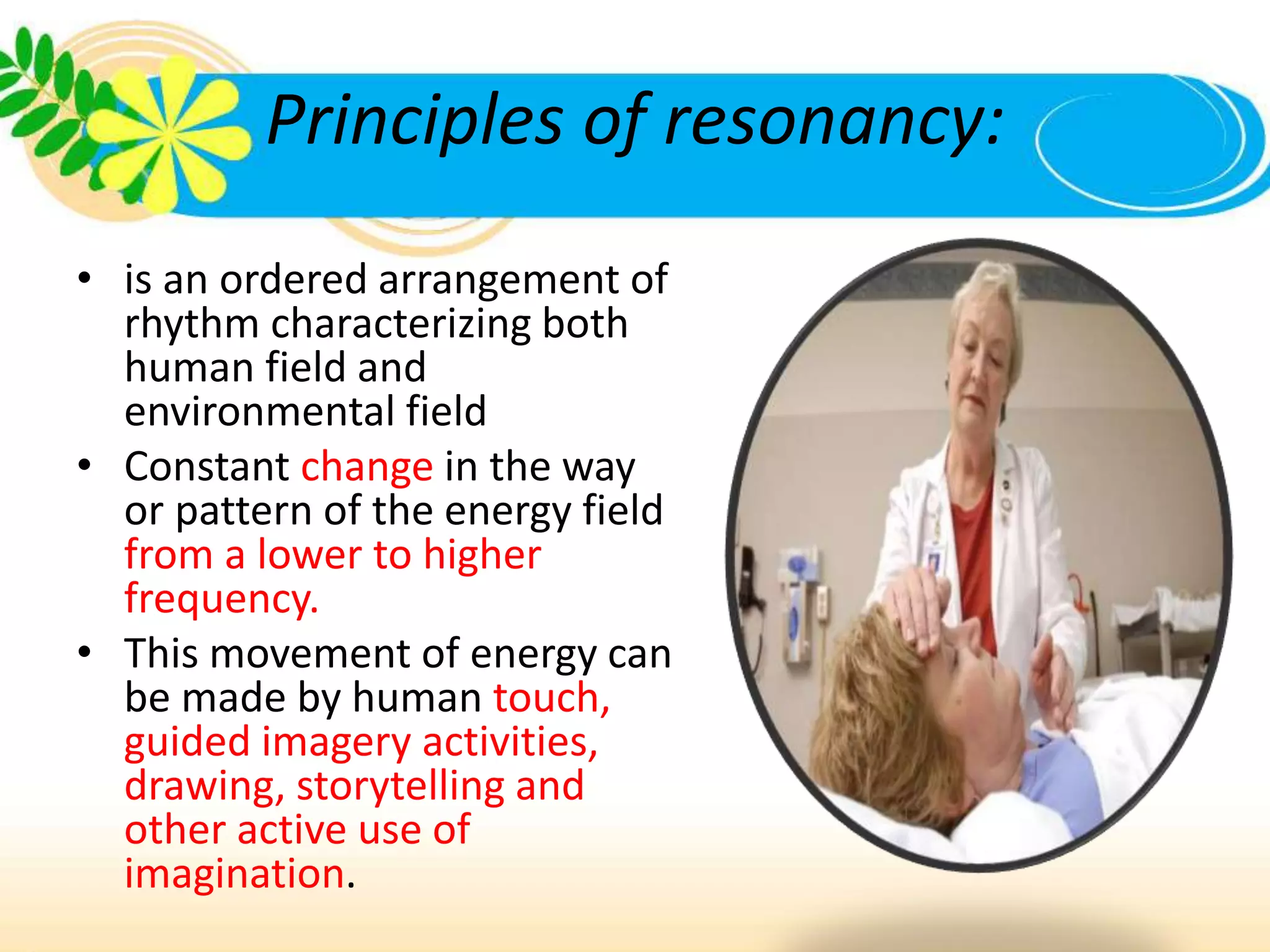
• This movement of energy can
be made by human touch,
guided imagery activities,
drawing, storytelling and
other active use of
imagination.
Principles of heliecy:
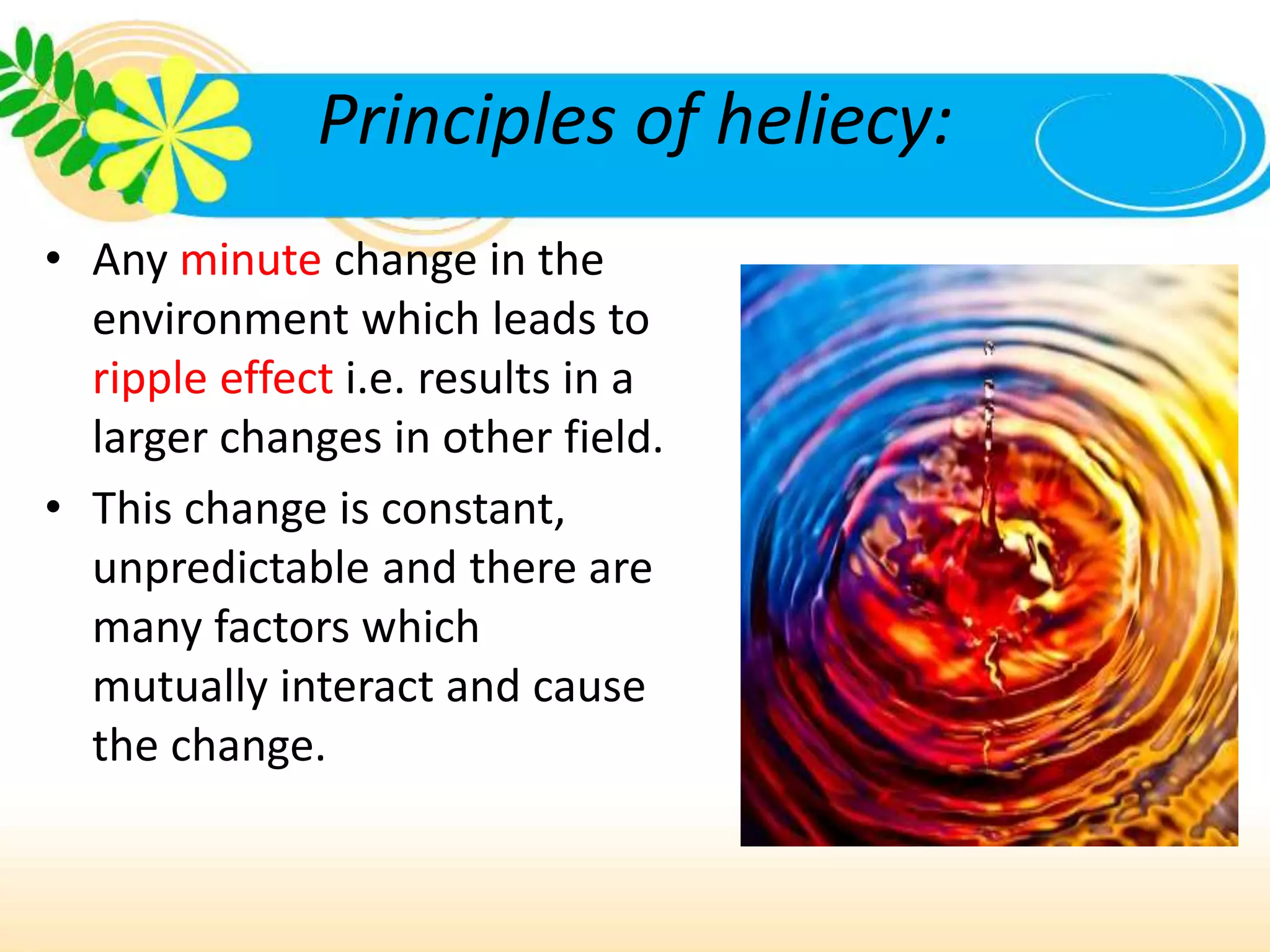
• Any minute change in the
environment which leads to
ripple effect i.e. results in a
larger changes in other field.
• This change is constant,
unpredictable and there are
many factors which
mutually interact and cause
the change.
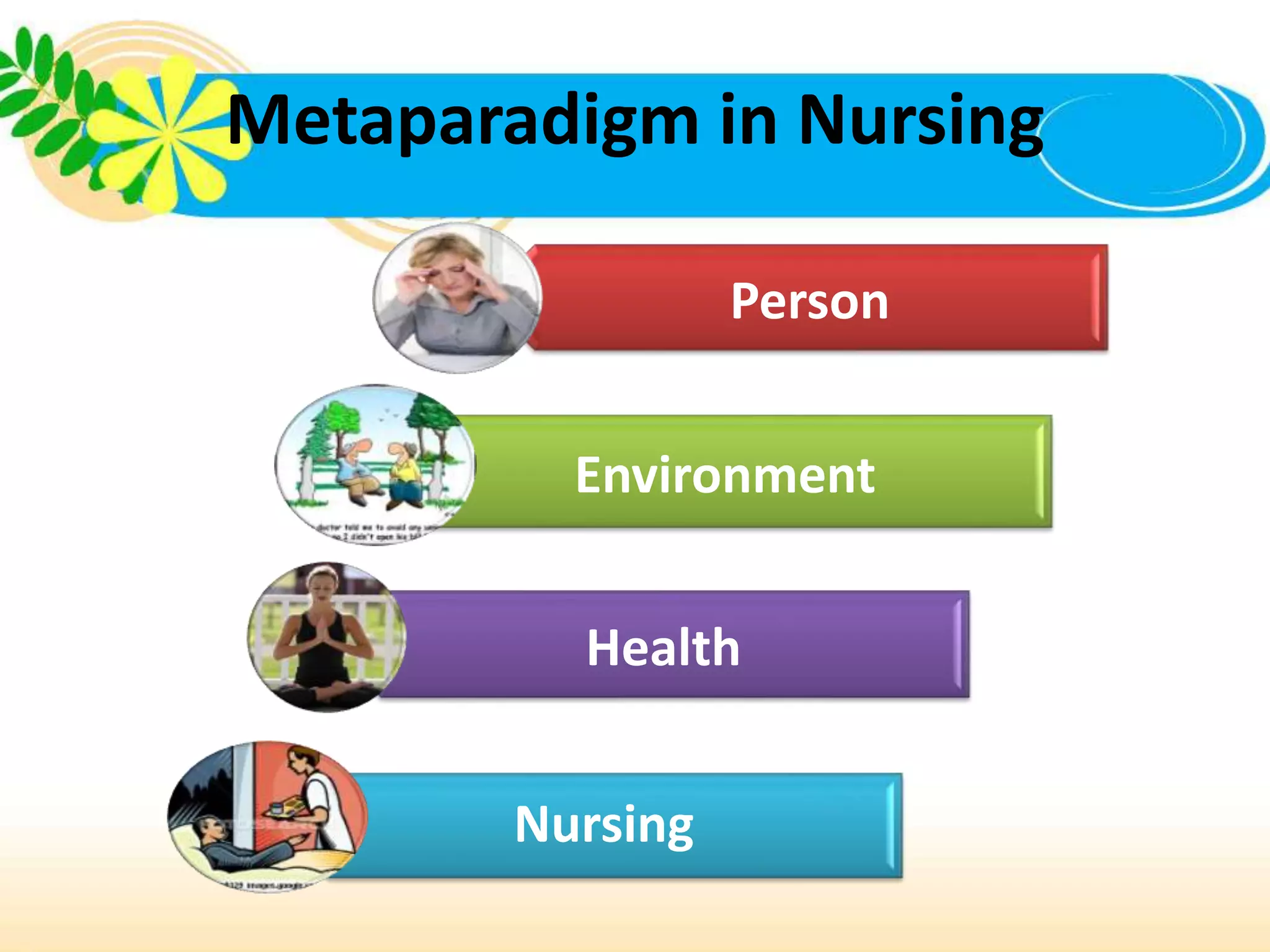
Metaparadigm in Nursing
Person
Environment
Health
Nursing
Person:
• a unitary human being is open systems which
continuously interact with environment. A
person cannot be viewed as parts, it should be
considered as a whole.
Environment:
• it includes the entire energy field other than a
person.
• These energy fields are irreducible, not limited
by space and time, identified by its pattern
and organization
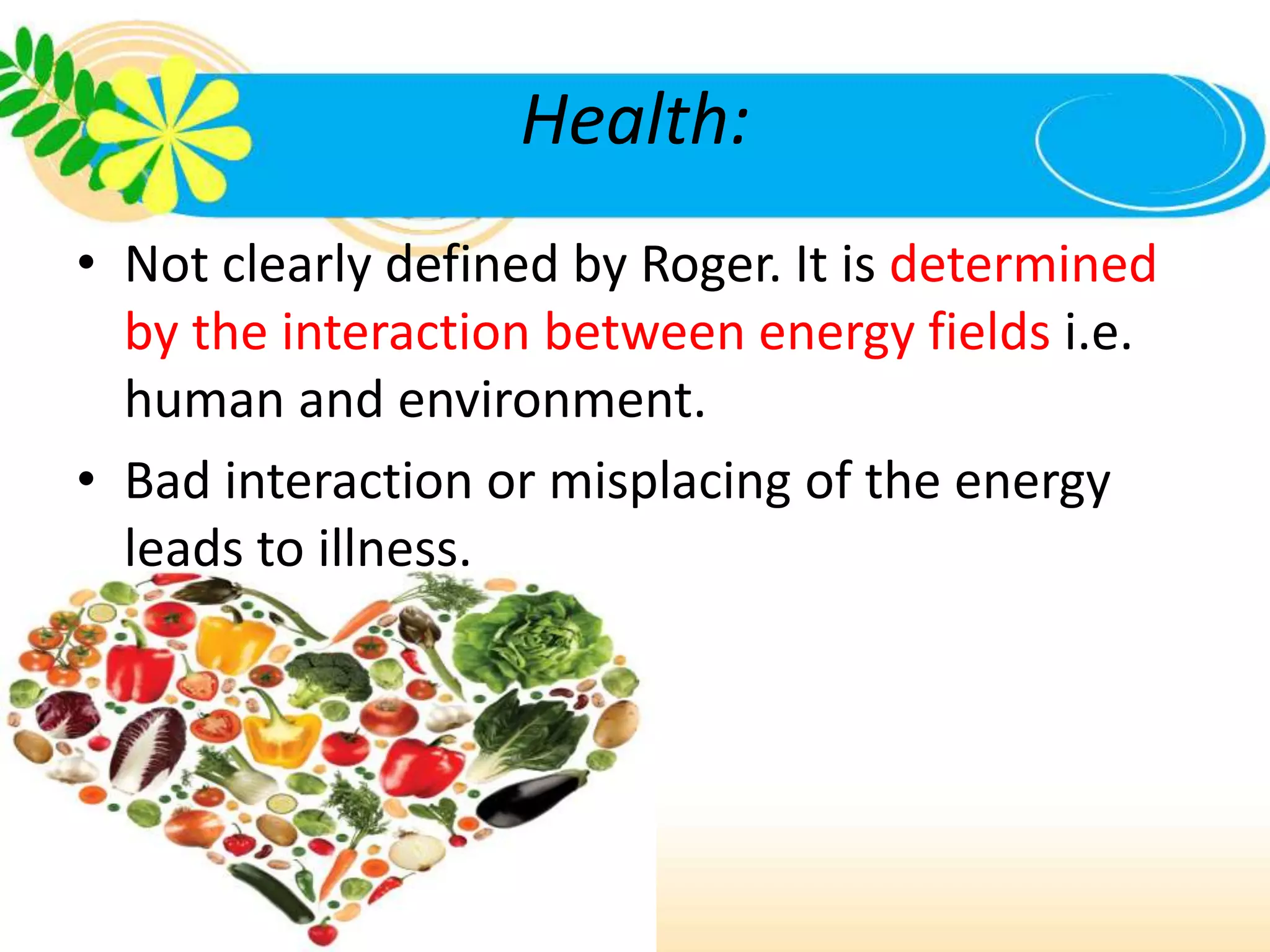
Health:
• Not clearly defined by Roger. It is determined
by the interaction between energy fields i.e.
human and environment.
• Bad interaction or misplacing of the energy
leads to illness.
Nursing:
• Is both science and art.
• It constantly maintains the energy field which
is conducive for patient.
• Nursing action directs the interaction of
person and environment to maximize health
potential.
Application of SUBH:
PRACTICE
EDUCATION
RESEARCH
Monday, April 20, 2015 23
Clinical Practice:
• Nursing action is always
focused on unitary human
being and change the energy
field between human and
environment.
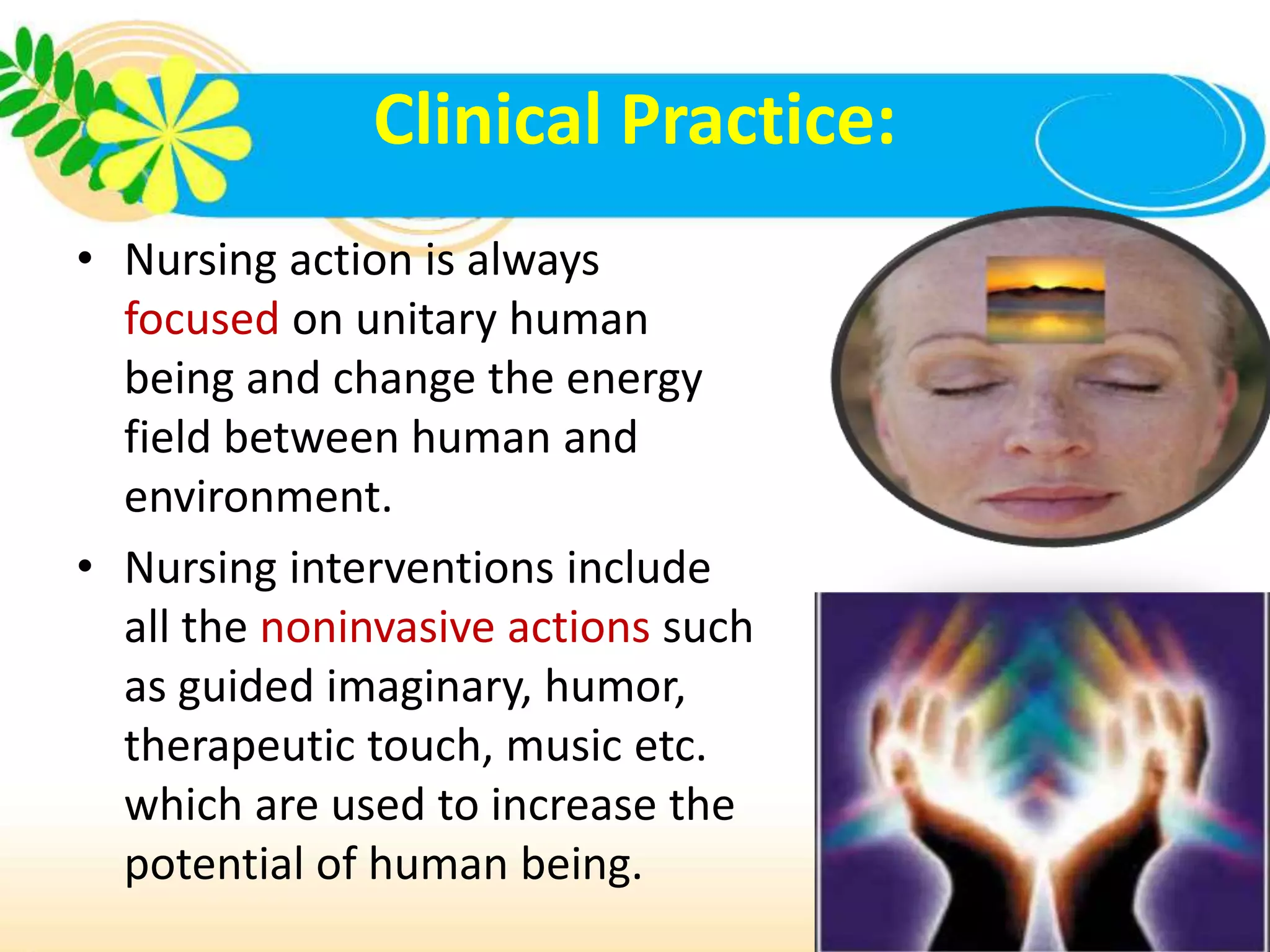
• Nursing interventions include
all the noninvasive actions such
as guided imaginary, humor,
therapeutic touch, music etc.
which are used to increase the
potential of human being.
Clinical practice cont…
• The more importance
should be on the
management of pain,
supportive psychotherapy
and rehabilitation of the
human being.
Clinical practice cont…
Nursing
Assessment &
Diagnosis
Interventions and
Rehabilitation
Prevention of
Illness
Maintennace of
Health
Promotion of
Health
Nursing Education:
• Emphasis should be given
on the understanding of the
patient and self, energy field
and environment.
• Training should lay more
focus on teaching non-
invasive modalities such as
therapeutic touch,
meditation, humor, regular
in-service education
programme etc.
Nursing Research:
• Rogerian theory has
been used in many
research works and has
always been found
testable and applicable
in research.
Nursing process according to SUBH:
Monday, April 20, 2015 29
Pattern
appraisal
Mutual
patterning
Evaluation
Pattern appraisal:
• It is an inclusive assessment
of human and environment
energy fields, its
organization of energy field,
and identification of areas
of dissonance.
• Nurses validate the entire
appraisal along with the
client.
Mutual patterning:
• It is the proper patterning of
the energy fields between
the human and environment.
• It is the mutual interaction
between the client and nurse
• Patterning can be done by
suggesting the various
alternatives, educating,
empowering, encouraging
etc. depending on the client’s
condition and needs.
Mutual patterning cont..
• Pattern appraisal
include appraisal of
nutrition, rest and
sleep, exercises,
discomfort, and relation
with others.
• The pattering activities
can be therapeutic
touch, meditation,
humor, imaginery etc.
Evaluation:
• Evaluation is done by
repeating the pattern
appraisal after the
mutual patterning to
determine the extents
of dissonance and
harmony.
•
Clinical scenario:
• Mr. X is a 54 years old male admitted in the Male
Psychiatric ward with the diagnosis of major
depression secondary to the diagnosis of Myocardial
Infraction (MI).
• He was very tense and sobbing during the history
collection.
• He was accompanied by his wife and son. Even though
his wife was anxious but still she was supportive and
helpful.
• Mr. X was diagnosed with MI four months back and
underwent the angioplasty three months ago.
• Currently he is on Statins and Antihypertensives.
Clinical scenario:
• He started to show the sings and symptoms of
depression from the past one month.
• He used to sit alone, diminished the activities of daily
living, regular crying spells, decreased chat, self
muttering, insomnia, anorexia, body aches, least
bothered about personal hygiene, two days before he
attempted suicide by hanging on ceiling fan.
• His present findings based on the assessment shows
that he is very tearful, socially withdrawn, nutritional
status is impaired, crying spells, sad mood, and risk for
committing suicide.
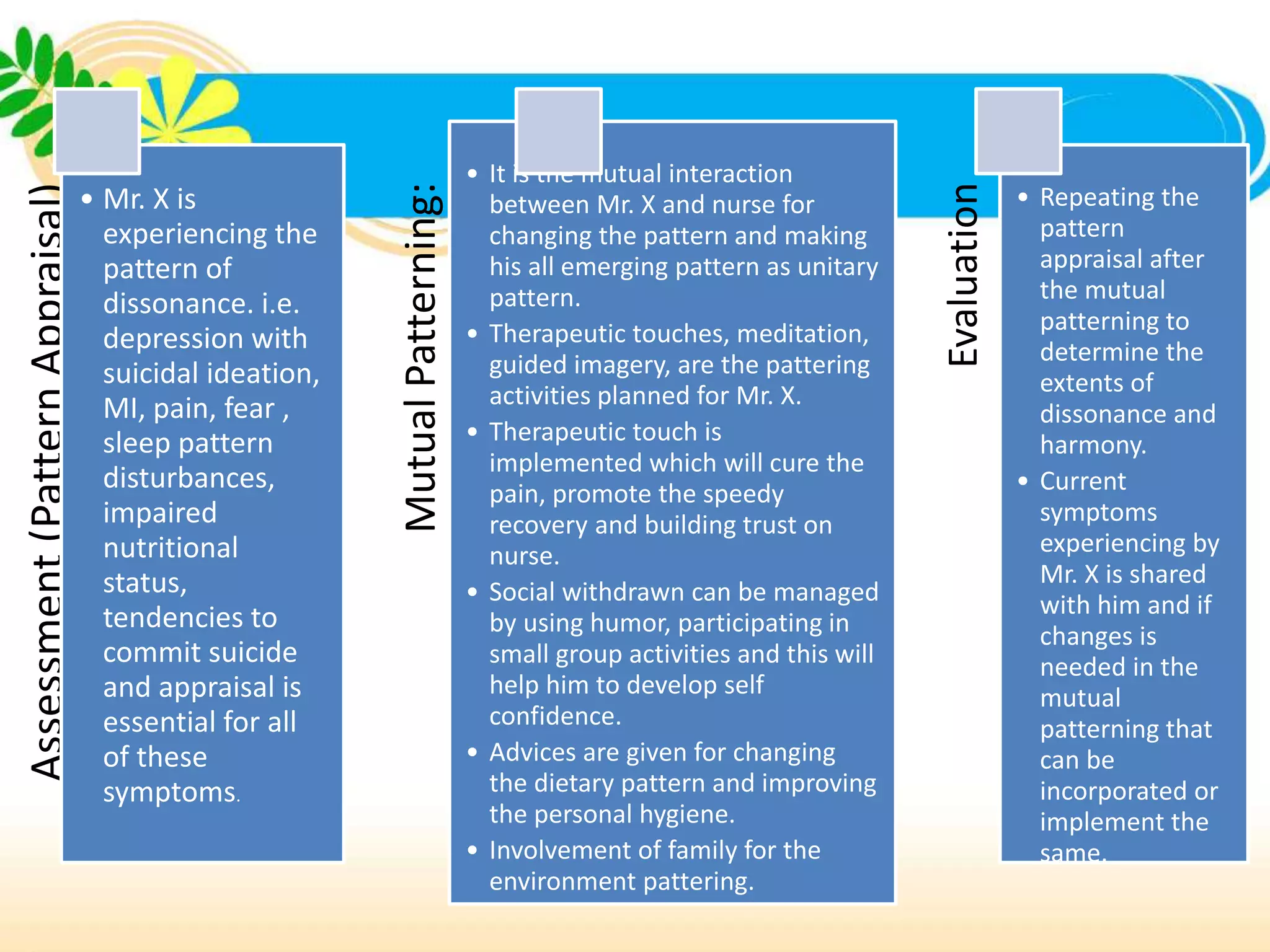
Assessment(PatternAppraisal)
• Mr. X is
experiencing the
pattern of
dissonance. i.e.
depression with
suicidal ideation,
MI, pain, fear ,
sleep pattern
disturbances,
impaired
nutritional
status,
tendencies to
commit suicide
and appraisal is
essential for all
of these
symptoms.
MutualPatterning:
• It is the mutual interaction
between Mr. X and nurse for
changing the pattern and making
his all emerging pattern as unitary
pattern.
• Therapeutic touches, meditation,
guided imagery, are the pattering
activities planned for Mr. X.
• Therapeutic touch is
implemented which will cure the
pain, promote the speedy
recovery and building trust on
nurse.
• Social withdrawn can be managed
by using humor, participating in
small group activities and this will
help him to develop self
confidence.
• Advices are given for changing
the dietary pattern and improving
the personal hygiene.
• Involvement of family for the
environment pattering.
Evaluation
• Repeating the
pattern
appraisal after
the mutual
patterning to
determine the
extents of
dissonance and
harmony.
• Current
symptoms
experiencing by
Mr. X is shared
with him and if
changes is
needed in the
mutual
patterning that
can be
incorporated or
implement the
same.
Critique of the SUBH:
Simplicity:
• although the concepts
seems to quite difficult
to understand.
• It’s a parsimonious
theory.
• Parsimony refers to
theory based on simple
assumption but proves
to be very valuable.
Clarity:
• overall Rogerian SUBH
is considered as
complex but still efforts
are going on to clarify
the complex concepts.
Generality:
• The uses on non-
invasive modalities are
very useful and
important to nursing
even today.
• SUBH is the foundation
of many theories and it
can be apply in a variety
of setting and all
spheres of life.
Empirical precision:
• Rogerian theory has been used
in many research works and
has been found testable and
applicable in research.
• But, many limitations have also
been identified by the
researchers such as difficult to
understand the concepts, lack
of operational definitions and
instruments for the proper
evaluation of the instruments.
Conclusion:
• SUBH leads to a new way of seeing the person as
a unitary human being and new style of nursing
practice.
• This model is applicable in all the setting and
every spheres of life.
• Rogers emphasized the need for noninvasive
nursing modalities in achieving the health
potential, it is very evident in today’s situation
that there is more focus on the alternative system
of medicine and noninvasive nursing actions are
in getting much importance.
References
• Margaret Ruddy; Model & Theories of
Nursing; Cardinal Stritch University Library;
2007; p. 34-35.
• Tomey, A.M. & Alligood,M.R.; Nursing Theorist
& their work; 5th edition; 2006; p. 226-249.
• George B. Julia, Nursing Theories, The base for
Professional Nursing Practice, 5th Edition 2002
Thank you….

NURSING THEORY Martha Rogers - The Science of Unitary Human Beings

  • 1.
    NURSING THEORY MARTHA ROGERS- THE SCIENCE OF UNITARY HUMAN BEINGS AJESH KUMAR ASSISTANT PROFESSOR M.M COLLEGE OF NURSING M.M UNIVERSITY, MULLANA PICTURE COURTESY http://images.google.com
  • 2.
    Introduction: • Martha Roger’stheory Science of Unitary Human Beings is mainly focusing on the four concepts and three principles of homeodynamic that are energy fields, openness, pattern, pandimensioal, integrality, resonancy, and helicy respectively.
  • 3.
    Biography: • She wasborn in Dallas, Texas May 12, 1914; sharing her birthday with Florence Nightingale. • Her family moved to Knoxville, Tennessee before she turned one. • As a young child she was very inquisitive to gain more and more knowledge, she had passion of reading books • In 1936 She attended nursing diploma programme at Knoxville General Hospital • She continued her schooling at George Peabody College and completed Bachelors of Science in Public Health Nursing in 1937. • She worked as a Public Health Nurse for two years after obtaining degree in Public Health Nursing.
  • 4.
    Biography: • After completeingher Masters in Public Health Nursing from Teachers College Columbia University in 1946, she started working as a public health nurse. • She worked as director of Visiting Nurses Association in Phoenix, Arizona. • In 1951 she joined Johns Hopkins University, Baltimore and completed Doctor of Science in 1954 while she was working at Catholic University. • After completing her Doctor of Science she served as the Head of the Division of nursing at New York University • In 1963 she edited the second journal in Nursing i.e. Nursing Science
  • 5.
    Biography: • An Introductionto the Theoretical Basis of Nursing was the most famous work of Rogers which was published in 1970. • In 1975 she retired as Head of the Division of nursing from New York University • She joined Emeritus University in 1979 as a Professor and continued to work on The Science of Unitary Human Beings till the time of her demise in March 13, 1994.
  • 6.
    Assumptions: • Human beingis considered as whole which cannot be viewed as subparts. • The life process of human is irreparable and one way i.e. from birth to death. • Health and illness are the continuous expression of the life process. • The energy flows freely between the individual and environment. • Human being possesses the ability to think, imagine, sense, feel, and can use language for expression. • Human beings have the ability to adapt according to the new changes in the environment.
  • 7.
  • 8.
    Concepts: • All thehuman beings are viewed as an integral part of universe. • Human beings and the environment have energy field, nursing action is directed towards patterning and maintaining these energy fields. Energy fields Pandime nsioal Openness Patter n
  • 9.
    Energy fields: • itis the inevitable part of life. Human and environment both have energy field which is open i.e. energy can freely flow between human and environment.
  • 10.
    Openness: • there isno boundary or barrier that can inhibit the flow of energy between human and environment which leads to the continuous movement or matter of energy.
  • 11.
    Pattern: • is thedistinguishing character of the energy field.
  • 12.
    Pandimensioal: • Undeviating fieldwhich is not constricted by space or time, it is an infinite domain without boundary.
  • 13.
  • 14.
    Principle of Homeodynamics: •Homeodynamics refers to the balance between the dynamic life process and environment. • These principles help to view human as unitary human being. The three separate principles are integrality, resonancy, and heliecy.
  • 15.
    Principles of integrality: •Energy fields are dynamic and constantly interact with the human and environment, which affects our environment and vice versa. • This is the principle on which meditation and humor works to produce a positive environment.
  • 16.
    Principles of resonancy: •is an ordered arrangement of rhythm characterizing both human field and environmental field • Constant change in the way or pattern of the energy field from a lower to higher frequency. • This movement of energy can be made by human touch, guided imagery activities, drawing, storytelling and other active use of imagination.
  • 17.
    Principles of heliecy: •Any minute change in the environment which leads to ripple effect i.e. results in a larger changes in other field. • This change is constant, unpredictable and there are many factors which mutually interact and cause the change.
  • 18.
  • 19.
    Person: • a unitaryhuman being is open systems which continuously interact with environment. A person cannot be viewed as parts, it should be considered as a whole.
  • 20.
    Environment: • it includesthe entire energy field other than a person. • These energy fields are irreducible, not limited by space and time, identified by its pattern and organization
  • 21.
    Health: • Not clearlydefined by Roger. It is determined by the interaction between energy fields i.e. human and environment. • Bad interaction or misplacing of the energy leads to illness.
  • 22.
    Nursing: • Is bothscience and art. • It constantly maintains the energy field which is conducive for patient. • Nursing action directs the interaction of person and environment to maximize health potential.
  • 23.
  • 24.
    Clinical Practice: • Nursingaction is always focused on unitary human being and change the energy field between human and environment. • Nursing interventions include all the noninvasive actions such as guided imaginary, humor, therapeutic touch, music etc. which are used to increase the potential of human being.
  • 25.
    Clinical practice cont… •The more importance should be on the management of pain, supportive psychotherapy and rehabilitation of the human being.
  • 26.
    Clinical practice cont… Nursing Assessment& Diagnosis Interventions and Rehabilitation Prevention of Illness Maintennace of Health Promotion of Health
  • 27.
    Nursing Education: • Emphasisshould be given on the understanding of the patient and self, energy field and environment. • Training should lay more focus on teaching non- invasive modalities such as therapeutic touch, meditation, humor, regular in-service education programme etc.
  • 28.
    Nursing Research: • Rogeriantheory has been used in many research works and has always been found testable and applicable in research.
  • 29.
    Nursing process accordingto SUBH: Monday, April 20, 2015 29 Pattern appraisal Mutual patterning Evaluation
  • 30.
    Pattern appraisal: • Itis an inclusive assessment of human and environment energy fields, its organization of energy field, and identification of areas of dissonance. • Nurses validate the entire appraisal along with the client.
  • 31.
    Mutual patterning: • Itis the proper patterning of the energy fields between the human and environment. • It is the mutual interaction between the client and nurse • Patterning can be done by suggesting the various alternatives, educating, empowering, encouraging etc. depending on the client’s condition and needs.
  • 32.
    Mutual patterning cont.. •Pattern appraisal include appraisal of nutrition, rest and sleep, exercises, discomfort, and relation with others. • The pattering activities can be therapeutic touch, meditation, humor, imaginery etc.
  • 33.
    Evaluation: • Evaluation isdone by repeating the pattern appraisal after the mutual patterning to determine the extents of dissonance and harmony. •
  • 34.
    Clinical scenario: • Mr.X is a 54 years old male admitted in the Male Psychiatric ward with the diagnosis of major depression secondary to the diagnosis of Myocardial Infraction (MI). • He was very tense and sobbing during the history collection. • He was accompanied by his wife and son. Even though his wife was anxious but still she was supportive and helpful. • Mr. X was diagnosed with MI four months back and underwent the angioplasty three months ago. • Currently he is on Statins and Antihypertensives.
  • 35.
    Clinical scenario: • Hestarted to show the sings and symptoms of depression from the past one month. • He used to sit alone, diminished the activities of daily living, regular crying spells, decreased chat, self muttering, insomnia, anorexia, body aches, least bothered about personal hygiene, two days before he attempted suicide by hanging on ceiling fan. • His present findings based on the assessment shows that he is very tearful, socially withdrawn, nutritional status is impaired, crying spells, sad mood, and risk for committing suicide.
  • 36.
    Assessment(PatternAppraisal) • Mr. Xis experiencing the pattern of dissonance. i.e. depression with suicidal ideation, MI, pain, fear , sleep pattern disturbances, impaired nutritional status, tendencies to commit suicide and appraisal is essential for all of these symptoms. MutualPatterning: • It is the mutual interaction between Mr. X and nurse for changing the pattern and making his all emerging pattern as unitary pattern. • Therapeutic touches, meditation, guided imagery, are the pattering activities planned for Mr. X. • Therapeutic touch is implemented which will cure the pain, promote the speedy recovery and building trust on nurse. • Social withdrawn can be managed by using humor, participating in small group activities and this will help him to develop self confidence. • Advices are given for changing the dietary pattern and improving the personal hygiene. • Involvement of family for the environment pattering. Evaluation • Repeating the pattern appraisal after the mutual patterning to determine the extents of dissonance and harmony. • Current symptoms experiencing by Mr. X is shared with him and if changes is needed in the mutual patterning that can be incorporated or implement the same.
  • 37.
  • 38.
    Simplicity: • although theconcepts seems to quite difficult to understand. • It’s a parsimonious theory. • Parsimony refers to theory based on simple assumption but proves to be very valuable.
  • 39.
    Clarity: • overall RogerianSUBH is considered as complex but still efforts are going on to clarify the complex concepts.
  • 40.
    Generality: • The useson non- invasive modalities are very useful and important to nursing even today. • SUBH is the foundation of many theories and it can be apply in a variety of setting and all spheres of life.
  • 41.
    Empirical precision: • Rogeriantheory has been used in many research works and has been found testable and applicable in research. • But, many limitations have also been identified by the researchers such as difficult to understand the concepts, lack of operational definitions and instruments for the proper evaluation of the instruments.
  • 43.
    Conclusion: • SUBH leadsto a new way of seeing the person as a unitary human being and new style of nursing practice. • This model is applicable in all the setting and every spheres of life. • Rogers emphasized the need for noninvasive nursing modalities in achieving the health potential, it is very evident in today’s situation that there is more focus on the alternative system of medicine and noninvasive nursing actions are in getting much importance.
  • 44.
    References • Margaret Ruddy;Model & Theories of Nursing; Cardinal Stritch University Library; 2007; p. 34-35. • Tomey, A.M. & Alligood,M.R.; Nursing Theorist & their work; 5th edition; 2006; p. 226-249. • George B. Julia, Nursing Theories, The base for Professional Nursing Practice, 5th Edition 2002
  • 45.