ROY'S ADAPTATION
MODEL
ABOUT THE THEORIST
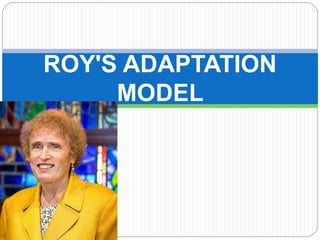
 Sr.Callista Roy- nurse theorist, writer, lecturer,
researcher and teacher
 Professor and Nurse Theorist at the Boston
College of Nursing in Chestnut Hill
 Born at Los Angeles on October 14, 1939.
 Bachelor of Arts with a major in nursing - Mount
St. Mary's College, Los Angeles in 1963.
 Master's degree program in pediatric nursing -
University of California ,Los Angeles in 1966.
ABOUT THE THEORIST
 Master’s and PhD in Sociology in 1973 and 1977.
 Worked with Dorothy E. Johnson
 Worked as f faculty of Mount St. Mary's College in
1966.
 Organized course content according to a view of
person and family as adaptive systems.
 RAM as a basis of curriculum i at Mount St. Mary’s
College
 1970-The model was implemented in Mount St.
Mary’s school
 1971- she was made chair of the nursing
department at the college.
MAJOR CONCEPTS
AND DEFINITIONS
SYSTEM
 A set of parts connected to function as a
whole
 React and interact with environment
 Have inputs, outputs, control and
feedback processes.
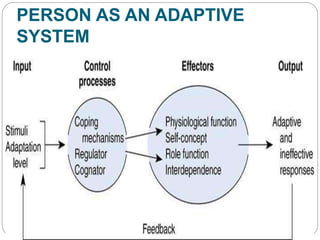
PERSON AS AN ADAPTIVE
SYSTEM
INPUT
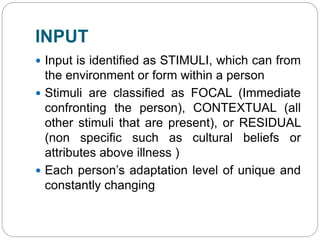
 Input is identified as STIMULI, which can from
the environment or form within a person
 Stimuli are classified as FOCAL (Immediate
confronting the person), CONTEXTUAL (all
other stimuli that are present), or RESIDUAL
(non specific such as cultural beliefs or
attributes above illness )
 Each person’s adaptation level of unique and
constantly changing
THROUGH PUT
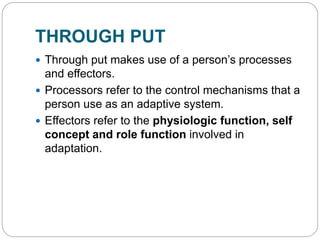
 Through put makes use of a person’s processes
and effectors.
 Processors refer to the control mechanisms that a
person use as an adaptive system.
 Effectors refer to the physiologic function, self
concept and role function involved in
adaptation.
OUT PUT
 Out put is the outcome of the system: when the
system is a person
Output refers to persons behaviors
 In Roy’s system is categorized as adaptive
response (those that promote a person’s integrity)
or ineffective response (those that do not promote
goal achievement)
Cont
 Adaptive responses are used when person
demonstrates behaviors that achieve the goals of
survival, growth, reproduction and mystery
 The responses, or output, provide feedback for
the system
COPING PROCESSES
 Are innate & acquired ways of interacting with the
changing behaviour
 Cognator subsystem — A major coping process
involving 4 cognitive-emotive channels:
perceptual and information processing, learning,
judgment and emotion.
 Regulator subsystem — a basic type of adaptive
process that responds automatically through
neural, chemical, and endocrine coping channels
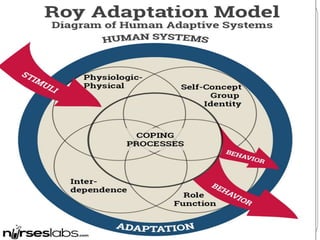
ADAPTIVE MODES
 Are part of the internal processes and act as
system effectors.
 Are categories of behaviour adapt to stimuli
 Include physiologic function, self concept, role
function and interdependence: the regulator and
cognators act within these modes.
PHYSIOLOGIC PHYSICAL MODE
 Behaviour pertaining to the physical aspect of the
human system
 Physical and Chemical Processes
 Nurse must be knowledge about normal
processes relative to the basic needs of
Physiological mode
 5 Needs (Oxygenation, Nutrition, Elimination,
Activity & Reset and Protection )
SELF CONCEPT- GROUP
IDENTITY MODE
 Focuses on psychological & Spiritual aspects of
human system.
 Self concept is a basic need which is psychic &
spiritual integrity
ROLE FUNCTION MODE
 Set of expectations about how a person
occupying one position behaves toward a person
occupying another person.
 Basic needs social integrity, the need to know
who one is in relation to others
INTERDEPENDENCE MODE
 Behaviour pertaining to interdependence
relationships of individual and groups.
 Focus on the close relationships of people and
their purpose
 Each relationships exist for some reason.
 Balance results in feelings of being valued and
supported by others.
 Basic need feeling of security in relationship.
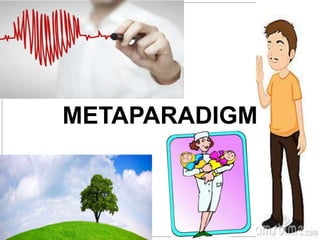
METAPARADIGM
PERSON
 Bio-psycho-social being in constant
interaction with a changing environment
 Uses innate and acquired mechanisms to
adapt
 An adaptive system described as a whole
comprised of parts
 Functions as a unity for some purpose
 Includes people as individuals or in groups-
families, organizations, communities, and
society as a whole.
HEALTH
 Nonevitable dimension of person's life
 Represented by a health-illness continuum
 A state and a process of being and becoming
integrated and whole
ENVIRONMENT
 Focal - internal or external and immediately
confronting the person
 Contextual- all stimuli present in the situation that
contribute to effect of focal stimulus
 Residual-a factor whose effects in the current
situation are unclear
 All conditions, circumstances, and influences
surrounding and affecting the development and
behavior of persons and groups with particular
consideration of mutuality of person and earth
resources, including focal, contextual and residual
stimuli
NURSING
 To promote adaptation in the four adaptive
modes
 To promote adaptation for individuals and
groups in the four adaptive modes, thus
contributing to health, quality of life, and dying
with dignity by assessing behaviors and
factors that influence adaptive abilities and by
intervening to enhance environmental
interactions
NURSING PROCESS
 Assessment of Behaviour
 Assessment of Stimuli
 Nursing Diagnosis
 Goal Setting
 Intervention
 Evaluation
APPLICATION
S
APPLICATION OF THE
THEORY
 In PRACTICE
 Model is applicable in variety of setting such
as CCU, OT, OPD, NICU, Community Health
Nursing, Rehabilitation Nursing
 Involve six step nursing process which makes
the nursing more systematic
APPLICATION OF THE
THEORY
 In EDUCATION
 Model facilitates the selection and
classification of study variables
 Provided various instruments such as for
measuring functional status in pregnancy,
questions to measure stigma in HIV patients
POSITIVE CRITICISM
 The arrangement of concepts by Roy is logical.
 Generable in all setting of nursing practice.
 The model has clearly redefined the nursing
process can be used in clinical practice
 Provide directions in providing nursing care which
is holistic in nature.
NEGATIVE CRITCISM
 Terms & concepts borrowed from other disciplines
are not redefined for nursing
 Concepts definition are overlapped
 Several major concepts & sub concepts complex
to understand.
ROY ADAPTATION MODEL .pptx

ROY ADAPTATION MODEL .pptx

  • 1.
  • 2.
    ABOUT THE THEORIST Sr.Callista Roy- nurse theorist, writer, lecturer, researcher and teacher  Professor and Nurse Theorist at the Boston College of Nursing in Chestnut Hill  Born at Los Angeles on October 14, 1939.  Bachelor of Arts with a major in nursing - Mount St. Mary's College, Los Angeles in 1963.  Master's degree program in pediatric nursing - University of California ,Los Angeles in 1966.
  • 3.
    ABOUT THE THEORIST Master’s and PhD in Sociology in 1973 and 1977.  Worked with Dorothy E. Johnson  Worked as f faculty of Mount St. Mary's College in 1966.  Organized course content according to a view of person and family as adaptive systems.  RAM as a basis of curriculum i at Mount St. Mary’s College  1970-The model was implemented in Mount St. Mary’s school  1971- she was made chair of the nursing department at the college.
  • 5.
  • 6.
    SYSTEM  A setof parts connected to function as a whole  React and interact with environment  Have inputs, outputs, control and feedback processes.
  • 7.
    PERSON AS ANADAPTIVE SYSTEM
  • 8.
    INPUT  Input isidentified as STIMULI, which can from the environment or form within a person  Stimuli are classified as FOCAL (Immediate confronting the person), CONTEXTUAL (all other stimuli that are present), or RESIDUAL (non specific such as cultural beliefs or attributes above illness )  Each person’s adaptation level of unique and constantly changing
  • 9.
    THROUGH PUT  Throughput makes use of a person’s processes and effectors.  Processors refer to the control mechanisms that a person use as an adaptive system.  Effectors refer to the physiologic function, self concept and role function involved in adaptation.
  • 10.
    OUT PUT  Output is the outcome of the system: when the system is a person Output refers to persons behaviors  In Roy’s system is categorized as adaptive response (those that promote a person’s integrity) or ineffective response (those that do not promote goal achievement)
  • 11.
    Cont  Adaptive responsesare used when person demonstrates behaviors that achieve the goals of survival, growth, reproduction and mystery  The responses, or output, provide feedback for the system
  • 12.
    COPING PROCESSES  Areinnate & acquired ways of interacting with the changing behaviour
  • 13.
     Cognator subsystem— A major coping process involving 4 cognitive-emotive channels: perceptual and information processing, learning, judgment and emotion.  Regulator subsystem — a basic type of adaptive process that responds automatically through neural, chemical, and endocrine coping channels
  • 14.
    ADAPTIVE MODES  Arepart of the internal processes and act as system effectors.  Are categories of behaviour adapt to stimuli  Include physiologic function, self concept, role function and interdependence: the regulator and cognators act within these modes.
  • 15.
    PHYSIOLOGIC PHYSICAL MODE Behaviour pertaining to the physical aspect of the human system  Physical and Chemical Processes  Nurse must be knowledge about normal processes relative to the basic needs of Physiological mode  5 Needs (Oxygenation, Nutrition, Elimination, Activity & Reset and Protection )
  • 16.
    SELF CONCEPT- GROUP IDENTITYMODE  Focuses on psychological & Spiritual aspects of human system.  Self concept is a basic need which is psychic & spiritual integrity
  • 17.
    ROLE FUNCTION MODE Set of expectations about how a person occupying one position behaves toward a person occupying another person.  Basic needs social integrity, the need to know who one is in relation to others
  • 18.
    INTERDEPENDENCE MODE  Behaviourpertaining to interdependence relationships of individual and groups.  Focus on the close relationships of people and their purpose  Each relationships exist for some reason.  Balance results in feelings of being valued and supported by others.  Basic need feeling of security in relationship.
  • 20.
  • 21.
    PERSON  Bio-psycho-social beingin constant interaction with a changing environment  Uses innate and acquired mechanisms to adapt  An adaptive system described as a whole comprised of parts  Functions as a unity for some purpose  Includes people as individuals or in groups- families, organizations, communities, and society as a whole.
  • 22.
    HEALTH  Nonevitable dimensionof person's life  Represented by a health-illness continuum  A state and a process of being and becoming integrated and whole
  • 23.
    ENVIRONMENT  Focal -internal or external and immediately confronting the person  Contextual- all stimuli present in the situation that contribute to effect of focal stimulus  Residual-a factor whose effects in the current situation are unclear  All conditions, circumstances, and influences surrounding and affecting the development and behavior of persons and groups with particular consideration of mutuality of person and earth resources, including focal, contextual and residual stimuli
  • 24.
    NURSING  To promoteadaptation in the four adaptive modes  To promote adaptation for individuals and groups in the four adaptive modes, thus contributing to health, quality of life, and dying with dignity by assessing behaviors and factors that influence adaptive abilities and by intervening to enhance environmental interactions
  • 25.
    NURSING PROCESS  Assessmentof Behaviour  Assessment of Stimuli  Nursing Diagnosis  Goal Setting  Intervention  Evaluation
  • 26.
  • 27.
    APPLICATION OF THE THEORY In PRACTICE  Model is applicable in variety of setting such as CCU, OT, OPD, NICU, Community Health Nursing, Rehabilitation Nursing  Involve six step nursing process which makes the nursing more systematic
  • 28.
    APPLICATION OF THE THEORY In EDUCATION  Model facilitates the selection and classification of study variables  Provided various instruments such as for measuring functional status in pregnancy, questions to measure stigma in HIV patients
  • 30.
    POSITIVE CRITICISM  Thearrangement of concepts by Roy is logical.  Generable in all setting of nursing practice.  The model has clearly redefined the nursing process can be used in clinical practice  Provide directions in providing nursing care which is holistic in nature.
  • 31.
    NEGATIVE CRITCISM  Terms& concepts borrowed from other disciplines are not redefined for nursing  Concepts definition are overlapped  Several major concepts & sub concepts complex to understand.