 Roy Adaptation theory Content
 Introduction
 Definition
 Concept
 Major concept
 Model
 Process
 Strength and weekness
 Example
 Summary
 Conclusion
 References
 To Introduction
 To define the roy adaptation theory
 To discuss the Assumption
 To list out Concept
 To enlist Major concept
 To describe the Model
 To explain the Process
 To list out the Strength and weakness
 To narrate the Example
 To Summary
 To conclude
 To view the Reference
 In 1976, sister Callista Roy developed the
Adaptation Model of nursing, a prominent nursing
theory.
 Nursing theories frame, explain or define the
practice of nursing. Roy s model sees the
individual a a set of interrelated systems like
Biological, psychological,and social.
 Roy focuses on the concept of adaptation of
man. Her concepts of Nursing, the Person,
Health and the Environment are all interrelated
to this central concept.
 Helson's view that adaptation is a process of
responding positively to environmental changes
was used by Roy as the foundation for the
model
 . This view, combined with Rapoport's definition
of a "system" lead to Roy's theory of the person
as an adaptive system. The model has been
further refined using concepts from other
theorists including Hans Selye and Abraham
Maslow.
 The person is a bio-psycho-social being. The
person is in constant interaction with a changing
environment.
 To cope with a changing world, person uses
both innate and acquired mechanisms which
are biological, psychological and social in origin.
 To respond positively to environmental
changes, the person must adapt.
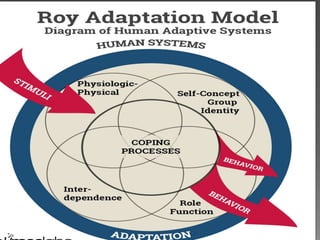
 The person has 4 modes of adaptation:
physiologic needs, self- concept, role function
and inter-dependence.
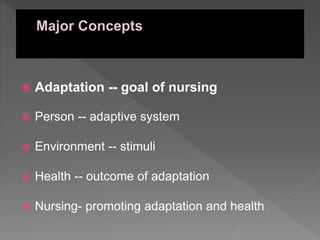
 Adaptation -- goal of nursing
 Person -- adaptive system
 Environment -- stimuli
 Health -- outcome of adaptation
 Nursing- promoting adaptation and health
 Responding positively to environmental
changes.
 The process and outcome of individuals and
groups who use conscious awareness, self
reflection and choice to create human and
environmental integration
 Bio-psycho-social being in constant interaction
with a changing environment
 Uses innate and acquired mechanisms to adapt
 Includes people as individuals or in groups-
families, organizations, communities, and
society as a whole.
 Focal - internal or external and immediately
confronting the person
 Contextual- all stimuli present in the situation that
contribute to effect of focal stimulus
 Residual-a factor whose effects in the current
situation are unclear
 All conditions, circumstances, and influences
surrounding and affecting the development and
behavior of persons and groups with particular
consideration of mutuality of person and earth
resources, including focal, contextual and
residual stimuli
 Represented by a health-illness continuum
 A state and a process of being and becoming
integrated and whole
 To promote adaptation for individuals and
groups in the four adaptive modes, thus
contributing to health, quality of life, and dying
with dignity by assessing behaviors and factors
that influence adaptive abilities and by
intervening to enhance environmental
interactions
 Four Adaptive Model
 Physiological,
 Self-Concept,
 Role Function,
 Interdependence
Behavior in this mode is a manifestation of the
physiological activity of all the cells, tissues,
organs,
 systems of the body.
› 5 needs serve to promote physiological integrity,
(oxygenation, nutrition, elimination, activity and rest,
and protection).
› 4 processes which help maintain physiological integrity
(senses, fluid and electrolytes, neuro, and endocrine
function)
 Deals with the person’s beliefs & feelings about
himself/herself. Basic underlying need: psychic
integrity (physical perceptions, ideals, goals,
moral/ethical beliefs)
 Physical self: how one sees his own physical
being
 body sensation: ability to express
sensations/feel symptoms
 body image: how one sees himself as a
physical being Personal self: how one views his
qualities, values, worth
 self-consistency: one’s self-description of
qualities; also includes self-organization
behavior
 self-ideal/self-expectancy: what one would like
to do or be
 moral-ethical-spiritual self: values, beliefs,
religion self-esteem: the value one places on
himself/herself
 involves the position one occupies in society;
behaviors associated with one’s position (role)
in society.
 Basic underlying need: social integrity
 Primary role: role based on age, sex,
developmental state
 Secondary role: role(s) a person assumes to
complete tasks associated with a primary role
or developmental stage
 Tertiary role: a role freely chosen; temporary;
associated with accomplishments of tasks or
goals
 associated with one’s relationships and interactions
with others and the giving and receiving of
 love, respect, and value. Basic underlying need:
nurturance and affection
 Significant others: intimate relationships (spouse,
parent, God)
 Support systems: less intimate relationships
(coworkers, friends)
 Giving behaviors: giving love, nurturance, affection
 Receiving behaviors: receiving/taking in love,
nurturance, affection
 Utilizes a bi-level assessment to problem solve
 Assessment of behaviors:
 Behavior is an action or reaction under
specified circumstances; behavior may be
observable, or not.
 Normally, a person adapts to stimuli positively,
maintaining a “steady state” but in times of stress
when coping mechanisms are overwhelmed (i.e.,
illness), the person’s ability to adapt to a new situation
is impaired.
 The nurse observes behaviors (signs/symptoms) or
responses of the patient and makes a judgment as to
whether the behavior is adaptive or ineffective.
 How does the nurse do this? Assessment phase of
nursing process
 Stimuli are the underlying causes or factors
contributing to the behaviors observed in first
level assessment; those things which provoke a
response.
 Nurse identifies stimuli in all 4 adaptive modes;
stimuli are manipulated via interventions to
achieve patient goals
 The Adaptation Model of Callista Roy suggests
the influence of multiple causes in a situation,
which is a strength when dealing with multi-
faceted human beings.
 Roy’s model follows logically. In the presentation
of each of the key concepts, there is the recurring
idea of adaptation to maintain integrity. Every
concept was operationally defined.
 The concepts of Roy’s model are stated in
relatively simple terms.
 A major strength of the model is that it guides
nurses to use observation and interviewing skills in
doing an individualized assessment of each
person. The concepts of Roy’s model are
applicable within many practice settings of nursing.
 Painstaking application of the model requires
significant input of time and effort.
 Roy’s model has many elements, systems,
structures and multiple concepts.
 5 elements - person, goal of nursing, nursing
activities, health and environment
 Persons are viewed as living adaptive systems
whose behaviors may be classified as adaptive or
ineffective.
 These mechanisms work within 4 adaptive modes.
 Activity Read the profile of Andrew Smith over
the page and examine the assessment
documentation and care plan
 Profile of Mr Andrew Smith
 Mr Andrew Smith is a 42 year-old man with
severe learning disabilities. He lives in an eight-
bedded unit in the grounds of an old institution
which is currently being developed as a housing
estate. The unit has a sister eight-bedded unit
next door . These units are primarily for
residential care, but the unit that Andrew lives
on also has 3 short-stay beds within the units.
 The goal of nursing is to promote adaptive
responses in relation to 4 adaptive modes,
using information about person’s adaptation
level, and various stimuli.
 Nursing activities involve manipulation of these
stimuli to promote adaptive responses.
- George B julia , nursing theories – the base for
professoional nursing practice, 3rd ed .
Norwalk,Appleton& lange
- - Potter A Patricia, perry G Anne (1992) FON –
Concepts process & practice, london Mosby
year book
Roy' adaptation theory.pptx

Roy' adaptation theory.pptx

  • 3.
     Roy Adaptationtheory Content  Introduction  Definition  Concept  Major concept  Model  Process  Strength and weekness  Example  Summary  Conclusion  References
  • 4.
     To Introduction To define the roy adaptation theory  To discuss the Assumption  To list out Concept  To enlist Major concept  To describe the Model  To explain the Process  To list out the Strength and weakness  To narrate the Example  To Summary  To conclude  To view the Reference
  • 5.
     In 1976,sister Callista Roy developed the Adaptation Model of nursing, a prominent nursing theory.  Nursing theories frame, explain or define the practice of nursing. Roy s model sees the individual a a set of interrelated systems like Biological, psychological,and social.
  • 6.
     Roy focuseson the concept of adaptation of man. Her concepts of Nursing, the Person, Health and the Environment are all interrelated to this central concept.  Helson's view that adaptation is a process of responding positively to environmental changes was used by Roy as the foundation for the model
  • 7.
     . Thisview, combined with Rapoport's definition of a "system" lead to Roy's theory of the person as an adaptive system. The model has been further refined using concepts from other theorists including Hans Selye and Abraham Maslow.
  • 8.
     The personis a bio-psycho-social being. The person is in constant interaction with a changing environment.  To cope with a changing world, person uses both innate and acquired mechanisms which are biological, psychological and social in origin.  To respond positively to environmental changes, the person must adapt.  The person has 4 modes of adaptation: physiologic needs, self- concept, role function and inter-dependence.
  • 9.
     Adaptation --goal of nursing  Person -- adaptive system  Environment -- stimuli  Health -- outcome of adaptation  Nursing- promoting adaptation and health
  • 10.
     Responding positivelyto environmental changes.  The process and outcome of individuals and groups who use conscious awareness, self reflection and choice to create human and environmental integration
  • 11.
     Bio-psycho-social beingin constant interaction with a changing environment  Uses innate and acquired mechanisms to adapt  Includes people as individuals or in groups- families, organizations, communities, and society as a whole.
  • 12.
     Focal -internal or external and immediately confronting the person  Contextual- all stimuli present in the situation that contribute to effect of focal stimulus  Residual-a factor whose effects in the current situation are unclear
  • 13.
     All conditions,circumstances, and influences surrounding and affecting the development and behavior of persons and groups with particular consideration of mutuality of person and earth resources, including focal, contextual and residual stimuli
  • 14.
     Represented bya health-illness continuum  A state and a process of being and becoming integrated and whole
  • 15.
     To promoteadaptation for individuals and groups in the four adaptive modes, thus contributing to health, quality of life, and dying with dignity by assessing behaviors and factors that influence adaptive abilities and by intervening to enhance environmental interactions
  • 17.
     Four AdaptiveModel  Physiological,  Self-Concept,  Role Function,  Interdependence
  • 18.
    Behavior in thismode is a manifestation of the physiological activity of all the cells, tissues, organs,  systems of the body. › 5 needs serve to promote physiological integrity, (oxygenation, nutrition, elimination, activity and rest, and protection). › 4 processes which help maintain physiological integrity (senses, fluid and electrolytes, neuro, and endocrine function)
  • 19.
     Deals withthe person’s beliefs & feelings about himself/herself. Basic underlying need: psychic integrity (physical perceptions, ideals, goals, moral/ethical beliefs)  Physical self: how one sees his own physical being
  • 20.
     body sensation:ability to express sensations/feel symptoms  body image: how one sees himself as a physical being Personal self: how one views his qualities, values, worth
  • 21.
     self-consistency: one’sself-description of qualities; also includes self-organization behavior  self-ideal/self-expectancy: what one would like to do or be  moral-ethical-spiritual self: values, beliefs, religion self-esteem: the value one places on himself/herself
  • 22.
     involves theposition one occupies in society; behaviors associated with one’s position (role) in society.  Basic underlying need: social integrity  Primary role: role based on age, sex, developmental state  Secondary role: role(s) a person assumes to complete tasks associated with a primary role or developmental stage  Tertiary role: a role freely chosen; temporary; associated with accomplishments of tasks or goals
  • 23.
     associated withone’s relationships and interactions with others and the giving and receiving of  love, respect, and value. Basic underlying need: nurturance and affection  Significant others: intimate relationships (spouse, parent, God)  Support systems: less intimate relationships (coworkers, friends)  Giving behaviors: giving love, nurturance, affection  Receiving behaviors: receiving/taking in love, nurturance, affection
  • 24.
     Utilizes abi-level assessment to problem solve  Assessment of behaviors:  Behavior is an action or reaction under specified circumstances; behavior may be observable, or not.
  • 25.
     Normally, aperson adapts to stimuli positively, maintaining a “steady state” but in times of stress when coping mechanisms are overwhelmed (i.e., illness), the person’s ability to adapt to a new situation is impaired.  The nurse observes behaviors (signs/symptoms) or responses of the patient and makes a judgment as to whether the behavior is adaptive or ineffective.  How does the nurse do this? Assessment phase of nursing process
  • 26.
     Stimuli arethe underlying causes or factors contributing to the behaviors observed in first level assessment; those things which provoke a response.  Nurse identifies stimuli in all 4 adaptive modes; stimuli are manipulated via interventions to achieve patient goals
  • 27.
     The AdaptationModel of Callista Roy suggests the influence of multiple causes in a situation, which is a strength when dealing with multi- faceted human beings.  Roy’s model follows logically. In the presentation of each of the key concepts, there is the recurring idea of adaptation to maintain integrity. Every concept was operationally defined.
  • 28.
     The conceptsof Roy’s model are stated in relatively simple terms.  A major strength of the model is that it guides nurses to use observation and interviewing skills in doing an individualized assessment of each person. The concepts of Roy’s model are applicable within many practice settings of nursing.
  • 29.
     Painstaking applicationof the model requires significant input of time and effort.  Roy’s model has many elements, systems, structures and multiple concepts.
  • 30.
     5 elements- person, goal of nursing, nursing activities, health and environment  Persons are viewed as living adaptive systems whose behaviors may be classified as adaptive or ineffective.  These mechanisms work within 4 adaptive modes.
  • 31.
     Activity Readthe profile of Andrew Smith over the page and examine the assessment documentation and care plan  Profile of Mr Andrew Smith  Mr Andrew Smith is a 42 year-old man with severe learning disabilities. He lives in an eight- bedded unit in the grounds of an old institution which is currently being developed as a housing estate. The unit has a sister eight-bedded unit next door . These units are primarily for residential care, but the unit that Andrew lives on also has 3 short-stay beds within the units.
  • 32.
     The goalof nursing is to promote adaptive responses in relation to 4 adaptive modes, using information about person’s adaptation level, and various stimuli.  Nursing activities involve manipulation of these stimuli to promote adaptive responses.
  • 33.
    - George Bjulia , nursing theories – the base for professoional nursing practice, 3rd ed . Norwalk,Appleton& lange - - Potter A Patricia, perry G Anne (1992) FON – Concepts process & practice, london Mosby year book