
Descriptive
Study
Prof.Dr.Chinna Chadayan.N
RN.RM., B.Sc (N)., M.Sc (N)., Ph.D (N).,
Professor,
Enam Nursing College – Savar,
Bangladesh
1
1 yr M.Sc(N)
Unit – 13a
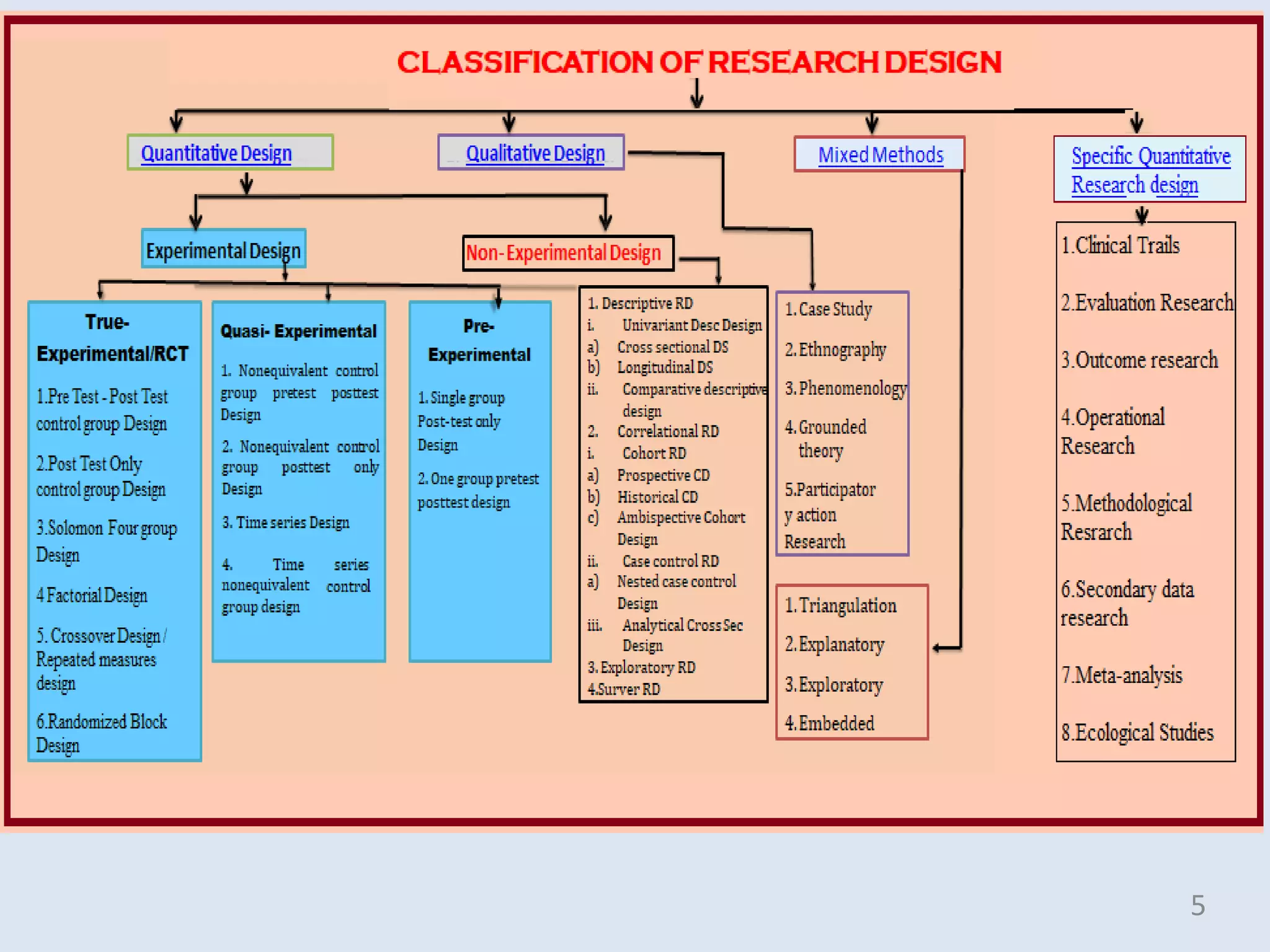
DESCRIPTIVE DESIGN.
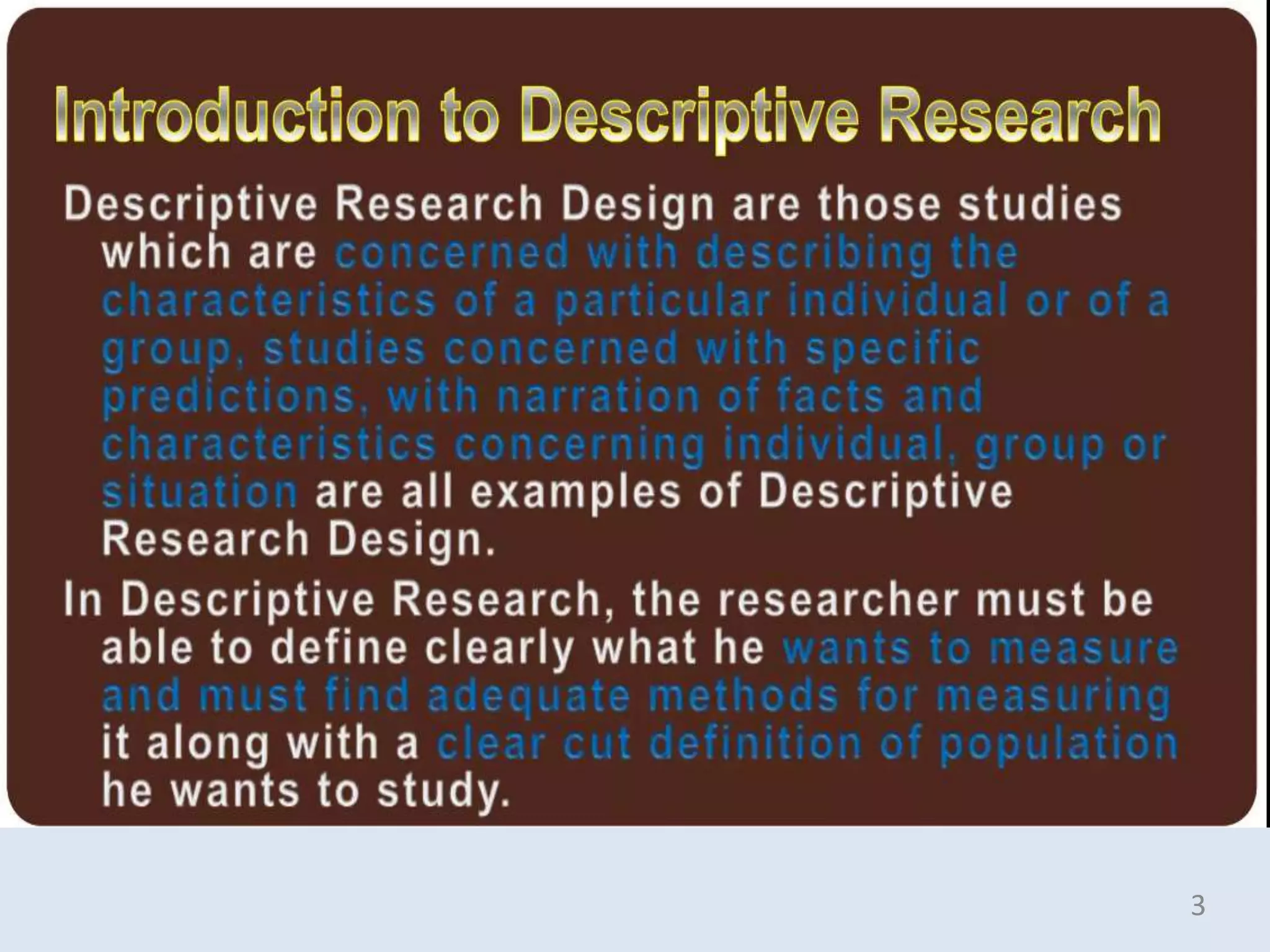
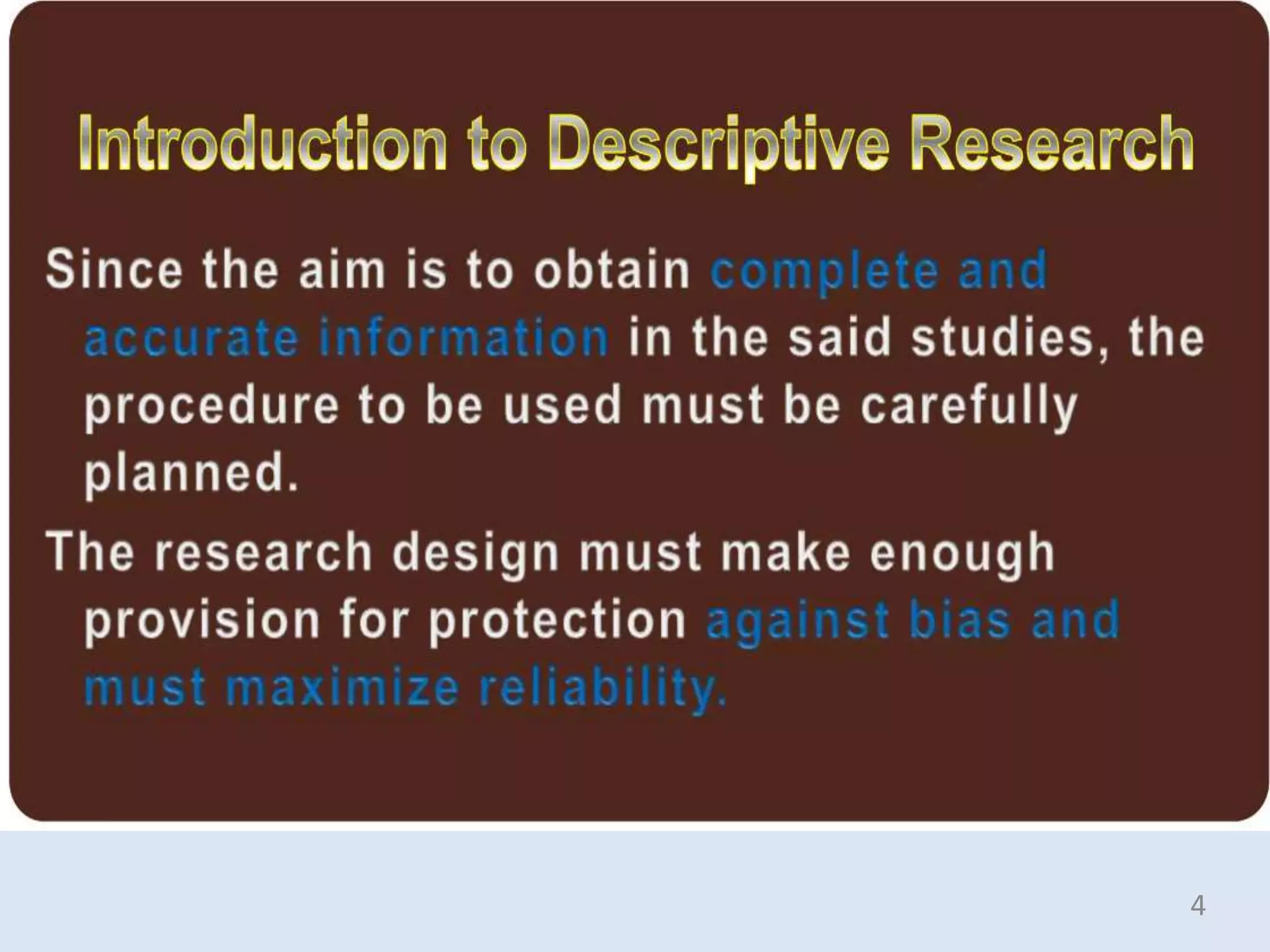
 Descriptive research design is a broad
class of non – experimental research.
 The basic purpose of descriptive studies
to observe, describe and documents
aspects of a situation without any
manipulation and control in the natural
settings.
2
3
4
5
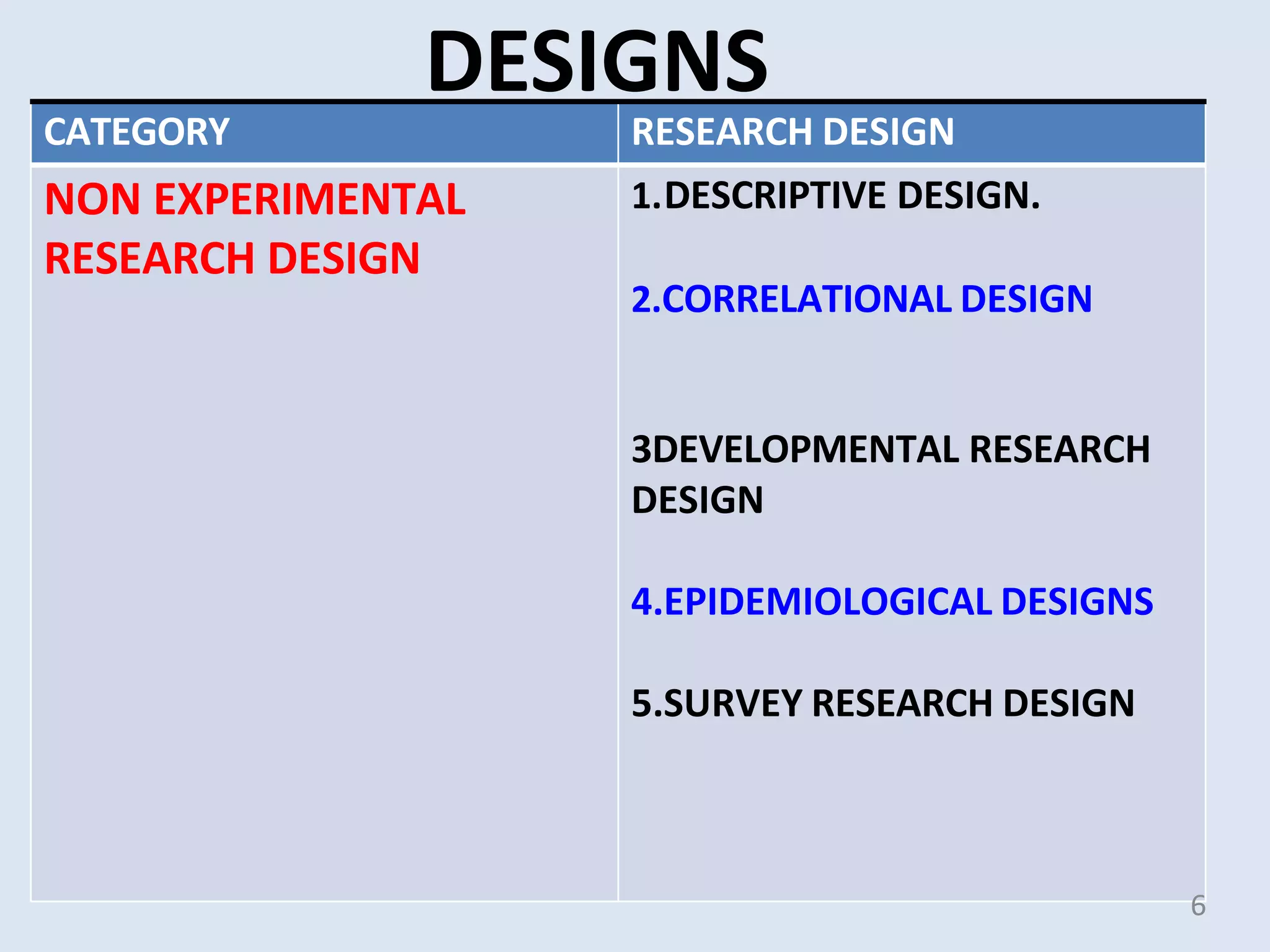
DESIGNS
CATEGORY RESEARCH DESIGN
NON EXPERIMENTAL
RESEARCH DESIGN
1.DESCRIPTIVE DESIGN.
2.CORRELATIONAL DESIGN
3DEVELOPMENTAL RESEARCH
DESIGN
4.EPIDEMIOLOGICAL DESIGNS
5.SURVEY RESEARCH DESIGN
6
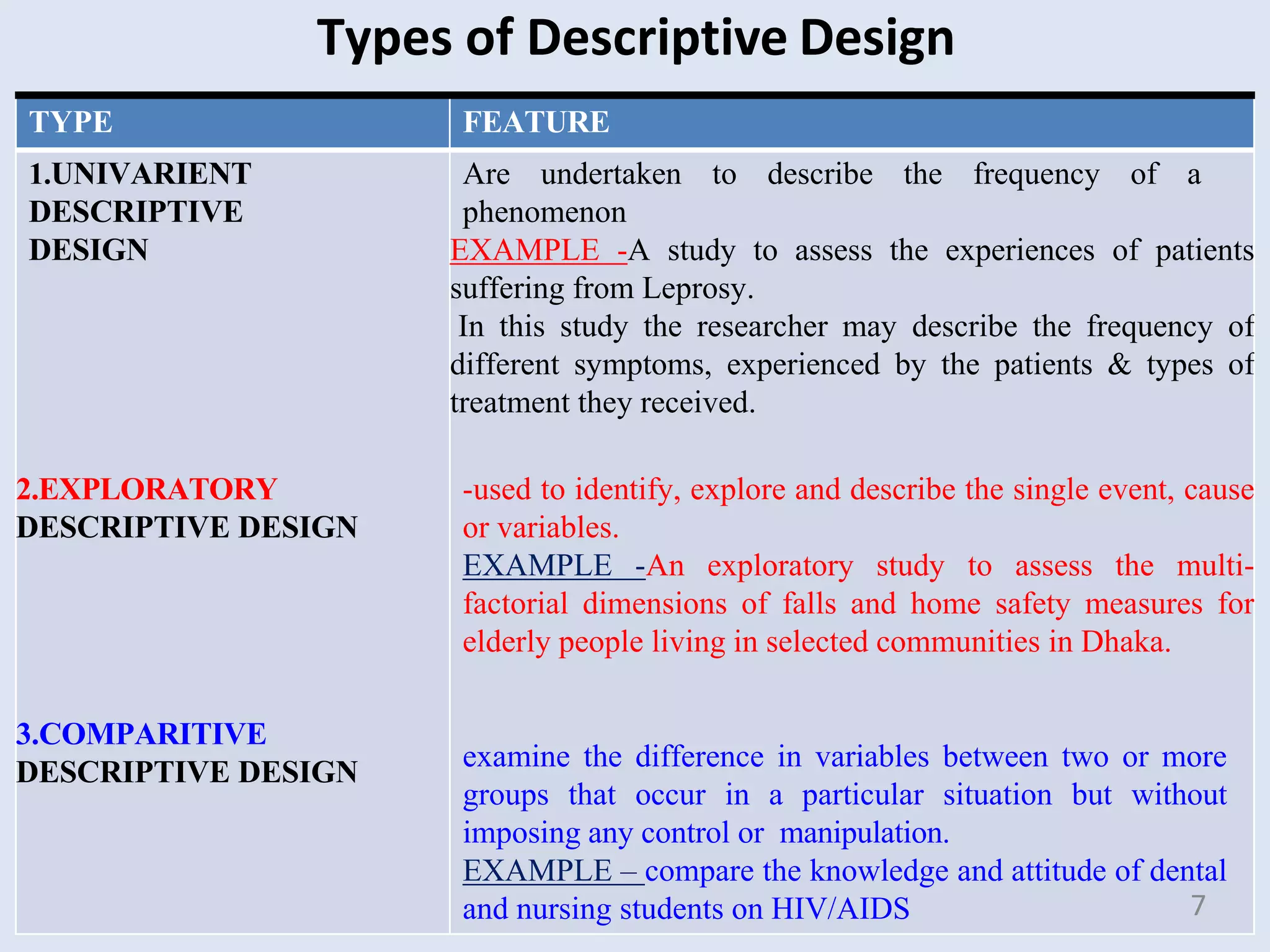
Types of Descriptive Design
TYPE FEATURE
1.UNIVARIENT
DESCRIPTIVE
DESIGN
Are undertaken to describe the frequency of a
phenomenon
EXAMPLE -A study to assess the experiences of patients
suffering from Leprosy.
In this study the researcher may describe the frequency of
different symptoms, experienced by the patients & types of
treatment they received.
2.EXPLORATORY
DESCRIPTIVE DESIGN
-used to identify, explore and describe the single event, cause
or variables.
EXAMPLE -An exploratory study to assess the multi-
factorial dimensions of falls and home safety measures for
elderly people living in selected communities in Dhaka.
3.COMPARITIVE
DESCRIPTIVE DESIGN examine the difference in variables between two or more
groups that occur in a particular situation but without
imposing any control or manipulation.
EXAMPLE – compare the knowledge and attitude of dental
and nursing students on HIV/AIDS 7
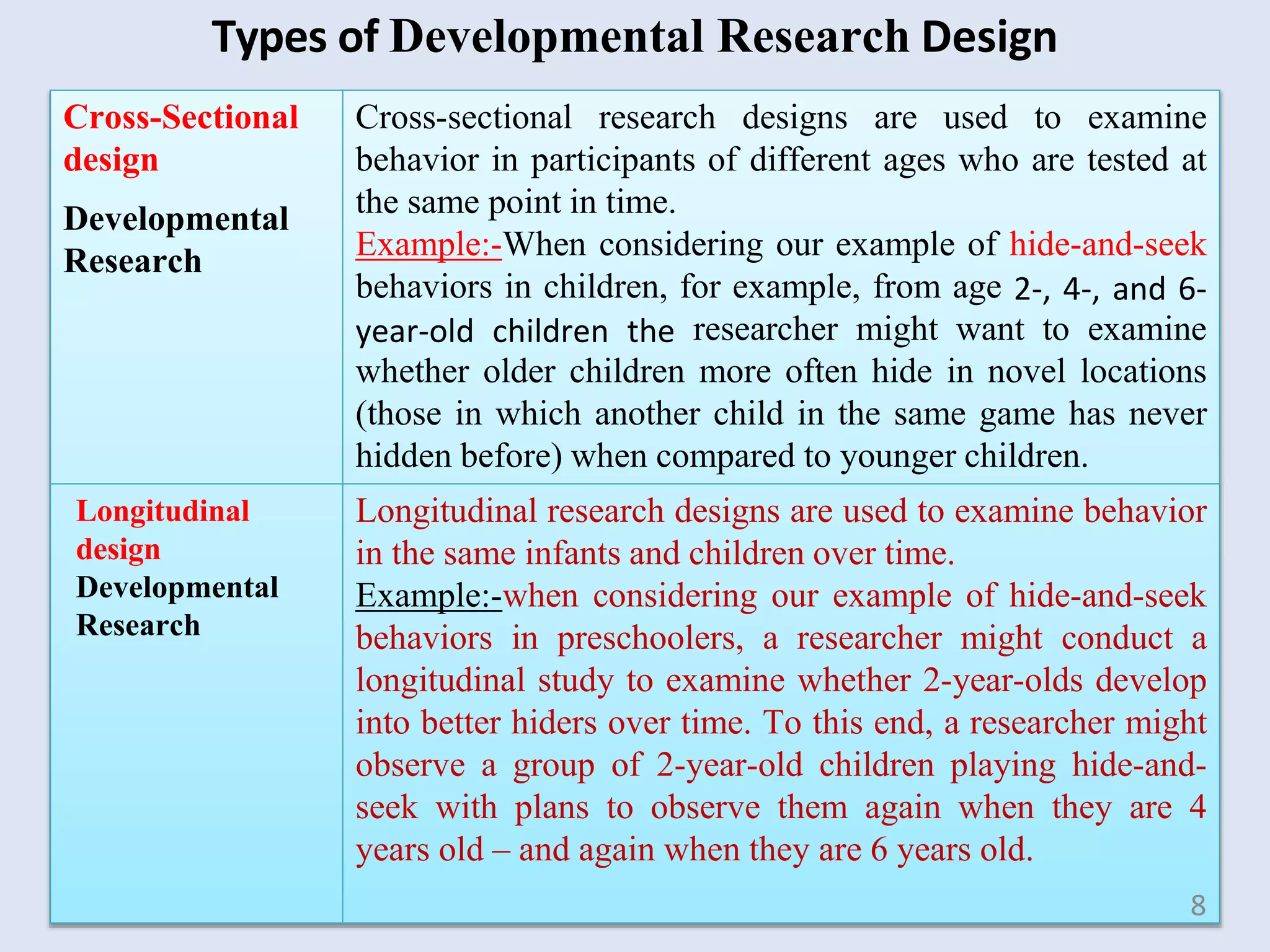
Cross-Sectional
design
Developmental
Research
Cross-sectional research designs are used to examine
behavior in participants of different ages who are tested at
the same point in time.
Example:-When considering our example of hide-and-seek
behaviors in children, for example, from age 2-, 4-, and 6-
year-old children the researcher might want to examine
whether older children more often hide in novel locations
(those in which another child in the same game has never
hidden before) when compared to younger children.
Longitudinal
design
Developmental
Research
Longitudinal research designs are used to examine behavior
in the same infants and children over time.
Example:-when considering our example of hide-and-seek
behaviors in preschoolers, a researcher might conduct a
longitudinal study to examine whether 2-year-olds develop
into better hiders over time. To this end, a researcher might
observe a group of 2-year-old children playing hide-and-
seek with plans to observe them again when they are 4
years old – and again when they are 6 years old.
Types of Developmental Research Design
8
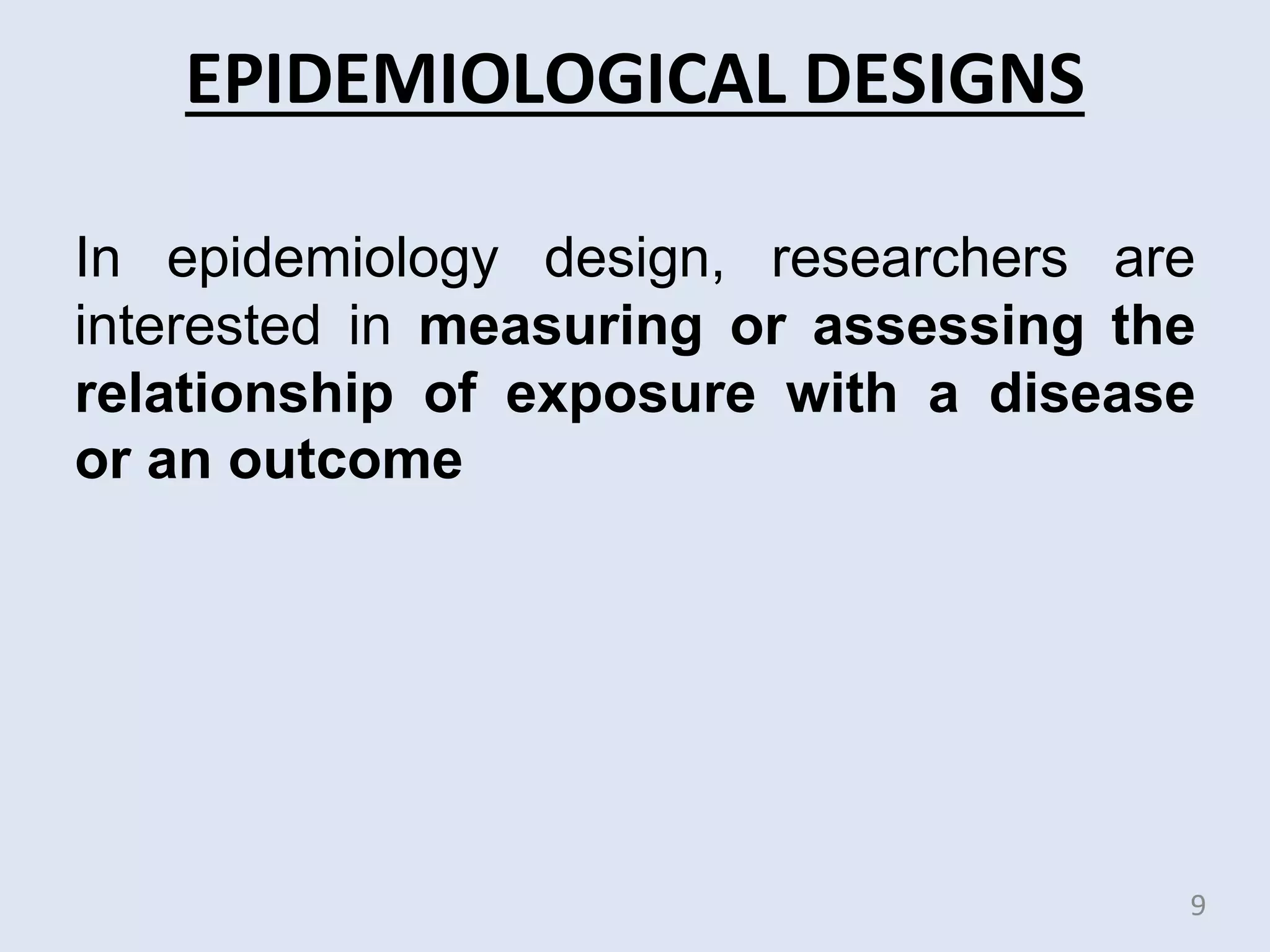
EPIDEMIOLOGICAL DESIGNS
In epidemiology design, researchers are
interested in measuring or assessing the
relationship of exposure with a disease
or an outcome
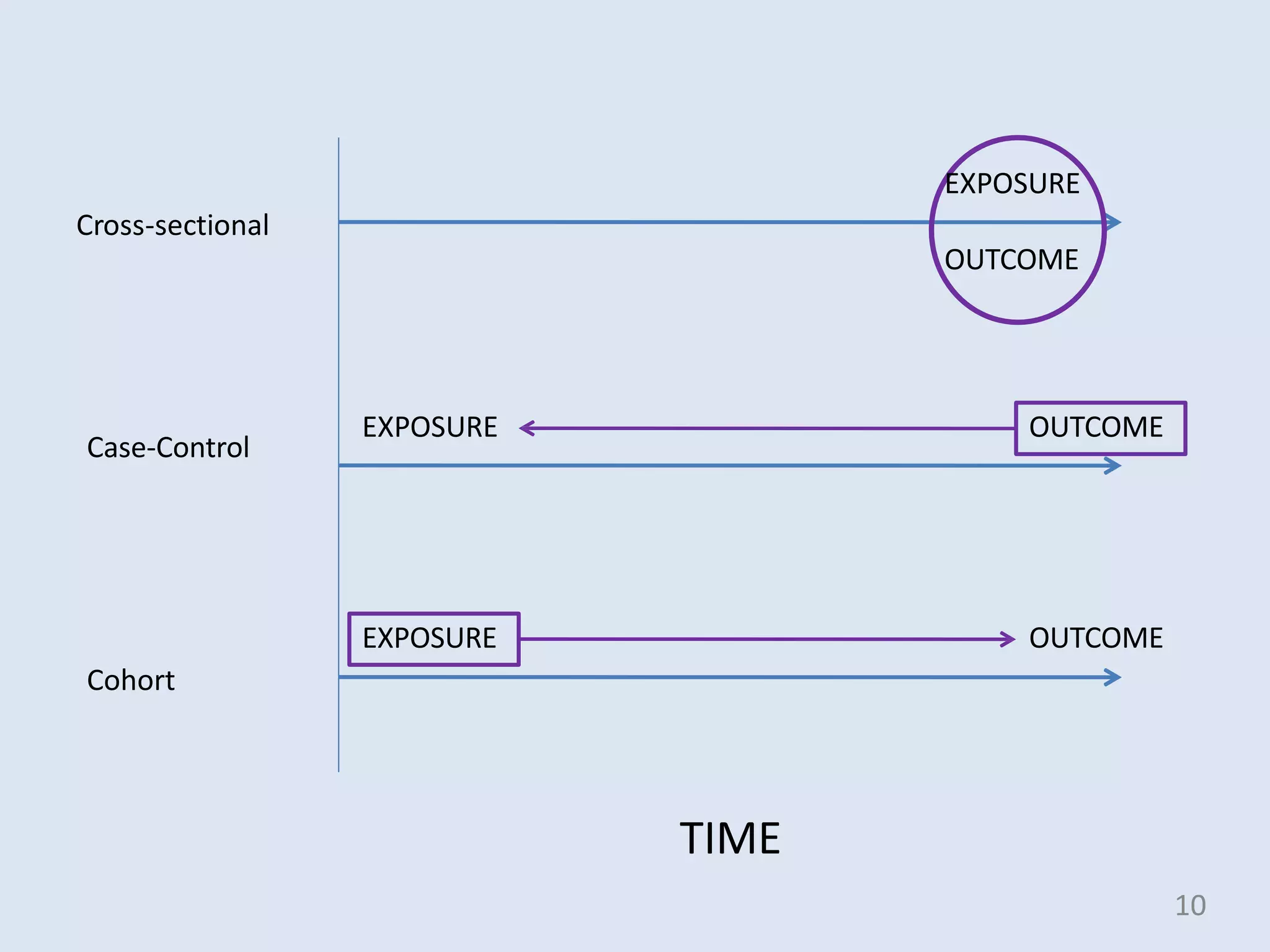
9
Cross-sectional
Case-Control
Cohort
TIME
EXPOSURE
OUTCOME
OUTCOME
EXPOSURE
EXPOSURE OUTCOME
10
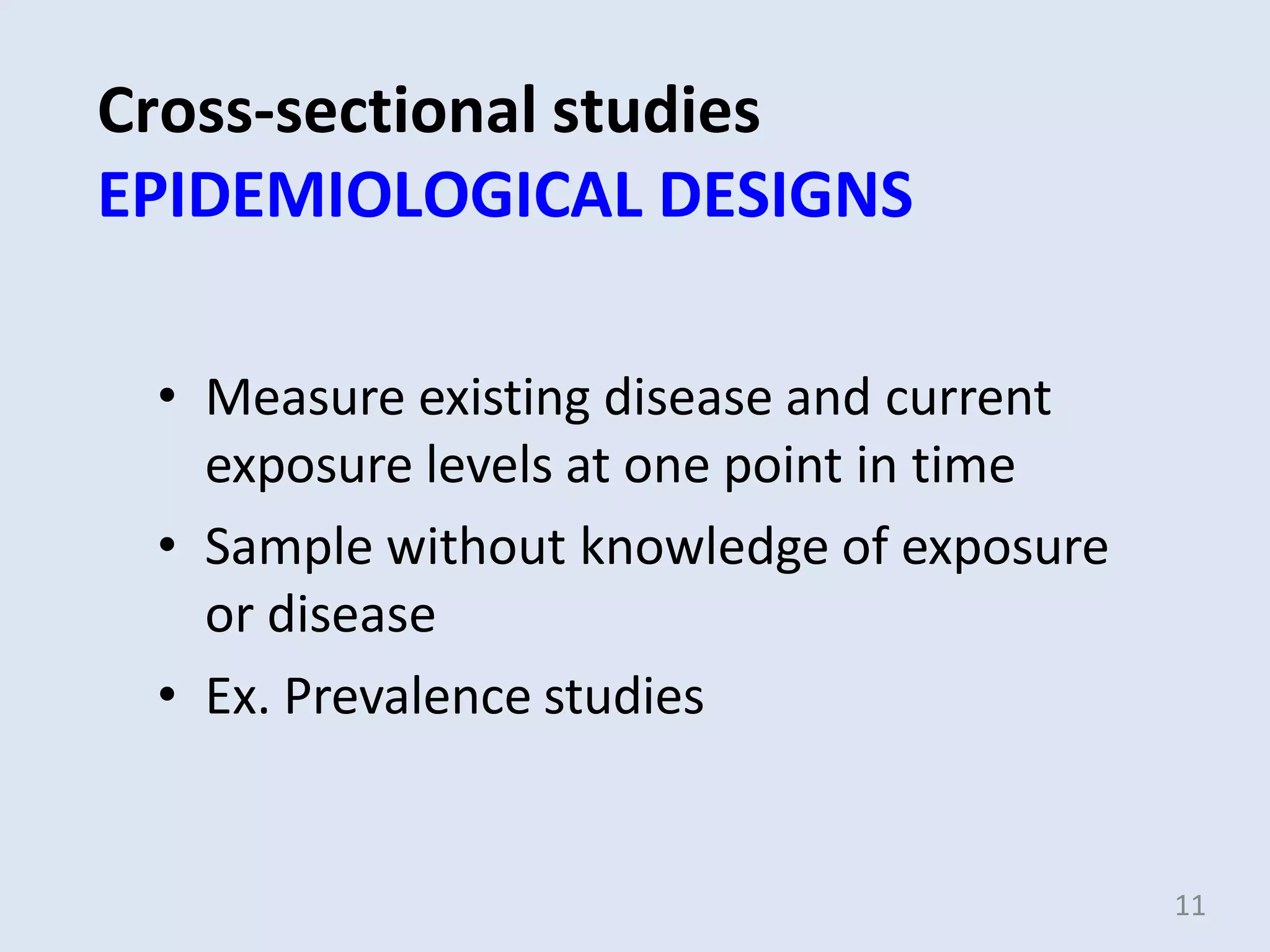
Cross-sectional studies
EPIDEMIOLOGICAL DESIGNS
• Measure existing disease and current
exposure levels at one point in time
• Sample without knowledge of exposure
or disease
• Ex. Prevalence studies
11
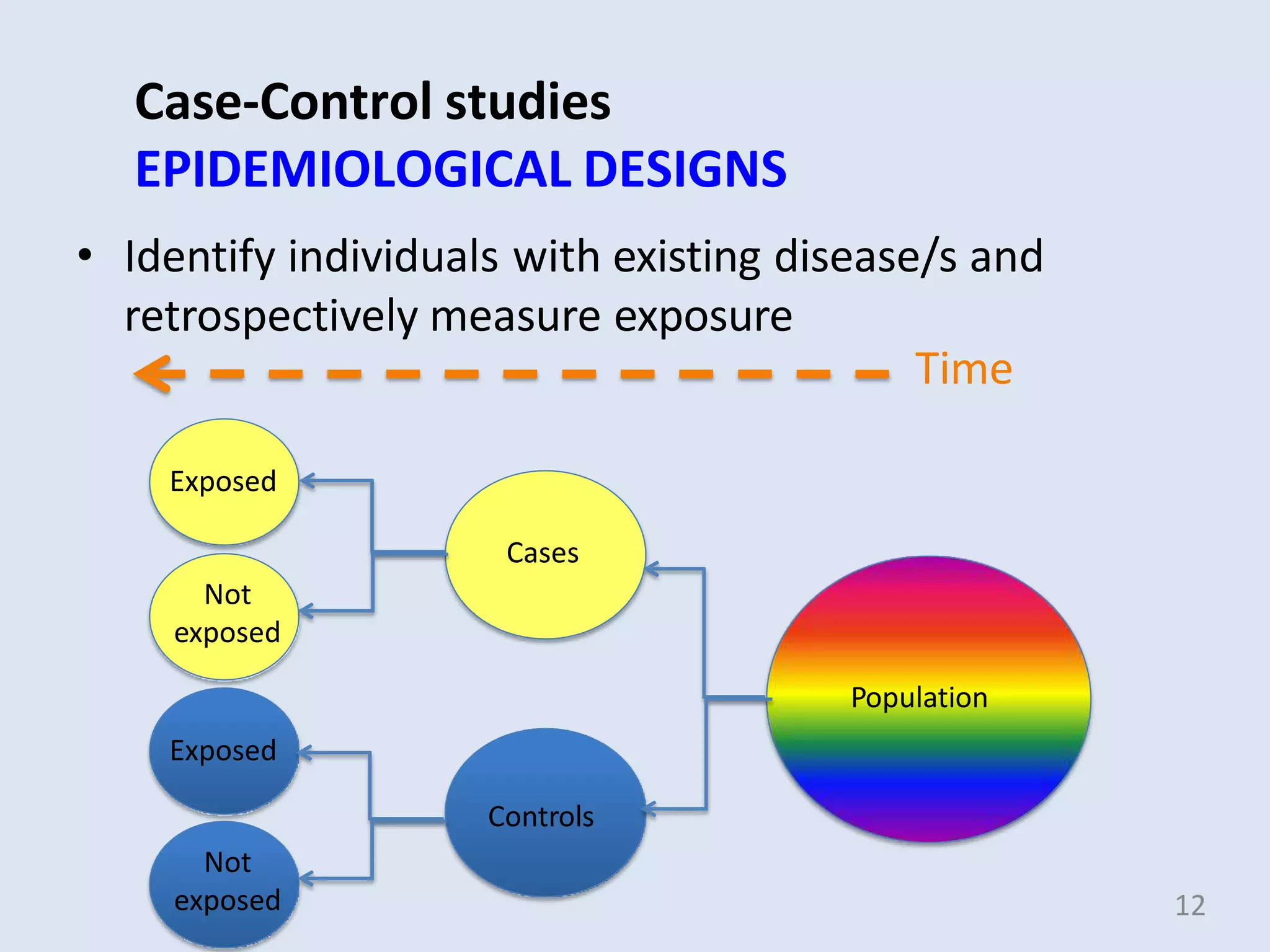
Case-Control studies
EPIDEMIOLOGICAL DESIGNS
Population
Cases
Controls
Exposed
Not
exposed
Exposed
Not
exposed
• Identify individuals with existing disease/s and
retrospectively measure exposure
Time
12
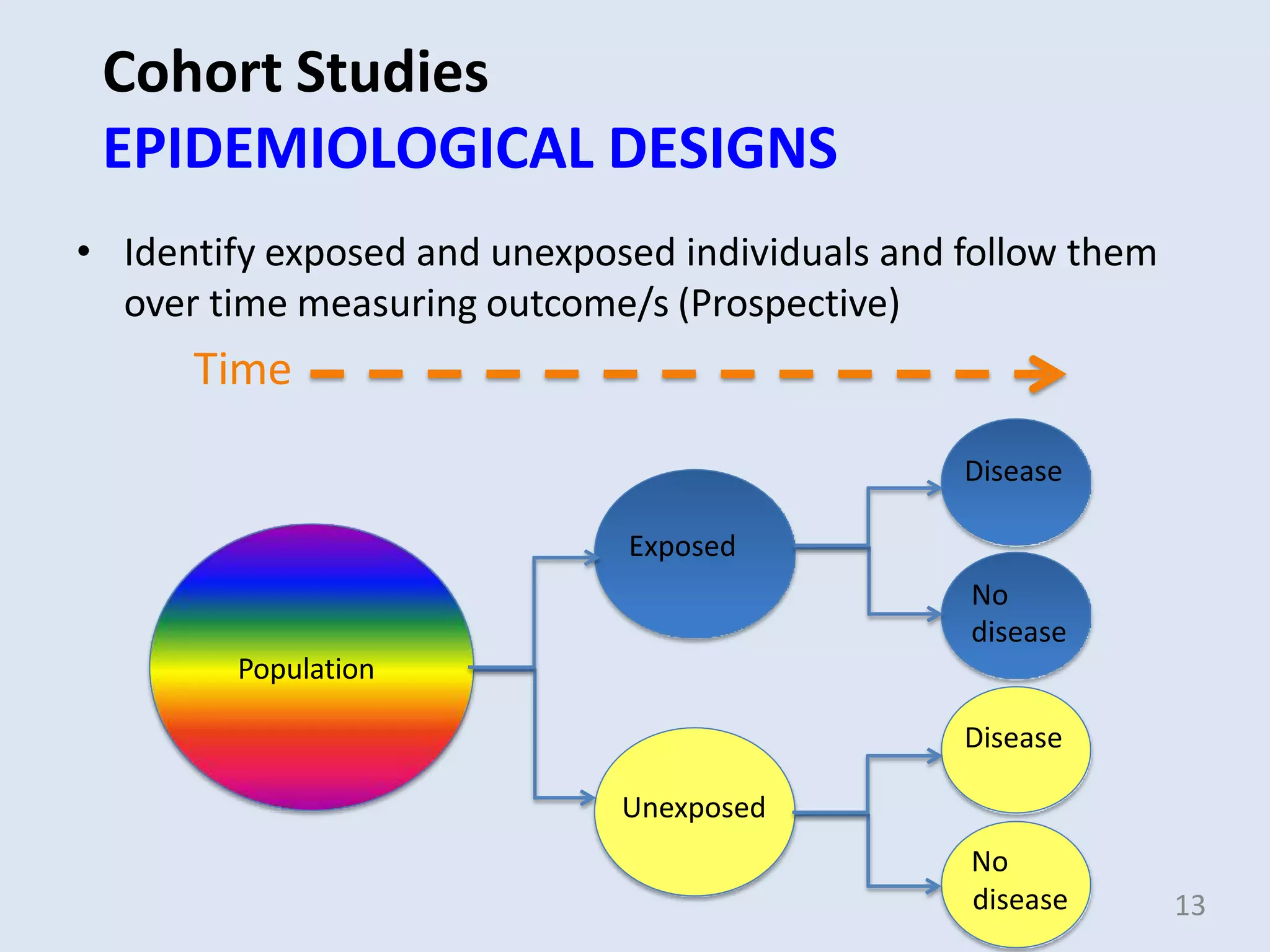
Cohort Studies
EPIDEMIOLOGICAL DESIGNS
• Identify exposed and unexposed individuals and follow them
over time measuring outcome/s (Prospective)
Time
Disease
Exposed
No
disease
Population
Disease
Unexposed
No
disease 13
Cohort Studies
EPIDEMIOLOGICAL DESIGNS
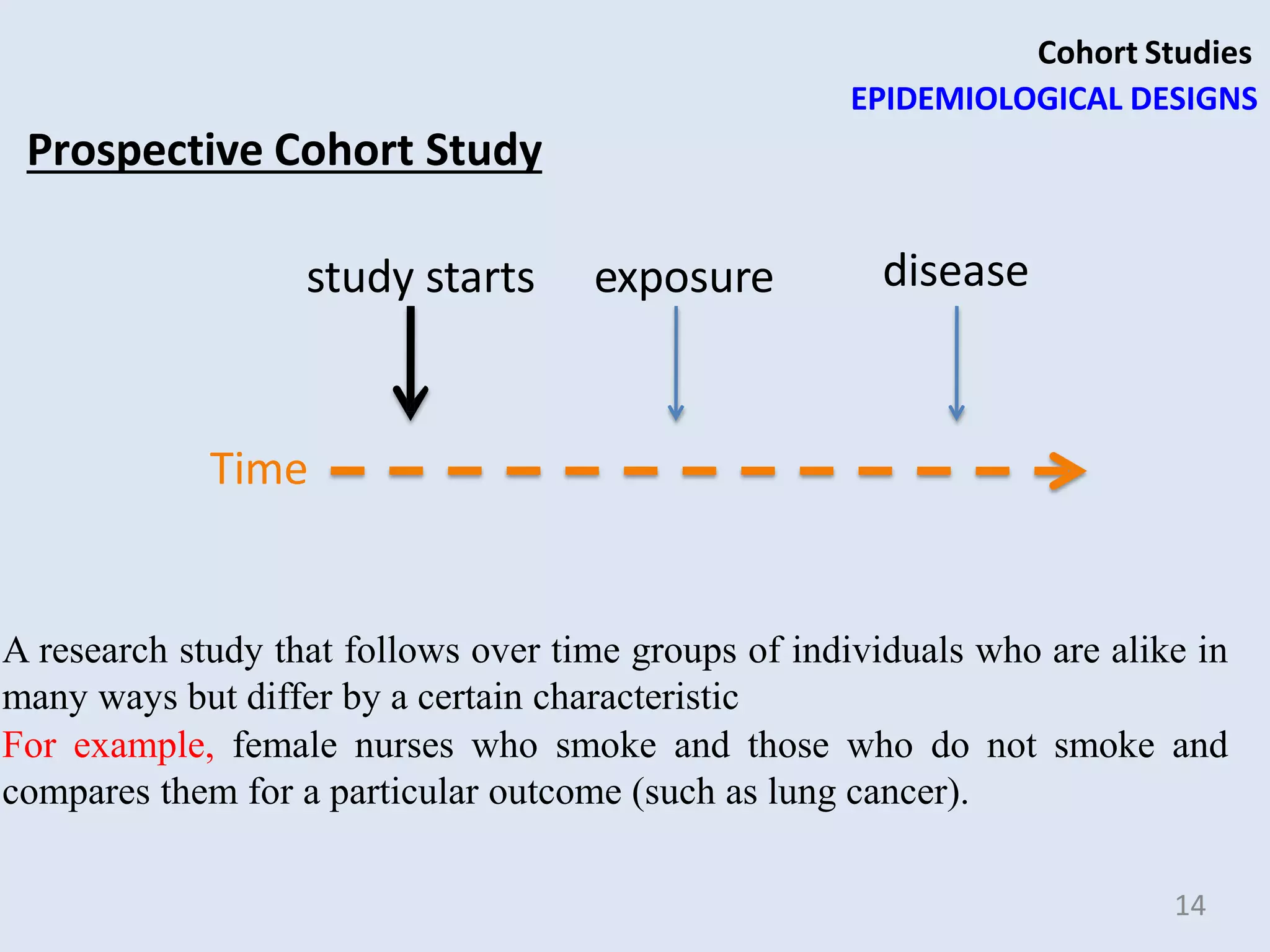
Prospective Cohort Study
study starts exposure disease
Time
A research study that follows over time groups of individuals who are alike in
many ways but differ by a certain characteristic
For example, female nurses who smoke and those who do not smoke and
compares them for a particular outcome (such as lung cancer).
14
Cohort Studies
EPIDEMIOLOGICAL DESIGNS
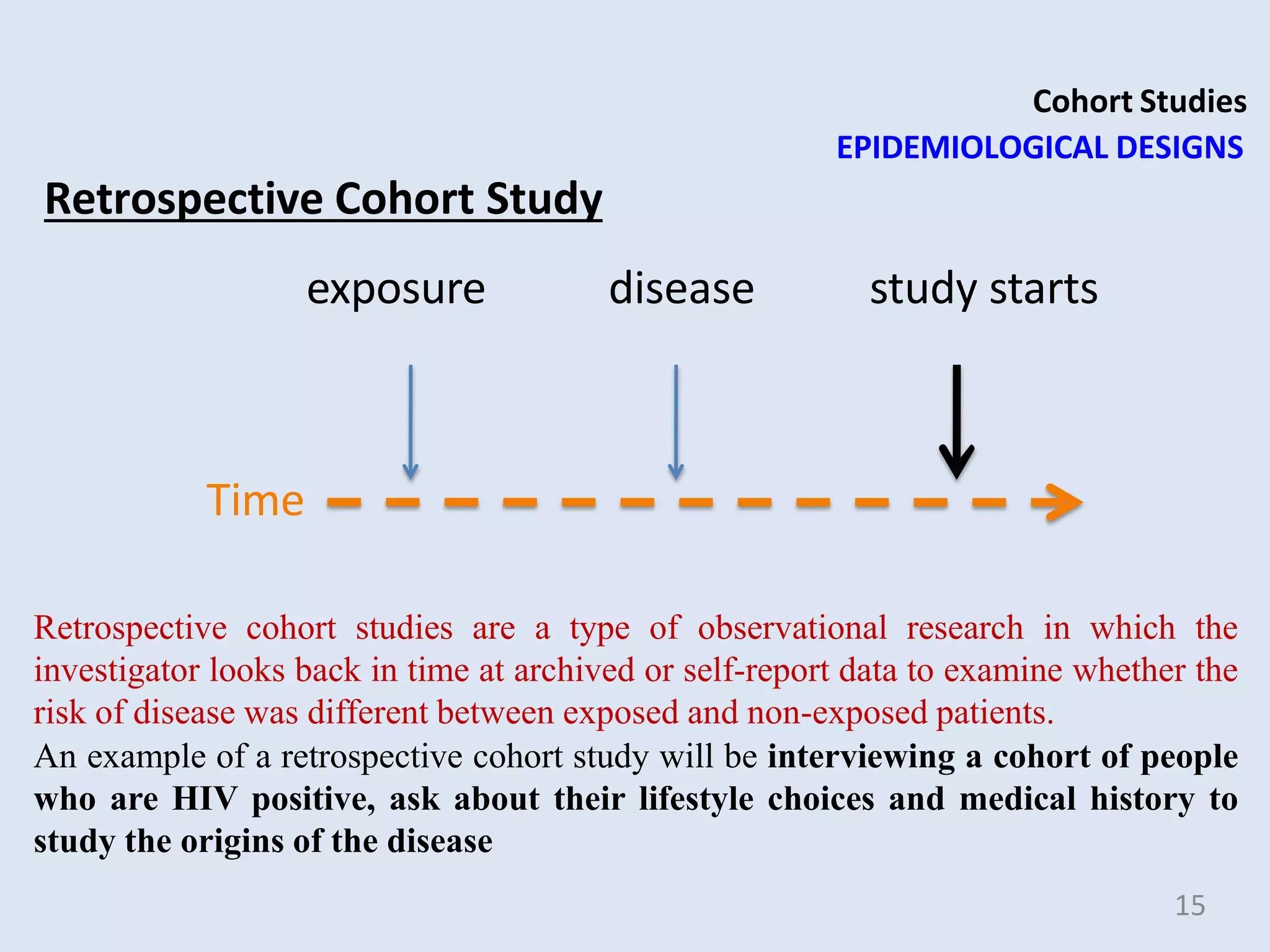
Retrospective Cohort Study
exposure disease study starts
Time
Retrospective cohort studies are a type of observational research in which the
investigator looks back in time at archived or self-report data to examine whether the
risk of disease was different between exposed and non-exposed patients.
An example of a retrospective cohort study will be interviewing a cohort of people
who are HIV positive, ask about their lifestyle choices and medical history to
study the origins of the disease
15
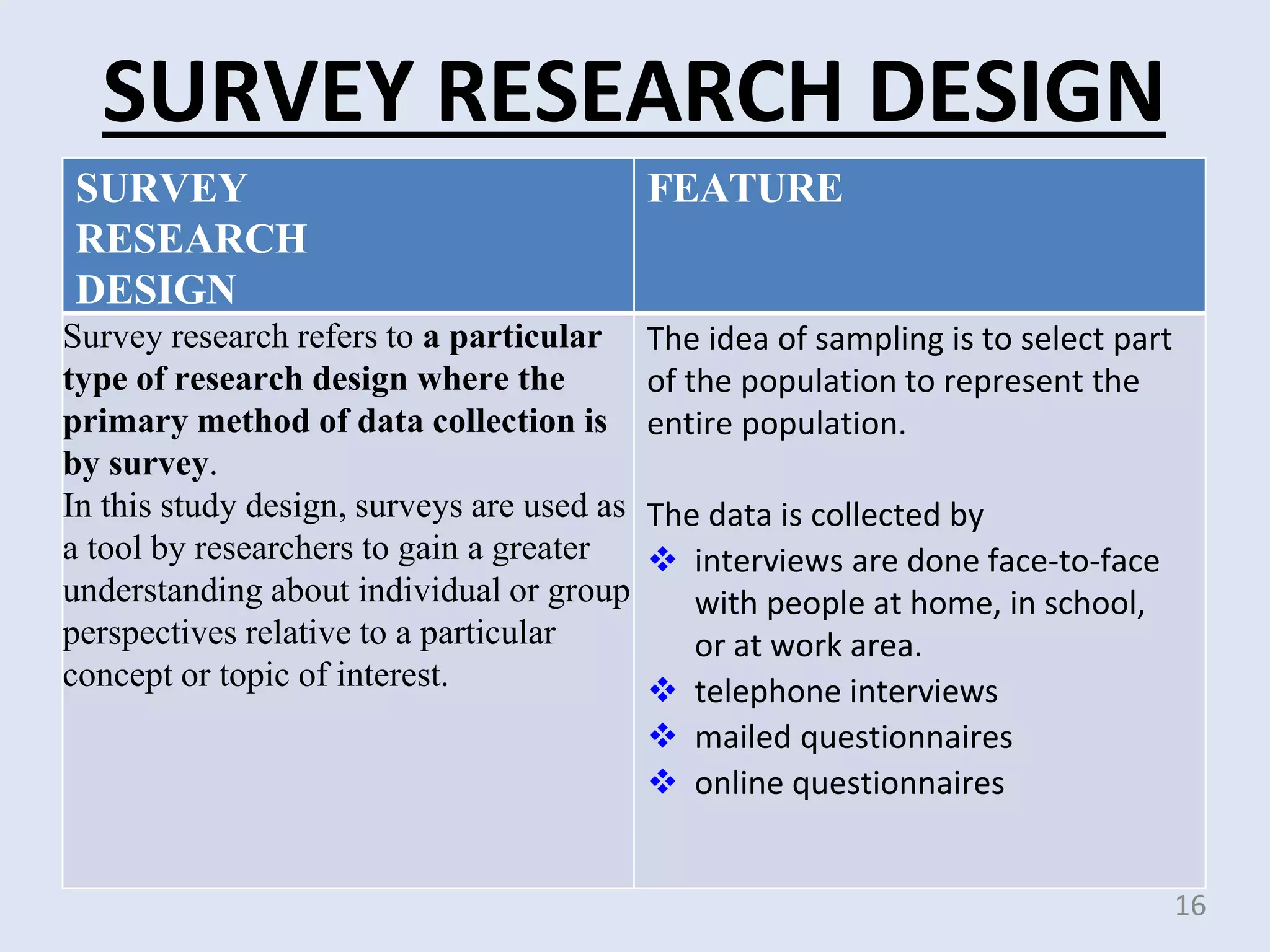
SURVEY RESEARCH DESIGN
SURVEY
RESEARCH
DESIGN
FEATURE
Survey research refers to a particular
type of research design where the
primary method of data collection is
by survey.
In this study design, surveys are used as
a tool by researchers to gain a greater
understanding about individual or group
perspectives relative to a particular
concept or topic of interest.
The idea of sampling is to select part
of the population to represent the
entire population.
The data is collected by
 interviews are done face-to-face
with people at home, in school,
or at work area.
 telephone interviews
 mailed questionnaires
 online questionnaires
16
ADVANTAGES
of Non experimental Design
• Non experimental research designs are close to the real
life situations.
• The non experimental studies are rarely criticized
for their artificiality.
• Non experimental research designs are most suitable for
the field of nursing as they help us to understand the
real world.
• Not all the human characteristics are inherently be
subjected to experimental manipulation (blood types,
health beliefs, medical diagnosis), therefore, the roles
of theses variables cannot be studied experimentally.
17
DISADVANTAGES
of Non experimental Design
• The results of the non experimental
researches' and the relationship
between the variables of the study
can never be absolutely clear and error
free.
• The mere existence of a relationship
between the variables is not enough
to warrant the conclusion that one
variable caused the other. 18
THANK ‘U’
19

Non Experimental Descriptive Study

  • 1.
    Descriptive Study Prof.Dr.Chinna Chadayan.N RN.RM., B.Sc(N)., M.Sc (N)., Ph.D (N)., Professor, Enam Nursing College – Savar, Bangladesh 1 1 yr M.Sc(N) Unit – 13a
  • 2.
    DESCRIPTIVE DESIGN.  Descriptiveresearch design is a broad class of non – experimental research.  The basic purpose of descriptive studies to observe, describe and documents aspects of a situation without any manipulation and control in the natural settings. 2
  • 3.
  • 4.
  • 5.
  • 6.
    DESIGNS CATEGORY RESEARCH DESIGN NONEXPERIMENTAL RESEARCH DESIGN 1.DESCRIPTIVE DESIGN. 2.CORRELATIONAL DESIGN 3DEVELOPMENTAL RESEARCH DESIGN 4.EPIDEMIOLOGICAL DESIGNS 5.SURVEY RESEARCH DESIGN 6
  • 7.
    Types of DescriptiveDesign TYPE FEATURE 1.UNIVARIENT DESCRIPTIVE DESIGN Are undertaken to describe the frequency of a phenomenon EXAMPLE -A study to assess the experiences of patients suffering from Leprosy. In this study the researcher may describe the frequency of different symptoms, experienced by the patients & types of treatment they received. 2.EXPLORATORY DESCRIPTIVE DESIGN -used to identify, explore and describe the single event, cause or variables. EXAMPLE -An exploratory study to assess the multi- factorial dimensions of falls and home safety measures for elderly people living in selected communities in Dhaka. 3.COMPARITIVE DESCRIPTIVE DESIGN examine the difference in variables between two or more groups that occur in a particular situation but without imposing any control or manipulation. EXAMPLE – compare the knowledge and attitude of dental and nursing students on HIV/AIDS 7
  • 8.
    Cross-Sectional design Developmental Research Cross-sectional research designsare used to examine behavior in participants of different ages who are tested at the same point in time. Example:-When considering our example of hide-and-seek behaviors in children, for example, from age 2-, 4-, and 6- year-old children the researcher might want to examine whether older children more often hide in novel locations (those in which another child in the same game has never hidden before) when compared to younger children. Longitudinal design Developmental Research Longitudinal research designs are used to examine behavior in the same infants and children over time. Example:-when considering our example of hide-and-seek behaviors in preschoolers, a researcher might conduct a longitudinal study to examine whether 2-year-olds develop into better hiders over time. To this end, a researcher might observe a group of 2-year-old children playing hide-and- seek with plans to observe them again when they are 4 years old – and again when they are 6 years old. Types of Developmental Research Design 8
  • 9.
    EPIDEMIOLOGICAL DESIGNS In epidemiologydesign, researchers are interested in measuring or assessing the relationship of exposure with a disease or an outcome 9
  • 10.
  • 11.
    Cross-sectional studies EPIDEMIOLOGICAL DESIGNS •Measure existing disease and current exposure levels at one point in time • Sample without knowledge of exposure or disease • Ex. Prevalence studies 11
  • 12.
    Case-Control studies EPIDEMIOLOGICAL DESIGNS Population Cases Controls Exposed Not exposed Exposed Not exposed •Identify individuals with existing disease/s and retrospectively measure exposure Time 12
  • 13.
    Cohort Studies EPIDEMIOLOGICAL DESIGNS •Identify exposed and unexposed individuals and follow them over time measuring outcome/s (Prospective) Time Disease Exposed No disease Population Disease Unexposed No disease 13
  • 14.
    Cohort Studies EPIDEMIOLOGICAL DESIGNS ProspectiveCohort Study study starts exposure disease Time A research study that follows over time groups of individuals who are alike in many ways but differ by a certain characteristic For example, female nurses who smoke and those who do not smoke and compares them for a particular outcome (such as lung cancer). 14
  • 15.
    Cohort Studies EPIDEMIOLOGICAL DESIGNS RetrospectiveCohort Study exposure disease study starts Time Retrospective cohort studies are a type of observational research in which the investigator looks back in time at archived or self-report data to examine whether the risk of disease was different between exposed and non-exposed patients. An example of a retrospective cohort study will be interviewing a cohort of people who are HIV positive, ask about their lifestyle choices and medical history to study the origins of the disease 15
  • 16.
    SURVEY RESEARCH DESIGN SURVEY RESEARCH DESIGN FEATURE Surveyresearch refers to a particular type of research design where the primary method of data collection is by survey. In this study design, surveys are used as a tool by researchers to gain a greater understanding about individual or group perspectives relative to a particular concept or topic of interest. The idea of sampling is to select part of the population to represent the entire population. The data is collected by  interviews are done face-to-face with people at home, in school, or at work area.  telephone interviews  mailed questionnaires  online questionnaires 16
  • 17.
    ADVANTAGES of Non experimentalDesign • Non experimental research designs are close to the real life situations. • The non experimental studies are rarely criticized for their artificiality. • Non experimental research designs are most suitable for the field of nursing as they help us to understand the real world. • Not all the human characteristics are inherently be subjected to experimental manipulation (blood types, health beliefs, medical diagnosis), therefore, the roles of theses variables cannot be studied experimentally. 17
  • 18.
    DISADVANTAGES of Non experimentalDesign • The results of the non experimental researches' and the relationship between the variables of the study can never be absolutely clear and error free. • The mere existence of a relationship between the variables is not enough to warrant the conclusion that one variable caused the other. 18
  • 19.