SATYA COLLEGE OF NURSING SISAR KHAS, MEHAM
(HARYANA)
LESSON PLAN
ON
PROTEIN ENERGY MALNUTRITION
SUBMITTED TO: SUBMIITED BY :
Mrs. Om Devi Anil jain
Principal of Satya College Of Nursing MSc.N1st
year
Sr.
No.
Time Specific
objective
Content Teaching
activity
Learning
activity
A.V. Aid Evaluation
1
2
2 min
3 min
To introduce
the concept
of preventive
pediatrics.
To classify
the PEM.
INTRODUCTION-
The term malnutrition can be applied to any
disorder that prevents an individual from achieving
an optimal nutritional state.
Protein energy malnutrition is the state occurs
due to insufficient or imbalanced consumption of
protein and energy.
The term protein energy malnutrition, refers to a class
of clinical conditions that may result from varying
degree of protein lack and energy (calorie)
inadequacy.
CLASSIFICATION
1. SYNDROMAL CLASSIFICATION:
 KWASHIORKAR
 NUTRITIONAL MARASMUS
 MARASMIC KWASHIORKAR
 PREKWASHIORKAR
 NUTRITIONAL DWARFING
2. GOMEZ CLASSIFICATION
PARAMETER: WEIGHT FOR AGE
CHART GRADES:
 (MILD) : 90-70
 (MODERATE): 70-60
 (SEVERE) : < 60
Lecture cum
discussion
Lecture cum
discussion
Listen
carefully
Listen
carefully
3
2 min
To define the
marasmus.
3. WELLCOME CLASSIFICATION
PARAMETER: WEIGHT FOR AGE +
OEDEMA
GRADES:
 80-60 % WITHOUT OEDEMA IS UNDER
WEIGHT
 80-60% WITH OEDEMA IS
KWASHIORKOR
 < 60 % WITH OEDEMA IS MARASMUS-
KWASH
 < 60 % WITHOUT OEDEMA IS
MARASMUS
4. INDIAN ACADEMY OF PAEDIATRIC
PARAMETER: WEIGHT FOR AGE
DEGREE:
 ( FIRST ) : 80-70
 (SECOND ) : 70-60
 (THIRD) : <50
MARASMUS
A severe form of malnutrition caused by inadequate
intake of protein and calories, and it usually occurs
in the first year of life, resulting in wasting and
growth retardation.
Nutritional Marasmus is a nutritional disorder results
due the gross deficiency of energy though protein
deficiency accompanies it.
Lecture cum
discussion
Listen
carefully
4
5
2min
3 min
To describe
the
kwashiorkor.
Describe the
etiology of
PEM.
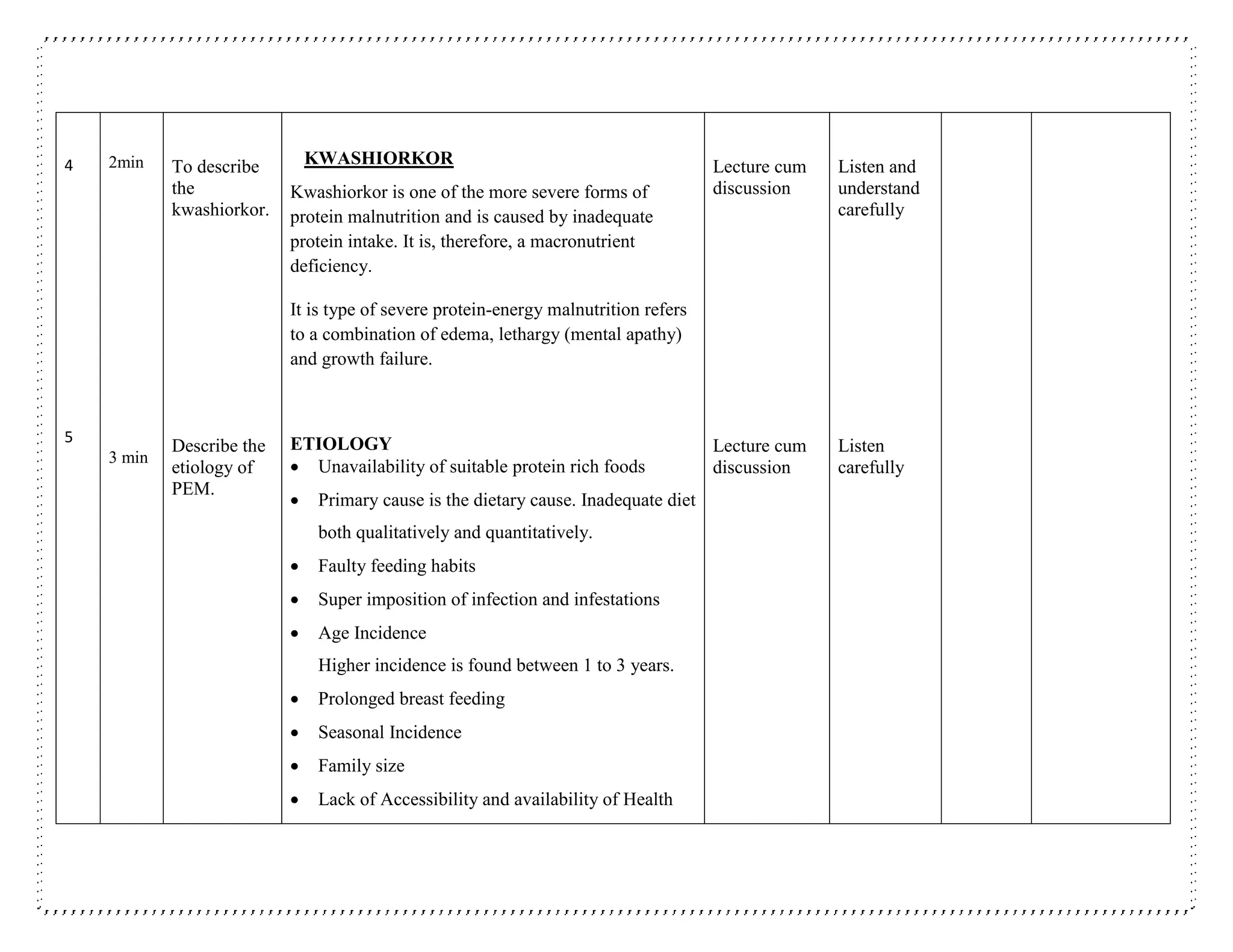
KWASHIORKOR
Kwashiorkor is one of the more severe forms of
protein malnutrition and is caused by inadequate
protein intake. It is, therefore, a macronutrient
deficiency.
It is type of severe protein-energy malnutrition refers
to a combination of edema, lethargy (mental apathy)
and growth failure.
ETIOLOGY
 Unavailability of suitable protein rich foods
 Primary cause is the dietary cause. Inadequate diet
both qualitatively and quantitatively.
 Faulty feeding habits
 Super imposition of infection and infestations
 Age Incidence
Higher incidence is found between 1 to 3 years.
 Prolonged breast feeding
 Seasonal Incidence
 Family size
 Lack of Accessibility and availability of Health
Lecture cum
discussion
Lecture cum
discussion
Listen and
understand
carefully
Listen
carefully
6 3min To describe
the clinical
menifestation
of PEM.
Services
MARASMUS
 Appearance of toothless old man and a
monkey look.
 Growth retardation as evidenced by marked
loss of weight and subnormal height.
 Gross muscle wasting
 Absence of edema.
 Eyes will be sunken
 Disappeared subcutaneous fat.
 Face will be round, till the loss of
subcutaneous fat.
 Skin over the buttocks becomes wrinkled and
saggy due to loss of adipose tissue.
 Bones will be prominent.
 Anemia
 Subnormal temperature.
 Skin becomes ashen gray because of anemia
 Atrophy and wasting of body tissues
especially subcutaneous fat.
 The child will be apathetic and lethargic.
 Recurrent infections.
KWASHIORKOR
 Onset: Insidious in onset over periods of weeks and
Lecture cum
discussion
Listen
carefully
months.
 Apathy: Gradually loss of interest and activity. The
degree unresponsiveness will be proportional to
severity of the disease.
 Diarrhea: Nearly 2/3rd
of Kwashiorkor cases will be
presenting with the complaints of loose stools with
infective in origin.
 Edema: Edema is a constant feature and is
extremely variable in degree. Inspite of gross
edema, ascites will be minimal.
 Muscle wasting: Due to degeneration and reduction
in the anterior horn cells may lead to weakness and
hypotonia as suggested by one postulate
(Kwashiorkor myelopathy). Protein deficiency also
causes muscle wasting.
 Skin changes: 40% to 60% of the florid
kwashiorkor will have skin changes. Dry and scaly
skin: Common over skin
 Pavement dermatosis: Jet black, later exfoliate
exposing underlying and also there will be peeling.
 Petichae and ecchymoses.
 Arabinoflavinosis
 Hair changes: The hair is scanty, lusterless
commonly brownish. The light color hair is known
as dyschromotrichia.
7
8
2min
3 min
Explain the
diagnostic
evaluation of
PEM.
Explain the
management
of PEM.
 Hepatomegally with fatty infiltration.
DIAGNOSTIC EVALUATION
 History collection
 Physical examination
 Biochemical Investigation
 Pathological references
 Anthropometric measurements
MANAGEMENT
MARASMUS
 Calorie requirement of the undernourished
infants are greater than those of normal infants
it almost doubled.
 The aim of treatment is to provide sufficient
proteins, calories, and other nutrients for
nutritional rehabilitation and maintenance.
 In case of severe PEM, restoring fluid and
electrolyte balance parentally is the initial
concern. A patient who shows normal
absorption may receive enteral nutrition after
anorexia has subsided.
Lecture cum
discussion
Lecture cum
discussion
Listen
carefully
Listen
carefully
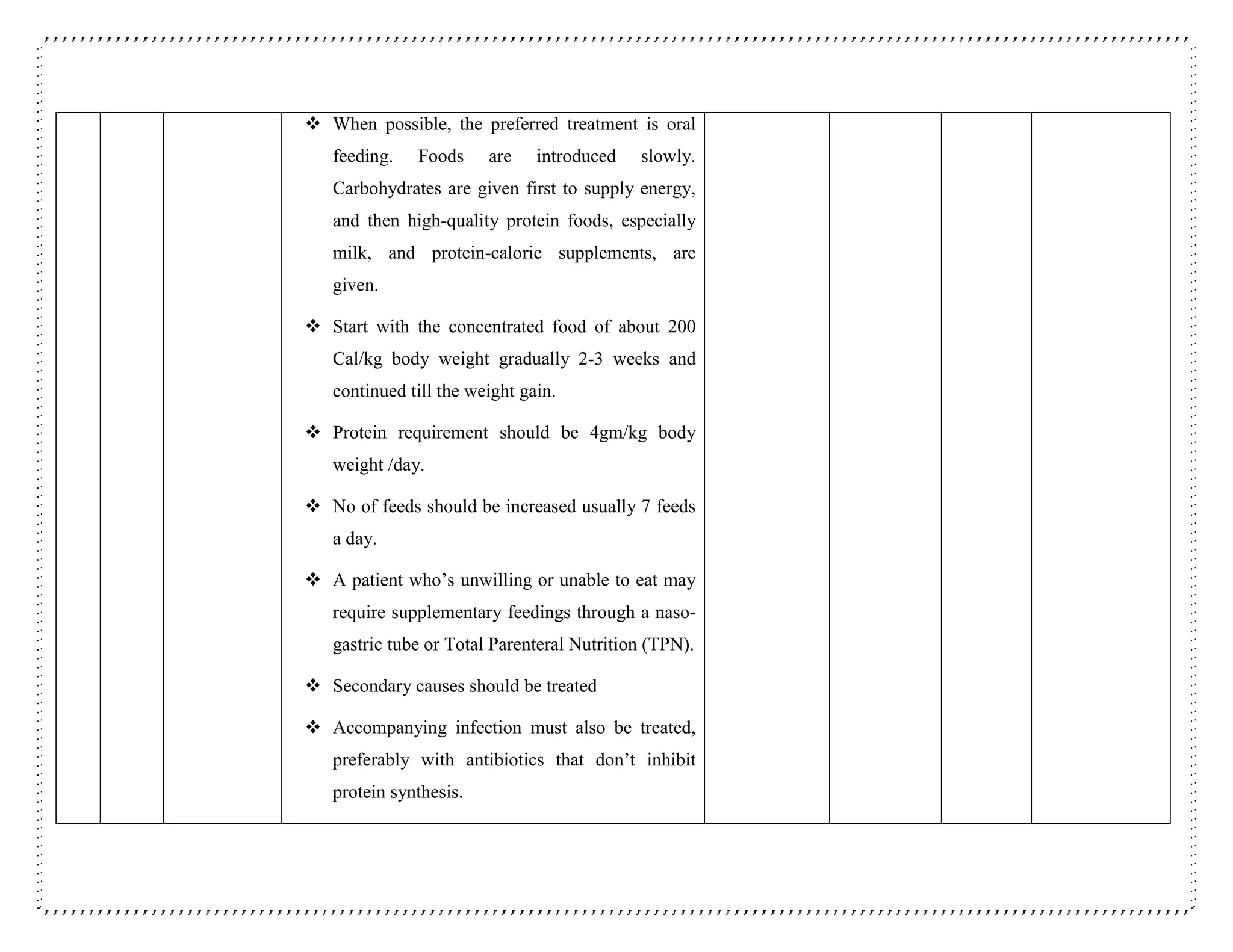
 When possible, the preferred treatment is oral
feeding. Foods are introduced slowly.
Carbohydrates are given first to supply energy,
and then high-quality protein foods, especially
milk, and protein-calorie supplements, are
given.
 Start with the concentrated food of about 200
Cal/kg body weight gradually 2-3 weeks and
continued till the weight gain.
 Protein requirement should be 4gm/kg body
weight /day.
 No of feeds should be increased usually 7 feeds
a day.
 A patient who’s unwilling or unable to eat may
require supplementary feedings through a naso-
gastric tube or Total Parenteral Nutrition (TPN).
 Secondary causes should be treated
 Accompanying infection must also be treated,
preferably with antibiotics that don’t inhibit
protein synthesis.
KWASHIORKOR
Management:
1. Dietary modifications
Dietary Management:
Liberal protein rich foods to be given with adequate
calories.
Proteins:
About 5 to 6 gms of protein/kg/day.
The total average protein intake of child is 50-
60gm/day.
Calories:
Calories should be in range of 120-150
Kcal/kg/day.
2. Control and Treatment of infections
3. Correction of Vitamin deficiencies
SUMMARY
Protein energy malnutrition is the major problem
among the children. It is a condition maily depend
upon the nutritional level of the child.
Poverty and low socio economic condition main
factor for PEM.
In this lesson we discuss the definition of protein
energy malnutrition, and classification of PEM.
We discuss the marasmus and kwashiorkor and its
etiology , clinical manifestation and management of
marasmus and kwashiorkor.
BIBLIOGRAPHY
1. Dutta Parul , pediatric nursing,
jaypee publisher, edition-second,
page number-143-144.
2. Park K., textbook of preventive and
social medicine, bhanot
publications, jabalpur, 18th
edition,
page number-408.
3. Internet source: google.com.
4. Sharma Rimple , essentials of
pediatric nursing, jaypee brothers
medical publishers (P) LTD , first
edition , page no.135-139.
IDENTIFICATION DATA:-
NAME OF INSTITUTION :- SONI NURSING COLLEGE , JAIPUR.
NAME OF INSTRUTOR :- Mr. ANKUR SHARMA
DESIGNATION :- PEDIATRIC NURSING (HOD)
SUBJECT OF TEACHING :- PEDIATRIC NURSING
TOPIC FOR TEACHING :- PROTEIN ENERGY MALNUTRITION
NUMBER OF STUDENTS :- 100
LANGUAGE :- ENGLISH
A.V.AID :- FLASH CARD , CHART , OHP SHEET , BLACK BOARD , PPT
DATE/TIME OF CLASS :- DECEMBER 9 , 2015
METHOD OF TEACHING :- LECTURE CUM DISCUSSION
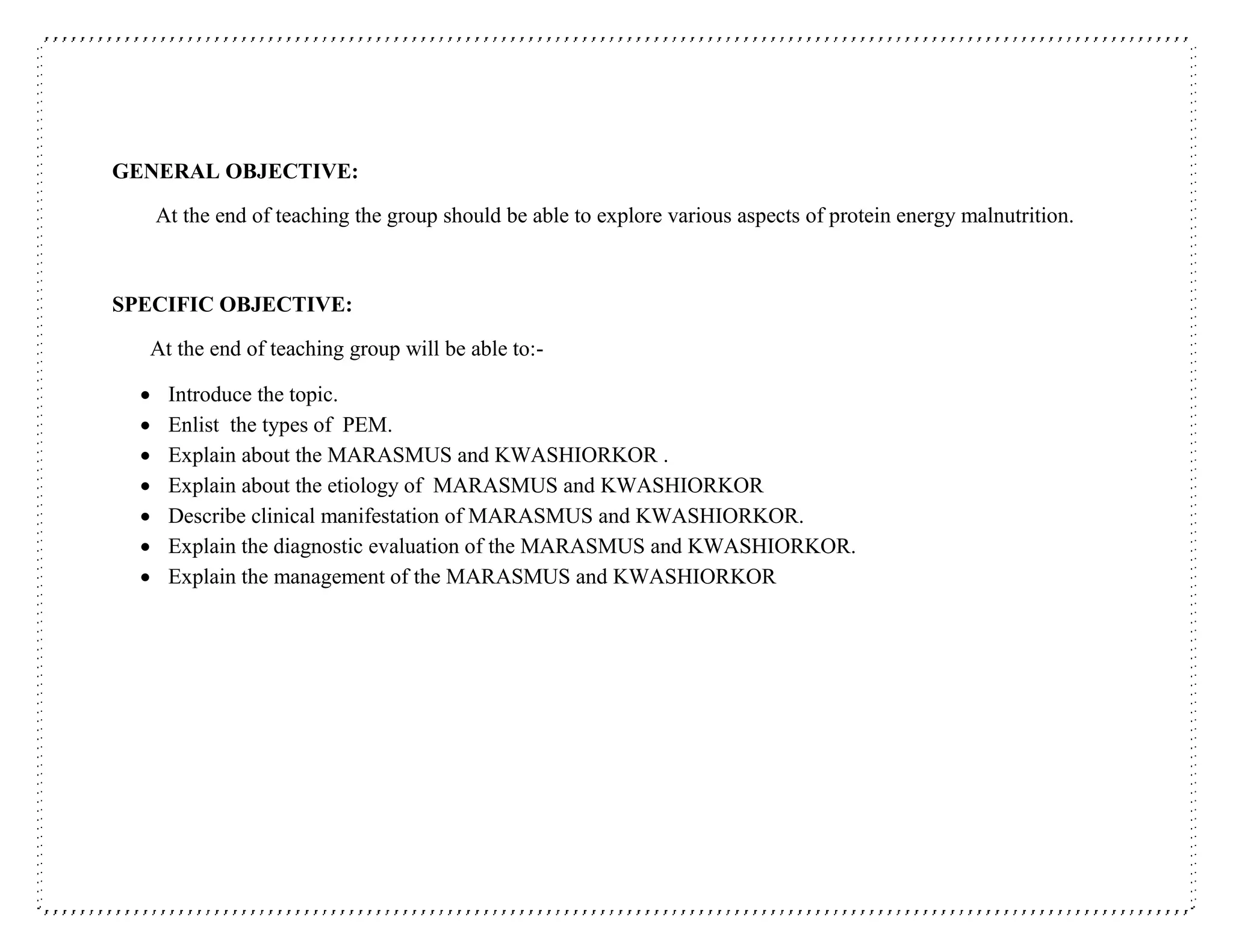
GENERAL OBJECTIVE:
At the end of teaching the group should be able to explore various aspects of protein energy malnutrition.
SPECIFIC OBJECTIVE:
At the end of teaching group will be able to:-
 Introduce the topic.
 Enlist the types of PEM.
 Explain about the MARASMUS and KWASHIORKOR .
 Explain about the etiology of MARASMUS and KWASHIORKOR
 Describe clinical manifestation of MARASMUS and KWASHIORKOR.
 Explain the diagnostic evaluation of the MARASMUS and KWASHIORKOR.
 Explain the management of the MARASMUS and KWASHIORKOR
BIBLIOGRAPHY
 Wong’s. ESSENTIALS OF PEDIATRIC NURSING.7TH
Edition. Elsevier Publications. 2005.
 Marlow’s. A TEXT BOOK OF PEDIATRIC NURSING. 6TH
Edition. Elsevier publications.LTD. 2005.
Page No: 593-596.
 B T Basavanthappa. COMMUNITY HEALTH NURSING. 5TH
Edition. Reprint 2005. Jaypee Publishers.
Page No: 300-366
 Klossner and Hatfield. INTRODUCTORY MATERNITY AND PEDIATRIC NURSING. Lippincott
Williams $ Wilkins Publiccations.2006.Page No: 358-360; 583-584.
 www.wikipedia.com
 www.thebirthclinic.co.uk
SONI NURSING COLLEGE, JAIPUR
MICRO TEACHING
ON
PROTEIN ENERGY MALNUTRITION
SUBMITTED TO:- SUBMITTED BY:-
MR.ANKUR SHARMA SUNITA MAWLIYA
PEADIATRIC NURSING (HOD) M.SC.NURSING (PREV.)
SONI NURSING COLLEGE, JAIPUR PEADIATRIC NURSING

THe protein energy LESSON-PLAN-ON-PEM.docx

  • 1.
    SATYA COLLEGE OFNURSING SISAR KHAS, MEHAM (HARYANA) LESSON PLAN ON PROTEIN ENERGY MALNUTRITION SUBMITTED TO: SUBMIITED BY : Mrs. Om Devi Anil jain Principal of Satya College Of Nursing MSc.N1st year
  • 2.
    Sr. No. Time Specific objective Content Teaching activity Learning activity A.V.Aid Evaluation 1 2 2 min 3 min To introduce the concept of preventive pediatrics. To classify the PEM. INTRODUCTION- The term malnutrition can be applied to any disorder that prevents an individual from achieving an optimal nutritional state. Protein energy malnutrition is the state occurs due to insufficient or imbalanced consumption of protein and energy. The term protein energy malnutrition, refers to a class of clinical conditions that may result from varying degree of protein lack and energy (calorie) inadequacy. CLASSIFICATION 1. SYNDROMAL CLASSIFICATION:  KWASHIORKAR  NUTRITIONAL MARASMUS  MARASMIC KWASHIORKAR  PREKWASHIORKAR  NUTRITIONAL DWARFING 2. GOMEZ CLASSIFICATION PARAMETER: WEIGHT FOR AGE CHART GRADES:  (MILD) : 90-70  (MODERATE): 70-60  (SEVERE) : < 60 Lecture cum discussion Lecture cum discussion Listen carefully Listen carefully
  • 3.
    3 2 min To definethe marasmus. 3. WELLCOME CLASSIFICATION PARAMETER: WEIGHT FOR AGE + OEDEMA GRADES:  80-60 % WITHOUT OEDEMA IS UNDER WEIGHT  80-60% WITH OEDEMA IS KWASHIORKOR  < 60 % WITH OEDEMA IS MARASMUS- KWASH  < 60 % WITHOUT OEDEMA IS MARASMUS 4. INDIAN ACADEMY OF PAEDIATRIC PARAMETER: WEIGHT FOR AGE DEGREE:  ( FIRST ) : 80-70  (SECOND ) : 70-60  (THIRD) : <50 MARASMUS A severe form of malnutrition caused by inadequate intake of protein and calories, and it usually occurs in the first year of life, resulting in wasting and growth retardation. Nutritional Marasmus is a nutritional disorder results due the gross deficiency of energy though protein deficiency accompanies it. Lecture cum discussion Listen carefully
  • 4.
    4 5 2min 3 min To describe the kwashiorkor. Describethe etiology of PEM. KWASHIORKOR Kwashiorkor is one of the more severe forms of protein malnutrition and is caused by inadequate protein intake. It is, therefore, a macronutrient deficiency. It is type of severe protein-energy malnutrition refers to a combination of edema, lethargy (mental apathy) and growth failure. ETIOLOGY  Unavailability of suitable protein rich foods  Primary cause is the dietary cause. Inadequate diet both qualitatively and quantitatively.  Faulty feeding habits  Super imposition of infection and infestations  Age Incidence Higher incidence is found between 1 to 3 years.  Prolonged breast feeding  Seasonal Incidence  Family size  Lack of Accessibility and availability of Health Lecture cum discussion Lecture cum discussion Listen and understand carefully Listen carefully
  • 5.
    6 3min Todescribe the clinical menifestation of PEM. Services MARASMUS  Appearance of toothless old man and a monkey look.  Growth retardation as evidenced by marked loss of weight and subnormal height.  Gross muscle wasting  Absence of edema.  Eyes will be sunken  Disappeared subcutaneous fat.  Face will be round, till the loss of subcutaneous fat.  Skin over the buttocks becomes wrinkled and saggy due to loss of adipose tissue.  Bones will be prominent.  Anemia  Subnormal temperature.  Skin becomes ashen gray because of anemia  Atrophy and wasting of body tissues especially subcutaneous fat.  The child will be apathetic and lethargic.  Recurrent infections. KWASHIORKOR  Onset: Insidious in onset over periods of weeks and Lecture cum discussion Listen carefully
  • 6.
    months.  Apathy: Graduallyloss of interest and activity. The degree unresponsiveness will be proportional to severity of the disease.  Diarrhea: Nearly 2/3rd of Kwashiorkor cases will be presenting with the complaints of loose stools with infective in origin.  Edema: Edema is a constant feature and is extremely variable in degree. Inspite of gross edema, ascites will be minimal.  Muscle wasting: Due to degeneration and reduction in the anterior horn cells may lead to weakness and hypotonia as suggested by one postulate (Kwashiorkor myelopathy). Protein deficiency also causes muscle wasting.  Skin changes: 40% to 60% of the florid kwashiorkor will have skin changes. Dry and scaly skin: Common over skin  Pavement dermatosis: Jet black, later exfoliate exposing underlying and also there will be peeling.  Petichae and ecchymoses.  Arabinoflavinosis  Hair changes: The hair is scanty, lusterless commonly brownish. The light color hair is known as dyschromotrichia.
  • 7.
    7 8 2min 3 min Explain the diagnostic evaluationof PEM. Explain the management of PEM.  Hepatomegally with fatty infiltration. DIAGNOSTIC EVALUATION  History collection  Physical examination  Biochemical Investigation  Pathological references  Anthropometric measurements MANAGEMENT MARASMUS  Calorie requirement of the undernourished infants are greater than those of normal infants it almost doubled.  The aim of treatment is to provide sufficient proteins, calories, and other nutrients for nutritional rehabilitation and maintenance.  In case of severe PEM, restoring fluid and electrolyte balance parentally is the initial concern. A patient who shows normal absorption may receive enteral nutrition after anorexia has subsided. Lecture cum discussion Lecture cum discussion Listen carefully Listen carefully
  • 8.
     When possible,the preferred treatment is oral feeding. Foods are introduced slowly. Carbohydrates are given first to supply energy, and then high-quality protein foods, especially milk, and protein-calorie supplements, are given.  Start with the concentrated food of about 200 Cal/kg body weight gradually 2-3 weeks and continued till the weight gain.  Protein requirement should be 4gm/kg body weight /day.  No of feeds should be increased usually 7 feeds a day.  A patient who’s unwilling or unable to eat may require supplementary feedings through a naso- gastric tube or Total Parenteral Nutrition (TPN).  Secondary causes should be treated  Accompanying infection must also be treated, preferably with antibiotics that don’t inhibit protein synthesis.
  • 9.
    KWASHIORKOR Management: 1. Dietary modifications DietaryManagement: Liberal protein rich foods to be given with adequate calories. Proteins: About 5 to 6 gms of protein/kg/day. The total average protein intake of child is 50- 60gm/day. Calories: Calories should be in range of 120-150 Kcal/kg/day. 2. Control and Treatment of infections 3. Correction of Vitamin deficiencies
  • 10.
    SUMMARY Protein energy malnutritionis the major problem among the children. It is a condition maily depend upon the nutritional level of the child. Poverty and low socio economic condition main factor for PEM. In this lesson we discuss the definition of protein energy malnutrition, and classification of PEM. We discuss the marasmus and kwashiorkor and its etiology , clinical manifestation and management of marasmus and kwashiorkor.
  • 11.
    BIBLIOGRAPHY 1. Dutta Parul, pediatric nursing, jaypee publisher, edition-second, page number-143-144. 2. Park K., textbook of preventive and social medicine, bhanot publications, jabalpur, 18th edition, page number-408. 3. Internet source: google.com. 4. Sharma Rimple , essentials of pediatric nursing, jaypee brothers medical publishers (P) LTD , first edition , page no.135-139.
  • 15.
    IDENTIFICATION DATA:- NAME OFINSTITUTION :- SONI NURSING COLLEGE , JAIPUR. NAME OF INSTRUTOR :- Mr. ANKUR SHARMA DESIGNATION :- PEDIATRIC NURSING (HOD) SUBJECT OF TEACHING :- PEDIATRIC NURSING TOPIC FOR TEACHING :- PROTEIN ENERGY MALNUTRITION NUMBER OF STUDENTS :- 100 LANGUAGE :- ENGLISH A.V.AID :- FLASH CARD , CHART , OHP SHEET , BLACK BOARD , PPT DATE/TIME OF CLASS :- DECEMBER 9 , 2015 METHOD OF TEACHING :- LECTURE CUM DISCUSSION
  • 16.
    GENERAL OBJECTIVE: At theend of teaching the group should be able to explore various aspects of protein energy malnutrition. SPECIFIC OBJECTIVE: At the end of teaching group will be able to:-  Introduce the topic.  Enlist the types of PEM.  Explain about the MARASMUS and KWASHIORKOR .  Explain about the etiology of MARASMUS and KWASHIORKOR  Describe clinical manifestation of MARASMUS and KWASHIORKOR.  Explain the diagnostic evaluation of the MARASMUS and KWASHIORKOR.  Explain the management of the MARASMUS and KWASHIORKOR
  • 17.
    BIBLIOGRAPHY  Wong’s. ESSENTIALSOF PEDIATRIC NURSING.7TH Edition. Elsevier Publications. 2005.  Marlow’s. A TEXT BOOK OF PEDIATRIC NURSING. 6TH Edition. Elsevier publications.LTD. 2005. Page No: 593-596.  B T Basavanthappa. COMMUNITY HEALTH NURSING. 5TH Edition. Reprint 2005. Jaypee Publishers. Page No: 300-366  Klossner and Hatfield. INTRODUCTORY MATERNITY AND PEDIATRIC NURSING. Lippincott Williams $ Wilkins Publiccations.2006.Page No: 358-360; 583-584.  www.wikipedia.com  www.thebirthclinic.co.uk
  • 18.
    SONI NURSING COLLEGE,JAIPUR MICRO TEACHING ON PROTEIN ENERGY MALNUTRITION SUBMITTED TO:- SUBMITTED BY:- MR.ANKUR SHARMA SUNITA MAWLIYA PEADIATRIC NURSING (HOD) M.SC.NURSING (PREV.) SONI NURSING COLLEGE, JAIPUR PEADIATRIC NURSING