ROY ADAPTATION MODEL
Presented by :
Ola Al-Omoush
Instructor: Dr. Ghadah Abu- Shosha
Zarqa University
Faculty of Nursing
Course title:
Nursing Theories: Development and Application
Objective:
At the end of this lecture the student will be able to :
-Summarize an overview about Dr. Roy background
& credential.
- Identify the theoretical source of RAM.
-Identify and define the major concepts of Roy
adaptation model ( RAM)
-understand the assumptions and proposition of
RAM .
-Paraphrase Meta-paradigm of the theory.
-Learn how Callista RAM can be utilize in the nursing
scopes (practice , education & research).
At the end of this lecture the student will be able
to :
-Criticize the theory.
-Determined the strengths and limitations of RAM.
-Discuss a case study and research article that
utilized RAM.
Why we choose Roy Adaptation Model
(RAM)?
because ( RAM ) had a strong emphasis on the
patients and their interactions with the
environment.
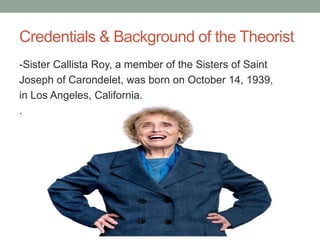
Credentials & Background of the Theorist
-Sister Callista Roy, a member of the Sisters of Saint
Joseph of Carondelet, was born on October 14, 1939,
in Los Angeles, California.
.
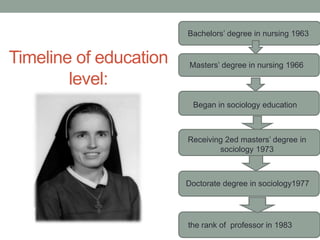
Timeline of education
level:
Bachelors’ degree in nursing 1963
Masters’ degree in nursing 1966
Began in sociology education
Receiving 2ed masters’ degree in
sociology 1973
Doctorate degree in sociology1977
the rank of professor in 1983
Professional Experience
-Pediatric Nurse
-Nursing instructor in many different capacities
-Teaching both pediatric and maternity nursing at Mary's
College in 1966.
-She has lectured across the United States and in more
than thirty other countries
-She organized course content according to a view of
person and family as adaptive systems.
-She introduced her ideas about ‘Adaptation Nursing’ as
the basis for an integrated nursing curriculum.
-She has published many works in (2002),(2008),(2009).
Honors and awards
2006
• Distinguished Teaching Award, Boston
College
2007
• Living Legend, American Academy of
Nursing
2010
• Inductee, Sigma Theta Tau’ Nurse
Researcher Hall of Fame
2011
• Mentor Award, Sigma Theta Tau Society
The Theoretical source:
•
.
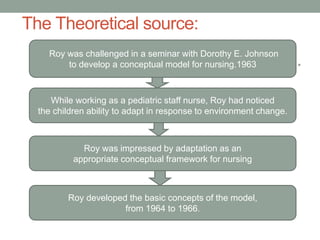
Roy was challenged in a seminar with Dorothy E. Johnson
to develop a conceptual model for nursing.1963
While working as a pediatric staff nurse, Roy had noticed
the children ability to adapt in response to environment change.
Roy developed the basic concepts of the model,
from 1964 to 1966.
Roy was impressed by adaptation as an
appropriate conceptual framework for nursing
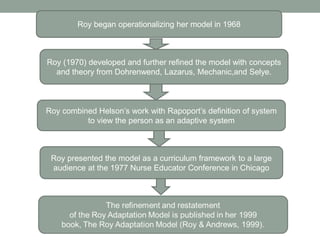
Roy began operationalizing her model in 1968
Roy combined Helson’s work with Rapoport’s definition of system
to view the person as an adaptive system
Roy (1970) developed and further refined the model with concepts
and theory from Dohrenwend, Lazarus, Mechanic,and Selye.
Roy presented the model as a curriculum framework to a large
audience at the 1977 Nurse Educator Conference in Chicago
Introduction to the Roy model
-The Roy adaptation model presents the person as holistic
adaptive system in constant interaction with the internal
and external environmental, the main task of the human
system is to maintain integrity in the face of environmental
stimuli.
-According to Roy ,adaptation refers to “the process and
outcome whereby thinking and feeling person as
individuals or in groups, use conscious awareness and
choice to create human and environmental integration.
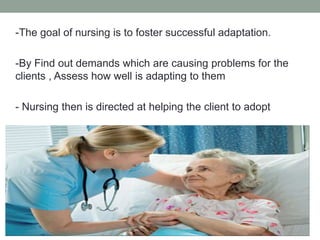
-The goal of nursing is to foster successful adaptation.
-By Find out demands which are causing problems for the
clients , Assess how well is adapting to them
- Nursing then is directed at helping the client to adopt
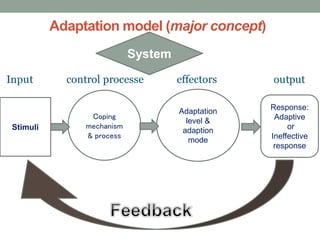
Adaptation model (major concept)
Stimuli
Coping
mechanism
& process
Adaptation
level &
adaption
mode
Response:
Adaptive
or
Ineffective
response
System
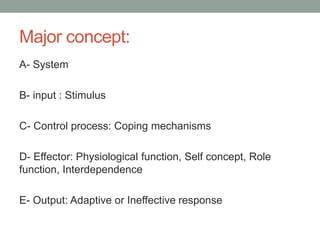
Major concept:
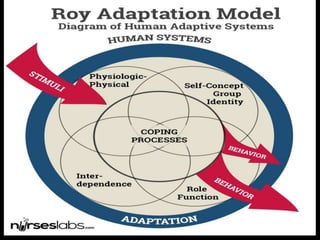
A- System
B- input : Stimulus
C- Control process: Coping mechanisms
D- Effector: Physiological function, Self concept, Role
function, Interdependence
E- Output: Adaptive or Ineffective response
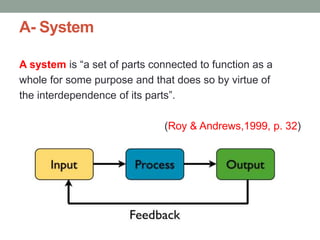
A- System
A system is “a set of parts connected to function as a
whole for some purpose and that does so by virtue of
the interdependence of its parts”.
(Roy & Andrews,1999, p. 32)
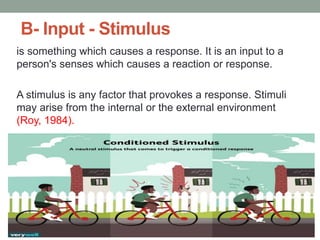
B- Input - Stimulus
is something which causes a response. It is an input to a
person's senses which causes a reaction or response.
A stimulus is any factor that provokes a response. Stimuli
may arise from the internal or the external environment
(Roy, 1984).
Type of stimulus:
1-The focal stimulus is “the internal or external stimulus
most immediately confronting the human system”
2-contextual stimuli are “all the environmental factors that
present to the person from within or without but which are
not the center of the person’s attention and/or energy”
3-Residual stimuli “are environmental factors within or
without the human system with effects in the current
situation that are unclear”
(Roy & Andrews,1999, p.9,31,32)
C- Control process:
Coping process & Coping mechanism
Coping :
“are innate or acquired ways of interacting with the changing
environment”
(Roy & Andrews, 1999, p. 46)
.
Coping process:
1- Regulator is “a major coping process involving the
neural, chemical, and endocrine systems”
(Roy & Andrews, 1999, p. 32).
2- Cognator is “a major coping process involving four
cognitive-emotive channels: perceptual and information
processing, learning, judgment, and emotion”
(Roy & Andrews, 1999, p. 31).
Coping mechanisms:
1-Innate coping mechanisms “are genetically determined
or common to the species and are generally viewed as
automatic processes; humans do not have
to think about them” .
2-Acquired coping mechanisms “are developed through
strategies such as learning. The experiences encountered
throughout life contribute to customary responses
to particular stimuli”
(Roy & Andrews, 1999, p. 46)
E- EFFECTOR :
Adaptation level & adaption mode
Adaptation is the physical or behavioral characteristic of an
organism that helps an organism to survive better in the
surrounding environment.
Adaptation Level
“Adaptation level represents the condition of the
life processes and its affects the individual's ability to
respond positively to a situation described on three levels
as integrated, compensatory, and compromised”
(Roy & Andrews,1999, p. 30).
There are three levels of adaptation:
1-Integrated: refers to the structure and functions of life
processes, working as a whole to meet human needs.
2-Compensatory: at this level, the regulatory and cognator
coping subsystems have been activated to respond to
threats or challenges from integrated processes.
3-Compromised: occurs when the above processes are
insufficient, generating an adaptation problem.
Adaptive modes:
1- The physiological physical mode.
2- Self-Concept-Group Identity Mode.
3- Role Function Mode.
4-Interdependence Mode.
1- The physiological physical mode :
-The physiological mode “is associated with the physical
and chemical processes involved in the function and
activities of living organisms”. Basic needs:
oxygenation, nutrition, elimination, activity and rest, and
protection.
-The physical mode is “the manner in which the collective
human adaptive system manifests adaptation relative to
basic operating resources, participants, physical facilities,
and fiscal resources”. Basic needs:
is operating integrity.
2- Self-Concept-Group Identity Mode
“it focuses specifically on the psychological and spiritual
aspects of the human system”.
**Self-concept is defined as the composite of beliefs and
feelings about oneself at a given time and is formed from
internal perceptions and perceptions of others’ reactions”
Its components include the following:
(1) the physical self, which involves sensation and body image.
(2) the personal self, which is made up of self-consistency, self-
ideal or expectancy, and the moral-ethical-spiritual self
**The group identity mode “reflects how people in groups
perceive themselves based on environmental feedback.
:
Composed of
-interpersonal relationships
-group self-image
-social milieu
-culture.
The basic need of the group identity mode is identity
Integrity.
(Roy & Andrews, 1999, p. 107-108).
3-Role Function Mode
is one of two social modes and focuses on the roles the
person occupies in society.
A role, as the functioning unit of society, is defined as a set
of expectations about how a person occupying one position
behaves toward a person occupying another position.
The basic need has been identified as social integrity—the
need to know who one is in relation to others so that one
can act.
4-Interdependence Mode
“The interdependence mode focuses on close relationships
of people and their purpose, structure, and development”
“Interdependent relationships involve the willingness and
ability to give to others and accept from them aspects of all
that one has to offer such as love, respect, value, nurturing,
knowledge, skills, commitments, material possessions,
time, and talents”
The basic need of this mode is termed relational integrity.
(Roy & Andrews, 1999, p. 111)
D- Output: Response
is a reaction to a question, experience, or some other type
of stimulus
Type of responses:
1-Adaptive Responses: Are those “that promote integrity in
terms of the goals of human systems”.
2-Ineffective Responses are those “that do not contribute
to integrity in terms of the goals of the human system”.
(Roy & Andrews, 1999, p. 31).
E- Perception
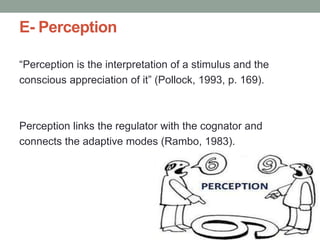
“Perception is the interpretation of a stimulus and the
conscious appreciation of it” (Pollock, 1993, p. 169).
Perception links the regulator with the cognator and
connects the adaptive modes (Rambo, 1983).
Assumption
-Assumptions from systems theory and assumptions from
adaptation level theory have been combined into a single
set of scientific assumptions.
-Human adaptive systems are complex and multifaceted
and respond to a myriad of environmental stimuli to
achieve adaptation.
-With their ability to adapt to environmental stimuli, humans
have the capacity to create changes in the environment
(Roy & Andrews, 1999).
-Roy combined the assumptions of humanism and veritivity
into a single set of philosophical assumptions.
*Humanism asserts that the person and human experiences
are essential to knowing and valuing, and that they share in
creative power.
*Veritivity affirms the belief in the purpose value, and
meaning of all human life. These scientific
and philosophical assumptions have been refined
for use of the model in the twenty-first century
Explicit assumptions
• The person is a bio-psycho-social being.
• The person is in constant interaction with a changing
environment.
• To cope with a changing world, person uses both
innate and acquired mechanisms which are biological,
psychological and social in origin.
•. To respond positively to environmental changes, the
person must adapt.
Explicit assumptions
• The person has 4 modes of adaptation:
physiologic needs, self- concept, role function and
inter-dependence.
• There is a dynamic objective for existence with
ultimate goal of achieving dignity and integrity.
• "Nursing accepts the humanistic approach of valuing
other persons’ opinions, and view points" interpersonal
relations are an integral part of nursing
Explicit assumptions
• Health and illness are inevitable dimensions of the
person’s life.
• The person’s adaptation is a function of the stimulus
he is exposed to and his adaptation level
• The person’s adaptation level is such that it
comprises a zone indicating the range of stimulation
that will lead to a positive response.
Implicit assumptions
• Nursing is based on causality.
• Patient’s values and opinions are to be considered and
respected.
• A state of adaptation frees an individual’s energy to
respond to other stimuli.
PROPOSITIONS—ROY
• Nursing actions promote a person’s adaptive responses.
• Nursing actions can decrease a person’s ineffective
adaptive responses.
• People interact with changing environment in an attempt
to achieve adaptation and health.
• Nursing actions enhance the interaction of persons with
environment.
• Enhanced interactions of persons with environment
promote adaptation.
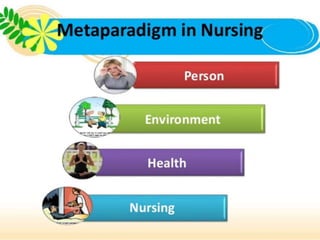
Human ( person)
Person : adaptive system constantly interacting with
external and internal environment.
Based on Roy, humans are holistic beings that are in
constant interaction with their environment. Humans use a
system of adaptation, both innate and acquired, to respond
to the environmental stimuli they experience.
Human systems can be individuals or groups, such as
families, organizations, and the whole global community.
Environment
• “The conditions, circumstances and influences
surrounding and affecting the development and
behavior of persons or groups, with particular
consideration of the mutuality of person and
health resources that includes focal, contextual
and residual stimuli.
(Roy and Andrews, 1991)
Health
“Health is not freedom from the inevitability of death,
disease, unhappiness, and stress, but the ability to cope
with them in a competent way.”
Health is defined as the state where humans can
continually adapt to stimuli. If human can continue to adapt
holistically, they will be able to maintain health to reach
completeness and unity within themselves. If they cannot
adapt accordingly, the integrity of the person can be
affected negatively
(Roy and Andrews, 1991)
Nursing
Defines nursing broadly as a " health care profession that
focuses on human life processes and pattern and
emphasizes promotion of health for individuals , families ,
groups , and society as a whole “.
“The goal of nursing is the promotion of adaptation for
individuals and groups in each of the four adaptive modes,
thus contributing to health, quality of life, and dying with
dignity.”
(Roy and Andrews, 1991)
In Adaptation Model, nurses are facilitators of adaptation.
They assess the patient’s behaviors for adaptation,
promote positive adaptation by enhancing environment
interactions and helping patients react positively to stimuli.
Nurses eliminate ineffective coping mechanisms and
eventually lead to better outcomes.
Logical Form
The Roy Adaptation Model of nursing is both deductive and
inductive.
It is deductive in that much of Roy’s theory is derived from
Helson’s psychophysics theory. Roy also uses other theory
outside the discipline of nursing .
It is inductive in that she developed the four adaptive modes
from research and nursing practice experiences. Roy built on
the conceptual framework of adaptation and developed a
step-by-step model.
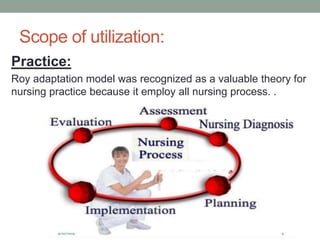
Scope of utilization:
:
Practice
Roy adaptation model was recognized as a valuable theory for
nursing practice because it employ all nursing process. .
Nursing process related to RAM:
1. Assesses the behaviors manifested from the four adaptive
modes.
2. Assesses the stimuli (focal, contextual, or residual stimulus.
3. Makes a statement or nursing diagnosis of the person’s
adaptive state.
4. Sets goals to promote adaptation.
5. Implements interventions aimed at managing the stimuli to
promote adaptation.
6. Evaluates whether the adaptive goals have been met.
Example:
The Roy Adaptation Model has been applied to:
-adult patients with (post-traumatic stress disorder)
-women in menopause
-An elderly man undergoing amputation.
-Adolescents with cancer, Asthma, high-normal or
hypertensive blood pressure readings.
-Death and dying
-Recovery following coronary artery bypass surgery
EDUCATION:
• The adaptation model is also useful in educational setting.
The model allow to increase knowledge in both area theory
and practice.
• The Roy Adaptation Model has been used in the
educational setting and has guided nursing education at
Mount Saint Mary’s College Department of Nursing in Los
Angeles since 1970.
• More than 100,000 student nurses had been educated in
nursing programs based on the Roy Adaptation Model in
the United States and abroad
RESEARCH
 If research is to affect practitioners’ behavior, it must be
directed at testing and retesting conceptual models for
nursing practice. Roy has stated that theory development
and the testing of developed theories are nursing’s highest
priorities. The model must be able to regenerate testable
hypotheses for it to be researchable.
Critique
Based on (Alligood, 2013) the theory critique will be as
follow :
CLARITY
• The Meta paradigm concepts of the roy
adaptation model are clearly defined and
consistent.
• Roy clearly defines the four adaptive modes with
minimal unclear boundaries.
-Interrelated by perception.
• Some use of theoretical jargon.
• Good assessment method.
SIMPLICITY
This model has several major concepts and sub
concepts, So the relational statements are
complex until The model is learned.
COMPLEXITY
• Abstract and difficult to understand
• Concept of person as an adaptive system
• Not easily operational for research
• Stimuli create an extensive list of potential
variables.
COMPLETENCES
• Addresses all four concepts of a nursing model.
• Comprehensive and systematic assessment.
• Focus on the individual.
• Person is adaptive system
GENRALITY
• The Roy adaptation model’s broad scope is an
advantage because it may be used for theory
building for deriving middle-range theories for
testing in studies .
• Roy’s model is generalizable to all settings in
nursing practice but is limited in scope, as it
primarily addresses the person-environment
adaptation of the patient, and information about
the nurse is implied.
ACCESSEPILITY
• Roy’s broad concepts stem from theory in
physiological psychology, psychology, sociology,
and nursing.
• Roy’s model offers direction for researchers who
want to incorporate physiological phenomena in
their studies.
• RAM identified many propositions to serve in the
development of middle-range theory.
IMPORTANCE
• The Roy adaptation model has a clearly defined
nursing process and is useful in guiding clinical
practice.
• The utility of the model has been demonstrated
globally by nurses.
Strength and limitation of
theory
Strength point:
• Clearly defined nursing process
• Useful in guiding clinical practice
• Accommodates for physical as well as
psychosocial needs
• Patient plays an active role – nurse is a facillator
• Persons values and opinions are considered and
respected
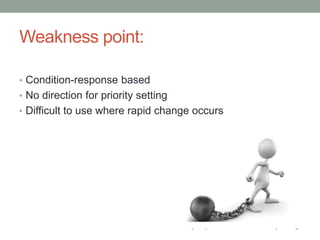
Weakness point:
• Condition-response based
• No direction for priority setting
• Difficult to use where rapid change occurs
CASE STUDY
 A 53 years old male patient who was suffering
with diabetes mellitus for past 10 years. He
developed a diabetic foot ulcer and had to
undergo amputation. He was admitted in __
Hospital. Mr. NR was selected for application of
RAM in providing nursing care.
1-ASSESS. OF BEHAVIOUR
Ineffective protection and sense in physical-physiological
mode(No pain sensation from the wound site.)
ASSESSMENT OF STIMULI
Focal stimuli:
Non-healing wound after amputation of great and
second toe of left leg.
NURSING DIAGNOSIS
Impaired skin integrity related to fragility of the skin
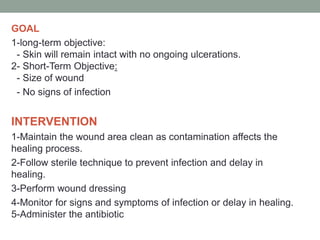
secondary to vascular insufficiency
GOAL
1-long-term objective:
- Skin will remain intact with no ongoing ulcerations.
2- Short-Term Objective:
- Size of wound
- No signs of infection
INTERVENTION
1-Maintain the wound area clean as contamination affects the
healing process.
2-Follow sterile technique to prevent infection and delay in
healing.
3-Perform wound dressing
4-Monitor for signs and symptoms of infection or delay in healing.
5-Administer the antibiotic
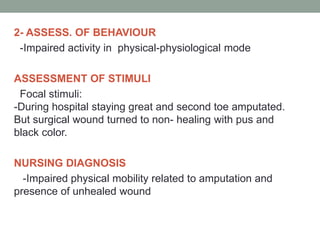
2- ASSESS. OF BEHAVIOUR
-Impaired activity in physical-physiological mode
ASSESSMENT OF STIMULI
Focal stimuli:
-During hospital staying great and second toe amputated.
But surgical wound turned to non- healing with pus and
black color.
NURSING DIAGNOSIS
-Impaired physical mobility related to amputation and
presence of unhealed wound
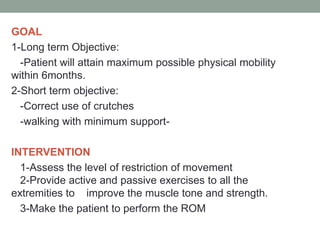
GOAL
1-Long term Objective:
-Patient will attain maximum possible physical mobility
within 6months.
2-Short term objective:
-Correct use of crutches
-walking with minimum support-
INTERVENTION
1-Assess the level of restriction of movement
2-Provide active and passive exercises to all the
extremities to improve the muscle tone and strength.
3-Make the patient to perform the ROM
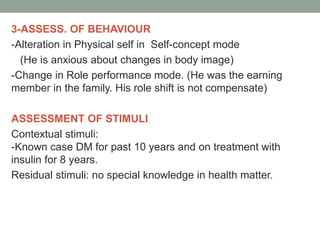
3-ASSESS. OF BEHAVIOUR
-Alteration in Physical self in Self-concept mode
(He is anxious about changes in body image)
-Change in Role performance mode. (He was the earning
member in the family. His role shift is not compensate)
ASSESSMENT OF STIMULI
Contextual stimuli:
-Known case DM for past 10 years and on treatment with
insulin for 8 years.
Residual stimuli: no special knowledge in health matter.
Nursing diagnosis
1-Anxiety related to hospital admission.
Goal
1-Long term Objective:
-The client will remain free from anxiety.
2-Short term objective
-demonstrating appropriate range effective coping in the
treatment .
INTERVENTION
1-Allow and encourage the client and family to ask
questions.
2-Allow the client and family to verbalize anxiety.
3- Repeat information as necessary because of the reduced
attention span of the client and family.
4-Provide comfortable quiet environment for the client and
family.
Research article that utilized RAM
roy adaptation model.pdf
References
- Marilyn ,E.and Marlaine,C.(2010).Nursing theories and
(
nursing practice ,3rd (ed).Philadelphia:F.A.Davis .p(83-103
Roy, C., & Andrews, H. A. (1999). The Roy adaptation
model(Vol. 2). Stamford, CT: Appleton & Lange. Chicago
Roy, S. C. (1984). Introduction to nursing: An adaptation
model (Vol. 84, No. 10, p. 1331). LWW.

Roy adaptation model

  • 1.
    ROY ADAPTATION MODEL Presentedby : Ola Al-Omoush Instructor: Dr. Ghadah Abu- Shosha Zarqa University Faculty of Nursing Course title: Nursing Theories: Development and Application
  • 2.
    Objective: At the endof this lecture the student will be able to : -Summarize an overview about Dr. Roy background & credential. - Identify the theoretical source of RAM. -Identify and define the major concepts of Roy adaptation model ( RAM) -understand the assumptions and proposition of RAM . -Paraphrase Meta-paradigm of the theory. -Learn how Callista RAM can be utilize in the nursing scopes (practice , education & research).
  • 3.
    At the endof this lecture the student will be able to : -Criticize the theory. -Determined the strengths and limitations of RAM. -Discuss a case study and research article that utilized RAM.
  • 4.
    Why we chooseRoy Adaptation Model (RAM)? because ( RAM ) had a strong emphasis on the patients and their interactions with the environment.
  • 5.
    Credentials & Backgroundof the Theorist -Sister Callista Roy, a member of the Sisters of Saint Joseph of Carondelet, was born on October 14, 1939, in Los Angeles, California. .
  • 6.
    Timeline of education level: Bachelors’degree in nursing 1963 Masters’ degree in nursing 1966 Began in sociology education Receiving 2ed masters’ degree in sociology 1973 Doctorate degree in sociology1977 the rank of professor in 1983
  • 7.
    Professional Experience -Pediatric Nurse -Nursinginstructor in many different capacities -Teaching both pediatric and maternity nursing at Mary's College in 1966. -She has lectured across the United States and in more than thirty other countries -She organized course content according to a view of person and family as adaptive systems. -She introduced her ideas about ‘Adaptation Nursing’ as the basis for an integrated nursing curriculum. -She has published many works in (2002),(2008),(2009).
  • 8.
    Honors and awards 2006 •Distinguished Teaching Award, Boston College 2007 • Living Legend, American Academy of Nursing 2010 • Inductee, Sigma Theta Tau’ Nurse Researcher Hall of Fame 2011 • Mentor Award, Sigma Theta Tau Society
  • 9.
    The Theoretical source: • . Roywas challenged in a seminar with Dorothy E. Johnson to develop a conceptual model for nursing.1963 While working as a pediatric staff nurse, Roy had noticed the children ability to adapt in response to environment change. Roy developed the basic concepts of the model, from 1964 to 1966. Roy was impressed by adaptation as an appropriate conceptual framework for nursing
  • 10.
    Roy began operationalizingher model in 1968 Roy combined Helson’s work with Rapoport’s definition of system to view the person as an adaptive system Roy (1970) developed and further refined the model with concepts and theory from Dohrenwend, Lazarus, Mechanic,and Selye. Roy presented the model as a curriculum framework to a large audience at the 1977 Nurse Educator Conference in Chicago
  • 11.
    Introduction to theRoy model -The Roy adaptation model presents the person as holistic adaptive system in constant interaction with the internal and external environmental, the main task of the human system is to maintain integrity in the face of environmental stimuli. -According to Roy ,adaptation refers to “the process and outcome whereby thinking and feeling person as individuals or in groups, use conscious awareness and choice to create human and environmental integration.
  • 12.
    -The goal ofnursing is to foster successful adaptation. -By Find out demands which are causing problems for the clients , Assess how well is adapting to them - Nursing then is directed at helping the client to adopt
  • 13.
    Adaptation model (majorconcept) Stimuli Coping mechanism & process Adaptation level & adaption mode Response: Adaptive or Ineffective response System
  • 14.
    Major concept: A- System B-input : Stimulus C- Control process: Coping mechanisms D- Effector: Physiological function, Self concept, Role function, Interdependence E- Output: Adaptive or Ineffective response
  • 15.
    A- System A systemis “a set of parts connected to function as a whole for some purpose and that does so by virtue of the interdependence of its parts”. (Roy & Andrews,1999, p. 32)
  • 16.
    B- Input -Stimulus is something which causes a response. It is an input to a person's senses which causes a reaction or response. A stimulus is any factor that provokes a response. Stimuli may arise from the internal or the external environment (Roy, 1984).
  • 17.
    Type of stimulus: 1-Thefocal stimulus is “the internal or external stimulus most immediately confronting the human system” 2-contextual stimuli are “all the environmental factors that present to the person from within or without but which are not the center of the person’s attention and/or energy” 3-Residual stimuli “are environmental factors within or without the human system with effects in the current situation that are unclear” (Roy & Andrews,1999, p.9,31,32)
  • 18.
    C- Control process: Copingprocess & Coping mechanism Coping : “are innate or acquired ways of interacting with the changing environment” (Roy & Andrews, 1999, p. 46) .
  • 19.
    Coping process: 1- Regulatoris “a major coping process involving the neural, chemical, and endocrine systems” (Roy & Andrews, 1999, p. 32). 2- Cognator is “a major coping process involving four cognitive-emotive channels: perceptual and information processing, learning, judgment, and emotion” (Roy & Andrews, 1999, p. 31).
  • 20.
    Coping mechanisms: 1-Innate copingmechanisms “are genetically determined or common to the species and are generally viewed as automatic processes; humans do not have to think about them” . 2-Acquired coping mechanisms “are developed through strategies such as learning. The experiences encountered throughout life contribute to customary responses to particular stimuli” (Roy & Andrews, 1999, p. 46)
  • 21.
    E- EFFECTOR : Adaptationlevel & adaption mode Adaptation is the physical or behavioral characteristic of an organism that helps an organism to survive better in the surrounding environment.
  • 22.
    Adaptation Level “Adaptation levelrepresents the condition of the life processes and its affects the individual's ability to respond positively to a situation described on three levels as integrated, compensatory, and compromised” (Roy & Andrews,1999, p. 30).
  • 23.
    There are threelevels of adaptation: 1-Integrated: refers to the structure and functions of life processes, working as a whole to meet human needs. 2-Compensatory: at this level, the regulatory and cognator coping subsystems have been activated to respond to threats or challenges from integrated processes. 3-Compromised: occurs when the above processes are insufficient, generating an adaptation problem.
  • 24.
    Adaptive modes: 1- Thephysiological physical mode. 2- Self-Concept-Group Identity Mode. 3- Role Function Mode. 4-Interdependence Mode.
  • 25.
    1- The physiologicalphysical mode : -The physiological mode “is associated with the physical and chemical processes involved in the function and activities of living organisms”. Basic needs: oxygenation, nutrition, elimination, activity and rest, and protection. -The physical mode is “the manner in which the collective human adaptive system manifests adaptation relative to basic operating resources, participants, physical facilities, and fiscal resources”. Basic needs: is operating integrity.
  • 26.
    2- Self-Concept-Group IdentityMode “it focuses specifically on the psychological and spiritual aspects of the human system”. **Self-concept is defined as the composite of beliefs and feelings about oneself at a given time and is formed from internal perceptions and perceptions of others’ reactions” Its components include the following: (1) the physical self, which involves sensation and body image. (2) the personal self, which is made up of self-consistency, self- ideal or expectancy, and the moral-ethical-spiritual self
  • 27.
    **The group identitymode “reflects how people in groups perceive themselves based on environmental feedback. : Composed of -interpersonal relationships -group self-image -social milieu -culture. The basic need of the group identity mode is identity Integrity. (Roy & Andrews, 1999, p. 107-108).
  • 28.
    3-Role Function Mode isone of two social modes and focuses on the roles the person occupies in society. A role, as the functioning unit of society, is defined as a set of expectations about how a person occupying one position behaves toward a person occupying another position. The basic need has been identified as social integrity—the need to know who one is in relation to others so that one can act.
  • 29.
    4-Interdependence Mode “The interdependencemode focuses on close relationships of people and their purpose, structure, and development” “Interdependent relationships involve the willingness and ability to give to others and accept from them aspects of all that one has to offer such as love, respect, value, nurturing, knowledge, skills, commitments, material possessions, time, and talents” The basic need of this mode is termed relational integrity. (Roy & Andrews, 1999, p. 111)
  • 30.
    D- Output: Response isa reaction to a question, experience, or some other type of stimulus
  • 31.
    Type of responses: 1-AdaptiveResponses: Are those “that promote integrity in terms of the goals of human systems”. 2-Ineffective Responses are those “that do not contribute to integrity in terms of the goals of the human system”. (Roy & Andrews, 1999, p. 31).
  • 32.
    E- Perception “Perception isthe interpretation of a stimulus and the conscious appreciation of it” (Pollock, 1993, p. 169). Perception links the regulator with the cognator and connects the adaptive modes (Rambo, 1983).
  • 33.
    Assumption -Assumptions from systemstheory and assumptions from adaptation level theory have been combined into a single set of scientific assumptions. -Human adaptive systems are complex and multifaceted and respond to a myriad of environmental stimuli to achieve adaptation. -With their ability to adapt to environmental stimuli, humans have the capacity to create changes in the environment (Roy & Andrews, 1999).
  • 34.
    -Roy combined theassumptions of humanism and veritivity into a single set of philosophical assumptions. *Humanism asserts that the person and human experiences are essential to knowing and valuing, and that they share in creative power. *Veritivity affirms the belief in the purpose value, and meaning of all human life. These scientific and philosophical assumptions have been refined for use of the model in the twenty-first century
  • 35.
    Explicit assumptions • Theperson is a bio-psycho-social being. • The person is in constant interaction with a changing environment. • To cope with a changing world, person uses both innate and acquired mechanisms which are biological, psychological and social in origin. •. To respond positively to environmental changes, the person must adapt.
  • 36.
    Explicit assumptions • Theperson has 4 modes of adaptation: physiologic needs, self- concept, role function and inter-dependence. • There is a dynamic objective for existence with ultimate goal of achieving dignity and integrity. • "Nursing accepts the humanistic approach of valuing other persons’ opinions, and view points" interpersonal relations are an integral part of nursing
  • 37.
    Explicit assumptions • Healthand illness are inevitable dimensions of the person’s life. • The person’s adaptation is a function of the stimulus he is exposed to and his adaptation level • The person’s adaptation level is such that it comprises a zone indicating the range of stimulation that will lead to a positive response.
  • 38.
    Implicit assumptions • Nursingis based on causality. • Patient’s values and opinions are to be considered and respected. • A state of adaptation frees an individual’s energy to respond to other stimuli.
  • 39.
    PROPOSITIONS—ROY • Nursing actionspromote a person’s adaptive responses. • Nursing actions can decrease a person’s ineffective adaptive responses. • People interact with changing environment in an attempt to achieve adaptation and health. • Nursing actions enhance the interaction of persons with environment. • Enhanced interactions of persons with environment promote adaptation.
  • 42.
    Human ( person) Person: adaptive system constantly interacting with external and internal environment. Based on Roy, humans are holistic beings that are in constant interaction with their environment. Humans use a system of adaptation, both innate and acquired, to respond to the environmental stimuli they experience. Human systems can be individuals or groups, such as families, organizations, and the whole global community.
  • 43.
    Environment • “The conditions,circumstances and influences surrounding and affecting the development and behavior of persons or groups, with particular consideration of the mutuality of person and health resources that includes focal, contextual and residual stimuli. (Roy and Andrews, 1991)
  • 44.
    Health “Health is notfreedom from the inevitability of death, disease, unhappiness, and stress, but the ability to cope with them in a competent way.” Health is defined as the state where humans can continually adapt to stimuli. If human can continue to adapt holistically, they will be able to maintain health to reach completeness and unity within themselves. If they cannot adapt accordingly, the integrity of the person can be affected negatively (Roy and Andrews, 1991)
  • 45.
    Nursing Defines nursing broadlyas a " health care profession that focuses on human life processes and pattern and emphasizes promotion of health for individuals , families , groups , and society as a whole “. “The goal of nursing is the promotion of adaptation for individuals and groups in each of the four adaptive modes, thus contributing to health, quality of life, and dying with dignity.” (Roy and Andrews, 1991)
  • 46.
    In Adaptation Model,nurses are facilitators of adaptation. They assess the patient’s behaviors for adaptation, promote positive adaptation by enhancing environment interactions and helping patients react positively to stimuli. Nurses eliminate ineffective coping mechanisms and eventually lead to better outcomes.
  • 47.
    Logical Form The RoyAdaptation Model of nursing is both deductive and inductive. It is deductive in that much of Roy’s theory is derived from Helson’s psychophysics theory. Roy also uses other theory outside the discipline of nursing . It is inductive in that she developed the four adaptive modes from research and nursing practice experiences. Roy built on the conceptual framework of adaptation and developed a step-by-step model.
  • 48.
    Scope of utilization: : Practice Royadaptation model was recognized as a valuable theory for nursing practice because it employ all nursing process. .
  • 49.
    Nursing process relatedto RAM: 1. Assesses the behaviors manifested from the four adaptive modes. 2. Assesses the stimuli (focal, contextual, or residual stimulus. 3. Makes a statement or nursing diagnosis of the person’s adaptive state. 4. Sets goals to promote adaptation. 5. Implements interventions aimed at managing the stimuli to promote adaptation. 6. Evaluates whether the adaptive goals have been met.
  • 50.
    Example: The Roy AdaptationModel has been applied to: -adult patients with (post-traumatic stress disorder) -women in menopause -An elderly man undergoing amputation. -Adolescents with cancer, Asthma, high-normal or hypertensive blood pressure readings. -Death and dying -Recovery following coronary artery bypass surgery
  • 51.
    EDUCATION: • The adaptationmodel is also useful in educational setting. The model allow to increase knowledge in both area theory and practice. • The Roy Adaptation Model has been used in the educational setting and has guided nursing education at Mount Saint Mary’s College Department of Nursing in Los Angeles since 1970. • More than 100,000 student nurses had been educated in nursing programs based on the Roy Adaptation Model in the United States and abroad
  • 52.
    RESEARCH  If researchis to affect practitioners’ behavior, it must be directed at testing and retesting conceptual models for nursing practice. Roy has stated that theory development and the testing of developed theories are nursing’s highest priorities. The model must be able to regenerate testable hypotheses for it to be researchable.
  • 53.
    Critique Based on (Alligood,2013) the theory critique will be as follow :
  • 54.
    CLARITY • The Metaparadigm concepts of the roy adaptation model are clearly defined and consistent. • Roy clearly defines the four adaptive modes with minimal unclear boundaries. -Interrelated by perception. • Some use of theoretical jargon. • Good assessment method.
  • 55.
    SIMPLICITY This model hasseveral major concepts and sub concepts, So the relational statements are complex until The model is learned.
  • 56.
    COMPLEXITY • Abstract anddifficult to understand • Concept of person as an adaptive system • Not easily operational for research • Stimuli create an extensive list of potential variables.
  • 57.
    COMPLETENCES • Addresses allfour concepts of a nursing model. • Comprehensive and systematic assessment. • Focus on the individual. • Person is adaptive system
  • 58.
    GENRALITY • The Royadaptation model’s broad scope is an advantage because it may be used for theory building for deriving middle-range theories for testing in studies . • Roy’s model is generalizable to all settings in nursing practice but is limited in scope, as it primarily addresses the person-environment adaptation of the patient, and information about the nurse is implied.
  • 59.
    ACCESSEPILITY • Roy’s broadconcepts stem from theory in physiological psychology, psychology, sociology, and nursing. • Roy’s model offers direction for researchers who want to incorporate physiological phenomena in their studies. • RAM identified many propositions to serve in the development of middle-range theory.
  • 60.
    IMPORTANCE • The Royadaptation model has a clearly defined nursing process and is useful in guiding clinical practice. • The utility of the model has been demonstrated globally by nurses.
  • 61.
  • 62.
    Strength point: • Clearlydefined nursing process • Useful in guiding clinical practice • Accommodates for physical as well as psychosocial needs • Patient plays an active role – nurse is a facillator • Persons values and opinions are considered and respected
  • 63.
    Weakness point: • Condition-responsebased • No direction for priority setting • Difficult to use where rapid change occurs
  • 65.
    CASE STUDY  A53 years old male patient who was suffering with diabetes mellitus for past 10 years. He developed a diabetic foot ulcer and had to undergo amputation. He was admitted in __ Hospital. Mr. NR was selected for application of RAM in providing nursing care.
  • 66.
    1-ASSESS. OF BEHAVIOUR Ineffectiveprotection and sense in physical-physiological mode(No pain sensation from the wound site.) ASSESSMENT OF STIMULI Focal stimuli: Non-healing wound after amputation of great and second toe of left leg. NURSING DIAGNOSIS Impaired skin integrity related to fragility of the skin secondary to vascular insufficiency
  • 67.
    GOAL 1-long-term objective: - Skinwill remain intact with no ongoing ulcerations. 2- Short-Term Objective: - Size of wound - No signs of infection INTERVENTION 1-Maintain the wound area clean as contamination affects the healing process. 2-Follow sterile technique to prevent infection and delay in healing. 3-Perform wound dressing 4-Monitor for signs and symptoms of infection or delay in healing. 5-Administer the antibiotic
  • 68.
    2- ASSESS. OFBEHAVIOUR -Impaired activity in physical-physiological mode ASSESSMENT OF STIMULI Focal stimuli: -During hospital staying great and second toe amputated. But surgical wound turned to non- healing with pus and black color. NURSING DIAGNOSIS -Impaired physical mobility related to amputation and presence of unhealed wound
  • 69.
    GOAL 1-Long term Objective: -Patientwill attain maximum possible physical mobility within 6months. 2-Short term objective: -Correct use of crutches -walking with minimum support- INTERVENTION 1-Assess the level of restriction of movement 2-Provide active and passive exercises to all the extremities to improve the muscle tone and strength. 3-Make the patient to perform the ROM
  • 70.
    3-ASSESS. OF BEHAVIOUR -Alterationin Physical self in Self-concept mode (He is anxious about changes in body image) -Change in Role performance mode. (He was the earning member in the family. His role shift is not compensate) ASSESSMENT OF STIMULI Contextual stimuli: -Known case DM for past 10 years and on treatment with insulin for 8 years. Residual stimuli: no special knowledge in health matter.
  • 71.
    Nursing diagnosis 1-Anxiety relatedto hospital admission. Goal 1-Long term Objective: -The client will remain free from anxiety. 2-Short term objective -demonstrating appropriate range effective coping in the treatment .
  • 72.
    INTERVENTION 1-Allow and encouragethe client and family to ask questions. 2-Allow the client and family to verbalize anxiety. 3- Repeat information as necessary because of the reduced attention span of the client and family. 4-Provide comfortable quiet environment for the client and family.
  • 73.
    Research article thatutilized RAM roy adaptation model.pdf
  • 74.
    References - Marilyn ,E.andMarlaine,C.(2010).Nursing theories and ( nursing practice ,3rd (ed).Philadelphia:F.A.Davis .p(83-103 Roy, C., & Andrews, H. A. (1999). The Roy adaptation model(Vol. 2). Stamford, CT: Appleton & Lange. Chicago Roy, S. C. (1984). Introduction to nursing: An adaptation model (Vol. 84, No. 10, p. 1331). LWW.