Theoretical & philosophical foundations of
nursing
Continuous Assessment
Presented by – A.masooth mohamed
ALK.Rinsith
10/14/2019
The Roy’s Adaptation Model
(RAM)
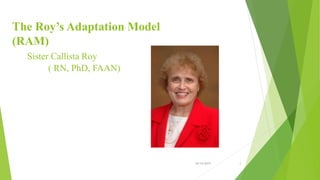
Sister Callista Roy
( RN, PhD, FAAN)
10/14/2019 2
Objectives
 Briefly describe introduction
 Describe biographical sketch about Sister Callista Roy
 Explain the evolution of the theory
 Define the purpose of the theory
 Explain the major concept of theory
 List of the type of stimuli
 Describe the adaptive modes
 Apply to the nursing practice, education and research.
10/14/2019 3
Introduction
 Nursing is establishing as a scientific discipline.
 The nursing models provide the basis for selecting
knowledge to be transmitted in nursing education.
 It is a frame work for nursing practice and the
direction for nursing research.
 Sister Callista Roy’s adaptation theory view the
client as an adaptive system.
10/14/2019 4
Biographical sketch about Callista Roy
 Was born on October 14,1939 in Los Angeles, California.
 Bachelor Degree in Nursing from Mount St Mary’s Collage
in 1963.
 Masters in Pediatric Nursing from University of California
in 1966.
 Second Masters degree and doctorate degree in Sociology
in 1973 and 1977 respectively.
10/14/2019 5
Biographical… con…..
 Currently serves as faculty member and nurse
theorist at Boston Collage.
 Honored as a Living Legent by the American
Academy of Nursing and the Massachusetts
Association of Registered Nurse.
10/14/2019 6
Evolution of Theory
 Dr. Roy also had a opportunity to be a clinical nurse scholar
two year post doctoral program in neuroscience Nursing at
University of California.
 she selected this field to develop her understanding of the
holistic person especially as an adaptive system and because of
her familiarity with this clinical area as the result of her own
neurological illness.
10/14/2019 7
Evolution… con…
 Adaptation was first introduced by sister Roy in her
psychology class.
 Adaptation of children: While working at as a
peadiatric nurse she had notice grate resiliency of
children and their ability to adapt in response to
major physiological and psychological changes.
 She developed the basic concepts of the model
while she was a graduate student in 1964 to 1966.
10/14/2019 8
Evolution… con…
 Theory development started in 1964.
 Mentored by Dorethy E.Johnson.
 1st publication of model appeared while a faculty member at a
liberal art collage in 1970,
Lead implementation.
 Used it as a part of curriculum.
First presented in nursing outlook in 1970,as ‘adaptation a
conceptual framework for nursing.
10/14/2019 9
Purpose of the Theory
 To help system (individuals, group, communities)adapt
to their environments.
 Anything that affects development of human including
illness.
10/14/2019 10
Significance of the theory
 1987 over 100,000 nurse have graduated from
program based on RAM.
 Used by global scholars.
 Model used in research, curriculum, development,
social issues, chronic illness and development of
research instrument.
10/14/2019 11
Major assumptions of the theory
 The person is a bio- psycho-social being.
 The person is in constant interaction with a
changing environment.
 To cope with a changing world, person uses both
innate and acquired mechanism witch are
biological, psychological, and social in origin.
 Health and illness are inevitable dimensions of the
person’s life.
10/14/2019 12
Major assumptions… con…
 To respond positively to environmental changes, the
person must adapt.
 The person’s adaptation level is function of the
stimulus, he is expose to and his adaptation level.
10/14/2019 13
Major assumptions… con…
 the person’s adaptation level is such that it
comprises a zone indicating the range of stimulation
that will lead to a positive response.
 The person has four modes of adaptation.
 Physiological/physical, self-concept, role function,
and inter-dependence.
10/14/2019 14
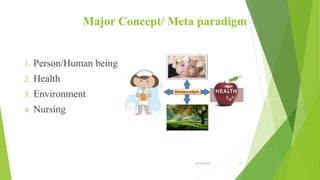
Major Concept/ Meta paradigm
1. Person/Human being
2. Health
3. Environment
4. Nursing
10/14/2019 15
Major Concept… con…
1.person
 Viewed as a holistic, adaptive system ,their health
and environment.
 Human systems include people as an individual or
in groups.
 refers to families, group, communities and society
as a whole
 In constant interaction with changing environment
10/14/2019 16
Major Concept… con…
 Person is an adaptive system with internal processes
(cognator and regulator) acting to maintain
adaptation through four adaptive modes,
( physiological, self-concept, role function and
interdependence).
10/14/2019 17
Major Concept… con…
2.Health
 It is a state and process of being and becoming
integrated and a whole person.
 It is a reflection of adaptation or the interaction of
the person and the environment.
 Involves around the outcome of the person's
ability to adapt to the stimuli. 10/14/2019 18
Major Concept… con…
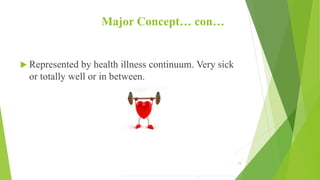
 Represented by health illness continuum. Very sick
or totally well or in between.
10/14/2019 19
Major Concept… con…
3.Enviroment
 viewed as the stimuli to the person(Internal &
External).
 Changes act as a stimulating and causes adaptive
response.
 All condition, circumstance and influences that
surrounding a person affect their healing process the
development and behaviors of person.
10/14/2019 20
Major Concept…con…
4.Nursing
 Act to enhance interaction of the person with the environment to
promote adaptation.
 Facilitates adaptation process by assessing behavior in each of
the four adaptive modes.
Physiological/physical mode
Self concept/group identity mode
Role function mode
Interdependence mode 10/14/2019 21
Major Concept… con…
Types of stimuli
Stimuli classified as focal, contextual and residual.
Focal - internal or external factors and
immediately confronting person.
Contextual – all other stimuli influencing the
situation.
Residual - include believes and attitudes that may
or may not influence the adaptation.
10/14/2019 22
Major Concept… con…
Example of 3 stimulus:
A man brought to hospital in severe pain with
fractured legs and he was drunk driving when it
happened.
 Focal Stimuli
Pain, fractured legs
 Contextual Stimuli
Drunk driving
 Residual Stimuli
Believed that drinking can reduce stress
10/14/2019 23
Adaptation level
A changing point influenced by the situation and the
internal resources of the person, family or group. The
three levels of adaptation are :
Integrated life process
Compensatory process
Compromised process
10/14/2019 24
Adaptation level…con..
Integrated life process
 Various modes and sub systems meet the need of the
environment.
 Usually stable process(Eg- breathing, spiritual
relationship
Compensatory process
 Cognator and regulator have been activated by a
challenge to the person or group.(Eg- grief, staring
with new job) 10/14/2019 25
Adaptation level…con..
Compromised process:
 Resulting from inadequate integrated and
compensatory life processes an adaptation to the
problem.
 Modes and subsystem are not adequately meet the
environmental challenges(Eg-hypoxia,abusive
relationship)
10/14/2019 26
Adaptive Modes
Identified four adaptive modes:
1.Physiological/physical mode
Associated with physical and chemical processes involved in function
and activities of living organisms.
Known as physiological integrity.
10/14/2019 27
Adaptive Modes… con…
Five needs are identified
1.Oxygenation,
2.Nutrition,
3.Elimination,
4.Activity and rest
5.Protection
Four complex processes- fluid, electrolyte; acid-base
balance; neurological function; endocrine function
10/14/2019 28
Adaptive Modes… con…
2.Self concept/group identity mode
 Focuses on psychological and spiritual aspects of the human
system.
 It is the composite of beliefs and feeling about oneself.
 There are two types of self concept.
Physical self – involves sensation and body image.
Personal self- made up of self consistency, self ideal,
expectancy, moral-ethical- spiritual self
10/14/2019 29
Adaptive Modes… con…
3.Role function mode
 One of two social modes and focuses on the roles the person occupies in
society.
 Known as social integrity.
 Person performs three roles.
Primary
Secondary
Tertiary 10/14/2019 30
Adaptive Modes… con…
These roles are carried out both
 Instrumental behavior – actual physical performance of a
behavior
 Expressive behavior – feelings, attitudes, likes or dislikes
that person has about a role or
performance of a role
10/14/2019 31
Adaptive Modes… con…
4.Interdependence mode
 The close relationship of people and their purpose, structure and
development individually and in groups.
 Focuses on attaining relational integrity through the giving and
receiving of love, respect and value. This is achieved with
effective communication and relations.
 Coping mechanism arising from close relationship10/14/2019 32
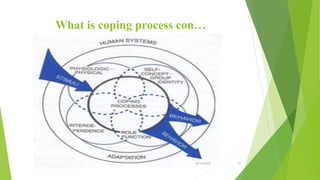
What is coping process
 Are innate or acquired ways of interacting with the
changing environment.
 Can be innate ( inborn ) or acquired ( learned through
life experiences)
 Occurs through two main sub-system
1.Regulator sub- system
Responds automatically from the body through neural,
chemical, and endocrine coping channels.
10/14/2019 33
What is coping process… con…
2.Cognator sub- system
Involving 4 cognitive –emotive channels.
 perceptual & information processing.
 Learning
 Emotion.
 judgment
10/14/2019 34
What is coping process con…
10/14/2019 35
Response
 Adaptive responses:
are those that promote the integrity and the system
works as a whole to meet human needs.
 Ineffective responses:
are those that do not contribute to maintain the
integrity; thus, failing to meet the human needs
10/14/2019 36
Application of RAM in Nursing
1.Nursing practice
 The model is useful for nursing practice, because I outlines the
features of the discipline and provides directions for practice,
education.
 The model considers goals, values, the patient and practitioner
interventions.
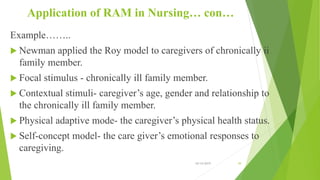
 Introduced a nursing process with two-level assessment.
 When using the six steps nursing process the nurse performs the six
functions.
10/14/2019 37
Application of RAM in Nursing… con…
10/14/2019 38
Application of RAM in Nursing… con…
Example……..
 Newman applied the Roy model to caregivers of chronically ii
family member.
 Focal stimulus - chronically ill family member.
 Contextual stimuli- caregiver’s age, gender and relationship to
the chronically ill family member.
 Physical adaptive mode- the caregiver’s physical health status.
 Self-concept model- the care giver’s emotional responses to
caregiving.
10/14/2019 39
Application of RAM in Nursing… con…
 Independence mode- relationship with significant
others and support indicate adaptive responses.
 Caregiver has primary, secondary, and tertiary roles
are strained by the addition of the caregiving role.
10/14/2019 40
Application of RAM in Nursing… con…
2. Nursing Education
 This model defines the distinct purpose of nursing for student.
 Also distinguished nursing science from medical science.
 She stressed nurses goal to help patient put his /her energy in to
getting well.
 But medical science focuses on the patient position on health
illness continuum.
 This model has been used in the education setting and has guided
nursing education since 1970.
10/14/2019 41
Application of RAM in Nursing… con…
3.Nursing Research
 This model has been used extensively to guild
knowledge development through nursing research.
 The influence of the Roy's adaptation model on
nursing research is evidenced by the vast number of
qualitative and quantitative research studies, it has
guided.
10/14/2019 42
Strength of RAM
 Use to analyze divers health care issues
 Analyze individual from a broad perspective
 Identify the factors affecting individual and
community
 Provide opportunity to understand whole human
being
 Include the spiritual aspect of nursing assessment
 The sequence of concepts in Roy’s model follows
logically
 Every concept was operationally defined.
10/14/2019 43
Weakness Of RAM
 The model requires significant input of time and
effort.
10/14/2019 44
Conclusion
 RAM identifies essential concept relevant to the
nursing profession and leads many application to
education and research.
 RAM is a complex theory
 The human adaptive system is constantly interacting
with internal and external stimuli which affect
individual’s health
 Useful in analyzing group, individual and societies
 Nursing is used to increase adaptive behavior10/14/2019 45
References
Wills M. Evelyn, McEwen Melanie (2002). Theoretical Basis for
Nursing. Philadelphia. Lippincott Williams & Wilkins.
Andrew, H.A. and Roy, C. (1991). Overview of the physiologic
mode. In George, J. (Ed.). Nursing theories: the base for
professional nursing practice. Norwalk, Connecticut:
Appleton & Lange.
10/14/2019 46
References
Roy, C. and McLeod, D. (1981) The theory of the
person as an adaptive system. In George, J.
(Ed.). Nursing theories: the base for professional
nursing practice. Norwalk, Connecticut: Appleton
& Lange.
Roy, C. and Adrews, H. A. (1999). The Roy adaptation
model (2nd ed). In McEwen, M. and Wills, E.
(Ed.). Theoretical basis for nursing. USA:
Lippincott Williams & Wilkins. 10/14/2019 47
10/14/2019 48
10/14/2019 49

Roy adaptation model

  • 1.
    Theoretical & philosophicalfoundations of nursing Continuous Assessment Presented by – A.masooth mohamed ALK.Rinsith 10/14/2019
  • 2.
    The Roy’s AdaptationModel (RAM) Sister Callista Roy ( RN, PhD, FAAN) 10/14/2019 2
  • 3.
    Objectives  Briefly describeintroduction  Describe biographical sketch about Sister Callista Roy  Explain the evolution of the theory  Define the purpose of the theory  Explain the major concept of theory  List of the type of stimuli  Describe the adaptive modes  Apply to the nursing practice, education and research. 10/14/2019 3
  • 4.
    Introduction  Nursing isestablishing as a scientific discipline.  The nursing models provide the basis for selecting knowledge to be transmitted in nursing education.  It is a frame work for nursing practice and the direction for nursing research.  Sister Callista Roy’s adaptation theory view the client as an adaptive system. 10/14/2019 4
  • 5.
    Biographical sketch aboutCallista Roy  Was born on October 14,1939 in Los Angeles, California.  Bachelor Degree in Nursing from Mount St Mary’s Collage in 1963.  Masters in Pediatric Nursing from University of California in 1966.  Second Masters degree and doctorate degree in Sociology in 1973 and 1977 respectively. 10/14/2019 5
  • 6.
    Biographical… con…..  Currentlyserves as faculty member and nurse theorist at Boston Collage.  Honored as a Living Legent by the American Academy of Nursing and the Massachusetts Association of Registered Nurse. 10/14/2019 6
  • 7.
    Evolution of Theory Dr. Roy also had a opportunity to be a clinical nurse scholar two year post doctoral program in neuroscience Nursing at University of California.  she selected this field to develop her understanding of the holistic person especially as an adaptive system and because of her familiarity with this clinical area as the result of her own neurological illness. 10/14/2019 7
  • 8.
    Evolution… con…  Adaptationwas first introduced by sister Roy in her psychology class.  Adaptation of children: While working at as a peadiatric nurse she had notice grate resiliency of children and their ability to adapt in response to major physiological and psychological changes.  She developed the basic concepts of the model while she was a graduate student in 1964 to 1966. 10/14/2019 8
  • 9.
    Evolution… con…  Theorydevelopment started in 1964.  Mentored by Dorethy E.Johnson.  1st publication of model appeared while a faculty member at a liberal art collage in 1970, Lead implementation.  Used it as a part of curriculum. First presented in nursing outlook in 1970,as ‘adaptation a conceptual framework for nursing. 10/14/2019 9
  • 10.
    Purpose of theTheory  To help system (individuals, group, communities)adapt to their environments.  Anything that affects development of human including illness. 10/14/2019 10
  • 11.
    Significance of thetheory  1987 over 100,000 nurse have graduated from program based on RAM.  Used by global scholars.  Model used in research, curriculum, development, social issues, chronic illness and development of research instrument. 10/14/2019 11
  • 12.
    Major assumptions ofthe theory  The person is a bio- psycho-social being.  The person is in constant interaction with a changing environment.  To cope with a changing world, person uses both innate and acquired mechanism witch are biological, psychological, and social in origin.  Health and illness are inevitable dimensions of the person’s life. 10/14/2019 12
  • 13.
    Major assumptions… con… To respond positively to environmental changes, the person must adapt.  The person’s adaptation level is function of the stimulus, he is expose to and his adaptation level. 10/14/2019 13
  • 14.
    Major assumptions… con… the person’s adaptation level is such that it comprises a zone indicating the range of stimulation that will lead to a positive response.  The person has four modes of adaptation.  Physiological/physical, self-concept, role function, and inter-dependence. 10/14/2019 14
  • 15.
    Major Concept/ Metaparadigm 1. Person/Human being 2. Health 3. Environment 4. Nursing 10/14/2019 15
  • 16.
    Major Concept… con… 1.person Viewed as a holistic, adaptive system ,their health and environment.  Human systems include people as an individual or in groups.  refers to families, group, communities and society as a whole  In constant interaction with changing environment 10/14/2019 16
  • 17.
    Major Concept… con… Person is an adaptive system with internal processes (cognator and regulator) acting to maintain adaptation through four adaptive modes, ( physiological, self-concept, role function and interdependence). 10/14/2019 17
  • 18.
    Major Concept… con… 2.Health It is a state and process of being and becoming integrated and a whole person.  It is a reflection of adaptation or the interaction of the person and the environment.  Involves around the outcome of the person's ability to adapt to the stimuli. 10/14/2019 18
  • 19.
    Major Concept… con… Represented by health illness continuum. Very sick or totally well or in between. 10/14/2019 19
  • 20.
    Major Concept… con… 3.Enviroment viewed as the stimuli to the person(Internal & External).  Changes act as a stimulating and causes adaptive response.  All condition, circumstance and influences that surrounding a person affect their healing process the development and behaviors of person. 10/14/2019 20
  • 21.
    Major Concept…con… 4.Nursing  Actto enhance interaction of the person with the environment to promote adaptation.  Facilitates adaptation process by assessing behavior in each of the four adaptive modes. Physiological/physical mode Self concept/group identity mode Role function mode Interdependence mode 10/14/2019 21
  • 22.
    Major Concept… con… Typesof stimuli Stimuli classified as focal, contextual and residual. Focal - internal or external factors and immediately confronting person. Contextual – all other stimuli influencing the situation. Residual - include believes and attitudes that may or may not influence the adaptation. 10/14/2019 22
  • 23.
    Major Concept… con… Exampleof 3 stimulus: A man brought to hospital in severe pain with fractured legs and he was drunk driving when it happened.  Focal Stimuli Pain, fractured legs  Contextual Stimuli Drunk driving  Residual Stimuli Believed that drinking can reduce stress 10/14/2019 23
  • 24.
    Adaptation level A changingpoint influenced by the situation and the internal resources of the person, family or group. The three levels of adaptation are : Integrated life process Compensatory process Compromised process 10/14/2019 24
  • 25.
    Adaptation level…con.. Integrated lifeprocess  Various modes and sub systems meet the need of the environment.  Usually stable process(Eg- breathing, spiritual relationship Compensatory process  Cognator and regulator have been activated by a challenge to the person or group.(Eg- grief, staring with new job) 10/14/2019 25
  • 26.
    Adaptation level…con.. Compromised process: Resulting from inadequate integrated and compensatory life processes an adaptation to the problem.  Modes and subsystem are not adequately meet the environmental challenges(Eg-hypoxia,abusive relationship) 10/14/2019 26
  • 27.
    Adaptive Modes Identified fouradaptive modes: 1.Physiological/physical mode Associated with physical and chemical processes involved in function and activities of living organisms. Known as physiological integrity. 10/14/2019 27
  • 28.
    Adaptive Modes… con… Fiveneeds are identified 1.Oxygenation, 2.Nutrition, 3.Elimination, 4.Activity and rest 5.Protection Four complex processes- fluid, electrolyte; acid-base balance; neurological function; endocrine function 10/14/2019 28
  • 29.
    Adaptive Modes… con… 2.Selfconcept/group identity mode  Focuses on psychological and spiritual aspects of the human system.  It is the composite of beliefs and feeling about oneself.  There are two types of self concept. Physical self – involves sensation and body image. Personal self- made up of self consistency, self ideal, expectancy, moral-ethical- spiritual self 10/14/2019 29
  • 30.
    Adaptive Modes… con… 3.Rolefunction mode  One of two social modes and focuses on the roles the person occupies in society.  Known as social integrity.  Person performs three roles. Primary Secondary Tertiary 10/14/2019 30
  • 31.
    Adaptive Modes… con… Theseroles are carried out both  Instrumental behavior – actual physical performance of a behavior  Expressive behavior – feelings, attitudes, likes or dislikes that person has about a role or performance of a role 10/14/2019 31
  • 32.
    Adaptive Modes… con… 4.Interdependencemode  The close relationship of people and their purpose, structure and development individually and in groups.  Focuses on attaining relational integrity through the giving and receiving of love, respect and value. This is achieved with effective communication and relations.  Coping mechanism arising from close relationship10/14/2019 32
  • 33.
    What is copingprocess  Are innate or acquired ways of interacting with the changing environment.  Can be innate ( inborn ) or acquired ( learned through life experiences)  Occurs through two main sub-system 1.Regulator sub- system Responds automatically from the body through neural, chemical, and endocrine coping channels. 10/14/2019 33
  • 34.
    What is copingprocess… con… 2.Cognator sub- system Involving 4 cognitive –emotive channels.  perceptual & information processing.  Learning  Emotion.  judgment 10/14/2019 34
  • 35.
    What is copingprocess con… 10/14/2019 35
  • 36.
    Response  Adaptive responses: arethose that promote the integrity and the system works as a whole to meet human needs.  Ineffective responses: are those that do not contribute to maintain the integrity; thus, failing to meet the human needs 10/14/2019 36
  • 37.
    Application of RAMin Nursing 1.Nursing practice  The model is useful for nursing practice, because I outlines the features of the discipline and provides directions for practice, education.  The model considers goals, values, the patient and practitioner interventions.  Introduced a nursing process with two-level assessment.  When using the six steps nursing process the nurse performs the six functions. 10/14/2019 37
  • 38.
    Application of RAMin Nursing… con… 10/14/2019 38
  • 39.
    Application of RAMin Nursing… con… Example……..  Newman applied the Roy model to caregivers of chronically ii family member.  Focal stimulus - chronically ill family member.  Contextual stimuli- caregiver’s age, gender and relationship to the chronically ill family member.  Physical adaptive mode- the caregiver’s physical health status.  Self-concept model- the care giver’s emotional responses to caregiving. 10/14/2019 39
  • 40.
    Application of RAMin Nursing… con…  Independence mode- relationship with significant others and support indicate adaptive responses.  Caregiver has primary, secondary, and tertiary roles are strained by the addition of the caregiving role. 10/14/2019 40
  • 41.
    Application of RAMin Nursing… con… 2. Nursing Education  This model defines the distinct purpose of nursing for student.  Also distinguished nursing science from medical science.  She stressed nurses goal to help patient put his /her energy in to getting well.  But medical science focuses on the patient position on health illness continuum.  This model has been used in the education setting and has guided nursing education since 1970. 10/14/2019 41
  • 42.
    Application of RAMin Nursing… con… 3.Nursing Research  This model has been used extensively to guild knowledge development through nursing research.  The influence of the Roy's adaptation model on nursing research is evidenced by the vast number of qualitative and quantitative research studies, it has guided. 10/14/2019 42
  • 43.
    Strength of RAM Use to analyze divers health care issues  Analyze individual from a broad perspective  Identify the factors affecting individual and community  Provide opportunity to understand whole human being  Include the spiritual aspect of nursing assessment  The sequence of concepts in Roy’s model follows logically  Every concept was operationally defined. 10/14/2019 43
  • 44.
    Weakness Of RAM The model requires significant input of time and effort. 10/14/2019 44
  • 45.
    Conclusion  RAM identifiesessential concept relevant to the nursing profession and leads many application to education and research.  RAM is a complex theory  The human adaptive system is constantly interacting with internal and external stimuli which affect individual’s health  Useful in analyzing group, individual and societies  Nursing is used to increase adaptive behavior10/14/2019 45
  • 46.
    References Wills M. Evelyn,McEwen Melanie (2002). Theoretical Basis for Nursing. Philadelphia. Lippincott Williams & Wilkins. Andrew, H.A. and Roy, C. (1991). Overview of the physiologic mode. In George, J. (Ed.). Nursing theories: the base for professional nursing practice. Norwalk, Connecticut: Appleton & Lange. 10/14/2019 46
  • 47.
    References Roy, C. andMcLeod, D. (1981) The theory of the person as an adaptive system. In George, J. (Ed.). Nursing theories: the base for professional nursing practice. Norwalk, Connecticut: Appleton & Lange. Roy, C. and Adrews, H. A. (1999). The Roy adaptation model (2nd ed). In McEwen, M. and Wills, E. (Ed.). Theoretical basis for nursing. USA: Lippincott Williams & Wilkins. 10/14/2019 47
  • 48.
  • 49.

Editor's Notes