


Quantitative
QUASI-EXPERIMENTAL RESEARCH DESIGN
Unit 8c
Quantitative
Research Design
Prof.Dr.Chinna Chadayan.N
RN.RM., B.Sc (N)., M.Sc (N)., Ph.D (N).,
Professor,
Enam Nursing College – Savar,
1
2
3
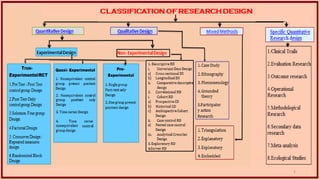
Quantitative Research Design
Experimental Design
Quasi - Experimental Design
4
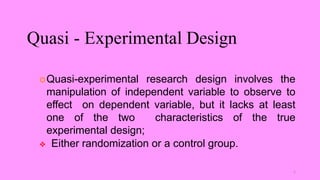
Quasi - Experimental Design
Quasi-experimental research design involves the
manipulation of independent variable to observe to
effect on dependent variable, but it lacks at least
one of the two characteristics of the true
experimental design;
 Either randomization or a control group.
5
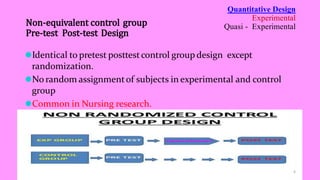
⚫Identical to pretest posttestcontrol group design except
randomization.
⚫No random assignmentof subjects in experimental and control
group
⚫Common in Nursing research.
Quantitative Design
Experimental
Quasi - Experimental
Non-equivalent control group
Pre-test Post-test Design
6
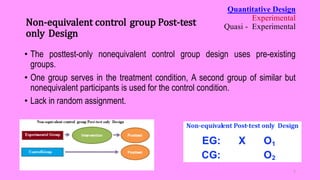
• The posttest-only nonequivalent control group design uses pre-existing
groups.
• One group serves in the treatment condition, A second group of similar but
nonequivalent participants is used for the control condition.
• Lack in random assignment.
Non-equivalent control group Post-test
only Design
Quantitative Design
Experimental
Quasi - Experimental
7
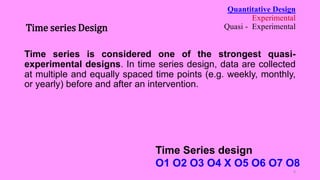
Time series is considered one of the strongest quasi-
experimental designs. In time series design, data are collected
at multiple and equally spaced time points (e.g. weekly, monthly,
or yearly) before and after an intervention.
Time series Design
Quantitative Design
Experimental
Quasi - Experimental
Time Series design
O1 O2 O3 O4 X O5 O6 O7 O8
8
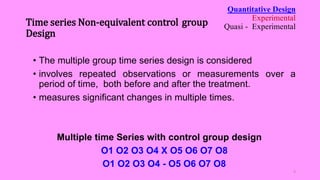
Multiple time Series with control group design
O1 O2 O3 O4 X O5 O6 O7 O8
O1 O2 O3 O4 - O5 O6 O7 O8
Time series Non-equivalent control group
Design
Quantitative Design
Experimental
Quasi - Experimental
• The multiple group time series design is considered
• involves repeated observations or measurements over a
period of time, both before and after the treatment.
• measures significant changes in multiple times.
9
ADVANTAGES OF QUASI-EXPERIMENTAL DESIGN
 Quasi-experimental designs are more frequently used because they are more
practical & feasible to conduct research studies in nursing, where in the absence
of a large sample size, randomization &/ or availability of control groups are not
always possible.
 This design is more suitable for real-world natural setting than true experimental
research designs.
 It allows researchers to evaluate the impact of quasi- independent variables
under naturally occurring conditions.
 It may be able to establishing casual relationship. Wherein some of the hypotheses
are practically answered through this design only. 10
DISADVANTAGES OF
QUASI-EXPERIMENTAL DESIGN
 There is no control over extraneous variables
influencing the dependent variables.
 The absence of a control group or lack of control over the
research setting makes the results of this design less reliable &
weak for the establishment of casual relationship between
independent & dependent variables.
11
Quantitative Research Design
Experimental Design
Pre - Experimental Design
12
Pre - Experimental Design
• Pre-experimental designs are research schemes in
which a subject or a group is observed after a
treatment has been applied, in order to test whether
the treatment has the potential to cause change.
• This design is considered as very weak, as the
researcher has very little control over the experiment
13
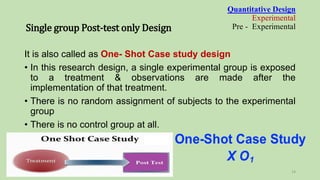
It is also called as One- Shot Case study design
• In this research design, a single experimental group is exposed
to a treatment & observations are made after the
implementation of that treatment.
• There is no random assignment of subjects to the experimental
group
• There is no control group at all.
Quantitative Design
Experimental
Pre - Experimental
Single group Post-test only Design
14
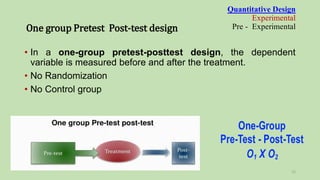
• In a one-group pretest-posttest design, the dependent
variable is measured before and after the treatment.
• No Randomization
• No Control group
Quantitative Design
Experimental
Pre - Experimental
One group Pretest Post-test design
15
• ADVANTAGES OF PRE-EXPERIMENTAL DESIGN:
o Very simple & convenient to conduct these studies in natural
• settings, especially in nursing.
o Most suitable design for the beginners in the field of
experimental research.
• DISADVANTAGES OF PRE-EXPERIMENTAL DESIGN:
o Considered a very weak experimental design to establish casual
relationship between independent & dependent variables,
because it controls no threat to internal validity.
o It has very little control over the research.
o It has a higher threat to internal validity of research, & may have a
selection bias, which can be very serious threats for in using this
particular design.
16
Thank u’
17

Quasi Exper designs - Copy.pptx

  • 1.
    Quantitative QUASI-EXPERIMENTAL RESEARCH DESIGN Unit8c Quantitative Research Design Prof.Dr.Chinna Chadayan.N RN.RM., B.Sc (N)., M.Sc (N)., Ph.D (N)., Professor, Enam Nursing College – Savar, 1
  • 2.
  • 3.
  • 4.
    Quantitative Research Design ExperimentalDesign Quasi - Experimental Design 4
  • 5.
    Quasi - ExperimentalDesign Quasi-experimental research design involves the manipulation of independent variable to observe to effect on dependent variable, but it lacks at least one of the two characteristics of the true experimental design;  Either randomization or a control group. 5
  • 6.
    ⚫Identical to pretestposttestcontrol group design except randomization. ⚫No random assignmentof subjects in experimental and control group ⚫Common in Nursing research. Quantitative Design Experimental Quasi - Experimental Non-equivalent control group Pre-test Post-test Design 6
  • 7.
    • The posttest-onlynonequivalent control group design uses pre-existing groups. • One group serves in the treatment condition, A second group of similar but nonequivalent participants is used for the control condition. • Lack in random assignment. Non-equivalent control group Post-test only Design Quantitative Design Experimental Quasi - Experimental 7
  • 8.
    Time series isconsidered one of the strongest quasi- experimental designs. In time series design, data are collected at multiple and equally spaced time points (e.g. weekly, monthly, or yearly) before and after an intervention. Time series Design Quantitative Design Experimental Quasi - Experimental Time Series design O1 O2 O3 O4 X O5 O6 O7 O8 8
  • 9.
    Multiple time Serieswith control group design O1 O2 O3 O4 X O5 O6 O7 O8 O1 O2 O3 O4 - O5 O6 O7 O8 Time series Non-equivalent control group Design Quantitative Design Experimental Quasi - Experimental • The multiple group time series design is considered • involves repeated observations or measurements over a period of time, both before and after the treatment. • measures significant changes in multiple times. 9
  • 10.
    ADVANTAGES OF QUASI-EXPERIMENTALDESIGN  Quasi-experimental designs are more frequently used because they are more practical & feasible to conduct research studies in nursing, where in the absence of a large sample size, randomization &/ or availability of control groups are not always possible.  This design is more suitable for real-world natural setting than true experimental research designs.  It allows researchers to evaluate the impact of quasi- independent variables under naturally occurring conditions.  It may be able to establishing casual relationship. Wherein some of the hypotheses are practically answered through this design only. 10
  • 11.
    DISADVANTAGES OF QUASI-EXPERIMENTAL DESIGN There is no control over extraneous variables influencing the dependent variables.  The absence of a control group or lack of control over the research setting makes the results of this design less reliable & weak for the establishment of casual relationship between independent & dependent variables. 11
  • 12.
    Quantitative Research Design ExperimentalDesign Pre - Experimental Design 12
  • 13.
    Pre - ExperimentalDesign • Pre-experimental designs are research schemes in which a subject or a group is observed after a treatment has been applied, in order to test whether the treatment has the potential to cause change. • This design is considered as very weak, as the researcher has very little control over the experiment 13
  • 14.
    It is alsocalled as One- Shot Case study design • In this research design, a single experimental group is exposed to a treatment & observations are made after the implementation of that treatment. • There is no random assignment of subjects to the experimental group • There is no control group at all. Quantitative Design Experimental Pre - Experimental Single group Post-test only Design 14
  • 15.
    • In aone-group pretest-posttest design, the dependent variable is measured before and after the treatment. • No Randomization • No Control group Quantitative Design Experimental Pre - Experimental One group Pretest Post-test design 15
  • 16.
    • ADVANTAGES OFPRE-EXPERIMENTAL DESIGN: o Very simple & convenient to conduct these studies in natural • settings, especially in nursing. o Most suitable design for the beginners in the field of experimental research. • DISADVANTAGES OF PRE-EXPERIMENTAL DESIGN: o Considered a very weak experimental design to establish casual relationship between independent & dependent variables, because it controls no threat to internal validity. o It has very little control over the research. o It has a higher threat to internal validity of research, & may have a selection bias, which can be very serious threats for in using this particular design. 16
  • 17.