SYSTEMS MODEL
BETTY NEUMAN
BETTY NEUMAN
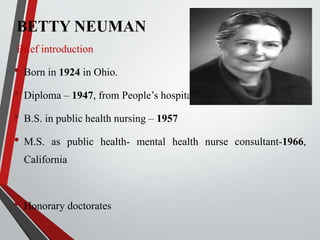
Brief introduction
• Born in 1924 in Ohio.
• Diploma – 1947, from People’s hospital, Ohio
• B.S. in public health nursing – 1957
• M.S. as public health- mental health nurse consultant-1966,
California
• Honorary doctorates
INTRODUCTION CONTD…
• Doctorate in clinical psychology from Pacific Western
University- 1985
• Multiple Honorary doctorate
Contribution Areas:
• Public health, hospital, school health, industry and mental
health settings.
Neuman’s System MODEL
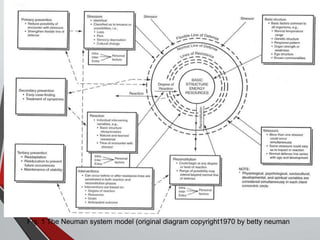
Fig. 1 The Neuman system model (original diagram copyright1970 by betty neuman
THE NEUMAN SYSTEMS
MODEL
• Provides a comprehensive, flexible, holistic and system
based perspective for nursing.
• Deals with stress and stress reduction and is primarily
concerned with the effects of stress on health.
• According to her, this model provides a total approach
to client problems by providing a multidimensional
view of the person as an individual.
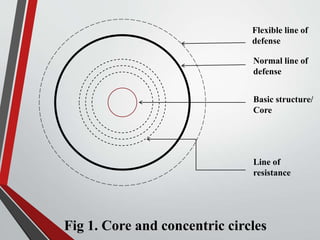
Fig 1. Core and concentric circles
Flexible line of
defense
Normal line of
defense
Basic structure/
Core
Line of
resistance
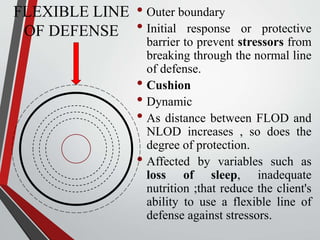
FLEXIBLE LINE
OF DEFENSE
• Outer boundary
• Initial response or protective
barrier to prevent stressors from
breaking through the normal line
of defense.
• Cushion
• Dynamic
• As distance between FLOD and
NLOD increases , so does the
degree of protection.
• Affected by variables such as
loss of sleep, inadequate
nutrition ;that reduce the client's
ability to use a flexible line of
defense against stressors.
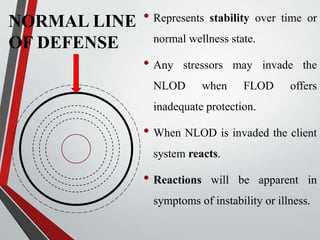
• Represents stability over time or
normal wellness state.
• Any stressors may invade the
NLOD when FLOD offers
inadequate protection.
• When NLOD is invaded the client
system reacts.
• Reactions will be apparent in
symptoms of instability or illness.
NORMAL LINE
OF DEFENSE
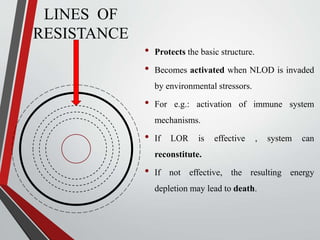
LINES OF
RESISTANCE
• Protects the basic structure.
• Becomes activated when NLOD is invaded
by environmental stressors.
• For e.g.: activation of immune system
mechanisms.
• If LOR is effective , system can
reconstitute.
• If not effective, the resulting energy
depletion may lead to death.
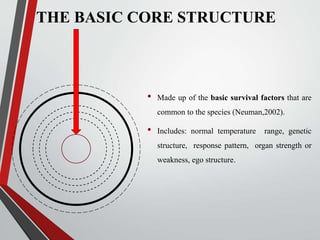
THE BASIC CORE STRUCTURE
• Made up of the basic survival factors that are
common to the species (Neuman,2002).
• Includes: normal temperature range, genetic
structure, response pattern, organ strength or
weakness, ego structure.
CLIENT VARIABLES
• Each concentric circle or layer is made up of the five variable
areas which occur simultaneously in each client :
• Physiologic variables
• Psychological variables
• Socio-cultural variables
• Developmental variables
• Spiritual variables- added in 1989
CLIENT VARIABLES contd…
• In ideal situation these variables function in harmony.
• Each of the variables should be considered when assessing
system reactions to stressors for each of the concentric circles
in the model diagram.
NURSING INTERVENTIONS
• Focus on retaining or maintaining system stability.
• Are carried out on three preventive levels.
 Primary prevention as intervention
 Secondary prevention as intervention
 Tertiary prevention as intervention
METAPARADIGM
Human being
Is viewed as an open system that interacts with both internal and
external environmental forces and
stressors.
The human is in constant change, moving towards a dynamic
state of system stability or towards illness of varying degrees.
ENVIRONMENT
The environment may be viewed as all factors that affect and
affected by the system. It includes interpersonal, intrapersonal and
extra-personal stressors that interfere with person's normal line of
defense and can affect the system's stability.
HEALTH
Defined as condition or degree of system stability
and is viewed as a continuum from wellness to illness.
Stability occurs when all system's parts and subparts are in balance
or harmony so that the
whole system is in balance.
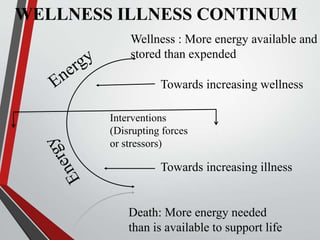
WELLNESS ILLNESS CONTINUM
Wellness : More energy available and
stored than expended
Towards increasing wellness
Interventions
(Disrupting forces
or stressors)
Death: More energy needed
than is available to support life
Towards increasing illness
NURSING
As actions that assist persons, families and groups to attain and
maintain a maximum level of wellness.
Nursing uses primary, secondary and tertiary interventions to
reduce client's stressors. It consist of three steps : Nursing
diagnosis, nursing goals and nursing outcomes.
Application of Neuman
system Model in clinical
practice
Neuman System Model Nursing Process
Format
 Neuman presents a 3 step nursing
process format, known as the Neuman
System Model Nursing Process Format.
Nursing Diagnosis (assessment and diagnosis)
Nursing Goals (plan and expected outcomes)
Nursing Outcomes (implementation and
evaluation)
Nursing Diagnosis
 To identify variances from wellness and development of
hypothetical interventions
 Nurses focus on obtaining data of client with regards:
 To determine the existing state of wellness
 (Assessment of basic structure, FLOD,NLOD,LOR)
 Identify, classify and evaluate actual and potential stressors
 ( intra, inter and extra personal interaction in all five variables)
 Identify, classify and evaluate the actual or potential reaction to
environmental stressors.
 Evaluate the influence of past, present and future coping patterns.
 For this use assessment and intervention tool.
An assessment and
intervention tool
1. Intake summary
Name, Age, Sex, Marital Status, referral source and
related information
2. Stressors as perceived by clients
 Major stress area of health concerns
 lifestyle patterns
 past coping patterns
 anticipating oneself in the future as a consequences of
present situation
 activities doing to help oneself now and what can you do
 expectation of activities for oneself from caregivers, family,
friends
Contd..
3. Stressors as perceived by caregiver
 Major stress area of health for client
 difference of client present and usual pattern of living
 client past coping patterns
 anticipating client in the future as a consequences of present
situation
 activities of client to help himself
 and expectation of client (activities) from caregivers, family,
friends
Summary of impression
Note any discrepancies or distortion between the
client’s perception and that of the caregiver as relates
to the situation.
Contd..
4. Intrapersonal factors
i. Physical
ii. Psychological
iii. Sociocultural
iv. Developmental
v. Spiritual
5. Interpersonal factors- resources and relationships of
family, friends or caregivers that either influence or
could influence area 4.
6. Extrapersonal factors - resources and relationships of
community facilities, finances, employment or other
area that either influence or could influence area 4 and
5.
Overall summary
Physiological, Pshyological, Sociocultural, Developmental and Spiritual
Contd…
7. Formulation of a comprehensive
Nursing Diagnosis
Identifying and ranking the priority of
needs based on total data obtained from
:
the client’s perception
the caregivers perception
or other resources such as laboratory reports,
other caregivers or agencies.
Nursing Goal
 Intervention strategies negotiated with
client to retain, attain and maintain
client/client system stability.
 Outcomes are specified under it as goal
outcome to correct variances.
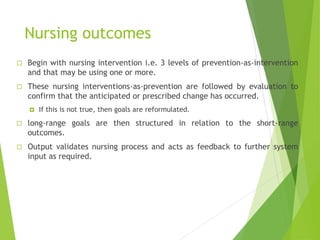
Nursing outcomes
 Begin with nursing intervention i.e. 3 levels of prevention-as-intervention
and that may be using one or more.
 These nursing interventions-as-prevention are followed by evaluation to
confirm that the anticipated or prescribed change has occurred.
 If this is not true, then goals are reformulated.
 long-range goals are then structured in relation to the short-range
outcomes.
 Output validates nursing process and acts as feedback to further system
input as required.
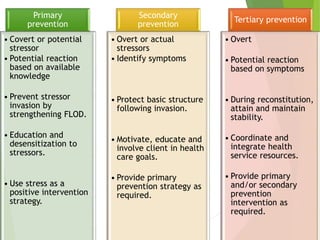
Primary
prevention
• Covert or potential
stressor
• Potential reaction
based on available
knowledge
• Prevent stressor
invasion by
strengthening FLOD.
• Education and
desensitization to
stressors.
• Use stress as a
positive intervention
strategy.
Secondary
prevention
• Overt or actual
stressors
• Identify symptoms
• Protect basic structure
following invasion.
• Motivate, educate and
involve client in health
care goals.
• Provide primary
prevention strategy as
required.
Tertiary prevention
• Overt
• Potential reaction
based on symptoms
• During reconstitution,
attain and maintain
stability.
• Coordinate and
integrate health
service resources.
• Provide primary
and/or secondary
prevention
intervention as
required.
APPLICATION IN
EDUCATION, RESEARCH AND
PRACTICE
In Education
• 1980s --exploration and use of the model greatly
accelerated in education at all levels of practice in
varied settings.
• Many schools of nursing in the world (usa, canada,
australia, india, nepal etc.) use the Neuman Systems
Model as a curriculum framework or for selected
courses.
• B.sc. Nursing course of Nepal incorporate this model
in the curriculum.
In research
• In order to facilitate the use of nursing research with
the Neuman Systems Model, Fawcett has offered
guidelines for constructing Neuman Systems
Model–based studies.
• Neuman model has guided a range of study
designs, from qualitative descriptions of relevant
phenomena to quantitative experiments that tested
the effects of prevention interventions on a variety
of client-system outcomes
In practice
•Used in different settings
•Used to guide practice with clients with
cognitive impairments, meeting the family
needs of clients in critical care, to provide
stable support groups for parents with infants
in NICU and to meet the needs of home
caregivers, with emphasis on clients with
cancer, HIV/AIDS, and head traumas.
STRENGTHS
AND
LIMITATIONS
STRENGTHS
• The relationship among concepts are logically and clearly
defined.
• Fairly simple and straightforward in approach.
• Easily identifiable definitions
• The holistic system approach used; indicates the model is not
situation specific but may be used in a variety of situations.
STRENGTHS contd..
• Provides clear direction for interventions through primary,
secondary, and tertiary prevention which have gained universal
acceptance.
• Provide important guidelines for nursing research, education
and practice.
LIMITATIONS
• Some concepts like level of wellness, and concept of
reconstitution requires clearer definition and further
explanations.
• Components of the flexible line of defense interact in
very complex ways and it may be difficult to
overgeneralize their interaction.
• Although reaction is identified in the pictorial model, it is not
discussed separately.
References
Adhikari, R. D. (2010). Nursing theories and modules (2nd ed).
Makalu Publication House: Dillibazar, Kathmandu.
George, J. B. (2011). Nursing theories: the base for professional
nursing practice (6th ed). Pearson, India
Rai, L. (2011). Nursing Concepts Theories and Principles (2nd edition
ed.). Udayapur: Nabin Kumar Rai.
Raj, D. E. (2011). Nursing Theories A practical View. New Delhi:
Jaypee Brothers Medical Publisher (Pvt.) Ltd.
THANK YOU

NEUMAN SYSTEMS MODEL.ppt

  • 1.
  • 2.
    BETTY NEUMAN Brief introduction •Born in 1924 in Ohio. • Diploma – 1947, from People’s hospital, Ohio • B.S. in public health nursing – 1957 • M.S. as public health- mental health nurse consultant-1966, California • Honorary doctorates
  • 3.
    INTRODUCTION CONTD… • Doctoratein clinical psychology from Pacific Western University- 1985 • Multiple Honorary doctorate Contribution Areas: • Public health, hospital, school health, industry and mental health settings.
  • 4.
  • 5.
    Fig. 1 TheNeuman system model (original diagram copyright1970 by betty neuman
  • 6.
    THE NEUMAN SYSTEMS MODEL •Provides a comprehensive, flexible, holistic and system based perspective for nursing. • Deals with stress and stress reduction and is primarily concerned with the effects of stress on health. • According to her, this model provides a total approach to client problems by providing a multidimensional view of the person as an individual.
  • 7.
    Fig 1. Coreand concentric circles Flexible line of defense Normal line of defense Basic structure/ Core Line of resistance
  • 8.
    FLEXIBLE LINE OF DEFENSE •Outer boundary • Initial response or protective barrier to prevent stressors from breaking through the normal line of defense. • Cushion • Dynamic • As distance between FLOD and NLOD increases , so does the degree of protection. • Affected by variables such as loss of sleep, inadequate nutrition ;that reduce the client's ability to use a flexible line of defense against stressors.
  • 9.
    • Represents stabilityover time or normal wellness state. • Any stressors may invade the NLOD when FLOD offers inadequate protection. • When NLOD is invaded the client system reacts. • Reactions will be apparent in symptoms of instability or illness. NORMAL LINE OF DEFENSE
  • 10.
    LINES OF RESISTANCE • Protectsthe basic structure. • Becomes activated when NLOD is invaded by environmental stressors. • For e.g.: activation of immune system mechanisms. • If LOR is effective , system can reconstitute. • If not effective, the resulting energy depletion may lead to death.
  • 11.
    THE BASIC CORESTRUCTURE • Made up of the basic survival factors that are common to the species (Neuman,2002). • Includes: normal temperature range, genetic structure, response pattern, organ strength or weakness, ego structure.
  • 12.
    CLIENT VARIABLES • Eachconcentric circle or layer is made up of the five variable areas which occur simultaneously in each client : • Physiologic variables • Psychological variables • Socio-cultural variables • Developmental variables • Spiritual variables- added in 1989
  • 13.
    CLIENT VARIABLES contd… •In ideal situation these variables function in harmony. • Each of the variables should be considered when assessing system reactions to stressors for each of the concentric circles in the model diagram.
  • 14.
    NURSING INTERVENTIONS • Focuson retaining or maintaining system stability. • Are carried out on three preventive levels.  Primary prevention as intervention  Secondary prevention as intervention  Tertiary prevention as intervention
  • 15.
    METAPARADIGM Human being Is viewedas an open system that interacts with both internal and external environmental forces and stressors. The human is in constant change, moving towards a dynamic state of system stability or towards illness of varying degrees.
  • 16.
    ENVIRONMENT The environment maybe viewed as all factors that affect and affected by the system. It includes interpersonal, intrapersonal and extra-personal stressors that interfere with person's normal line of defense and can affect the system's stability.
  • 17.
    HEALTH Defined as conditionor degree of system stability and is viewed as a continuum from wellness to illness. Stability occurs when all system's parts and subparts are in balance or harmony so that the whole system is in balance.
  • 18.
    WELLNESS ILLNESS CONTINUM Wellness: More energy available and stored than expended Towards increasing wellness Interventions (Disrupting forces or stressors) Death: More energy needed than is available to support life Towards increasing illness
  • 19.
    NURSING As actions thatassist persons, families and groups to attain and maintain a maximum level of wellness. Nursing uses primary, secondary and tertiary interventions to reduce client's stressors. It consist of three steps : Nursing diagnosis, nursing goals and nursing outcomes.
  • 20.
    Application of Neuman systemModel in clinical practice
  • 21.
    Neuman System ModelNursing Process Format  Neuman presents a 3 step nursing process format, known as the Neuman System Model Nursing Process Format. Nursing Diagnosis (assessment and diagnosis) Nursing Goals (plan and expected outcomes) Nursing Outcomes (implementation and evaluation)
  • 22.
    Nursing Diagnosis  Toidentify variances from wellness and development of hypothetical interventions  Nurses focus on obtaining data of client with regards:  To determine the existing state of wellness  (Assessment of basic structure, FLOD,NLOD,LOR)  Identify, classify and evaluate actual and potential stressors  ( intra, inter and extra personal interaction in all five variables)  Identify, classify and evaluate the actual or potential reaction to environmental stressors.  Evaluate the influence of past, present and future coping patterns.  For this use assessment and intervention tool.
  • 23.
    An assessment and interventiontool 1. Intake summary Name, Age, Sex, Marital Status, referral source and related information 2. Stressors as perceived by clients  Major stress area of health concerns  lifestyle patterns  past coping patterns  anticipating oneself in the future as a consequences of present situation  activities doing to help oneself now and what can you do  expectation of activities for oneself from caregivers, family, friends
  • 24.
    Contd.. 3. Stressors asperceived by caregiver  Major stress area of health for client  difference of client present and usual pattern of living  client past coping patterns  anticipating client in the future as a consequences of present situation  activities of client to help himself  and expectation of client (activities) from caregivers, family, friends Summary of impression Note any discrepancies or distortion between the client’s perception and that of the caregiver as relates to the situation.
  • 25.
    Contd.. 4. Intrapersonal factors i.Physical ii. Psychological iii. Sociocultural iv. Developmental v. Spiritual 5. Interpersonal factors- resources and relationships of family, friends or caregivers that either influence or could influence area 4. 6. Extrapersonal factors - resources and relationships of community facilities, finances, employment or other area that either influence or could influence area 4 and 5. Overall summary Physiological, Pshyological, Sociocultural, Developmental and Spiritual
  • 26.
    Contd… 7. Formulation ofa comprehensive Nursing Diagnosis Identifying and ranking the priority of needs based on total data obtained from : the client’s perception the caregivers perception or other resources such as laboratory reports, other caregivers or agencies.
  • 27.
    Nursing Goal  Interventionstrategies negotiated with client to retain, attain and maintain client/client system stability.  Outcomes are specified under it as goal outcome to correct variances.
  • 28.
    Nursing outcomes  Beginwith nursing intervention i.e. 3 levels of prevention-as-intervention and that may be using one or more.  These nursing interventions-as-prevention are followed by evaluation to confirm that the anticipated or prescribed change has occurred.  If this is not true, then goals are reformulated.  long-range goals are then structured in relation to the short-range outcomes.  Output validates nursing process and acts as feedback to further system input as required.
  • 29.
    Primary prevention • Covert orpotential stressor • Potential reaction based on available knowledge • Prevent stressor invasion by strengthening FLOD. • Education and desensitization to stressors. • Use stress as a positive intervention strategy. Secondary prevention • Overt or actual stressors • Identify symptoms • Protect basic structure following invasion. • Motivate, educate and involve client in health care goals. • Provide primary prevention strategy as required. Tertiary prevention • Overt • Potential reaction based on symptoms • During reconstitution, attain and maintain stability. • Coordinate and integrate health service resources. • Provide primary and/or secondary prevention intervention as required.
  • 30.
  • 31.
    In Education • 1980s--exploration and use of the model greatly accelerated in education at all levels of practice in varied settings. • Many schools of nursing in the world (usa, canada, australia, india, nepal etc.) use the Neuman Systems Model as a curriculum framework or for selected courses. • B.sc. Nursing course of Nepal incorporate this model in the curriculum.
  • 32.
    In research • Inorder to facilitate the use of nursing research with the Neuman Systems Model, Fawcett has offered guidelines for constructing Neuman Systems Model–based studies. • Neuman model has guided a range of study designs, from qualitative descriptions of relevant phenomena to quantitative experiments that tested the effects of prevention interventions on a variety of client-system outcomes
  • 33.
    In practice •Used indifferent settings •Used to guide practice with clients with cognitive impairments, meeting the family needs of clients in critical care, to provide stable support groups for parents with infants in NICU and to meet the needs of home caregivers, with emphasis on clients with cancer, HIV/AIDS, and head traumas.
  • 34.
  • 35.
    STRENGTHS • The relationshipamong concepts are logically and clearly defined. • Fairly simple and straightforward in approach. • Easily identifiable definitions • The holistic system approach used; indicates the model is not situation specific but may be used in a variety of situations.
  • 36.
    STRENGTHS contd.. • Providesclear direction for interventions through primary, secondary, and tertiary prevention which have gained universal acceptance. • Provide important guidelines for nursing research, education and practice.
  • 37.
    LIMITATIONS • Some conceptslike level of wellness, and concept of reconstitution requires clearer definition and further explanations. • Components of the flexible line of defense interact in very complex ways and it may be difficult to overgeneralize their interaction. • Although reaction is identified in the pictorial model, it is not discussed separately.
  • 38.
    References Adhikari, R. D.(2010). Nursing theories and modules (2nd ed). Makalu Publication House: Dillibazar, Kathmandu. George, J. B. (2011). Nursing theories: the base for professional nursing practice (6th ed). Pearson, India Rai, L. (2011). Nursing Concepts Theories and Principles (2nd edition ed.). Udayapur: Nabin Kumar Rai. Raj, D. E. (2011). Nursing Theories A practical View. New Delhi: Jaypee Brothers Medical Publisher (Pvt.) Ltd.
  • 39.

Editor's Notes

  • #6 The Neuman system model (original diagram copyright1970 by betty neuman
  • #8 Surrounding the basic core structure are concentric circles, which include: line of resistance and line of defense.
  • #9 The particular inter-relationships of client variables at any point in time can affect the degree to which a client is protected by the flexible LOD. Stability, or homeostasis, occurs when the amount of energy that is available exceeds that being used Any environmental force that alters the system's stability are stressor. Intrapersonal stressors eg. Infection thought Interpersonal stressors and role expectation Extrapersonal stressors eg. Job related Intrapersonal - occur within person, example is infection, fear and feelings Interpersonal - occur between individuals, e.g. role expectations Extrapersonal - occur outside the individual, e.g. job or finance pressure Many known, unknown, and universal stressors exist. Each differ in it’s potential for disturbing a client’s usual stability level or normal LOD (Line of Defence)
  • #10 If flexible line of defense cannot protect a person from stressor, it can break through normal line of defense causing a reaction which depends on the client's lines of resistance. Amount of system instability that occurs after exposure to a stressor. Determined by natural and learned resistance; manifested by strength of lines of resistance and of normal and flexible lines of defense. Determined by timing, type, strength of stressor, person's core structure, experience and perception. Person's system can adapt to the stressor : this adaptation is called reconstitution.
  • #11 The particular inter-relationships of client variables at any point in time can affect the degree to which a client is protected by the flexible LOD.
  • #12 These factors include:- – Normal temp. range, Genetic structure.- Response pattern. Organ strength or weakness, Ego structure.
  • #13 Each concentric circle or layer is made up of the five variable areas which are considered and occur simultaneously in each client concentric circles
  • #22 The purpose is clinical practice is to assist clients to retain, attain and maintain optimal client stability.
  • #23 Assessment of basic structure, FLOD,NLOD,LOR, degree of potential reaction Includes the use of database to identify variances from wellness and development of hypothetical interventions. Assessment and intervention tool is used.
  • #24 7steps: If client cant get data from family memebers; {perceptual experience - the representation of what is perceived; basic component in the formation of a conceptperceptual factors (expectations, present and possible future coping patterns)},
  • #28 Based on the identified needs and the available resources. Outcomes are specified under nursing goals in the NSM as goal outcomes to correct variances.
  • #29 Identify the mode of nursing action
  • #30 Flod—desensitize existing or possible noxious stressors.
  • #31 The multidimensionality and wholistic systemic perspective of the Neuman Systems Model is increasingly demonstrating its relevance and reliability in a wide variety of clinical and educational settings throughout the world.
  • #32 Generally, the reason for choosing the model was
  • #33 Research focus on advance understanding of the influence of preventive interventions on stressors and client system stability.
  • #36 Ainterrelated concepts logically consistent. Relevant with present context of holistic patient care. lthough the model is a conceptual framework for nursing, Although concepts are organized in a complex manner,