
Sister Callista Roy’s
Adaptation Model
Presented By:
Ms. Mamta Bisht
(Assistant Professor)
INTRODUCTION
• Nursing is establishing itself as a scientific
discipline.
• Its thrust toward scientifically sound social
usefulness including the development of conceptual
models.
• The nursing models provide the basis for selecting
knowledge to be transmitted in nursing education.
 It is the framework for nursing practice and the
direction for nursing research.
 Sister Callista Roy’s adaptation theory (Roy and
Obloy 1979,Roy 1980,1984,1989) views the client
as an adaptive system.
BIOGRAPHICAL SKETCH OF THE NURSE
THEORIST
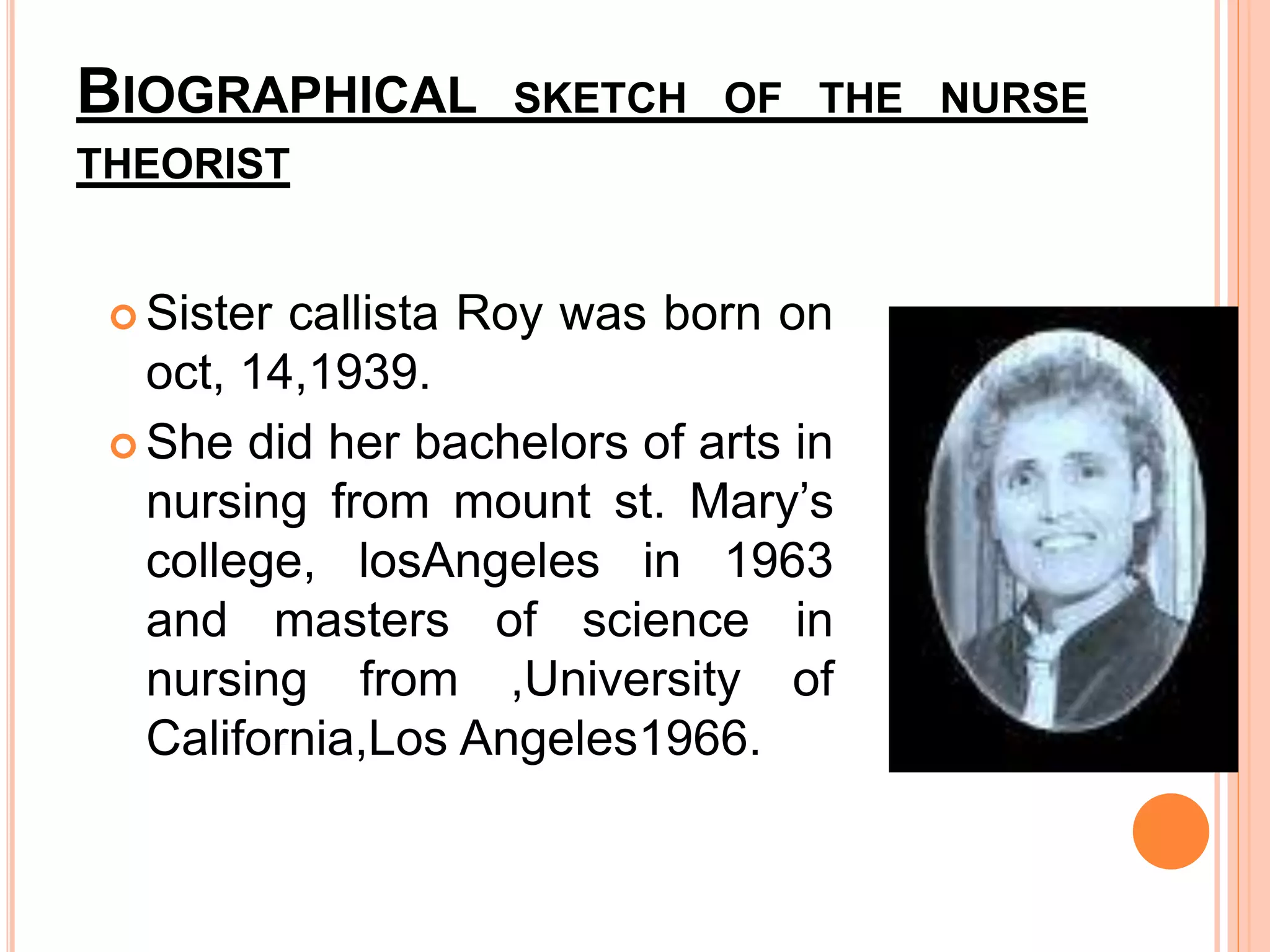
 Sister callista Roy was born on
oct, 14,1939.
 She did her bachelors of arts in
nursing from mount st. Mary’s
college, losAngeles in 1963
and masters of science in
nursing from ,University of
California,Los Angeles1966.
CONTD….
 She also received her masters of arts(M.A) in
sociology from the same university in 1975 and Ph.D
in sociology .
 Roy was an associate professor and chairperson of
the department of nursing at mount Saint Mary’s
college until 1982.
CONTD….
 From 1983 to 1985; she was Post Doctoral fellow at
Robert Wood Johnson at University of California, as a
clinical nurse scholar in neuroscience.
 In 1988 Roy began the newly created position of
graduate faculty at, Boston school of nursing.
CONTD….
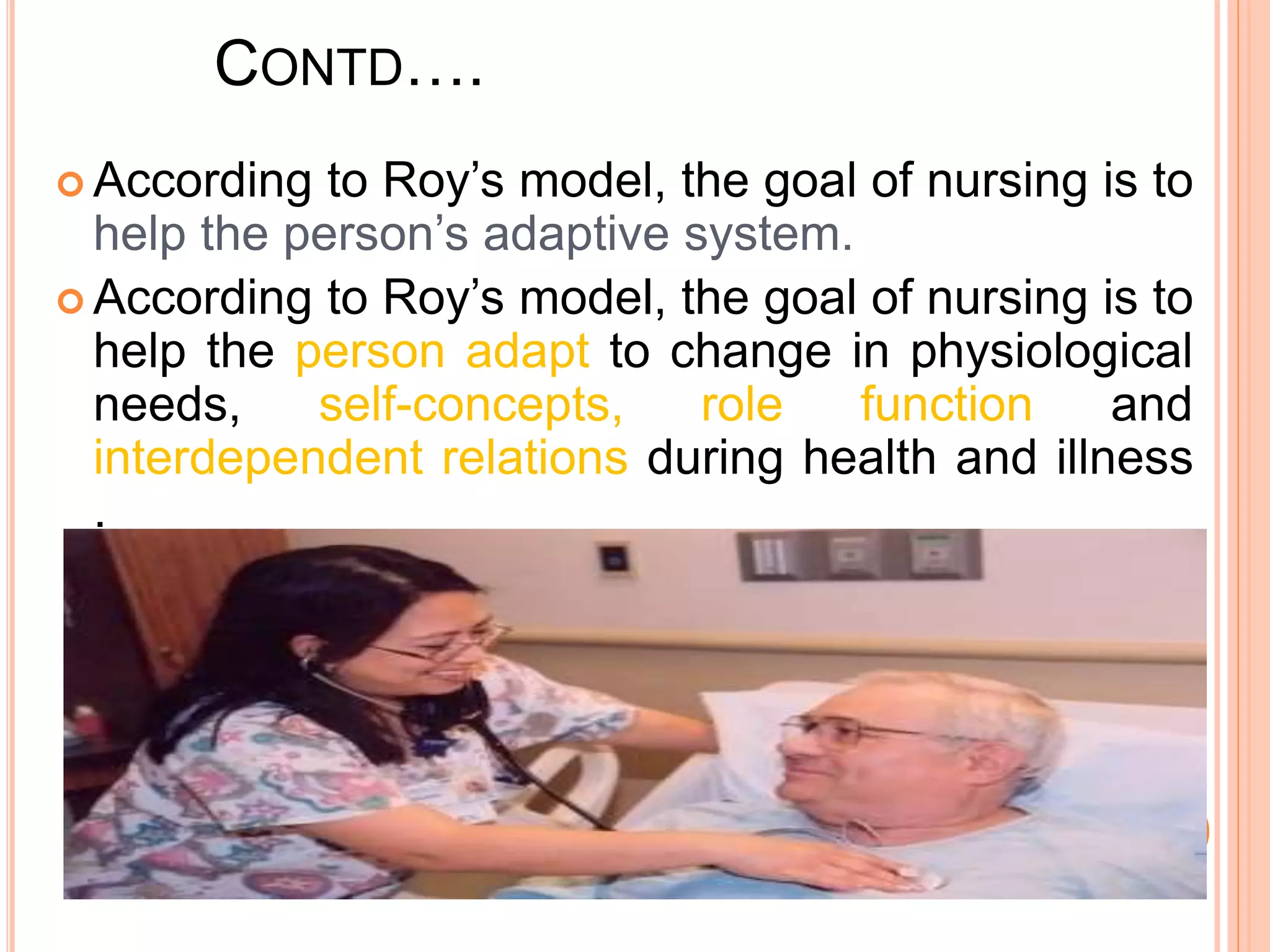
 According to Roy’s model, the goal of nursing is to
help the person’s adaptive system.
 According to Roy’s model, the goal of nursing is to
help the person adapt to change in physiological
needs, self-concepts, role function and
interdependent relations during health and illness
.
CONTD….
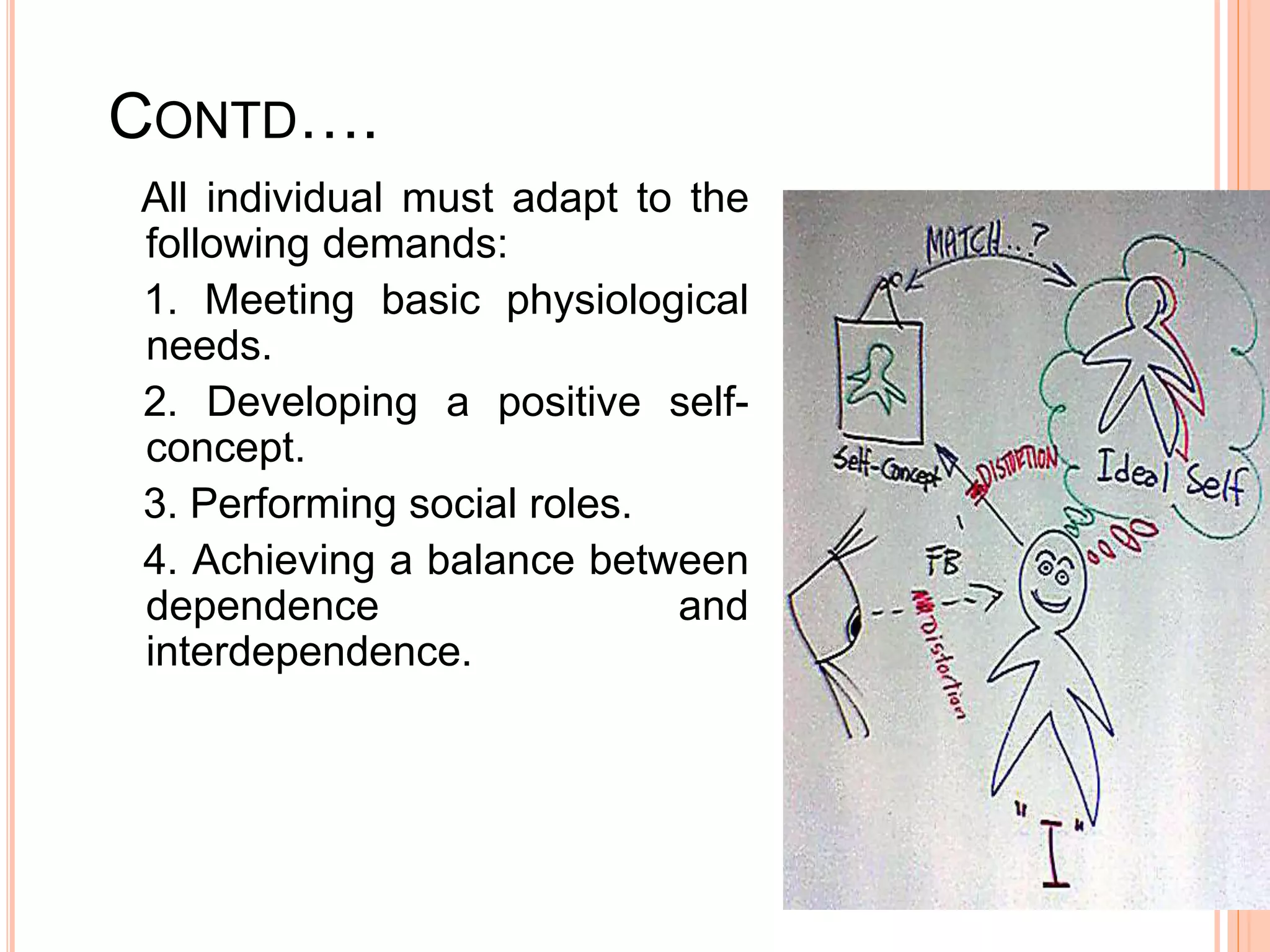
All individual must adapt to the
following demands:
1. Meeting basic physiological
needs.
2. Developing a positive self-
concept.
3. Performing social roles.
4. Achieving a balance between
dependence and
interdependence.
CONTD….
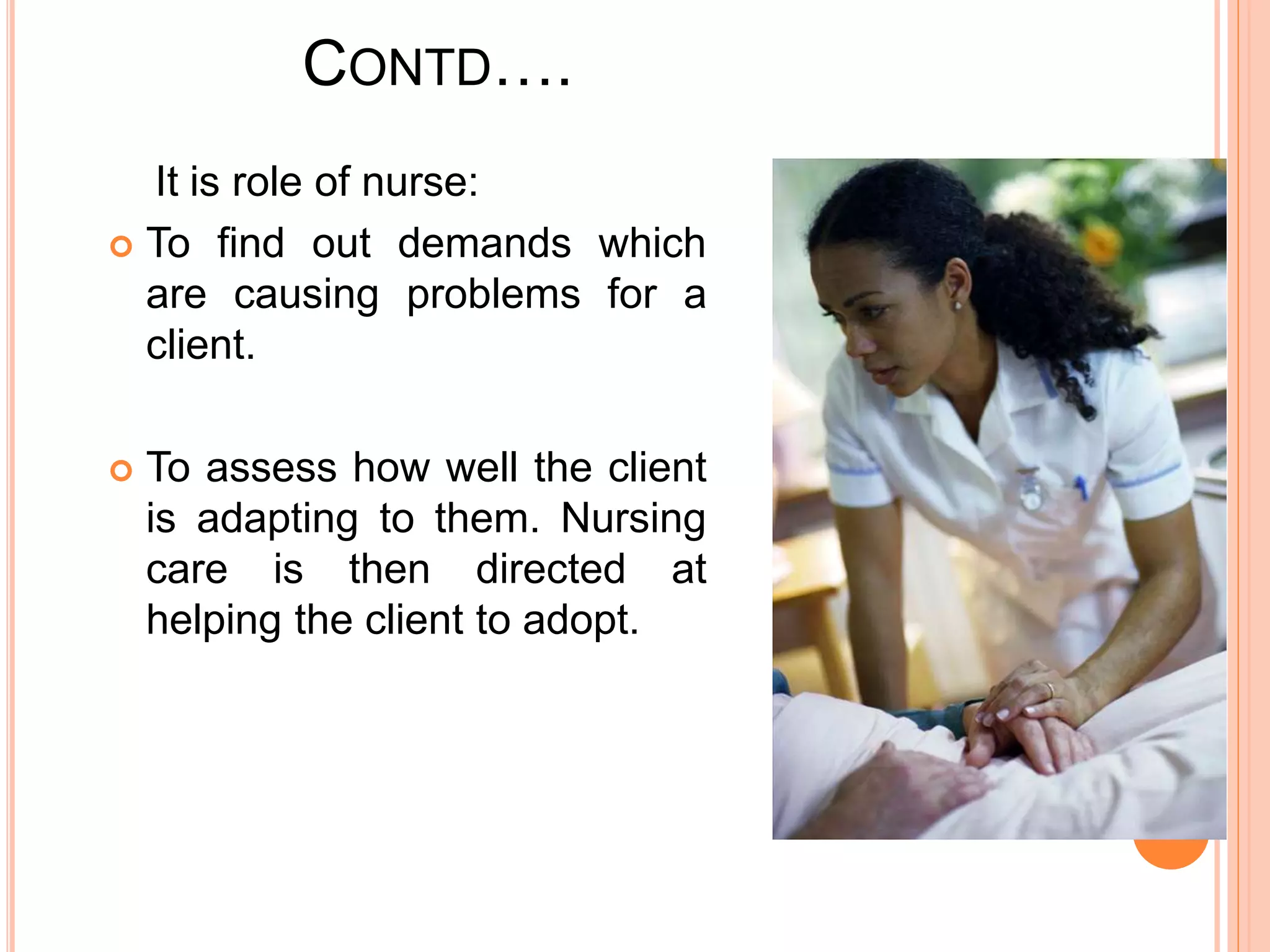
It is role of nurse:
 To find out demands which
are causing problems for a
client.
 To assess how well the client
is adapting to them. Nursing
care is then directed at
helping the client to adopt.
ORIGIN OF THE MODEL:
 While a student of M.sc. nursing, at the university of
California sister C. Roy was challenged in a seminar
by another nurse theorist Dorothy E.JOHNSON to
develop a theory of nursing , subsequently in 1970
the ‘ROY ADAPTATION MODEL’ was born as a
derivation of Bertalanfty (1968) general system theory
and Harry Helson’s Adaptation level theory (1964).
ASSUMPTIONS OF
THE MODEL
CONTD….
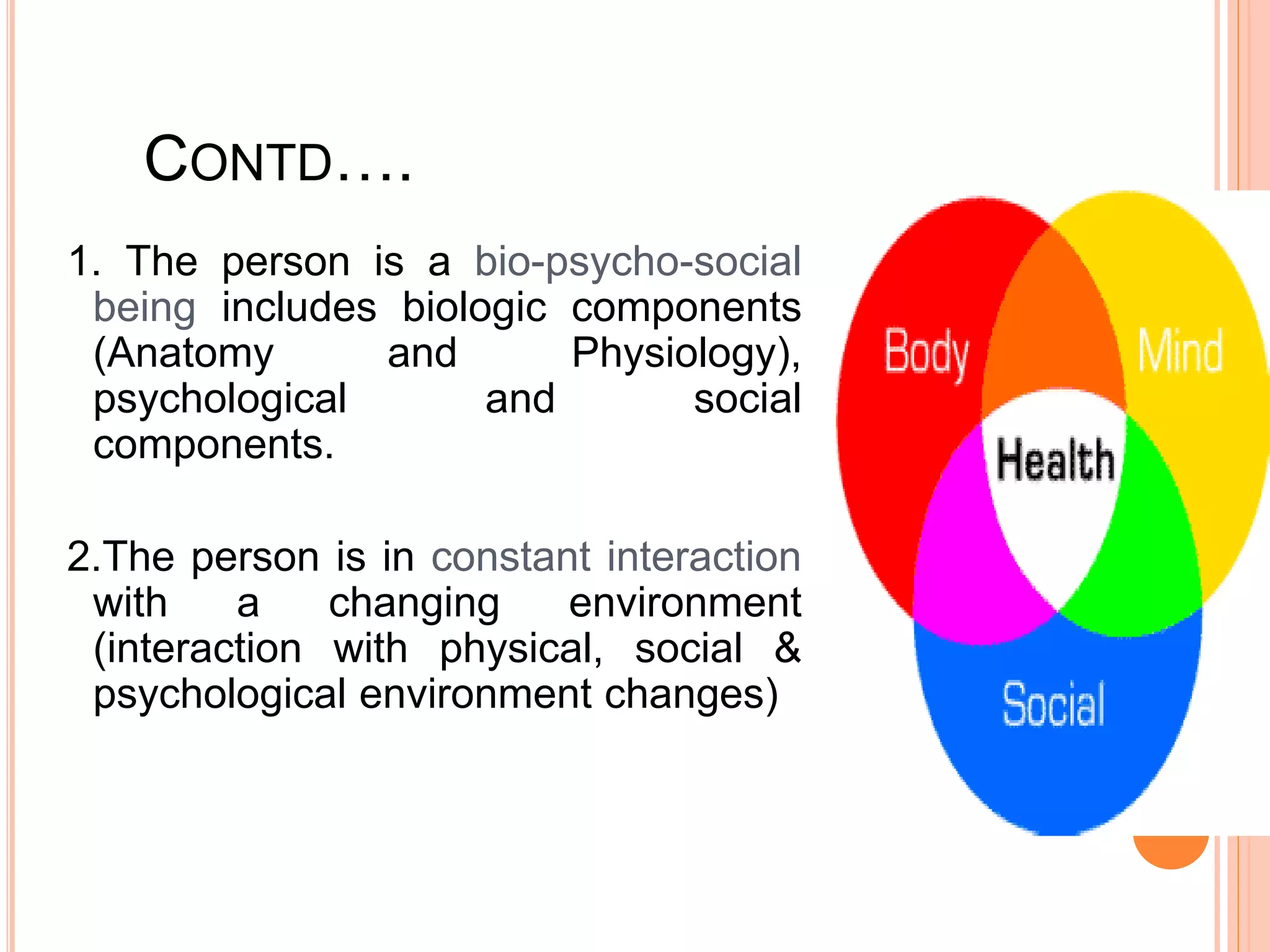
1. The person is a bio-psycho-social
being includes biologic components
(Anatomy and Physiology),
psychological and social
components.
2.The person is in constant interaction
with a changing environment
(interaction with physical, social &
psychological environment changes)
CONTD…
3.To cope with a changing world, the
person uses both innate and
acquired mechanisms which are
biologic,psychological and social in
origin.
4.Health and illness are an
inevitable dimension of the
person’s life.
5.To respond positively to
environmental changes, the person
must adapt (changing environment
demands positive response)
CONTD….
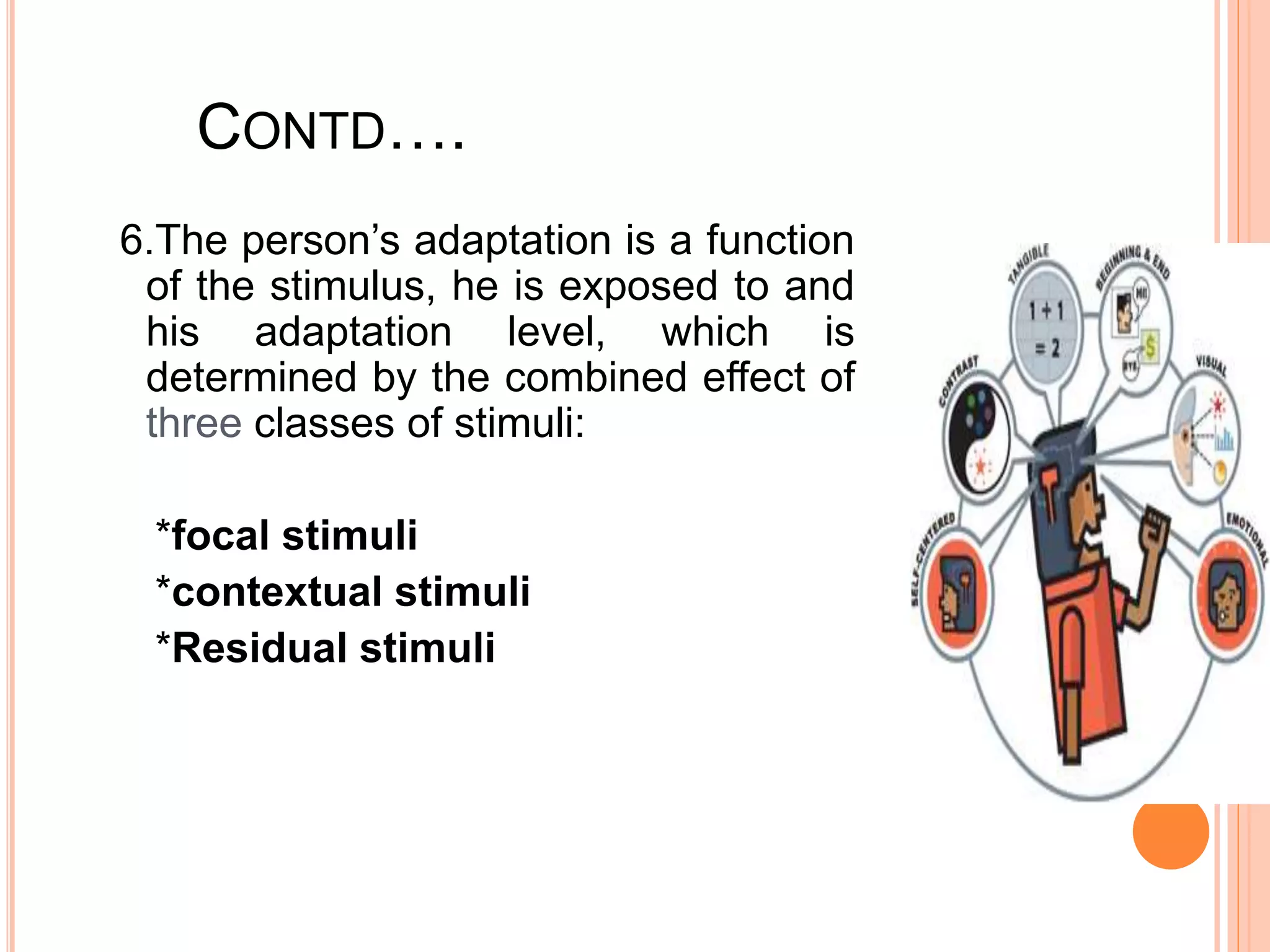
6.The person’s adaptation is a function
of the stimulus, he is exposed to and
his adaptation level, which is
determined by the combined effect of
three classes of stimuli:
*focal stimuli
*contextual stimuli
*Residual stimuli
CONTD….
*Focal stimuli or stimuli demanding prompt attention.
*Contextual stimuli or stimuli present in a
surrounding and situation.
*Residual stimuli such as belief, attitude and habits,
which have an indeterminate on the present situation.
CONTD….
7. The person’s adaptation level is such that it comprises
a zone indicating the range of stimulation that will lead
to a positive response. (if the stimulus is within the zone
the person responds positively, however if the stimulus
outside the zone ,the person cannot make a positive
response)
CONTD….
8. The person is conceptualized as
having four modes of adaptation:
 psychological needs
 self-concept,
 role function, and
 interdependence relations.
Four philosophical assumptions based
on the humanist principles are as
follows.
a. The individual shares in creative
power.
b. Behaves purposefully, not in
sequence of cause and effect.
c. Possesses intrinsic holism and
d. Strives to maintain integrity & to
realize the need for relationship.
CONTD….
VERTIVITY
The term vertivity derived from
the Latin ‘veritas’ meaning the
trust, was coined by Roy. It’s a
principle of human nature
that affirms a “common
purposefulness of human
existence”.
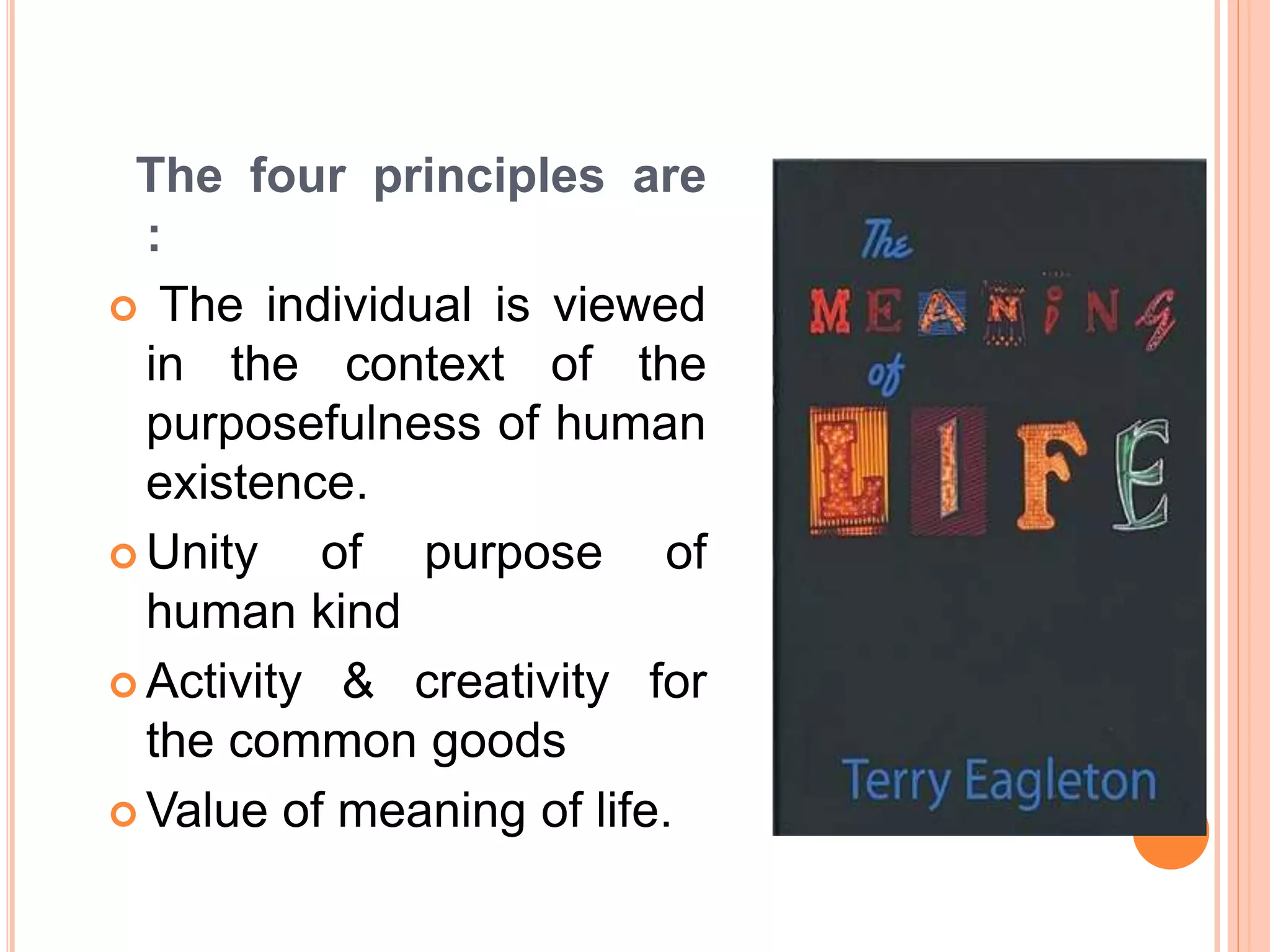
The four principles are
:
 The individual is viewed
in the context of the
purposefulness of human
existence.
 Unity of purpose of
human kind
 Activity & creativity for
the common goods
 Value of meaning of life.
5. CONCEPTS OF MODEL
 Roy’s model is a system model that focuses on
outcomes. the major features of the system models
are the:
-System and its environment
 A system is a set of parts connects to function as a
whole for some purposes and are interdependence of
its parts.
CONTD….
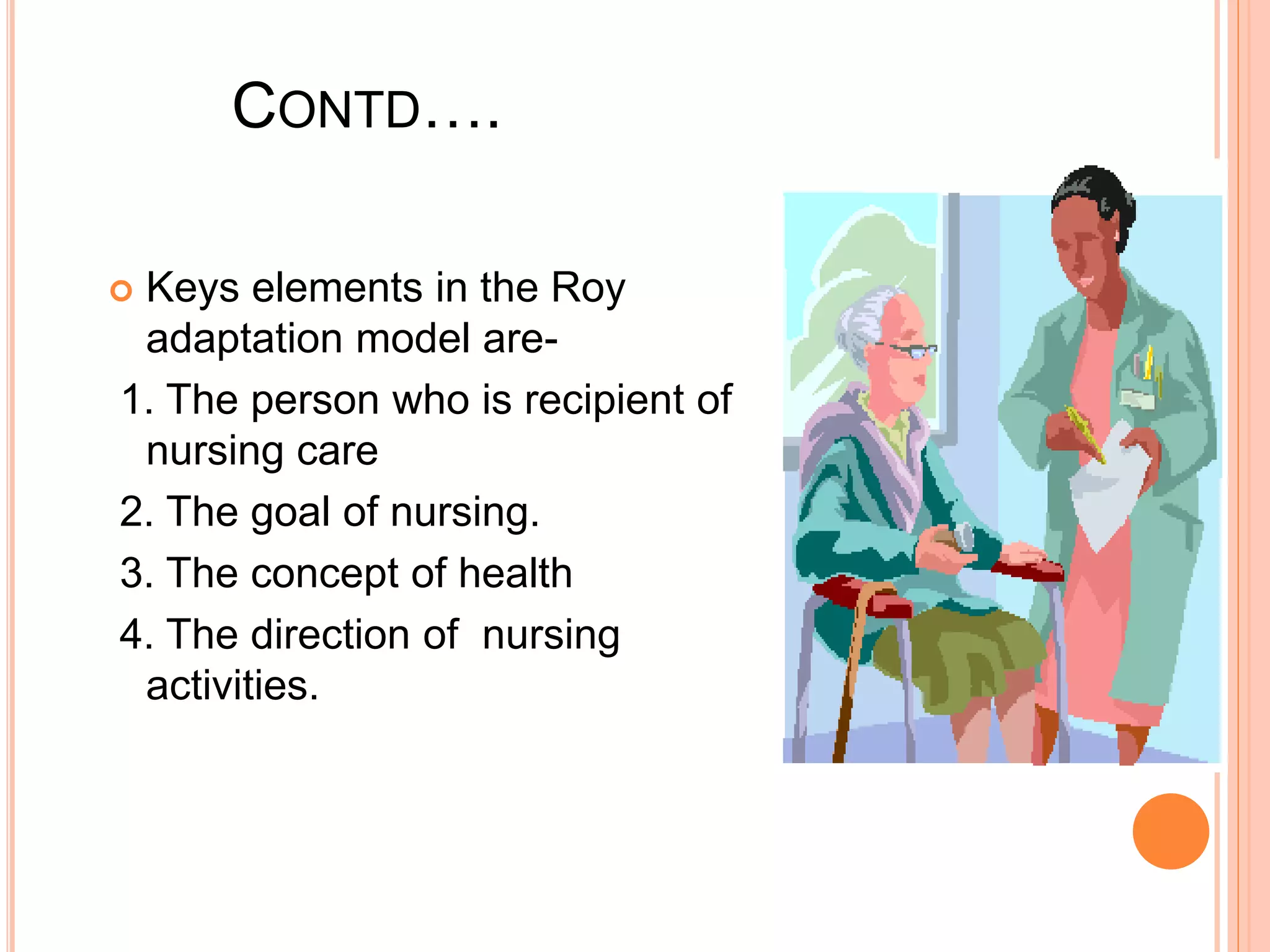
 Keys elements in the Roy
adaptation model are-
1. The person who is recipient of
nursing care
2. The goal of nursing.
3. The concept of health
4. The direction of nursing
activities.
CONTD…
 Person: Roy uses person in her model as a concept
to identify the recipient of nursing care. critical to the
model is the description of recipient of nsg care as
holistic adaptive systems.
 Persons as living systems are in constant interactions
with their environments between the system and the
environment occurs on exchange of information,
matter and energy.
Goal-the goal of nsg. as the promotion of adaptive
responses in relation to the four adaptive modes
(physiological, self concept, role function and
interdependence)and contribute to health.
 Nsg activities-The nursing activities are delineated
by the model as those that promotes adaptive
responses in situation of health and illness. The nsg
activities are identified as actions taken by nurses to
manipulate the focal, contextual residual stimuli
impringing on person.
CONTD….
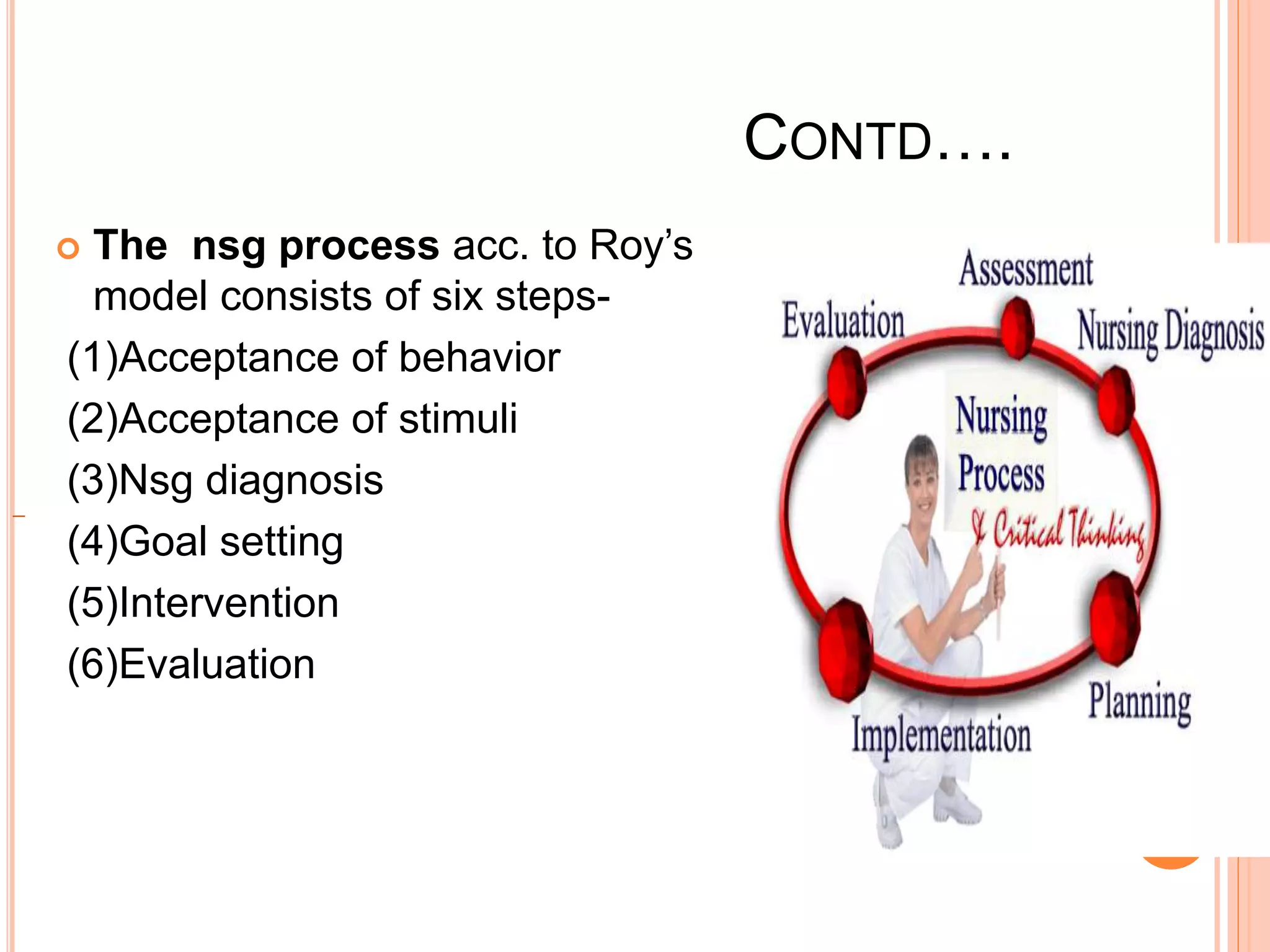
 The nsg process acc. to Roy’s
model consists of six steps-
(1)Acceptance of behavior
(2)Acceptance of stimuli
(3)Nsg diagnosis
(4)Goal setting
(5)Intervention
(6)Evaluation
Health-health has been defined as a “state and process
of being and becoming an integrate and whole
person’’ Health is a process where by individuals are
striving to achieve their maximum potentials.
Environment-stimuli from within the person and stimuli
from around the person represents the element of
environment acc. to Roy.
 Environment is specifically defined by Roy as “all
conditions, circumstances influences surrounding and
affecting the development and behavior of persons and
groups.
6. THE PERSON AS AN ADAPTIVE
SYSTEM
In addition to the concept of person,goal of
nsg,health and environment and nsg activities in
the model ,the theory of person as an adaptive
system employs additional concepts.
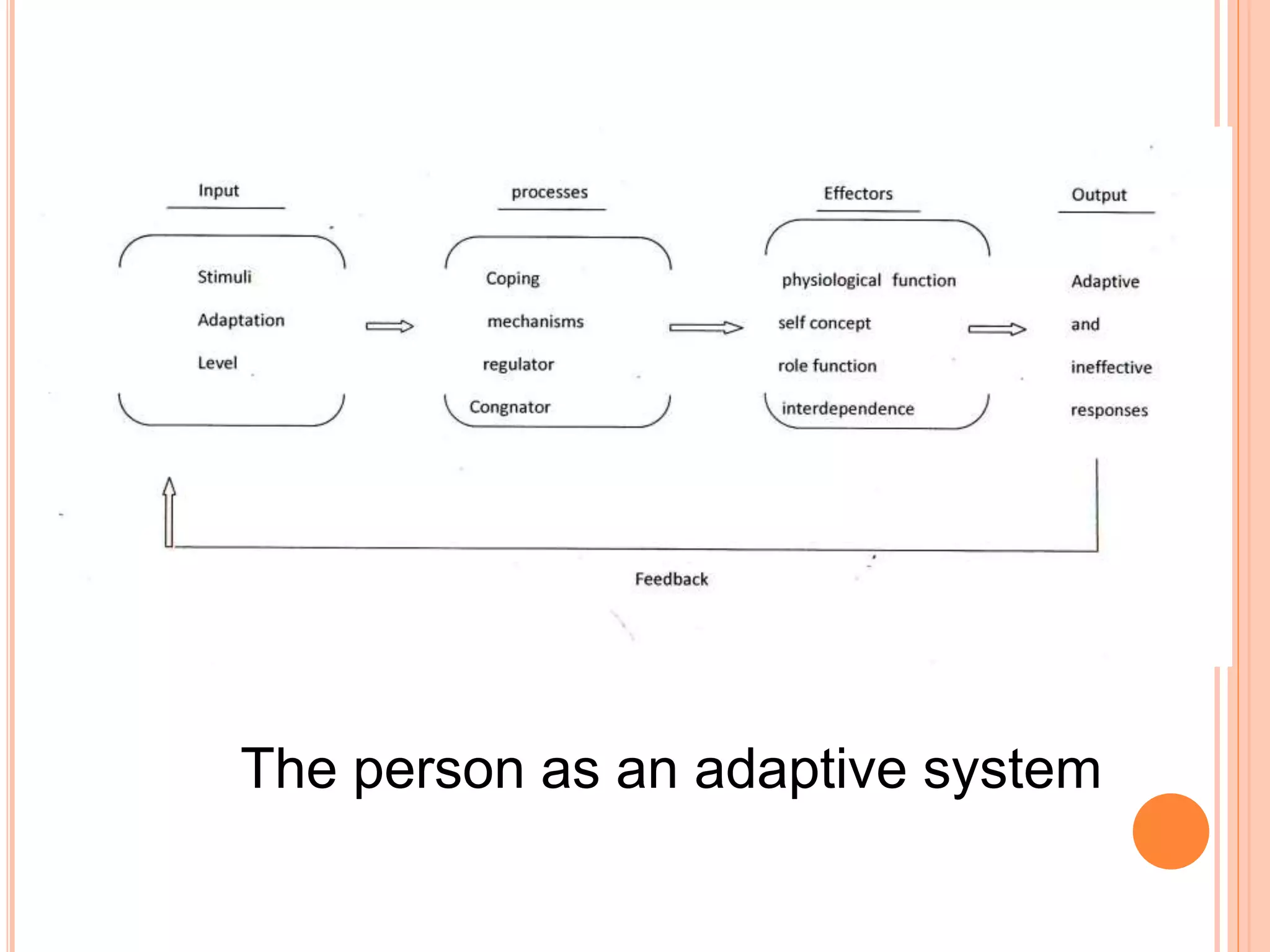
The person as an adaptive system
CONTD….
(1)Input-input coming from external environment as
well as internally from the person as a stimuli(a
stimulus is a unit of information,matter,or energy
from the environment or a person who elicits a
response).The stimuli immediately confronting the
person are focal stimuli greatest degree of change
impact on person.
CONTD…
 Contextual stimuli-observable, measureable and
reported by the person.
 Residual stimuli-those make up characteristics of
the person that are present and relevant to
situation.
CONTD…….
Example: Mr. smith experiencing the chest
pain, the stimulus immediately confronting Mr.
smith,the focal stimulus ,is the deficit of
oxygen supply to his heart muscles.The
contextual stimuli include the 90 degree of
temperature ,the sensation of pain ,Mr. smith’s
age ,weight,blood sugar level,and degree of
coronary artery patency.The residual stimuli
include his history of cigarette smoking and
work relate stress.
Adaptation level is a constantly changing point
that represents the person’s ability to cope with
the changing environment in a positive manner.
 Adaptation level sets up a zone or a range within
which stimulation will lead to adaptive responses.
 Stimuli falling outside their adaptive zone lead to
ineffective responses.
 Suicide due to inability to cope up with the child is
an extreme example of an ineffective response.
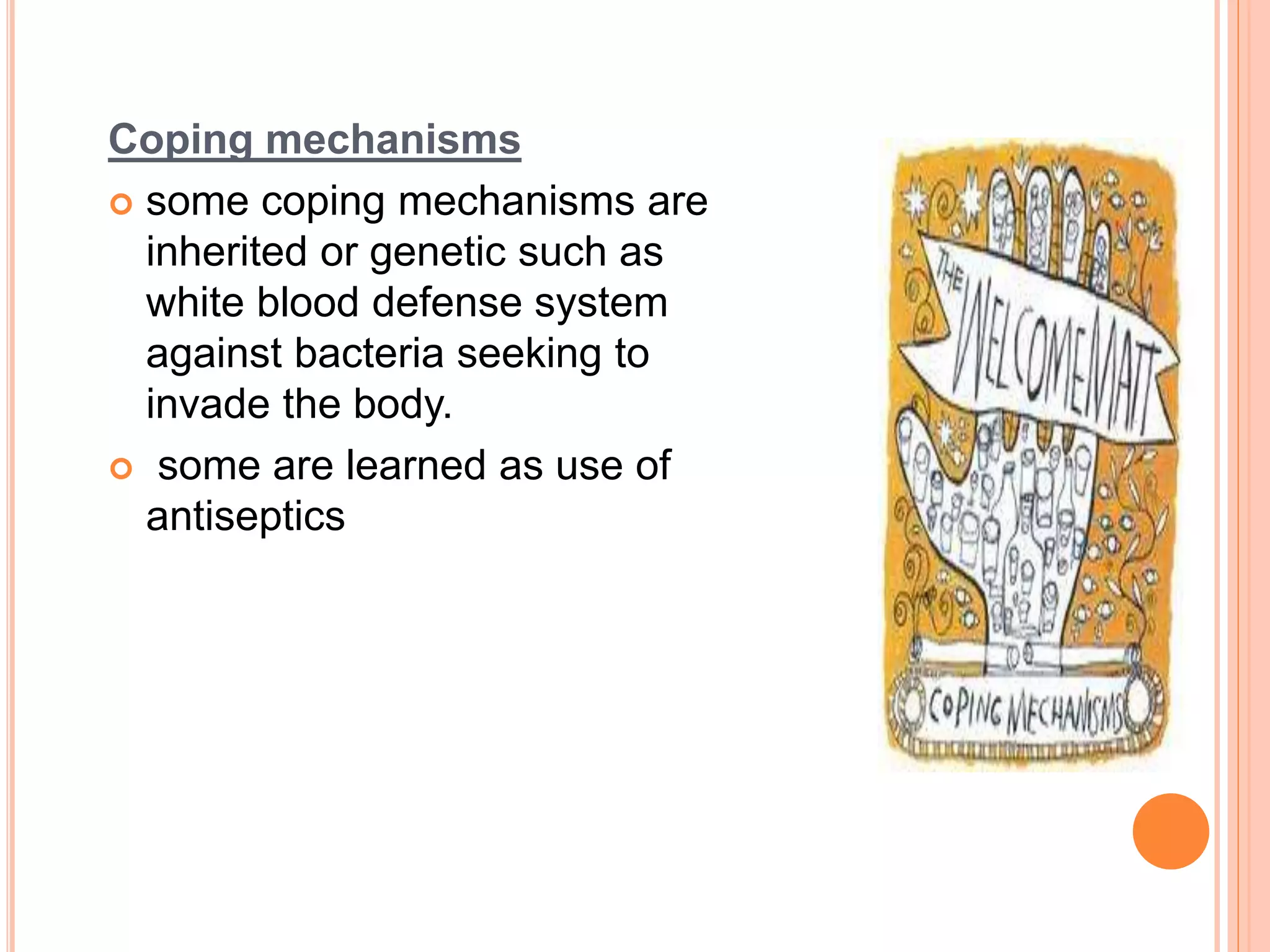
Coping mechanisms
 some coping mechanisms are
inherited or genetic such as
white blood defense system
against bacteria seeking to
invade the body.
 some are learned as use of
antiseptics
CONTD….
 Mechanisms are of 2 types:
(1)Regulator is used primarily as a mechanism to
cope with physiological stimuli.
(2)Cognator used mainly as mechanism to cope
with psychological stimuli dealing primarily in area
of cognition, judgment and emotion.
-Regulator and cognator mechanisms are linked
through the process of perception.
CONTD….
 It is important to recognize that it is the manifestation
of the coping mechanism that can be observed and
measured within the adaptive modes. Thus adaptive
modes are often referred as effectors.
CONTD….
Effectors: Roy has identified four adaptive modes;
 Physiological
 self concept
 role function
 interdependence.
CONTD….
Adaptive responses output-
The behaviors that contribute to the general goals of
the person(i.e survival,growth,reproduction and
mastery)are considered adaptive response.
 Behaviors not contributing to general goals are
considered ineffective responses.
 Adaptive responses being about a state of adaptation.
7. THEORY OF ADAPTIVE MODES:
The theory of adaptive modes was developed in 1981,
consist of four parts:
 physiological,
 self concept,
 role function &
 interdependence.
CONTD…
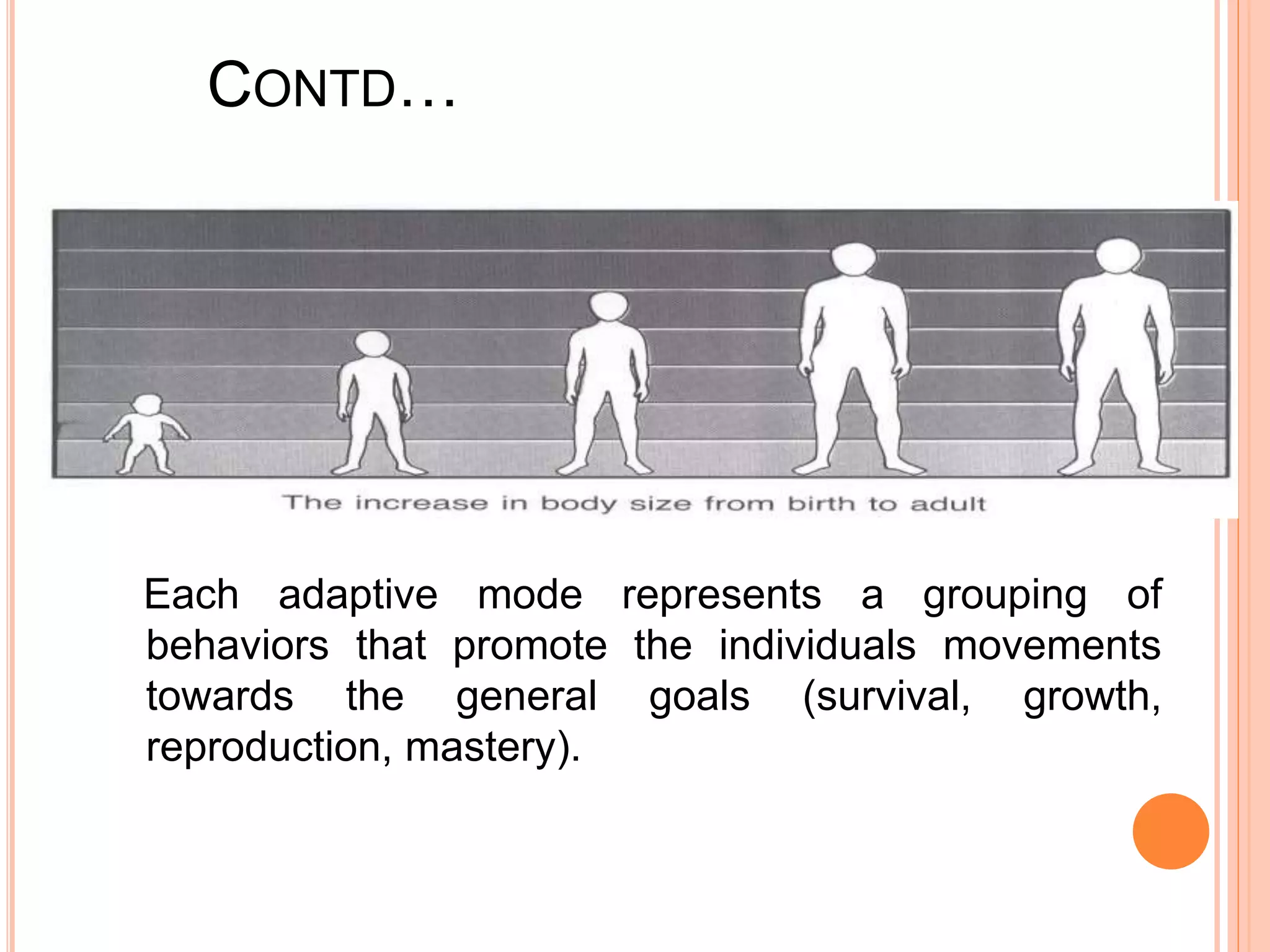
Each adaptive mode represents a grouping of
behaviors that promote the individuals movements
towards the general goals (survival, growth,
reproduction, mastery).
CONTD…..
(1)PHYSIOLOGICAL MODE
Physiological wholeness is achieved
by adapting to changes in
physiological needs.
 The regulator coping mechanism is
primarily responsible for attaining and
maintaining this integrity.
 other complex process that
influences regulator
activities are the senses, fluids and
electrolytes, neurological function &
endocrine function.
Five primary needs have been identified as
necessary for physiological integrity:
 oxygen,
 nutrition,
 activity rest,
 protection,
 elimination
CONTD…
(2)SELF CONCEPT MODE
Self concept is one of the 3 psychosocial modes, the
basic human need within modes in psychic
integrity,which means people need to know who they
are so that can exist with a sense of unity.
CONTD…..
 Physical self: is an appraisal of one’s physical,
attributes, appearance, functioning,
sensation(feeling about self) sexually and
wellness illness status.
 Personal self: is an appraisal of one’s own
characteristics, expectations, values & worth.
Personal self has been divided into the moral
ethical spiritual self ,self consistency & self ideal,
self expectancy e.g. I believe God will help me
through this surgery.
CONTD…..
(3)ROLE FUNCTION MODE:
The basic need in the role function adaptive model is
for social integrity. This means that people need to
know who they are in relation to others so that they
can act. All people have role in society. With each role
there are expected behavior .Role have been divided
into primary, secondary and tertiary.
CONTD….
(4)INTERDEPENDENCE MODE
Interdependence is a social adaptive
mode,needs affection adequacy or the feeling of
security in nurturing relationships.
 Interdependence means the close relationship of
people that involves willingness & ability to love,
respect & value others and to accept & responds
to love, respect and value given by others.
 Loneliness as a common adaptation problem
resulting from a disruption in the modes.
Those currently identified
needs are listed below:
(a) Basic physiological needs-
 Exercise and rest
 Nutrition
 Elimination
 Fluid and electrolyte
 Oxygen
 Circulations
 Regulations
CONTD….
(b)self concepts:
 Physical self
 Personal self
 Interpersonal self
(c) role mastery:
-Role failure
-Role conflict
CONTD….
(d)interdependence:-
Alteration,rejection,aggression,rivalry,
hostility,loneliness,dominance,exhibition.
-The aspects of care which are examined in
view of the model are:
 The nature of the people receiving nursing
care.
 Cause of problems likely to require nsg
intervention.
 Nature of assessment
CONTD….
 Nature of planning and goal setting process
 The focus of nsg interventions during the
implementation of the nsg care plan
 The nature of the process of evaluating the quality of
effects of the care given.
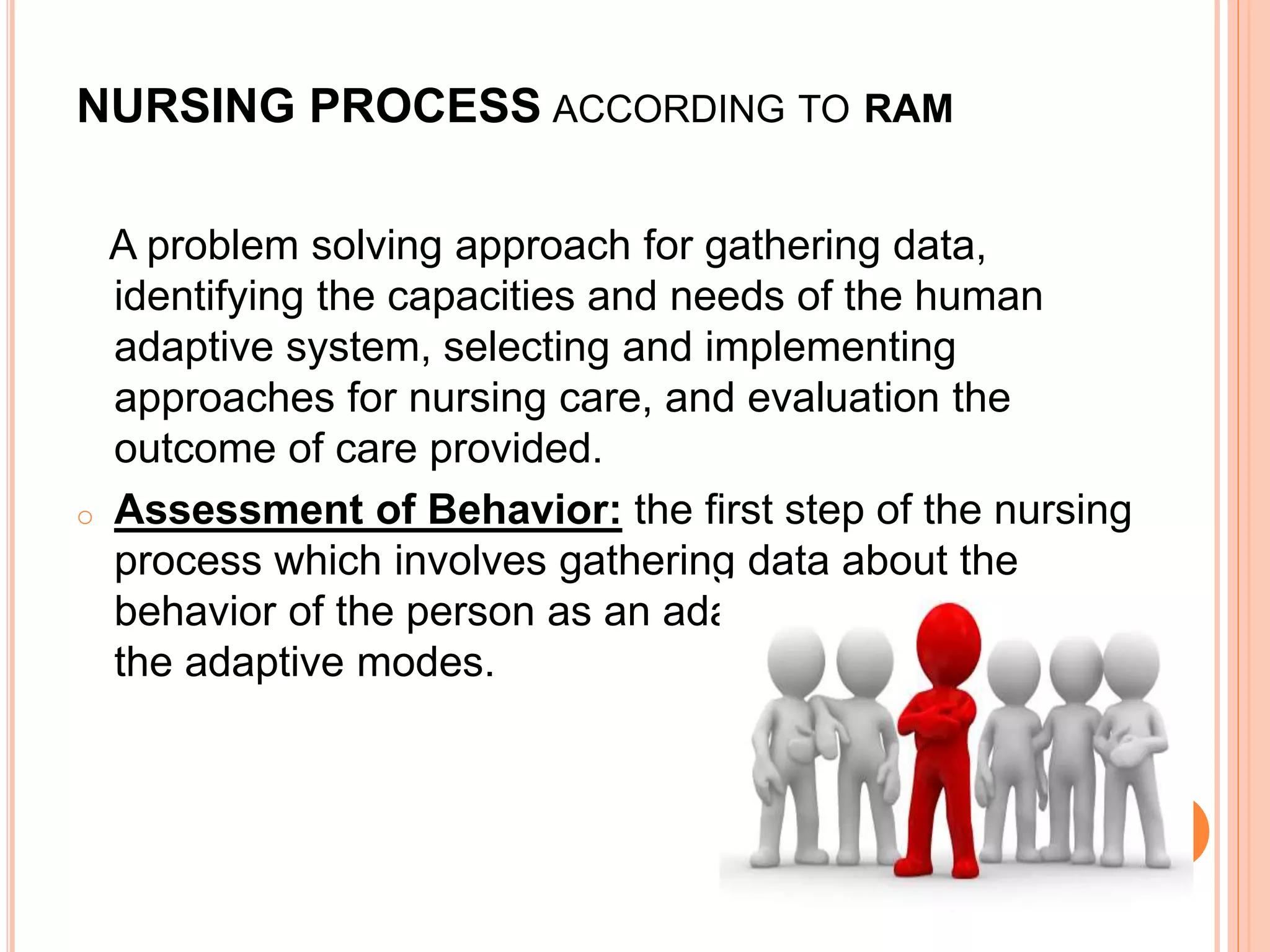
NURSING PROCESS ACCORDING TO RAM
A problem solving approach for gathering data,
identifying the capacities and needs of the human
adaptive system, selecting and implementing
approaches for nursing care, and evaluation the
outcome of care provided.
o Assessment of Behavior: the first step of the nursing
process which involves gathering data about the
behavior of the person as an adaptive system in each of
the adaptive modes.
CONTD….
 Assessment of Stimuli: the second step of the
nursing process which involves the identification of
internal and external stimuli that are influencing the
person’s adaptive behaviors.
Stimuli are classified as:
1) Focal- those most immediately confronting the
person
2) Contextual-all other stimuli present that are
affecting the situation
3) Residual- those stimuli whose effect on the
situation are unclear.
 Nursing Diagnosis: step three of the nursing process
which involves the formulation of statements that
interpret data about the adaptation status of the person,
including the behavior and most relevant stimuli
GOAL SETTING
 the fourth step of the nursing process which
involves the establishment of clear statements of
the behavioral outcomes for nursing care.
 Intervention: the fifth
step of the nursing
process which involves
the determination of
how best to assist the
person in attaining the
established goals
 Evaluation: the sixth
and final step of the
nursing process which
involves judging the
effectiveness of the
nursing intervention in
relation to the behavior
after the nursing
intervention in
comparison with the
goal established.
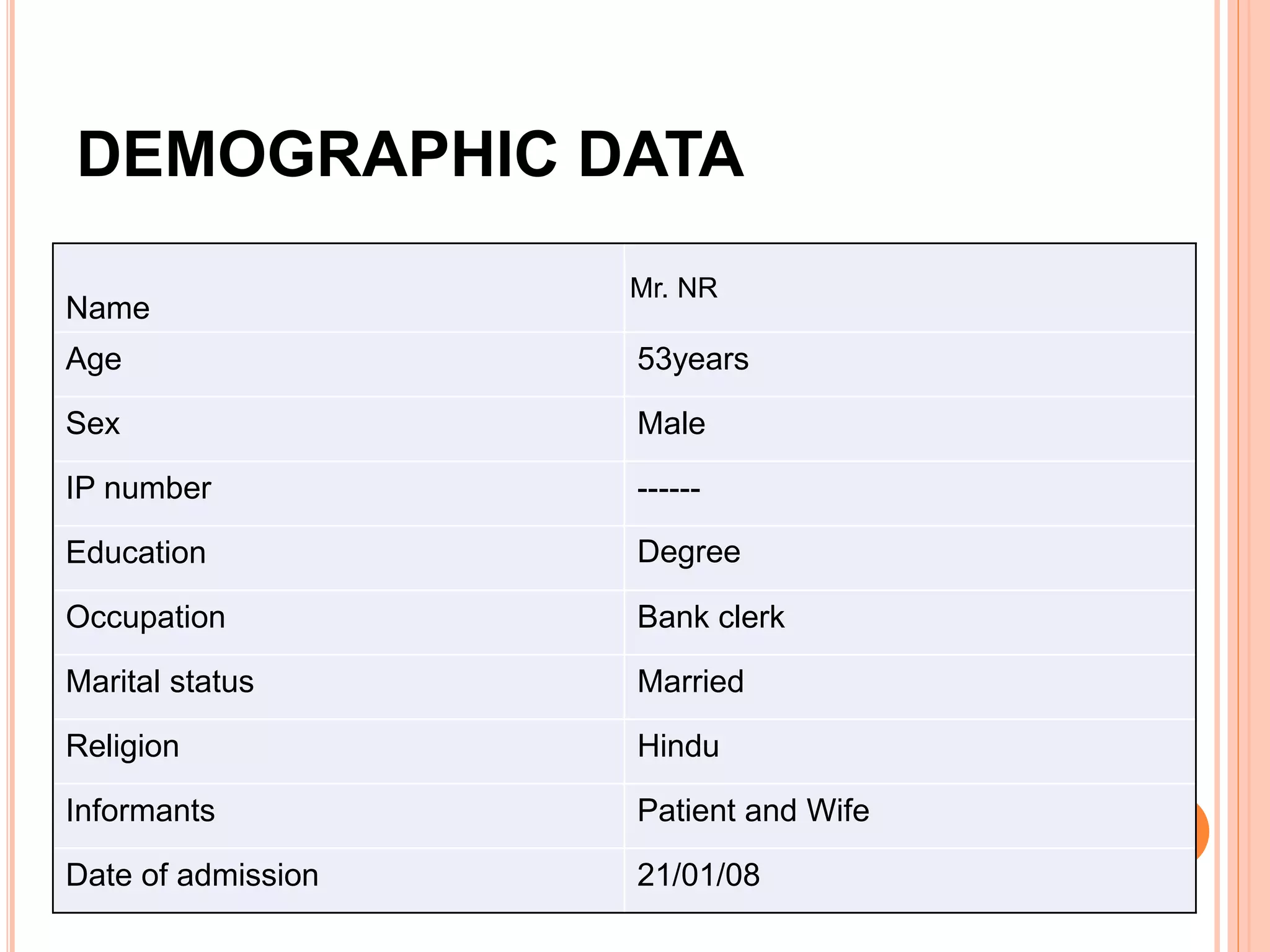
DEMOGRAPHIC DATA


Name
Mr. NR
Age 53years
Sex Male
IP number ------
Education Degree
Occupation Bank clerk
Marital status Married
Religion Hindu
Informants Patient and Wife
Date of admission 21/01/08
FIRST LEVEL ASSESSMENT
PHYSIOLOGIC-PHYSICAL MODE
Oxygenation:
 Stable process of ventilation and stable process of gas exchange.
RR= 18Bpm.
 Chest normal in shape. Chest expansion normal on either side.
 Apex beat felt on left 5th inter-costal space mid-clavicular line.
 Air entry equal bilaterally. No ronchi or crepitus.
 No abnormal heart sounds.
 S1& S2 heard.
 BP- Normotensive. .
CONTD….
Nutrition
 He is on diabetic diet (1500kcal). Non
vegetarian.
 Recently his Weight reduced markedly (10
kg/ 6 month).
 He has stable digestive process.
 He has complaints of anorexia and not
taking adequate food.
 No abdominal distension. No tenderness.
 Bowel sounds heard.
 Percussion revealed dullness over
hepatic area.
CONTD….
Elimination:
 No signs of infections, no
pain during micturation or
defecation.
 Normal bladder pattern.
Using urinal for micturation.
 Stool is hard and he
complaints of constipation.
CONTD…
Activity and rest:
 Taking adequate rest.
 Sleep pattern disturbed
at night due unfamiliar
surrounding.
 Not following any
peculiar relaxation
measure.
 Like movies and
reading. No regular
pattern of exercise.
CONTD….
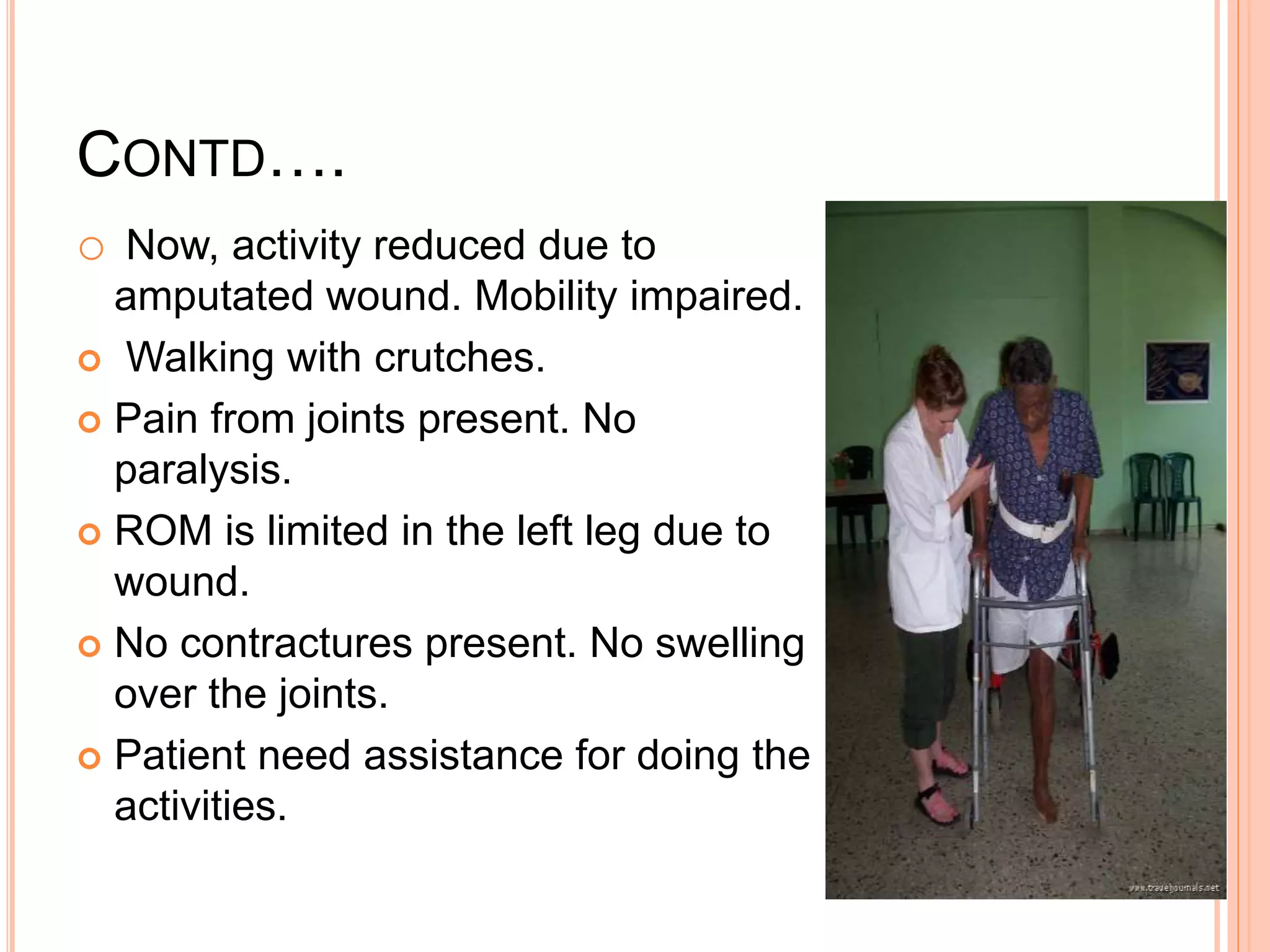
o Now, activity reduced due to
amputated wound. Mobility impaired.
 Walking with crutches.
 Pain from joints present. No
paralysis.
 ROM is limited in the left leg due to
wound.
 No contractures present. No swelling
over the joints.
 Patient need assistance for doing the
activities.
CONTD….
Protection:
 Left lower fore foot is amputated.
 Black discoloration present over the area.
 No redness, discharge or other signs of infection.
 Wound healing better now.
 Pain form knee and hip joint present while walking.
 Dorsalis pedis pulsation, not present over the left leg. Right
leg is normal in length and size.
 All peripheral pulses are present with normal rate, rhythm and
depth over right leg.
CONTD….
Senses:
 No pain sensation from the wound site. Relatively,
reduced touch and pain sensation in the lower
periphery; because of neuropathy. Using spectacle
for reading. Gustatory, olfaction, and auditory
senses are normal.
Fluids and electrolytes:
 Drinks approximately 2000ml of water. Stable
intake out put ratio. Serum electrolyte values are
with in normal limit. No signs of acidosis or
alkalosis. Blood glucose elevated.
CONTD….
Neurological function:
 He is conscious and oriented.
 He is anxious about the disease
conditon
 Touch and pain sensation
decreased in lower extrimity.
Endocrine function
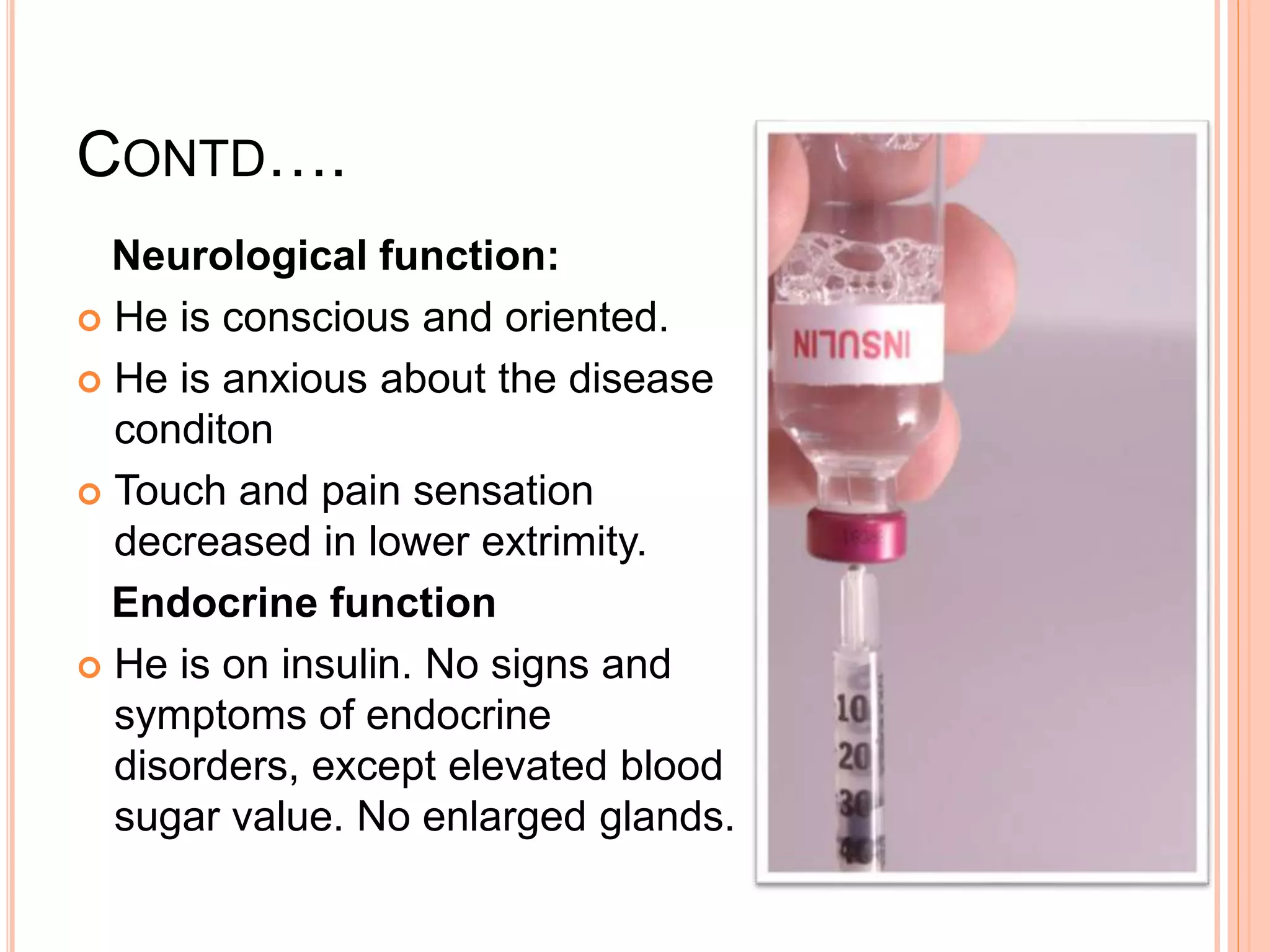
 He is on insulin. No signs and
symptoms of endocrine
disorders, except elevated blood
sugar value. No enlarged glands.
CONTD….
Personal self:
 Self esteem disturbed because of financial burden and
hospitalization. He believes in god and worshiping Hindu
culture.
ROLE PERFORMANCE MODE:
 He was the earning member in the family. His role shift
is not compensated. His son doesn’t have any work. His
role clarity is not achieved. INTERDEPENDENCE
MODE:
 He has good relationship with the neighbours. Good
interaction with the friends relatives. But he believes, no
one is capable of helping him at this moment. He
says ”all are under financial constrains”. He was
moderately active in local social activities
SECOND LEVEL ASSESSMENT
FOCAL STIMULUS:
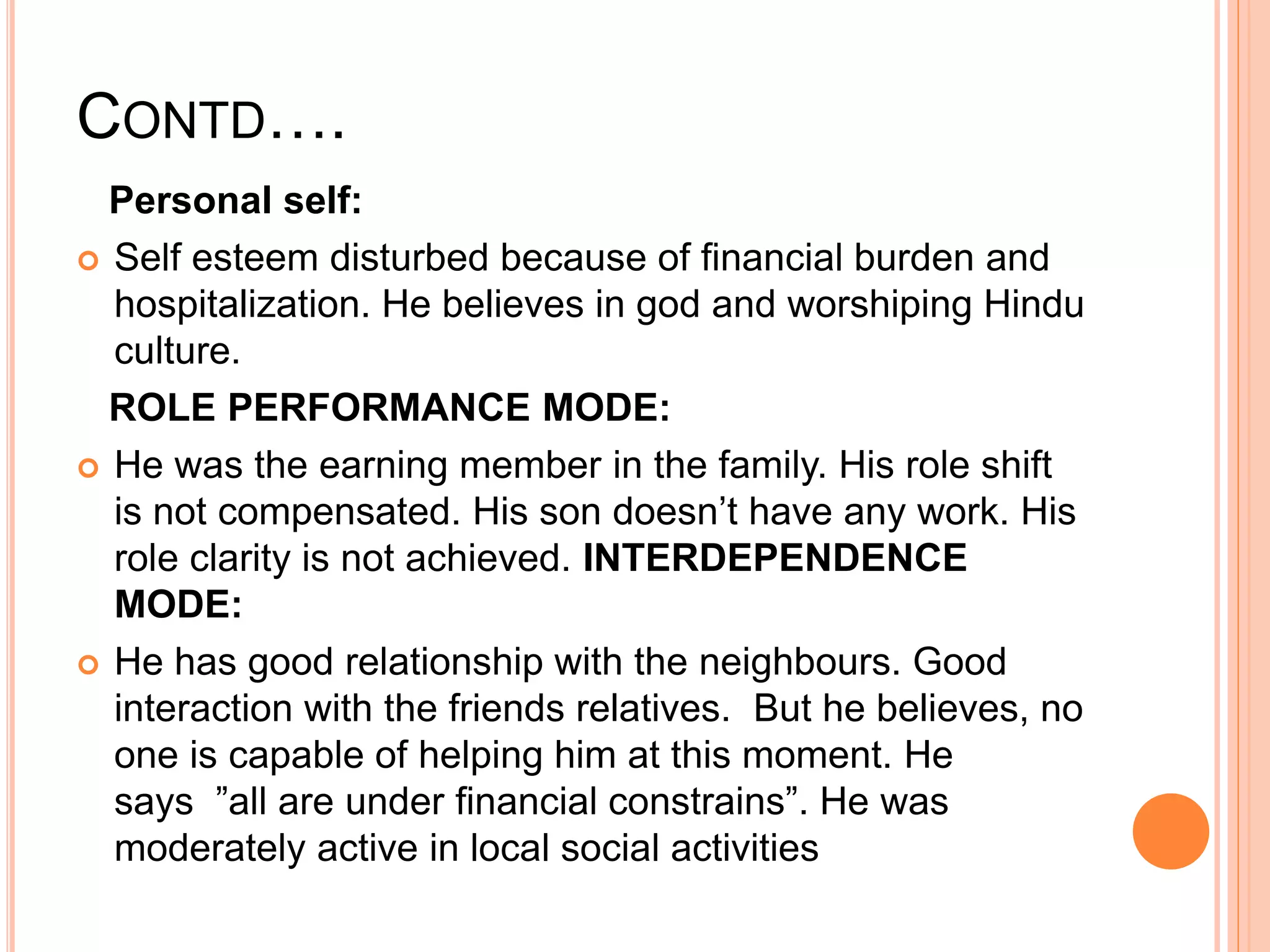
 Non-healing wound after amputation of great and
second toe of left leg- 4 week. A wound first found
on the junction between first and second toe-4
month back. The wound was non-healing and
gradually increased in size with pus collected over
the area.
 He first showed in a local hospital,referred to
medical college; During hospital stay great and
second toe amputated. But surgical wound turned to
non- healing with pus and black colour. So the
physician suggested for below knee amputation.
That made them to come to ---Hospital, ---. He
underwent a plastic surgery 3 week before.
CONTD….
CONTEXTUAL STIMULI:
 Known case DM for past 10 years. Was on oral
hypoglycemic agent for initial 2 years, but switched
to insulin and using it for 8 years now. Not wearing
foot wear in house and premises.
RESIDUAL STIMULI:
 He had TB attack 10 year back, and took complete
course of treatment. Previously, he admitted in ---
Hospital for leg pain about 4 year back. . Mother’s
brother had DM. Mother had history of PTB. He is a
graduate in humanities, no special knowledge on
health matters.
CONCLUSION
 Mr.NR who was suffering with diabetes
mellitus for past 10 years. Diabetic foot
ulcer and recent amputation made his life
more stressful. Nursing care of this patient
based on Roy's adaptation model provided
had a dramatic change in his condition. He
studied how to use crutches and mobilized
at least twice in a day. Patient’s anxiety
reduced to a great extends by proper
explanation and reassurance. He gained
good knowledge on various aspect of
diabetic foot ulcer for the future self care
activities.
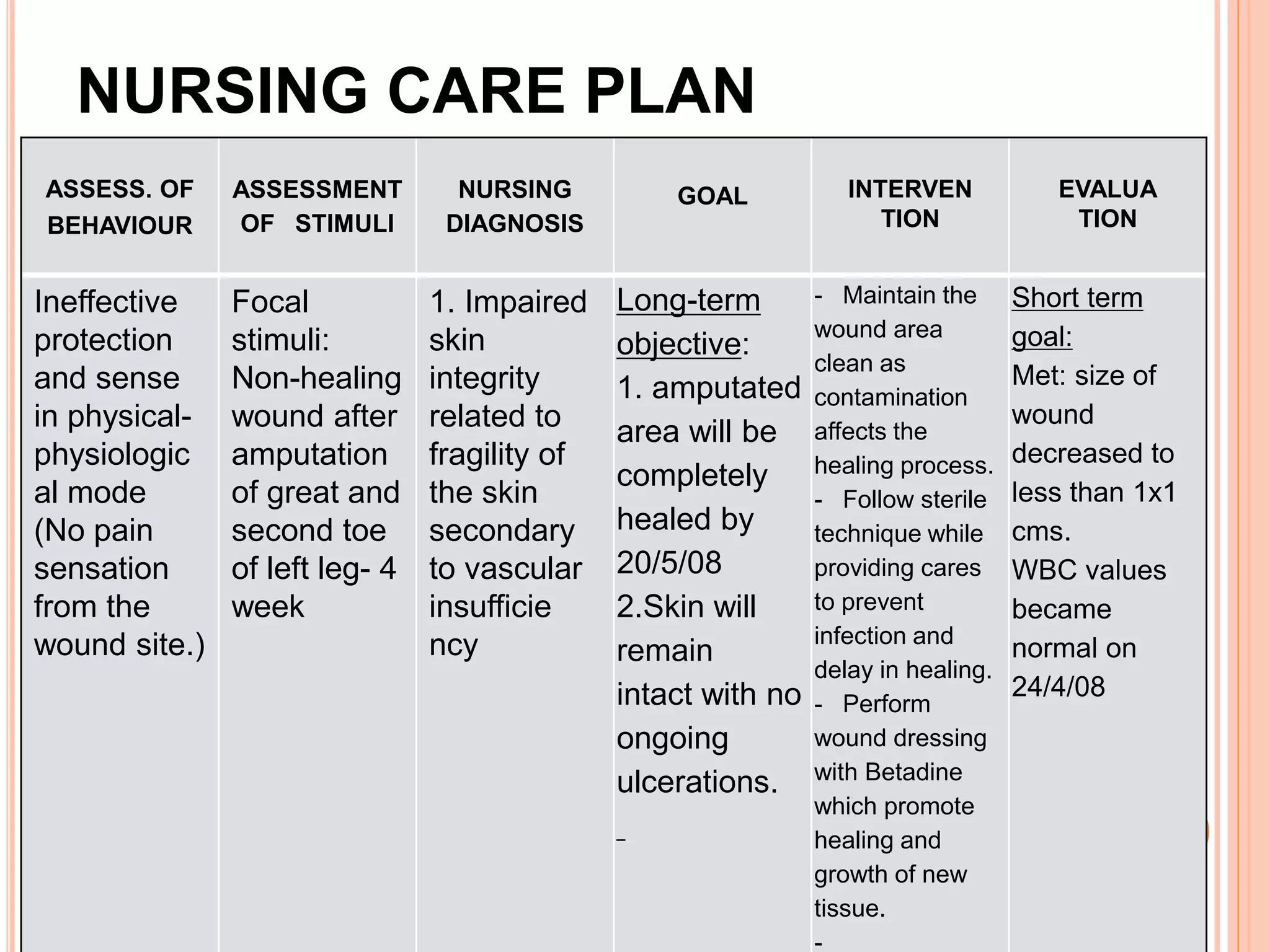
NURSING CARE PLAN
ASSESS. OF
BEHAVIOUR
ASSESSMENT
OF STIMULI
NURSING
DIAGNOSIS
GOAL INTERVEN
TION
EVALUA
TION
Ineffective
protection
and sense
in physical-
physiologic
al mode
(No pain
sensation
from the
wound site.)
Focal
stimuli:
Non-healing
wound after
amputation
of great and
second toe
of left leg- 4
week
1. Impaired
skin
integrity
related to
fragility of
the skin
secondary
to vascular
insufficie
ncy
Long-term
objective:
1. amputated
area will be
completely
healed by
20/5/08
2.Skin will
remain
intact with no
ongoing
ulcerations.
- Maintain the
wound area
clean as
contamination
affects the
healing process.
- Follow sterile
technique while
providing cares
to prevent
infection and
delay in healing.
- Perform
wound dressing
with Betadine
which promote
healing and
growth of new
tissue.
-
Short term
goal:
Met: size of
wound
decreased to
less than 1x1
cms.
WBC values
became
normal on
24/4/08
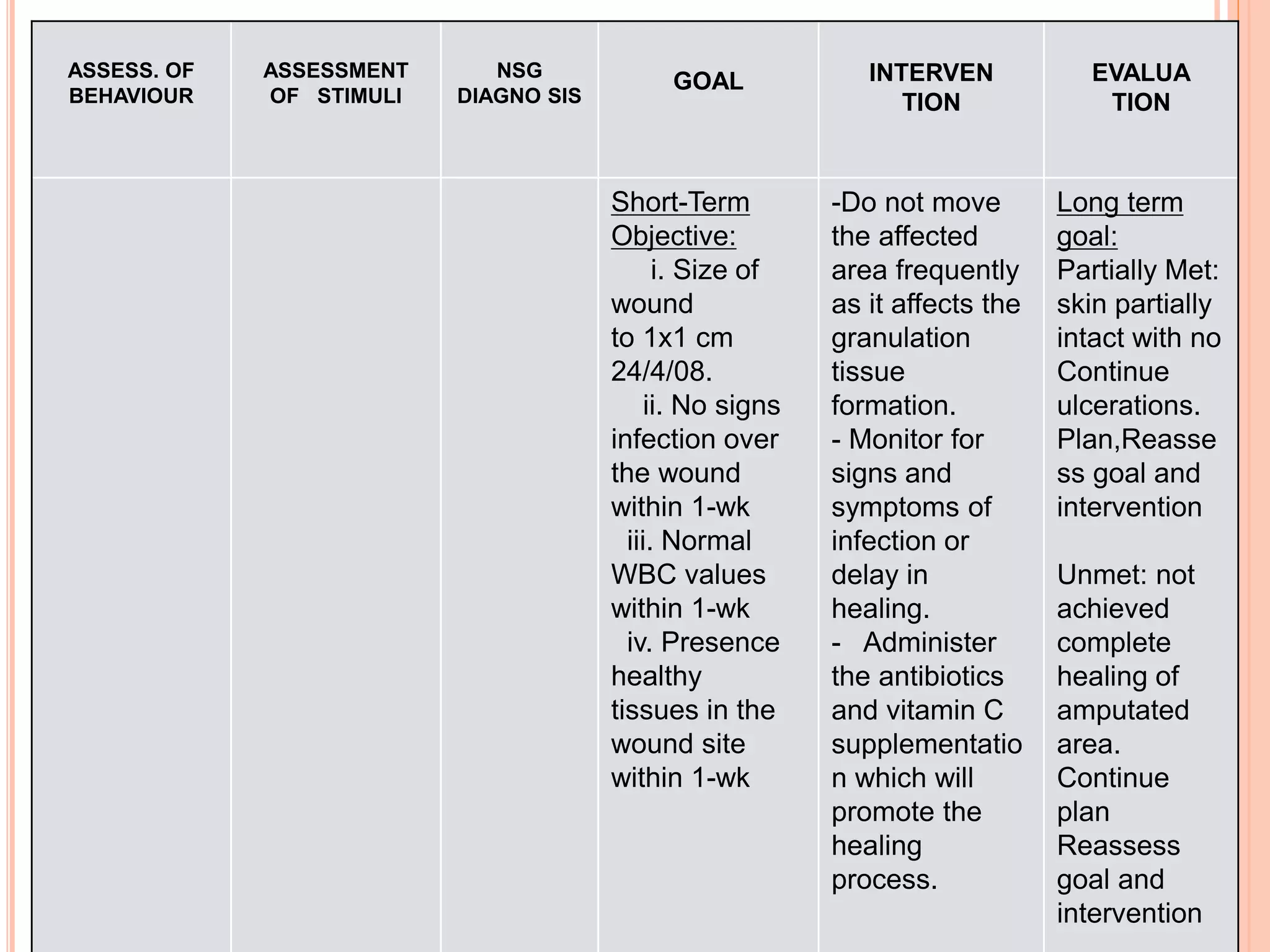
ASSESS. OF
BEHAVIOUR
ASSESSMENT
OF STIMULI
NSG
DIAGNO SIS
GOAL INTERVEN
TION
EVALUA
TION
Short-Term
Objective:
i. Size of
wound
to 1x1 cm
24/4/08.
ii. No signs
infection over
the wound
within 1-wk
iii. Normal
WBC values
within 1-wk
iv. Presence
healthy
tissues in the
wound site
within 1-wk
-Do not move
the affected
area frequently
as it affects the
granulation
tissue
formation.
- Monitor for
signs and
symptoms of
infection or
delay in
healing.
- Administer
the antibiotics
and vitamin C
supplementatio
n which will
promote the
healing
process.
Long term
goal:
Partially Met:
skin partially
intact with no
Continue
ulcerations.
Plan,Reasse
ss goal and
intervention
Unmet: not
achieved
complete
healing of
amputated
area.
Continue
plan
Reassess
goal and
intervention
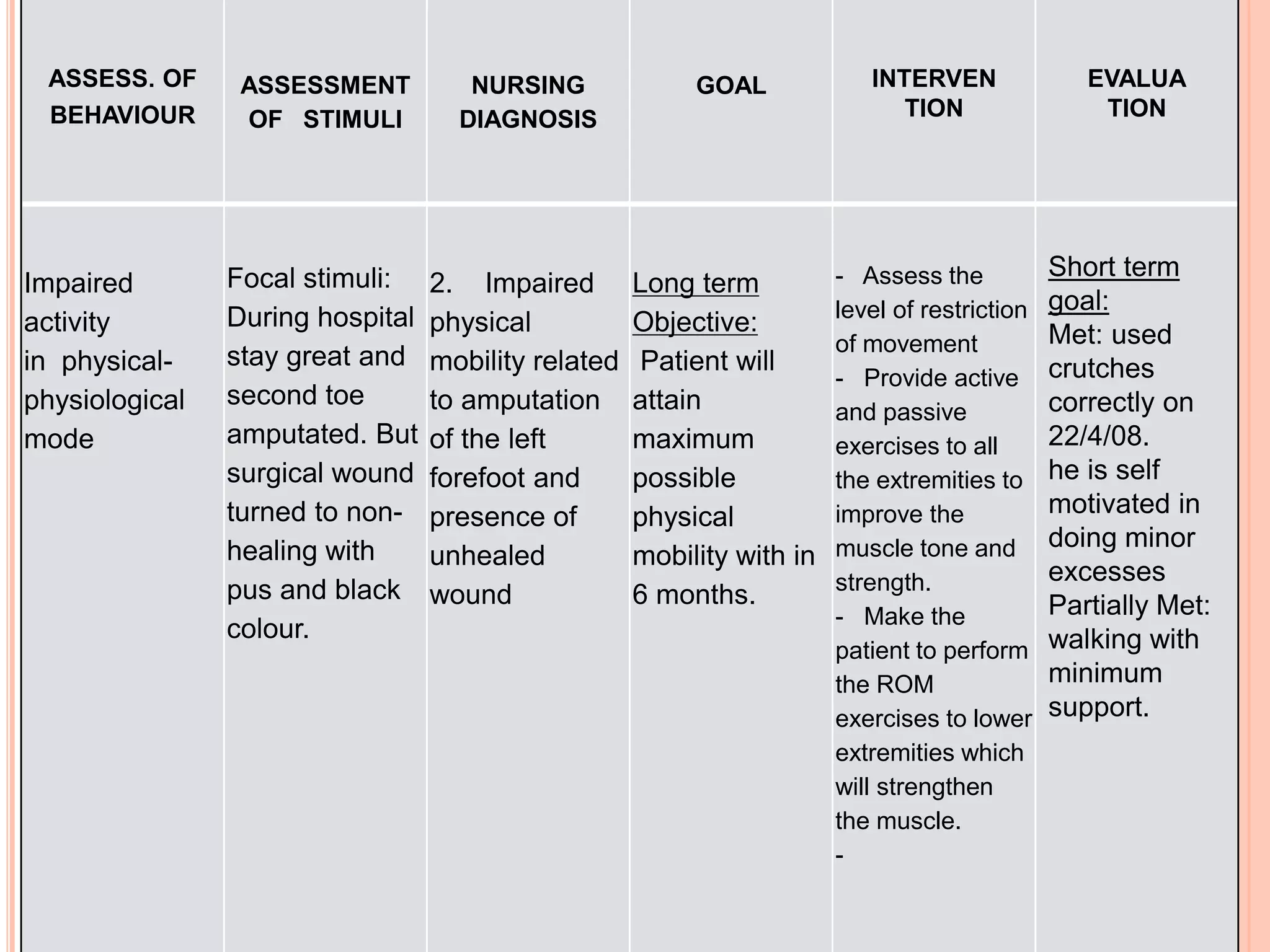
ASSESS. OF
BEHAVIOUR
ASSESSMENT
OF STIMULI
NURSING
DIAGNOSIS
GOAL INTERVEN
TION
EVALUA
TION
Impaired
activity
in physical-
physiological
mode
Focal stimuli:
During hospital
stay great and
second toe
amputated. But
surgical wound
turned to non-
healing with
pus and black
colour.
2. Impaired
physical
mobility related
to amputation
of the left
forefoot and
presence of
unhealed
wound
Long term
Objective:
Patient will
attain
maximum
possible
physical
mobility with in
6 months.
- Assess the
level of restriction
of movement
- Provide active
and passive
exercises to all
the extremities to
improve the
muscle tone and
strength.
- Make the
patient to perform
the ROM
exercises to lower
extremities which
will strengthen
the muscle.
-
Short term
goal:
Met: used
crutches
correctly on
22/4/08.
he is self
motivated in
doing minor
excesses
Partially Met:
walking with
minimum
support.
ASSESS. OF
BEHAVIOUR
ASSESSMENT
OF STIMULI
NURSING
DIAGNOSIS GOAL INTERVEN
TION
EVALUA
TION
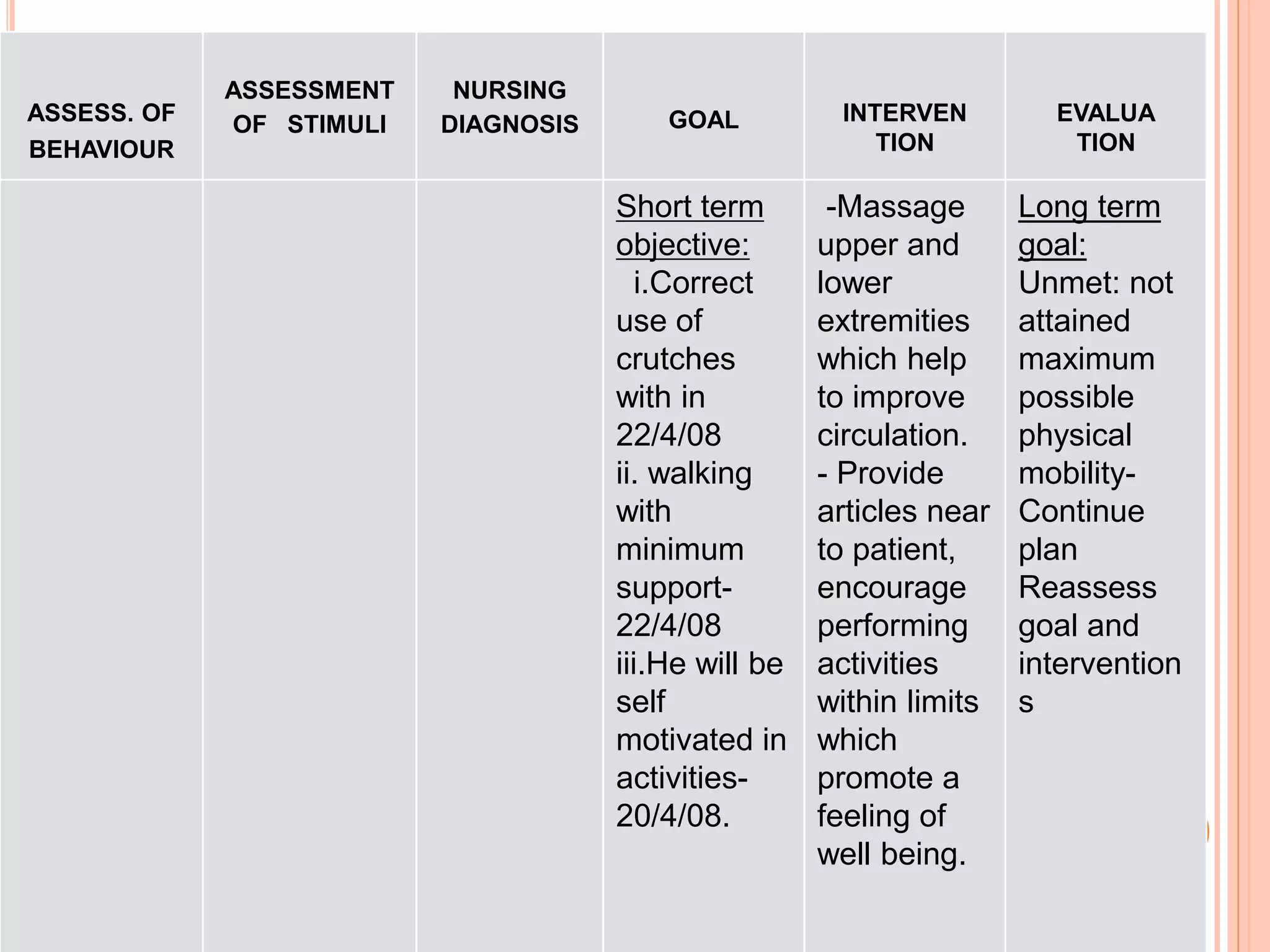
Short term
objective:
i.Correct
use of
crutches
with in
22/4/08
ii. walking
with
minimum
support-
22/4/08
iii.He will be
self
motivated in
activities-
20/4/08.
-Massage
upper and
lower
extremities
which help
to improve
circulation.
- Provide
articles near
to patient,
encourage
performing
activities
within limits
which
promote a
feeling of
well being.
Long term
goal:
Unmet: not
attained
maximum
possible
physical
mobility-
Continue
plan
Reassess
goal and
intervention
s
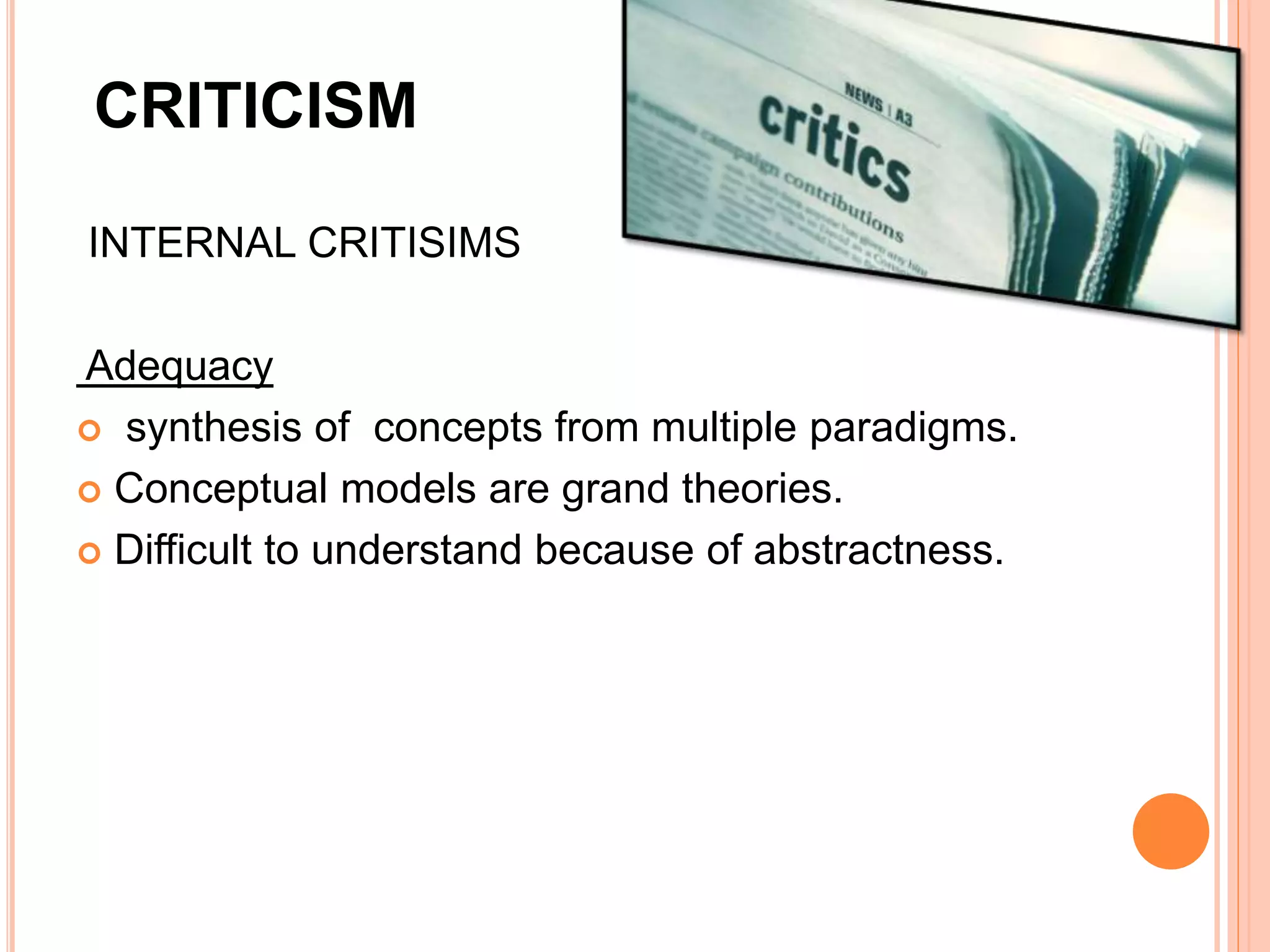
CRITICISM
INTERNAL CRITISIMS
Adequacy
 synthesis of concepts from multiple paradigms.
 Conceptual models are grand theories.
 Difficult to understand because of abstractness.
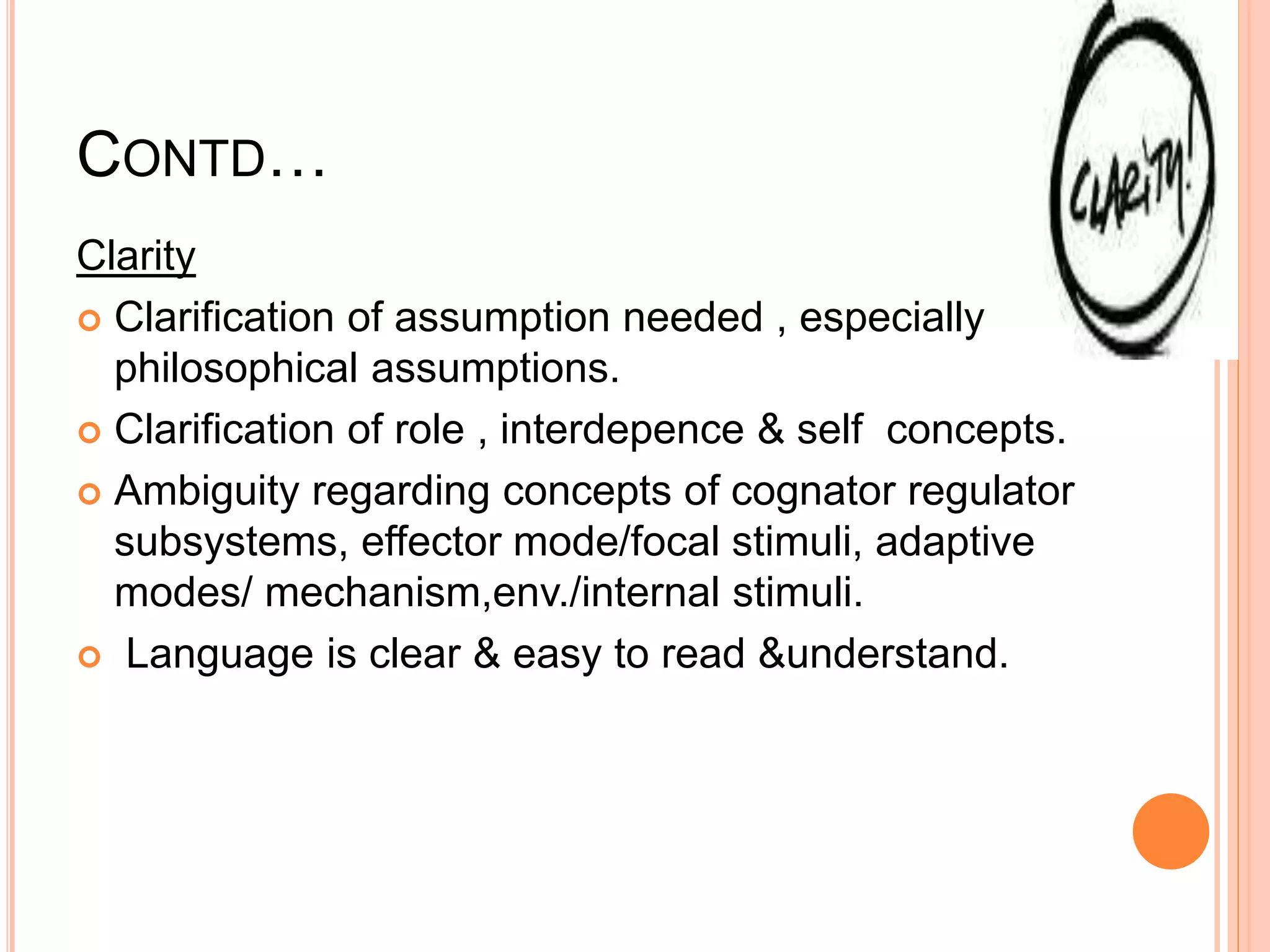
CONTD…
Clarity
 Clarification of assumption needed , especially
philosophical assumptions.
 Clarification of role , interdepence & self concepts.
 Ambiguity regarding concepts of cognator regulator
subsystems, effector mode/focal stimuli, adaptive
modes/ mechanism,env./internal stimuli.
 Language is clear & easy to read &understand.
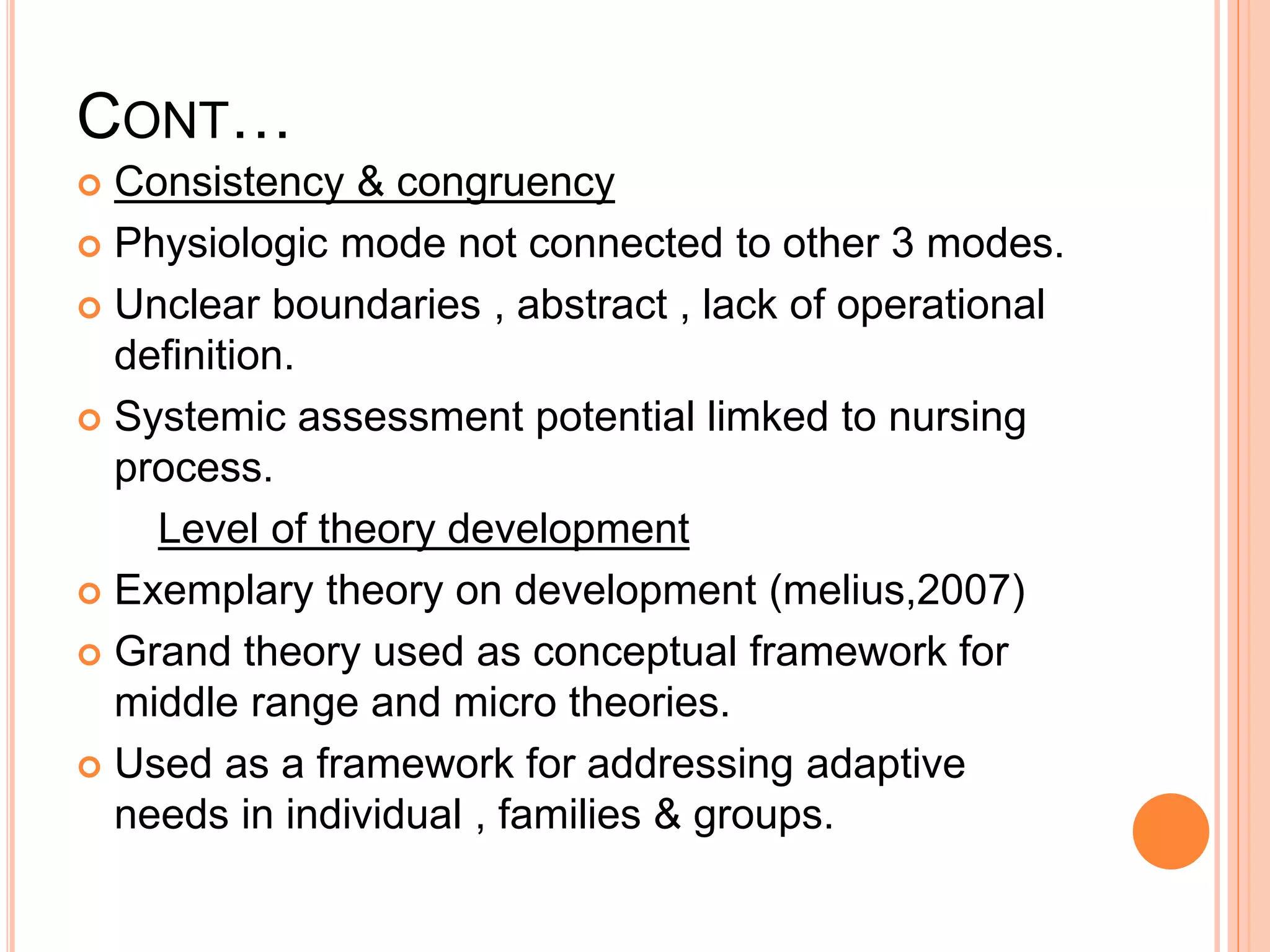
CONT…
 Consistency & congruency
 Physiologic mode not connected to other 3 modes.
 Unclear boundaries , abstract , lack of operational
definition.
 Systemic assessment potential limked to nursing
process.
Level of theory development
 Exemplary theory on development (melius,2007)
 Grand theory used as conceptual framework for
middle range and micro theories.
 Used as a framework for addressing adaptive
needs in individual , families & groups.
EXTERNAL CRITICISM
Complexity/ simplicity /discrimination /pragmatism.
 Simplicity is based on the language & terms.
 Grand theories are inherently complex.
 Complexity doesn’t bend into operationalizability for
research .
 Studies based on the model moved from face
validity to construct validity studies and relational
research studies.
CONTD….
Reality convergence
 Nutrsing interfaces between the individual & health
care system providing holistic care.
 Nurses need to continue to learn and adapt to avoid
outsourcing.
 Roy belives nurses can avoid extinction of the
profession by not allowing themselves to nurse
solely in the physiologi mode.
CONTD….
Scope
 Grand theory RAM
 Middle range theory evolved RAM:-
 Caregivers’s effectiveness & well being.
 Coping with pain & chronicity.
 Coping with diabetes.
 Gentle touch in preterm infants.
CONTD…
Significance
 1987 – over 100,000 nurses have
graduated from program based on
RAM
 Used by global scholars
 Models used in research , curriculum
development, social issues , chronic
illness & development of research
instruments.
CONTD….
Utility
 Research tool development
 Describes responses to health illness.
 Evaluates intervention
 Measures perception of adaptation levels.
 Measures perception of powerlessness & decision
making.
 Measures health care outcomes of cancer patients.
 Regaining functional abilities after delivery.
 Used to identify adaptive and maladaptive behavior
to stimuli.
 Lack of motivation to quit smoking.
 Assessing & planning care of surgical patients.
 Care of geriatric patients.
CONTD….
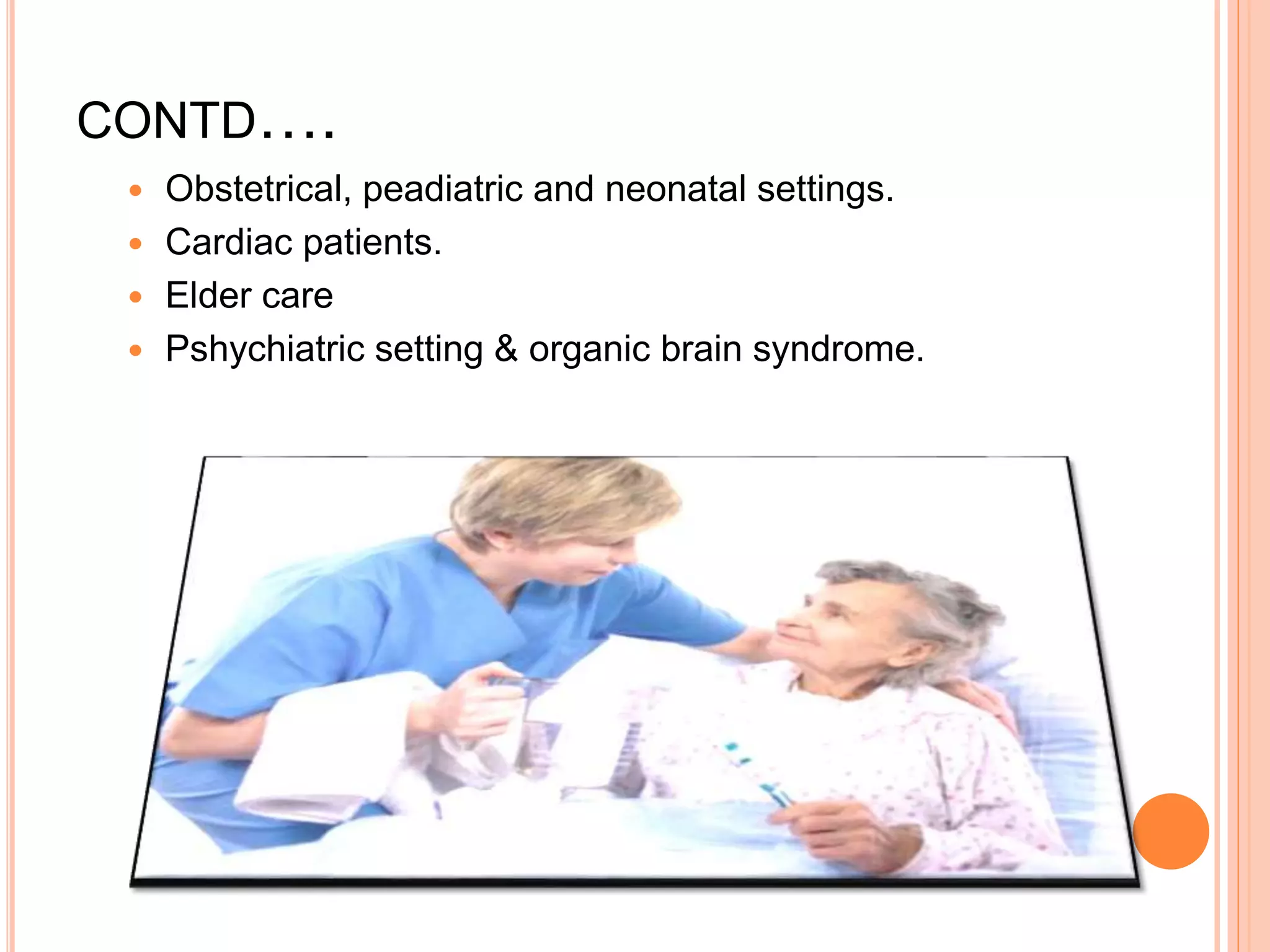
 Obstetrical, peadiatric and neonatal settings.
 Cardiac patients.
 Elder care
 Pshychiatric setting & organic brain syndrome.
9. APPLICATION OF R.A.M IN NURSING
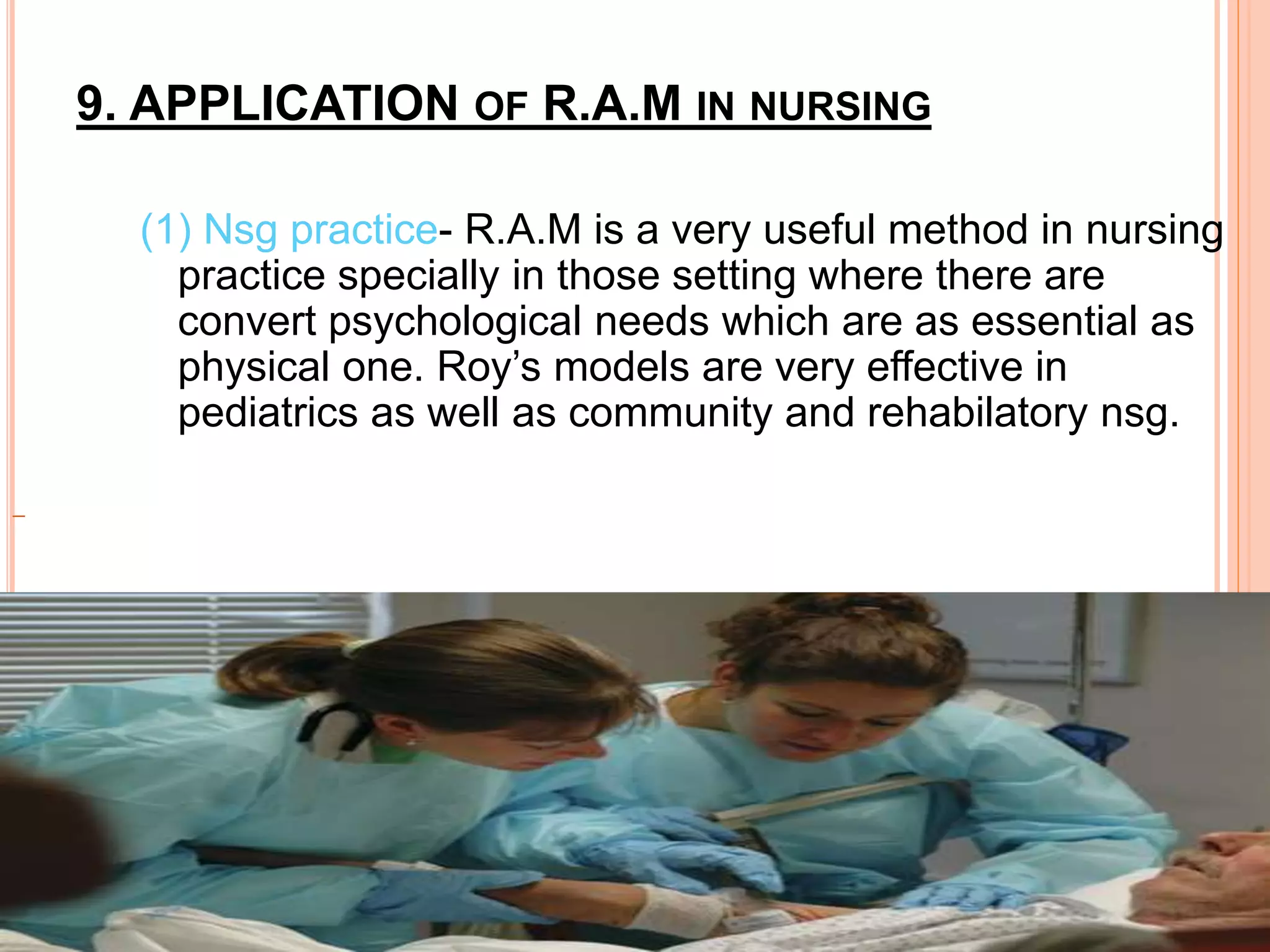
(1) Nsg practice- R.A.M is a very useful method in nursing
practice specially in those setting where there are
convert psychological needs which are as essential as
physical one. Roy’s models are very effective in
pediatrics as well as community and rehabilatory nsg.
CONTD….
(2)Nursing Research-
R.A.M provide a conceptual model for
nursing process and this has been a
basis for number of research being
done.for e.g measuring functional
status after child birth,functional status
during pregnancy.
If research is to affect practitioners’
behavior, it must be directed at testing
and retesting conceptual models for
nursing practice. Roy has stated that
theory development and the testing of
developed theories are nursing’s
highest priorities. The model must be
able to regenerate testable hypotheses
for it to be researchable.
CONTD….
(3)Education-
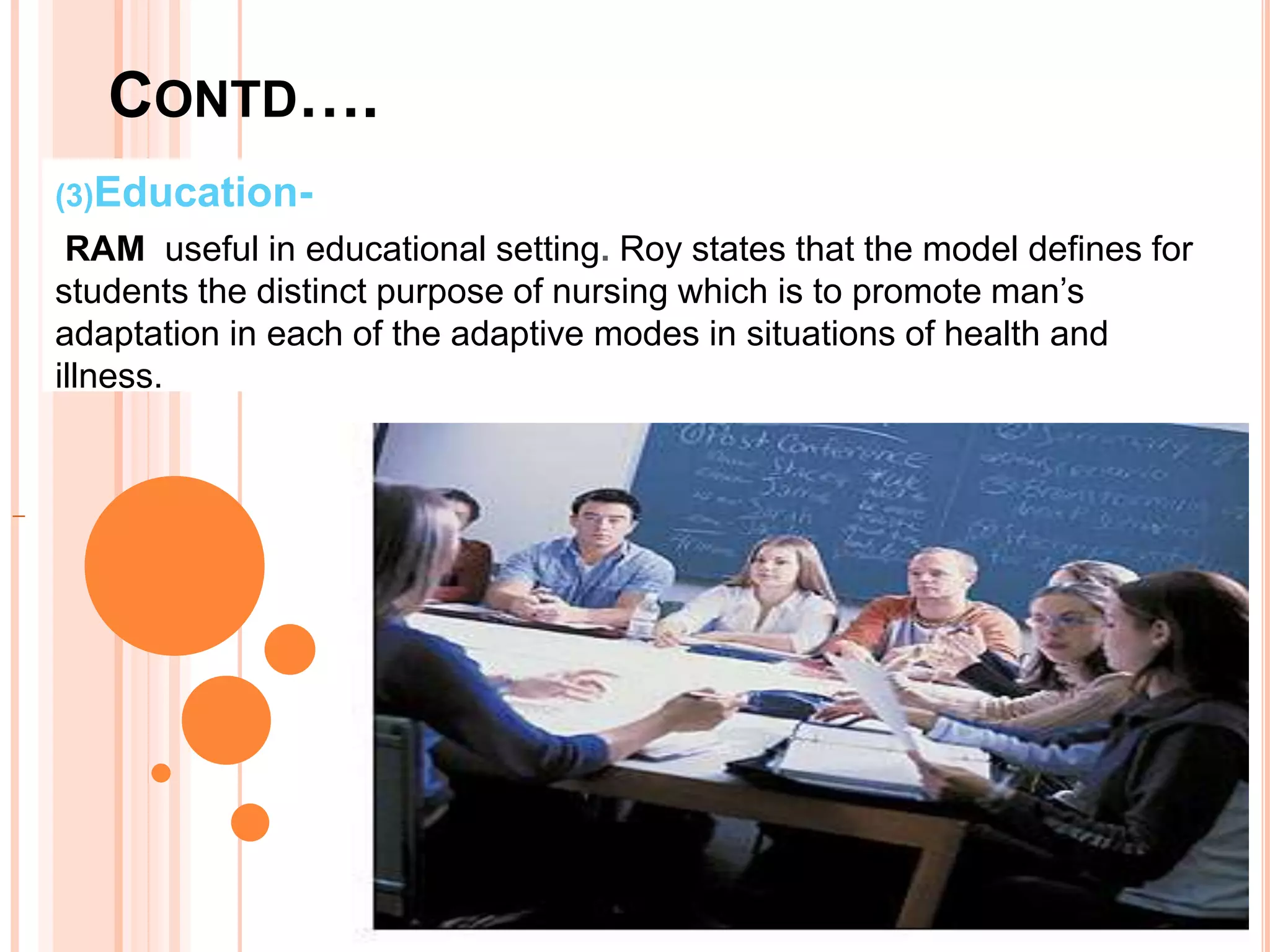
RAM useful in educational setting. Roy states that the model defines for
students the distinct purpose of nursing which is to promote man’s
adaptation in each of the adaptive modes in situations of health and
illness.
THANKS

Callista Roy's Theory of Adaptation.ppt

  • 1.
    Sister Callista Roy’s AdaptationModel Presented By: Ms. Mamta Bisht (Assistant Professor)
  • 2.
    INTRODUCTION • Nursing isestablishing itself as a scientific discipline. • Its thrust toward scientifically sound social usefulness including the development of conceptual models. • The nursing models provide the basis for selecting knowledge to be transmitted in nursing education.  It is the framework for nursing practice and the direction for nursing research.  Sister Callista Roy’s adaptation theory (Roy and Obloy 1979,Roy 1980,1984,1989) views the client as an adaptive system.
  • 3.
    BIOGRAPHICAL SKETCH OFTHE NURSE THEORIST  Sister callista Roy was born on oct, 14,1939.  She did her bachelors of arts in nursing from mount st. Mary’s college, losAngeles in 1963 and masters of science in nursing from ,University of California,Los Angeles1966.
  • 4.
    CONTD….  She alsoreceived her masters of arts(M.A) in sociology from the same university in 1975 and Ph.D in sociology .  Roy was an associate professor and chairperson of the department of nursing at mount Saint Mary’s college until 1982.
  • 5.
    CONTD….  From 1983to 1985; she was Post Doctoral fellow at Robert Wood Johnson at University of California, as a clinical nurse scholar in neuroscience.  In 1988 Roy began the newly created position of graduate faculty at, Boston school of nursing.
  • 6.
    CONTD….  According toRoy’s model, the goal of nursing is to help the person’s adaptive system.  According to Roy’s model, the goal of nursing is to help the person adapt to change in physiological needs, self-concepts, role function and interdependent relations during health and illness .
  • 7.
    CONTD…. All individual mustadapt to the following demands: 1. Meeting basic physiological needs. 2. Developing a positive self- concept. 3. Performing social roles. 4. Achieving a balance between dependence and interdependence.
  • 8.
    CONTD…. It is roleof nurse:  To find out demands which are causing problems for a client.  To assess how well the client is adapting to them. Nursing care is then directed at helping the client to adopt.
  • 9.
    ORIGIN OF THEMODEL:  While a student of M.sc. nursing, at the university of California sister C. Roy was challenged in a seminar by another nurse theorist Dorothy E.JOHNSON to develop a theory of nursing , subsequently in 1970 the ‘ROY ADAPTATION MODEL’ was born as a derivation of Bertalanfty (1968) general system theory and Harry Helson’s Adaptation level theory (1964).
  • 10.
  • 11.
    CONTD…. 1. The personis a bio-psycho-social being includes biologic components (Anatomy and Physiology), psychological and social components. 2.The person is in constant interaction with a changing environment (interaction with physical, social & psychological environment changes)
  • 12.
    CONTD… 3.To cope witha changing world, the person uses both innate and acquired mechanisms which are biologic,psychological and social in origin. 4.Health and illness are an inevitable dimension of the person’s life. 5.To respond positively to environmental changes, the person must adapt (changing environment demands positive response)
  • 13.
    CONTD…. 6.The person’s adaptationis a function of the stimulus, he is exposed to and his adaptation level, which is determined by the combined effect of three classes of stimuli: *focal stimuli *contextual stimuli *Residual stimuli
  • 14.
    CONTD…. *Focal stimuli orstimuli demanding prompt attention. *Contextual stimuli or stimuli present in a surrounding and situation. *Residual stimuli such as belief, attitude and habits, which have an indeterminate on the present situation.
  • 15.
    CONTD…. 7. The person’sadaptation level is such that it comprises a zone indicating the range of stimulation that will lead to a positive response. (if the stimulus is within the zone the person responds positively, however if the stimulus outside the zone ,the person cannot make a positive response)
  • 16.
    CONTD…. 8. The personis conceptualized as having four modes of adaptation:  psychological needs  self-concept,  role function, and  interdependence relations.
  • 17.
    Four philosophical assumptionsbased on the humanist principles are as follows. a. The individual shares in creative power. b. Behaves purposefully, not in sequence of cause and effect. c. Possesses intrinsic holism and d. Strives to maintain integrity & to realize the need for relationship.
  • 18.
    CONTD…. VERTIVITY The term vertivityderived from the Latin ‘veritas’ meaning the trust, was coined by Roy. It’s a principle of human nature that affirms a “common purposefulness of human existence”.
  • 19.
    The four principlesare :  The individual is viewed in the context of the purposefulness of human existence.  Unity of purpose of human kind  Activity & creativity for the common goods  Value of meaning of life.
  • 20.
    5. CONCEPTS OFMODEL  Roy’s model is a system model that focuses on outcomes. the major features of the system models are the: -System and its environment  A system is a set of parts connects to function as a whole for some purposes and are interdependence of its parts.
  • 21.
    CONTD….  Keys elementsin the Roy adaptation model are- 1. The person who is recipient of nursing care 2. The goal of nursing. 3. The concept of health 4. The direction of nursing activities.
  • 22.
    CONTD…  Person: Royuses person in her model as a concept to identify the recipient of nursing care. critical to the model is the description of recipient of nsg care as holistic adaptive systems.  Persons as living systems are in constant interactions with their environments between the system and the environment occurs on exchange of information, matter and energy.
  • 23.
    Goal-the goal ofnsg. as the promotion of adaptive responses in relation to the four adaptive modes (physiological, self concept, role function and interdependence)and contribute to health.  Nsg activities-The nursing activities are delineated by the model as those that promotes adaptive responses in situation of health and illness. The nsg activities are identified as actions taken by nurses to manipulate the focal, contextual residual stimuli impringing on person.
  • 24.
    CONTD….  The nsgprocess acc. to Roy’s model consists of six steps- (1)Acceptance of behavior (2)Acceptance of stimuli (3)Nsg diagnosis (4)Goal setting (5)Intervention (6)Evaluation
  • 25.
    Health-health has beendefined as a “state and process of being and becoming an integrate and whole person’’ Health is a process where by individuals are striving to achieve their maximum potentials. Environment-stimuli from within the person and stimuli from around the person represents the element of environment acc. to Roy.  Environment is specifically defined by Roy as “all conditions, circumstances influences surrounding and affecting the development and behavior of persons and groups.
  • 26.
    6. THE PERSONAS AN ADAPTIVE SYSTEM In addition to the concept of person,goal of nsg,health and environment and nsg activities in the model ,the theory of person as an adaptive system employs additional concepts.
  • 27.
    The person asan adaptive system
  • 28.
    CONTD…. (1)Input-input coming fromexternal environment as well as internally from the person as a stimuli(a stimulus is a unit of information,matter,or energy from the environment or a person who elicits a response).The stimuli immediately confronting the person are focal stimuli greatest degree of change impact on person.
  • 29.
    CONTD…  Contextual stimuli-observable,measureable and reported by the person.  Residual stimuli-those make up characteristics of the person that are present and relevant to situation.
  • 30.
    CONTD……. Example: Mr. smithexperiencing the chest pain, the stimulus immediately confronting Mr. smith,the focal stimulus ,is the deficit of oxygen supply to his heart muscles.The contextual stimuli include the 90 degree of temperature ,the sensation of pain ,Mr. smith’s age ,weight,blood sugar level,and degree of coronary artery patency.The residual stimuli include his history of cigarette smoking and work relate stress.
  • 31.
    Adaptation level isa constantly changing point that represents the person’s ability to cope with the changing environment in a positive manner.  Adaptation level sets up a zone or a range within which stimulation will lead to adaptive responses.  Stimuli falling outside their adaptive zone lead to ineffective responses.  Suicide due to inability to cope up with the child is an extreme example of an ineffective response.
  • 32.
    Coping mechanisms  somecoping mechanisms are inherited or genetic such as white blood defense system against bacteria seeking to invade the body.  some are learned as use of antiseptics
  • 33.
    CONTD….  Mechanisms areof 2 types: (1)Regulator is used primarily as a mechanism to cope with physiological stimuli. (2)Cognator used mainly as mechanism to cope with psychological stimuli dealing primarily in area of cognition, judgment and emotion. -Regulator and cognator mechanisms are linked through the process of perception.
  • 34.
    CONTD….  It isimportant to recognize that it is the manifestation of the coping mechanism that can be observed and measured within the adaptive modes. Thus adaptive modes are often referred as effectors.
  • 35.
    CONTD…. Effectors: Roy hasidentified four adaptive modes;  Physiological  self concept  role function  interdependence.
  • 36.
    CONTD…. Adaptive responses output- Thebehaviors that contribute to the general goals of the person(i.e survival,growth,reproduction and mastery)are considered adaptive response.  Behaviors not contributing to general goals are considered ineffective responses.  Adaptive responses being about a state of adaptation.
  • 37.
    7. THEORY OFADAPTIVE MODES: The theory of adaptive modes was developed in 1981, consist of four parts:  physiological,  self concept,  role function &  interdependence.
  • 38.
    CONTD… Each adaptive moderepresents a grouping of behaviors that promote the individuals movements towards the general goals (survival, growth, reproduction, mastery).
  • 39.
    CONTD….. (1)PHYSIOLOGICAL MODE Physiological wholenessis achieved by adapting to changes in physiological needs.  The regulator coping mechanism is primarily responsible for attaining and maintaining this integrity.  other complex process that influences regulator activities are the senses, fluids and electrolytes, neurological function & endocrine function.
  • 40.
    Five primary needshave been identified as necessary for physiological integrity:  oxygen,  nutrition,  activity rest,  protection,  elimination
  • 41.
    CONTD… (2)SELF CONCEPT MODE Selfconcept is one of the 3 psychosocial modes, the basic human need within modes in psychic integrity,which means people need to know who they are so that can exist with a sense of unity.
  • 42.
    CONTD…..  Physical self:is an appraisal of one’s physical, attributes, appearance, functioning, sensation(feeling about self) sexually and wellness illness status.  Personal self: is an appraisal of one’s own characteristics, expectations, values & worth. Personal self has been divided into the moral ethical spiritual self ,self consistency & self ideal, self expectancy e.g. I believe God will help me through this surgery.
  • 43.
    CONTD….. (3)ROLE FUNCTION MODE: Thebasic need in the role function adaptive model is for social integrity. This means that people need to know who they are in relation to others so that they can act. All people have role in society. With each role there are expected behavior .Role have been divided into primary, secondary and tertiary.
  • 44.
    CONTD…. (4)INTERDEPENDENCE MODE Interdependence isa social adaptive mode,needs affection adequacy or the feeling of security in nurturing relationships.  Interdependence means the close relationship of people that involves willingness & ability to love, respect & value others and to accept & responds to love, respect and value given by others.  Loneliness as a common adaptation problem resulting from a disruption in the modes.
  • 45.
    Those currently identified needsare listed below: (a) Basic physiological needs-  Exercise and rest  Nutrition  Elimination  Fluid and electrolyte  Oxygen  Circulations  Regulations
  • 46.
    CONTD…. (b)self concepts:  Physicalself  Personal self  Interpersonal self (c) role mastery: -Role failure -Role conflict
  • 47.
    CONTD…. (d)interdependence:- Alteration,rejection,aggression,rivalry, hostility,loneliness,dominance,exhibition. -The aspects ofcare which are examined in view of the model are:  The nature of the people receiving nursing care.  Cause of problems likely to require nsg intervention.  Nature of assessment
  • 48.
    CONTD….  Nature ofplanning and goal setting process  The focus of nsg interventions during the implementation of the nsg care plan  The nature of the process of evaluating the quality of effects of the care given.
  • 49.
    NURSING PROCESS ACCORDINGTO RAM A problem solving approach for gathering data, identifying the capacities and needs of the human adaptive system, selecting and implementing approaches for nursing care, and evaluation the outcome of care provided. o Assessment of Behavior: the first step of the nursing process which involves gathering data about the behavior of the person as an adaptive system in each of the adaptive modes.
  • 50.
    CONTD….  Assessment ofStimuli: the second step of the nursing process which involves the identification of internal and external stimuli that are influencing the person’s adaptive behaviors. Stimuli are classified as: 1) Focal- those most immediately confronting the person 2) Contextual-all other stimuli present that are affecting the situation 3) Residual- those stimuli whose effect on the situation are unclear.
  • 51.
     Nursing Diagnosis:step three of the nursing process which involves the formulation of statements that interpret data about the adaptation status of the person, including the behavior and most relevant stimuli
  • 52.
    GOAL SETTING  thefourth step of the nursing process which involves the establishment of clear statements of the behavioral outcomes for nursing care.
  • 53.
     Intervention: thefifth step of the nursing process which involves the determination of how best to assist the person in attaining the established goals
  • 54.
     Evaluation: thesixth and final step of the nursing process which involves judging the effectiveness of the nursing intervention in relation to the behavior after the nursing intervention in comparison with the goal established.
  • 55.
    DEMOGRAPHIC DATA   Name Mr. NR Age53years Sex Male IP number ------ Education Degree Occupation Bank clerk Marital status Married Religion Hindu Informants Patient and Wife Date of admission 21/01/08
  • 56.
    FIRST LEVEL ASSESSMENT PHYSIOLOGIC-PHYSICALMODE Oxygenation:  Stable process of ventilation and stable process of gas exchange. RR= 18Bpm.  Chest normal in shape. Chest expansion normal on either side.  Apex beat felt on left 5th inter-costal space mid-clavicular line.  Air entry equal bilaterally. No ronchi or crepitus.  No abnormal heart sounds.  S1& S2 heard.  BP- Normotensive. .
  • 57.
    CONTD…. Nutrition  He ison diabetic diet (1500kcal). Non vegetarian.  Recently his Weight reduced markedly (10 kg/ 6 month).  He has stable digestive process.  He has complaints of anorexia and not taking adequate food.  No abdominal distension. No tenderness.  Bowel sounds heard.  Percussion revealed dullness over hepatic area.
  • 58.
    CONTD…. Elimination:  No signsof infections, no pain during micturation or defecation.  Normal bladder pattern. Using urinal for micturation.  Stool is hard and he complaints of constipation.
  • 59.
    CONTD… Activity and rest: Taking adequate rest.  Sleep pattern disturbed at night due unfamiliar surrounding.  Not following any peculiar relaxation measure.  Like movies and reading. No regular pattern of exercise.
  • 60.
    CONTD…. o Now, activityreduced due to amputated wound. Mobility impaired.  Walking with crutches.  Pain from joints present. No paralysis.  ROM is limited in the left leg due to wound.  No contractures present. No swelling over the joints.  Patient need assistance for doing the activities.
  • 61.
    CONTD…. Protection:  Left lowerfore foot is amputated.  Black discoloration present over the area.  No redness, discharge or other signs of infection.  Wound healing better now.  Pain form knee and hip joint present while walking.  Dorsalis pedis pulsation, not present over the left leg. Right leg is normal in length and size.  All peripheral pulses are present with normal rate, rhythm and depth over right leg.
  • 62.
    CONTD…. Senses:  No painsensation from the wound site. Relatively, reduced touch and pain sensation in the lower periphery; because of neuropathy. Using spectacle for reading. Gustatory, olfaction, and auditory senses are normal. Fluids and electrolytes:  Drinks approximately 2000ml of water. Stable intake out put ratio. Serum electrolyte values are with in normal limit. No signs of acidosis or alkalosis. Blood glucose elevated.
  • 63.
    CONTD…. Neurological function:  Heis conscious and oriented.  He is anxious about the disease conditon  Touch and pain sensation decreased in lower extrimity. Endocrine function  He is on insulin. No signs and symptoms of endocrine disorders, except elevated blood sugar value. No enlarged glands.
  • 64.
    CONTD…. Personal self:  Selfesteem disturbed because of financial burden and hospitalization. He believes in god and worshiping Hindu culture. ROLE PERFORMANCE MODE:  He was the earning member in the family. His role shift is not compensated. His son doesn’t have any work. His role clarity is not achieved. INTERDEPENDENCE MODE:  He has good relationship with the neighbours. Good interaction with the friends relatives. But he believes, no one is capable of helping him at this moment. He says ”all are under financial constrains”. He was moderately active in local social activities
  • 65.
    SECOND LEVEL ASSESSMENT FOCALSTIMULUS:  Non-healing wound after amputation of great and second toe of left leg- 4 week. A wound first found on the junction between first and second toe-4 month back. The wound was non-healing and gradually increased in size with pus collected over the area.  He first showed in a local hospital,referred to medical college; During hospital stay great and second toe amputated. But surgical wound turned to non- healing with pus and black colour. So the physician suggested for below knee amputation. That made them to come to ---Hospital, ---. He underwent a plastic surgery 3 week before.
  • 66.
    CONTD…. CONTEXTUAL STIMULI:  Knowncase DM for past 10 years. Was on oral hypoglycemic agent for initial 2 years, but switched to insulin and using it for 8 years now. Not wearing foot wear in house and premises. RESIDUAL STIMULI:  He had TB attack 10 year back, and took complete course of treatment. Previously, he admitted in --- Hospital for leg pain about 4 year back. . Mother’s brother had DM. Mother had history of PTB. He is a graduate in humanities, no special knowledge on health matters.
  • 67.
    CONCLUSION  Mr.NR whowas suffering with diabetes mellitus for past 10 years. Diabetic foot ulcer and recent amputation made his life more stressful. Nursing care of this patient based on Roy's adaptation model provided had a dramatic change in his condition. He studied how to use crutches and mobilized at least twice in a day. Patient’s anxiety reduced to a great extends by proper explanation and reassurance. He gained good knowledge on various aspect of diabetic foot ulcer for the future self care activities.
  • 68.
    NURSING CARE PLAN ASSESS.OF BEHAVIOUR ASSESSMENT OF STIMULI NURSING DIAGNOSIS GOAL INTERVEN TION EVALUA TION Ineffective protection and sense in physical- physiologic al mode (No pain sensation from the wound site.) Focal stimuli: Non-healing wound after amputation of great and second toe of left leg- 4 week 1. Impaired skin integrity related to fragility of the skin secondary to vascular insufficie ncy Long-term objective: 1. amputated area will be completely healed by 20/5/08 2.Skin will remain intact with no ongoing ulcerations. - Maintain the wound area clean as contamination affects the healing process. - Follow sterile technique while providing cares to prevent infection and delay in healing. - Perform wound dressing with Betadine which promote healing and growth of new tissue. - Short term goal: Met: size of wound decreased to less than 1x1 cms. WBC values became normal on 24/4/08
  • 69.
    ASSESS. OF BEHAVIOUR ASSESSMENT OF STIMULI NSG DIAGNOSIS GOAL INTERVEN TION EVALUA TION Short-Term Objective: i. Size of wound to 1x1 cm 24/4/08. ii. No signs infection over the wound within 1-wk iii. Normal WBC values within 1-wk iv. Presence healthy tissues in the wound site within 1-wk -Do not move the affected area frequently as it affects the granulation tissue formation. - Monitor for signs and symptoms of infection or delay in healing. - Administer the antibiotics and vitamin C supplementatio n which will promote the healing process. Long term goal: Partially Met: skin partially intact with no Continue ulcerations. Plan,Reasse ss goal and intervention Unmet: not achieved complete healing of amputated area. Continue plan Reassess goal and intervention
  • 70.
    ASSESS. OF BEHAVIOUR ASSESSMENT OF STIMULI NURSING DIAGNOSIS GOALINTERVEN TION EVALUA TION Impaired activity in physical- physiological mode Focal stimuli: During hospital stay great and second toe amputated. But surgical wound turned to non- healing with pus and black colour. 2. Impaired physical mobility related to amputation of the left forefoot and presence of unhealed wound Long term Objective: Patient will attain maximum possible physical mobility with in 6 months. - Assess the level of restriction of movement - Provide active and passive exercises to all the extremities to improve the muscle tone and strength. - Make the patient to perform the ROM exercises to lower extremities which will strengthen the muscle. - Short term goal: Met: used crutches correctly on 22/4/08. he is self motivated in doing minor excesses Partially Met: walking with minimum support.
  • 71.
    ASSESS. OF BEHAVIOUR ASSESSMENT OF STIMULI NURSING DIAGNOSISGOAL INTERVEN TION EVALUA TION Short term objective: i.Correct use of crutches with in 22/4/08 ii. walking with minimum support- 22/4/08 iii.He will be self motivated in activities- 20/4/08. -Massage upper and lower extremities which help to improve circulation. - Provide articles near to patient, encourage performing activities within limits which promote a feeling of well being. Long term goal: Unmet: not attained maximum possible physical mobility- Continue plan Reassess goal and intervention s
  • 72.
    CRITICISM INTERNAL CRITISIMS Adequacy  synthesisof concepts from multiple paradigms.  Conceptual models are grand theories.  Difficult to understand because of abstractness.
  • 73.
    CONTD… Clarity  Clarification ofassumption needed , especially philosophical assumptions.  Clarification of role , interdepence & self concepts.  Ambiguity regarding concepts of cognator regulator subsystems, effector mode/focal stimuli, adaptive modes/ mechanism,env./internal stimuli.  Language is clear & easy to read &understand.
  • 74.
    CONT…  Consistency &congruency  Physiologic mode not connected to other 3 modes.  Unclear boundaries , abstract , lack of operational definition.  Systemic assessment potential limked to nursing process. Level of theory development  Exemplary theory on development (melius,2007)  Grand theory used as conceptual framework for middle range and micro theories.  Used as a framework for addressing adaptive needs in individual , families & groups.
  • 75.
    EXTERNAL CRITICISM Complexity/ simplicity/discrimination /pragmatism.  Simplicity is based on the language & terms.  Grand theories are inherently complex.  Complexity doesn’t bend into operationalizability for research .  Studies based on the model moved from face validity to construct validity studies and relational research studies.
  • 76.
    CONTD…. Reality convergence  Nutrsinginterfaces between the individual & health care system providing holistic care.  Nurses need to continue to learn and adapt to avoid outsourcing.  Roy belives nurses can avoid extinction of the profession by not allowing themselves to nurse solely in the physiologi mode.
  • 77.
    CONTD…. Scope  Grand theoryRAM  Middle range theory evolved RAM:-  Caregivers’s effectiveness & well being.  Coping with pain & chronicity.  Coping with diabetes.  Gentle touch in preterm infants.
  • 78.
    CONTD… Significance  1987 –over 100,000 nurses have graduated from program based on RAM  Used by global scholars  Models used in research , curriculum development, social issues , chronic illness & development of research instruments.
  • 79.
    CONTD…. Utility  Research tooldevelopment  Describes responses to health illness.  Evaluates intervention  Measures perception of adaptation levels.  Measures perception of powerlessness & decision making.  Measures health care outcomes of cancer patients.  Regaining functional abilities after delivery.  Used to identify adaptive and maladaptive behavior to stimuli.  Lack of motivation to quit smoking.  Assessing & planning care of surgical patients.  Care of geriatric patients.
  • 80.
    CONTD….  Obstetrical, peadiatricand neonatal settings.  Cardiac patients.  Elder care  Pshychiatric setting & organic brain syndrome.
  • 81.
    9. APPLICATION OFR.A.M IN NURSING (1) Nsg practice- R.A.M is a very useful method in nursing practice specially in those setting where there are convert psychological needs which are as essential as physical one. Roy’s models are very effective in pediatrics as well as community and rehabilatory nsg.
  • 82.
    CONTD…. (2)Nursing Research- R.A.M providea conceptual model for nursing process and this has been a basis for number of research being done.for e.g measuring functional status after child birth,functional status during pregnancy. If research is to affect practitioners’ behavior, it must be directed at testing and retesting conceptual models for nursing practice. Roy has stated that theory development and the testing of developed theories are nursing’s highest priorities. The model must be able to regenerate testable hypotheses for it to be researchable.
  • 83.
    CONTD…. (3)Education- RAM useful ineducational setting. Roy states that the model defines for students the distinct purpose of nursing which is to promote man’s adaptation in each of the adaptive modes in situations of health and illness.
  • 84.