
1
Structured
Self Report Instrument
Prof.Dr.Chinna Chadayan.N
RN.RM., B.Sc (N)., M.Sc (N)., Ph.D (N).,
Professor
Enam Nursing College
M.Sc (N) I year
Unit 16b
Structured Self Report
1
2
Rating Scale
A rating scale is a set of categories designed to elicit information
about a quantitative or a qualitative attribute
The most common example is the Likert scale, star rating, and
slider.
There are four types of rating scales that can be used effectively:
1.Graphic rating scale.
2.Numerical rating scale.
3.Descriptive rating scale.
4.Comparative rating scale.
3
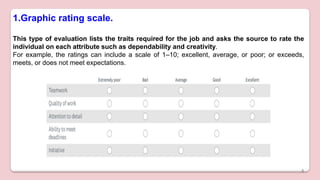
1.Graphic rating scale.
This type of evaluation lists the traits required for the job and asks the source to rate the
individual on each attribute such as dependability and creativity.
For example, the ratings can include a scale of 1–10; excellent, average, or poor; or exceeds,
meets, or does not meet expectations.
4
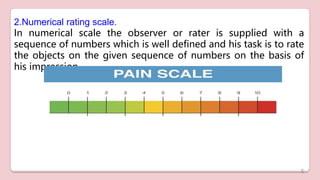
2.Numerical rating scale.
In numerical scale the observer or rater is supplied with a
sequence of numbers which is well defined and his task is to rate
the objects on the given sequence of numbers on the basis of
his impression.
5
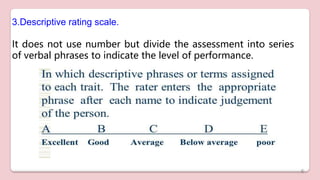
3.Descriptive rating scale.
It does not use number but divide the assessment into series
of verbal phrases to indicate the level of performance.
6
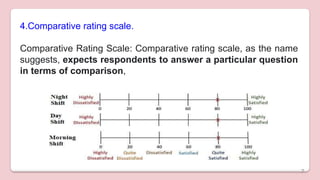
4.Comparative rating scale.
Comparative Rating Scale: Comparative rating scale, as the name
suggests, expects respondents to answer a particular question
in terms of comparison,
7
When conducting a survey, there are four types of
rating scales that can be used effectively:
•Graphic rating scale.
•Numerical rating scale.
•Descriptive rating scale.
•Comparative rating scale.
8
Structured Self Report
Self-reported measures are measures in which respondents are
asked to report directly on their own behaviors, beliefs, attitudes, or
intentions.
For example,
common measures of rating Scales such as Thur-stone scales,
Likert scales, and semantic differentials are self-report
instruments.
9
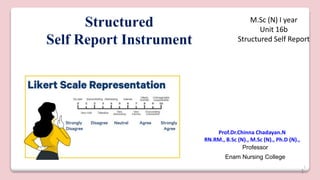
The Likert Scale
A measure of attitudes designed to allow
respondents to rate how strongly they agree or
disagree with carefully constructed statements,
ranging from very positive to very negative
attitudes toward some object.
A Likert scale consist of a series of statements
each followed by a series of response alternative
for the respondent to express himself or herself
about the statement. 10
In a Likert scale the most common number of alternative
is five because it often respondents a sufficient range of
choice without requiring unnecessarily minute
distinctions in attitudes.
strongly agree, agree, uncertain, disagree, and strongly
disagree
11
Uses
To measure attitude values and feelings of
about specific concepts , quantifying the
qualitative attributes
Characteristics
• Psychological
• measurement tool
• Illustrative in nature
• Neutral statement
• Bipolar scaling methods 12
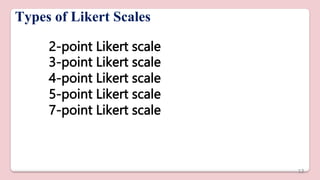
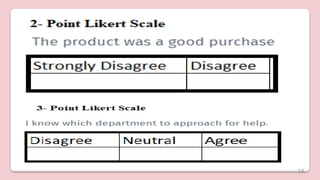
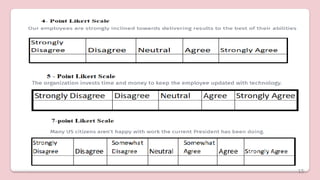
Types of Likert Scales
2-point Likert scale
3-point Likert scale
4-point Likert scale
5-point Likert scale
7-point Likert scale
13
14
15
Advantages
• Easy to construct
• More reliable and valuable
• Easy to administer
Disadvantages
• Respondent may feel force to answer
• Feeling of respondent is not fully assessed
• Casual approach providing misleading data
16
Thank u
17

self report Instrument.pptx

  • 1.
    1 Structured Self Report Instrument Prof.Dr.ChinnaChadayan.N RN.RM., B.Sc (N)., M.Sc (N)., Ph.D (N)., Professor Enam Nursing College M.Sc (N) I year Unit 16b Structured Self Report 1
  • 2.
  • 3.
    Rating Scale A ratingscale is a set of categories designed to elicit information about a quantitative or a qualitative attribute The most common example is the Likert scale, star rating, and slider. There are four types of rating scales that can be used effectively: 1.Graphic rating scale. 2.Numerical rating scale. 3.Descriptive rating scale. 4.Comparative rating scale. 3
  • 4.
    1.Graphic rating scale. Thistype of evaluation lists the traits required for the job and asks the source to rate the individual on each attribute such as dependability and creativity. For example, the ratings can include a scale of 1–10; excellent, average, or poor; or exceeds, meets, or does not meet expectations. 4
  • 5.
    2.Numerical rating scale. Innumerical scale the observer or rater is supplied with a sequence of numbers which is well defined and his task is to rate the objects on the given sequence of numbers on the basis of his impression. 5
  • 6.
    3.Descriptive rating scale. Itdoes not use number but divide the assessment into series of verbal phrases to indicate the level of performance. 6
  • 7.
    4.Comparative rating scale. ComparativeRating Scale: Comparative rating scale, as the name suggests, expects respondents to answer a particular question in terms of comparison, 7
  • 8.
    When conducting asurvey, there are four types of rating scales that can be used effectively: •Graphic rating scale. •Numerical rating scale. •Descriptive rating scale. •Comparative rating scale. 8
  • 9.
    Structured Self Report Self-reportedmeasures are measures in which respondents are asked to report directly on their own behaviors, beliefs, attitudes, or intentions. For example, common measures of rating Scales such as Thur-stone scales, Likert scales, and semantic differentials are self-report instruments. 9
  • 10.
    The Likert Scale Ameasure of attitudes designed to allow respondents to rate how strongly they agree or disagree with carefully constructed statements, ranging from very positive to very negative attitudes toward some object. A Likert scale consist of a series of statements each followed by a series of response alternative for the respondent to express himself or herself about the statement. 10
  • 11.
    In a Likertscale the most common number of alternative is five because it often respondents a sufficient range of choice without requiring unnecessarily minute distinctions in attitudes. strongly agree, agree, uncertain, disagree, and strongly disagree 11
  • 12.
    Uses To measure attitudevalues and feelings of about specific concepts , quantifying the qualitative attributes Characteristics • Psychological • measurement tool • Illustrative in nature • Neutral statement • Bipolar scaling methods 12
  • 13.
    Types of LikertScales 2-point Likert scale 3-point Likert scale 4-point Likert scale 5-point Likert scale 7-point Likert scale 13
  • 14.
  • 15.
  • 16.
    Advantages • Easy toconstruct • More reliable and valuable • Easy to administer Disadvantages • Respondent may feel force to answer • Feeling of respondent is not fully assessed • Casual approach providing misleading data 16
  • 17.