
Government Engineering
College - Modasa
Name : Milan Bhatiya
Subject : Numerical and Statistical Methods
Topic : Taylor’s Series Method
TAYLOR SERIES THEORY
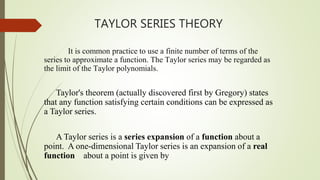
It is common practice to use a finite number of terms of the
series to approximate a function. The Taylor series may be regarded as
the limit of the Taylor polynomials.
Taylor's theorem (actually discovered first by Gregory) states
that any function satisfying certain conditions can be expressed as
a Taylor series.
A Taylor series is a series expansion of a function about a
point. A one-dimensional Taylor series is an expansion of a real
function about a point is given by
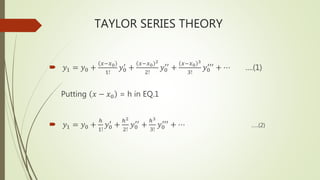
 𝑦1 = 𝑦0 +
𝑥−𝑥0
1!
𝑦0
′
+
𝑥−𝑥0
2
2!
𝑦0
′′
+
𝑥−𝑥0
3
3!
𝑦0
′′′
+ ⋯ ….(1)
Putting 𝑥 − 𝑥0 = h in EQ.1
 𝑦1 = 𝑦0 +
ℎ
1!
𝑦0
′
+
ℎ2
2!
𝑦0
′′
+
ℎ3
3!
𝑦0
′′′
+ ⋯ …..(2)
TAYLOR SERIES THEORY
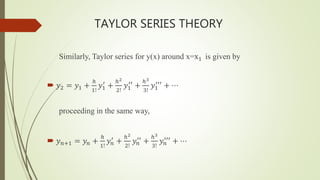
Similarly, Taylor series for y(x) around x=x1 is given by
 𝑦2 = 𝑦1 +
ℎ
1!
𝑦1
′
+
ℎ2
2!
𝑦1
′′
+
ℎ3
3!
𝑦1
′′′
+ ⋯
proceeding in the same way,
 𝑦 𝑛+1 = 𝑦𝑛 +
ℎ
1!
𝑦𝑛
′ +
ℎ2
2!
𝑦𝑛
′′ +
ℎ3
3!
𝑦𝑛
′′′ + ⋯
TAYLOR SERIES THEORY
Taylor series
Taylor series
Taylor series

Taylor series

  • 1.
    Government Engineering College -Modasa Name : Milan Bhatiya Subject : Numerical and Statistical Methods Topic : Taylor’s Series Method
  • 2.
    TAYLOR SERIES THEORY Itis common practice to use a finite number of terms of the series to approximate a function. The Taylor series may be regarded as the limit of the Taylor polynomials. Taylor's theorem (actually discovered first by Gregory) states that any function satisfying certain conditions can be expressed as a Taylor series. A Taylor series is a series expansion of a function about a point. A one-dimensional Taylor series is an expansion of a real function about a point is given by
  • 3.
     𝑦1 =𝑦0 + 𝑥−𝑥0 1! 𝑦0 ′ + 𝑥−𝑥0 2 2! 𝑦0 ′′ + 𝑥−𝑥0 3 3! 𝑦0 ′′′ + ⋯ ….(1) Putting 𝑥 − 𝑥0 = h in EQ.1  𝑦1 = 𝑦0 + ℎ 1! 𝑦0 ′ + ℎ2 2! 𝑦0 ′′ + ℎ3 3! 𝑦0 ′′′ + ⋯ …..(2) TAYLOR SERIES THEORY
  • 4.
    Similarly, Taylor seriesfor y(x) around x=x1 is given by  𝑦2 = 𝑦1 + ℎ 1! 𝑦1 ′ + ℎ2 2! 𝑦1 ′′ + ℎ3 3! 𝑦1 ′′′ + ⋯ proceeding in the same way,  𝑦 𝑛+1 = 𝑦𝑛 + ℎ 1! 𝑦𝑛 ′ + ℎ2 2! 𝑦𝑛 ′′ + ℎ3 3! 𝑦𝑛 ′′′ + ⋯ TAYLOR SERIES THEORY