TIPS and TRICKS to prepare
CSIR-UGC NET- Part-A - General
Dr. N. Meenakshi Sundaram
Asst. Prof. of Physics
Vivekananda College
Tiruvedakam West
Madurai – 625 234
JUNE 2020
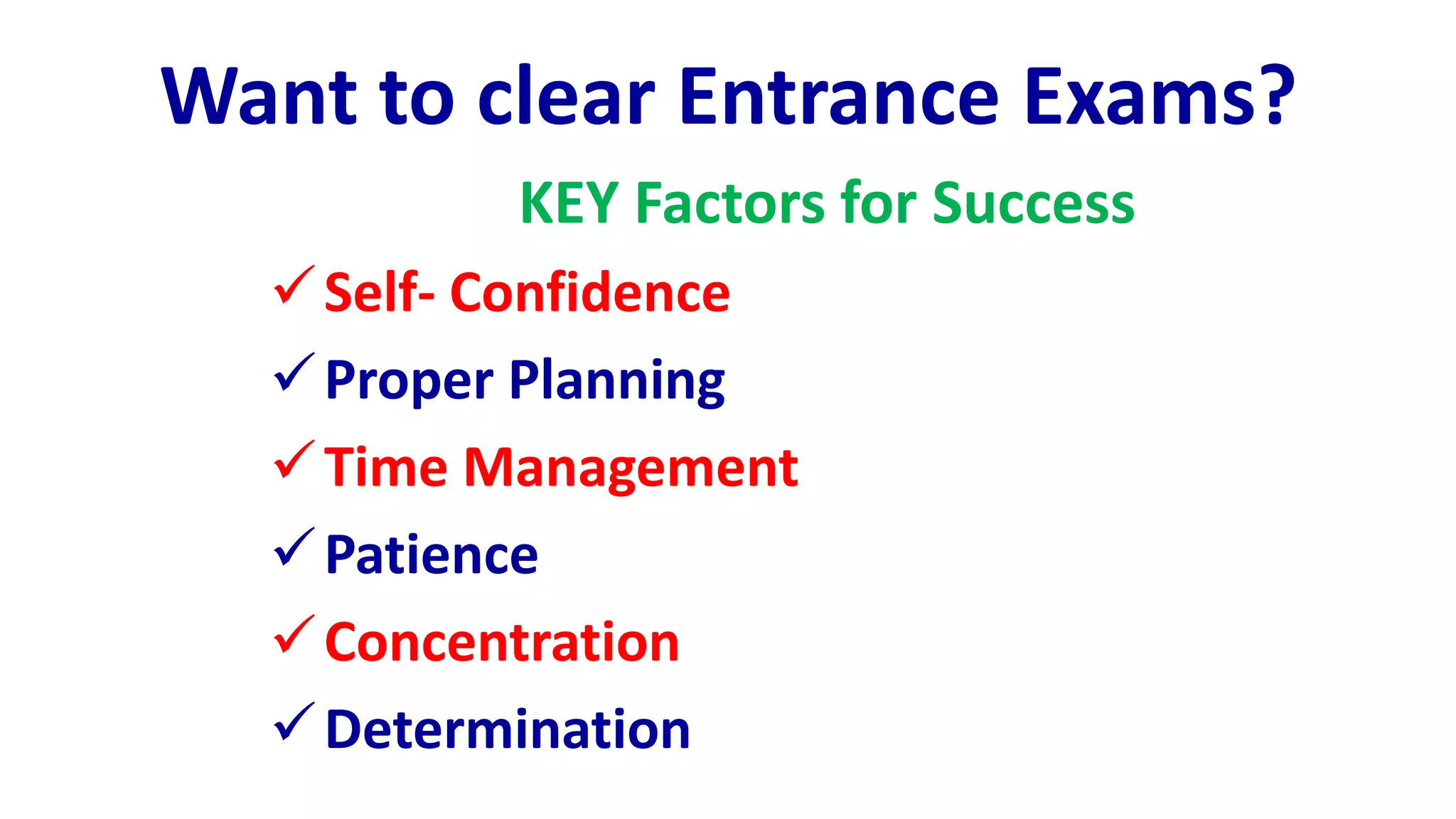
Want to clear Entrance Exams?
KEY Factors for Success
Self- Confidence
Proper Planning
Time Management
Patience
Concentration
Determination
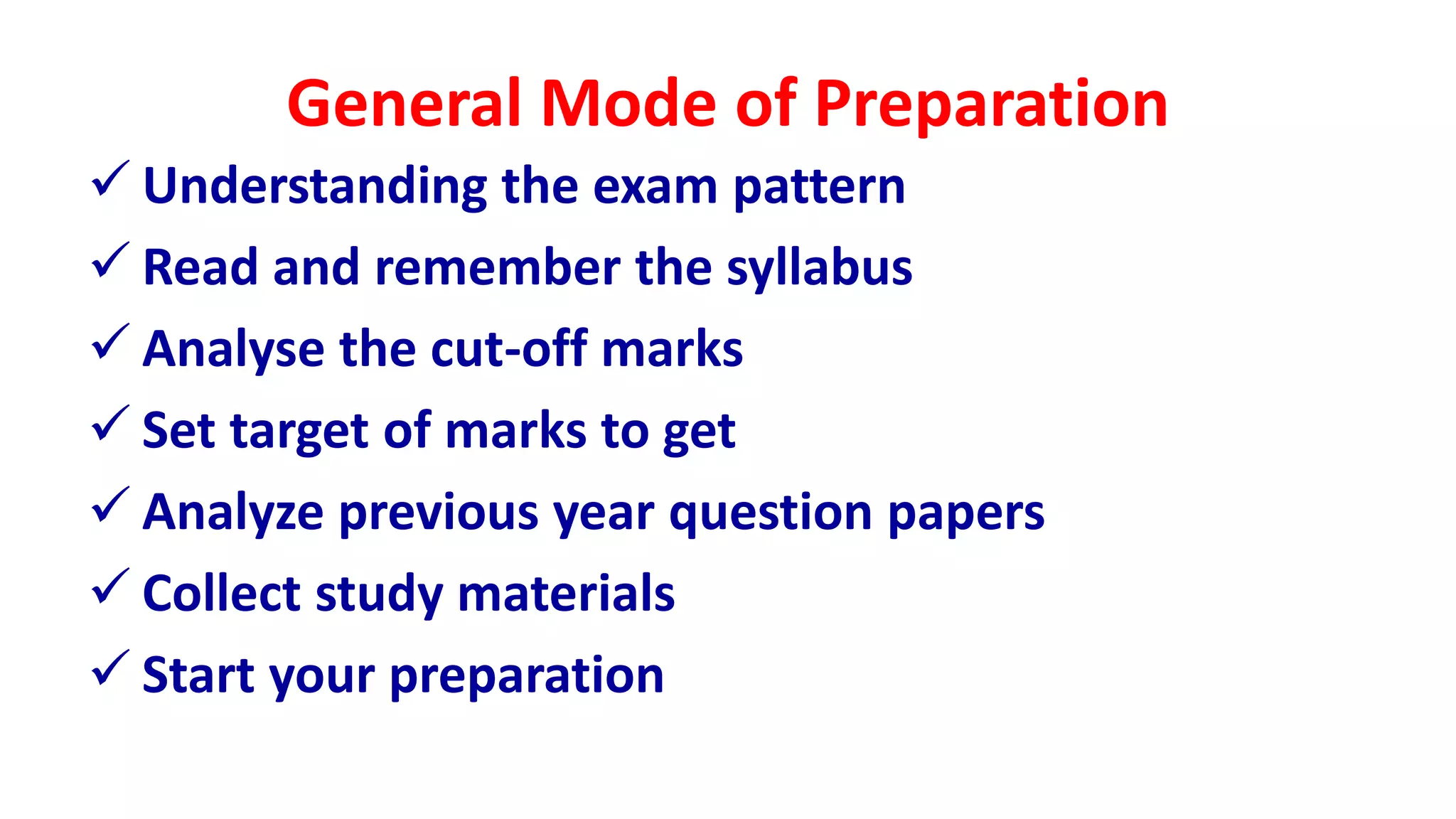
General Mode of Preparation
 Understanding the exam pattern
 Read and remember the syllabus
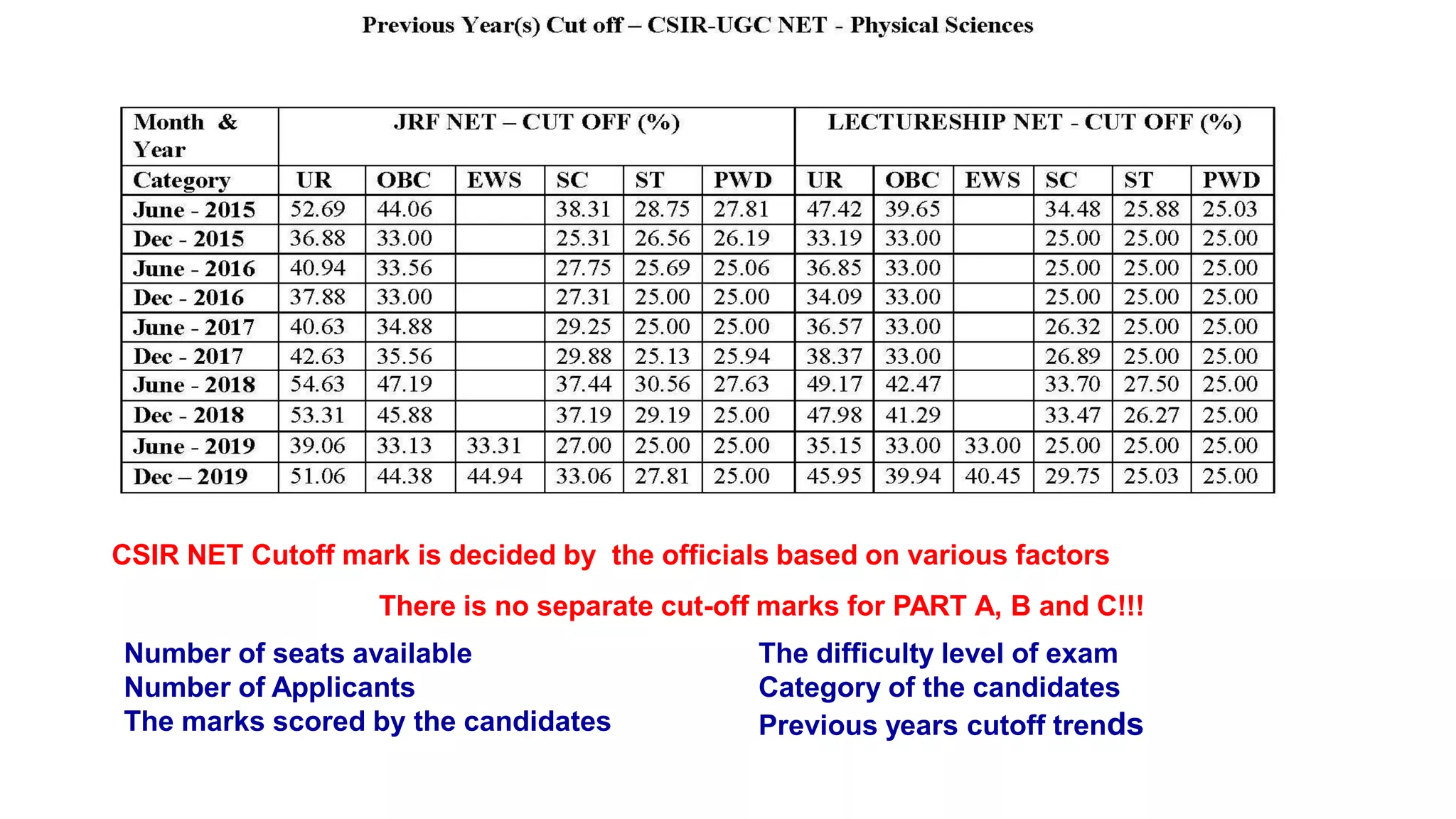
 Analyse the cut-off marks
 Set target of marks to get
 Analyze previous year question papers
 Collect study materials
 Start your preparation
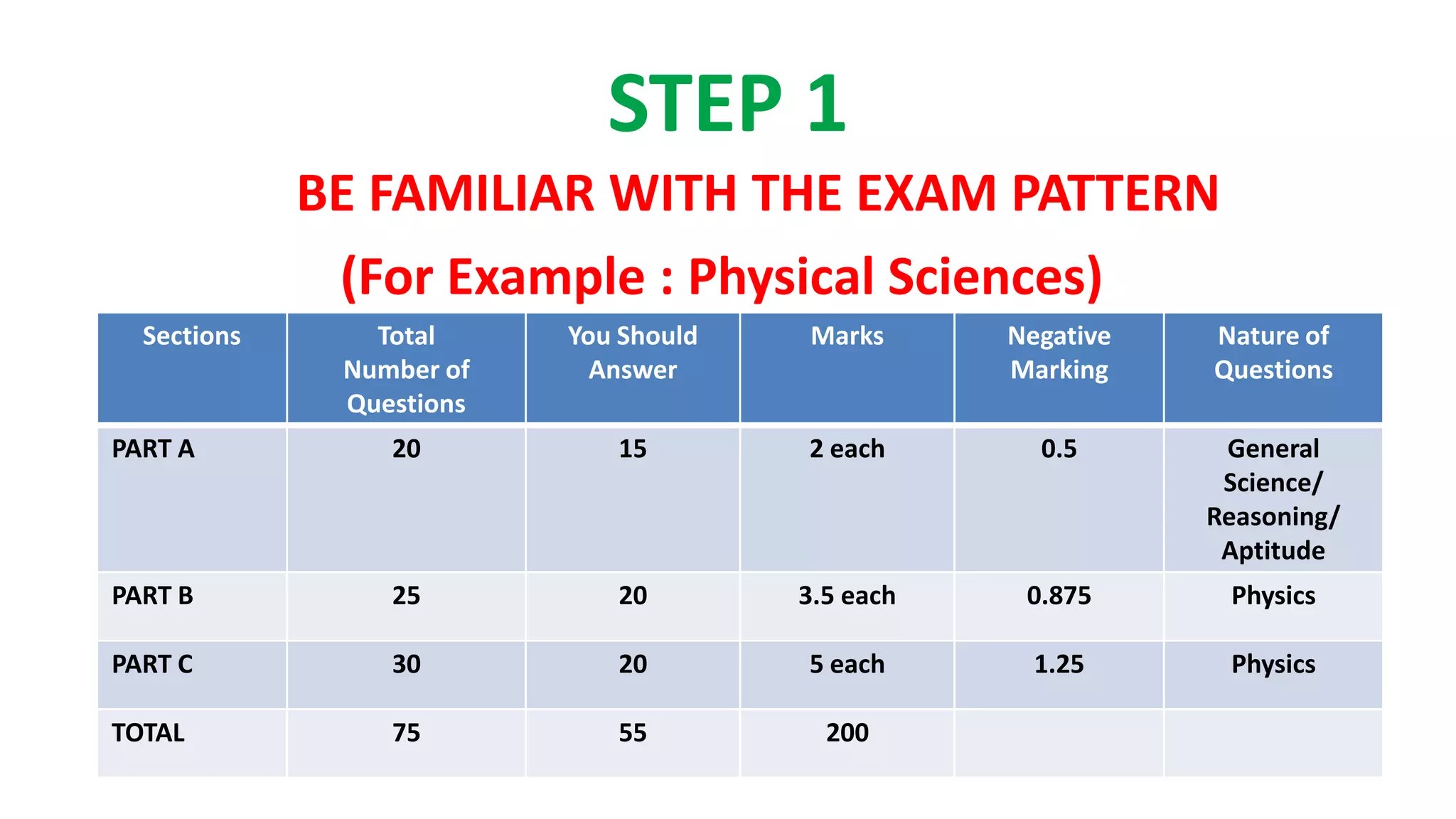
STEP 1
BE FAMILIAR WITH THE EXAM PATTERN
(For Example : Physical Sciences)
Sections Total
Number of
Questions
You Should
Answer
Marks Negative
Marking
Nature of
Questions
PART A 20 15 2 each 0.5 General
Science/
Reasoning/
Aptitude
PART B 25 20 3.5 each 0.875 Physics
PART C 30 20 5 each 1.25 Physics
TOTAL 75 55 200
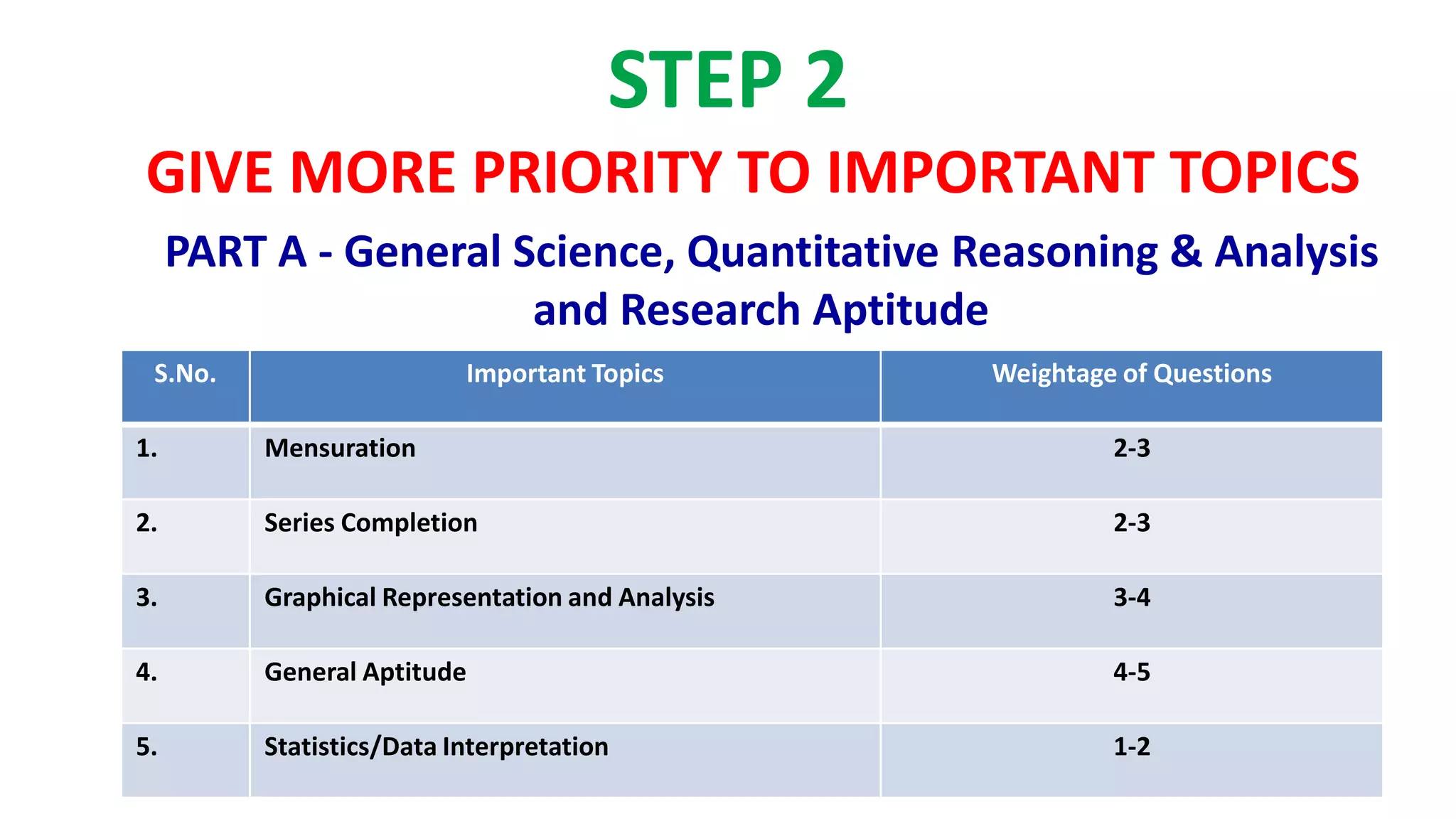
STEP 2
GIVE MORE PRIORITY TO IMPORTANT TOPICS
PART A - General Science, Quantitative Reasoning & Analysis
and Research Aptitude
S.No. Important Topics Weightage of Questions
1. Mensuration 2-3
2. Series Completion 2-3
3. Graphical Representation and Analysis 3-4
4. General Aptitude 4-5
5. Statistics/Data Interpretation 1-2
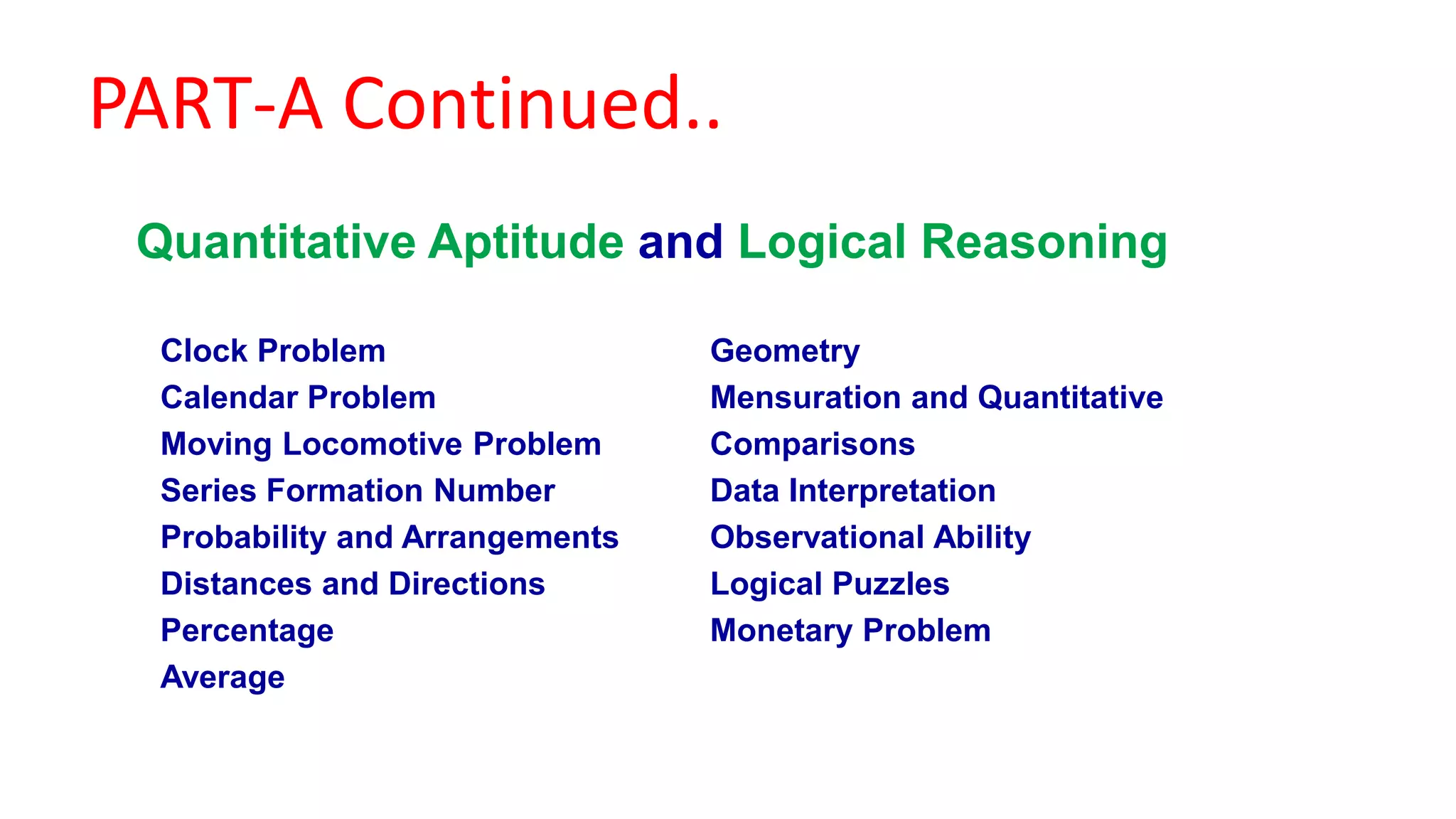
PART-A Continued..
Clock Problem
Calendar Problem
Moving Locomotive Problem
Series Formation Number
Probability and Arrangements
Distances and Directions
Percentage
Average
Geometry
Mensuration and Quantitative
Comparisons
Data Interpretation
Observational Ability
Logical Puzzles
Monetary Problem
Quantitative Aptitude and Logical Reasoning
Number of seats available
Number of Applicants
The marks scored by the candidates
The difficulty level of exam
Category of the candidates
Previous years cutoff trends
CSIR NET Cutoff mark is decided by the officials based on various factors
There is no separate cut-off marks for PART A, B and C!!!
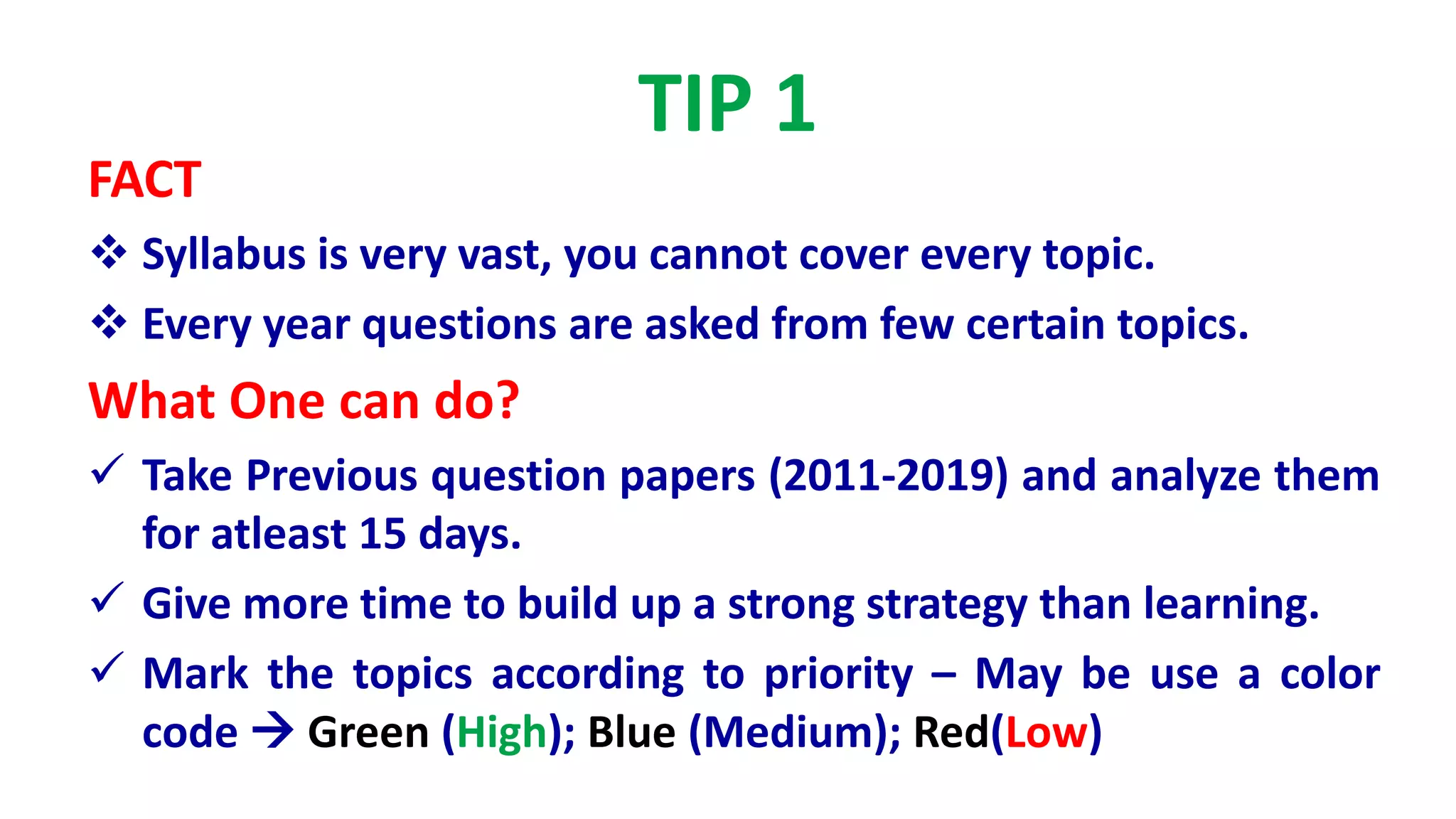
TIP 1
FACT
 Syllabus is very vast, you cannot cover every topic.
 Every year questions are asked from few certain topics.
What One can do?
 Take Previous question papers (2011-2019) and analyze them
for atleast 15 days.
 Give more time to build up a strong strategy than learning.
 Mark the topics according to priority – May be use a color
code  Green (High); Blue (Medium); Red(Low)
TIP 2
FACT
They do not ask complicated questions. They ask
questions on simple concept.
What One can do?
 Clear your basics.
 Focus on actual basics first, then delve on deeper
study.
TIP 3
In PART-B : Don’t waste time on a single question.
In PART-C : Analyze and Answer – Try to read the
question twice or thrice to analyze.
TIP 4
Guessing is not always harmful. Sometimes it’s a good idea
to guess the answer, but wisely.
(Not applicable for PART-A !!)
TIP 5
FACT
There are certain topics in CSIR NET for which we can
not learn the basics, we need to mug up.
What One can do?
 Make a table of such topics and read them daily.
 You can also record them and listen when ever you
feel like.
Common mistakes during Preparation
 Not preparing consistently
 Not making proper notes
 Referring too many books
 Doing Ph.D. on a single topic
 Reading every book madly from page to page
 Daydreaming
 Just reading but not thinking
 Going directionless - not preparing according to the syllabus
 Feeling Isolated
 Following the Quote “I will study in a focused manner from tomorrow ”
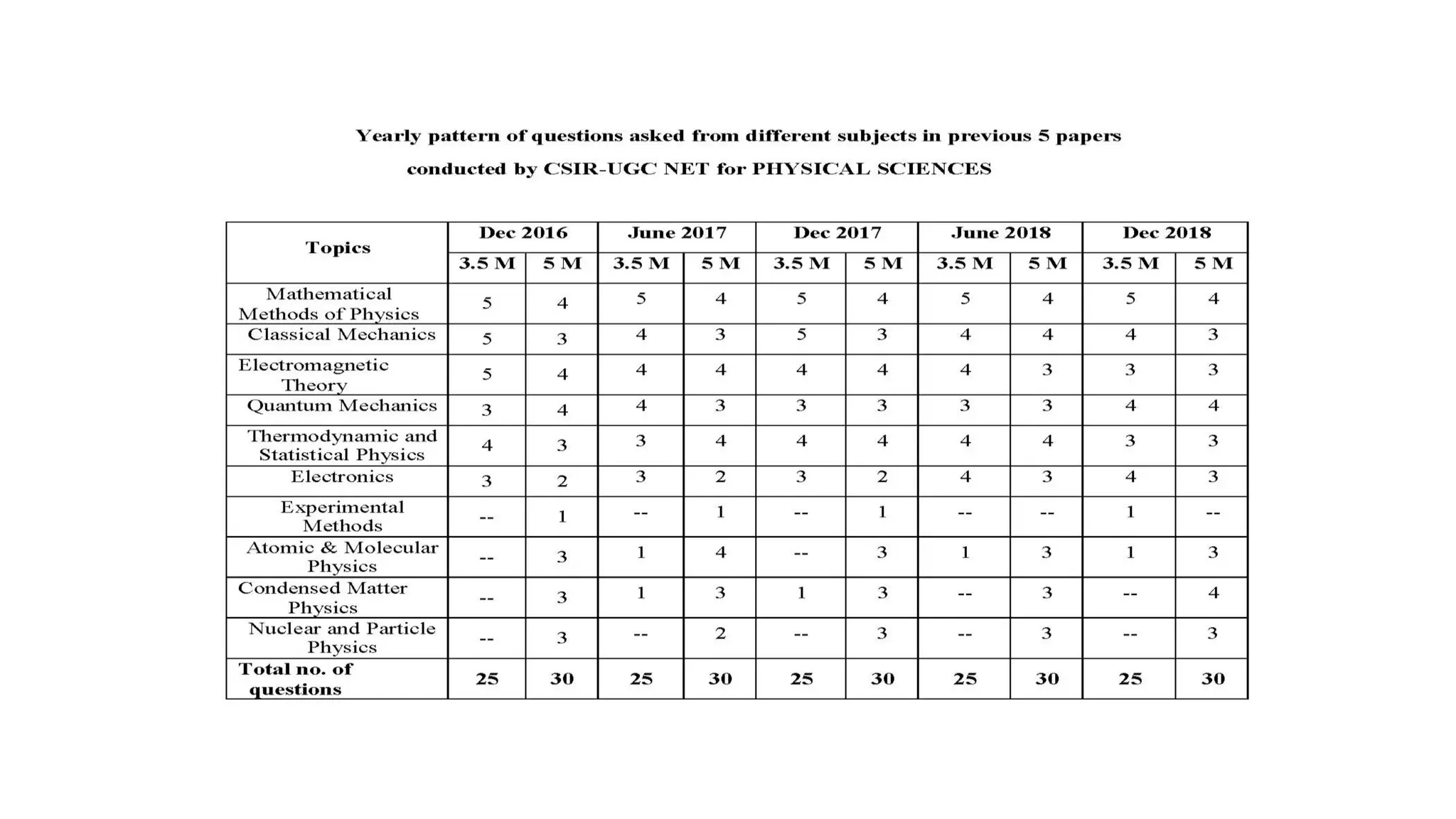
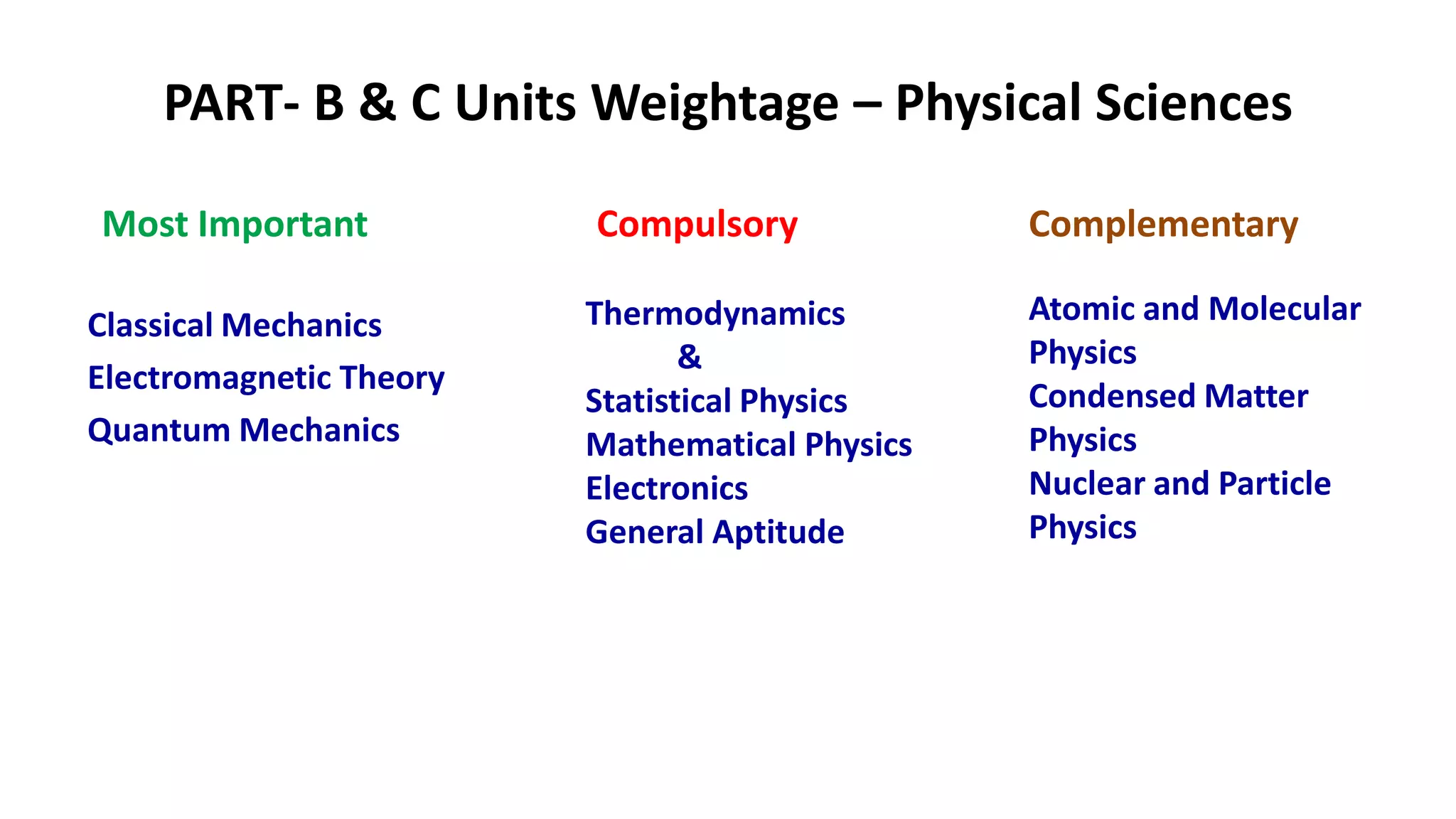
PART- B & C Units Weightage – Physical Sciences
Most Important
Classical Mechanics
Electromagnetic Theory
Quantum Mechanics
Compulsory
Thermodynamics
&
Statistical Physics
Mathematical Physics
Electronics
General Aptitude
Complementary
Atomic and Molecular
Physics
Condensed Matter
Physics
Nuclear and Particle
Physics
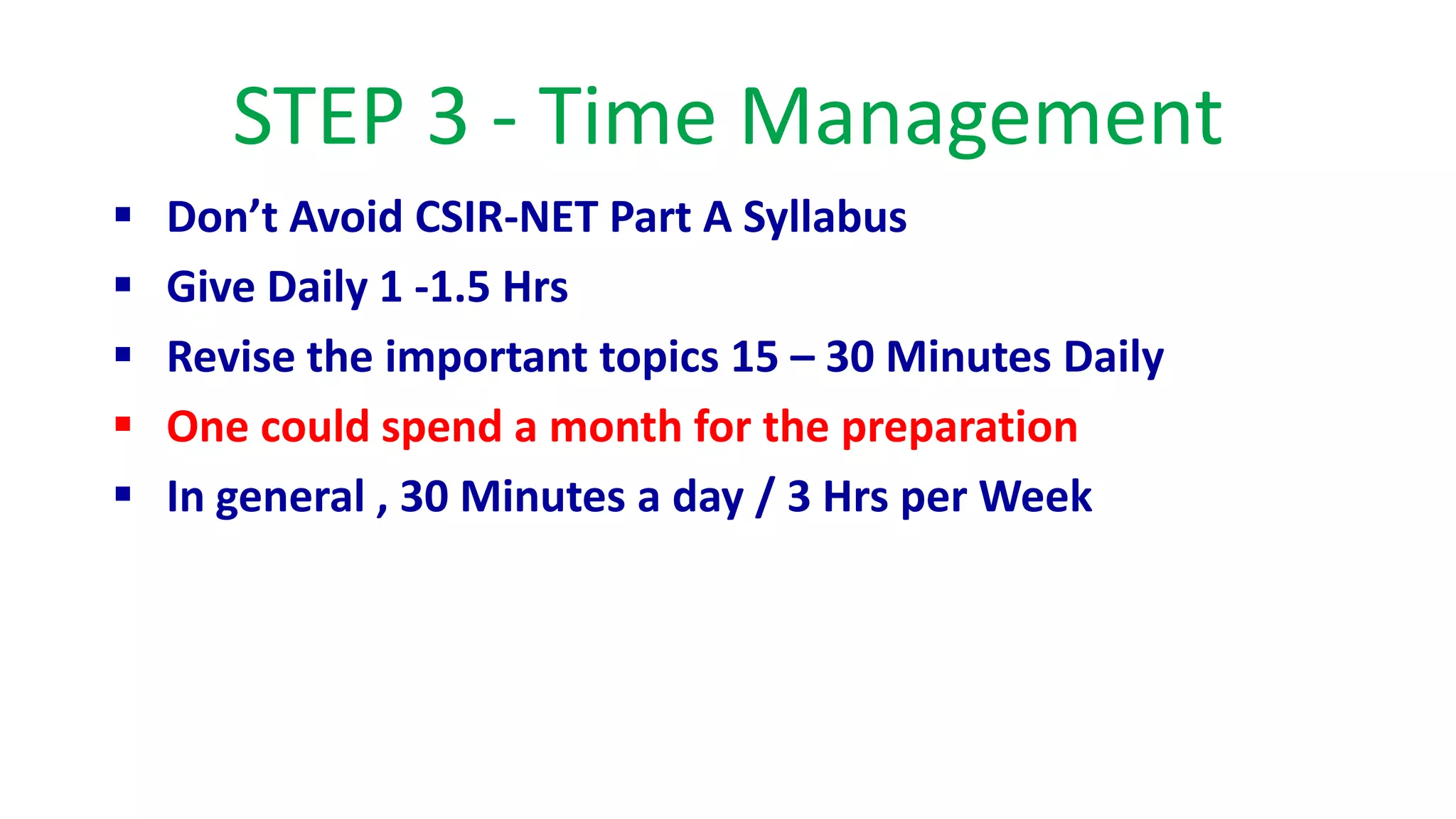
STEP 3 - Time Management
 Don’t Avoid CSIR-NET Part A Syllabus
 Give Daily 1 -1.5 Hrs
 Revise the important topics 15 – 30 Minutes Daily
 One could spend a month for the preparation
 In general , 30 Minutes a day / 3 Hrs per Week
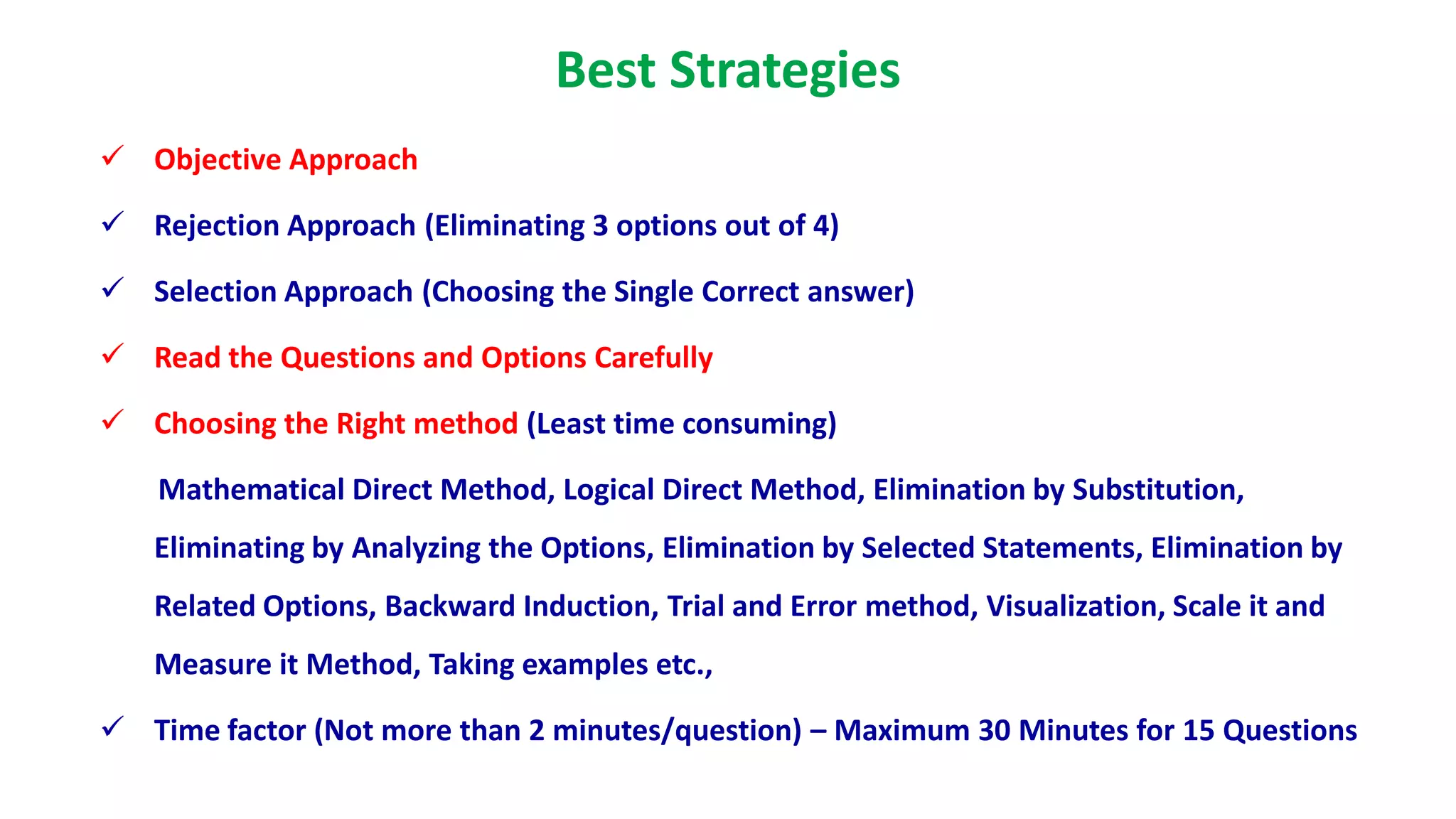
Best Strategies
 Objective Approach
 Rejection Approach (Eliminating 3 options out of 4)
 Selection Approach (Choosing the Single Correct answer)
 Read the Questions and Options Carefully
 Choosing the Right method (Least time consuming)
Mathematical Direct Method, Logical Direct Method, Elimination by Substitution,
Eliminating by Analyzing the Options, Elimination by Selected Statements, Elimination by
Related Options, Backward Induction, Trial and Error method, Visualization, Scale it and
Measure it Method, Taking examples etc.,
 Time factor (Not more than 2 minutes/question) – Maximum 30 Minutes for 15 Questions
Best Strategies
 Choose the Right Questions ( Easy 7-8 ; 5-6 Medium; 6-8 Difficult)
 Finding the Catch in the Questions
 Choosing the Starting Points – Logical Reasoning
 Get the Apt Questions – Locomotive problem for example (Emphasize is on Aptitude &
Reasoning than accurate and speed Numerical Skills (Bank PO etc.,) !!)
 Never Attempt Tough Problems at First
 Always Start With Solving Simple Problems (It will aid in boosting confidence)
 Use Smart Preparation Techniques (Analyzing questions and answers more closely while
solving previous year question papers ; constructing mind maps, mnemonics etc., while
preparing short notes)
Study Plan
 First, analyze the complete syllabus and previous year question papers of CSIR UGC
NET General Aptitude, Part A. Make a list of your Strong, Moderate and Weak topics.
With this, you will get an idea where to focus more, while preparing.
 Self-Analysis – Fix Your Priority in order of their importance
For self-examination, you should divide your Subject Expertise into 3 categories
according to the syllabus such as Strong, Moderate and Weak topics.
Strong Category: Easy category covers topics in which you have knowledge about
the topic, and you are confident enough to solve the questions.
Moderate Category: Moderate category includes topics that require a little
modification and practice.
Weak Category: Topics that fall into the difficult category which require preparation
from basic level and more practice, mostly your weak area.
This process will give you a proper analysis of your knowledge and will define your start
towards the preparation of General Aptitude, Part A.
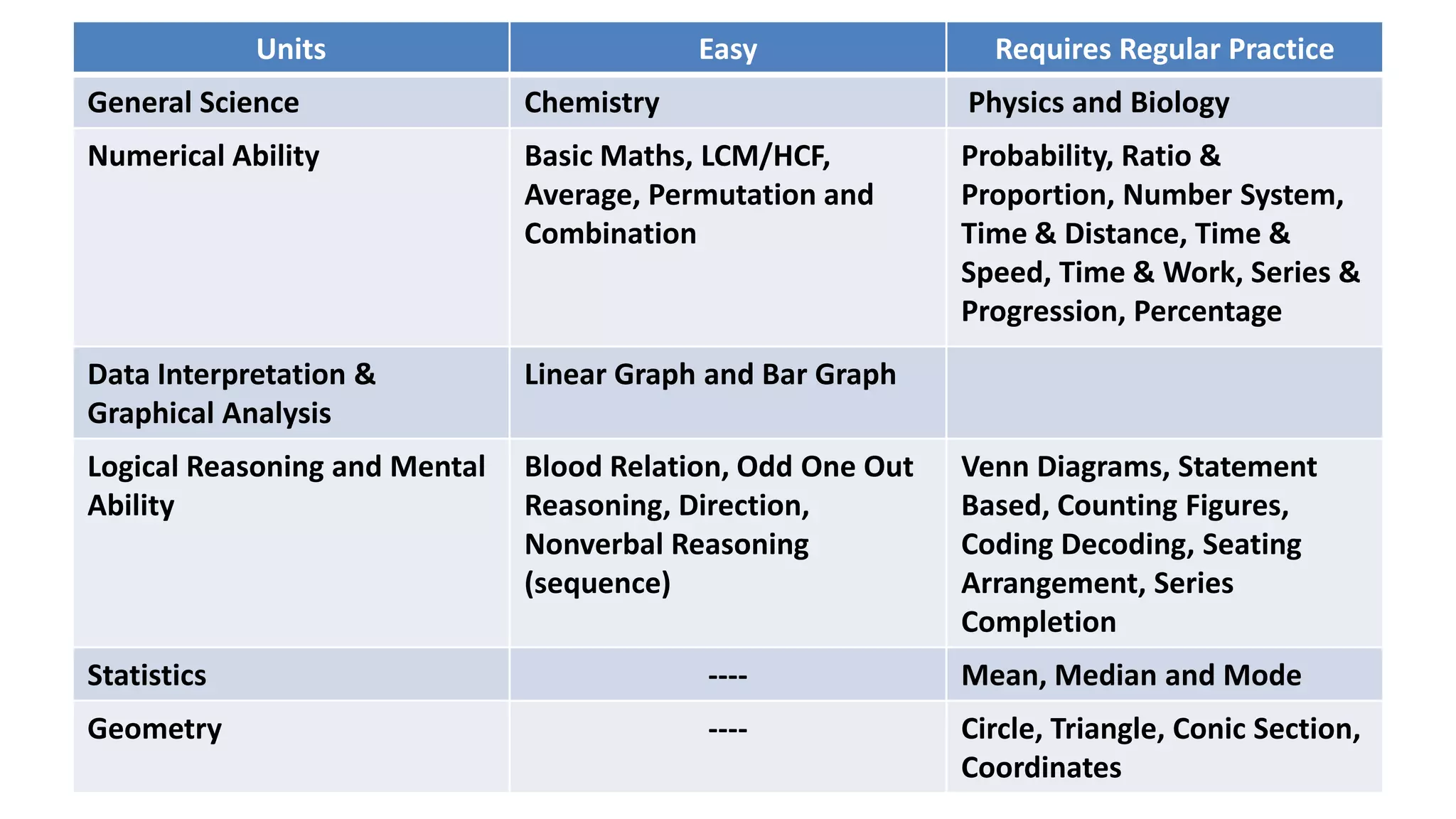
Units Easy Requires Regular Practice
General Science Chemistry Physics and Biology
Numerical Ability Basic Maths, LCM/HCF,
Average, Permutation and
Combination
Probability, Ratio &
Proportion, Number System,
Time & Distance, Time &
Speed, Time & Work, Series &
Progression, Percentage
Data Interpretation &
Graphical Analysis
Linear Graph and Bar Graph
Logical Reasoning and Mental
Ability
Blood Relation, Odd One Out
Reasoning, Direction,
Nonverbal Reasoning
(sequence)
Venn Diagrams, Statement
Based, Counting Figures,
Coding Decoding, Seating
Arrangement, Series
Completion
Statistics ---- Mean, Median and Mode
Geometry ---- Circle, Triangle, Conic Section,
Coordinates
How to Start?
• Start your preparation from Non-Practical Units (Non-Verbal Reasoning, General
Science) as they are less time consuming and scoring
• Units like Data Interpretation, Mathematical Reasoning and Aptitude, Logical
Reasoning require Recurring Practice of Questions at least twice a week
• Give equal importance to Numerical Ability and Logical Reasoning units, since both
units are most important.
• Go through your Basic Concepts of Mathematics (Ratio & Proportion, Average,
Percentage). Data Interpretation is generally based on Statistics (Basic
mathematics Concepts from Class 10th) so you must focus on statistics part which
will help you to perform well in Data Interpretation.
• In Logical Reasoning, most of the questions are based on simple concepts for
Directions, Venn Diagram, Odd One Out, Blood Relations and Non-Verbal
Reasoning, by them you can score more in less time.
• Some of the topics require regular practice like Seating Arrangements, Coding
Decoding and Series Completion so to solve them follow basic rules and tricks
• From Statistics, Questions will be based on group or individual data so go for the
concepts of Mean, Median and Mode while remembering options since many
answers you can make correct after checking options only
• Never Memorize a formula blindly. Try to know the concept behind it. Sometimes
they twist the concept in a question so merely memorizing formula can lead to
wrong answer.
Learn  Practice  Revise  Test Analyze
• Knowing is one thing but practicing really cements your logic and increases your
speed and skills
• Give as many mock tests as possible. Feel every test as your final exam and try to
score as much as possible. Learn from your mistakes that which kind of problems
you are comfortable in and which kind of problem takes more of your time.
• When you start any topic, always start with the basics, divide the sub-topics over
time intervals and take a break of 10 mins between any subtopics to recall the
portion you studied. This will help you absorb better because it gives your brain
time to absorb the fundamentals and concepts
• When you complete any topic, practice the solved examples and make short notes,
it will help you in the last time preparation. Any Unit completion shall be followed
by practicing questions related to unit. Revise the topics again. Check your accuracy
as well as your speed.
“You don’t have to be great to start, but you have to start to be great.”
• When you have covered any unit, then just revise the short notes and give a quick
practice to solved examples again, without looking at the solution. After that,
Exercises in the reference material shall be tried by allotting it a maximum time of
3 hours. Assess your score and work on your mistakes & weak topics.
Note: Same method is recommended to follow in all units.
• Once you are done with the whole syllabus, it’s time to assess our true level of
preparation by giving a shot at MSP (Model Solved papers). Revise the short notes
and start practicing Model Solved papers (3 hours for every paper). Check your
answers and calculate your marks to get an idea of your accuracy and speed.
• Note down your mistakes and next day, revise topics related to mistakes, again try
to solve the questions you were unable to solve.
“Push Yourself, because no one else is going to do it for you.”
• After solving all MSPs, Similar approach shall be followed in PSPs (Previous Year
Test Papers). Compare your marks with cutoff of that year.
Note: While solving PSP, note down the tricks which have been used to solve
difficult questions.
“Smart work always pays better than hard work”
Let Us Solve a few Previous Year Questions!
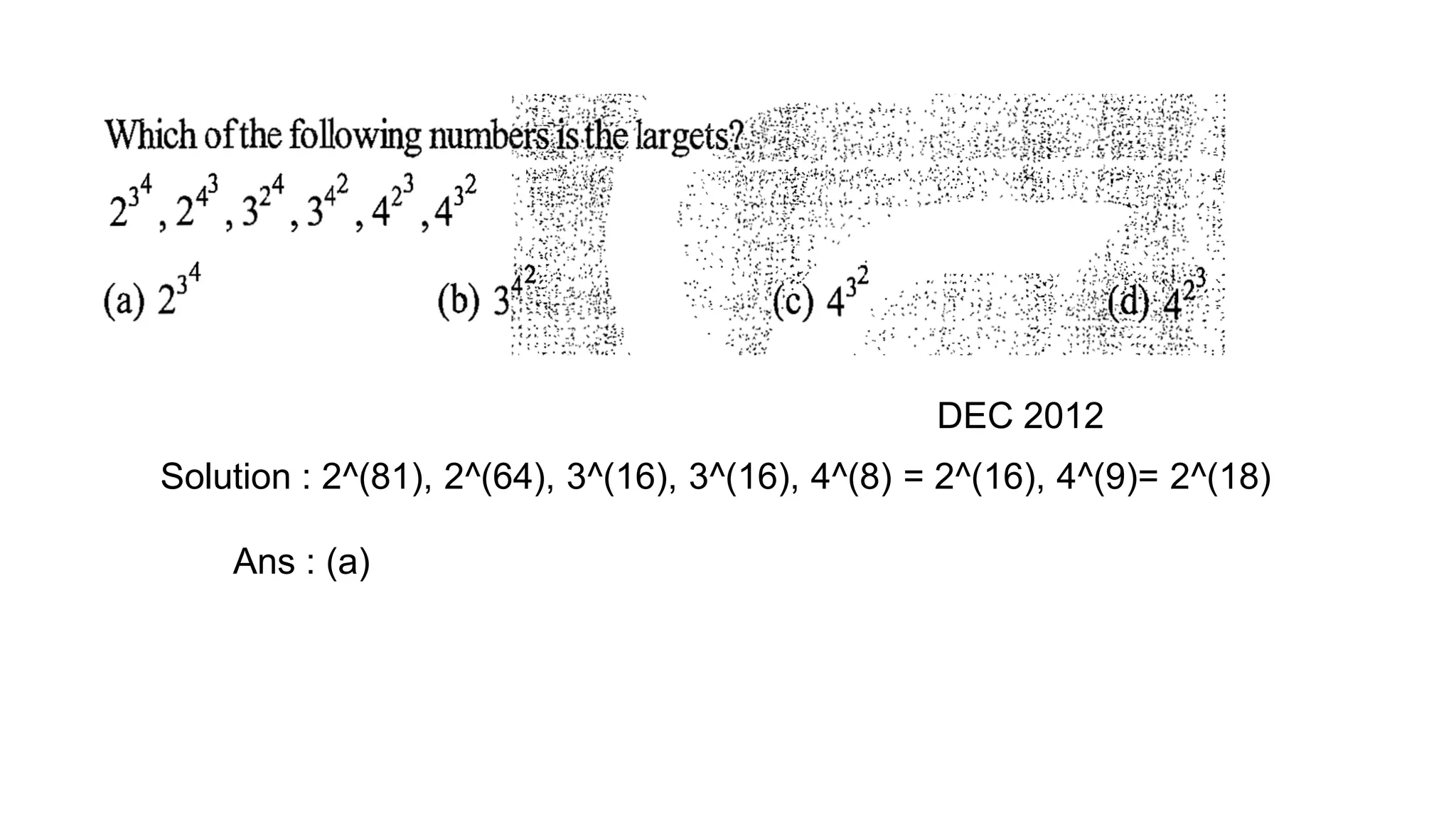
Solution : 2^(81), 2^(64), 3^(16), 3^(16), 4^(8) = 2^(16), 4^(9)= 2^(18)
Ans : (a)
DEC 2012
DEC 2012
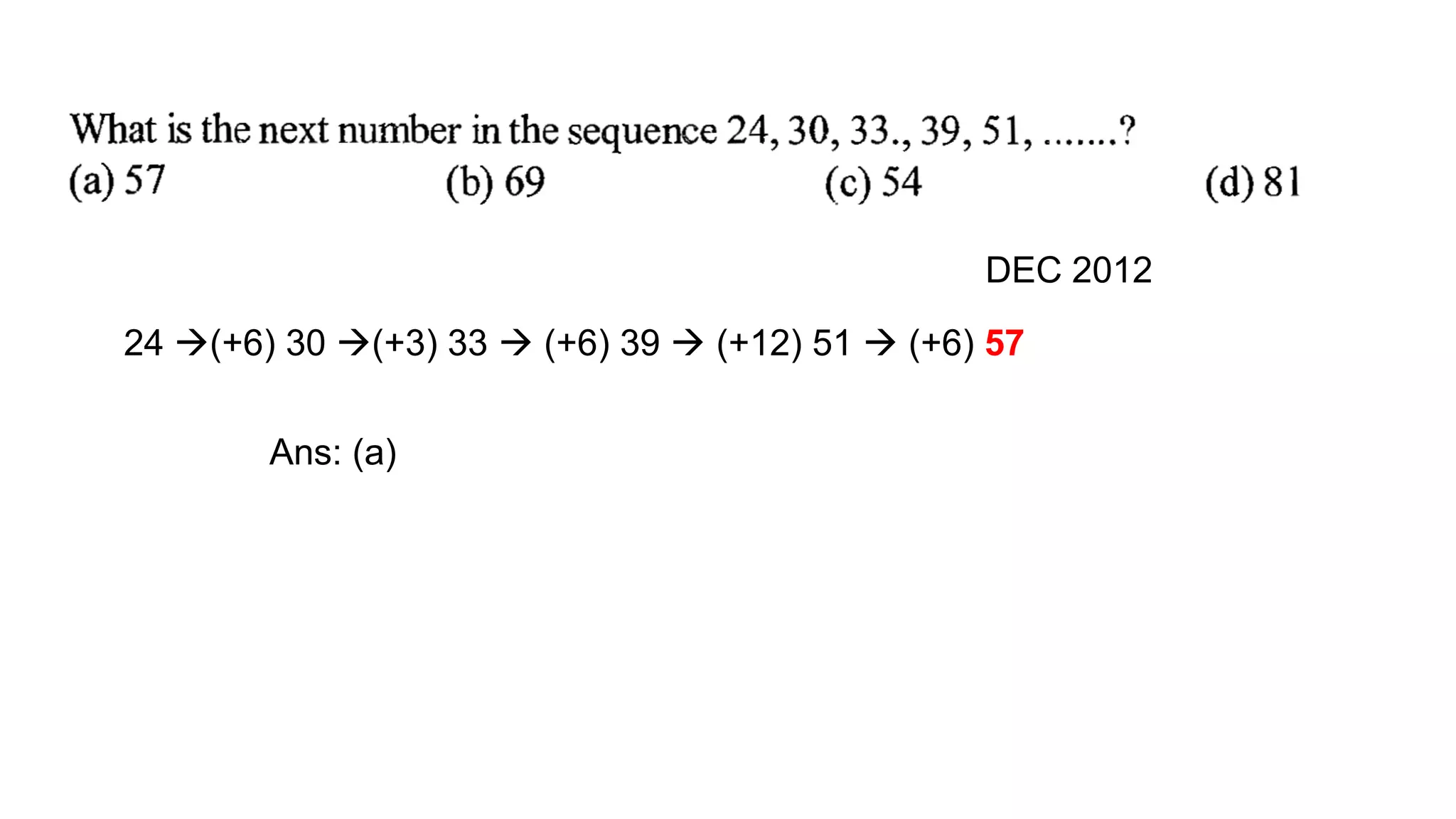
24 (+6) 30 (+3) 33  (+6) 39  (+12) 51  (+6) 57
Ans: (a)
DEC 2012
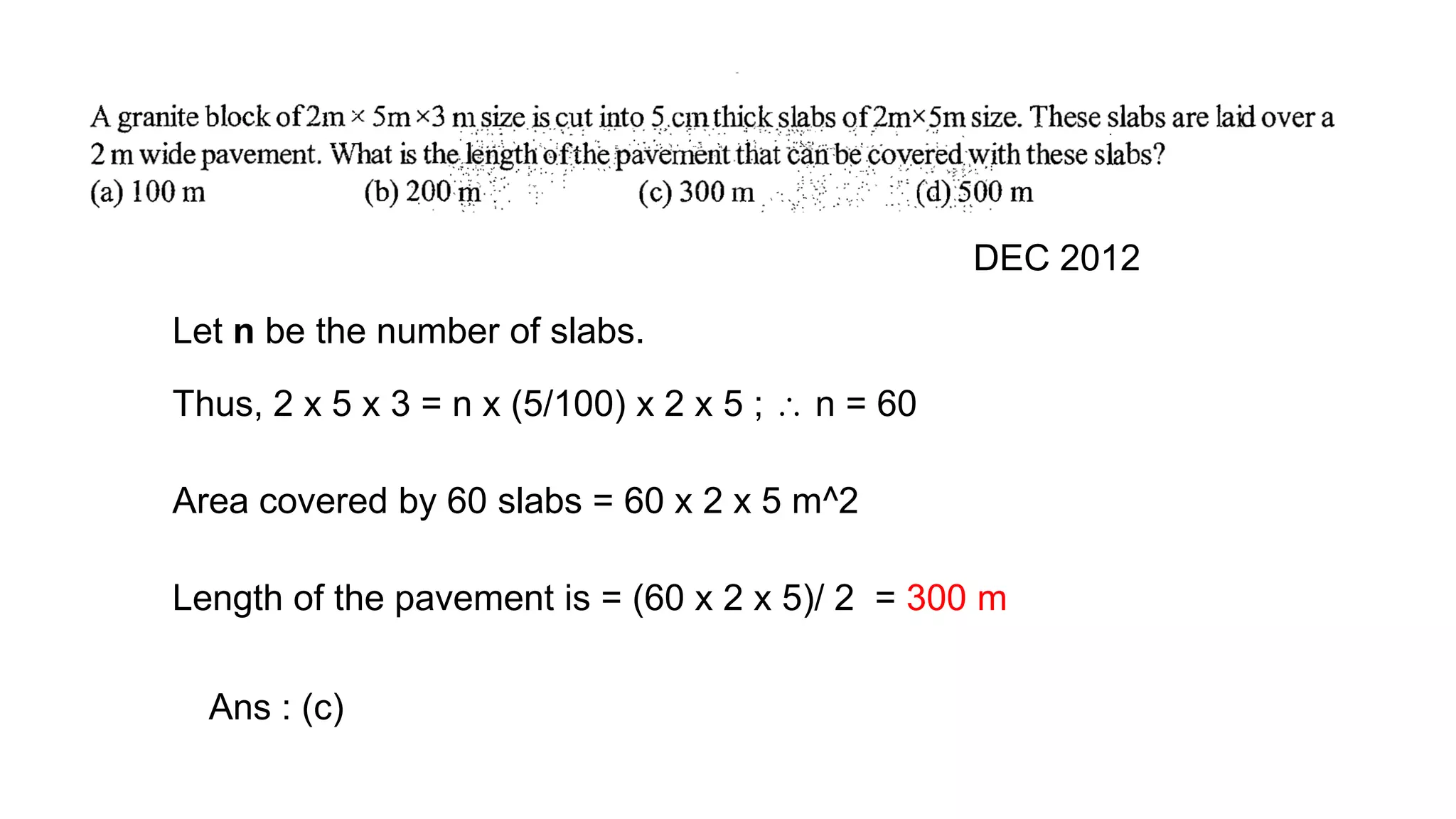
Let n be the number of slabs.
Thus, 2 x 5 x 3 = n x (5/100) x 2 x 5 ;  n = 60
Area covered by 60 slabs = 60 x 2 x 5 m^2
Length of the pavement is = (60 x 2 x 5)/ 2 = 300 m
Ans : (c)
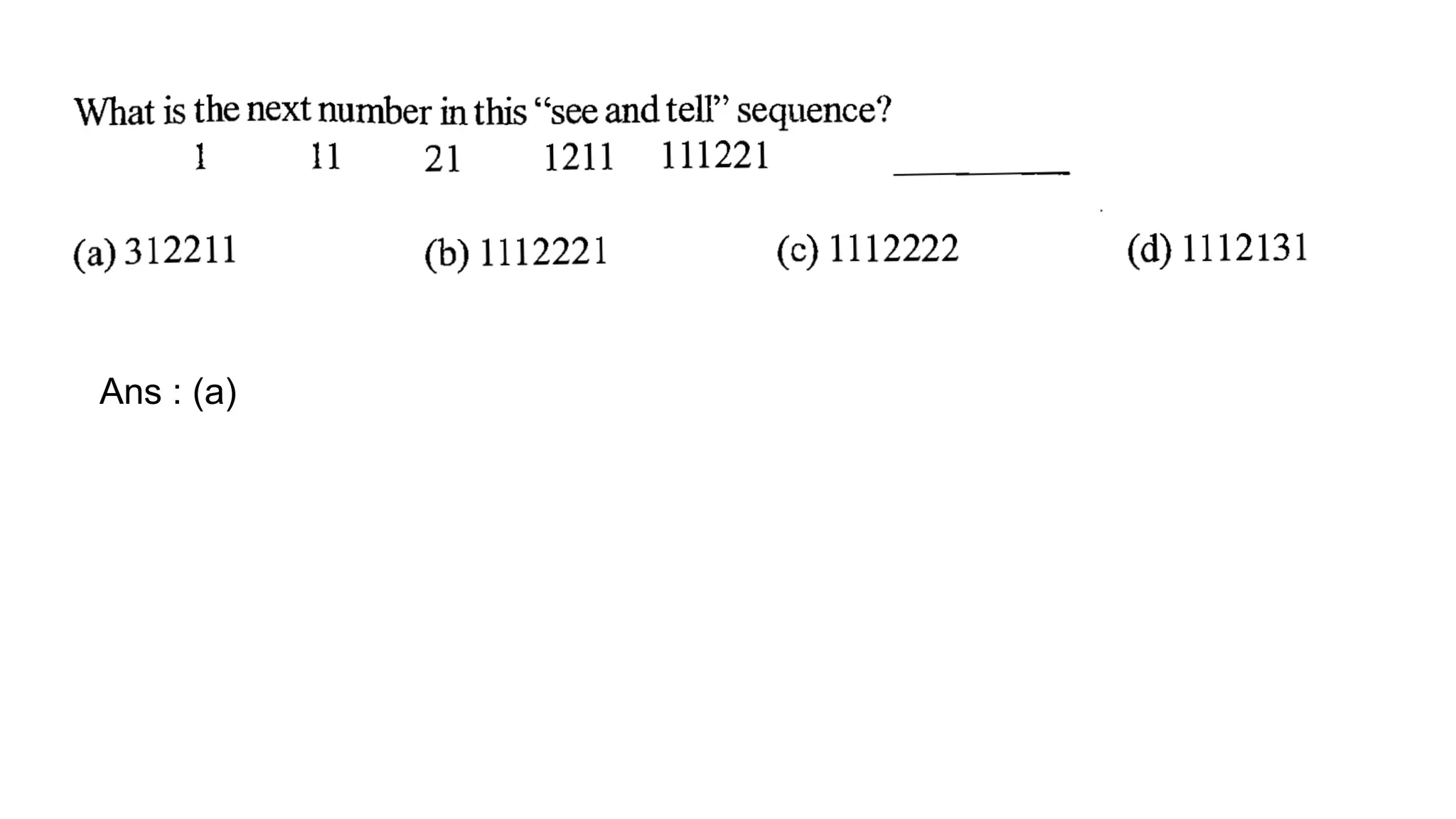
Ans : (a)
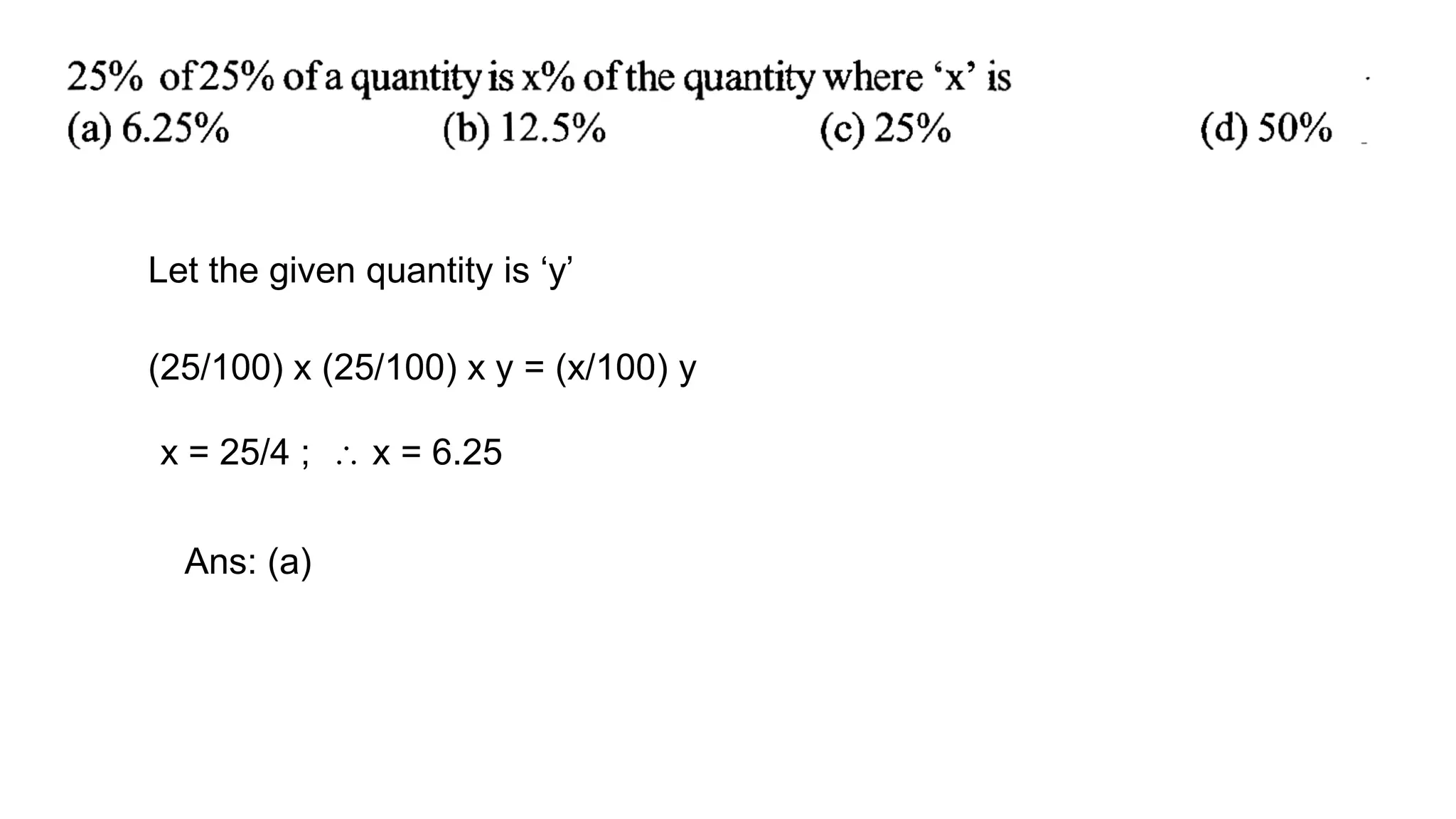
Let the given quantity is ‘y’
(25/100) x (25/100) x y = (x/100) y
x = 25/4 ;  x = 6.25
Ans: (a)
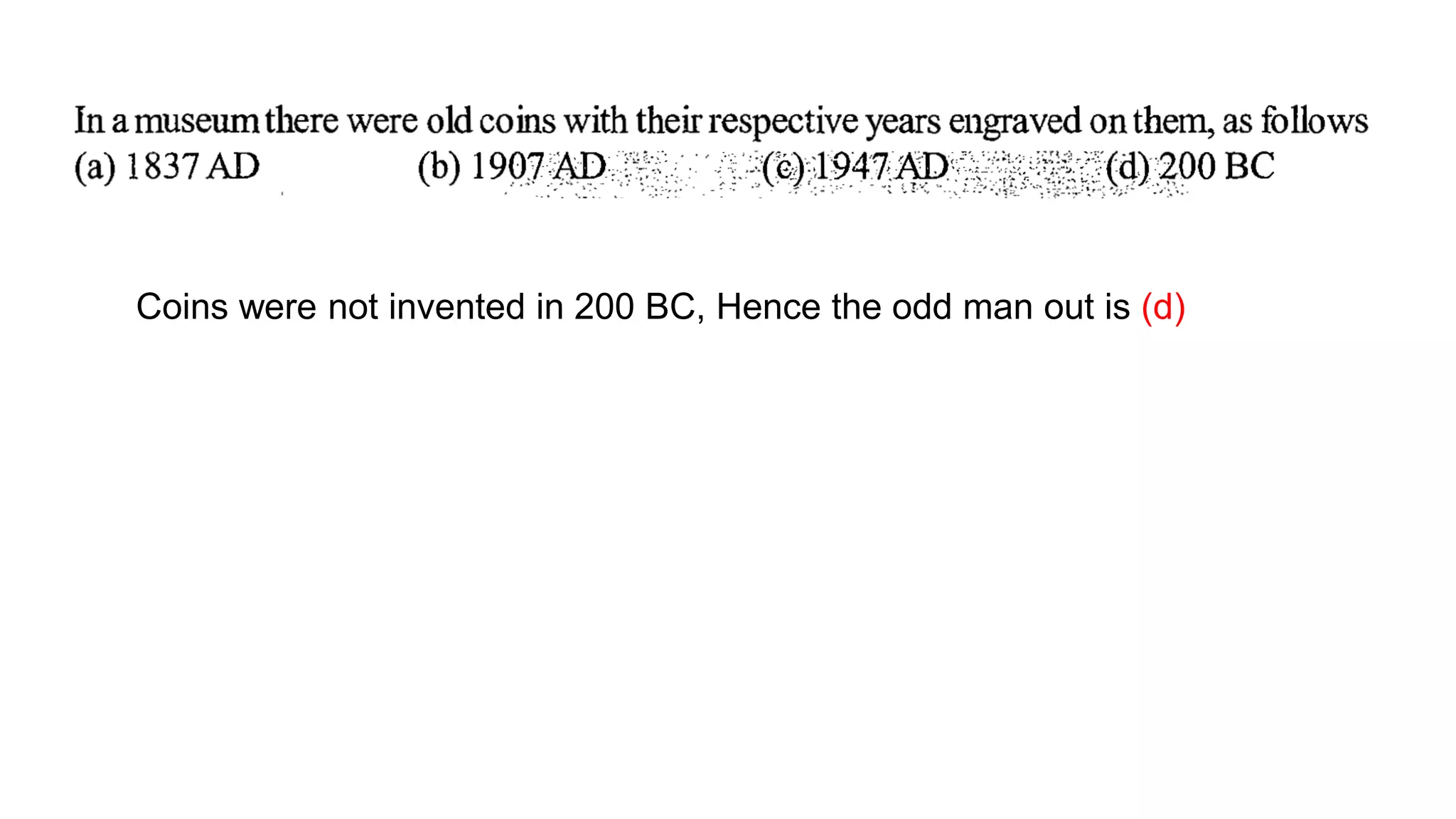
Coins were not invented in 200 BC, Hence the odd man out is (d)
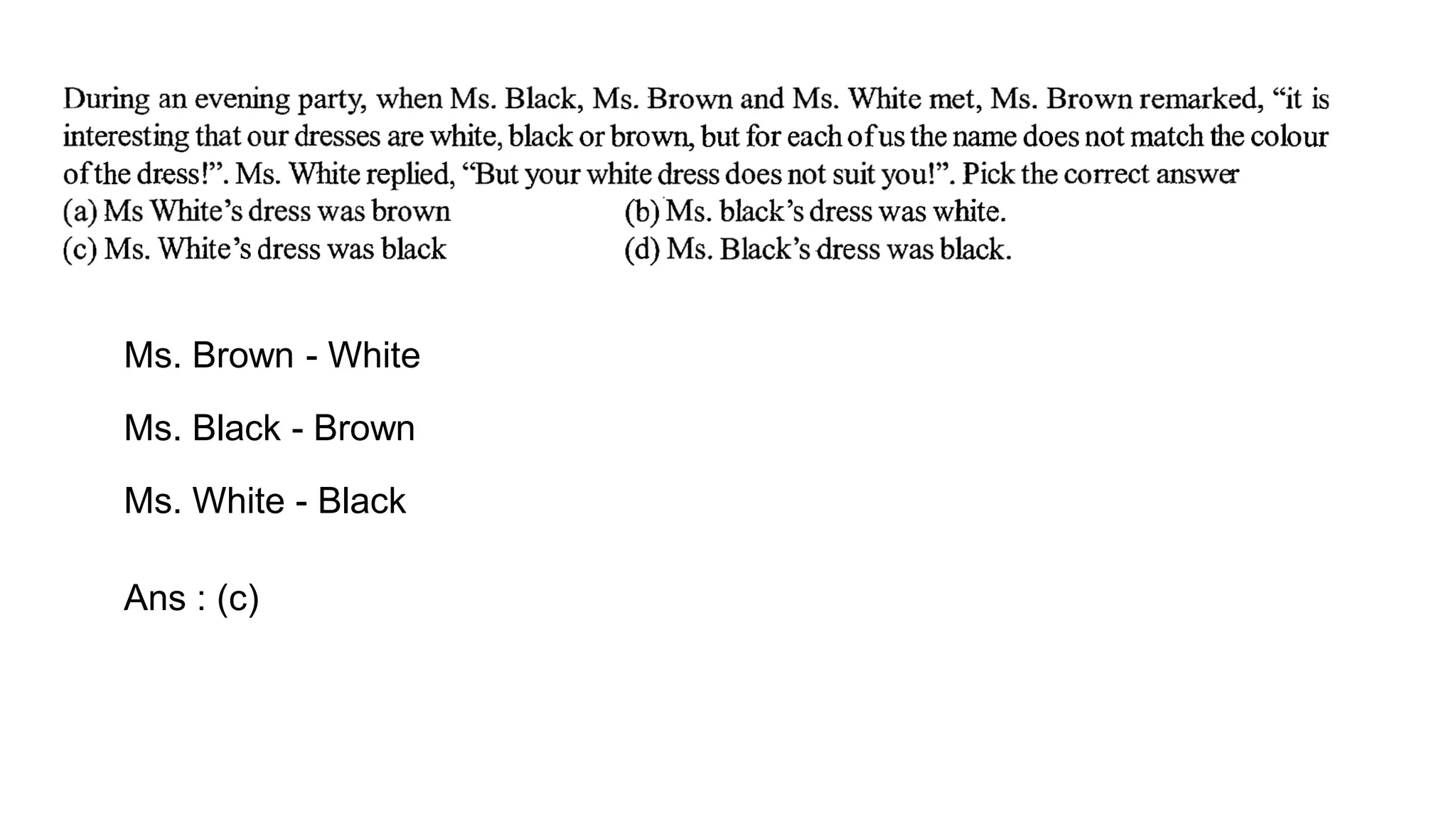
Ms. Brown - White
Ms. Black - Brown
Ms. White - Black
Ans : (c)
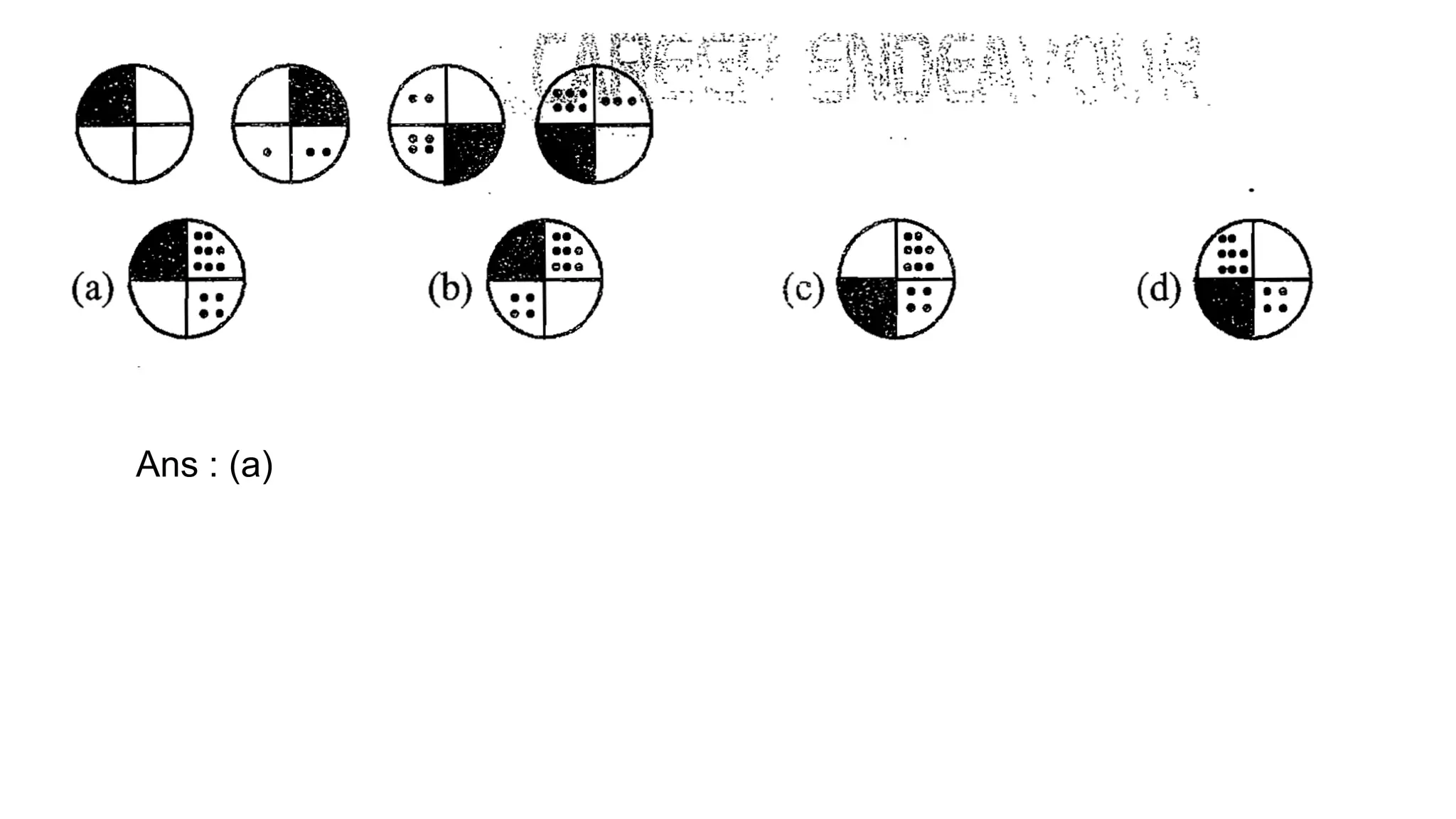
Ans : (a)
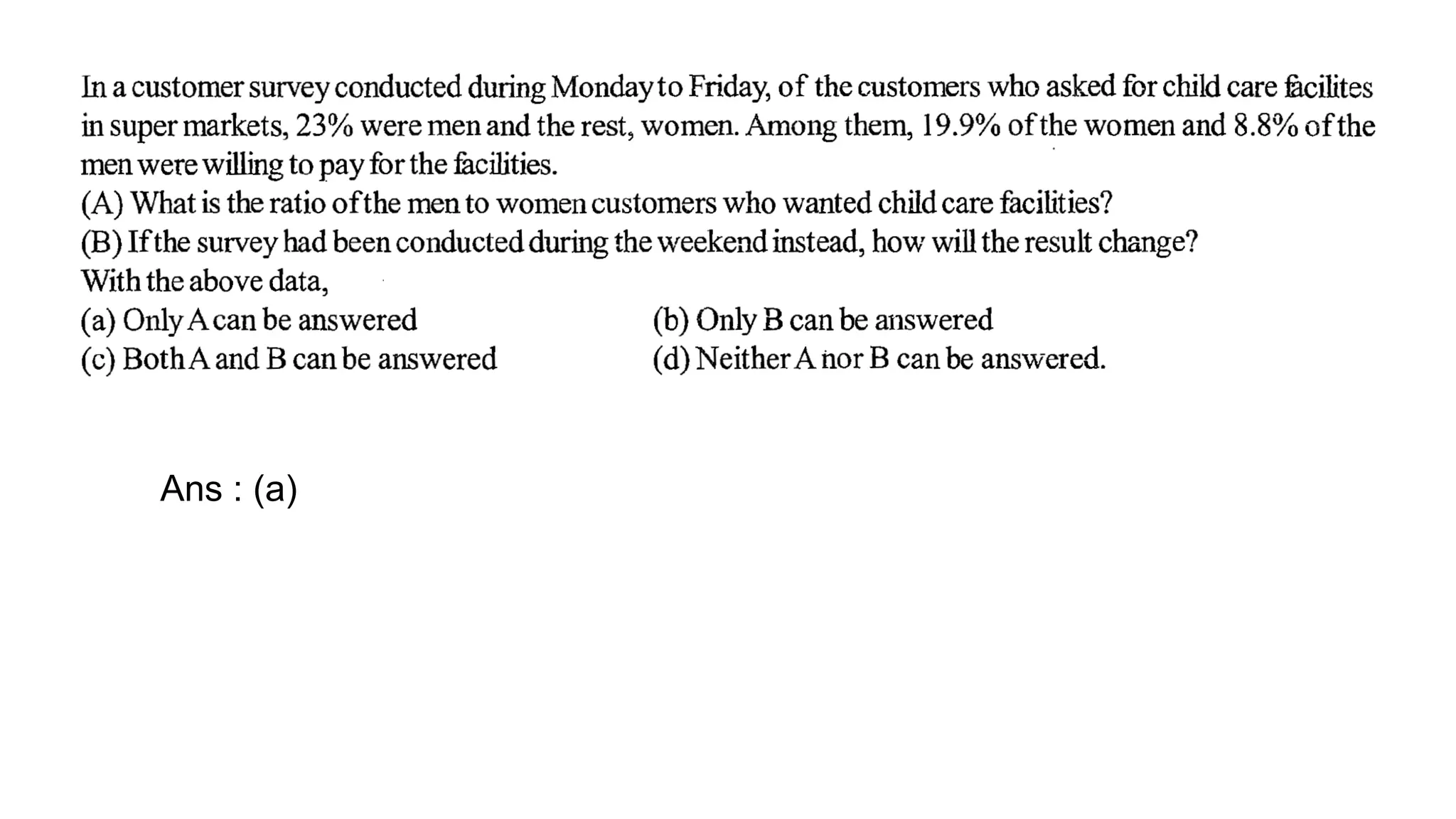
Ans : (a)
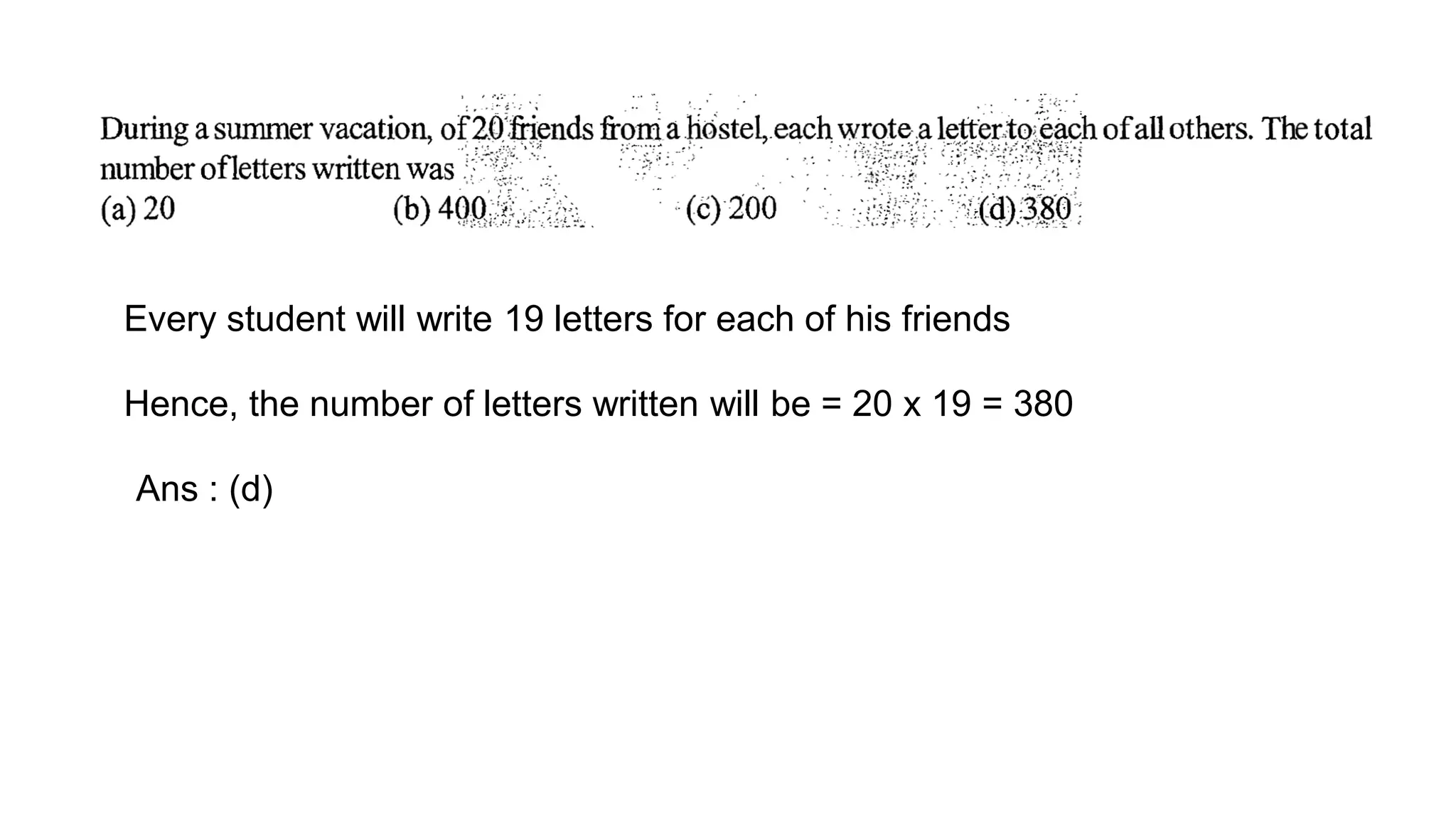
Every student will write 19 letters for each of his friends
Hence, the number of letters written will be = 20 x 19 = 380
Ans : (d)
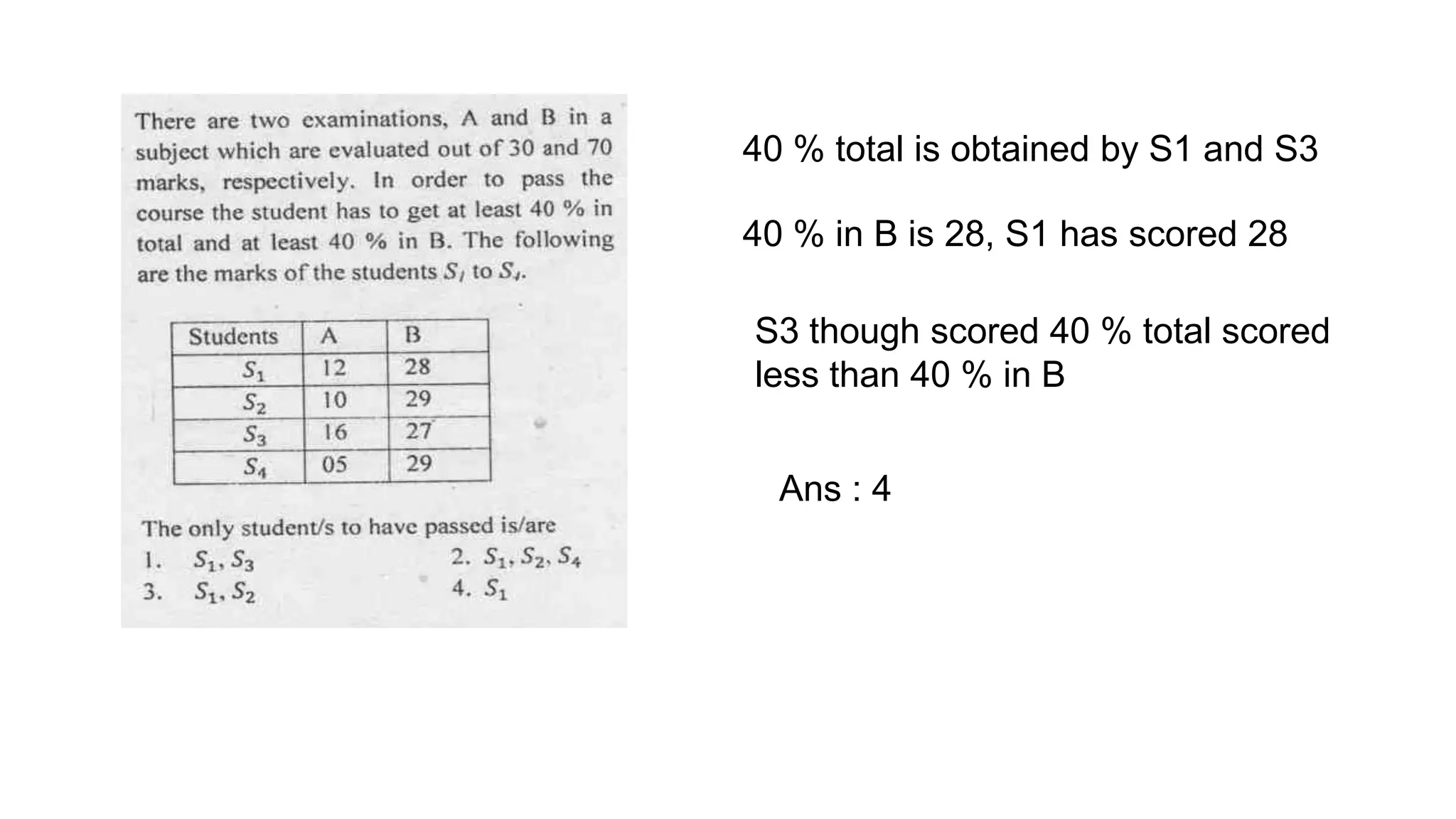
40 % total is obtained by S1 and S3
40 % in B is 28, S1 has scored 28
S3 though scored 40 % total scored
less than 40 % in B
Ans : 4
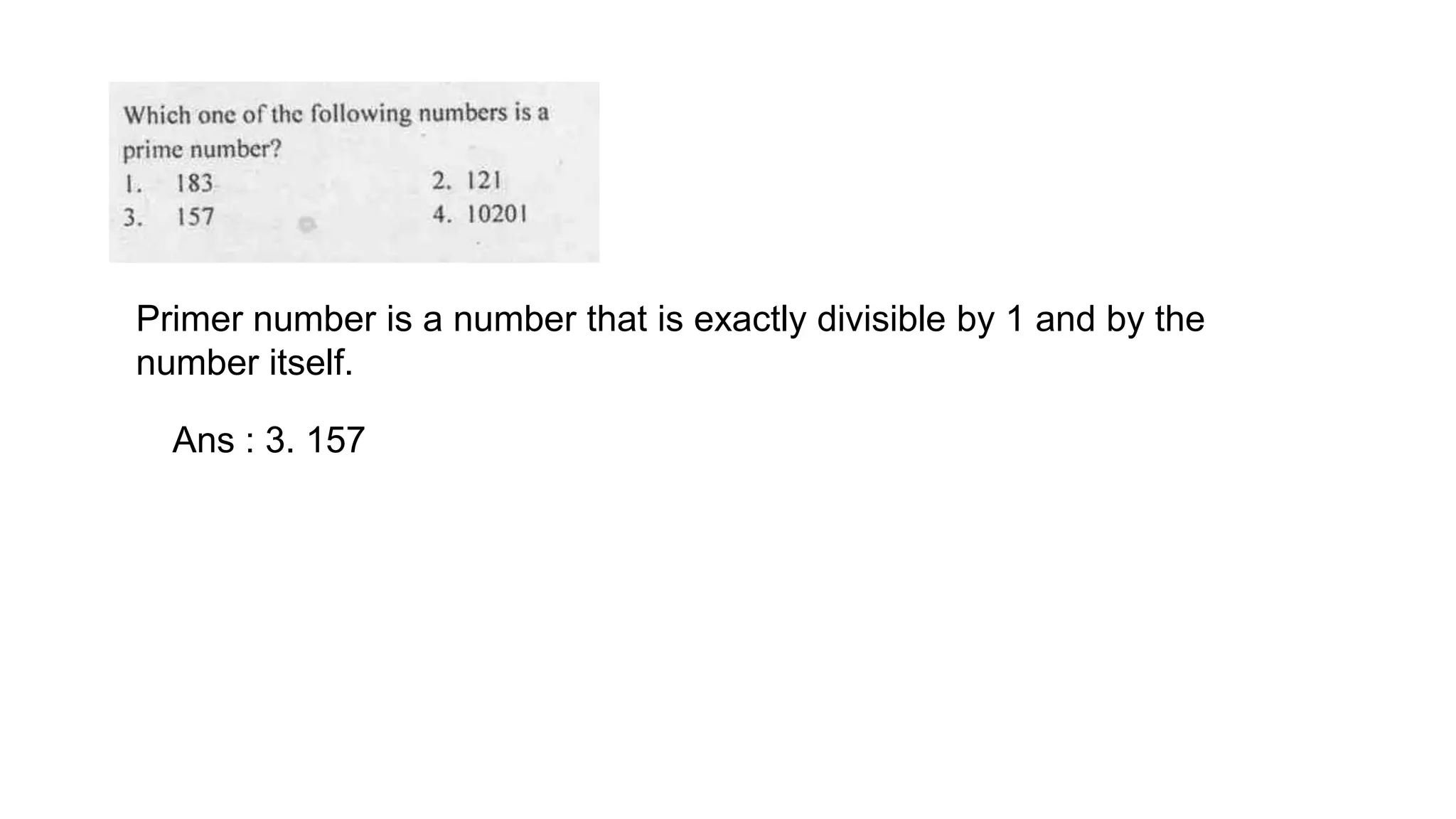
Primer number is a number that is exactly divisible by 1 and by the
number itself.
Ans : 3. 157
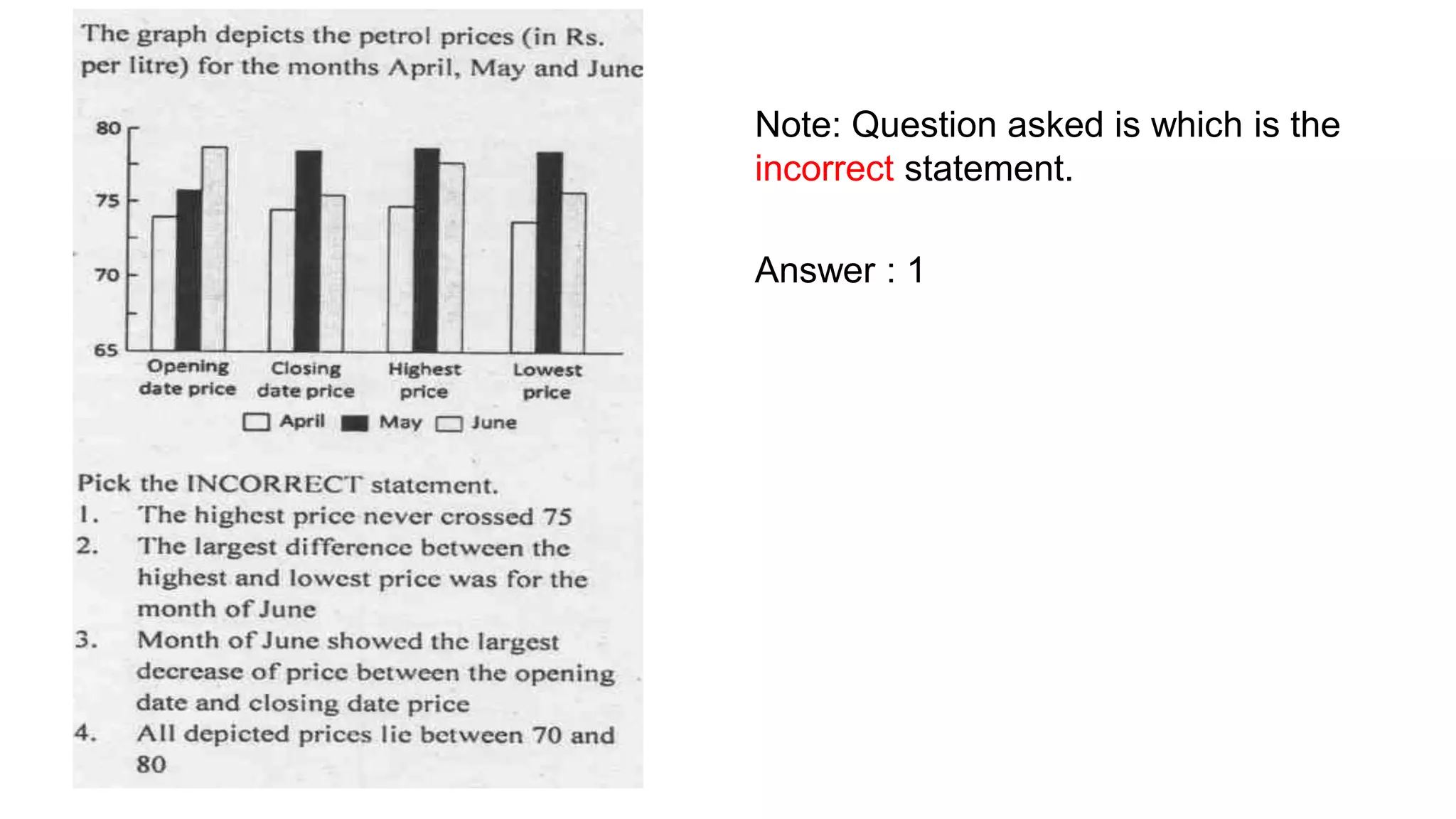
Note: Question asked is which is the
incorrect statement.
Answer : 1
1,2,3,4….9 – 1 digit (9)
10, 11, 12….99 – 2 digits (90 x 2 = 180)
2019 – (189) = 1830 ; 1830/3 = 610 ; 9 + 90 + 610 =709
100, 101, 102 …. 999 – 3 digits
Ans : 3 [(1 x 9) + (2 x 90) + (3 x 610) = 2019]
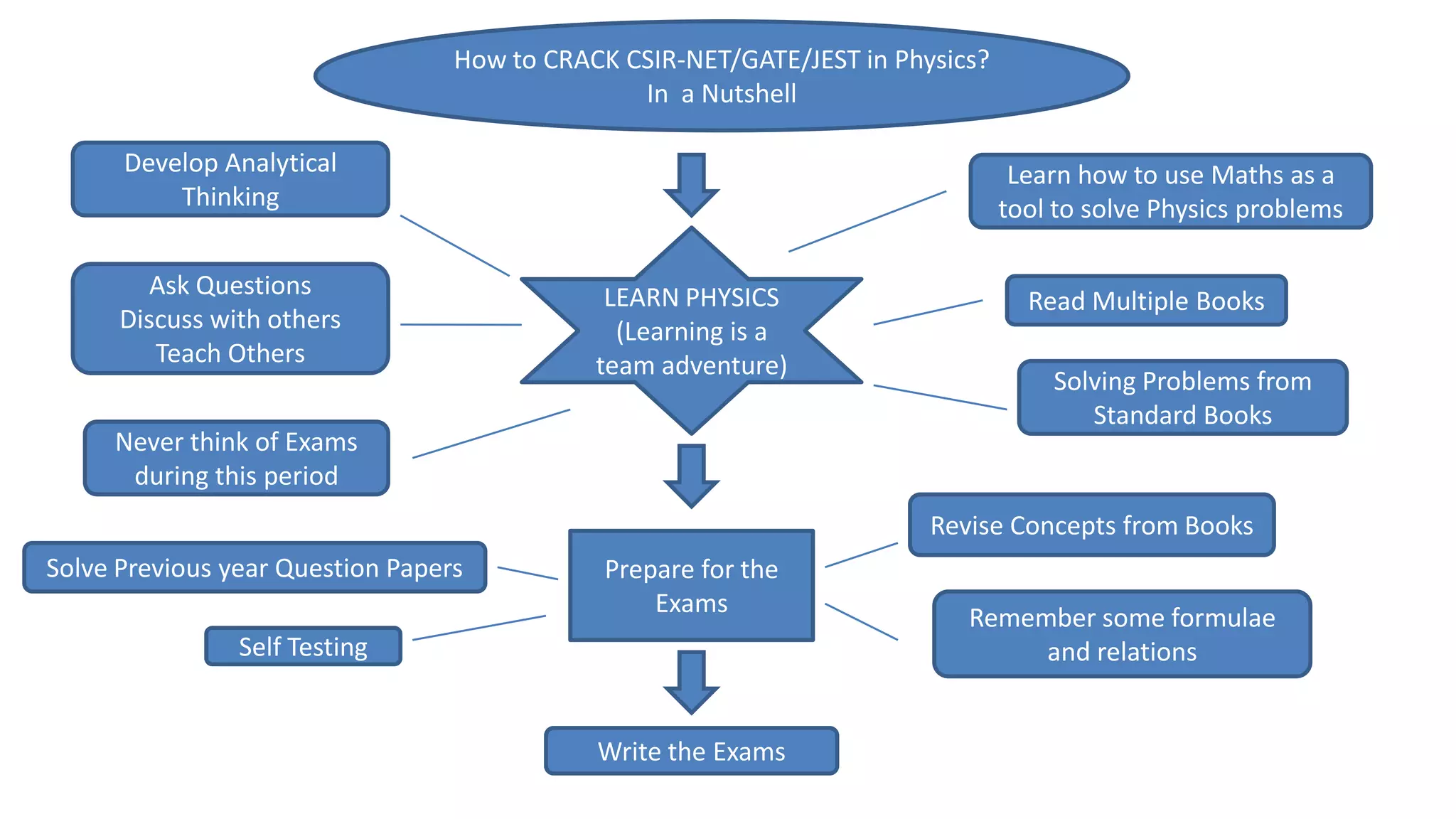
How to CRACK CSIR-NET/GATE/JEST in Physics?
In a Nutshell
LEARN PHYSICS
(Learning is a
team adventure)
Develop Analytical
Thinking
Ask Questions
Discuss with others
Teach Others
Never think of Exams
during this period
Learn how to use Maths as a
tool to solve Physics problems
Read Multiple Books
Solving Problems from
Standard Books
Solve Previous year Question Papers
Self Testing
Remember some formulae
and relations
Revise Concepts from Books
Write the Exams
Prepare for the
Exams
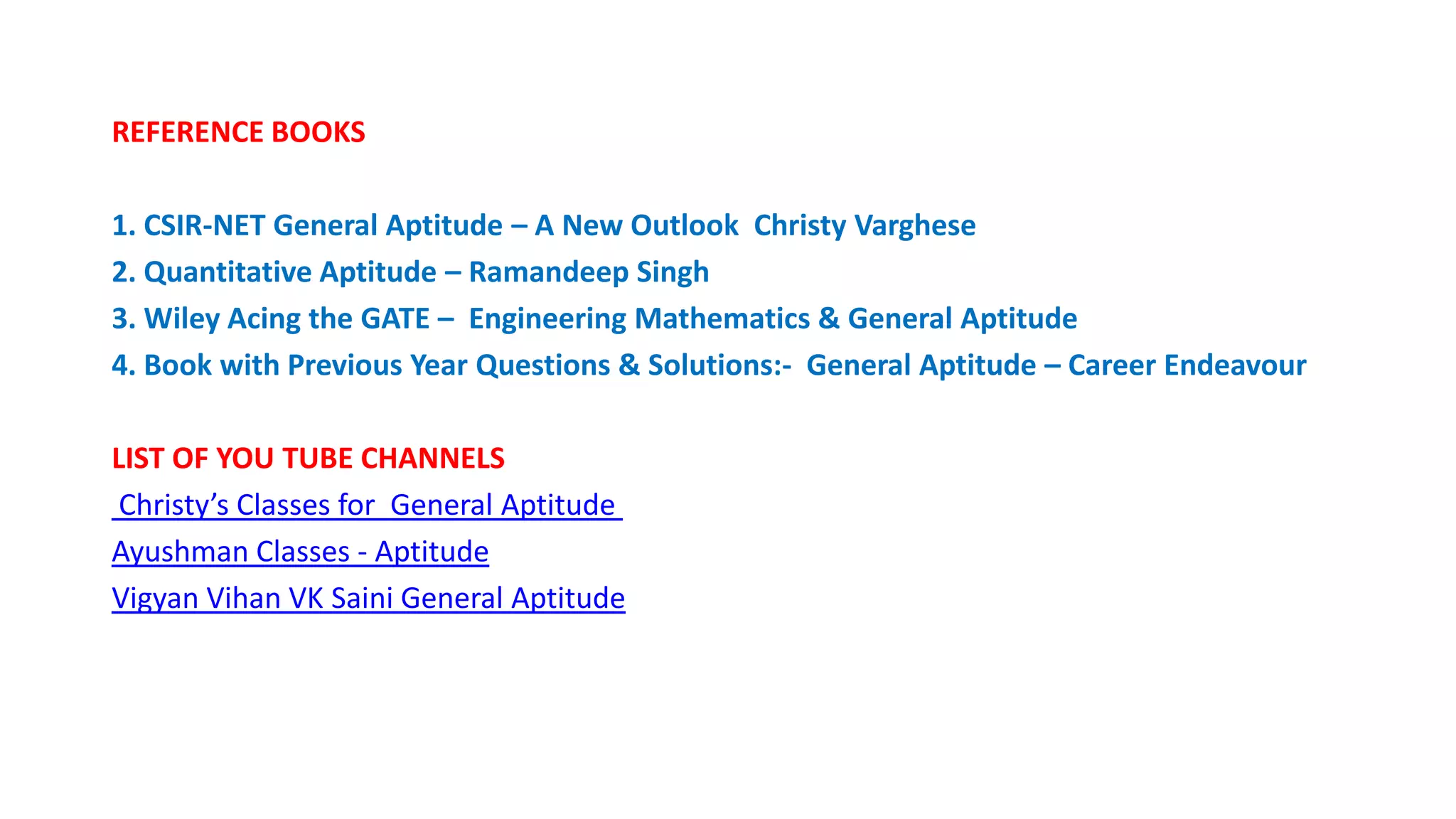
REFERENCE BOOKS
1. CSIR-NET General Aptitude – A New Outlook Christy Varghese
2. Quantitative Aptitude – Ramandeep Singh
3. Wiley Acing the GATE – Engineering Mathematics & General Aptitude
4. Book with Previous Year Questions & Solutions:- General Aptitude – Career Endeavour
LIST OF YOU TUBE CHANNELS
Christy’s Classes for General Aptitude
Ayushman Classes - Aptitude
Vigyan Vihan VK Saini General Aptitude
Thank you for our patience!!

CSIR-UGC-NET-TIPS and Tricks to prepare Part A - Aptitude and Reasoning

  • 1.
    TIPS and TRICKSto prepare CSIR-UGC NET- Part-A - General Dr. N. Meenakshi Sundaram Asst. Prof. of Physics Vivekananda College Tiruvedakam West Madurai – 625 234 JUNE 2020
  • 2.
    Want to clearEntrance Exams? KEY Factors for Success Self- Confidence Proper Planning Time Management Patience Concentration Determination
  • 3.
    General Mode ofPreparation  Understanding the exam pattern  Read and remember the syllabus  Analyse the cut-off marks  Set target of marks to get  Analyze previous year question papers  Collect study materials  Start your preparation
  • 4.
    STEP 1 BE FAMILIARWITH THE EXAM PATTERN (For Example : Physical Sciences) Sections Total Number of Questions You Should Answer Marks Negative Marking Nature of Questions PART A 20 15 2 each 0.5 General Science/ Reasoning/ Aptitude PART B 25 20 3.5 each 0.875 Physics PART C 30 20 5 each 1.25 Physics TOTAL 75 55 200
  • 5.
    STEP 2 GIVE MOREPRIORITY TO IMPORTANT TOPICS PART A - General Science, Quantitative Reasoning & Analysis and Research Aptitude S.No. Important Topics Weightage of Questions 1. Mensuration 2-3 2. Series Completion 2-3 3. Graphical Representation and Analysis 3-4 4. General Aptitude 4-5 5. Statistics/Data Interpretation 1-2
  • 6.
    PART-A Continued.. Clock Problem CalendarProblem Moving Locomotive Problem Series Formation Number Probability and Arrangements Distances and Directions Percentage Average Geometry Mensuration and Quantitative Comparisons Data Interpretation Observational Ability Logical Puzzles Monetary Problem Quantitative Aptitude and Logical Reasoning
  • 7.
    Number of seatsavailable Number of Applicants The marks scored by the candidates The difficulty level of exam Category of the candidates Previous years cutoff trends CSIR NET Cutoff mark is decided by the officials based on various factors There is no separate cut-off marks for PART A, B and C!!!
  • 8.
    TIP 1 FACT  Syllabusis very vast, you cannot cover every topic.  Every year questions are asked from few certain topics. What One can do?  Take Previous question papers (2011-2019) and analyze them for atleast 15 days.  Give more time to build up a strong strategy than learning.  Mark the topics according to priority – May be use a color code  Green (High); Blue (Medium); Red(Low)
  • 9.
    TIP 2 FACT They donot ask complicated questions. They ask questions on simple concept. What One can do?  Clear your basics.  Focus on actual basics first, then delve on deeper study.
  • 10.
    TIP 3 In PART-B: Don’t waste time on a single question. In PART-C : Analyze and Answer – Try to read the question twice or thrice to analyze. TIP 4 Guessing is not always harmful. Sometimes it’s a good idea to guess the answer, but wisely. (Not applicable for PART-A !!)
  • 11.
    TIP 5 FACT There arecertain topics in CSIR NET for which we can not learn the basics, we need to mug up. What One can do?  Make a table of such topics and read them daily.  You can also record them and listen when ever you feel like.
  • 12.
    Common mistakes duringPreparation  Not preparing consistently  Not making proper notes  Referring too many books  Doing Ph.D. on a single topic  Reading every book madly from page to page  Daydreaming  Just reading but not thinking  Going directionless - not preparing according to the syllabus  Feeling Isolated  Following the Quote “I will study in a focused manner from tomorrow ”
  • 14.
    PART- B &C Units Weightage – Physical Sciences Most Important Classical Mechanics Electromagnetic Theory Quantum Mechanics Compulsory Thermodynamics & Statistical Physics Mathematical Physics Electronics General Aptitude Complementary Atomic and Molecular Physics Condensed Matter Physics Nuclear and Particle Physics
  • 15.
    STEP 3 -Time Management  Don’t Avoid CSIR-NET Part A Syllabus  Give Daily 1 -1.5 Hrs  Revise the important topics 15 – 30 Minutes Daily  One could spend a month for the preparation  In general , 30 Minutes a day / 3 Hrs per Week
  • 16.
    Best Strategies  ObjectiveApproach  Rejection Approach (Eliminating 3 options out of 4)  Selection Approach (Choosing the Single Correct answer)  Read the Questions and Options Carefully  Choosing the Right method (Least time consuming) Mathematical Direct Method, Logical Direct Method, Elimination by Substitution, Eliminating by Analyzing the Options, Elimination by Selected Statements, Elimination by Related Options, Backward Induction, Trial and Error method, Visualization, Scale it and Measure it Method, Taking examples etc.,  Time factor (Not more than 2 minutes/question) – Maximum 30 Minutes for 15 Questions
  • 17.
    Best Strategies  Choosethe Right Questions ( Easy 7-8 ; 5-6 Medium; 6-8 Difficult)  Finding the Catch in the Questions  Choosing the Starting Points – Logical Reasoning  Get the Apt Questions – Locomotive problem for example (Emphasize is on Aptitude & Reasoning than accurate and speed Numerical Skills (Bank PO etc.,) !!)  Never Attempt Tough Problems at First  Always Start With Solving Simple Problems (It will aid in boosting confidence)  Use Smart Preparation Techniques (Analyzing questions and answers more closely while solving previous year question papers ; constructing mind maps, mnemonics etc., while preparing short notes)
  • 18.
    Study Plan  First,analyze the complete syllabus and previous year question papers of CSIR UGC NET General Aptitude, Part A. Make a list of your Strong, Moderate and Weak topics. With this, you will get an idea where to focus more, while preparing.  Self-Analysis – Fix Your Priority in order of their importance For self-examination, you should divide your Subject Expertise into 3 categories according to the syllabus such as Strong, Moderate and Weak topics. Strong Category: Easy category covers topics in which you have knowledge about the topic, and you are confident enough to solve the questions. Moderate Category: Moderate category includes topics that require a little modification and practice. Weak Category: Topics that fall into the difficult category which require preparation from basic level and more practice, mostly your weak area. This process will give you a proper analysis of your knowledge and will define your start towards the preparation of General Aptitude, Part A.
  • 19.
    Units Easy RequiresRegular Practice General Science Chemistry Physics and Biology Numerical Ability Basic Maths, LCM/HCF, Average, Permutation and Combination Probability, Ratio & Proportion, Number System, Time & Distance, Time & Speed, Time & Work, Series & Progression, Percentage Data Interpretation & Graphical Analysis Linear Graph and Bar Graph Logical Reasoning and Mental Ability Blood Relation, Odd One Out Reasoning, Direction, Nonverbal Reasoning (sequence) Venn Diagrams, Statement Based, Counting Figures, Coding Decoding, Seating Arrangement, Series Completion Statistics ---- Mean, Median and Mode Geometry ---- Circle, Triangle, Conic Section, Coordinates
  • 20.
    How to Start? •Start your preparation from Non-Practical Units (Non-Verbal Reasoning, General Science) as they are less time consuming and scoring • Units like Data Interpretation, Mathematical Reasoning and Aptitude, Logical Reasoning require Recurring Practice of Questions at least twice a week • Give equal importance to Numerical Ability and Logical Reasoning units, since both units are most important. • Go through your Basic Concepts of Mathematics (Ratio & Proportion, Average, Percentage). Data Interpretation is generally based on Statistics (Basic mathematics Concepts from Class 10th) so you must focus on statistics part which will help you to perform well in Data Interpretation. • In Logical Reasoning, most of the questions are based on simple concepts for Directions, Venn Diagram, Odd One Out, Blood Relations and Non-Verbal Reasoning, by them you can score more in less time.
  • 21.
    • Some ofthe topics require regular practice like Seating Arrangements, Coding Decoding and Series Completion so to solve them follow basic rules and tricks • From Statistics, Questions will be based on group or individual data so go for the concepts of Mean, Median and Mode while remembering options since many answers you can make correct after checking options only • Never Memorize a formula blindly. Try to know the concept behind it. Sometimes they twist the concept in a question so merely memorizing formula can lead to wrong answer. Learn  Practice  Revise  Test Analyze • Knowing is one thing but practicing really cements your logic and increases your speed and skills • Give as many mock tests as possible. Feel every test as your final exam and try to score as much as possible. Learn from your mistakes that which kind of problems you are comfortable in and which kind of problem takes more of your time.
  • 22.
    • When youstart any topic, always start with the basics, divide the sub-topics over time intervals and take a break of 10 mins between any subtopics to recall the portion you studied. This will help you absorb better because it gives your brain time to absorb the fundamentals and concepts • When you complete any topic, practice the solved examples and make short notes, it will help you in the last time preparation. Any Unit completion shall be followed by practicing questions related to unit. Revise the topics again. Check your accuracy as well as your speed. “You don’t have to be great to start, but you have to start to be great.” • When you have covered any unit, then just revise the short notes and give a quick practice to solved examples again, without looking at the solution. After that, Exercises in the reference material shall be tried by allotting it a maximum time of 3 hours. Assess your score and work on your mistakes & weak topics. Note: Same method is recommended to follow in all units.
  • 23.
    • Once youare done with the whole syllabus, it’s time to assess our true level of preparation by giving a shot at MSP (Model Solved papers). Revise the short notes and start practicing Model Solved papers (3 hours for every paper). Check your answers and calculate your marks to get an idea of your accuracy and speed. • Note down your mistakes and next day, revise topics related to mistakes, again try to solve the questions you were unable to solve. “Push Yourself, because no one else is going to do it for you.” • After solving all MSPs, Similar approach shall be followed in PSPs (Previous Year Test Papers). Compare your marks with cutoff of that year. Note: While solving PSP, note down the tricks which have been used to solve difficult questions. “Smart work always pays better than hard work” Let Us Solve a few Previous Year Questions!
  • 24.
    Solution : 2^(81),2^(64), 3^(16), 3^(16), 4^(8) = 2^(16), 4^(9)= 2^(18) Ans : (a) DEC 2012
  • 25.
    DEC 2012 24 (+6)30 (+3) 33  (+6) 39  (+12) 51  (+6) 57 Ans: (a)
  • 26.
    DEC 2012 Let nbe the number of slabs. Thus, 2 x 5 x 3 = n x (5/100) x 2 x 5 ;  n = 60 Area covered by 60 slabs = 60 x 2 x 5 m^2 Length of the pavement is = (60 x 2 x 5)/ 2 = 300 m Ans : (c)
  • 27.
  • 28.
    Let the givenquantity is ‘y’ (25/100) x (25/100) x y = (x/100) y x = 25/4 ;  x = 6.25 Ans: (a)
  • 29.
    Coins were notinvented in 200 BC, Hence the odd man out is (d)
  • 30.
    Ms. Brown -White Ms. Black - Brown Ms. White - Black Ans : (c)
  • 31.
  • 32.
  • 33.
    Every student willwrite 19 letters for each of his friends Hence, the number of letters written will be = 20 x 19 = 380 Ans : (d)
  • 34.
    40 % totalis obtained by S1 and S3 40 % in B is 28, S1 has scored 28 S3 though scored 40 % total scored less than 40 % in B Ans : 4
  • 35.
    Primer number isa number that is exactly divisible by 1 and by the number itself. Ans : 3. 157
  • 36.
    Note: Question askedis which is the incorrect statement. Answer : 1
  • 37.
    1,2,3,4….9 – 1digit (9) 10, 11, 12….99 – 2 digits (90 x 2 = 180) 2019 – (189) = 1830 ; 1830/3 = 610 ; 9 + 90 + 610 =709 100, 101, 102 …. 999 – 3 digits Ans : 3 [(1 x 9) + (2 x 90) + (3 x 610) = 2019]
  • 38.
    How to CRACKCSIR-NET/GATE/JEST in Physics? In a Nutshell LEARN PHYSICS (Learning is a team adventure) Develop Analytical Thinking Ask Questions Discuss with others Teach Others Never think of Exams during this period Learn how to use Maths as a tool to solve Physics problems Read Multiple Books Solving Problems from Standard Books Solve Previous year Question Papers Self Testing Remember some formulae and relations Revise Concepts from Books Write the Exams Prepare for the Exams
  • 39.
    REFERENCE BOOKS 1. CSIR-NETGeneral Aptitude – A New Outlook Christy Varghese 2. Quantitative Aptitude – Ramandeep Singh 3. Wiley Acing the GATE – Engineering Mathematics & General Aptitude 4. Book with Previous Year Questions & Solutions:- General Aptitude – Career Endeavour LIST OF YOU TUBE CHANNELS Christy’s Classes for General Aptitude Ayushman Classes - Aptitude Vigyan Vihan VK Saini General Aptitude
  • 40.
    Thank you forour patience!!