Trapezoidal rule,
Simpson's rule,
Simpsons 3/8th rule,
Boole's rule,
midpoint rule,
composite trapezoidal rule,
composite Simpson's rule
NUMERICAL
INTEGRATION :
 The antiderivatives of many functions either cannot be
expressed or cannot be expressed easily in closed form
(that is, in terms of known functions).
 Consequently, rather than evaluating definite integrals of
these functions directly, we resort to various techniques
of numerical integration to approximate their values.
 In this unit we will explore several of these techniques.
NUMERICAL INTEGRATION
 The process of evaluating a definite integral from a set of
tabulated values of the integrand f(x) is called numerical
integration.
 This process when applied to a function of a single
variable, is known as quadrature.
 The problem of numerical integration, like that of
numerical differentiation, is solved by representing f(x)
by an interpolation formula and then integrating it
between the given limits.
 Numerical integration of a function is calculated as the
area under the curve.
NUMERICAL INTEGRATION
 Assume that f(x) is continuous on [a,b].
 Let n be a positive integer and Δx=(b a)/n.
−
 If [a,b] is divided into n subintervals, each of length Δx,
and mi is the midpoint of the ith subinterval,
 Where,
THE MIDPOINT RULE
 As we can see in Figure, if f(x) 0 over [a,b], then
≥
corresponding to the sum of the areas of rectangles
approximates the area between the graph of f(x) and
the x-axis over [a,b].
THE MIDPOINT RULE
EX:
Compare the result with the actual value of this integral
EX:
 Use the midpoint rule with n=2 to estimate
TRY YOURSELF!
 Use the midpoint rule with n=2 to estimate
 Sol : 24/35
TRY YOURSELF!
NEWTON-COTES QUADRATURE
FORMULA
NEWTON-COTES QUADRATURE
FORMULA
NEWTON-COTES QUADRATURE
FORMULA
 This is known as Newton-Cotes quadrature formula. From this
general formula, we deduce the following important quadrature
rules by taking n = 1, 2, 3, ⋯
 In Trapezoidal rule we put n = 1 in (1) and taking the
curve through (x0, y0) and (x1, y1) as a straight line i.e., a
polynomial of first order so that differences of order
higher than first become zero.
TRAPEZOIDAL RULE
TRAPEZOIDAL RULE
Hence,
 Obs.
 1. The area of each strip (trapezium) is found separately.
Then the area under the curve and the ordinates at x0 and
xn is approximately equal to the sum of the areas of the n
trapeziums.
 2. Not accurate as mid point formula
 3. Also referred sometimes as composite Trapezoidal rule
TRAPEZOIDAL RULE
EX:
SOL
 Find the error in calculating the integral using the
Midpoint Rule and the trapezoidal rule for the integral
CALCULATING ERROR
 using the Midpoint Rule
 Using the trapezoidal rule for the integral
CALCULATING ERROR
 In this method, putting n = 2 in (1) Newton Cotes
quadrature formula and taking the curve through (x0,
y0), (x1,y1), and (x2, y2) as a parabola i.e., a polynomial
of the second order so that differences of order higher
than the second vanish we get the formula in simplified
form.
II. SIMPSON’S ONE-THIRD RULE
Hence,
 Obs.
 1. While applying this rule, the given interval must be
divided into an even number of equal subintervals, since we
find the area of two strips at a time.
 2. Also known as composite Simpson Rule
II. SIMPSON’S ONE-THIRD RULE
USE SIMPSON’S METHOD
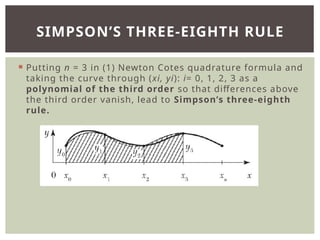
 Putting n = 3 in (1) Newton Cotes quadrature formula and
taking the curve through (xi, yi): i= 0, 1, 2, 3 as a
polynomial of the third order so that differences above
the third order vanish, lead to Simpson’s three-eighth
rule.
SIMPSON’S THREE-EIGHTH RULE
 Putting n = 3 in (1) Newton Cotes quadrature formula and
taking the curve through (xi, yi): i= 0, 1, 2, 3 as a
polynomial of the third order so that differences above
the third order vanish, lead to Simpson’s three-eighth
rule.
SIMPSON’S THREE-EIGHTH RULE
 Hence,
SIMPSON’S THREE-EIGHTH RULE
 Obs.
 While applying this formula, the number of sub-intervals
should be taken as a multiple of 3.
SIMPSON’S THREE-EIGHTH RULE
 Putting n = 4 in Newton Cotes quadrature formula and
taking the curve (xi, yi), i = 0, 1, 2, 3, 4 as a polynomial
of the fourth order and neglecting all differences above
the fourth, we obtain Boole’s formula
BOOLE’S RULE.
BOOLE’S RULE.
 Consider the integration of the function f(x) = 1 + e x
−
sin(4x) over [a, b] = [0, 1] using Boole’s rule with uniform
step size
 h = 1/4
 Consider the integration of the function f(x) = 1 + e x
−
sin(4x) over [a, b] = [0, 1] using Boole’s rule with uniform
step size
 h = ¼
 Solution
1.30859
 Obs.
 While applying Boole’s Rule, the number of sub-intervals
should be taken as a multiple of 4.
BOOLE’S RULE.
 Putting n = 6 in Newton’s Cotes formula and neglecting
all differences above the sixth, we obtain Weddle’s rule.
WEDDLE’S RULE.
 Obs. While applying Weddle's rule, the number of sub-
intervals should be taken as a multiple of 6.
 Weddle’s rule is generally more accurate than any of the
others.
 Of the two Simpson rules, the 1/3 rule is better.
WEDDLE’S RULE.
 Evaluate Integral of function from [0,6] by
using
(i) Trapezoidal rule,
(ii) Simpson’s 1/3 rule,
(iii) Simpson’s 3/8 rule,
(iv) Weddle’s rule and compare the results with its actual
value.
EXAMPLE
 Divide the interval (0, 6) into six parts each of width h =
1. The values of are given below:
SOLUTION:
SOLUTION:
SOLUTION:
 This shows that the value of the integral found by Weddle’s rule
is the nearest to the actual value followed by its value given by
Simpson’s 1/3 rule.
SOLUTION:
SOLUTION:
EXAMPLE
EXAMPLE
Solution:
Taking h = 0.2, n = 6.
The values of y are as given below:
TRY YOURSELF
 Let y(x) be a continuous function and has continuous
derivative in [x0,xn].
 Trapezoidal rule
ERRORS
 Error in Simpson’s 1/3 rule
 Error in Simpson’s 3/8 rule
 Error in Boole’s rule
 Error in Weddle’s rule
 Evaluate the integral using Trapezoidal Rule using 7
points.
EXAMPLE
5.2
4
log xdx

x 4 4.2 4.4 4.6 4.8 5 5.2
y 1.386294 1.435085 1.481605 1.526056 1.568616 1.609438 1.648659
 The velocity(v) of a particle at distance(s) from a point on
its path is given as follows
 Calculate the time taken to travel distance of 60 meter by
using Simpson’s Rule
EXAMPLE
S(mt) 0 10 20 30 40 50 60
V(mt/
s)
47 58 64 65 61 52 38
x 0 10 20 30 40 50 60
V(mt/s) 47 58 64 65 61 52 38
1/y 0.021277 0.017241 0.015625 0.015385 0.016393 0.019231 0.026316
 A car is moving at the speed of 30 m/sec, if suddenly
brakes applied the speed of the car per sec after t sec is
given
 Calculate the distance covered by the car in 45 sec using
Simpson’s 3/8 rule
EXAMPLE
0 5 10 15 20 25 30 35 40 45
30 24 19 16 13 11 10 8 7 5

Numerical integration for engineering students.pptx

  • 1.
    Trapezoidal rule, Simpson's rule, Simpsons3/8th rule, Boole's rule, midpoint rule, composite trapezoidal rule, composite Simpson's rule NUMERICAL INTEGRATION :
  • 2.
     The antiderivativesof many functions either cannot be expressed or cannot be expressed easily in closed form (that is, in terms of known functions).  Consequently, rather than evaluating definite integrals of these functions directly, we resort to various techniques of numerical integration to approximate their values.  In this unit we will explore several of these techniques. NUMERICAL INTEGRATION
  • 3.
     The processof evaluating a definite integral from a set of tabulated values of the integrand f(x) is called numerical integration.  This process when applied to a function of a single variable, is known as quadrature.  The problem of numerical integration, like that of numerical differentiation, is solved by representing f(x) by an interpolation formula and then integrating it between the given limits.  Numerical integration of a function is calculated as the area under the curve. NUMERICAL INTEGRATION
  • 4.
     Assume thatf(x) is continuous on [a,b].  Let n be a positive integer and Δx=(b a)/n. −  If [a,b] is divided into n subintervals, each of length Δx, and mi is the midpoint of the ith subinterval,  Where, THE MIDPOINT RULE
  • 5.
     As wecan see in Figure, if f(x) 0 over [a,b], then ≥ corresponding to the sum of the areas of rectangles approximates the area between the graph of f(x) and the x-axis over [a,b]. THE MIDPOINT RULE
  • 6.
    EX: Compare the resultwith the actual value of this integral
  • 7.
  • 9.
     Use themidpoint rule with n=2 to estimate TRY YOURSELF!
  • 10.
     Use themidpoint rule with n=2 to estimate  Sol : 24/35 TRY YOURSELF!
  • 11.
  • 12.
  • 13.
    NEWTON-COTES QUADRATURE FORMULA  Thisis known as Newton-Cotes quadrature formula. From this general formula, we deduce the following important quadrature rules by taking n = 1, 2, 3, ⋯
  • 14.
     In Trapezoidalrule we put n = 1 in (1) and taking the curve through (x0, y0) and (x1, y1) as a straight line i.e., a polynomial of first order so that differences of order higher than first become zero. TRAPEZOIDAL RULE
  • 15.
  • 16.
     Obs.  1.The area of each strip (trapezium) is found separately. Then the area under the curve and the ordinates at x0 and xn is approximately equal to the sum of the areas of the n trapeziums.  2. Not accurate as mid point formula  3. Also referred sometimes as composite Trapezoidal rule TRAPEZOIDAL RULE
  • 17.
  • 18.
  • 21.
     Find theerror in calculating the integral using the Midpoint Rule and the trapezoidal rule for the integral CALCULATING ERROR
  • 22.
     using theMidpoint Rule  Using the trapezoidal rule for the integral CALCULATING ERROR
  • 23.
     In thismethod, putting n = 2 in (1) Newton Cotes quadrature formula and taking the curve through (x0, y0), (x1,y1), and (x2, y2) as a parabola i.e., a polynomial of the second order so that differences of order higher than the second vanish we get the formula in simplified form. II. SIMPSON’S ONE-THIRD RULE
  • 24.
  • 25.
     Obs.  1.While applying this rule, the given interval must be divided into an even number of equal subintervals, since we find the area of two strips at a time.  2. Also known as composite Simpson Rule II. SIMPSON’S ONE-THIRD RULE
  • 26.
  • 28.
     Putting n= 3 in (1) Newton Cotes quadrature formula and taking the curve through (xi, yi): i= 0, 1, 2, 3 as a polynomial of the third order so that differences above the third order vanish, lead to Simpson’s three-eighth rule. SIMPSON’S THREE-EIGHTH RULE
  • 29.
     Putting n= 3 in (1) Newton Cotes quadrature formula and taking the curve through (xi, yi): i= 0, 1, 2, 3 as a polynomial of the third order so that differences above the third order vanish, lead to Simpson’s three-eighth rule. SIMPSON’S THREE-EIGHTH RULE
  • 30.
  • 31.
     Obs.  Whileapplying this formula, the number of sub-intervals should be taken as a multiple of 3. SIMPSON’S THREE-EIGHTH RULE
  • 32.
     Putting n= 4 in Newton Cotes quadrature formula and taking the curve (xi, yi), i = 0, 1, 2, 3, 4 as a polynomial of the fourth order and neglecting all differences above the fourth, we obtain Boole’s formula BOOLE’S RULE.
  • 33.
  • 34.
     Consider theintegration of the function f(x) = 1 + e x − sin(4x) over [a, b] = [0, 1] using Boole’s rule with uniform step size  h = 1/4
  • 35.
     Consider theintegration of the function f(x) = 1 + e x − sin(4x) over [a, b] = [0, 1] using Boole’s rule with uniform step size  h = ¼  Solution 1.30859
  • 36.
     Obs.  Whileapplying Boole’s Rule, the number of sub-intervals should be taken as a multiple of 4. BOOLE’S RULE.
  • 37.
     Putting n= 6 in Newton’s Cotes formula and neglecting all differences above the sixth, we obtain Weddle’s rule. WEDDLE’S RULE.
  • 38.
     Obs. Whileapplying Weddle's rule, the number of sub- intervals should be taken as a multiple of 6.  Weddle’s rule is generally more accurate than any of the others.  Of the two Simpson rules, the 1/3 rule is better. WEDDLE’S RULE.
  • 39.
     Evaluate Integralof function from [0,6] by using (i) Trapezoidal rule, (ii) Simpson’s 1/3 rule, (iii) Simpson’s 3/8 rule, (iv) Weddle’s rule and compare the results with its actual value. EXAMPLE
  • 40.
     Divide theinterval (0, 6) into six parts each of width h = 1. The values of are given below: SOLUTION:
  • 41.
  • 42.
  • 43.
     This showsthat the value of the integral found by Weddle’s rule is the nearest to the actual value followed by its value given by Simpson’s 1/3 rule. SOLUTION:
  • 44.
  • 45.
  • 46.
    EXAMPLE Solution: Taking h =0.2, n = 6. The values of y are as given below:
  • 48.
  • 49.
     Let y(x)be a continuous function and has continuous derivative in [x0,xn].  Trapezoidal rule ERRORS
  • 50.
     Error inSimpson’s 1/3 rule  Error in Simpson’s 3/8 rule
  • 51.
     Error inBoole’s rule  Error in Weddle’s rule
  • 52.
     Evaluate theintegral using Trapezoidal Rule using 7 points. EXAMPLE 5.2 4 log xdx  x 4 4.2 4.4 4.6 4.8 5 5.2 y 1.386294 1.435085 1.481605 1.526056 1.568616 1.609438 1.648659
  • 53.
     The velocity(v)of a particle at distance(s) from a point on its path is given as follows  Calculate the time taken to travel distance of 60 meter by using Simpson’s Rule EXAMPLE S(mt) 0 10 20 30 40 50 60 V(mt/ s) 47 58 64 65 61 52 38
  • 54.
    x 0 1020 30 40 50 60 V(mt/s) 47 58 64 65 61 52 38 1/y 0.021277 0.017241 0.015625 0.015385 0.016393 0.019231 0.026316
  • 55.
     A caris moving at the speed of 30 m/sec, if suddenly brakes applied the speed of the car per sec after t sec is given  Calculate the distance covered by the car in 45 sec using Simpson’s 3/8 rule EXAMPLE 0 5 10 15 20 25 30 35 40 45 30 24 19 16 13 11 10 8 7 5