DHANUJA.N
2019508005
Nucleic acid and its chemistry - DNA, RNA,
DNA as genetic material
 The nucleic acids are vital biopolymers found in all living
organisms, where they function to encode, transfer, and
express genes. The nucleic acids are of two types, namely
deoxyribonucleic acid (DNA) and ribonucleic acid(RNA)
HISTORY:
 Friedric Miescher (1868) discovered an acidic substance
from pus cells and named it as Nuclein
 Altman (1889) coined the term Nucleic acids
NITROGEN BASES
Purines
 Adenine, guanine
 Dicyclic molecules
 4 N atoms at 1,3,5,9
positions
 Glycosidic bond formed
between 1 C of pentose
sugar and N (9) of purine
Pyrimidines
 Cytosine, thymine, uracil
 monocyclic molecules
 2 N atoms at 1,3, positions
 Glycosidic bond formed
between 1 C of pentose
sugar and N (1) of pyrimidine
Pentose sugar:
Form glycosidic bond
RNA – Ribose sugar
DNA – Deoxyribose sugar
Phosphoric acid
Attached to 5 C of pentose
sugar by phospho diester
bond
Minor bases
Several minor & unusual bases are often found in DNA &
RNA
 These include 5-methylcytosine, N4-acetylcytosine, N6
methyl
adenine, N6 dimethyl adenine, dihydrouracil & N7
methylguanine
Importance:
 The unusual bases in nucleic acids help in the recognition
of
specific enzymes.
DNA
 Location : In eukaryotes it is present in both nucleus and
cytoplasm.
In prokaryotes it is found in cytoplasm.
 Structure: Double stranded structure, however in some
viruses it is single stranded.
 Shape : In eukaryotes, DNA is of linear shape. In
prokaryotes and mitochondria DNA is circular.
 Replication: Semi-conservative manner.
 Types : A , B, C, D and Z forms of DNA. (tropic and
genetic)
 Functions: Stores and transforms genetic information
and involved in mRNA synthesis.
STRUCTURE OF DNA: Watson and Crick
proposed double helix structure in 1953 (term DNA -
Zacharis)
Features of DNA double helix structure:
• Double helix structure
• Each strand is made up of a chain of
nucleotides
• 2 strands run antiparallel to each other
• Purine always pairs with pyrimidine
• The diameter of the helix is 20Å. Pitch of the
helix is 34Å and 10bp in each turn. Adjacent
bases are separated by 3.4Å.
• The two chains are held together by hydrogen
bonds between the nitrogen bases. (A=T,
C=G)
Rosalind Franklin
- X-ray diffraction
Photo 51 analysis
 X- helix
 Diamonds - long extended
molecules
 Smear spacing- distance
between repeating structures
 CHARGAFF’S RULE
 Purine=Pyrimidine.
 A=T & G=C
 A+G/C+T=1.
 CG Rule: The overall G+C content is species specific, it
tends to be higher in exons than the introns
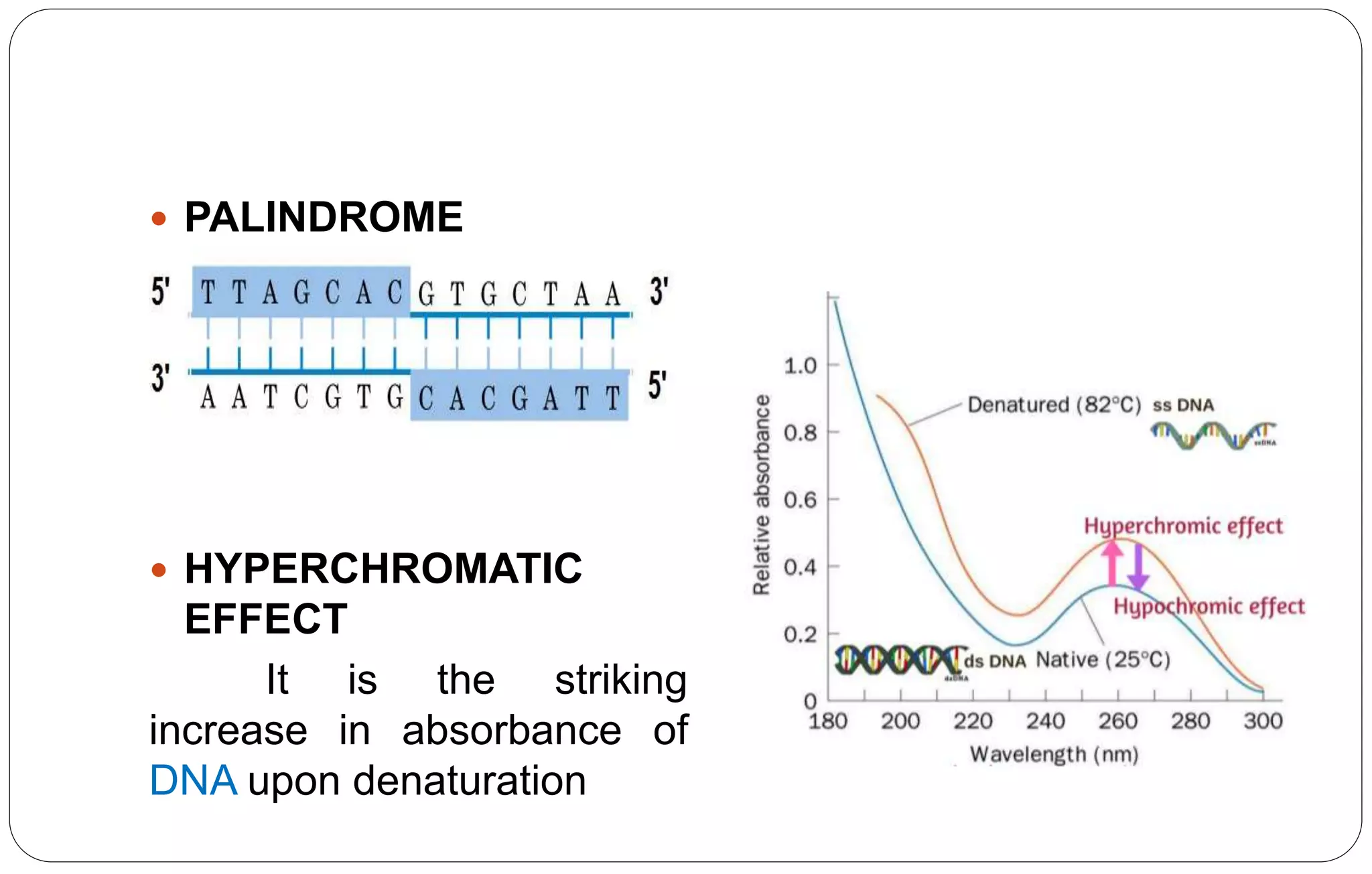
 PALINDROME
SEQUENCE
 HYPERCHROMATIC
EFFECT
It is the striking
increase in absorbance of
DNA upon denaturation
Which Came First?
RNA OR DNA
 Most scientists believe RNA evolved before DNA. RNA has
a simpler structure and is needed in order for DNA to
function. Also, RNA is found in prokaryotes.
 RNA on its own can act as a catalyst for certain chemical
reactions.
Why DNA evolved if RNA existed?
 Having a double-stranded molecule helps protect the
genetic code from damage. If one strand is broken, the
other strand can serve as a template for repair.
RNA
 A nucleic acid that carries the genetic message from DNA
to ribosomes and is involved in the process of protein
synthesis is referred to as RNA. It contains:
 Ribose sugar
 Nitrogen base (A, G, U, C)
 Phosphoric acid
Heterogeneous RNA( hnRNA):
 Precursor RNA synthesized from DNA through transcription.
Contains both exons and introns.
Messenger RNA( mRNA) :
 It constitutes about 5% of total RNA in the cell.
 Role: carries the information for the protein synthesis.
 mRNA is formed after processing of hnRNA. Processed
through the process of capping (7-methyl guanosine is
added to the 5’ terminal end), tailing, splicing and base
modifications.
Transfer RNA (tRNA) ( soluble RNA or adapter molecules)
 Smallest of all the 3 major RNA (mRNA, rRNA, tRNA)
 Role : transfers amino acids from cytoplasm to protein
synthesis machinery.
 The first nucleic acid to be completely sequenced was
tRNA ( tRNA alanine), by HOLLEY and Co-workers.
Ribosomal RNA( rRNA) :
 rRNA is synthesized in nucleolus.
 Role : Plays an important role in binding of mRNA to
ribosome and its translation.
Functions of RNA:
 Storage function:Many viruses have RNA as genetic
material, it may be ssRNA or dsRNA.
 Structural RNA: rRNA is the major component of ribosome.
 Transfer function: mRNA encodes for protein synthesis
involved in transfer of genetic information.
 Catalytic function: RNA in ribosomes has peptidyl
transferase activity which is responsible for formation of
peptide bond between the amino acids. Ribozymes have
catalytic activity.
 Regulatory function: siRNA, miRNA are involved in plant
defense mechanism.
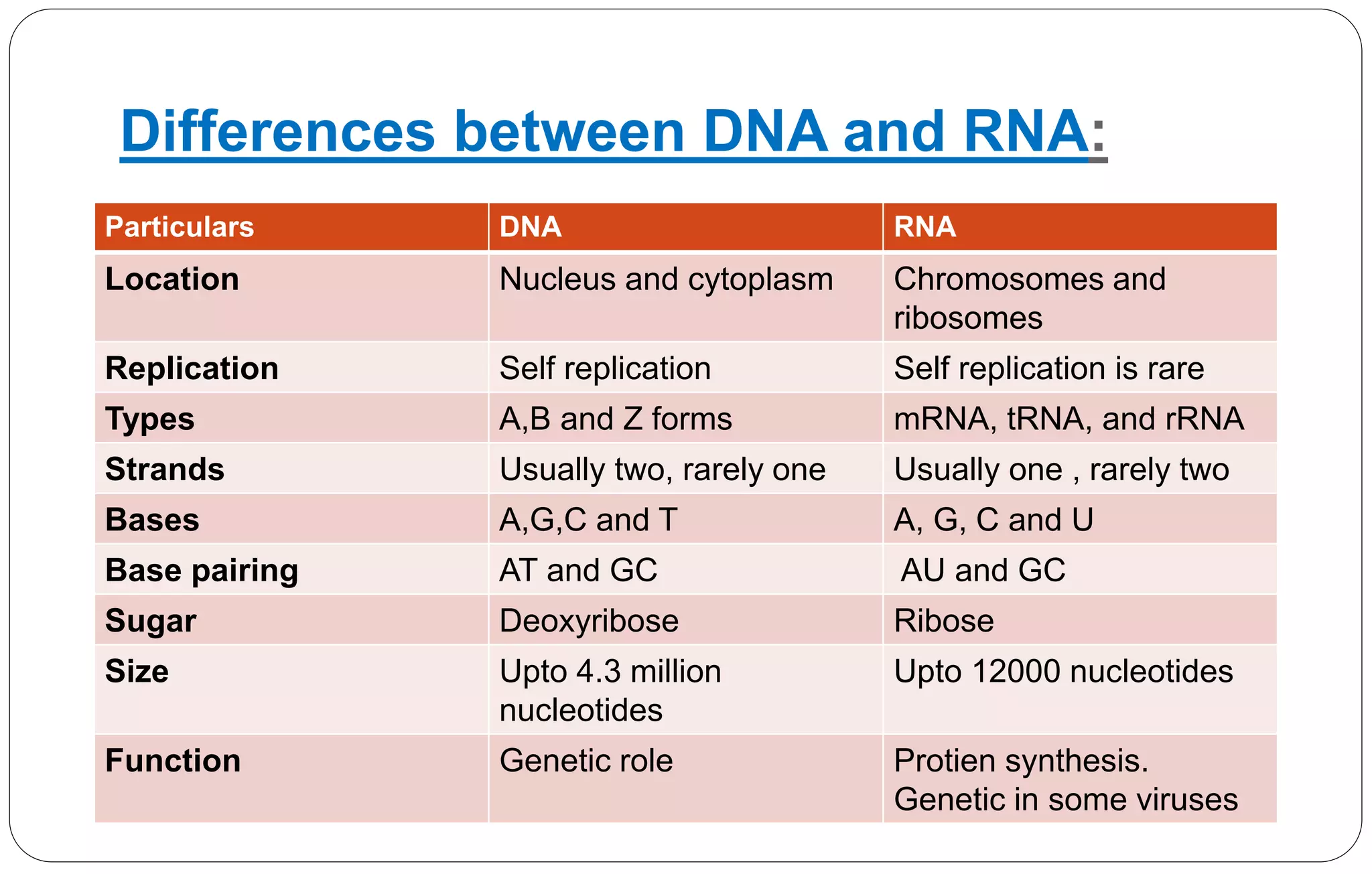
Differences between DNA and RNA:
Particulars DNA RNA
Location Nucleus and cytoplasm Chromosomes and
ribosomes
Replication Self replication Self replication is rare
Types A,B and Z forms mRNA, tRNA, and rRNA
Strands Usually two, rarely one Usually one , rarely two
Bases A,G,C and T A, G, C and U
Base pairing AT and GC AU and GC
Sugar Deoxyribose Ribose
Size Upto 4.3 million
nucleotides
Upto 12000 nucleotides
Function Genetic role Protien synthesis.
Genetic in some viruses
CHARACTERISTICS OF GENETIC
MATERIAL
 Replication
 Storage information for the expression of the trait
 Control expression of traits
 Change in controlled way (undergo mutation)
 Must be stable
Is the Genetic Material Protein or DNA?
 Untill 1940 Proteins were considered as genetic material
as proteins are polymer of 20 protein amino acids and
present in larger quantity, encode more and variety of
information.
 DNA is polymer of only 4 different deoxyribonucleotides
(ATP, CTP, GTP & TTP) and is present in smaller quantity
Evidences which prove DNA as Genetic Material
 Frederick Griffith’s (1928) experiment on Bacterial
Transformation
 Oswald Avery, Colin Macleod and Maclyn McCarty’s
(1944) experiment on Transformation
 Alfred D. Hershey and Martha Chase (1952 ) experiment
on T- Even (2,4 ) Bacteriophage
GRIFFITH’S EXPERIMENT ON
BACTERIAL TRANSFORMATION (1928)
 It was postulated that some of the cells of IIR had changed
into III S type due to the influence of he dead III S cells
present in the mixture
 This phenomenon was called transformation
 The components of the IIIS cells which induced the
conversion of II R cells into III S cells was named the
transforming principle
Avery, Macleod and Mc Carty (1944)
experiment on Transformation
 Carried out the experiments of Griffith in vitro
 They concluded that DNA was the genetic material and
not the proteins. Because the transformation occurred
when the DNA was present in the extract and there was no
transformation when DNA was digested with DNAse
enzyme
Hershey and Chase (1952)
 Universal acceptance of DNA as the genetic material
 The studies of Hershey and Chase clearly showed that
DNA of T2 is transmitted from one generation to next, while
proteins are not transmitted
 This led to the universal acceptance of DNA as the
genetic material
Recent findings - Scientists Have Created
Synthetic DNA with 4 Extra Letters
 "HACHIMOJI“
 Much greater capacity to
store information.
 P, B, Z and S.
 Stable and predictable.
 Hachimoji RNA
 NO self sustainability
Water, not hydrogen bonds, key to DNA
double helix
References
 Singh, B.D. 2018. “Fundamentals of Genetics”. New delhi,
Kalyani publishers, 359-370
 Gardner, E.J., M.J.Simmons, and D.P.Snustad. 2012. “
Principles of genetics”. New delhi, Wiley India Pvt. Ltd., 92-
103
 www2.chemistry.msu.edu/faculty/reusch/VirtTxtJml/nucacid
s.htm
 www.britannica.com/science/nucleic-acid
 www.thoughtco.com/nucleic-acids-structure-and-function-
4025779

Nucleic acid and its chemistry - DNA, RNA, DNA as genetic material

  • 1.
    DHANUJA.N 2019508005 Nucleic acid andits chemistry - DNA, RNA, DNA as genetic material
  • 2.
     The nucleicacids are vital biopolymers found in all living organisms, where they function to encode, transfer, and express genes. The nucleic acids are of two types, namely deoxyribonucleic acid (DNA) and ribonucleic acid(RNA) HISTORY:  Friedric Miescher (1868) discovered an acidic substance from pus cells and named it as Nuclein  Altman (1889) coined the term Nucleic acids
  • 4.
    NITROGEN BASES Purines  Adenine,guanine  Dicyclic molecules  4 N atoms at 1,3,5,9 positions  Glycosidic bond formed between 1 C of pentose sugar and N (9) of purine Pyrimidines  Cytosine, thymine, uracil  monocyclic molecules  2 N atoms at 1,3, positions  Glycosidic bond formed between 1 C of pentose sugar and N (1) of pyrimidine
  • 6.
    Pentose sugar: Form glycosidicbond RNA – Ribose sugar DNA – Deoxyribose sugar Phosphoric acid Attached to 5 C of pentose sugar by phospho diester bond
  • 8.
    Minor bases Several minor& unusual bases are often found in DNA & RNA  These include 5-methylcytosine, N4-acetylcytosine, N6 methyl adenine, N6 dimethyl adenine, dihydrouracil & N7 methylguanine Importance:  The unusual bases in nucleic acids help in the recognition of specific enzymes.
  • 9.
    DNA  Location :In eukaryotes it is present in both nucleus and cytoplasm. In prokaryotes it is found in cytoplasm.  Structure: Double stranded structure, however in some viruses it is single stranded.  Shape : In eukaryotes, DNA is of linear shape. In prokaryotes and mitochondria DNA is circular.  Replication: Semi-conservative manner.  Types : A , B, C, D and Z forms of DNA. (tropic and genetic)  Functions: Stores and transforms genetic information and involved in mRNA synthesis.
  • 10.
    STRUCTURE OF DNA:Watson and Crick proposed double helix structure in 1953 (term DNA - Zacharis) Features of DNA double helix structure: • Double helix structure • Each strand is made up of a chain of nucleotides • 2 strands run antiparallel to each other • Purine always pairs with pyrimidine • The diameter of the helix is 20Å. Pitch of the helix is 34Å and 10bp in each turn. Adjacent bases are separated by 3.4Å. • The two chains are held together by hydrogen bonds between the nitrogen bases. (A=T, C=G)
  • 11.
    Rosalind Franklin - X-raydiffraction Photo 51 analysis  X- helix  Diamonds - long extended molecules  Smear spacing- distance between repeating structures
  • 12.
     CHARGAFF’S RULE Purine=Pyrimidine.  A=T & G=C  A+G/C+T=1.  CG Rule: The overall G+C content is species specific, it tends to be higher in exons than the introns
  • 13.
     PALINDROME SEQUENCE  HYPERCHROMATIC EFFECT Itis the striking increase in absorbance of DNA upon denaturation
  • 14.
    Which Came First? RNAOR DNA  Most scientists believe RNA evolved before DNA. RNA has a simpler structure and is needed in order for DNA to function. Also, RNA is found in prokaryotes.  RNA on its own can act as a catalyst for certain chemical reactions. Why DNA evolved if RNA existed?  Having a double-stranded molecule helps protect the genetic code from damage. If one strand is broken, the other strand can serve as a template for repair.
  • 15.
    RNA  A nucleicacid that carries the genetic message from DNA to ribosomes and is involved in the process of protein synthesis is referred to as RNA. It contains:  Ribose sugar  Nitrogen base (A, G, U, C)  Phosphoric acid
  • 16.
    Heterogeneous RNA( hnRNA): Precursor RNA synthesized from DNA through transcription. Contains both exons and introns. Messenger RNA( mRNA) :  It constitutes about 5% of total RNA in the cell.  Role: carries the information for the protein synthesis.  mRNA is formed after processing of hnRNA. Processed through the process of capping (7-methyl guanosine is added to the 5’ terminal end), tailing, splicing and base modifications.
  • 17.
    Transfer RNA (tRNA)( soluble RNA or adapter molecules)  Smallest of all the 3 major RNA (mRNA, rRNA, tRNA)  Role : transfers amino acids from cytoplasm to protein synthesis machinery.  The first nucleic acid to be completely sequenced was tRNA ( tRNA alanine), by HOLLEY and Co-workers. Ribosomal RNA( rRNA) :  rRNA is synthesized in nucleolus.  Role : Plays an important role in binding of mRNA to ribosome and its translation.
  • 18.
    Functions of RNA: Storage function:Many viruses have RNA as genetic material, it may be ssRNA or dsRNA.  Structural RNA: rRNA is the major component of ribosome.  Transfer function: mRNA encodes for protein synthesis involved in transfer of genetic information.  Catalytic function: RNA in ribosomes has peptidyl transferase activity which is responsible for formation of peptide bond between the amino acids. Ribozymes have catalytic activity.  Regulatory function: siRNA, miRNA are involved in plant defense mechanism.
  • 19.
    Differences between DNAand RNA: Particulars DNA RNA Location Nucleus and cytoplasm Chromosomes and ribosomes Replication Self replication Self replication is rare Types A,B and Z forms mRNA, tRNA, and rRNA Strands Usually two, rarely one Usually one , rarely two Bases A,G,C and T A, G, C and U Base pairing AT and GC AU and GC Sugar Deoxyribose Ribose Size Upto 4.3 million nucleotides Upto 12000 nucleotides Function Genetic role Protien synthesis. Genetic in some viruses
  • 21.
    CHARACTERISTICS OF GENETIC MATERIAL Replication  Storage information for the expression of the trait  Control expression of traits  Change in controlled way (undergo mutation)  Must be stable
  • 22.
    Is the GeneticMaterial Protein or DNA?  Untill 1940 Proteins were considered as genetic material as proteins are polymer of 20 protein amino acids and present in larger quantity, encode more and variety of information.  DNA is polymer of only 4 different deoxyribonucleotides (ATP, CTP, GTP & TTP) and is present in smaller quantity
  • 23.
    Evidences which proveDNA as Genetic Material  Frederick Griffith’s (1928) experiment on Bacterial Transformation  Oswald Avery, Colin Macleod and Maclyn McCarty’s (1944) experiment on Transformation  Alfred D. Hershey and Martha Chase (1952 ) experiment on T- Even (2,4 ) Bacteriophage
  • 24.
  • 26.
     It waspostulated that some of the cells of IIR had changed into III S type due to the influence of he dead III S cells present in the mixture  This phenomenon was called transformation  The components of the IIIS cells which induced the conversion of II R cells into III S cells was named the transforming principle
  • 27.
    Avery, Macleod andMc Carty (1944) experiment on Transformation  Carried out the experiments of Griffith in vitro  They concluded that DNA was the genetic material and not the proteins. Because the transformation occurred when the DNA was present in the extract and there was no transformation when DNA was digested with DNAse enzyme
  • 29.
    Hershey and Chase(1952)  Universal acceptance of DNA as the genetic material  The studies of Hershey and Chase clearly showed that DNA of T2 is transmitted from one generation to next, while proteins are not transmitted  This led to the universal acceptance of DNA as the genetic material
  • 31.
    Recent findings -Scientists Have Created Synthetic DNA with 4 Extra Letters  "HACHIMOJI“  Much greater capacity to store information.  P, B, Z and S.  Stable and predictable.  Hachimoji RNA  NO self sustainability
  • 32.
    Water, not hydrogenbonds, key to DNA double helix
  • 33.
    References  Singh, B.D.2018. “Fundamentals of Genetics”. New delhi, Kalyani publishers, 359-370  Gardner, E.J., M.J.Simmons, and D.P.Snustad. 2012. “ Principles of genetics”. New delhi, Wiley India Pvt. Ltd., 92- 103  www2.chemistry.msu.edu/faculty/reusch/VirtTxtJml/nucacid s.htm  www.britannica.com/science/nucleic-acid  www.thoughtco.com/nucleic-acids-structure-and-function- 4025779