Nucleic Acid Chemistry www.freelivedoctor.com
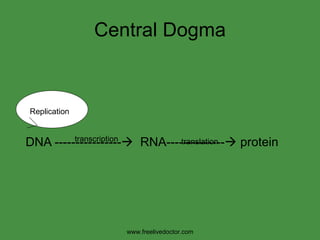
Central Dogma DNA ----------------    RNA--------------   protein Replication transcription translation www.freelivedoctor.com
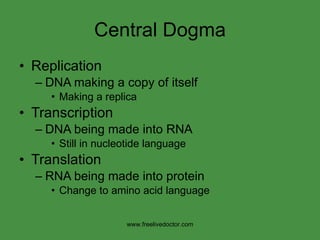
Central Dogma Replication DNA making a copy of itself Making a replica Transcription DNA being made into RNA Still in nucleotide language Translation RNA being made into protein Change to amino acid language www.freelivedoctor.com
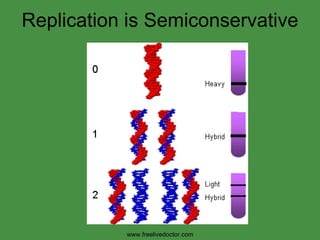
Replication Remember that DNA is self complementary Replication is semiconservative One strand goes to next generation Other is new  Each strand is a template for the other If one strand is  5’ AGCT 3’ Other  is:  3’ TCGA 5’ www.freelivedoctor.com
Replication is Semiconservative www.freelivedoctor.com
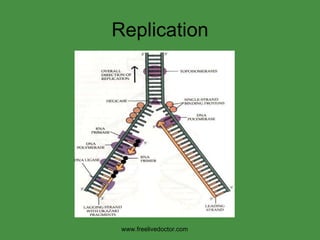
Replication Roles of enzymes Topoisomerases Helicase DNA polymerases ligase DNA binding proteins DNA synthesis Leading strand Lagging strand www.freelivedoctor.com
Replication www.freelivedoctor.com
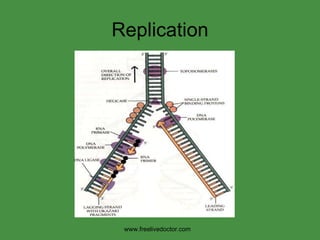
Replication Helix opens Helicase Causes supercoiling upstream Topoisomerases (gyrase) DNA Binding Proteins Prevent reannealing www.freelivedoctor.com
Replication www.freelivedoctor.com
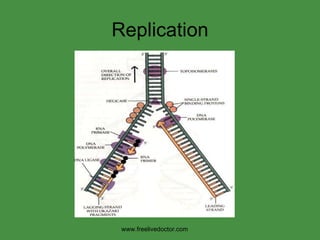
Replication Leading strand 3’ end of template As opens up, DNA polymerase binds Makes new DNA 5’ -   3’ Same direction as opening of helix Made continuously www.freelivedoctor.com
Replication www.freelivedoctor.com
Replication Lagging strand 5’ end of template Can’t be made continuously as direction is wrong RNA primer New DNA made 5’    3’ Opposite direction of replication Discontinuous Okazaki fragments Ligase closes gaps www.freelivedoctor.com
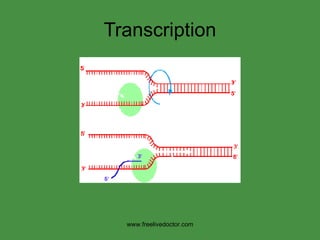
Transcription DNA template made into RNA copy Uracil instead of Thymine One DNA strand is template Sense strand Other is just for replication  Antisense In nucleus nucleoli www.freelivedoctor.com
Transcription www.freelivedoctor.com
Transcription DNA opens up Enzymes? RNA polymerase binds  Which strand? Using DNA template, makes RNA  5’-  3’ Raw transcript called hnRNA www.freelivedoctor.com
Transcription How does RNA polymerase know where to start? upstream promotor sequences Pribnow Box TATA box RNA polymerase starts transcription X nucleotides downstream of TATA box www.freelivedoctor.com
Introns and Exons Introns Intervening sequences Not all DNA codes for protein Regulatory info, “junk DNA” Exons Code for protein www.freelivedoctor.com
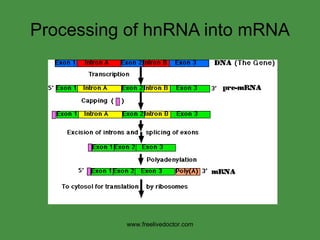
Processing of hnRNA into mRNA 3 steps Introns removed Self splicing 5’ methyl guanosine cap added Poly A tail added Moved to cytosol for translation www.freelivedoctor.com
Processing of hnRNA into mRNA www.freelivedoctor.com
Translation RNA --   Protein Change from nucleotide language to amino acid language On ribosomes Vectorial nature preserved 5’ end of mRNA becomes amino terminus of protein Translation depends on genetic code www.freelivedoctor.com
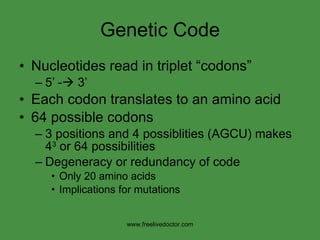
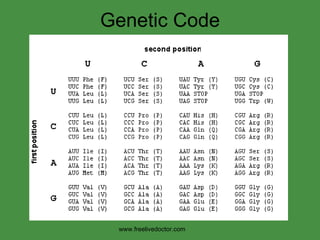
Genetic Code Nucleotides read in triplet “codons” 5’ -   3’ Each codon translates to an amino acid 64 possible codons 3 positions and 4 possiblities (AGCU) makes 4 3  or 64 possibilities Degeneracy or redundancy of code Only 20 amino acids Implications for mutations www.freelivedoctor.com
Genetic Code www.freelivedoctor.com
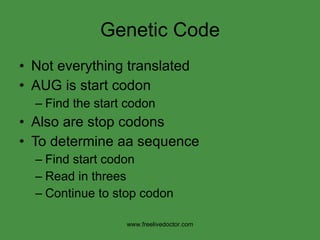
Genetic Code Not everything translated AUG is start codon Find the start codon Also are stop codons To determine aa sequence Find start codon Read in threes Continue to stop codon www.freelivedoctor.com
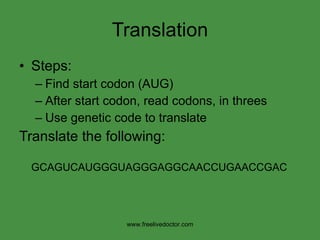
Translation Steps: Find start codon (AUG)  After start codon, read codons, in threes Use genetic code to translate Translate the following: GCAGUCAUGGGUAGGGAGGCAACCUGAACCGAC www.freelivedoctor.com
Translation Process Requires Ribosomes, rRNA, tRNA and, of course, mRNA Ribosome Made of protein and rRNA 2 subunits Has internal sites for 2 transfer RNA molecules www.freelivedoctor.com
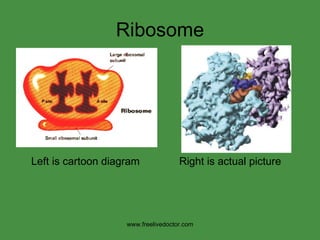
Ribosome Left is cartoon diagram   Right is actual picture www.freelivedoctor.com
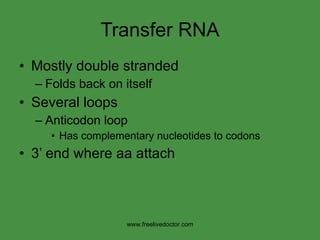
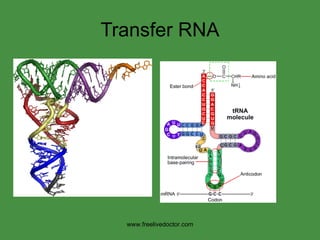
Transfer RNA Mostly double stranded Folds back on itself Several loops Anticodon loop Has complementary nucleotides to codons 3’ end where aa attach www.freelivedoctor.com
Transfer RNA www.freelivedoctor.com
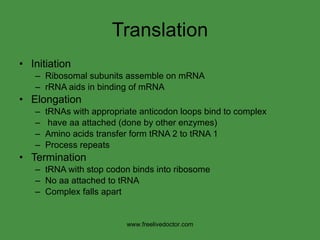
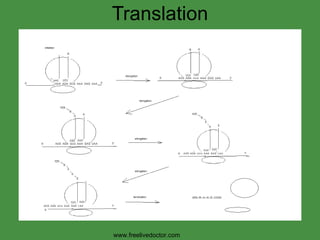
Translation Initiation Ribosomal subunits assemble on mRNA rRNA aids in binding of mRNA Elongation tRNAs with appropriate anticodon loops bind to complex have aa attached (done by other enzymes) Amino acids transfer form tRNA 2 to tRNA 1 Process repeats Termination tRNA with stop codon binds into ribosome No aa attached to tRNA Complex falls apart www.freelivedoctor.com
Translation www.freelivedoctor.com
Mutations Changes in nucleotide sequence Can cause changes in aa sequence Degeneracy in genetic code can prevent Two types Point mutations Single nucleotide changes Frame shift Insertions or deletions www.freelivedoctor.com
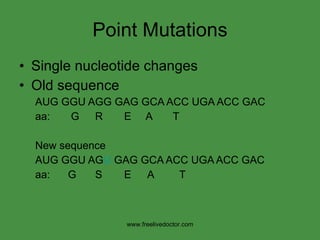
Point Mutations Single nucleotide changes Old sequence AUG   GGU AGG GAG GCA ACC UGA ACC GAC aa:  G   R   E  A  T New sequence AUG   GGU AG U  GAG GCA ACC UGA ACC GAC aa:  G   S   E A T www.freelivedoctor.com
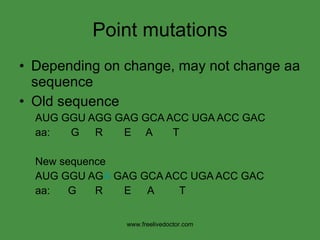
Point mutations Depending on change, may not change aa sequence Old sequence AUG   GGU AGG GAG GCA ACC UGA ACC GAC aa:  G   R   E  A  T New sequence AUG   GGU AG A  GAG GCA ACC UGA ACC GAC aa:  G   R   E A T www.freelivedoctor.com
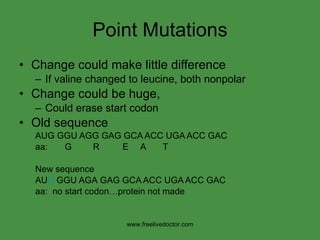
Point Mutations Change could make little difference If valine changed to leucine, both nonpolar Change could be huge, Could erase start codon Old sequence AUG   GGU AGG GAG GCA ACC UGA ACC GAC aa:  G   R   E  A  T New sequence AU U  GGU AG A  GAG GCA ACC UGA ACC GAC aa:  no start codon…protein not made www.freelivedoctor.com
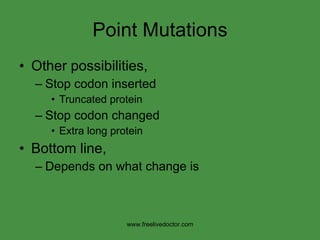
Point Mutations Other possibilities, Stop codon inserted Truncated protein Stop codon changed Extra long protein Bottom line, Depends on what change is www.freelivedoctor.com
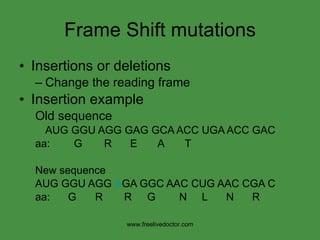
Frame Shift mutations Insertions or deletions Change the reading frame Insertion example Old sequence AUG   GGU AGG GAG GCA ACC UGA ACC GAC aa:  G   R   E  A  T New sequence AUG   GGU AGG  A GA GGC AAC CUG AAC CGA C aa:  G   R   R G N  L   N   R www.freelivedoctor.com
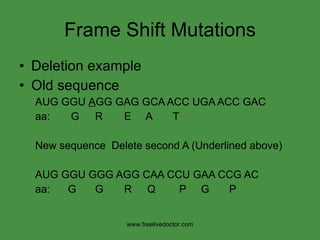
Frame Shift Mutations Deletion example Old sequence AUG   GGU  A GG GAG GCA ACC UGA ACC GAC aa:  G   R   E  A  T New sequence  Delete second A (Underlined above) AUG   GGU GGG AGG CAA CCU GAA CCG AC aa:  G   G   R Q P  G   P www.freelivedoctor.com
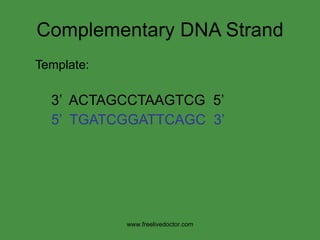
Complementary DNA Strand Template: 3’  ACTAGCCTAAGTCG  5’ 5’  TGATCGGATTCAGC  3’ www.freelivedoctor.com
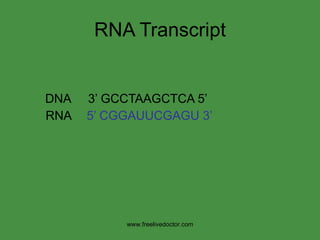
RNA Transcript DNA  3’ GCCTAAGCTCA 5’ RNA   5’ CGGAUUCGAGU 3’ www.freelivedoctor.com

Nucleic Acid Chemistry

  • 1.
    Nucleic Acid Chemistrywww.freelivedoctor.com
  • 2.
    Central Dogma DNA----------------  RNA--------------  protein Replication transcription translation www.freelivedoctor.com
  • 3.
    Central Dogma ReplicationDNA making a copy of itself Making a replica Transcription DNA being made into RNA Still in nucleotide language Translation RNA being made into protein Change to amino acid language www.freelivedoctor.com
  • 4.
    Replication Remember thatDNA is self complementary Replication is semiconservative One strand goes to next generation Other is new Each strand is a template for the other If one strand is 5’ AGCT 3’ Other is: 3’ TCGA 5’ www.freelivedoctor.com
  • 5.
    Replication is Semiconservativewww.freelivedoctor.com
  • 6.
    Replication Roles ofenzymes Topoisomerases Helicase DNA polymerases ligase DNA binding proteins DNA synthesis Leading strand Lagging strand www.freelivedoctor.com
  • 7.
  • 8.
    Replication Helix opensHelicase Causes supercoiling upstream Topoisomerases (gyrase) DNA Binding Proteins Prevent reannealing www.freelivedoctor.com
  • 9.
  • 10.
    Replication Leading strand3’ end of template As opens up, DNA polymerase binds Makes new DNA 5’ -  3’ Same direction as opening of helix Made continuously www.freelivedoctor.com
  • 11.
  • 12.
    Replication Lagging strand5’ end of template Can’t be made continuously as direction is wrong RNA primer New DNA made 5’  3’ Opposite direction of replication Discontinuous Okazaki fragments Ligase closes gaps www.freelivedoctor.com
  • 13.
    Transcription DNA templatemade into RNA copy Uracil instead of Thymine One DNA strand is template Sense strand Other is just for replication Antisense In nucleus nucleoli www.freelivedoctor.com
  • 14.
  • 15.
    Transcription DNA opensup Enzymes? RNA polymerase binds Which strand? Using DNA template, makes RNA 5’-  3’ Raw transcript called hnRNA www.freelivedoctor.com
  • 16.
    Transcription How doesRNA polymerase know where to start? upstream promotor sequences Pribnow Box TATA box RNA polymerase starts transcription X nucleotides downstream of TATA box www.freelivedoctor.com
  • 17.
    Introns and ExonsIntrons Intervening sequences Not all DNA codes for protein Regulatory info, “junk DNA” Exons Code for protein www.freelivedoctor.com
  • 18.
    Processing of hnRNAinto mRNA 3 steps Introns removed Self splicing 5’ methyl guanosine cap added Poly A tail added Moved to cytosol for translation www.freelivedoctor.com
  • 19.
    Processing of hnRNAinto mRNA www.freelivedoctor.com
  • 20.
    Translation RNA -- Protein Change from nucleotide language to amino acid language On ribosomes Vectorial nature preserved 5’ end of mRNA becomes amino terminus of protein Translation depends on genetic code www.freelivedoctor.com
  • 21.
    Genetic Code Nucleotidesread in triplet “codons” 5’ -  3’ Each codon translates to an amino acid 64 possible codons 3 positions and 4 possiblities (AGCU) makes 4 3 or 64 possibilities Degeneracy or redundancy of code Only 20 amino acids Implications for mutations www.freelivedoctor.com
  • 22.
  • 23.
    Genetic Code Noteverything translated AUG is start codon Find the start codon Also are stop codons To determine aa sequence Find start codon Read in threes Continue to stop codon www.freelivedoctor.com
  • 24.
    Translation Steps: Findstart codon (AUG) After start codon, read codons, in threes Use genetic code to translate Translate the following: GCAGUCAUGGGUAGGGAGGCAACCUGAACCGAC www.freelivedoctor.com
  • 25.
    Translation Process RequiresRibosomes, rRNA, tRNA and, of course, mRNA Ribosome Made of protein and rRNA 2 subunits Has internal sites for 2 transfer RNA molecules www.freelivedoctor.com
  • 26.
    Ribosome Left iscartoon diagram Right is actual picture www.freelivedoctor.com
  • 27.
    Transfer RNA Mostlydouble stranded Folds back on itself Several loops Anticodon loop Has complementary nucleotides to codons 3’ end where aa attach www.freelivedoctor.com
  • 28.
  • 29.
    Translation Initiation Ribosomalsubunits assemble on mRNA rRNA aids in binding of mRNA Elongation tRNAs with appropriate anticodon loops bind to complex have aa attached (done by other enzymes) Amino acids transfer form tRNA 2 to tRNA 1 Process repeats Termination tRNA with stop codon binds into ribosome No aa attached to tRNA Complex falls apart www.freelivedoctor.com
  • 30.
  • 31.
    Mutations Changes innucleotide sequence Can cause changes in aa sequence Degeneracy in genetic code can prevent Two types Point mutations Single nucleotide changes Frame shift Insertions or deletions www.freelivedoctor.com
  • 32.
    Point Mutations Singlenucleotide changes Old sequence AUG GGU AGG GAG GCA ACC UGA ACC GAC aa: G R E A T New sequence AUG GGU AG U GAG GCA ACC UGA ACC GAC aa: G S E A T www.freelivedoctor.com
  • 33.
    Point mutations Dependingon change, may not change aa sequence Old sequence AUG GGU AGG GAG GCA ACC UGA ACC GAC aa: G R E A T New sequence AUG GGU AG A GAG GCA ACC UGA ACC GAC aa: G R E A T www.freelivedoctor.com
  • 34.
    Point Mutations Changecould make little difference If valine changed to leucine, both nonpolar Change could be huge, Could erase start codon Old sequence AUG GGU AGG GAG GCA ACC UGA ACC GAC aa: G R E A T New sequence AU U GGU AG A GAG GCA ACC UGA ACC GAC aa: no start codon…protein not made www.freelivedoctor.com
  • 35.
    Point Mutations Otherpossibilities, Stop codon inserted Truncated protein Stop codon changed Extra long protein Bottom line, Depends on what change is www.freelivedoctor.com
  • 36.
    Frame Shift mutationsInsertions or deletions Change the reading frame Insertion example Old sequence AUG GGU AGG GAG GCA ACC UGA ACC GAC aa: G R E A T New sequence AUG GGU AGG A GA GGC AAC CUG AAC CGA C aa: G R R G N L N R www.freelivedoctor.com
  • 37.
    Frame Shift MutationsDeletion example Old sequence AUG GGU A GG GAG GCA ACC UGA ACC GAC aa: G R E A T New sequence Delete second A (Underlined above) AUG GGU GGG AGG CAA CCU GAA CCG AC aa: G G R Q P G P www.freelivedoctor.com
  • 38.
    Complementary DNA StrandTemplate: 3’ ACTAGCCTAAGTCG 5’ 5’ TGATCGGATTCAGC 3’ www.freelivedoctor.com
  • 39.
    RNA Transcript DNA 3’ GCCTAAGCTCA 5’ RNA 5’ CGGAUUCGAGU 3’ www.freelivedoctor.com