CHAPTER 3
BASIC ELECTRICITY
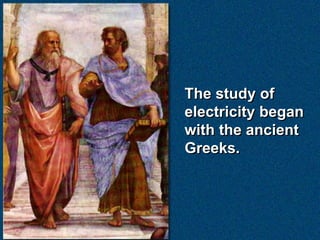
The study of
electricity began
with the ancient
Greeks.
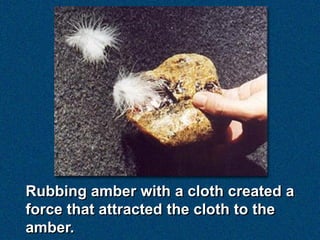
Rubbing amber with a cloth created a
force that attracted the cloth to the
amber.
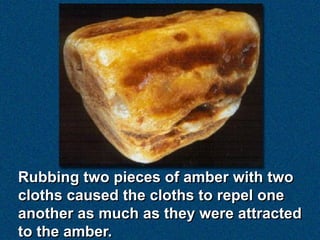
Rubbing two pieces of amber with two
cloths caused the cloths to repel one
another as much as they were attracted
to the amber.
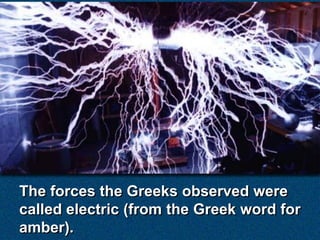
The forces the Greeks observed were
called electric (from the Greek word for
amber).
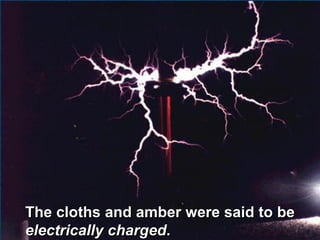
The cloths and amber were said to be
electrically charged.
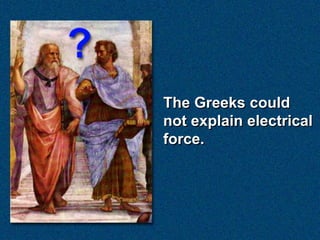
The Greeks could
not explain electrical
force.
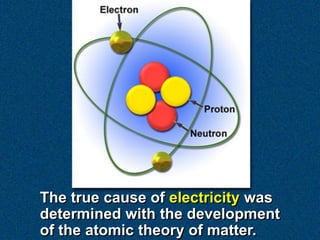
The true cause of electricity was
determined with the development
of the atomic theory of matter.
Electricity

The presence and motion of
electrons, protons, and other
charged particles

Manifests itself as attraction,
repulsion, luminous and heating
effects
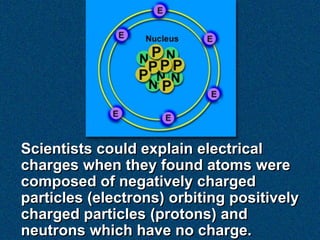
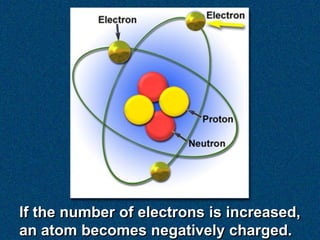
Scientists could explain electrical
charges when they found atoms were
composed of negatively charged
particles (electrons) orbiting positively
charged particles (protons) and
neutrons which have no charge.
Under most conditions, an atom will
have no charge.
If the number of electrons is increased,
an atom becomes negatively charged.
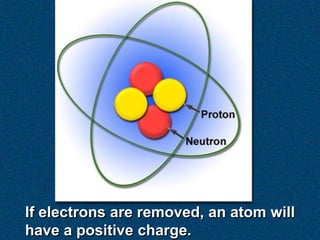
If electrons are removed, an atom will
have a positive charge.
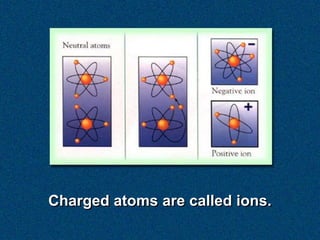
Charged atoms are called ions.
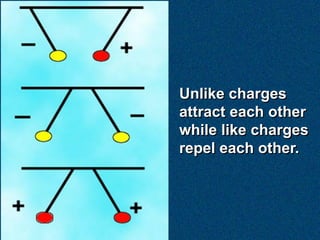
Unlike charges
attract each other
while like charges
repel each other.
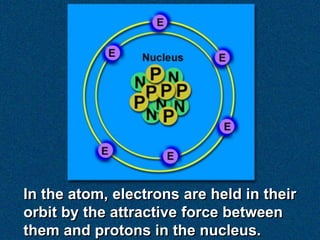
In the atom, electrons are held in their
orbit by the attractive force between
them and protons in the nucleus.
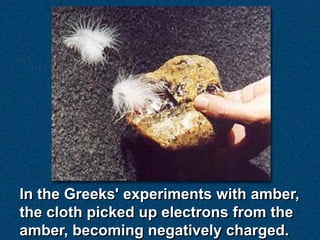
In the Greeks' experiments with amber,
the cloth picked up electrons from the
amber, becoming negatively charged.
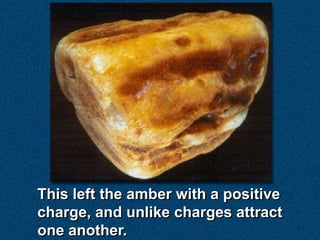
This left the amber with a positive
charge, and unlike charges attract
one another.
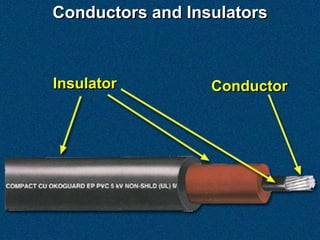
Conductors and Insulators


Insulator         Conductor
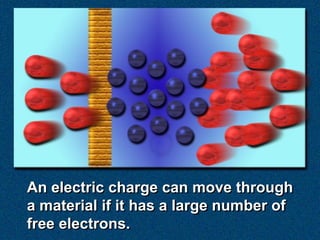
An electric charge can move through
a material if it has a large number of
free electrons.
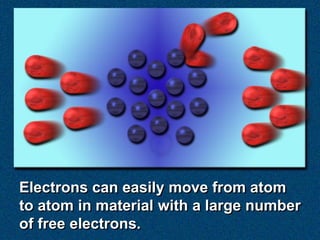
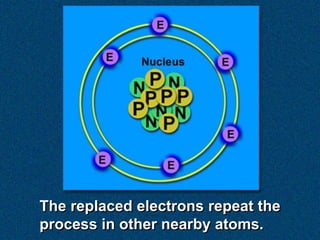
Electrons can easily move from atom
to atom in material with a large number
of free electrons.
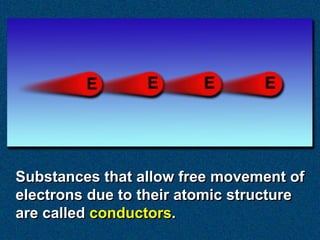
Substances that allow free movement of
electrons due to their atomic structure
are called conductors.
Conductor

A material or object that permits an
electric current to flow easily
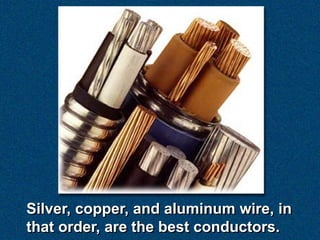
Silver, copper, and aluminum wire, in
that order, are the best conductors.
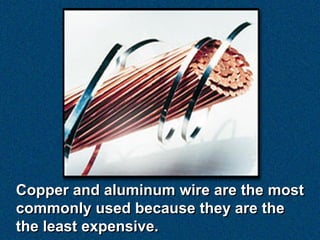
Copper and aluminum wire are the most
commonly used because they are the
the least expensive.
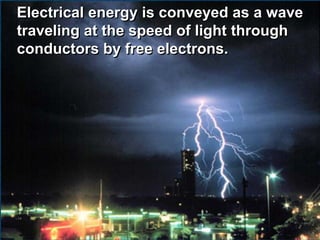
Electrical energy is conveyed as a wave
traveling at the speed of light through
conductors by free electrons.
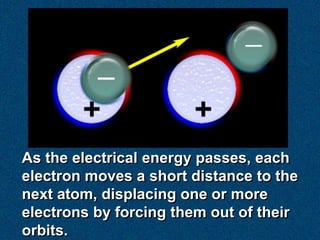
As the electrical energy passes, each
electron moves a short distance to the
next atom, displacing one or more
electrons by forcing them out of their
orbits.
The replaced electrons repeat the
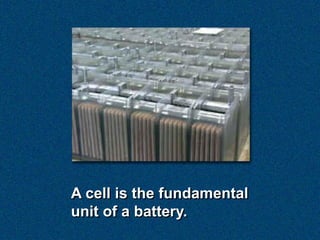
process in other nearby atoms.
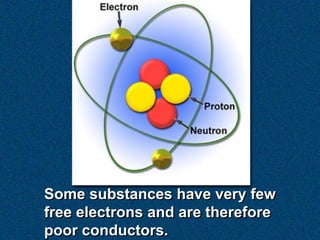
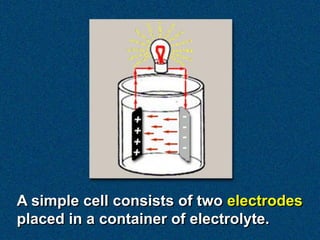
Some substances have very few
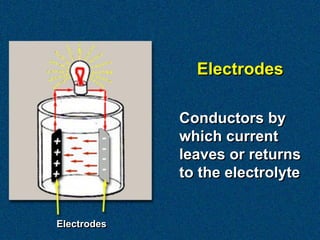
free electrons and are therefore
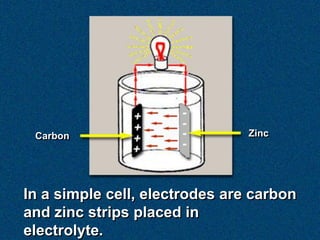
poor conductors.
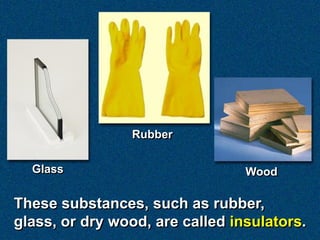
Rubber

  Glass                          Wood

These substances, such as rubber,
glass, or dry wood, are called insulators.
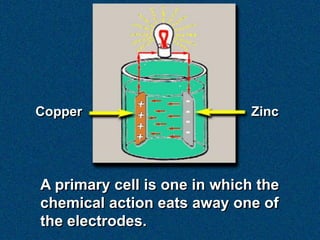
Insulators

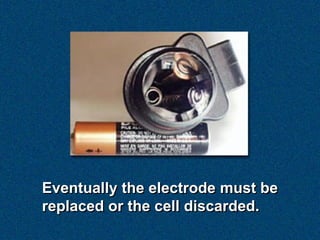
Materials that are poor conductors
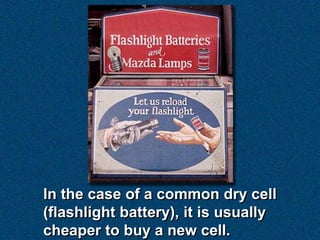
(as in electricity or heat)

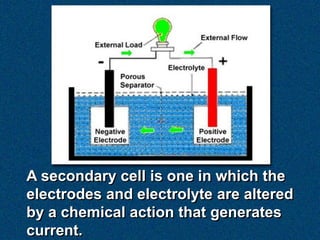
Materials that have few free electrons
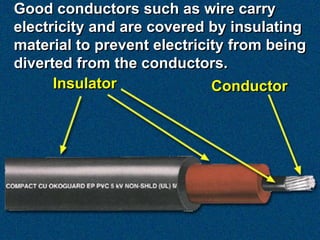
Good conductors such as wire carry
electricity and are covered by insulating
material to prevent electricity from being
diverted from the conductors.
      Insulator              Conductor
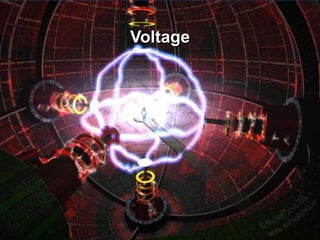
Voltage
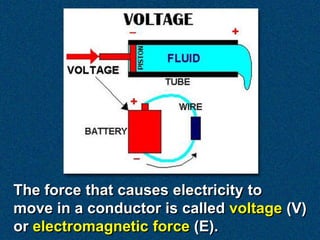
The force that causes electricity to
move in a conductor is called voltage (V)
or electromagnetic force (E).
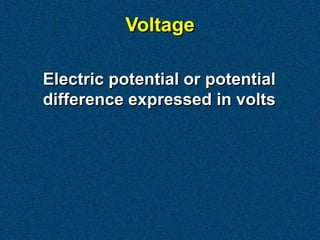
Voltage

Electric potential or potential
difference expressed in volts
Electromotive Force

Something that moves or tends to
move electricity; the potential
difference derived from an electrical
source per unit quantity of electricity
passing through the source (such as
a cell or generator)
Six Basic Ways to Generate Voltage


• Friction
• Pressure
• Heat
• Light
• Chemical action
• Magnetism
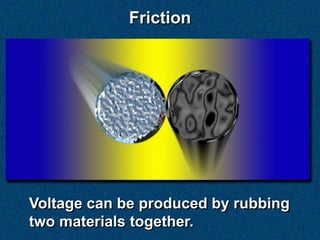
Friction


Voltage can be produced by rubbing
two materials together.
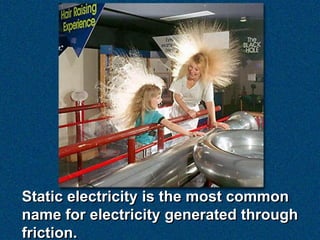
Static electricity is the most common
name for electricity generated through
friction.
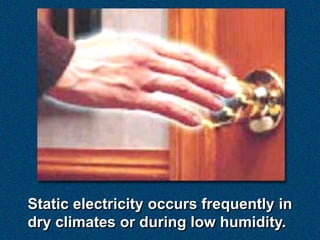
Static electricity occurs frequently in
dry climates or during low humidity.
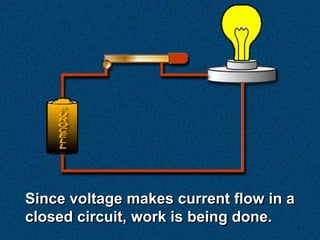
Pressure


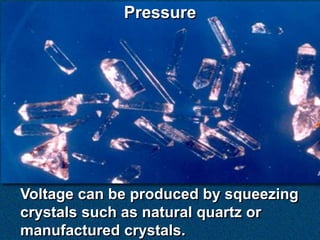
Voltage can be produced by squeezing
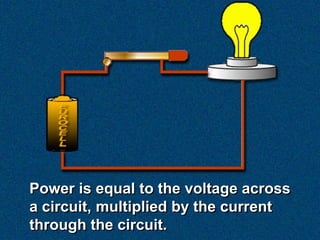
crystals such as natural quartz or
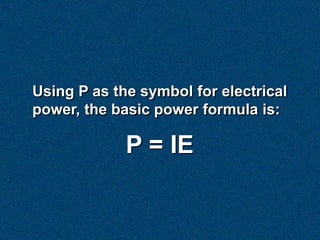
manufactured crystals.
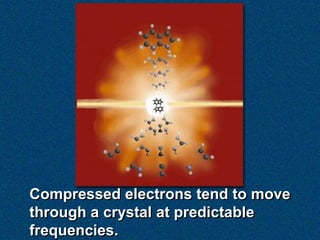
Compressed electrons tend to move
through a crystal at predictable
frequencies.
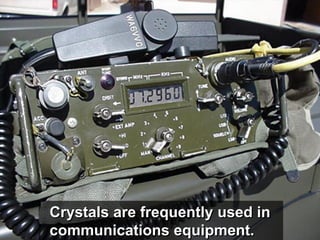
Crystals are frequently used in
communications equipment.
Heat


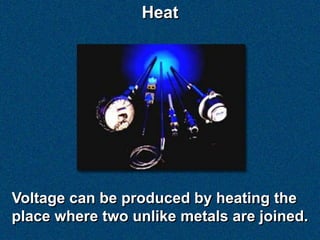
Voltage can be produced by heating the
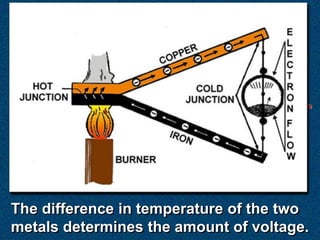
place where two unlike metals are joined.
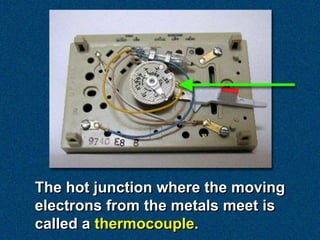
The hot junction where the moving
electrons from the metals meet is
called a thermocouple.
Thermocouple

A device for measuring temperature
in which a pair of wires of dissimilar
metals (such as copper and iron) are
joined and the free ends of the wires
are connected to an instrument (such
as a voltmeter) that measures the
difference in potential created at the
junction of the two metals
The difference in temperature of the two
metals determines the amount of voltage.
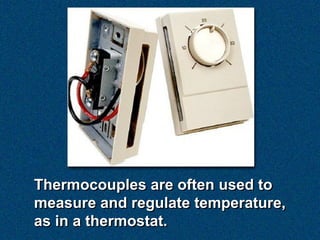
Thermocouples are often used to
measure and regulate temperature,
as in a thermostat.
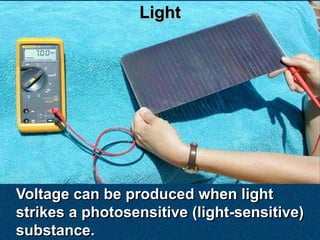
Light


Voltage can be produced when light
strikes a photosensitive (light-sensitive)
substance.
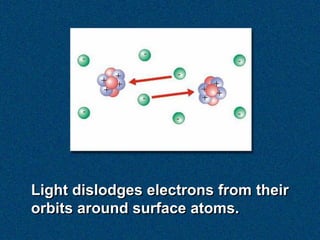
Light dislodges electrons from their
orbits around surface atoms.
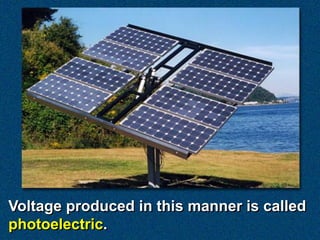
Voltage produced in this manner is called
photoelectric.
Photoelectric

Involving, relating to, or utilizing any
of various electrical effects due to
the interaction of radiation (such as
light) with matter
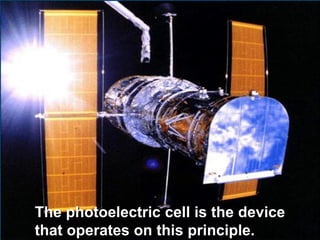
The photoelectric cell is the device
that operates on this principle.
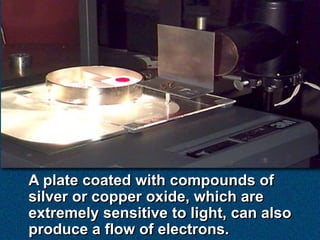
A plate coated with compounds of
silver or copper oxide, which are
extremely sensitive to light, can also
produce a flow of electrons.
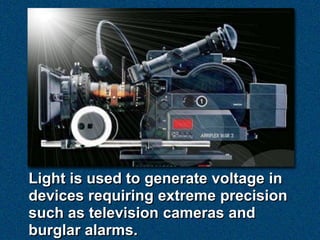
Light is used to generate voltage in
devices requiring extreme precision
such as television cameras and
burglar alarms.
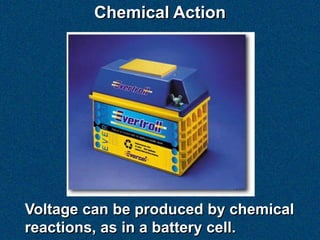
Chemical Action


Voltage can be produced by chemical
reactions, as in a battery cell.
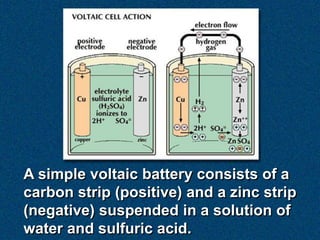
A simple voltaic battery consists of a
carbon strip (positive) and a zinc strip
(negative) suspended in a solution of
water and sulfuric acid.
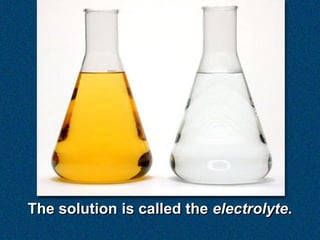
The solution is called the electrolyte.
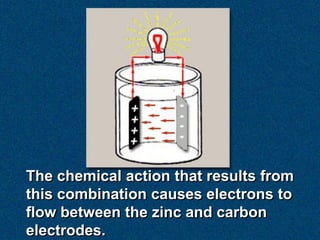
The chemical action that results from
this combination causes electrons to
flow between the zinc and carbon
electrodes.
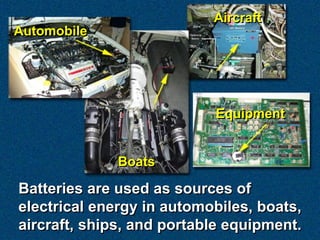
Aircraft
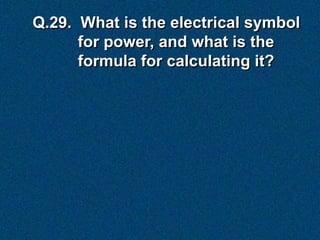
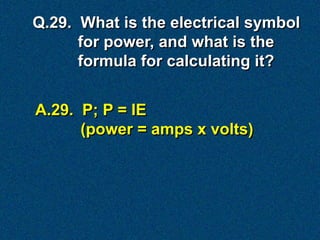
Automobile


                           Equipment


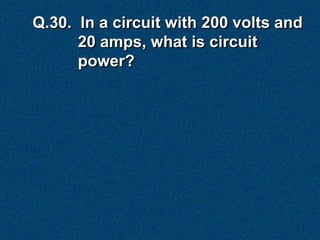
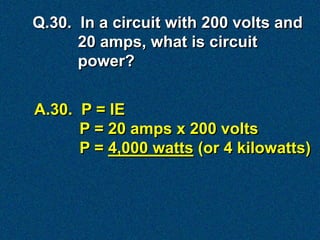
              Boats

Batteries are used as sources of
electrical energy in automobiles, boats,
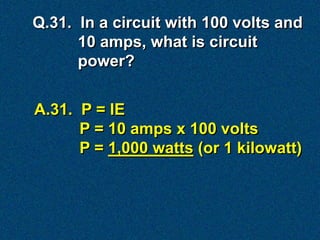
aircraft, ships, and portable equipment.
Magnetism


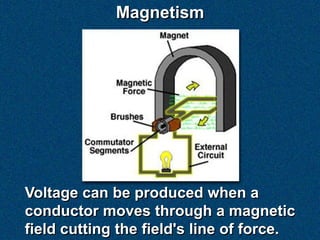
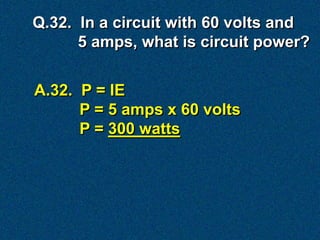
Voltage can be produced when a
conductor moves through a magnetic
field cutting the field's line of force.
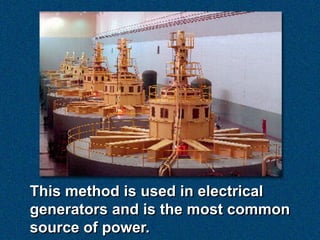
This method is used in electrical
generators and is the most common
source of power.
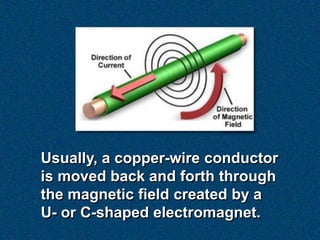
Usually, a copper-wire conductor
is moved back and forth through
the magnetic field created by a
U- or C-shaped electromagnet.
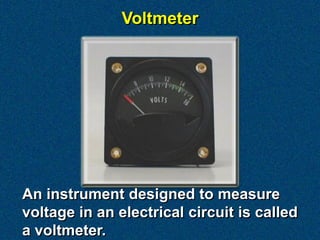
Voltmeter


An instrument designed to measure
voltage in an electrical circuit is called
a voltmeter.
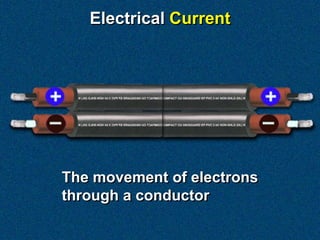
Electrical Current


The movement of electrons
through a conductor
Current

A flow of electric charge;
also, the rate of such flow
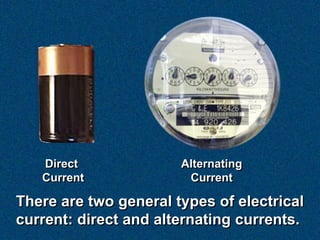
Direct              Alternating
   Current              Current

There are two general types of electrical
current: direct and alternating currents.
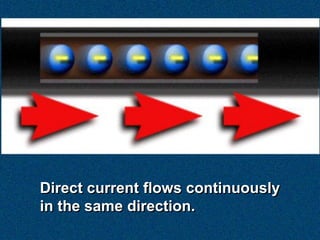
Direct current flows continuously
in the same direction.
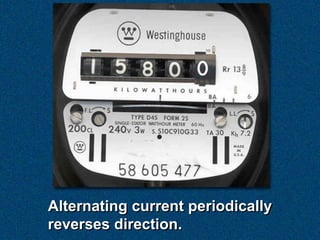
Alternating current periodically
reverses direction.
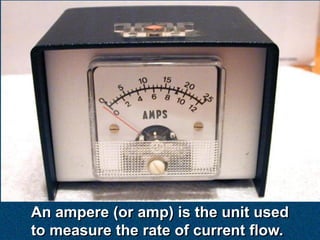
An ampere (or amp) is the unit used
to measure the rate of current flow.
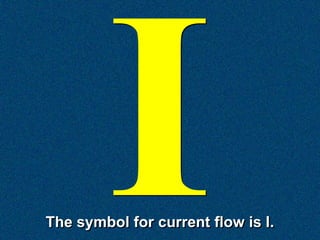
The symbol for current flow is I.
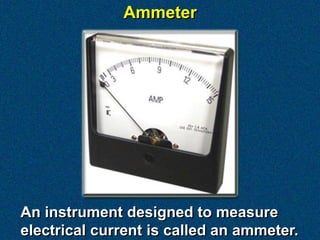
Ammeter


An instrument designed to measure
electrical current is called an ammeter.
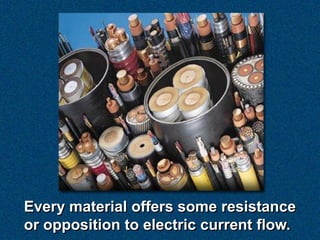
Every material offers some resistance
or opposition to electric current flow.
Good conductor
  Very little resistance


Insulator/poor conductor
     High resistance
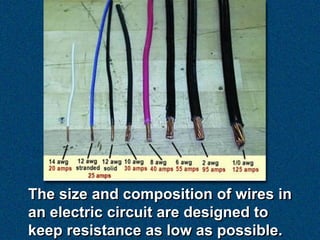
The size and composition of wires in
an electric circuit are designed to
keep resistance as low as possible.
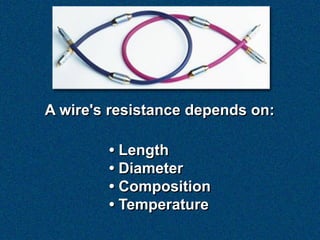
A wire's resistance depends on:

        • Length
        • Diameter
        • Composition
        • Temperature
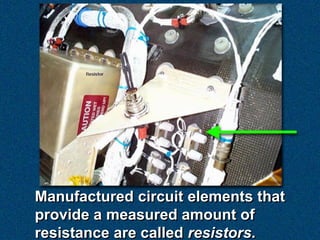
Manufactured circuit elements that
provide a measured amount of
resistance are called resistors.
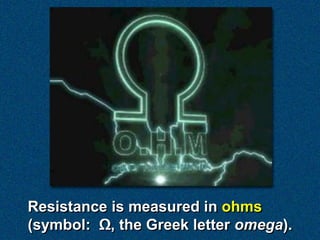
Resistance is measured in ohms
(symbol: Ω, the Greek letter omega).
Ohm

The resistance of a circuit element
(or circuit) that permits a steady
current of one ampere to flow when
a constant potential difference of
one volt is applied to that circuit
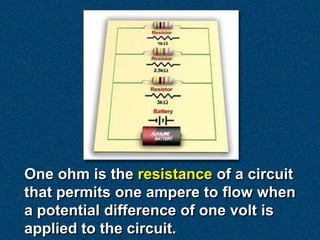
One ohm is the resistance of a circuit
that permits one ampere to flow when
a potential difference of one volt is
applied to the circuit.
Resistance

The opposition offered by a body or
substance to the passage through
it of a steady electric current
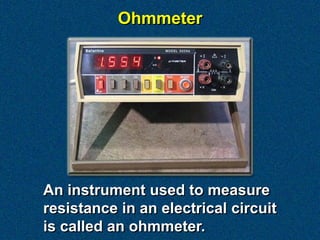
Ohmmeter


An instrument used to measure
resistance in an electrical circuit
is called an ohmmeter.
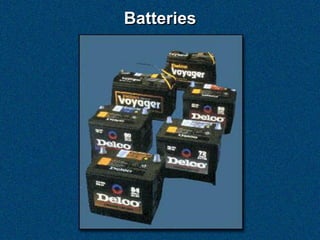
Batteries
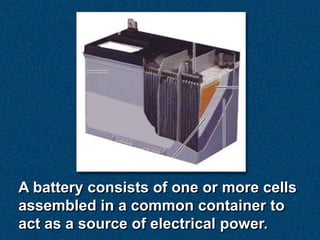
A battery consists of one or more cells
assembled in a common container to
act as a source of electrical power.
A cell is the fundamental
unit of a battery.
A simple cell consists of two electrodes
placed in a container of electrolyte.
Electrodes

             Conductors by
             which current
             leaves or returns
             to the electrolyte


Electrodes
Carbon                         Zinc


In a simple cell, electrodes are carbon
and zinc strips placed in
electrolyte.
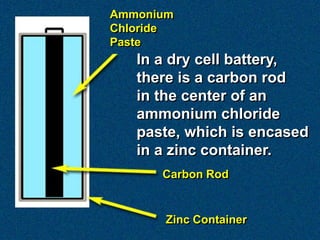
Ammonium
Chloride
Paste
   In a dry cell battery,
   there is a carbon rod
   in the center of an
   ammonium chloride
   paste, which is encased
   in a zinc container.
      Carbon Rod


       Zinc Container
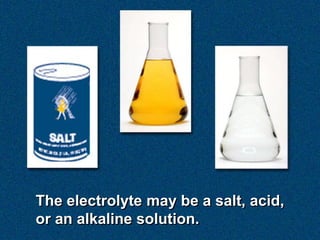
The electrolyte may be a salt, acid,
or an alkaline solution.
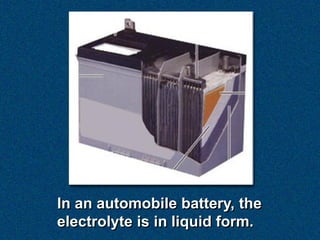
In an automobile battery, the
electrolyte is in liquid form.
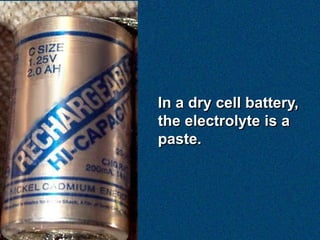
In a dry cell battery,
the electrolyte is a
paste.
Copper                        Zinc


A primary cell is one in which the
chemical action eats away one of
the electrodes.
Eventually the electrode must be
replaced or the cell discarded.
In the case of a common dry cell
(flashlight battery), it is usually
cheaper to buy a new cell.
A secondary cell is one in which the
electrodes and electrolyte are altered
by a chemical action that generates
current.
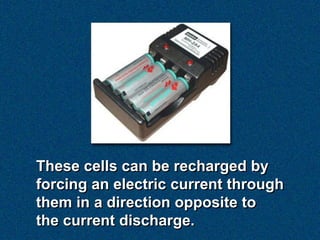
These cells can be recharged by
forcing an electric current through
them in a direction opposite to
the current discharge.
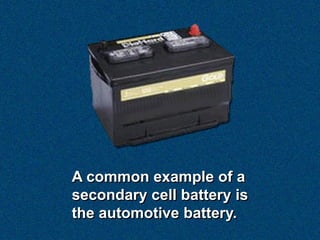
A common example of a
secondary cell battery is
the automotive battery.
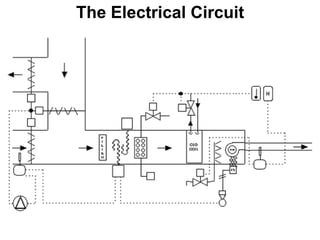
The Electrical Circuit
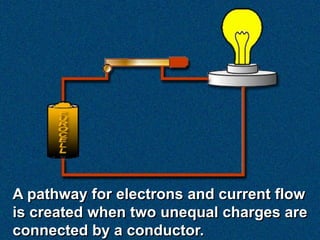
A pathway for electrons and current flow
is created when two unequal charges are
connected by a conductor.
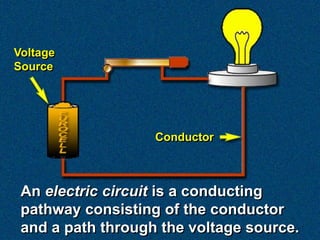
Voltage
Source


                   Conductor


 An electric circuit is a conducting
 pathway consisting of the conductor
 and a path through the voltage source.
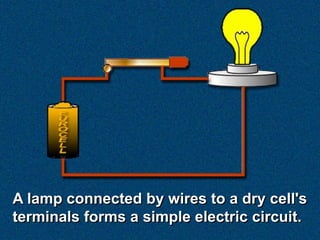
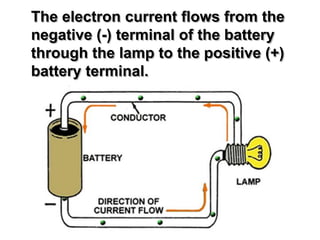
A lamp connected by wires to a dry cell's
terminals forms a simple electric circuit.
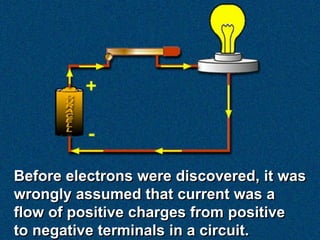
The electron current flows from the
negative (-) terminal of the battery
through the lamp to the positive (+)
battery terminal.
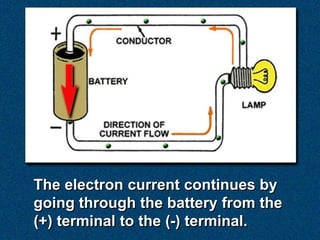
The electron current continues by
going through the battery from the
(+) terminal to the (-) terminal.
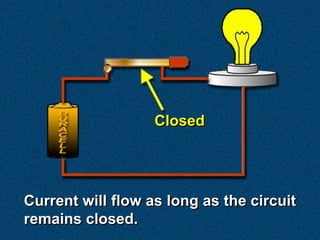
Closed


Current will flow as long as the circuit
remains closed.
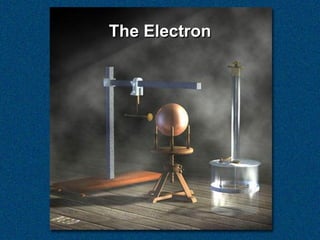
The Electron
Before electrons were discovered, it was
wrongly assumed that current was a
flow of positive charges from positive
to negative terminals in a circuit.
Schematic

A diagram in which symbols are
used for a circuit’s components,
instead of pictures

A structural or procedural diagram,
especially of an electrical or
mechanical system
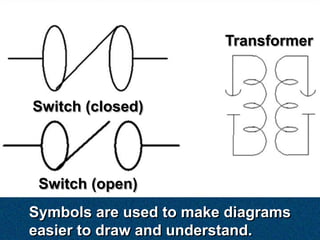
Transformer


Switch (closed)


 Switch (open)
Symbols are used to make diagrams
easier to draw and understand.
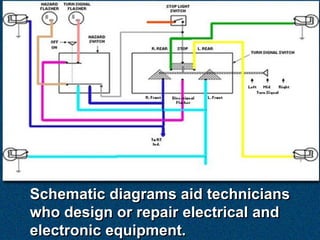
Schematic diagrams aid technicians
who design or repair electrical and
electronic equipment.
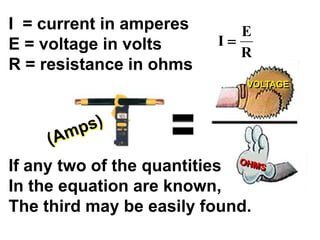
Ohm's Law
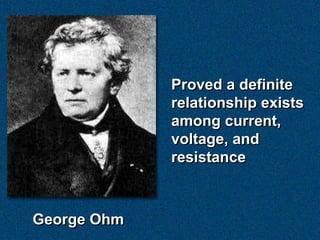
Proved a definite
             relationship exists
             among current,
             voltage, and
             resistance


George Ohm
Ohm's Law

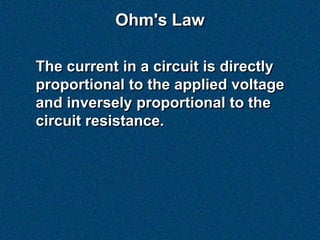
The current in a circuit is directly
proportional to the applied voltage
and inversely proportional to the
circuit resistance.
Ohm's Law
I = current in amperes      E
E = voltage in volts     I
                            R
R = resistance in ohms
                             VOLTAGE


If any two of the quantities
In the equation are known,
The third may be easily found.
Ampere

The unit used to measure the rate
at which current flows
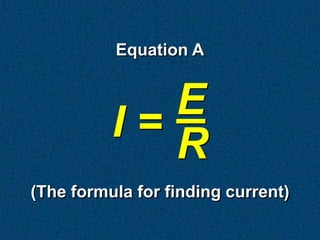
Equation A


            E
          I=R
(The formula for finding current)
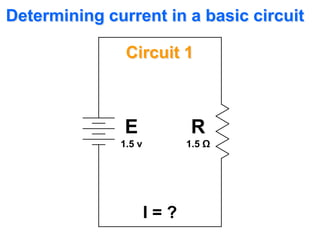
Determining current in a basic circuit

               Circuit 1


               E             R
              1.5 v         1.5 Ω


                      I=?
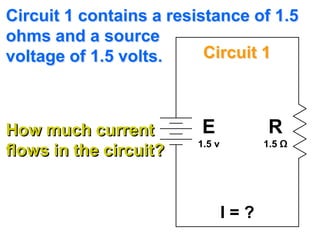
Circuit 1 contains a resistance of 1.5
ohms and a source
voltage of 1.5 volts.     Circuit 1


How much current         E             R
                        1.5 v         1.5 Ω
flows in the circuit?


                                I=?
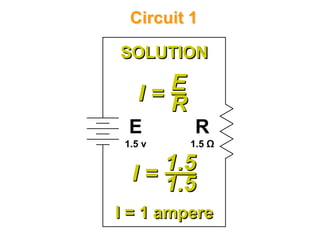
Circuit 1

SOLUTION
      E
    I=R
 E         R
 1.5 v    1.5 Ω

      1.5
  I = 1.5
I = 1 ampere
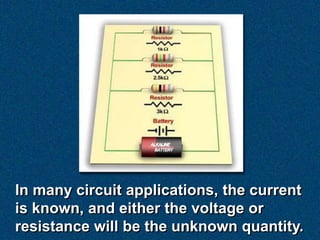
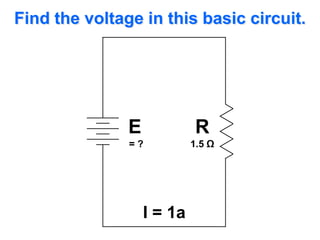
In many circuit applications, the current
is known, and either the voltage or
resistance will be the unknown quantity.
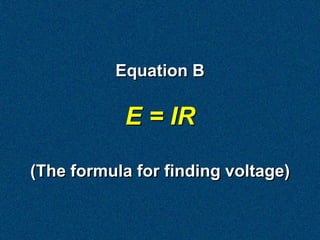
Equation B

            E = IR

(The formula for finding voltage)
Find the voltage in this basic circuit.


               E             R
               =?           1.5 Ω


                   I = 1a
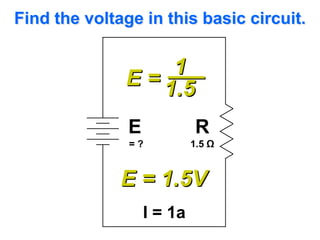
Find the voltage in this basic circuit.

                   1_
              E = 1.5

               E             R
               =?           1.5 Ω


              E = 1.5V
                   I = 1a
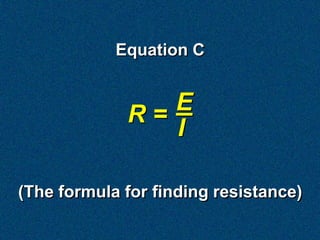
Equation C


             R= E
                I

(The formula for finding resistance)
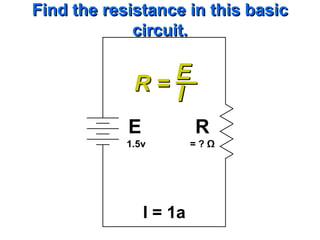
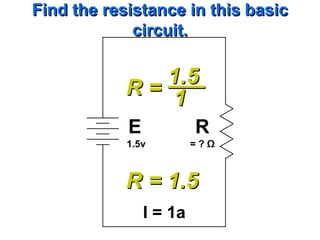
Find the resistance in this basic
             circuit.

                E
             R= I
            E            R
            1.5v         =?Ω


                I = 1a
Find the resistance in this basic
             circuit.

               1.5
            R= 1
            E            R
            1.5v         =?Ω


            R = 1.5
                I = 1a
Power
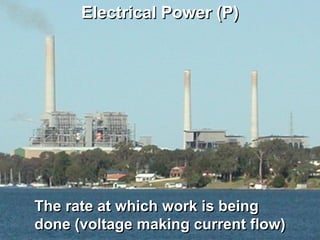
Electrical Power (P)


The rate at which work is being
done (voltage making current flow)
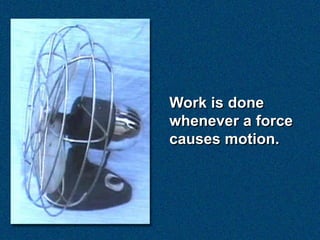
Work is done
whenever a force
causes motion.
Since voltage makes current flow in a
closed circuit, work is being done.
Electric power rate
is measured by the
watt - the basic unit
of power.
Power is equal to the voltage across
a circuit, multiplied by the current
through the circuit.
Using P as the symbol for electrical
power, the basic power formula is:

             P = IE
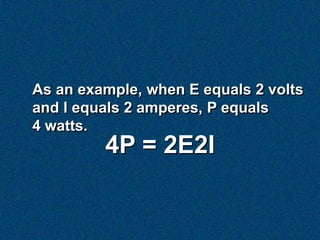
As an example, when E equals 2 volts
and I equals 2 amperes, P equals
4 watts.
         4P = 2E2I
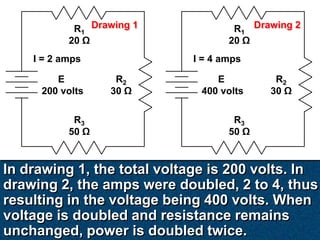
R1 Drawing 1            R1 Drawing 2
           20 Ω                    20 Ω
    I = 2 amps              I = 4 amps

        E          R2            E         R2
     200 volts    30 Ω        400 volts   30 Ω

            R3                      R3
           50 Ω                    50 Ω


In drawing 1, the total voltage is 200 volts. In
drawing 2, the amps were doubled, 2 to 4, thus
resulting in the voltage being 400 volts. When
voltage is doubled and resistance remains
unchanged, power is doubled twice.
Doubling voltage causes a doubling of
current that doubles both of the factors
that determine power.
The rate of change of power, in a
circuit of fixed resistance, is the
square of the change in voltage.
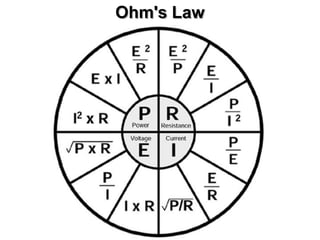
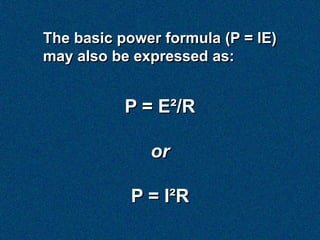
The basic power formula (P = IE)
may also be expressed as:


           P = E²/R

              or

            P = I²R
Q.1. Who began the study of
     electricity?
Q.1. Who began the study of
     electricity?


A.1. Ancient Greeks
Q.2. What is an ion?


A.2. A charged atom
Q.3. What is the force that causes
     electricity to move through a
     conductor called, and what is its
     symbol?
Q.3. What is the force that causes
     electricity to move through a
     conductor called, and what is its
     symbol?


A.3. Voltage; E
Q.4. What is the most common name
     for the voltage produced by
     rubbing two materials together?
Q.4. What is the most common name
     for the voltage produced by
     rubbing two materials together?


A.4. Static electricity
Q.5. Why is the voltage produced by
     squeezing crystals useful in
     communications equipment?
Q.5. Why is the voltage produced by
     squeezing crystals useful in
     communications equipment?


A.5. Because the voltage produced
     will be at predictable
     frequencies
Q.6. Why are thermocouples often
     used to measure or regulate
     temperature?
Q.6. Why are thermocouples often
     used to measure or regulate
     temperature?


A.6. Because the difference in the
     temperature of the metals
     determines the voltage
Q.7. What is the voltage called that
     is produced when light strikes a
     photosensitive (light sensitive)
     substance?
Q.7. What is the voltage called that
     is produced when light strikes a
     photosensitive (light sensitive)
     substance?


A.7. Photoelectric voltage
Q.8. What is a common source of
     electrical energy in automobiles,
     boats, and aircraft?
Q.8. What is a common source of
     electrical energy in automobiles,
     boats, and aircraft?


A.8. The secondary (wet) cell battery
Q.9. What method is used to
      produce electric energy in
     electric generators?
Q.9. What method is used to
     produce electric energy in
     electric generators?


A.9. Magnetism
Q.10. What are the two types of
      electric current?
Q.10. What are the two types of
      electric current?


A.10. Direct and alternating
Q.11. What is the unit called that is
      used to measure the rate at
      which current flows, and what
      is its symbol?
Q.11. What is the unit called that is
      used to measure the rate at
      which current flows, and what
      is its symbol?


A.11. The Ampere; I
Q.12. Wires in an electric circuit are
      designed to keep what at a
      minimum?
Q.12. Wires in an electric circuit are
      designed to keep what at a
      minimum?


A.12. Electrical resistance
Q.13. What are circuit elements
      called that are manufactured to
      provide a definite specified
      amount of resistance?
Q.13. What are circuit elements
      called that are manufactured to
      provide a definite specified
      amount of resistance?


A.13. Resistors
Q.14. What is the unit of
      measurement of resistance,
      and what is its symbol?
Q.14. What is the unit of
      measurement of resistance,
      and what is its symbol?


A.14. The Ohm; R
Q.15. What is the fundamental unit
      of a battery called?
Q.15. What is the fundamental unit
      of a battery called?


A.15. A cell
Q.16. What is the cell called in which
      carbon and zinc strips are
      placed in a container holding
      an electrolyte?
Q.16. What is the cell called in which
      carbon and zinc strips are
      placed in a container holding
      an electrolyte?


A.16. A simple cell
Q.17. What is the cell called in which
      a carbon rod is placed in a zinc
      container with an electrolyte
      paste?
Q.17. What is the cell called in which
      a carbon rod is placed in a zinc
      container with an electrolyte
      paste?


A.17. A dry cell
Q.18. What is one of the more
      significant features of a battery
      composed of secondary cells,
      such as an automobile battery?
Q.18. What is one of the more
      significant features of a battery
      composed of secondary cells,
      such as an automobile battery?


A.18. It is rechargeable.
Q.19. What is a conducting pathway
      consisting of a conductor and
      a path through the voltage
      source?
Q.19. What is a conducting pathway
      consisting of a conductor and
      a path through the voltage
      source?


A.19. An electric circuit
Q.20. What is a schematic?


A.20. A diagram in which symbols
      are used to represent circuit
      components
Q.21. What is Ohm’s Law?


A.21. I = E/R
      (current = volts ÷ resistance)
Q.22. Applying Ohm's Law to a
      circuit, if source voltage
      increases and resistance stays
      constant, what will circuit
      current do?
Q.22. Applying Ohm's Law to a
      circuit, if source voltage
      increases and resistance stays
      constant, what will circuit
      current do?


A.22. Increase
Q.23. Applying Ohm's Law to a
      circuit, if resistance increases
      and source voltage remains
      constant, what will circuit
      current do?
Q.23. Applying Ohm's Law to a
      circuit, if resistance increases
      and source voltage remains
      constant, what will circuit
      current do?


A.23. Decrease
Q.24. Applying Ohm's Law to a
      circuit, if resistance increases
      and source voltage increases,
      what will circuit current do?
Q.24. Applying Ohm's Law to a
      circuit, if resistance increases
      and source voltage increases,
      what will circuit current do?


A.24. You cannot tell without
      knowing actual values.
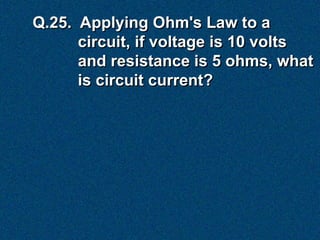
Q.25. Applying Ohm's Law to a
      circuit, if voltage is 10 volts
      and resistance is 5 ohms, what
      is circuit current?
Q.25. Applying Ohm's Law to a
      circuit, if voltage is 10 volts
      and resistance is 5 ohms, what
      is circuit current?


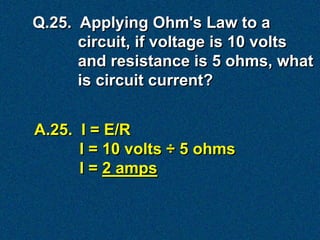
A.25. I = E/R
      I = 10 volts ÷ 5 ohms
      I = 2 amps
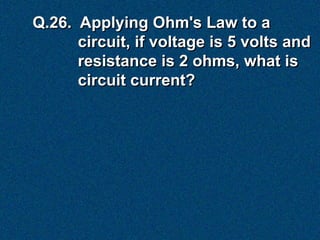
Q.26. Applying Ohm's Law to a
      circuit, if voltage is 5 volts and
      resistance is 2 ohms, what is
      circuit current?
Q.26. Applying Ohm's Law to a
      circuit, if voltage is 5 volts and
      resistance is 2 ohms, what is
      circuit current?


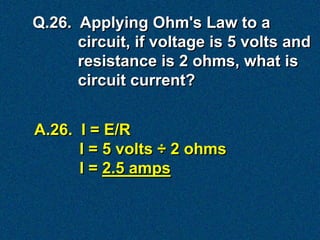
A.26. I = E/R
      I = 5 volts ÷ 2 ohms
      I = 2.5 amps
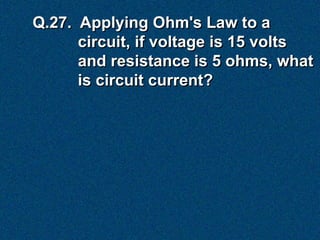
Q.27. Applying Ohm's Law to a
      circuit, if voltage is 15 volts
      and resistance is 5 ohms, what
      is circuit current?
Q.27. Applying Ohm's Law to a
      circuit, if voltage is 15 volts
      and resistance is 5 ohms, what
      is circuit current?


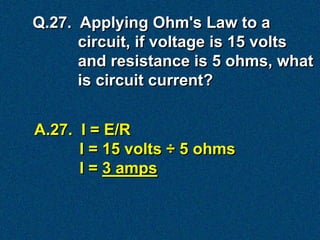
A.27. I = E/R
      I = 15 volts ÷ 5 ohms
      I = 3 amps
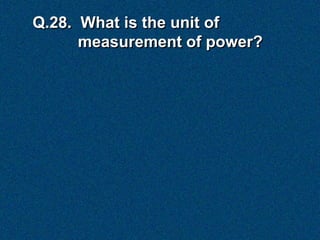
Q.28. What is the unit of
      measurement of power?
Q.28. What is the unit of
      measurement of power?


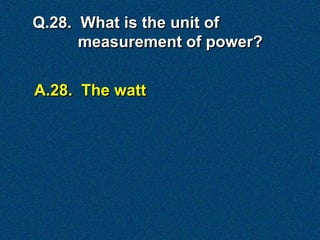
A.28. The watt
Q.29. What is the electrical symbol
      for power, and what is the
      formula for calculating it?
Q.29. What is the electrical symbol
      for power, and what is the
      formula for calculating it?


A.29. P; P = IE
      (power = amps x volts)
Q.30. In a circuit with 200 volts and
      20 amps, what is circuit
      power?
Q.30. In a circuit with 200 volts and
      20 amps, what is circuit
      power?


A.30. P = IE
      P = 20 amps x 200 volts
      P = 4,000 watts (or 4 kilowatts)
Q.31. In a circuit with 100 volts and
      10 amps, what is circuit
      power?
Q.31. In a circuit with 100 volts and
      10 amps, what is circuit
      power?


A.31. P = IE
      P = 10 amps x 100 volts
      P = 1,000 watts (or 1 kilowatt)
Q.32. In a circuit with 60 volts and
      5 amps, what is circuit power?
Q.32. In a circuit with 60 volts and
      5 amps, what is circuit power?


A.32. P = IE
      P = 5 amps x 60 volts
      P = 300 watts
Q.33. In a circuit with a current of
      3 amps and a resistance of 20
      ohms, what is circuit power?
Q.33. In a circuit with a current of
      3 amps and a resistance of 20
      ohms, what is circuit power?


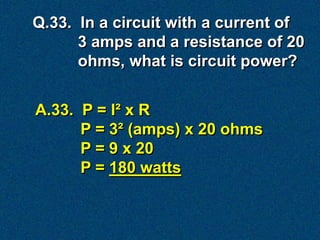
A.33. P = I² x R
      P = 3² (amps) x 20 ohms
      P = 9 x 20
      P = 180 watts
Q.34. In a circuit with a current of
      4 amps and a resistance of 25
      ohms, what is circuit power?
Q.34. In a circuit with a current of
      4 amps and a resistance of 25
      ohms, what is circuit power?


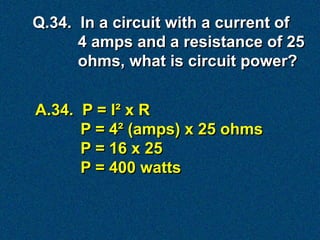
A.34. P = I² x R
      P = 4² (amps) x 25 ohms
      P = 16 x 25
      P = 400 watts
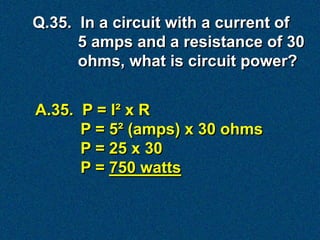
Q.35. In a circuit with a current of
      5 amps and a resistance of 30
      ohms, what is circuit power?
Q.35. In a circuit with a current of
      5 amps and a resistance of 30
      ohms, what is circuit power?


A.35. P = I² x R
      P = 5² (amps) x 30 ohms
      P = 25 x 30
      P = 750 watts

NS2 5.3 Basic Electricity

  • 1.
  • 2.
    The study of electricitybegan with the ancient Greeks.
  • 3.
    Rubbing amber witha cloth created a force that attracted the cloth to the amber.
  • 4.
    Rubbing two piecesof amber with two cloths caused the cloths to repel one another as much as they were attracted to the amber.
  • 5.
    The forces theGreeks observed were called electric (from the Greek word for amber).
  • 6.
    The cloths andamber were said to be electrically charged.
  • 7.
    The Greeks could notexplain electrical force.
  • 8.
    The true causeof electricity was determined with the development of the atomic theory of matter.
  • 9.
    Electricity The presence andmotion of electrons, protons, and other charged particles Manifests itself as attraction, repulsion, luminous and heating effects
  • 10.
    Scientists could explainelectrical charges when they found atoms were composed of negatively charged particles (electrons) orbiting positively charged particles (protons) and neutrons which have no charge.
  • 11.
    Under most conditions,an atom will have no charge.
  • 12.
    If the numberof electrons is increased, an atom becomes negatively charged.
  • 13.
    If electrons areremoved, an atom will have a positive charge.
  • 14.
    Charged atoms arecalled ions.
  • 15.
    Unlike charges attract eachother while like charges repel each other.
  • 16.
    In the atom,electrons are held in their orbit by the attractive force between them and protons in the nucleus.
  • 17.
    In the Greeks'experiments with amber, the cloth picked up electrons from the amber, becoming negatively charged.
  • 18.
    This left theamber with a positive charge, and unlike charges attract one another.
  • 19.
  • 20.
    An electric chargecan move through a material if it has a large number of free electrons.
  • 21.
    Electrons can easilymove from atom to atom in material with a large number of free electrons.
  • 22.
    Substances that allowfree movement of electrons due to their atomic structure are called conductors.
  • 23.
    Conductor A material orobject that permits an electric current to flow easily
  • 24.
    Silver, copper, andaluminum wire, in that order, are the best conductors.
  • 25.
    Copper and aluminumwire are the most commonly used because they are the the least expensive.
  • 26.
    Electrical energy isconveyed as a wave traveling at the speed of light through conductors by free electrons.
  • 27.
    As the electricalenergy passes, each electron moves a short distance to the next atom, displacing one or more electrons by forcing them out of their orbits.
  • 28.
    The replaced electronsrepeat the process in other nearby atoms.
  • 29.
    Some substances havevery few free electrons and are therefore poor conductors.
  • 30.
    Rubber Glass Wood These substances, such as rubber, glass, or dry wood, are called insulators.
  • 31.
    Insulators Materials that arepoor conductors (as in electricity or heat) Materials that have few free electrons
  • 32.
    Good conductors suchas wire carry electricity and are covered by insulating material to prevent electricity from being diverted from the conductors. Insulator Conductor
  • 33.
  • 34.
    The force thatcauses electricity to move in a conductor is called voltage (V) or electromagnetic force (E).
  • 35.
    Voltage Electric potential orpotential difference expressed in volts
  • 36.
    Electromotive Force Something thatmoves or tends to move electricity; the potential difference derived from an electrical source per unit quantity of electricity passing through the source (such as a cell or generator)
  • 37.
    Six Basic Waysto Generate Voltage • Friction • Pressure • Heat • Light • Chemical action • Magnetism
  • 38.
    Friction Voltage can beproduced by rubbing two materials together.
  • 39.
    Static electricity isthe most common name for electricity generated through friction.
  • 40.
    Static electricity occursfrequently in dry climates or during low humidity.
  • 41.
    Pressure Voltage can beproduced by squeezing crystals such as natural quartz or manufactured crystals.
  • 42.
    Compressed electrons tendto move through a crystal at predictable frequencies.
  • 43.
    Crystals are frequentlyused in communications equipment.
  • 44.
    Heat Voltage can beproduced by heating the place where two unlike metals are joined.
  • 45.
    The hot junctionwhere the moving electrons from the metals meet is called a thermocouple.
  • 46.
    Thermocouple A device formeasuring temperature in which a pair of wires of dissimilar metals (such as copper and iron) are joined and the free ends of the wires are connected to an instrument (such as a voltmeter) that measures the difference in potential created at the junction of the two metals
  • 47.
    The difference intemperature of the two metals determines the amount of voltage.
  • 48.
    Thermocouples are oftenused to measure and regulate temperature, as in a thermostat.
  • 49.
    Light Voltage can beproduced when light strikes a photosensitive (light-sensitive) substance.
  • 50.
    Light dislodges electronsfrom their orbits around surface atoms.
  • 51.
    Voltage produced inthis manner is called photoelectric.
  • 52.
    Photoelectric Involving, relating to,or utilizing any of various electrical effects due to the interaction of radiation (such as light) with matter
  • 53.
    The photoelectric cellis the device that operates on this principle.
  • 54.
    A plate coatedwith compounds of silver or copper oxide, which are extremely sensitive to light, can also produce a flow of electrons.
  • 55.
    Light is usedto generate voltage in devices requiring extreme precision such as television cameras and burglar alarms.
  • 56.
    Chemical Action Voltage canbe produced by chemical reactions, as in a battery cell.
  • 57.
    A simple voltaicbattery consists of a carbon strip (positive) and a zinc strip (negative) suspended in a solution of water and sulfuric acid.
  • 58.
    The solution iscalled the electrolyte.
  • 59.
    The chemical actionthat results from this combination causes electrons to flow between the zinc and carbon electrodes.
  • 60.
    Aircraft Automobile Equipment Boats Batteries are used as sources of electrical energy in automobiles, boats, aircraft, ships, and portable equipment.
  • 61.
    Magnetism Voltage can beproduced when a conductor moves through a magnetic field cutting the field's line of force.
  • 62.
    This method isused in electrical generators and is the most common source of power.
  • 63.
    Usually, a copper-wireconductor is moved back and forth through the magnetic field created by a U- or C-shaped electromagnet.
  • 64.
    Voltmeter An instrument designedto measure voltage in an electrical circuit is called a voltmeter.
  • 65.
    Electrical Current The movementof electrons through a conductor
  • 66.
    Current A flow ofelectric charge; also, the rate of such flow
  • 67.
    Direct Alternating Current Current There are two general types of electrical current: direct and alternating currents.
  • 68.
    Direct current flowscontinuously in the same direction.
  • 69.
  • 70.
    An ampere (oramp) is the unit used to measure the rate of current flow.
  • 71.
    The symbol forcurrent flow is I.
  • 72.
    Ammeter An instrument designedto measure electrical current is called an ammeter.
  • 73.
    Every material offerssome resistance or opposition to electric current flow.
  • 74.
    Good conductor Very little resistance Insulator/poor conductor High resistance
  • 75.
    The size andcomposition of wires in an electric circuit are designed to keep resistance as low as possible.
  • 76.
    A wire's resistancedepends on: • Length • Diameter • Composition • Temperature
  • 77.
    Manufactured circuit elementsthat provide a measured amount of resistance are called resistors.
  • 78.
    Resistance is measuredin ohms (symbol: Ω, the Greek letter omega).
  • 79.
    Ohm The resistance ofa circuit element (or circuit) that permits a steady current of one ampere to flow when a constant potential difference of one volt is applied to that circuit
  • 80.
    One ohm isthe resistance of a circuit that permits one ampere to flow when a potential difference of one volt is applied to the circuit.
  • 81.
    Resistance The opposition offeredby a body or substance to the passage through it of a steady electric current
  • 82.
    Ohmmeter An instrument usedto measure resistance in an electrical circuit is called an ohmmeter.
  • 83.
  • 84.
    A battery consistsof one or more cells assembled in a common container to act as a source of electrical power.
  • 85.
    A cell isthe fundamental unit of a battery.
  • 86.
    A simple cellconsists of two electrodes placed in a container of electrolyte.
  • 87.
    Electrodes Conductors by which current leaves or returns to the electrolyte Electrodes
  • 88.
    Carbon Zinc In a simple cell, electrodes are carbon and zinc strips placed in electrolyte.
  • 89.
    Ammonium Chloride Paste In a dry cell battery, there is a carbon rod in the center of an ammonium chloride paste, which is encased in a zinc container. Carbon Rod Zinc Container
  • 90.
    The electrolyte maybe a salt, acid, or an alkaline solution.
  • 91.
    In an automobilebattery, the electrolyte is in liquid form.
  • 92.
    In a drycell battery, the electrolyte is a paste.
  • 93.
    Copper Zinc A primary cell is one in which the chemical action eats away one of the electrodes.
  • 94.
    Eventually the electrodemust be replaced or the cell discarded.
  • 95.
    In the caseof a common dry cell (flashlight battery), it is usually cheaper to buy a new cell.
  • 96.
    A secondary cellis one in which the electrodes and electrolyte are altered by a chemical action that generates current.
  • 97.
    These cells canbe recharged by forcing an electric current through them in a direction opposite to the current discharge.
  • 98.
    A common exampleof a secondary cell battery is the automotive battery.
  • 99.
  • 100.
    A pathway forelectrons and current flow is created when two unequal charges are connected by a conductor.
  • 101.
    Voltage Source Conductor An electric circuit is a conducting pathway consisting of the conductor and a path through the voltage source.
  • 102.
    A lamp connectedby wires to a dry cell's terminals forms a simple electric circuit.
  • 103.
    The electron currentflows from the negative (-) terminal of the battery through the lamp to the positive (+) battery terminal.
  • 104.
    The electron currentcontinues by going through the battery from the (+) terminal to the (-) terminal.
  • 105.
    Closed Current will flowas long as the circuit remains closed.
  • 106.
  • 107.
    Before electrons werediscovered, it was wrongly assumed that current was a flow of positive charges from positive to negative terminals in a circuit.
  • 108.
    Schematic A diagram inwhich symbols are used for a circuit’s components, instead of pictures A structural or procedural diagram, especially of an electrical or mechanical system
  • 109.
    Transformer Switch (closed) Switch(open) Symbols are used to make diagrams easier to draw and understand.
  • 110.
    Schematic diagrams aidtechnicians who design or repair electrical and electronic equipment.
  • 111.
  • 112.
    Proved a definite relationship exists among current, voltage, and resistance George Ohm
  • 113.
    Ohm's Law The currentin a circuit is directly proportional to the applied voltage and inversely proportional to the circuit resistance.
  • 114.
  • 115.
    I = currentin amperes E E = voltage in volts I R R = resistance in ohms VOLTAGE If any two of the quantities In the equation are known, The third may be easily found.
  • 116.
    Ampere The unit usedto measure the rate at which current flows
  • 117.
    Equation A E I=R (The formula for finding current)
  • 118.
    Determining current ina basic circuit Circuit 1 E R 1.5 v 1.5 Ω I=?
  • 119.
    Circuit 1 containsa resistance of 1.5 ohms and a source voltage of 1.5 volts. Circuit 1 How much current E R 1.5 v 1.5 Ω flows in the circuit? I=?
  • 120.
    Circuit 1 SOLUTION E I=R E R 1.5 v 1.5 Ω 1.5 I = 1.5 I = 1 ampere
  • 121.
    In many circuitapplications, the current is known, and either the voltage or resistance will be the unknown quantity.
  • 122.
    Equation B E = IR (The formula for finding voltage)
  • 123.
    Find the voltagein this basic circuit. E R =? 1.5 Ω I = 1a
  • 124.
    Find the voltagein this basic circuit. 1_ E = 1.5 E R =? 1.5 Ω E = 1.5V I = 1a
  • 125.
    Equation C R= E I (The formula for finding resistance)
  • 126.
    Find the resistancein this basic circuit. E R= I E R 1.5v =?Ω I = 1a
  • 127.
    Find the resistancein this basic circuit. 1.5 R= 1 E R 1.5v =?Ω R = 1.5 I = 1a
  • 128.
  • 129.
    Electrical Power (P) Therate at which work is being done (voltage making current flow)
  • 130.
    Work is done whenevera force causes motion.
  • 131.
    Since voltage makescurrent flow in a closed circuit, work is being done.
  • 132.
    Electric power rate ismeasured by the watt - the basic unit of power.
  • 133.
    Power is equalto the voltage across a circuit, multiplied by the current through the circuit.
  • 134.
    Using P asthe symbol for electrical power, the basic power formula is: P = IE
  • 135.
    As an example,when E equals 2 volts and I equals 2 amperes, P equals 4 watts. 4P = 2E2I
  • 136.
    R1 Drawing 1 R1 Drawing 2 20 Ω 20 Ω I = 2 amps I = 4 amps E R2 E R2 200 volts 30 Ω 400 volts 30 Ω R3 R3 50 Ω 50 Ω In drawing 1, the total voltage is 200 volts. In drawing 2, the amps were doubled, 2 to 4, thus resulting in the voltage being 400 volts. When voltage is doubled and resistance remains unchanged, power is doubled twice.
  • 137.
    Doubling voltage causesa doubling of current that doubles both of the factors that determine power.
  • 138.
    The rate ofchange of power, in a circuit of fixed resistance, is the square of the change in voltage.
  • 139.
    The basic powerformula (P = IE) may also be expressed as: P = E²/R or P = I²R
  • 140.
    Q.1. Who beganthe study of electricity?
  • 141.
    Q.1. Who beganthe study of electricity? A.1. Ancient Greeks
  • 142.
    Q.2. What isan ion?
  • 143.
    Q.2. What isan ion? A.2. A charged atom
  • 144.
    Q.3. What isthe force that causes electricity to move through a conductor called, and what is its symbol?
  • 145.
    Q.3. What isthe force that causes electricity to move through a conductor called, and what is its symbol? A.3. Voltage; E
  • 146.
    Q.4. What isthe most common name for the voltage produced by rubbing two materials together?
  • 147.
    Q.4. What isthe most common name for the voltage produced by rubbing two materials together? A.4. Static electricity
  • 148.
    Q.5. Why isthe voltage produced by squeezing crystals useful in communications equipment?
  • 149.
    Q.5. Why isthe voltage produced by squeezing crystals useful in communications equipment? A.5. Because the voltage produced will be at predictable frequencies
  • 150.
    Q.6. Why arethermocouples often used to measure or regulate temperature?
  • 151.
    Q.6. Why arethermocouples often used to measure or regulate temperature? A.6. Because the difference in the temperature of the metals determines the voltage
  • 152.
    Q.7. What isthe voltage called that is produced when light strikes a photosensitive (light sensitive) substance?
  • 153.
    Q.7. What isthe voltage called that is produced when light strikes a photosensitive (light sensitive) substance? A.7. Photoelectric voltage
  • 154.
    Q.8. What isa common source of electrical energy in automobiles, boats, and aircraft?
  • 155.
    Q.8. What isa common source of electrical energy in automobiles, boats, and aircraft? A.8. The secondary (wet) cell battery
  • 156.
    Q.9. What methodis used to produce electric energy in electric generators?
  • 157.
    Q.9. What methodis used to produce electric energy in electric generators? A.9. Magnetism
  • 158.
    Q.10. What arethe two types of electric current?
  • 159.
    Q.10. What arethe two types of electric current? A.10. Direct and alternating
  • 160.
    Q.11. What isthe unit called that is used to measure the rate at which current flows, and what is its symbol?
  • 161.
    Q.11. What isthe unit called that is used to measure the rate at which current flows, and what is its symbol? A.11. The Ampere; I
  • 162.
    Q.12. Wires inan electric circuit are designed to keep what at a minimum?
  • 163.
    Q.12. Wires inan electric circuit are designed to keep what at a minimum? A.12. Electrical resistance
  • 164.
    Q.13. What arecircuit elements called that are manufactured to provide a definite specified amount of resistance?
  • 165.
    Q.13. What arecircuit elements called that are manufactured to provide a definite specified amount of resistance? A.13. Resistors
  • 166.
    Q.14. What isthe unit of measurement of resistance, and what is its symbol?
  • 167.
    Q.14. What isthe unit of measurement of resistance, and what is its symbol? A.14. The Ohm; R
  • 168.
    Q.15. What isthe fundamental unit of a battery called?
  • 169.
    Q.15. What isthe fundamental unit of a battery called? A.15. A cell
  • 170.
    Q.16. What isthe cell called in which carbon and zinc strips are placed in a container holding an electrolyte?
  • 171.
    Q.16. What isthe cell called in which carbon and zinc strips are placed in a container holding an electrolyte? A.16. A simple cell
  • 172.
    Q.17. What isthe cell called in which a carbon rod is placed in a zinc container with an electrolyte paste?
  • 173.
    Q.17. What isthe cell called in which a carbon rod is placed in a zinc container with an electrolyte paste? A.17. A dry cell
  • 174.
    Q.18. What isone of the more significant features of a battery composed of secondary cells, such as an automobile battery?
  • 175.
    Q.18. What isone of the more significant features of a battery composed of secondary cells, such as an automobile battery? A.18. It is rechargeable.
  • 176.
    Q.19. What isa conducting pathway consisting of a conductor and a path through the voltage source?
  • 177.
    Q.19. What isa conducting pathway consisting of a conductor and a path through the voltage source? A.19. An electric circuit
  • 178.
    Q.20. What isa schematic?
  • 179.
    Q.20. What isa schematic? A.20. A diagram in which symbols are used to represent circuit components
  • 180.
    Q.21. What isOhm’s Law?
  • 181.
    Q.21. What isOhm’s Law? A.21. I = E/R (current = volts ÷ resistance)
  • 182.
    Q.22. Applying Ohm'sLaw to a circuit, if source voltage increases and resistance stays constant, what will circuit current do?
  • 183.
    Q.22. Applying Ohm'sLaw to a circuit, if source voltage increases and resistance stays constant, what will circuit current do? A.22. Increase
  • 184.
    Q.23. Applying Ohm'sLaw to a circuit, if resistance increases and source voltage remains constant, what will circuit current do?
  • 185.
    Q.23. Applying Ohm'sLaw to a circuit, if resistance increases and source voltage remains constant, what will circuit current do? A.23. Decrease
  • 186.
    Q.24. Applying Ohm'sLaw to a circuit, if resistance increases and source voltage increases, what will circuit current do?
  • 187.
    Q.24. Applying Ohm'sLaw to a circuit, if resistance increases and source voltage increases, what will circuit current do? A.24. You cannot tell without knowing actual values.
  • 188.
    Q.25. Applying Ohm'sLaw to a circuit, if voltage is 10 volts and resistance is 5 ohms, what is circuit current?
  • 189.
    Q.25. Applying Ohm'sLaw to a circuit, if voltage is 10 volts and resistance is 5 ohms, what is circuit current? A.25. I = E/R I = 10 volts ÷ 5 ohms I = 2 amps
  • 190.
    Q.26. Applying Ohm'sLaw to a circuit, if voltage is 5 volts and resistance is 2 ohms, what is circuit current?
  • 191.
    Q.26. Applying Ohm'sLaw to a circuit, if voltage is 5 volts and resistance is 2 ohms, what is circuit current? A.26. I = E/R I = 5 volts ÷ 2 ohms I = 2.5 amps
  • 192.
    Q.27. Applying Ohm'sLaw to a circuit, if voltage is 15 volts and resistance is 5 ohms, what is circuit current?
  • 193.
    Q.27. Applying Ohm'sLaw to a circuit, if voltage is 15 volts and resistance is 5 ohms, what is circuit current? A.27. I = E/R I = 15 volts ÷ 5 ohms I = 3 amps
  • 194.
    Q.28. What isthe unit of measurement of power?
  • 195.
    Q.28. What isthe unit of measurement of power? A.28. The watt
  • 196.
    Q.29. What isthe electrical symbol for power, and what is the formula for calculating it?
  • 197.
    Q.29. What isthe electrical symbol for power, and what is the formula for calculating it? A.29. P; P = IE (power = amps x volts)
  • 198.
    Q.30. In acircuit with 200 volts and 20 amps, what is circuit power?
  • 199.
    Q.30. In acircuit with 200 volts and 20 amps, what is circuit power? A.30. P = IE P = 20 amps x 200 volts P = 4,000 watts (or 4 kilowatts)
  • 200.
    Q.31. In acircuit with 100 volts and 10 amps, what is circuit power?
  • 201.
    Q.31. In acircuit with 100 volts and 10 amps, what is circuit power? A.31. P = IE P = 10 amps x 100 volts P = 1,000 watts (or 1 kilowatt)
  • 202.
    Q.32. In acircuit with 60 volts and 5 amps, what is circuit power?
  • 203.
    Q.32. In acircuit with 60 volts and 5 amps, what is circuit power? A.32. P = IE P = 5 amps x 60 volts P = 300 watts
  • 204.
    Q.33. In acircuit with a current of 3 amps and a resistance of 20 ohms, what is circuit power?
  • 205.
    Q.33. In acircuit with a current of 3 amps and a resistance of 20 ohms, what is circuit power? A.33. P = I² x R P = 3² (amps) x 20 ohms P = 9 x 20 P = 180 watts
  • 206.
    Q.34. In acircuit with a current of 4 amps and a resistance of 25 ohms, what is circuit power?
  • 207.
    Q.34. In acircuit with a current of 4 amps and a resistance of 25 ohms, what is circuit power? A.34. P = I² x R P = 4² (amps) x 25 ohms P = 16 x 25 P = 400 watts
  • 208.
    Q.35. In acircuit with a current of 5 amps and a resistance of 30 ohms, what is circuit power?
  • 209.
    Q.35. In acircuit with a current of 5 amps and a resistance of 30 ohms, what is circuit power? A.35. P = I² x R P = 5² (amps) x 30 ohms P = 25 x 30 P = 750 watts