Basic Principles of Electricity
Jayson Magnaye-JericCantillana-Althea
Enriquez-Analyn Pilea-Ailyn Reformado- Jamaica
Alba-Kim Borromeo- ArvilVillanueva
A form of energy generated by
friction, induction or chemical
change having magnetic,
chemical and radiant effect.
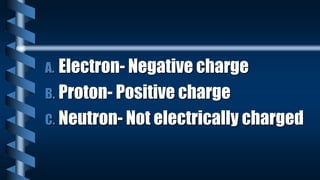
A. Electron- Negative charge
B. Proton- Positive charge
C. Neutron- Not electrically charged
TWO TYPES OF ELECTRICITY
Static Electricity- Usually
caused by frictions
Current Electricity- Produced
by moving electrons
DEFINITION OF TERMS
ION
 a term applied to an atom or molecule that is
electrically charged, but not electrically
balanced.
IONS occur when the electrons in the atom is
loosened through friction by another atom.
Loss or gain of one or more electrons.
Alessandro Volta – Italian Scientist, discovered
the Flow of Electrons
VOLT OR VOLTAGE – electrical pressure that
causes the electrons to move through a
conductor (wire).
Voltage is the electromotive force.
High voltage = more force to flow
VOLTAGE
AMPERE
Andre M. Ampere
Standard unit use in measuring the
strength of an electric current.
The amount of current flow, sent by
one volt through the resistance of one
Ohm.
WATT
 James Watt – Scottish inventor
 Is the rate or measure of power used or consumed.
 It represents the equivalent heat volts and ampere
consumed by lights, appliances, or motors.
 Commonly labelled on light bulbs or appliances, giving
us the idea of what kind of circuit would be installed.
CIRCUIT
Refers to the wire installations that
supply current to lights and
convenient outlets.
RESISTANCE
Friction or opposition to the flow of
current by the wires and transformers.
For direct current (DC electricity)
resistance is used for friction, and
Impedance for alternating current (AC
electricity).
CURRENT
The intensity of the flow of electrons in a
conductor.
POWER
The total measure of electrical energy
consumed in a circuit.
Conductors and Insulators
Conductors
Material with low resistance,
and thus it permits the flow of
current
Insulators
Material with high resistance;
hence, it does not permit the
flow of electric current
Sources of Electricity
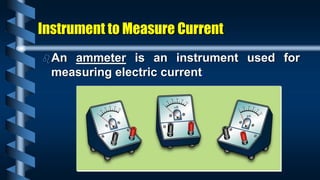
Instrument to Measure Current
An ammeter is an instrument used for
measuring electric current.
Classification of Electric Current
Direct Current (DC)
Alternating Current (AC)
Direct Current
The flow of electron in a
conductor is in one direction
only.
Alternating Current
The flow of electron changes
alternately. At one moment it goes
positive, and then it goes negative, and
so on as cycle.
Ohm’s Law
George Simoun Ohm
 German physicist
 He discovered that voltage, current, and resistance in a
circuit have definite relationship with one another.
Ohm’s Law means two things:
 Current (I) is directly proportional to voltage (E)
 Current (I) is inversely proportional to resistance (R)
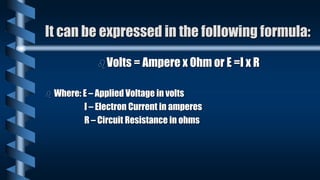
It can be expressed in the following formula:
Volts = Ampere x Ohm or E =I x R
 Where: E – Applied Voltage in volts
I – Electron Current in amperes
R – Circuit Resistance in ohms
The Electric Circuit
The electric circuit is the complete flow of
current through a conductor or path from
the source to the load and back to the
source.
Parts of an Electric Circuit:
 Source
 Load
 Control/Switch
 Path
Source
 Provides electrical power to the circuit.
Load
 An electric device, usually in appliance, lights, or any
equipment, connected to the circuits that consume power
or electricity.
Control/Switch
 An electrical device that turns the current ON and OFF
Circuit Connection
Series Circuit
 Loads are connected end to end along the path of current
in a single closed loop.
RULE 1:
When two or more resistors are connected in
series, the total resistance is the sum of ll the
resistance in the circuit.
RULE 2:
The total voltage in series circuit is the sum of
all individual voltage drops of the loads.
RULE 3:
The current flowing in a series circuit is the
same or constant.
RULE 4:
The total power in series circuit is the sum of
the individual power consumption of each in
the circuit.
Parallel Circuit
Loads are connected side by side across the
path of current.
RULE 1:
 The resistance in a parallel circuit is the reciprocal of the
sum of the reciprocals of all the branches.
RULE 2:
 The voltage in parallel circuit is always equal to the
voltage drop in each load.
RULE 3:
 The current in parallel circuit is distributed in every
branch. The total current is the sum of the currents of each
branch
RULE 4:
 The total power in the circuit is the sum of all the power
consumed by each branch.
Complex Circuit
(Series-Parallel Combination)
It is used when it is necessary to provide the
various amounts of current and voltage at
different points of the circuit using only one
source of supply voltage.
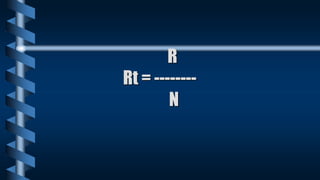
R
Rt = --------
N
Conditions of a Short Circuit
Short Circuit – when uninsulted conductors
from line 1 and 2 of a circuit come into
contact with each other without passing any
load or when the resistance of the load
becomes unnecessarily low.
Open Circuit – when the flow of the current
is incomplete or when the circuit is swithed
OFF.
Closed Circuit – when there is a complete
flow in the circuit or when the circuit is
switched ON.
Grounded Circuit – when one uninsulated
conductor in a circuit touches metal part of
the appliance.
Overload Circuit – when the total current
flowing in the circuit is more than the
current capacity or ampacity or the branch
circuit.
Common or Standard Wiring
Specification
Wire Sizes/Cable
 For lightning fixtures and circuit - # 14 AWG
 Circuit for convenience outlets - # 12 AWG
 Cable for service entrance - # 8 AWG
Circuits Protection Device
 Fuses:
• 60 Amp to 100 Amp – Main Fuse
• 20 Amp – lightning circuit
• 30 Amp – convenience outlets
 Circuit Breakers:
• Amp – 100 Amp – Main breaker
 Branch Circuits:
• 15 Amp – for lightning fixtures
• 20 Amp – for convenience outlets
• 30 Amp – Heavy duty appliance

Basic Principles of Electricity

  • 1.
    Basic Principles ofElectricity Jayson Magnaye-JericCantillana-Althea Enriquez-Analyn Pilea-Ailyn Reformado- Jamaica Alba-Kim Borromeo- ArvilVillanueva
  • 2.
    A form ofenergy generated by friction, induction or chemical change having magnetic, chemical and radiant effect.
  • 3.
    A. Electron- Negativecharge B. Proton- Positive charge C. Neutron- Not electrically charged
  • 4.
    TWO TYPES OFELECTRICITY Static Electricity- Usually caused by frictions Current Electricity- Produced by moving electrons
  • 5.
    DEFINITION OF TERMS ION a term applied to an atom or molecule that is electrically charged, but not electrically balanced. IONS occur when the electrons in the atom is loosened through friction by another atom. Loss or gain of one or more electrons.
  • 6.
    Alessandro Volta –Italian Scientist, discovered the Flow of Electrons VOLT OR VOLTAGE – electrical pressure that causes the electrons to move through a conductor (wire). Voltage is the electromotive force. High voltage = more force to flow VOLTAGE
  • 7.
    AMPERE Andre M. Ampere Standardunit use in measuring the strength of an electric current. The amount of current flow, sent by one volt through the resistance of one Ohm.
  • 8.
    WATT  James Watt– Scottish inventor  Is the rate or measure of power used or consumed.  It represents the equivalent heat volts and ampere consumed by lights, appliances, or motors.  Commonly labelled on light bulbs or appliances, giving us the idea of what kind of circuit would be installed.
  • 9.
    CIRCUIT Refers to thewire installations that supply current to lights and convenient outlets.
  • 10.
    RESISTANCE Friction or oppositionto the flow of current by the wires and transformers. For direct current (DC electricity) resistance is used for friction, and Impedance for alternating current (AC electricity).
  • 11.
    CURRENT The intensity ofthe flow of electrons in a conductor.
  • 12.
    POWER The total measureof electrical energy consumed in a circuit.
  • 13.
  • 14.
    Conductors Material with lowresistance, and thus it permits the flow of current
  • 15.
    Insulators Material with highresistance; hence, it does not permit the flow of electric current
  • 16.
  • 17.
    Instrument to MeasureCurrent An ammeter is an instrument used for measuring electric current.
  • 18.
    Classification of ElectricCurrent Direct Current (DC) Alternating Current (AC)
  • 19.
    Direct Current The flowof electron in a conductor is in one direction only.
  • 20.
    Alternating Current The flowof electron changes alternately. At one moment it goes positive, and then it goes negative, and so on as cycle.
  • 21.
  • 22.
    George Simoun Ohm German physicist  He discovered that voltage, current, and resistance in a circuit have definite relationship with one another.
  • 23.
    Ohm’s Law meanstwo things:  Current (I) is directly proportional to voltage (E)  Current (I) is inversely proportional to resistance (R)
  • 24.
    It can beexpressed in the following formula: Volts = Ampere x Ohm or E =I x R  Where: E – Applied Voltage in volts I – Electron Current in amperes R – Circuit Resistance in ohms
  • 25.
  • 26.
    The electric circuitis the complete flow of current through a conductor or path from the source to the load and back to the source.
  • 27.
    Parts of anElectric Circuit:  Source  Load  Control/Switch  Path
  • 28.
    Source  Provides electricalpower to the circuit.
  • 29.
    Load  An electricdevice, usually in appliance, lights, or any equipment, connected to the circuits that consume power or electricity.
  • 30.
    Control/Switch  An electricaldevice that turns the current ON and OFF
  • 31.
  • 32.
    Series Circuit  Loadsare connected end to end along the path of current in a single closed loop.
  • 33.
    RULE 1: When twoor more resistors are connected in series, the total resistance is the sum of ll the resistance in the circuit.
  • 34.
    RULE 2: The totalvoltage in series circuit is the sum of all individual voltage drops of the loads.
  • 35.
    RULE 3: The currentflowing in a series circuit is the same or constant.
  • 36.
    RULE 4: The totalpower in series circuit is the sum of the individual power consumption of each in the circuit.
  • 37.
    Parallel Circuit Loads areconnected side by side across the path of current.
  • 38.
    RULE 1:  Theresistance in a parallel circuit is the reciprocal of the sum of the reciprocals of all the branches.
  • 39.
    RULE 2:  Thevoltage in parallel circuit is always equal to the voltage drop in each load.
  • 40.
    RULE 3:  Thecurrent in parallel circuit is distributed in every branch. The total current is the sum of the currents of each branch
  • 41.
    RULE 4:  Thetotal power in the circuit is the sum of all the power consumed by each branch.
  • 42.
    Complex Circuit (Series-Parallel Combination) Itis used when it is necessary to provide the various amounts of current and voltage at different points of the circuit using only one source of supply voltage.
  • 43.
  • 44.
    Conditions of aShort Circuit
  • 45.
    Short Circuit –when uninsulted conductors from line 1 and 2 of a circuit come into contact with each other without passing any load or when the resistance of the load becomes unnecessarily low.
  • 46.
    Open Circuit –when the flow of the current is incomplete or when the circuit is swithed OFF.
  • 47.
    Closed Circuit –when there is a complete flow in the circuit or when the circuit is switched ON.
  • 48.
    Grounded Circuit –when one uninsulated conductor in a circuit touches metal part of the appliance.
  • 49.
    Overload Circuit –when the total current flowing in the circuit is more than the current capacity or ampacity or the branch circuit.
  • 50.
    Common or StandardWiring Specification
  • 51.
    Wire Sizes/Cable  Forlightning fixtures and circuit - # 14 AWG  Circuit for convenience outlets - # 12 AWG  Cable for service entrance - # 8 AWG
  • 52.
    Circuits Protection Device Fuses: • 60 Amp to 100 Amp – Main Fuse • 20 Amp – lightning circuit • 30 Amp – convenience outlets
  • 53.
     Circuit Breakers: •Amp – 100 Amp – Main breaker  Branch Circuits: • 15 Amp – for lightning fixtures • 20 Amp – for convenience outlets • 30 Amp – Heavy duty appliance