WELCOME
TO
BASIC ELECTRICITY
TRAINING
OBJECTIVES
To be able to identify and implement. Theory of Ohms Law.
Define electrical terms.
To be able to describe the interrelationship between voltage,
current and resistance in electrical circuits.
To be able to identify digital multimeter features and its
capabilities.
To be able to correctly use the digital multimeter and understand
your findings when taking electrical measurements,in normal and
fault finding situations
Basics of electricity
Types of energy-
- Electrical energy
- Heat energy
- Atomic energy
- Mechanical energy
- One form of energy can be converted into another
OIL - Heat , Water - Steam , Turbine - Mechanical energy
Generator - Electrical energy
What is ElectricityWhat is Electricity
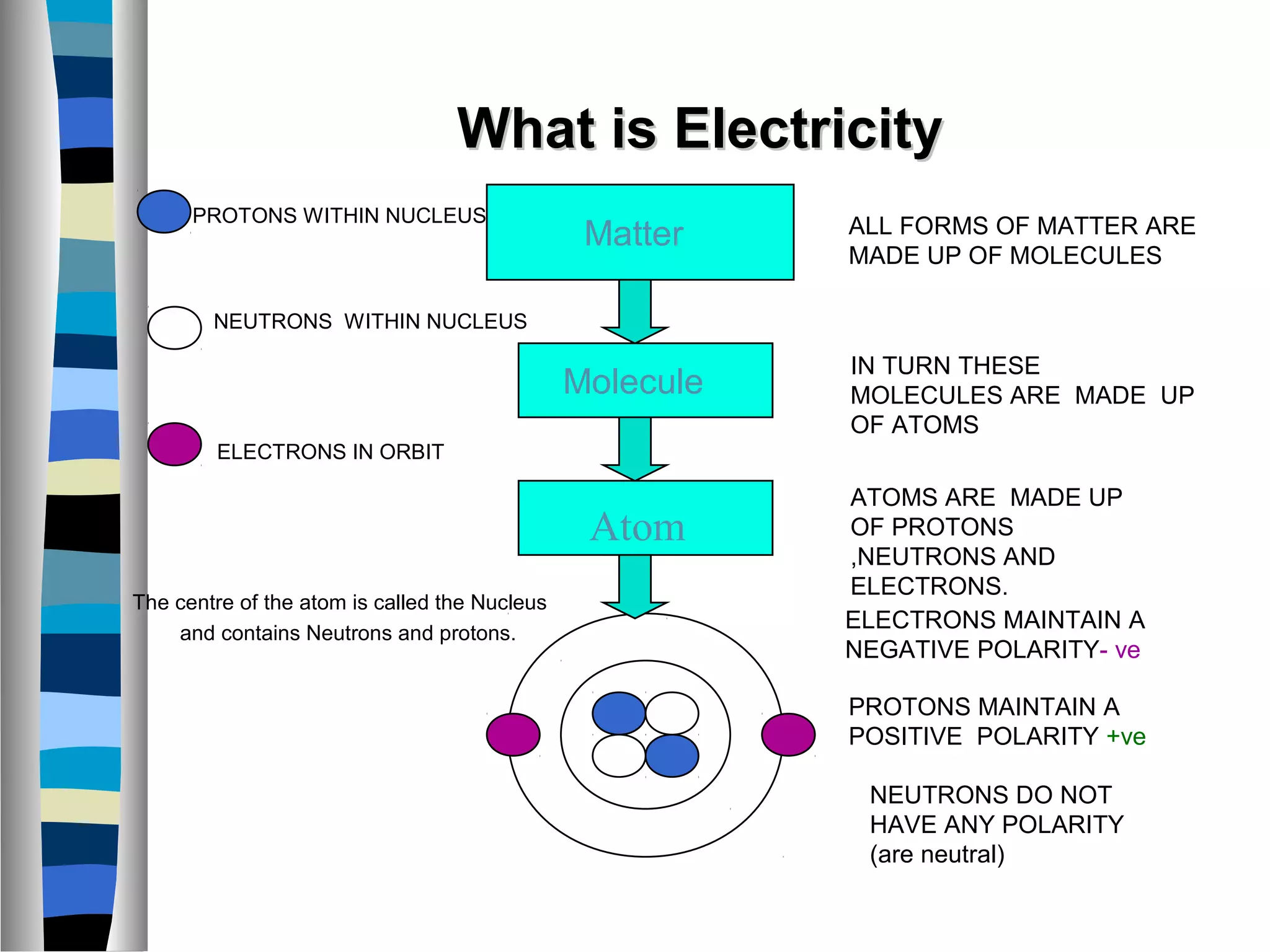
Matter
Molecule
Atom
ALL FORMS OF MATTER ARE
MADE UP OF MOLECULES
IN TURN THESE
MOLECULES ARE MADE UP
OF ATOMS
ATOMS ARE MADE UP
OF PROTONS
,NEUTRONS AND
ELECTRONS.
ELECTRONS MAINTAIN A
NEGATIVE POLARITY- ve
PROTONS MAINTAIN A
POSITIVE POLARITY +ve
NEUTRONS DO NOT
HAVE ANY POLARITY
(are neutral)
The centre of the atom is called the Nucleus
and contains Neutrons and protons.
ELECTRONS IN ORBIT
PROTONS WITHIN NUCLEUS
NEUTRONS WITHIN NUCLEUS
ELECTRONS IN ORBIT
NUCLEUS
What is ElectricityWhat is Electricity
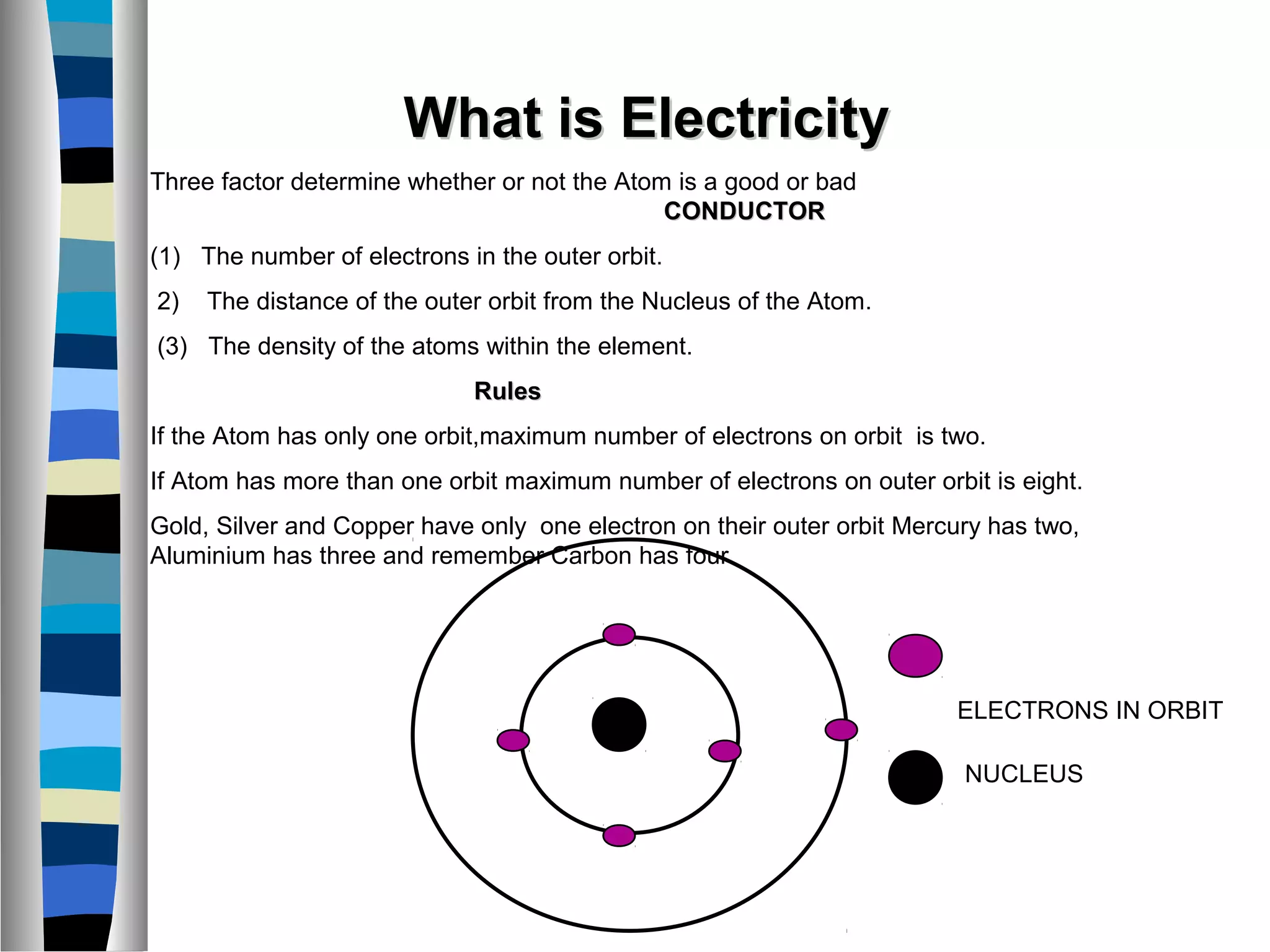
Three factor determine whether or not the Atom is a good or bad
CONDUCTORCONDUCTOR
(1) The number of electrons in the outer orbit.
2) The distance of the outer orbit from the Nucleus of the Atom.
(3) The density of the atoms within the element.
RulesRules
If the Atom has only one orbit,maximum number of electrons on orbit is two.
If Atom has more than one orbit maximum number of electrons on outer orbit is eight.
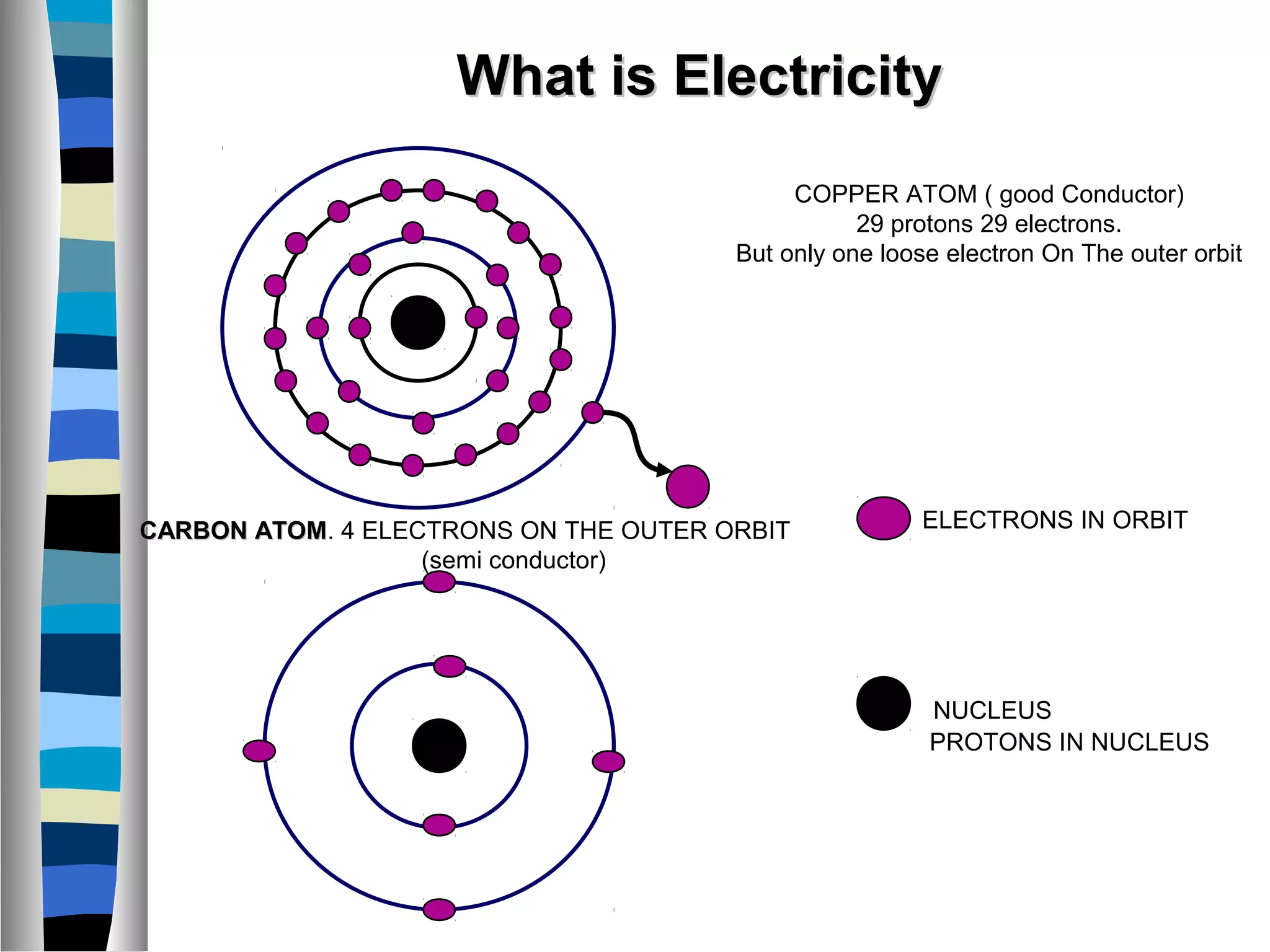
Gold, Silver and Copper have only one electron on their outer orbit Mercury has two,
Aluminium has three and remember Carbon has four.
ELECTRONS IN ORBIT
PROTONS IN NUCLEUS
NUCLEUS
COPPER ATOM ( good Conductor)
29 protons 29 electrons.
But only one loose electron On The outer orbit
CARBON ATOMCARBON ATOM. 4 ELECTRONS ON THE OUTER ORBIT
(semi conductor)
What is ElectricityWhat is Electricity
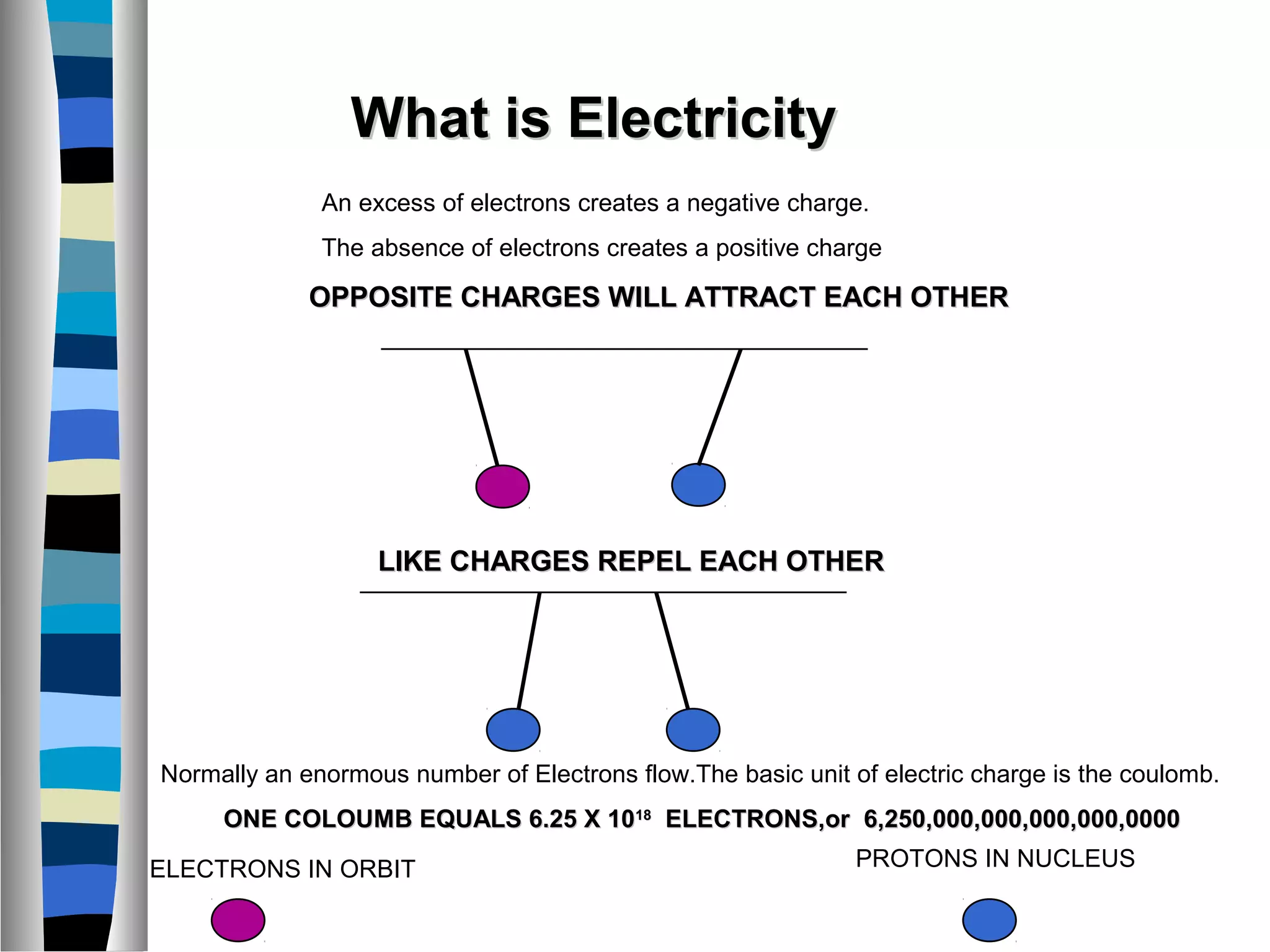
LIKE CHARGES REPEL EACH OTHERLIKE CHARGES REPEL EACH OTHER
What is ElectricityWhat is Electricity
An excess of electrons creates a negative charge.
The absence of electrons creates a positive charge
OPPOSITE CHARGES WILL ATTRACT EACH OTHEROPPOSITE CHARGES WILL ATTRACT EACH OTHER
Normally an enormous number of Electrons flow.The basic unit of electric charge is the coulomb.
ONE COLOUMB EQUALS 6.25 X 10ONE COLOUMB EQUALS 6.25 X 101818
ELECTRONS,or 6,250,000,000,000,000,0000ELECTRONS,or 6,250,000,000,000,000,0000
ELECTRONS IN ORBIT PROTONS IN NUCLEUS
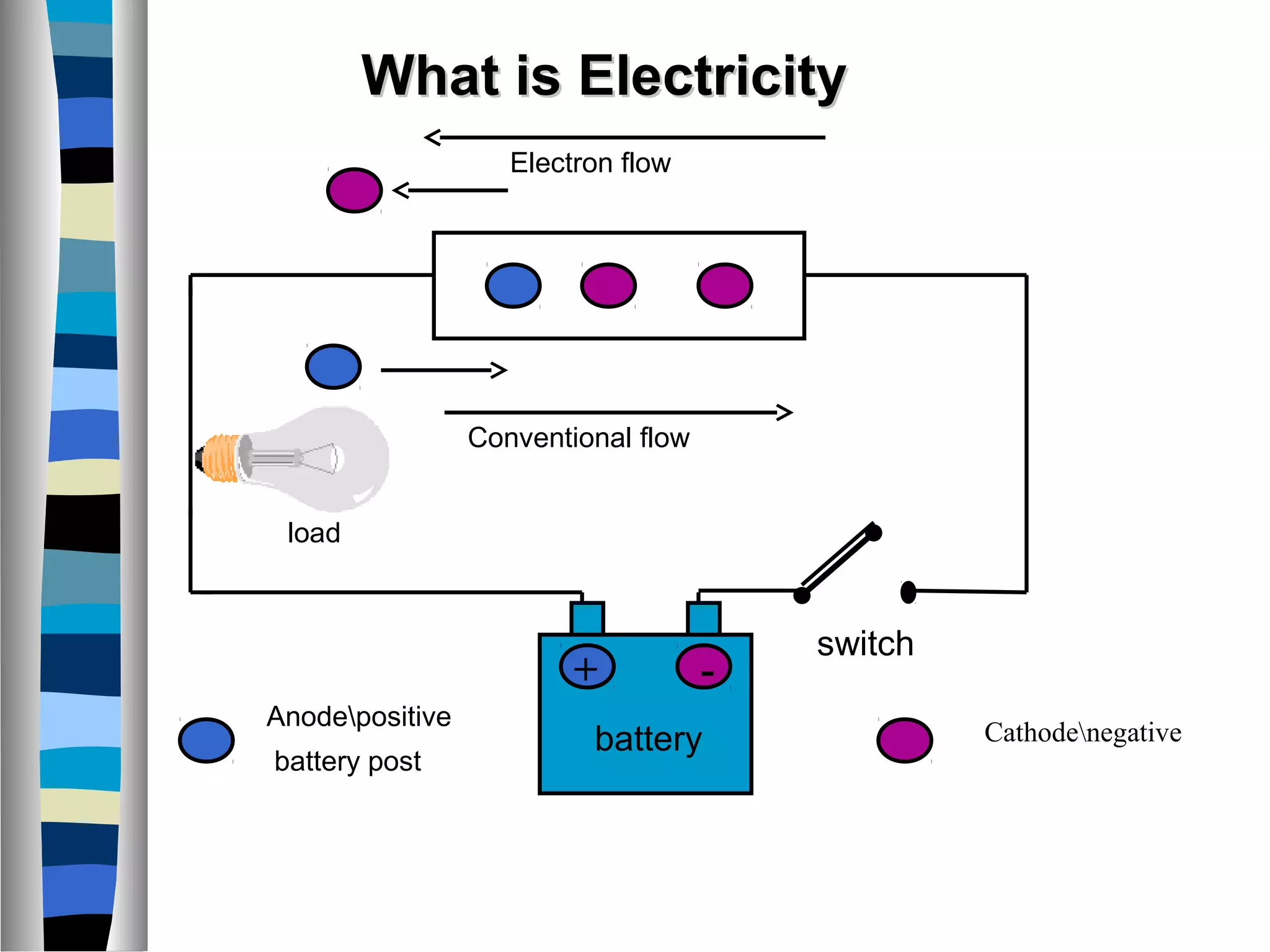
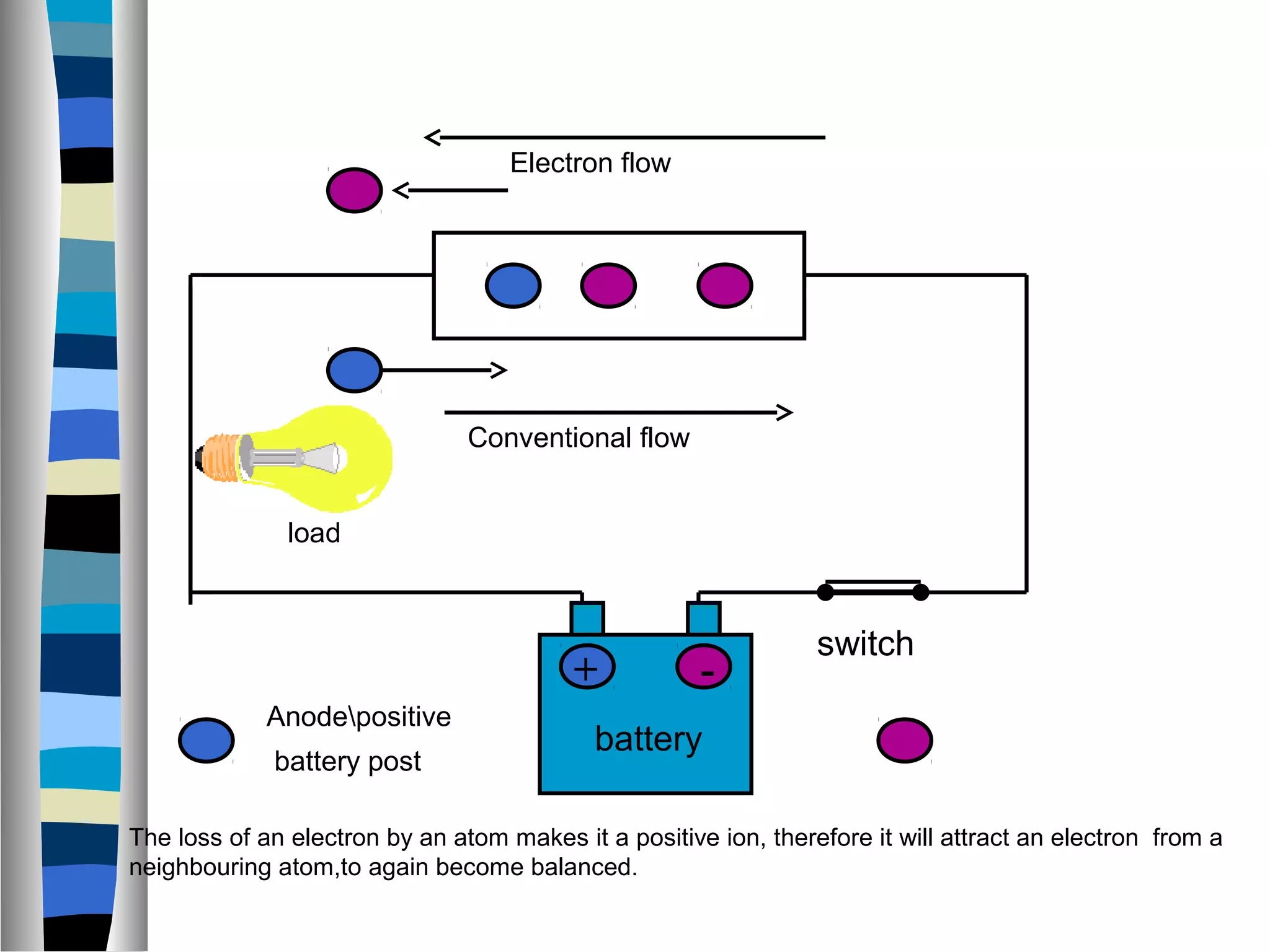
Electron flow
Conventional flow
load
battery
switch
Anodepositive
battery post
What is ElectricityWhat is Electricity
+ -
Cathodenegative
Electron flow
Conventional flow
load
battery
switch
Anodepositive
battery post
+ -
The loss of an electron by an atom makes it a positive ion, therefore it will attract an electron from a
neighbouring atom,to again become balanced.
Basics of electricity
Electricity-
- There are variety of methods for producing electricity
- Through chemical reaction in a battery.
- For large amount of electricity electromagnetic
generators are used.
Current -
- Flow of electron.
- Conventional current is in opposite direction.
- High voltage to low voltage.
- Unit of current is ampere.
- Current is measured by ammeter, Connected in
series.
- Polarity in DC
6
Basics of electricity-
Potential - Ability to do work
Voltage - Potential difference.(work done in moving a unit +ve charge
from a point of lower to higher potential).
- Unit of voltage is volt (v).
- Measured by voltmeter,connected across source.
- Sources can be Battery,DC generator,alternator etc.
- Can be AC or DC.
- Polarity in DC
- Equivalent to two water tanks,connected by pipe water
flows.
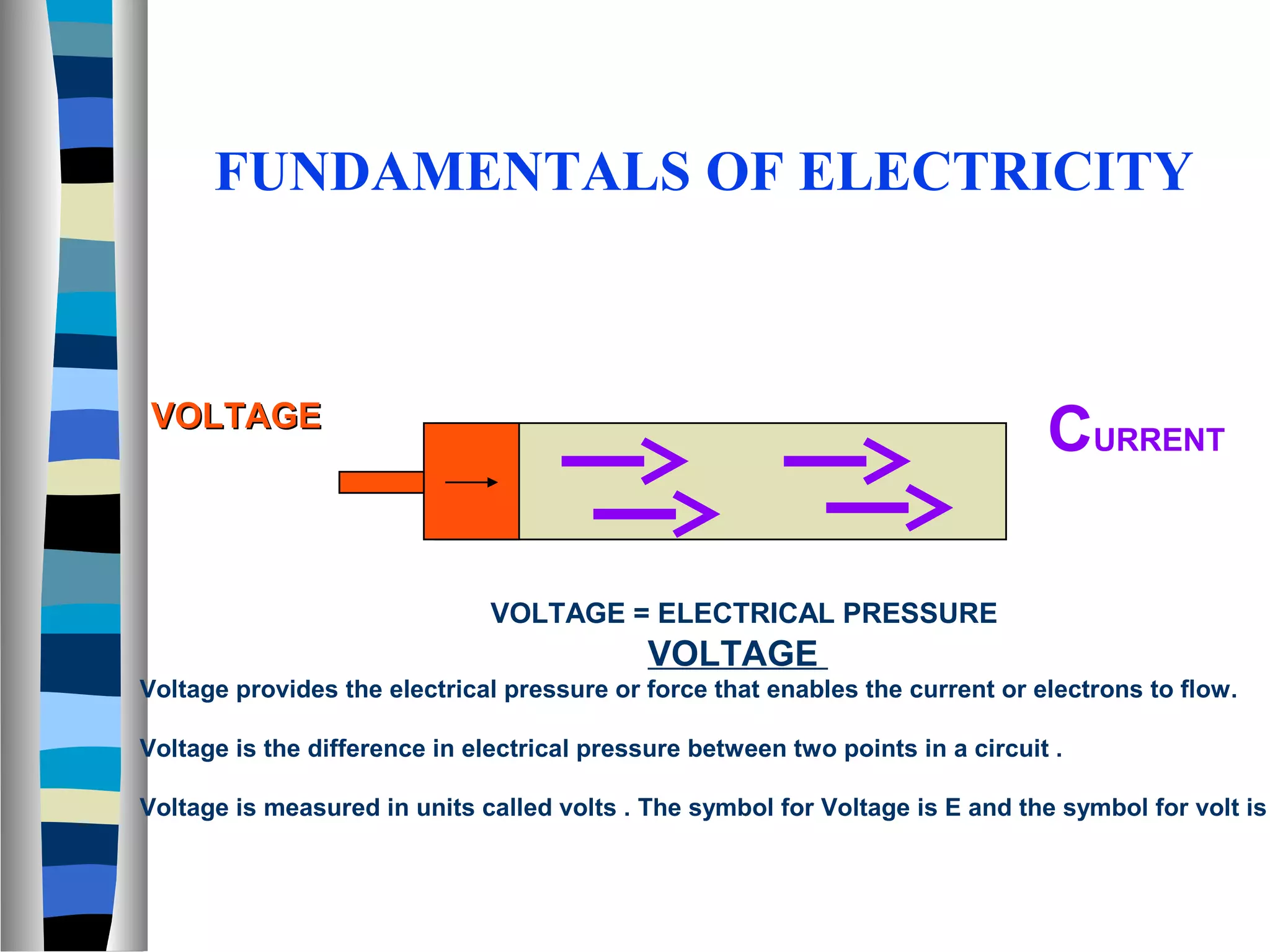
VOLTAGEVOLTAGE
CURRENT
VOLTAGE = ELECTRICAL PRESSURE
FUNDAMENTALS OF ELECTRICITY
VOLTAGE
Voltage provides the electrical pressure or force that enables the current or electrons to flow.
Voltage is the difference in electrical pressure between two points in a circuit .
Voltage is measured in units called volts . The symbol for Voltage is E and the symbol for volt is
Basics of electricity
Resistance -
- Opposes flow of current.
- Unit is ohms.
- Measured by ohm meter connected across it.
- Depends upon type of material, area & length.
- Produces heat when current flows through it.
- Fixed and variable resistor (potentiometer).
10
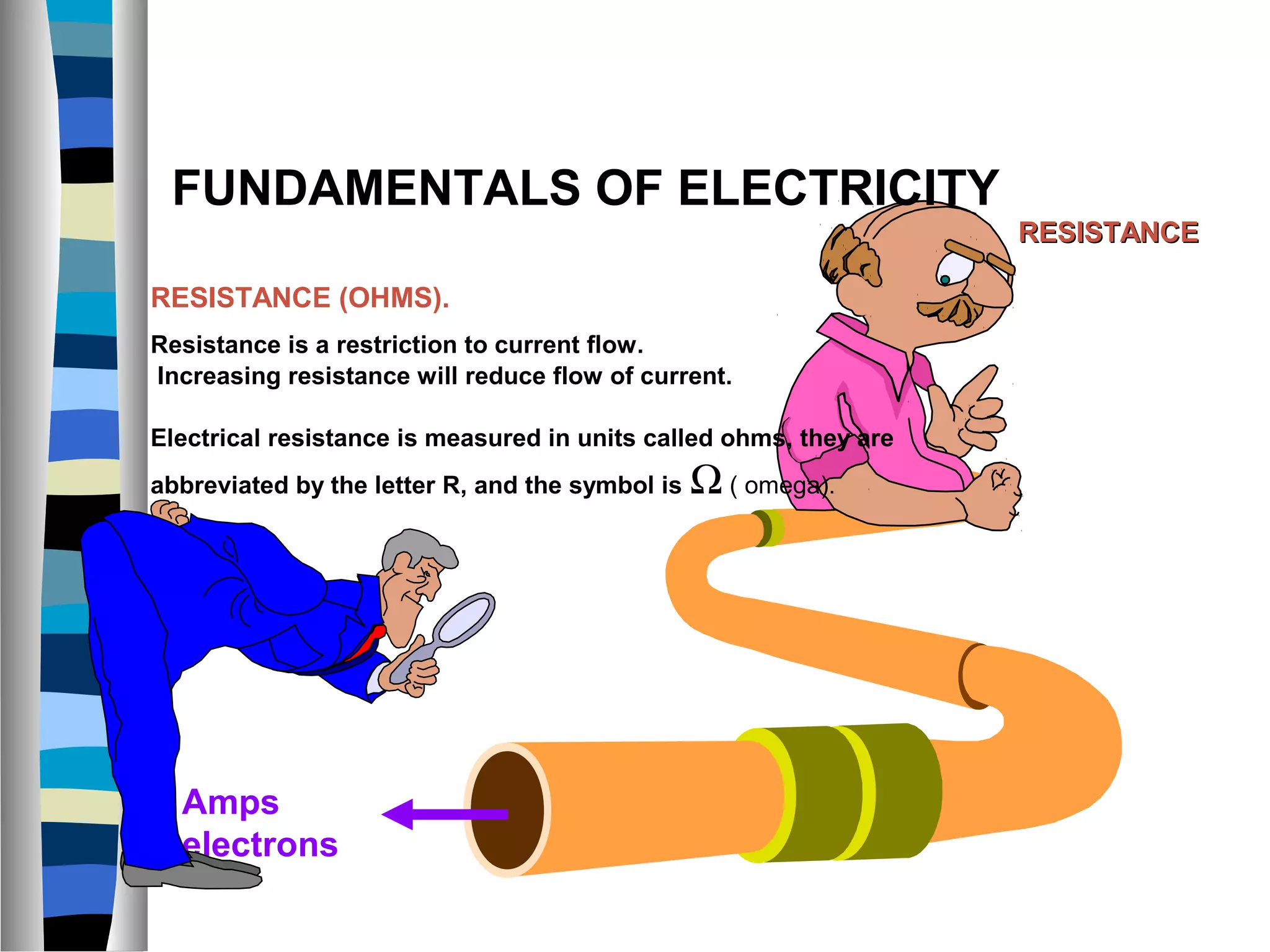
Amps
electrons
RESISTANCE (OHMS).
Resistance is a restriction to current flow.
Increasing resistance will reduce flow of current.
Electrical resistance is measured in units called ohms, they are
abbreviated by the letter R, and the symbol is Ω ( omega).
RESISTANCERESISTANCE
FUNDAMENTALS OF ELECTRICITY
Basics of electricity
Inductor -
- Coil of wire.
- Opposes change in current.
- Used to create magnetic field for rotation.
- Unit is henry.
- Open and short inductor.
Basics of electricity
Capacitor -
- Two metal plates separated by a DI-electric (Max volts/mm which a
medium can withstand without breakdown).
- Gets charged when voltage is applied.
- Unit of capacitance is farad.
- Capacitor in series 1/C=1/C1+1/C2 & in parallel C= C1+C2.
- C = Q / V
- Practical unitsMicro and Pico farad.
Basics of electricity
Insulators and Conductors -
Conductors -
- Materials that have a low resistance to current flow
are classified as conductors.
- Copper and aluminium wires are conductors.
- Conductors are used in electrical circuits to connect
components to one another.
- Conductors are wrapped in insulators to isolate from
one another.
Insulators -
- Materials that have a high resistance to current flow
are classified as Insulators.
- Glass, rubber & dry air are insulators
13
Basics of electricity
Ohm’s law - Relation between three quantities learnt
V= I x R
I = V/ R
R = V / I
Where R = Resistance of circuit, in ohms.
V = Applied voltage, in volts.
I = Current, in amperes.
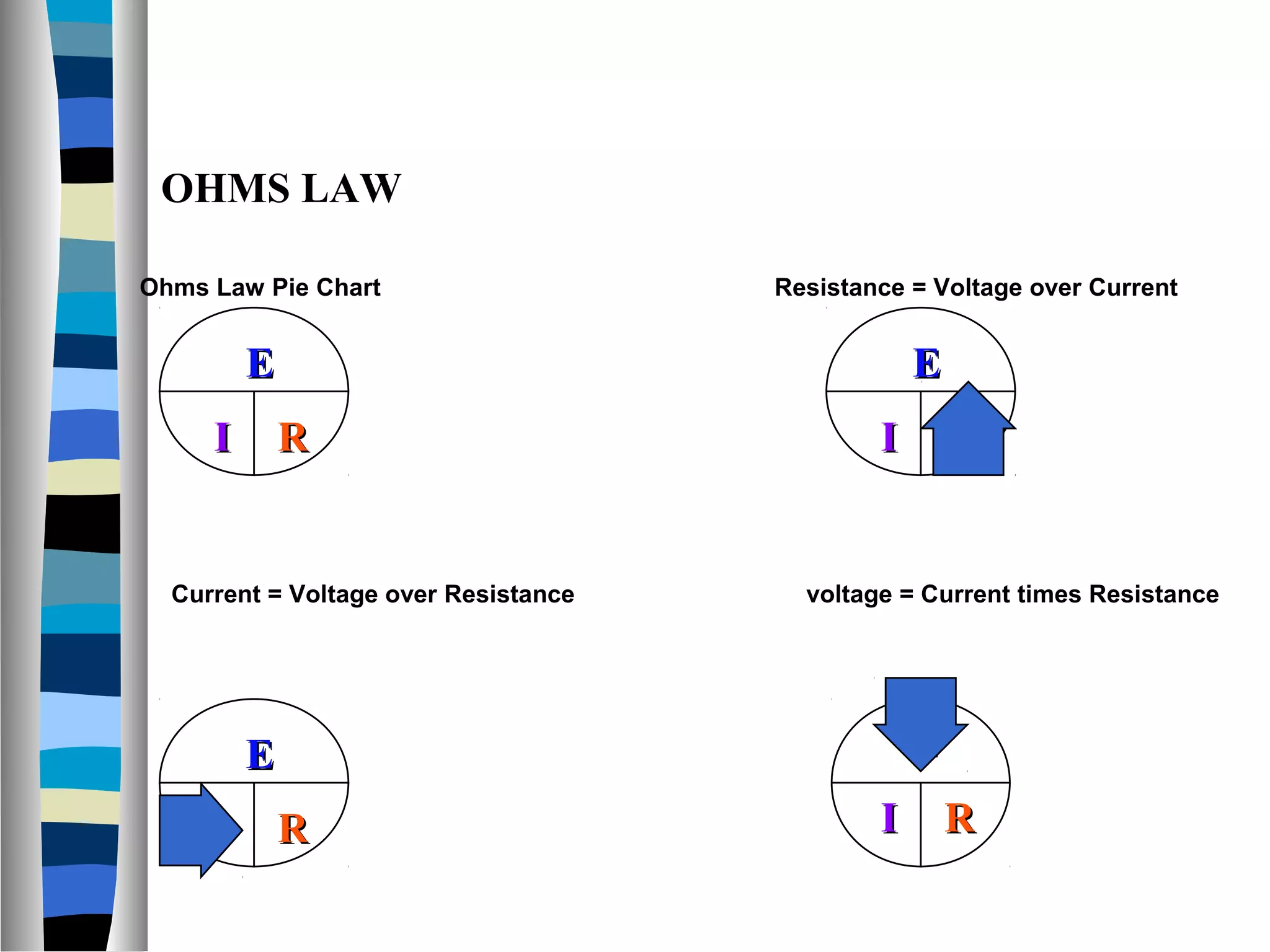
EE
II RR
EE
II R
EE E
I RR II RR
OHMS LAW
Ohms Law Pie Chart Resistance = Voltage over Current
Current = Voltage over Resistance voltage = Current times Resistance
Basics of electricity-
DC power -
- Power consumed in industry is almost A.C.
- Power in DC circuit is P = V x I =I x R x I
- Different types of load have different effect on
power source.
- Unit of mechanical power is horsepower.
- 1 hp = 0.746 kilowatts.
- Measured by wattmeter.
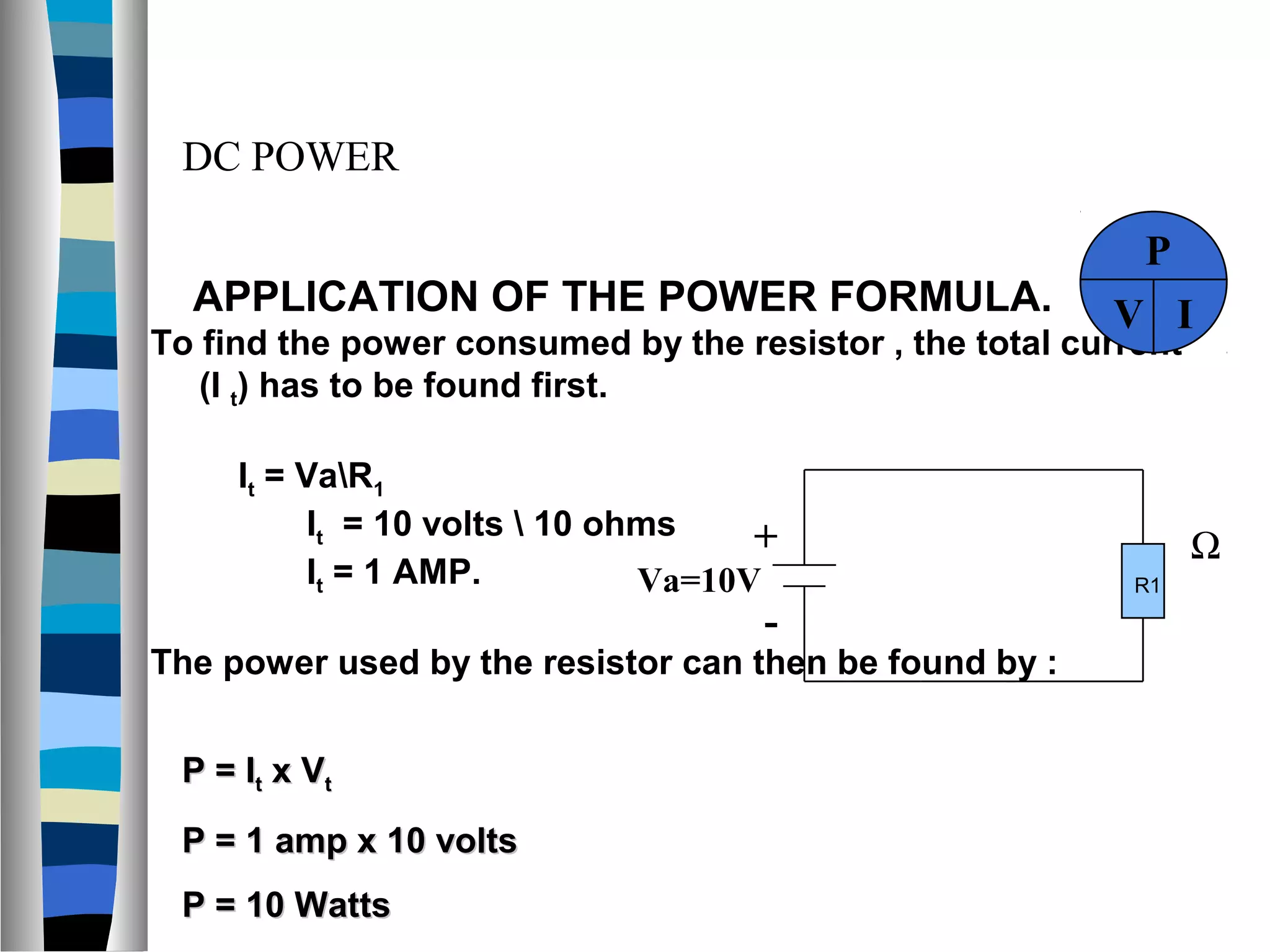
APPLICATION OF THE POWER FORMULA.
To find the power consumed by the resistor , the total current
(I t) has to be found first.
It = VaR1
It = 10 volts  10 ohms
It = 1 AMP.
The power used by the resistor can then be found by :
DC POWER
P
V I
+
-
Va=10V
Ω
R1
P = IP = Itt x Vx Vtt
P = 1 amp x 10 voltsP = 1 amp x 10 volts
P = 10 WattsP = 10 Watts
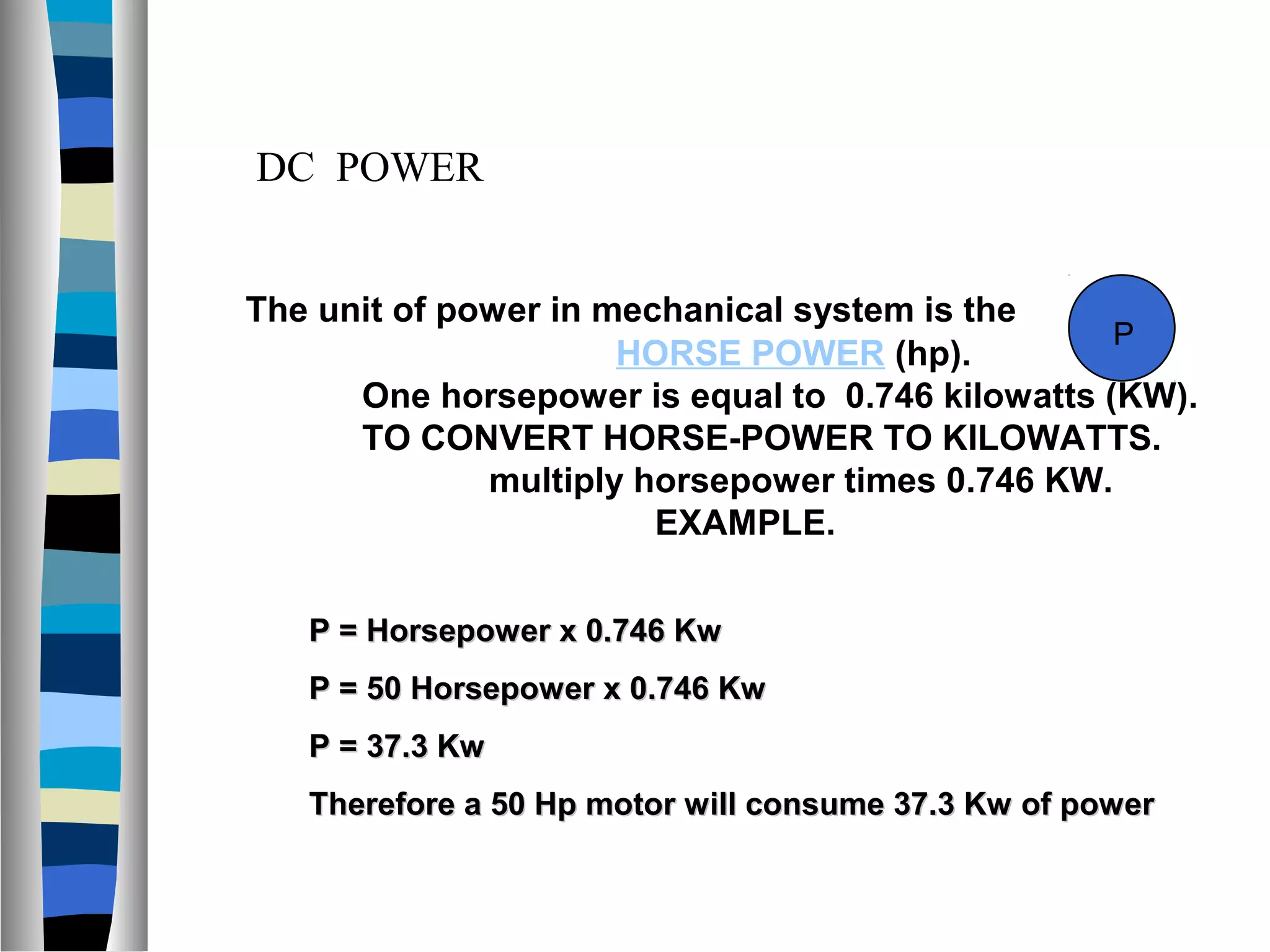
The unit of power in mechanical system is the
HORSE POWER (hp).
One horsepower is equal to 0.746 kilowatts (KW).
TO CONVERT HORSE-POWER TO KILOWATTS.
multiply horsepower times 0.746 KW.
EXAMPLE.
P = Horsepower x 0.746 KwP = Horsepower x 0.746 Kw
P = 50 Horsepower x 0.746 KwP = 50 Horsepower x 0.746 Kw
P = 37.3 KwP = 37.3 Kw
Therefore a 50 Hp motor will consume 37.3 Kw of powerTherefore a 50 Hp motor will consume 37.3 Kw of power
P
DC POWER
Basics of electricity
AC Power-
- Alternating quantity is one which periodically passes through
a definite cycle of changes.
- In AC RMS values are used .
- AC power is consumed by different types of load such as
inductive , resistive & capacitive.
- AC power is given by P= V x I x CosO
- Symbol for AC source.
- AC power is measured by Wattmeter.
- Unit of power is Watts.
18
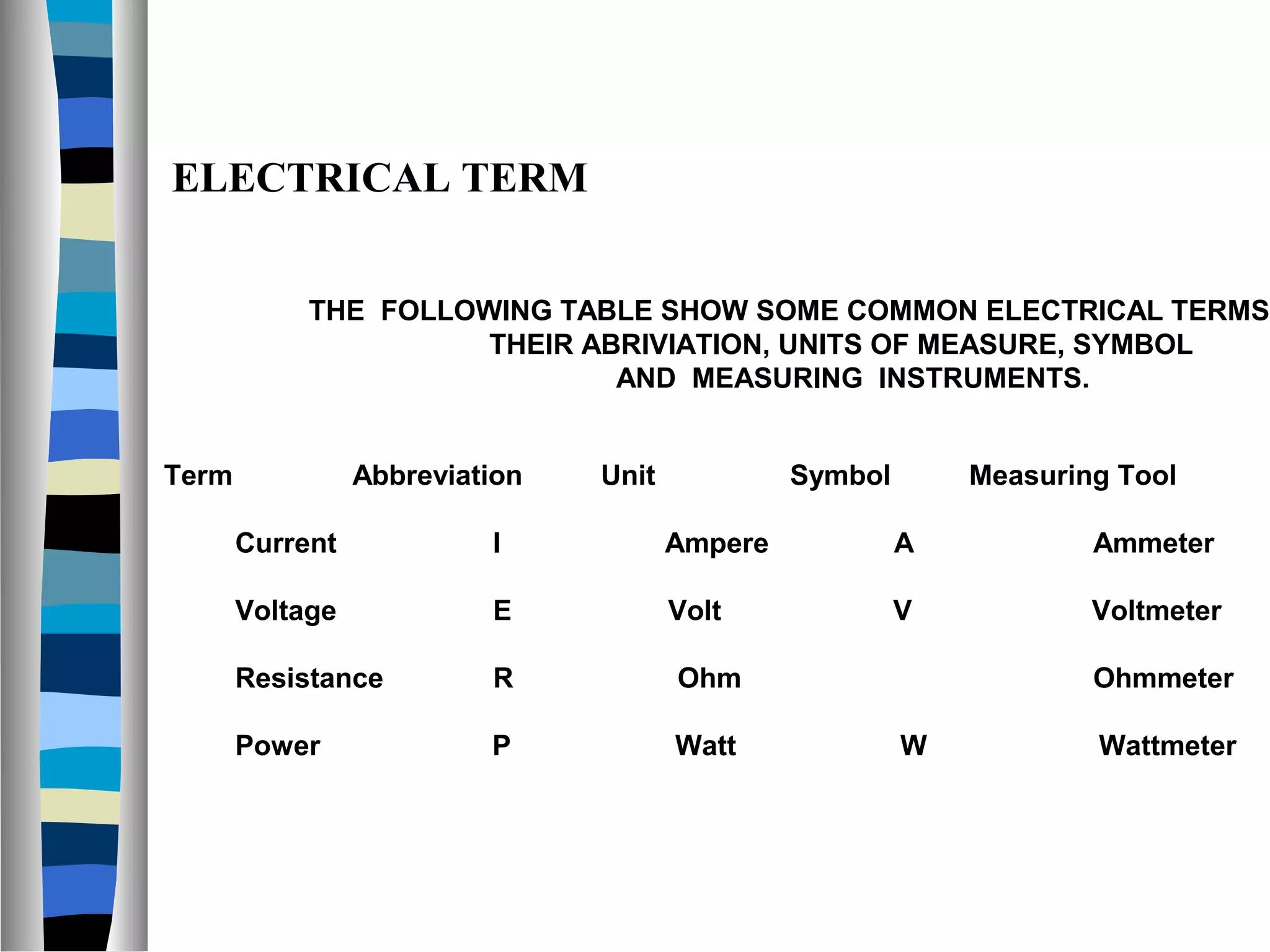
THE FOLLOWING TABLE SHOW SOME COMMON ELECTRICAL TERMS
THEIR ABRIVIATION, UNITS OF MEASURE, SYMBOL
AND MEASURING INSTRUMENTS.
Term Abbreviation Unit Symbol Measuring Tool
Current I Ampere A Ammeter
Voltage E Volt V Voltmeter
Resistance R Ohm Ohmmeter
Power P Watt W Wattmeter
ELECTRICAL TERM
Basics of electricity
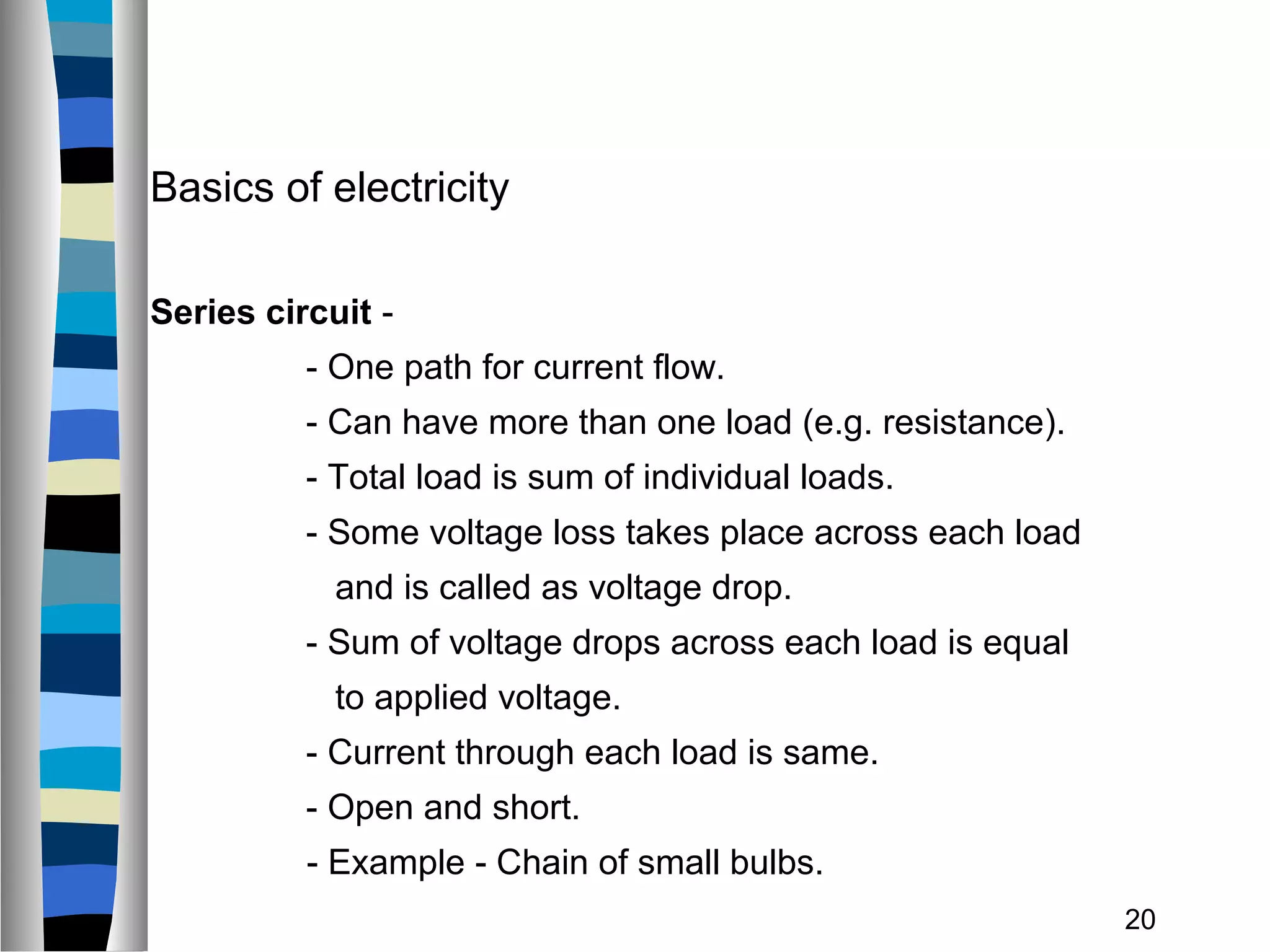
Series circuit -
- One path for current flow.
- Can have more than one load (e.g. resistance).
- Total load is sum of individual loads.
- Some voltage loss takes place across each load
and is called as voltage drop.
- Sum of voltage drops across each load is equal
to applied voltage.
- Current through each load is same.
- Open and short.
- Example - Chain of small bulbs.
20
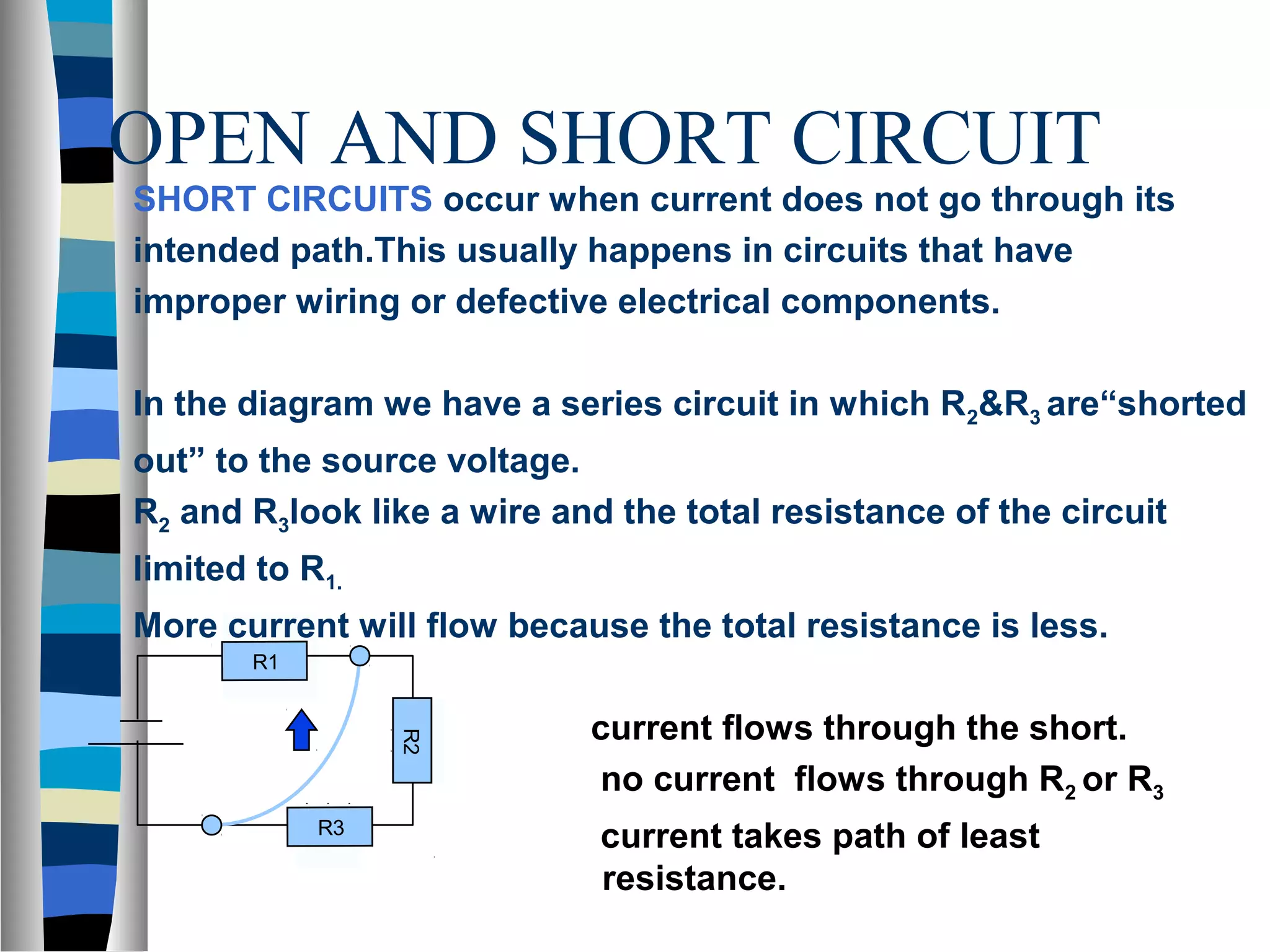
OPEN AND SHORT CIRCUIT
R2
R3
R1
SHORT CIRCUITS occur when current does not go through its
intended path.This usually happens in circuits that have
improper wiring or defective electrical components.
In the diagram we have a series circuit in which R2&R3 are“shorted
out” to the source voltage.
R2 and R3look like a wire and the total resistance of the circuit
limited to R1.
More current will flow because the total resistance is less.
current flows through the short.
no current flows through R2 or R3
current takes path of least
resistance.
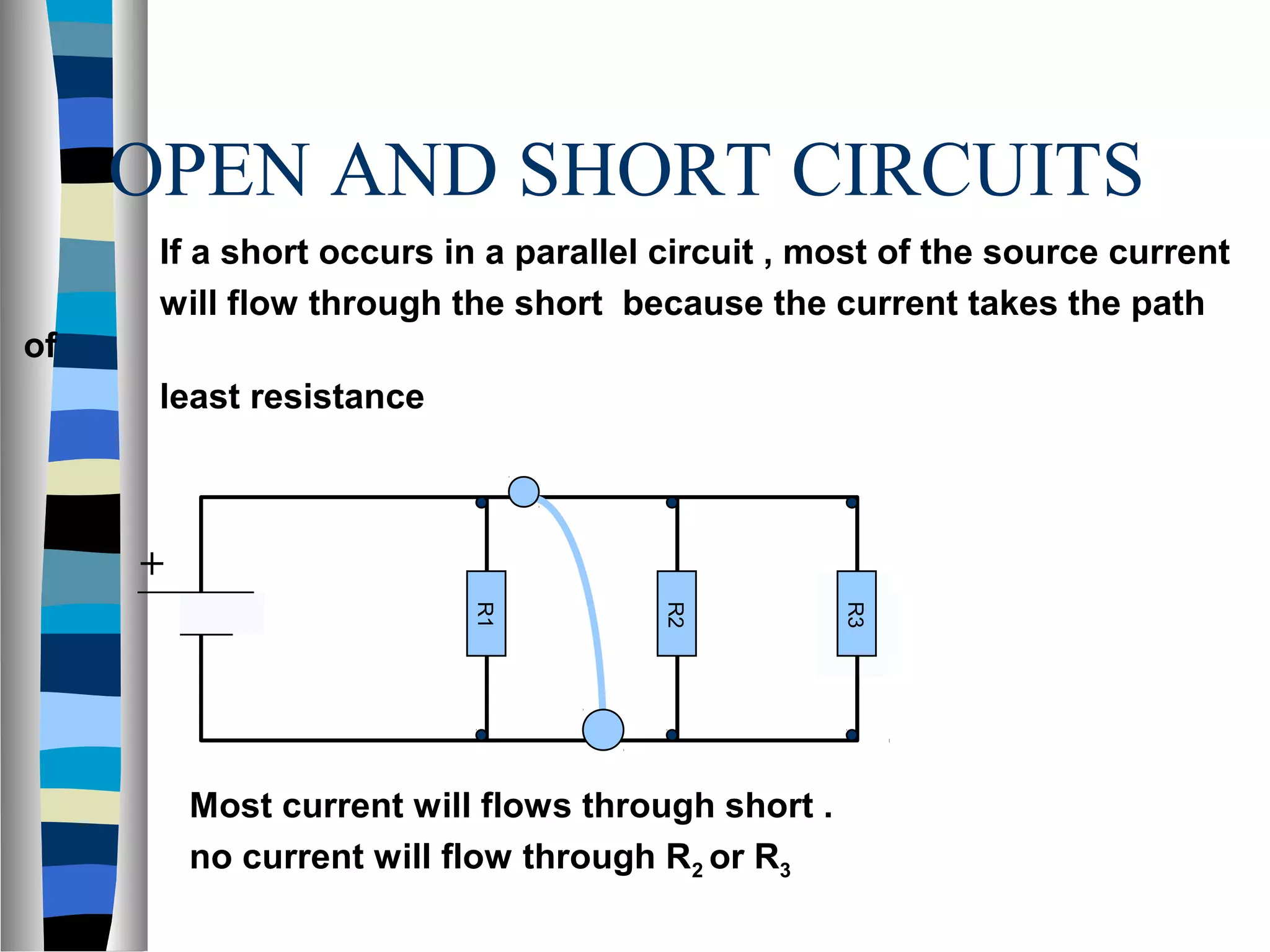
OPEN AND SHORT CIRCUITS
+
R1
R2
R3
If a short occurs in a parallel circuit , most of the source current
will flow through the short because the current takes the path
of
least resistance
Most current will flows through short .
no current will flow through R2 or R3
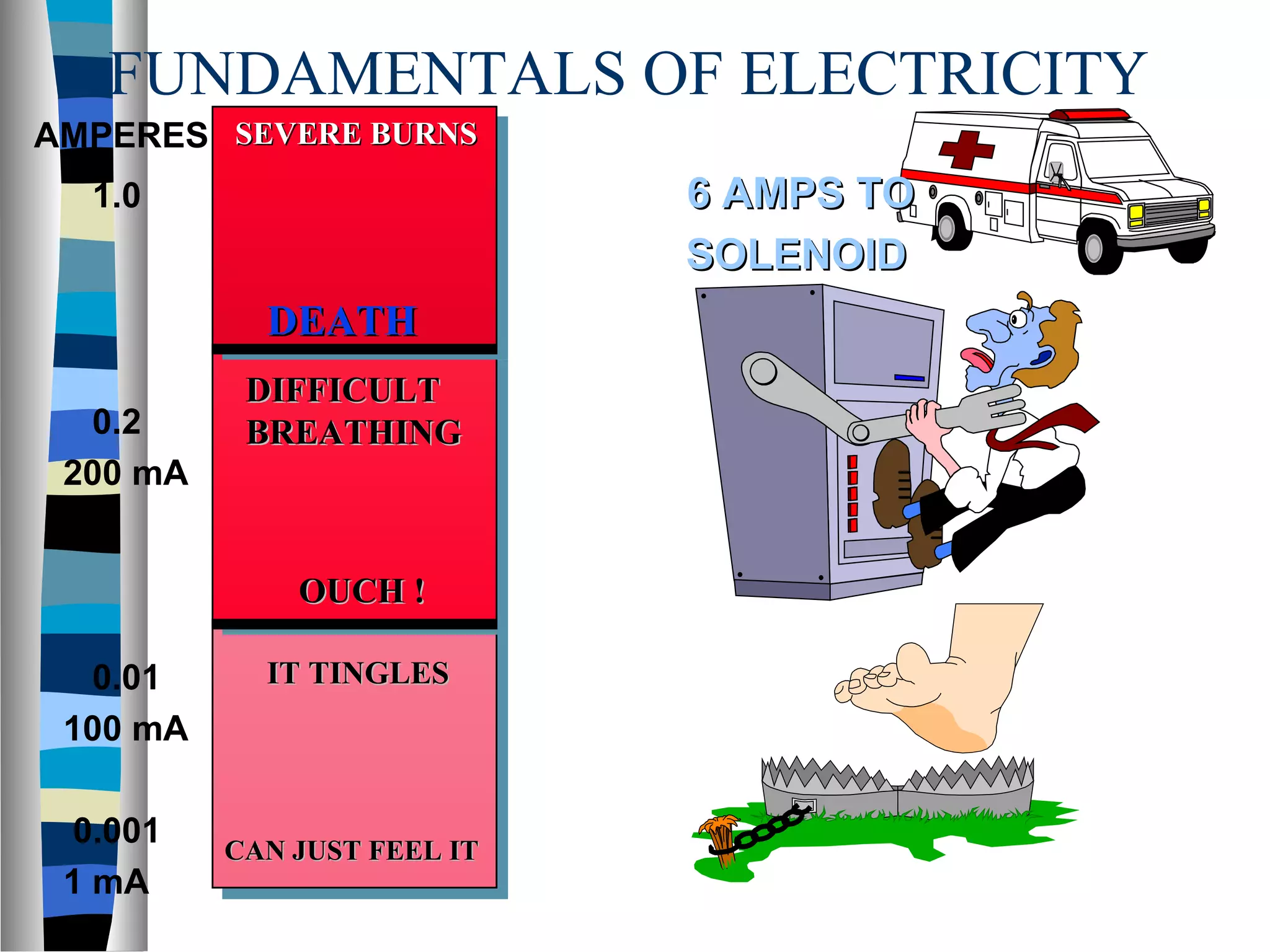
CAN JUST FEEL ITCAN JUST FEEL IT
DEATHDEATH
IT TINGLESIT TINGLES
OUCH !OUCH !
DIFFICULTDIFFICULT
BREATHINGBREATHING
SEVERE BURNSSEVERE BURNSAMPERES
1.0 6 AMPS TO6 AMPS TO
SOLENOIDSOLENOID
0.2
200 mA
0.01
100 mA
0.001
1 mA
FUNDAMENTALS OF ELECTRICITY
DIGITAL MULTIMETER DESCRIPTION.DIGITAL MULTIMETER DESCRIPTION.
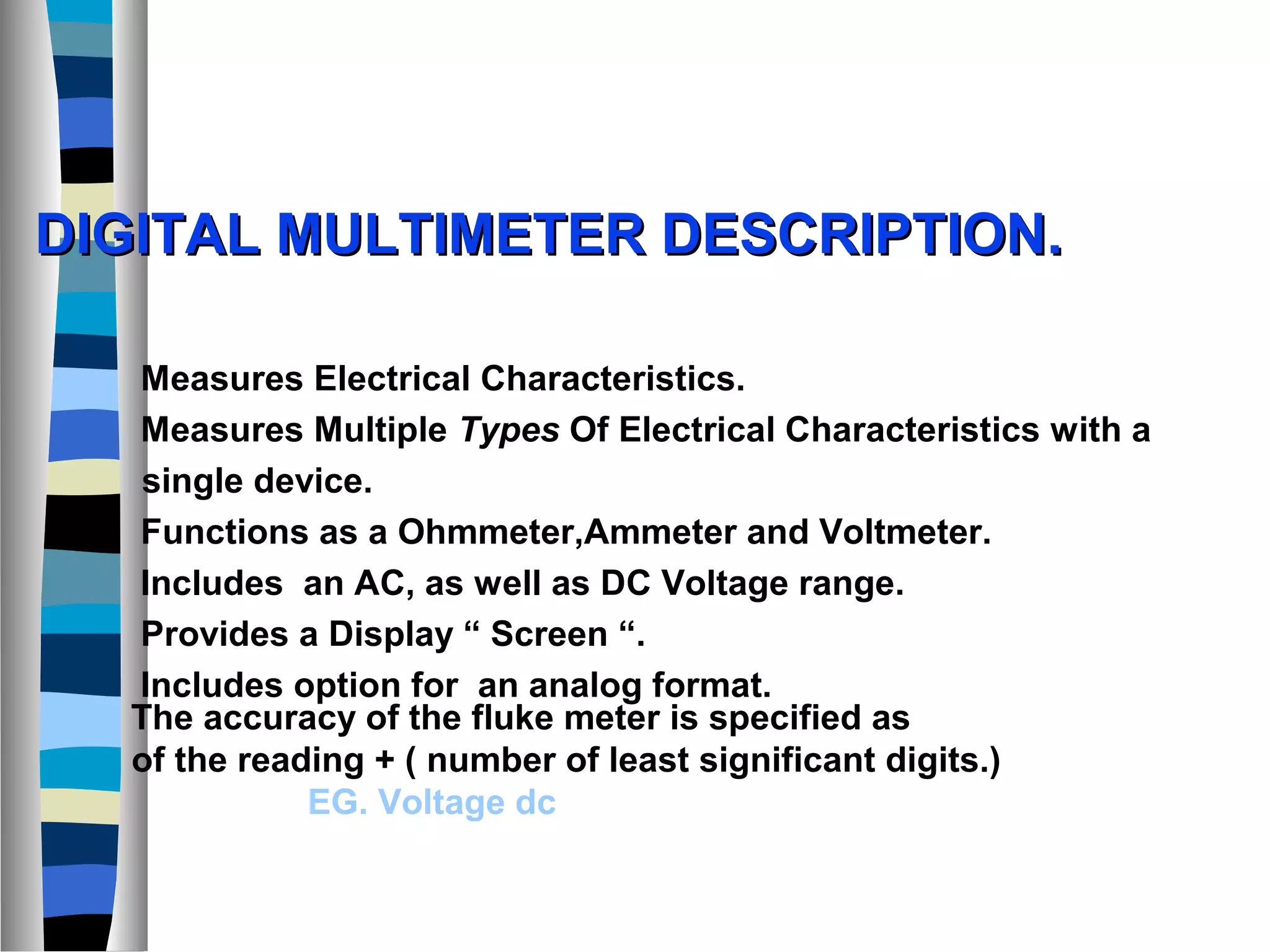
Measures Electrical Characteristics.
Measures Multiple Types Of Electrical Characteristics with a
single device.
Functions as a Ohmmeter,Ammeter and Voltmeter.
Includes an AC, as well as DC Voltage range.
Provides a Display “ Screen “.
Includes option for an analog format.
The accuracy of the fluke meter is specified as
of the reading + ( number of least significant digits.)
EG. Voltage dc
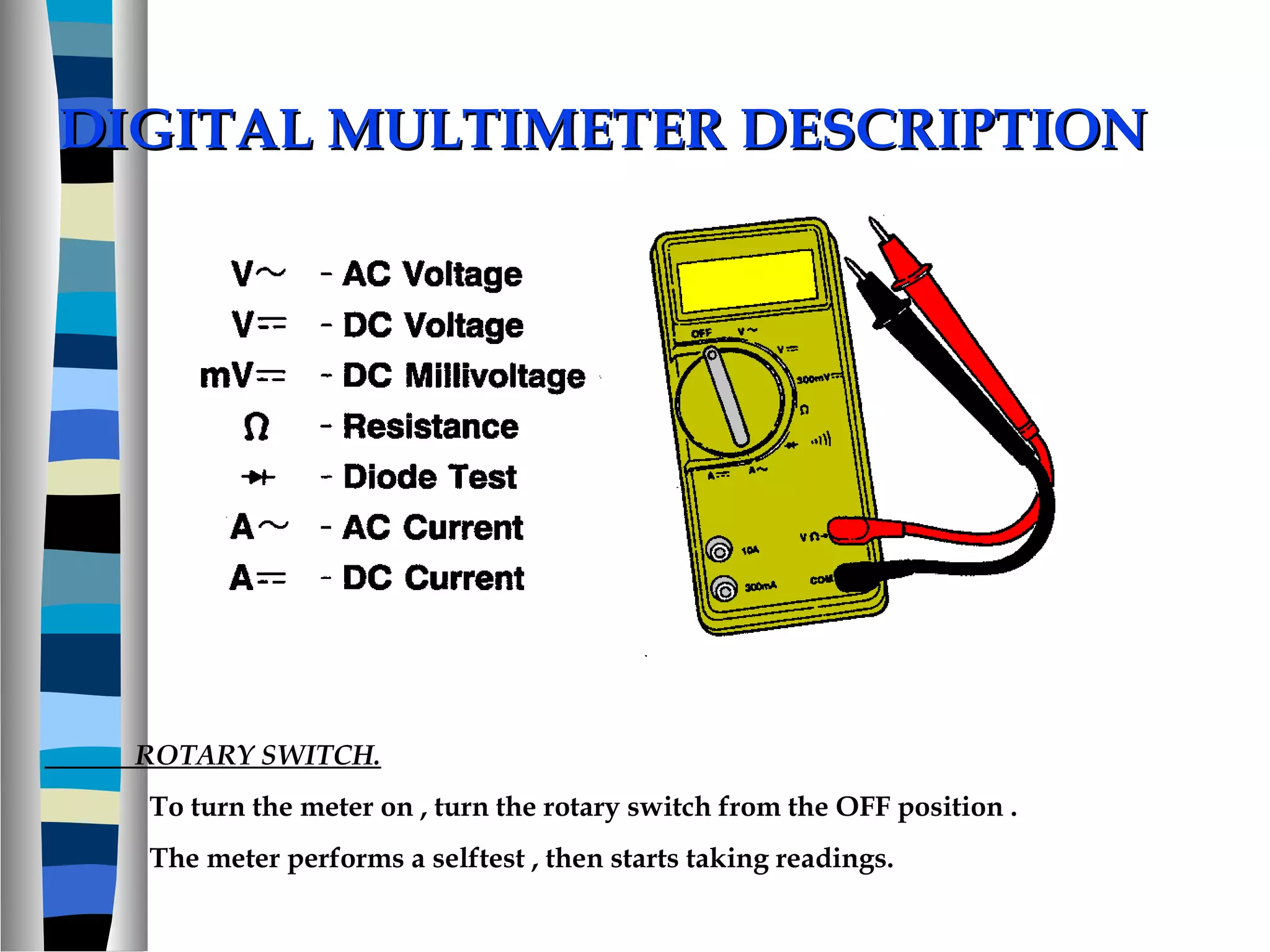
ROTARY SWITCH.
To turn the meter on , turn the rotary switch from the OFF position .
The meter performs a selftest , then starts taking readings.
DIGITAL MULTIMETER DESCRIPTIONDIGITAL MULTIMETER DESCRIPTION
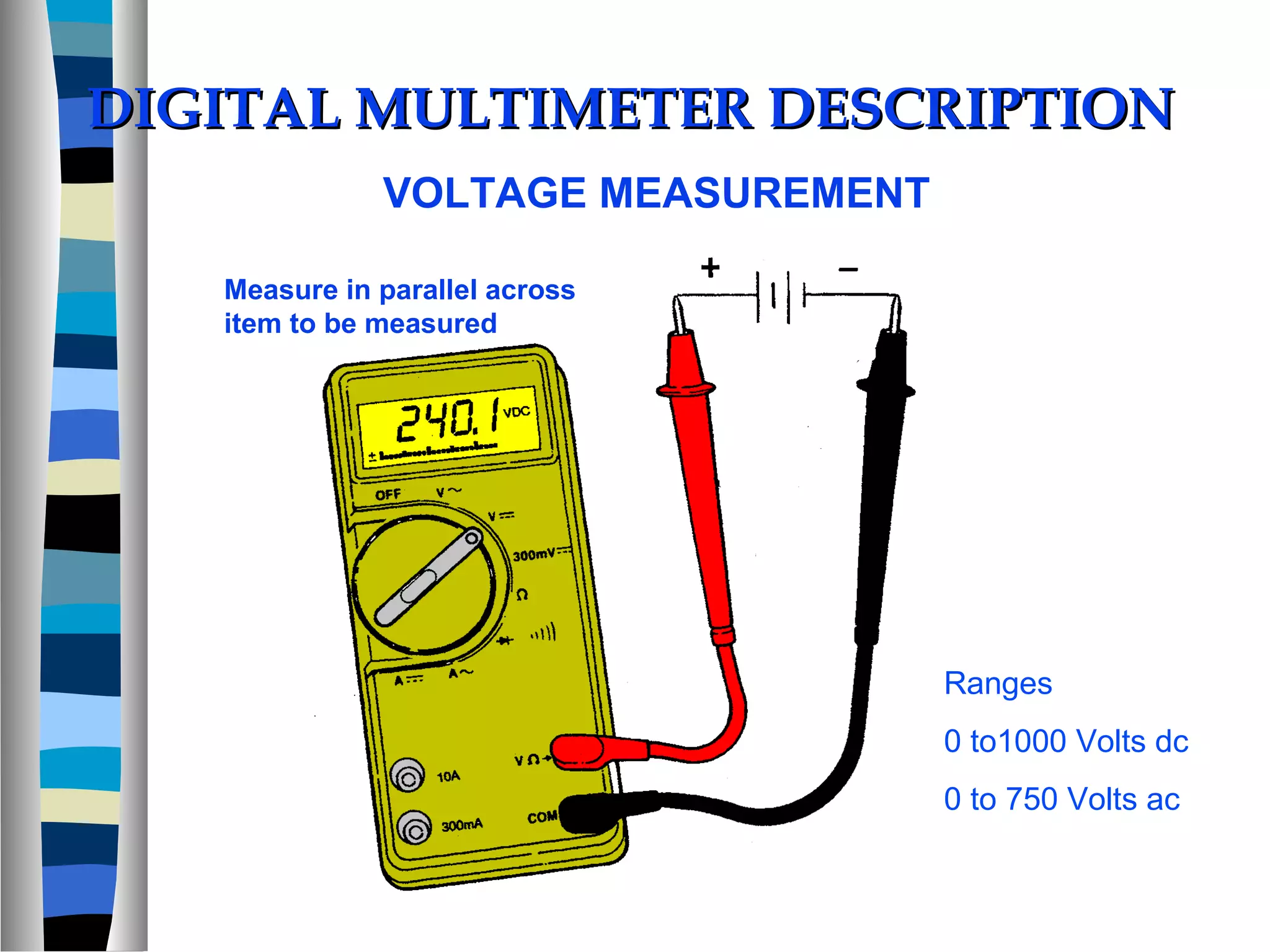
VOLTAGE MEASUREMENT
Ranges
0 to1000 Volts dc
0 to 750 Volts ac
DIGITAL MULTIMETER DESCRIPTIONDIGITAL MULTIMETER DESCRIPTION
Measure in parallel across
item to be measured
DIGITAL MULTIMETER DESCRIPTIONDIGITAL MULTIMETER DESCRIPTION
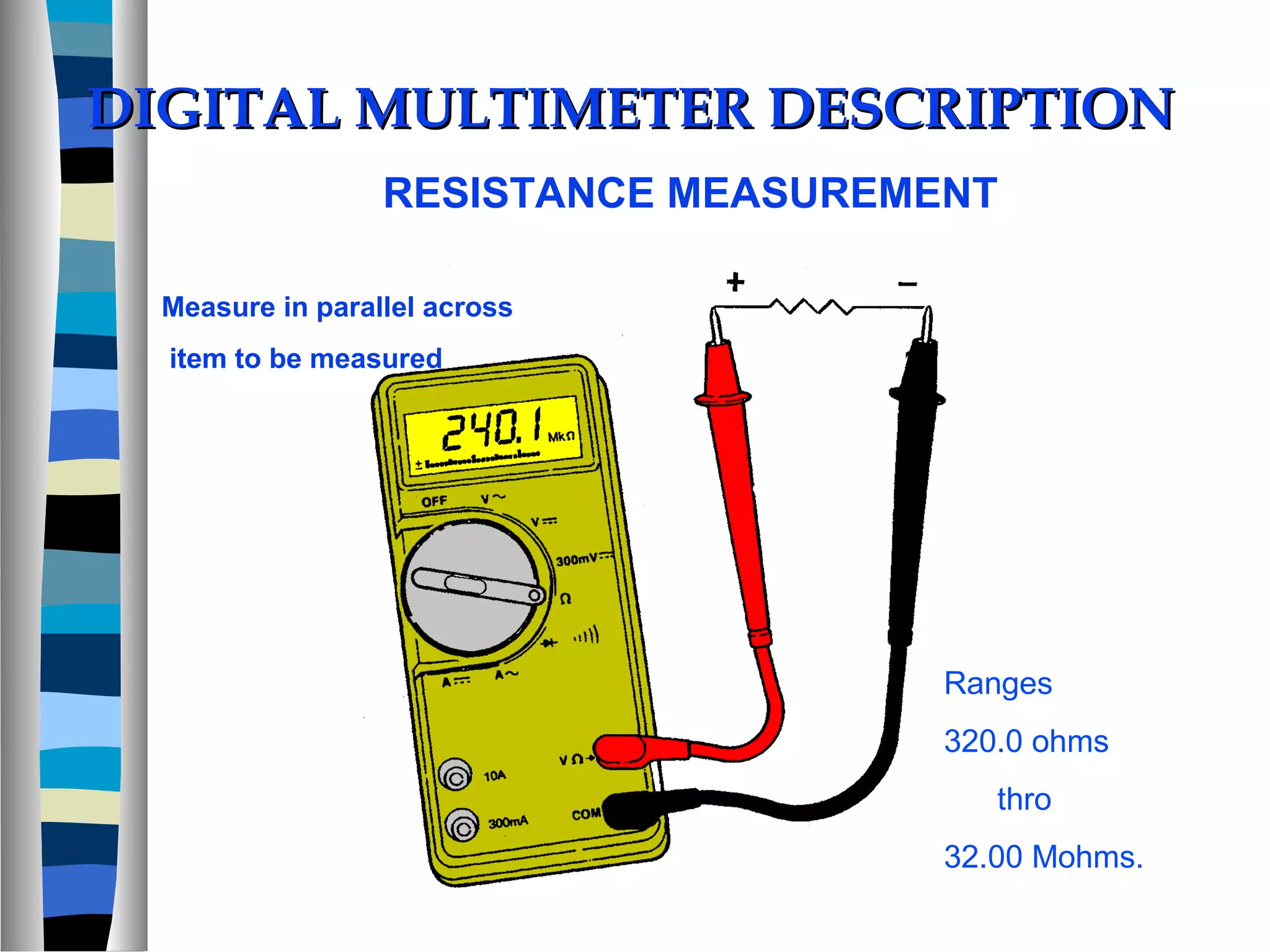
RESISTANCE MEASUREMENT
Measure in parallel across
item to be measured
Ranges
320.0 ohms
thro
32.00 Mohms.
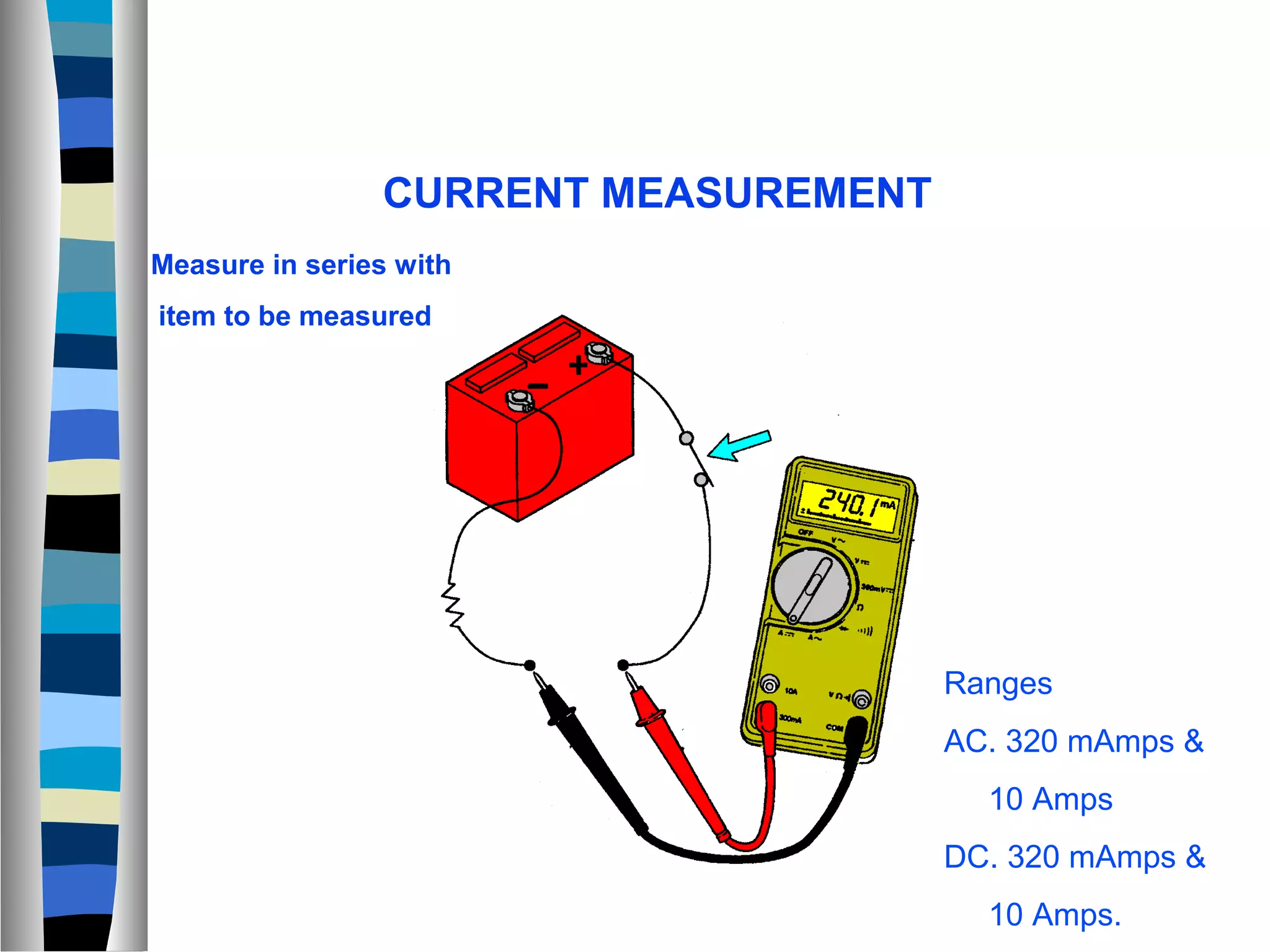
CURRENT MEASUREMENT
Measure in series with
item to be measured
Ranges
AC. 320 mAmps &
10 Amps
DC. 320 mAmps &
10 Amps.
Range
2 Volts dc.
Continuity test.
Bleep while
resistance is below
150 ohms
DIGITAL MULTIMETER DESCRIPTIONDIGITAL MULTIMETER DESCRIPTION
DIODE TEST
Measure in parallel across
item to be measured
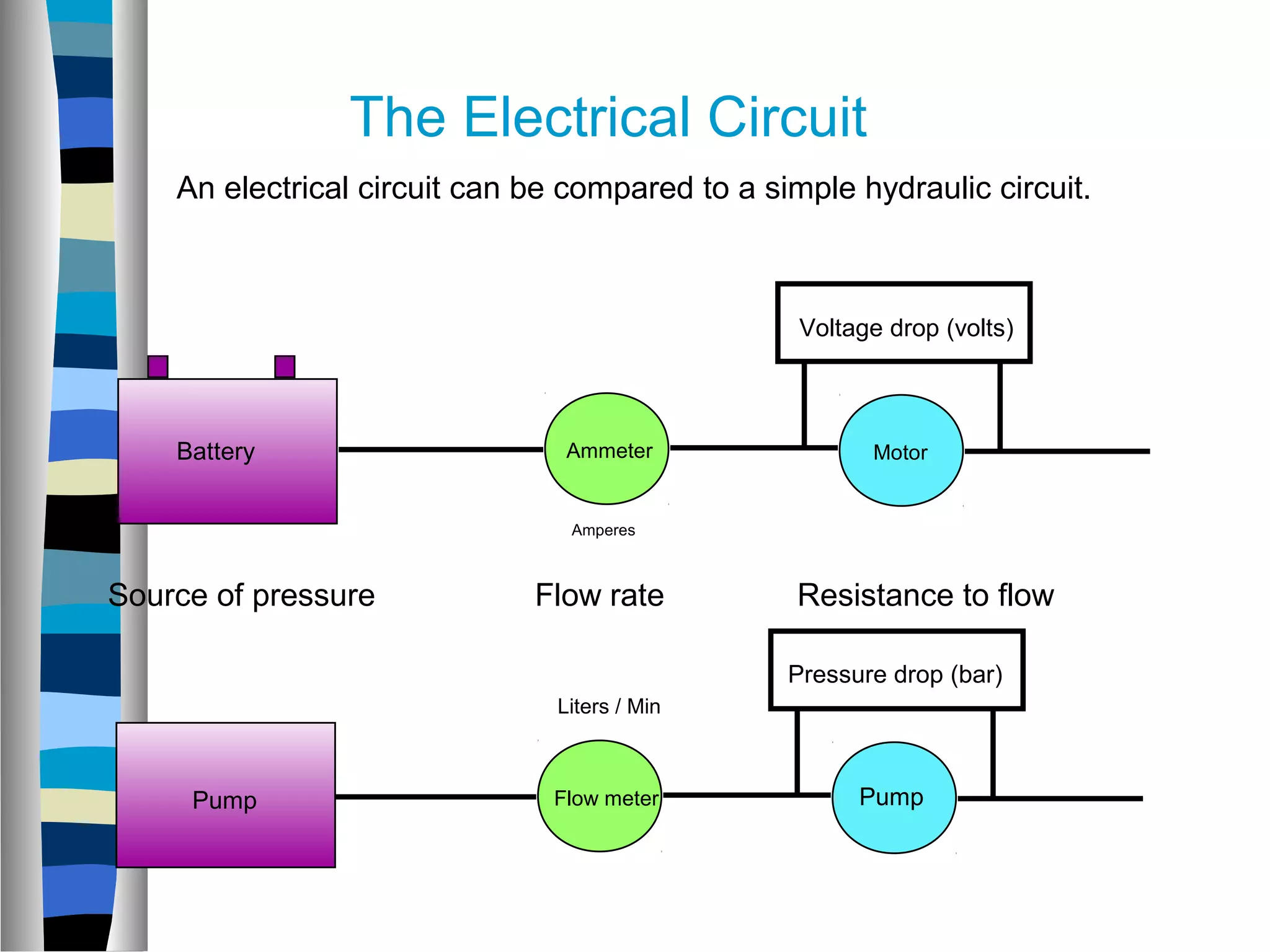
An electrical circuit can be compared to a simple hydraulic circuit.
Battery
Pump
Ammeter Motor
Voltage drop (volts)
Flow meter
Pressure drop (bar)
Source of pressure Flow rate Resistance to flow
Pump
Amperes
Liters / Min
The Electrical Circuit
Basics of electricity-
Types of loads - (Resistor,inductor& capacitor)
Resistive load -
- In DC circuit (fig) the voltage and current waveforms
are straight lines because voltage is constant.
- In AC circuit with pure resistance,voltage and current
are always in phase.
- Power consumed in DC circuit is constant as
voltage and current are constant.
- An AC ckt. that has only resistance produces a
positive power curve.
Basics of electricity-
Types of loads - (Resistor,inductor& capacitor)
Resistive load -
- In DC circuit (fig) the voltage and current waveforms
are straight lines because voltage is constant.
- In AC circuit with pure resistance,voltage and current
are always in phase.
- Power consumed in DC circuit is constant as
voltage and current are constant.
- An AC ckt. that has only resistance produces a
positive power curve.
Basics of electricity
Inductive load -
- An inductor is a coil of wire. A common inductive
load is an electric motor.
- Current lag behind voltage by 900
since voltage
is max at 900
while current is zero.
- Produce both positive and negative power. These
powers are equal in amplitude so their sum will
equal to zero.
- The inductor does not use real power still generator
supply it with voltage and current .
- So efficiency is lowered.
37
Basics of electricity
Capacitive load-
- A capacitor opposes change in voltage.
- Current lead voltage by 900
since voltage across it
is zero and the current is maximum.
- Produce both positive and negative power. These
powers are equal in amplitude so their sum will
equal to zero.
- The capacitor does not use real power still generator
supply it with voltage and current .
- So efficiency is lowered. 39

Basic of electrical

  • 1.
  • 2.
    OBJECTIVES To be ableto identify and implement. Theory of Ohms Law. Define electrical terms. To be able to describe the interrelationship between voltage, current and resistance in electrical circuits. To be able to identify digital multimeter features and its capabilities. To be able to correctly use the digital multimeter and understand your findings when taking electrical measurements,in normal and fault finding situations
  • 3.
    Basics of electricity Typesof energy- - Electrical energy - Heat energy - Atomic energy - Mechanical energy - One form of energy can be converted into another OIL - Heat , Water - Steam , Turbine - Mechanical energy Generator - Electrical energy
  • 4.
    What is ElectricityWhatis Electricity Matter Molecule Atom ALL FORMS OF MATTER ARE MADE UP OF MOLECULES IN TURN THESE MOLECULES ARE MADE UP OF ATOMS ATOMS ARE MADE UP OF PROTONS ,NEUTRONS AND ELECTRONS. ELECTRONS MAINTAIN A NEGATIVE POLARITY- ve PROTONS MAINTAIN A POSITIVE POLARITY +ve NEUTRONS DO NOT HAVE ANY POLARITY (are neutral) The centre of the atom is called the Nucleus and contains Neutrons and protons. ELECTRONS IN ORBIT PROTONS WITHIN NUCLEUS NEUTRONS WITHIN NUCLEUS
  • 5.
    ELECTRONS IN ORBIT NUCLEUS Whatis ElectricityWhat is Electricity Three factor determine whether or not the Atom is a good or bad CONDUCTORCONDUCTOR (1) The number of electrons in the outer orbit. 2) The distance of the outer orbit from the Nucleus of the Atom. (3) The density of the atoms within the element. RulesRules If the Atom has only one orbit,maximum number of electrons on orbit is two. If Atom has more than one orbit maximum number of electrons on outer orbit is eight. Gold, Silver and Copper have only one electron on their outer orbit Mercury has two, Aluminium has three and remember Carbon has four.
  • 6.
    ELECTRONS IN ORBIT PROTONSIN NUCLEUS NUCLEUS COPPER ATOM ( good Conductor) 29 protons 29 electrons. But only one loose electron On The outer orbit CARBON ATOMCARBON ATOM. 4 ELECTRONS ON THE OUTER ORBIT (semi conductor) What is ElectricityWhat is Electricity
  • 7.
    LIKE CHARGES REPELEACH OTHERLIKE CHARGES REPEL EACH OTHER What is ElectricityWhat is Electricity An excess of electrons creates a negative charge. The absence of electrons creates a positive charge OPPOSITE CHARGES WILL ATTRACT EACH OTHEROPPOSITE CHARGES WILL ATTRACT EACH OTHER Normally an enormous number of Electrons flow.The basic unit of electric charge is the coulomb. ONE COLOUMB EQUALS 6.25 X 10ONE COLOUMB EQUALS 6.25 X 101818 ELECTRONS,or 6,250,000,000,000,000,0000ELECTRONS,or 6,250,000,000,000,000,0000 ELECTRONS IN ORBIT PROTONS IN NUCLEUS
  • 8.
    Electron flow Conventional flow load battery switch Anodepositive batterypost What is ElectricityWhat is Electricity + - Cathodenegative
  • 9.
    Electron flow Conventional flow load battery switch Anodepositive batterypost + - The loss of an electron by an atom makes it a positive ion, therefore it will attract an electron from a neighbouring atom,to again become balanced.
  • 10.
    Basics of electricity Electricity- -There are variety of methods for producing electricity - Through chemical reaction in a battery. - For large amount of electricity electromagnetic generators are used.
  • 11.
    Current - - Flowof electron. - Conventional current is in opposite direction. - High voltage to low voltage. - Unit of current is ampere. - Current is measured by ammeter, Connected in series. - Polarity in DC 6 Basics of electricity-
  • 12.
    Basics of electricity- Potential- Ability to do work Voltage - Potential difference.(work done in moving a unit +ve charge from a point of lower to higher potential). - Unit of voltage is volt (v). - Measured by voltmeter,connected across source. - Sources can be Battery,DC generator,alternator etc. - Can be AC or DC. - Polarity in DC - Equivalent to two water tanks,connected by pipe water flows.
  • 13.
    VOLTAGEVOLTAGE CURRENT VOLTAGE = ELECTRICALPRESSURE FUNDAMENTALS OF ELECTRICITY VOLTAGE Voltage provides the electrical pressure or force that enables the current or electrons to flow. Voltage is the difference in electrical pressure between two points in a circuit . Voltage is measured in units called volts . The symbol for Voltage is E and the symbol for volt is
  • 14.
    Basics of electricity Resistance- - Opposes flow of current. - Unit is ohms. - Measured by ohm meter connected across it. - Depends upon type of material, area & length. - Produces heat when current flows through it. - Fixed and variable resistor (potentiometer). 10
  • 15.
    Amps electrons RESISTANCE (OHMS). Resistance isa restriction to current flow. Increasing resistance will reduce flow of current. Electrical resistance is measured in units called ohms, they are abbreviated by the letter R, and the symbol is Ω ( omega). RESISTANCERESISTANCE FUNDAMENTALS OF ELECTRICITY
  • 16.
    Basics of electricity Inductor- - Coil of wire. - Opposes change in current. - Used to create magnetic field for rotation. - Unit is henry. - Open and short inductor.
  • 17.
    Basics of electricity Capacitor- - Two metal plates separated by a DI-electric (Max volts/mm which a medium can withstand without breakdown). - Gets charged when voltage is applied. - Unit of capacitance is farad. - Capacitor in series 1/C=1/C1+1/C2 & in parallel C= C1+C2. - C = Q / V - Practical unitsMicro and Pico farad.
  • 18.
    Basics of electricity Insulatorsand Conductors - Conductors - - Materials that have a low resistance to current flow are classified as conductors. - Copper and aluminium wires are conductors. - Conductors are used in electrical circuits to connect components to one another. - Conductors are wrapped in insulators to isolate from one another. Insulators - - Materials that have a high resistance to current flow are classified as Insulators. - Glass, rubber & dry air are insulators 13
  • 19.
    Basics of electricity Ohm’slaw - Relation between three quantities learnt V= I x R I = V/ R R = V / I Where R = Resistance of circuit, in ohms. V = Applied voltage, in volts. I = Current, in amperes.
  • 20.
    EE II RR EE II R EEE I RR II RR OHMS LAW Ohms Law Pie Chart Resistance = Voltage over Current Current = Voltage over Resistance voltage = Current times Resistance
  • 21.
    Basics of electricity- DCpower - - Power consumed in industry is almost A.C. - Power in DC circuit is P = V x I =I x R x I - Different types of load have different effect on power source. - Unit of mechanical power is horsepower. - 1 hp = 0.746 kilowatts. - Measured by wattmeter.
  • 22.
    APPLICATION OF THEPOWER FORMULA. To find the power consumed by the resistor , the total current (I t) has to be found first. It = VaR1 It = 10 volts 10 ohms It = 1 AMP. The power used by the resistor can then be found by : DC POWER P V I + - Va=10V Ω R1 P = IP = Itt x Vx Vtt P = 1 amp x 10 voltsP = 1 amp x 10 volts P = 10 WattsP = 10 Watts
  • 23.
    The unit ofpower in mechanical system is the HORSE POWER (hp). One horsepower is equal to 0.746 kilowatts (KW). TO CONVERT HORSE-POWER TO KILOWATTS. multiply horsepower times 0.746 KW. EXAMPLE. P = Horsepower x 0.746 KwP = Horsepower x 0.746 Kw P = 50 Horsepower x 0.746 KwP = 50 Horsepower x 0.746 Kw P = 37.3 KwP = 37.3 Kw Therefore a 50 Hp motor will consume 37.3 Kw of powerTherefore a 50 Hp motor will consume 37.3 Kw of power P DC POWER
  • 24.
    Basics of electricity ACPower- - Alternating quantity is one which periodically passes through a definite cycle of changes. - In AC RMS values are used . - AC power is consumed by different types of load such as inductive , resistive & capacitive. - AC power is given by P= V x I x CosO - Symbol for AC source. - AC power is measured by Wattmeter. - Unit of power is Watts. 18
  • 25.
    THE FOLLOWING TABLESHOW SOME COMMON ELECTRICAL TERMS THEIR ABRIVIATION, UNITS OF MEASURE, SYMBOL AND MEASURING INSTRUMENTS. Term Abbreviation Unit Symbol Measuring Tool Current I Ampere A Ammeter Voltage E Volt V Voltmeter Resistance R Ohm Ohmmeter Power P Watt W Wattmeter ELECTRICAL TERM
  • 26.
    Basics of electricity Seriescircuit - - One path for current flow. - Can have more than one load (e.g. resistance). - Total load is sum of individual loads. - Some voltage loss takes place across each load and is called as voltage drop. - Sum of voltage drops across each load is equal to applied voltage. - Current through each load is same. - Open and short. - Example - Chain of small bulbs. 20
  • 27.
    OPEN AND SHORTCIRCUIT R2 R3 R1 SHORT CIRCUITS occur when current does not go through its intended path.This usually happens in circuits that have improper wiring or defective electrical components. In the diagram we have a series circuit in which R2&R3 are“shorted out” to the source voltage. R2 and R3look like a wire and the total resistance of the circuit limited to R1. More current will flow because the total resistance is less. current flows through the short. no current flows through R2 or R3 current takes path of least resistance.
  • 28.
    OPEN AND SHORTCIRCUITS + R1 R2 R3 If a short occurs in a parallel circuit , most of the source current will flow through the short because the current takes the path of least resistance Most current will flows through short . no current will flow through R2 or R3
  • 29.
    CAN JUST FEELITCAN JUST FEEL IT DEATHDEATH IT TINGLESIT TINGLES OUCH !OUCH ! DIFFICULTDIFFICULT BREATHINGBREATHING SEVERE BURNSSEVERE BURNSAMPERES 1.0 6 AMPS TO6 AMPS TO SOLENOIDSOLENOID 0.2 200 mA 0.01 100 mA 0.001 1 mA FUNDAMENTALS OF ELECTRICITY
  • 30.
    DIGITAL MULTIMETER DESCRIPTION.DIGITALMULTIMETER DESCRIPTION. Measures Electrical Characteristics. Measures Multiple Types Of Electrical Characteristics with a single device. Functions as a Ohmmeter,Ammeter and Voltmeter. Includes an AC, as well as DC Voltage range. Provides a Display “ Screen “. Includes option for an analog format. The accuracy of the fluke meter is specified as of the reading + ( number of least significant digits.) EG. Voltage dc
  • 31.
    ROTARY SWITCH. To turnthe meter on , turn the rotary switch from the OFF position . The meter performs a selftest , then starts taking readings. DIGITAL MULTIMETER DESCRIPTIONDIGITAL MULTIMETER DESCRIPTION
  • 32.
    VOLTAGE MEASUREMENT Ranges 0 to1000Volts dc 0 to 750 Volts ac DIGITAL MULTIMETER DESCRIPTIONDIGITAL MULTIMETER DESCRIPTION Measure in parallel across item to be measured
  • 33.
    DIGITAL MULTIMETER DESCRIPTIONDIGITALMULTIMETER DESCRIPTION RESISTANCE MEASUREMENT Measure in parallel across item to be measured Ranges 320.0 ohms thro 32.00 Mohms.
  • 34.
    CURRENT MEASUREMENT Measure inseries with item to be measured Ranges AC. 320 mAmps & 10 Amps DC. 320 mAmps & 10 Amps.
  • 35.
    Range 2 Volts dc. Continuitytest. Bleep while resistance is below 150 ohms DIGITAL MULTIMETER DESCRIPTIONDIGITAL MULTIMETER DESCRIPTION DIODE TEST Measure in parallel across item to be measured
  • 36.
    An electrical circuitcan be compared to a simple hydraulic circuit. Battery Pump Ammeter Motor Voltage drop (volts) Flow meter Pressure drop (bar) Source of pressure Flow rate Resistance to flow Pump Amperes Liters / Min The Electrical Circuit
  • 37.
    Basics of electricity- Typesof loads - (Resistor,inductor& capacitor) Resistive load - - In DC circuit (fig) the voltage and current waveforms are straight lines because voltage is constant. - In AC circuit with pure resistance,voltage and current are always in phase. - Power consumed in DC circuit is constant as voltage and current are constant. - An AC ckt. that has only resistance produces a positive power curve.
  • 38.
    Basics of electricity- Typesof loads - (Resistor,inductor& capacitor) Resistive load - - In DC circuit (fig) the voltage and current waveforms are straight lines because voltage is constant. - In AC circuit with pure resistance,voltage and current are always in phase. - Power consumed in DC circuit is constant as voltage and current are constant. - An AC ckt. that has only resistance produces a positive power curve.
  • 39.
    Basics of electricity Inductiveload - - An inductor is a coil of wire. A common inductive load is an electric motor. - Current lag behind voltage by 900 since voltage is max at 900 while current is zero. - Produce both positive and negative power. These powers are equal in amplitude so their sum will equal to zero. - The inductor does not use real power still generator supply it with voltage and current . - So efficiency is lowered. 37
  • 40.
    Basics of electricity Capacitiveload- - A capacitor opposes change in voltage. - Current lead voltage by 900 since voltage across it is zero and the current is maximum. - Produce both positive and negative power. These powers are equal in amplitude so their sum will equal to zero. - The capacitor does not use real power still generator supply it with voltage and current . - So efficiency is lowered. 39