ELECTRIC CIRCUITS
HOUSE WIRING

How is your house

wired?
Can you trace the
electrical connection
around your house?
Outside of the house – two wires
leading to your house (drop wires)
which having a voltage of
220 volts (V).
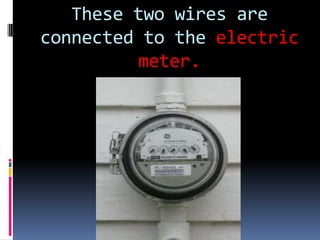
These two wires are
connected to the electric
meter.
From the meter, the wires go through
the main switch.
From the main switch, wires
go through the panel board
and branch out to the
different parts of the
house.
In the panel board, fuses or
circuit breakers are found.
protect a circuit in event of
an overload.
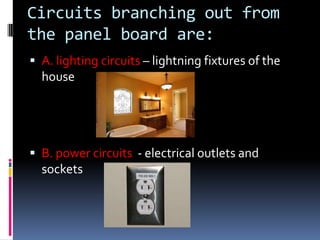
Circuits branching out from
the panel board are:
 A. lighting circuits – lightning fixtures of the

house

 B. power circuits - electrical outlets and

sockets
MAIN COMPONENTS OF A
HOUSEHOLD CIRCUIT






A. electrical meter
B. Main switch
C. Panel Board
D. Sockets
E. Loads (electrical devices and
appliances)
 F. Connecting wires
 G. Switches
1. How many power circuits
do you have?
2. How many sockets are
there in your power circuit?
3. Do you have enough
sockets for your home
appliances?
SIMPLE ELECTRIC CIRCUIT
 CIRCUIT – any arrangement of materials that

provides a path of electrons to flow.
It is composed of:
a. electrical energy
b. load (electrical appliances)
c. connecting wires
It can be opened or closed by turning the switch.
Circuit diagram

When the
switch is open,
there is no
electric current.
SEATWORK:
 IDENTIFY TWO SIMPLE CIRCUITS FOUND IN

OUR HOME.
Review:
1. What is the charge of an electron?
2. What is the charge of a proton?
3. What is the charge of the neutron?
4. What is the basic unit of electric
charge?
SI UNITS used in electricity:
 VOLTS (V): unit of potential difference, emf,







or voltage
OHM (Ω): unit of resistance
AMPS (AMPERES) (A): unit of current
COULOMBS (C): unit of charge (= the
charge moved when one amp of current runs
for one second).
WATTS (W): unit of power (power energy
per unit time). In electrical circuits, one
watt is produced when a current of one
amp flows down a potential difference
of one volt.
JOULE (J): unit of energy.

Electric circuits

  • 1.
  • 2.
    HOUSE WIRING How isyour house wired? Can you trace the electrical connection around your house?
  • 3.
    Outside of thehouse – two wires leading to your house (drop wires) which having a voltage of 220 volts (V).
  • 4.
    These two wiresare connected to the electric meter.
  • 5.
    From the meter,the wires go through the main switch.
  • 6.
    From the mainswitch, wires go through the panel board and branch out to the different parts of the house.
  • 7.
    In the panelboard, fuses or circuit breakers are found. protect a circuit in event of an overload.
  • 8.
    Circuits branching outfrom the panel board are:  A. lighting circuits – lightning fixtures of the house  B. power circuits - electrical outlets and sockets
  • 9.
    MAIN COMPONENTS OFA HOUSEHOLD CIRCUIT      A. electrical meter B. Main switch C. Panel Board D. Sockets E. Loads (electrical devices and appliances)  F. Connecting wires  G. Switches
  • 10.
    1. How manypower circuits do you have? 2. How many sockets are there in your power circuit? 3. Do you have enough sockets for your home appliances?
  • 11.
    SIMPLE ELECTRIC CIRCUIT CIRCUIT – any arrangement of materials that provides a path of electrons to flow. It is composed of: a. electrical energy b. load (electrical appliances) c. connecting wires It can be opened or closed by turning the switch.
  • 13.
    Circuit diagram When the switchis open, there is no electric current.
  • 14.
    SEATWORK:  IDENTIFY TWOSIMPLE CIRCUITS FOUND IN OUR HOME.
  • 15.
    Review: 1. What isthe charge of an electron? 2. What is the charge of a proton? 3. What is the charge of the neutron? 4. What is the basic unit of electric charge?
  • 16.
    SI UNITS usedin electricity:  VOLTS (V): unit of potential difference, emf,      or voltage OHM (Ω): unit of resistance AMPS (AMPERES) (A): unit of current COULOMBS (C): unit of charge (= the charge moved when one amp of current runs for one second). WATTS (W): unit of power (power energy per unit time). In electrical circuits, one watt is produced when a current of one amp flows down a potential difference of one volt. JOULE (J): unit of energy.