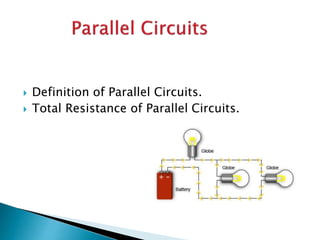
 Definition of Parallel Circuits.
 Total Resistance of Parallel Circuits.
 Why Total Resistance of Parallel Circuits is
smaller?
Voltage is always the same across parallel
elements.
V1 = V2 = E
The voltage across resistor 1 equals the voltage
across resistor 2, and both equal the voltage
supplies by the source.
 Why Voltage is Constant in Parallel Circuits?
Ohms Law, V=IR
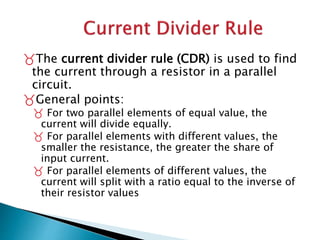
The current divider rule (CDR) is used to find
the current through a resistor in a parallel
circuit.
General points:
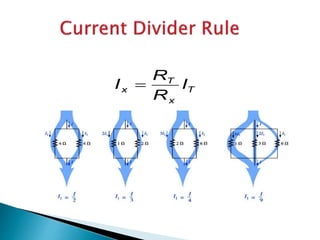
 For two parallel elements of equal value, the
current will divide equally.
 For parallel elements with different values, the
smaller the resistance, the greater the share of
input current.
 For parallel elements of different values, the
current will split with a ratio equal to the inverse of
their resistor values
T
x
T
x I
R
R
I 
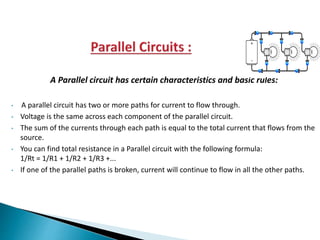
A Parallel circuit has certain characteristics and basic rules:
• A parallel circuit has two or more paths for current to flow through.
• Voltage is the same across each component of the parallel circuit.
• The sum of the currents through each path is equal to the total current that flows from the
source.
• You can find total resistance in a Parallel circuit with the following formula:
1/Rt = 1/R1 + 1/R2 + 1/R3 +...
• If one of the parallel paths is broken, current will continue to flow in all the other paths.
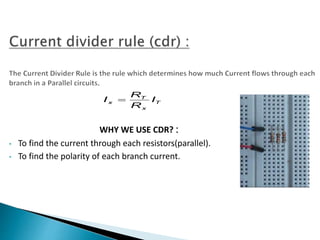
WHY WE USE CDR? :
• To find the current through each resistors(parallel).
• To find the polarity of each branch current.
T
x
T
x I
R
R
I 
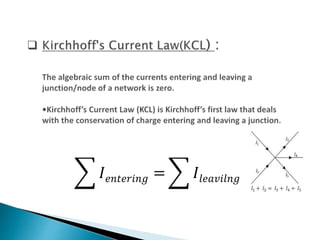
𝐼 𝑒𝑛𝑡𝑒𝑟𝑖𝑛𝑔 = 𝐼𝑙𝑒𝑎𝑣𝑖𝑙𝑛𝑔
 Conductance is the measure of the amount
of electrical current a material can carry or
it's ability to carry a current.
 Conductance is an expression of ease of
how current flows through a material .
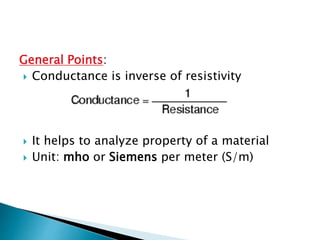
General Points:
 Conductance is inverse of resistivity
 It helps to analyze property of a material
 Unit: mho or Siemens per meter (S/m)
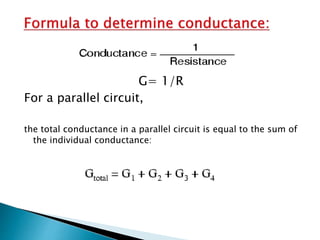
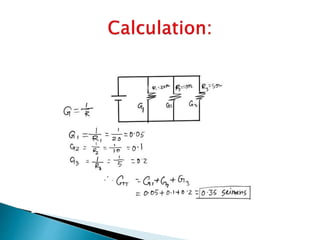
G= 1/R
For a parallel circuit,
the total conductance in a parallel circuit is equal to the sum of
the individual conductance:
Electric power is the rate, per unit time,
at which electrical energy is transferred
by an electric circuit. The SI unit of
power is the watt, one joule per second
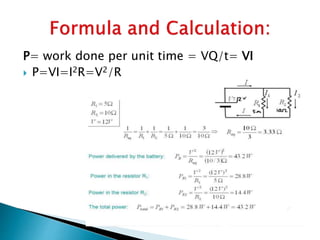
P= work done per unit time = VQ/t= VI
 P=VI=I2R=V2/R
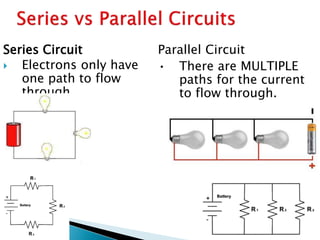
Series Circuit
 Electrons only have
one path to flow
through.
Parallel Circuit
• There are MULTIPLE
paths for the current
to flow through.
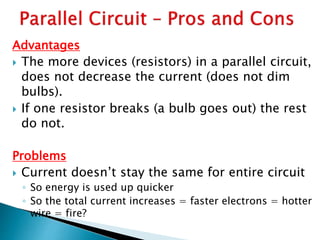
Advantages
 The more devices (resistors) in a parallel circuit,
does not decrease the current (does not dim
bulbs).
 If one resistor breaks (a bulb goes out) the rest
do not.
Problems
 Current doesn’t stay the same for entire circuit
◦ So energy is used up quicker
◦ So the total current increases = faster electrons = hotter
wire = fire?
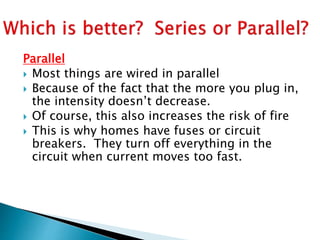
Parallel
 Most things are wired in parallel
 Because of the fact that the more you plug in,
the intensity doesn’t decrease.
 Of course, this also increases the risk of fire
 This is why homes have fuses or circuit
breakers. They turn off everything in the
circuit when current moves too fast.
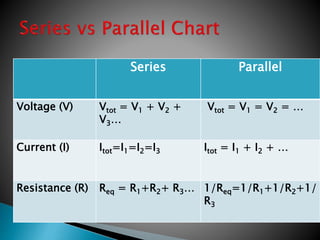
Series Parallel
Voltage (V) Vtot = V1 + V2 +
V3…
Vtot = V1 = V2 = …
Current (I) Itot=I1=I2=I3 Itot = I1 + I2 + …
Resistance (R) Req = R1+R2+ R3… 1/Req=1/R1+1/R2+1/
R3
Car system:
The electrical system on a car is essentially a parallel
system.
Parallel computer bus connections
The bus connectors are connected in parallel with
common connections to the power supply, address
and data buses, control signals, and ground.
House wiring:
Except in some very special circumstances the basic
wiring of a house is done in a parallel configuration.
Each parallel branch, however, can have a
combination of parallel and series elements.
Each branch receives a full 120 V or 208 V, with the
current determined by the applied load.
Parallel circuits.ppt

Parallel circuits.ppt

  • 3.
     Definition ofParallel Circuits.  Total Resistance of Parallel Circuits.
  • 4.
     Why TotalResistance of Parallel Circuits is smaller?
  • 5.
    Voltage is alwaysthe same across parallel elements. V1 = V2 = E The voltage across resistor 1 equals the voltage across resistor 2, and both equal the voltage supplies by the source.
  • 6.
     Why Voltageis Constant in Parallel Circuits? Ohms Law, V=IR
  • 7.
    The current dividerrule (CDR) is used to find the current through a resistor in a parallel circuit. General points:  For two parallel elements of equal value, the current will divide equally.  For parallel elements with different values, the smaller the resistance, the greater the share of input current.  For parallel elements of different values, the current will split with a ratio equal to the inverse of their resistor values
  • 8.
  • 9.
    A Parallel circuithas certain characteristics and basic rules: • A parallel circuit has two or more paths for current to flow through. • Voltage is the same across each component of the parallel circuit. • The sum of the currents through each path is equal to the total current that flows from the source. • You can find total resistance in a Parallel circuit with the following formula: 1/Rt = 1/R1 + 1/R2 + 1/R3 +... • If one of the parallel paths is broken, current will continue to flow in all the other paths.
  • 10.
    WHY WE USECDR? : • To find the current through each resistors(parallel). • To find the polarity of each branch current. T x T x I R R I 
  • 11.
    𝐼 𝑒𝑛𝑡𝑒𝑟𝑖𝑛𝑔 =𝐼𝑙𝑒𝑎𝑣𝑖𝑙𝑛𝑔
  • 12.
     Conductance isthe measure of the amount of electrical current a material can carry or it's ability to carry a current.  Conductance is an expression of ease of how current flows through a material .
  • 13.
    General Points:  Conductanceis inverse of resistivity  It helps to analyze property of a material  Unit: mho or Siemens per meter (S/m)
  • 14.
    G= 1/R For aparallel circuit, the total conductance in a parallel circuit is equal to the sum of the individual conductance:
  • 16.
    Electric power isthe rate, per unit time, at which electrical energy is transferred by an electric circuit. The SI unit of power is the watt, one joule per second
  • 17.
    P= work doneper unit time = VQ/t= VI  P=VI=I2R=V2/R
  • 18.
    Series Circuit  Electronsonly have one path to flow through. Parallel Circuit • There are MULTIPLE paths for the current to flow through.
  • 19.
    Advantages  The moredevices (resistors) in a parallel circuit, does not decrease the current (does not dim bulbs).  If one resistor breaks (a bulb goes out) the rest do not. Problems  Current doesn’t stay the same for entire circuit ◦ So energy is used up quicker ◦ So the total current increases = faster electrons = hotter wire = fire?
  • 20.
    Parallel  Most thingsare wired in parallel  Because of the fact that the more you plug in, the intensity doesn’t decrease.  Of course, this also increases the risk of fire  This is why homes have fuses or circuit breakers. They turn off everything in the circuit when current moves too fast.
  • 21.
    Series Parallel Voltage (V)Vtot = V1 + V2 + V3… Vtot = V1 = V2 = … Current (I) Itot=I1=I2=I3 Itot = I1 + I2 + … Resistance (R) Req = R1+R2+ R3… 1/Req=1/R1+1/R2+1/ R3
  • 22.
    Car system: The electricalsystem on a car is essentially a parallel system. Parallel computer bus connections The bus connectors are connected in parallel with common connections to the power supply, address and data buses, control signals, and ground.
  • 23.
    House wiring: Except insome very special circumstances the basic wiring of a house is done in a parallel configuration. Each parallel branch, however, can have a combination of parallel and series elements. Each branch receives a full 120 V or 208 V, with the current determined by the applied load.