08/01/12


  Chapter 1
Basic Concept


DKS1113 Electric Circuits
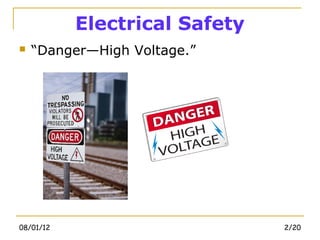
Electrical Safety
   “Danger—High Voltage.”


08/01/12                       2/20
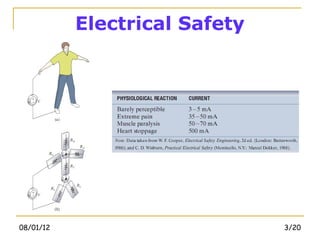
Electrical Safety


08/01/12                       3/20
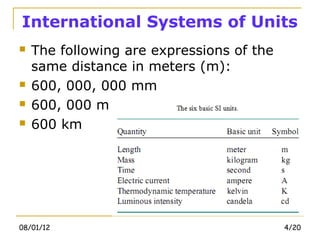
International Systems of Units
   The following are expressions of the
    same distance in meters (m):
   600, 000, 000 mm
   600, 000 m
   600 km


08/01/12                                   4/20
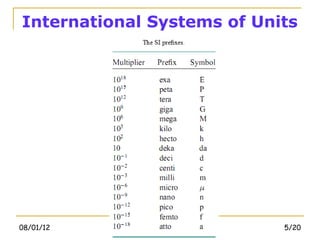
International Systems of Units


08/01/12                    5/20
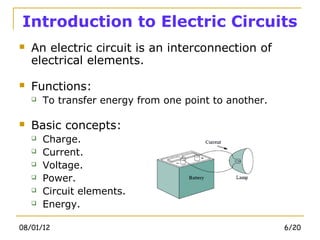
Introduction to Electric Circuits
   An electric circuit is an interconnection of
    electrical elements.

   Functions:
       To transfer energy from one point to another.

   Basic concepts:
       Charge.
       Current.
       Voltage.
       Power.
       Circuit elements.
       Energy.

08/01/12                                                6/20
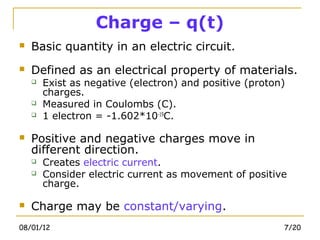
Charge – q(t)
   Basic quantity in an electric circuit.
   Defined as an electrical property of materials.
       Exist as negative (electron) and positive (proton)
        charges.
       Measured in Coulombs (C).
       1 electron = -1.602*10-19C.

   Positive and negative charges move in
    different direction.
       Creates electric current.
       Consider electric current as movement of positive
        charge.

   Charge may be constant/varying.
08/01/12                                                 7/20
Charge – q(t)

Question:

   How much charge is represented by
    4,600 electrons?


08/01/12                                8/20
Charge – q(t)
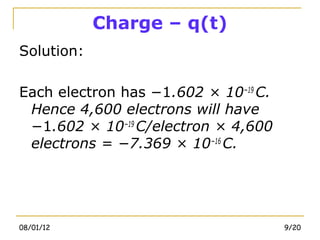
Solution:

Each electron has −1.602 × 10⁻¹⁹ C.
 Hence 4,600 electrons will have
 −1.602 × 10⁻¹⁹ C/electron × 4,600
 electrons = −7.369 × 10⁻¹⁶ C.


08/01/12                              9/20
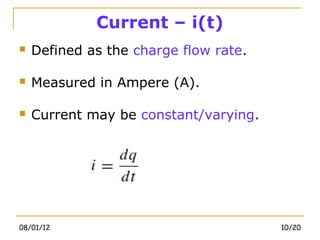
Current – i(t)
   Defined as the charge flow rate.

   Measured in Ampere (A).

   Current may be constant/varying.


08/01/12                               10/20
Current – i(t)


08/01/12                    11/20
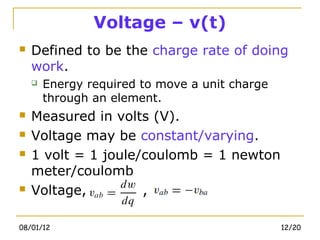
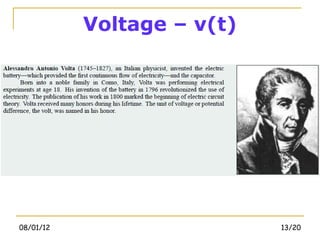
Voltage – v(t)
   Defined to be the charge rate of doing
    work.
       Energy required to move a unit charge
        through an element.
   Measured in volts (V).
   Voltage may be constant/varying.
   1 volt = 1 joule/coulomb = 1 newton
    meter/coulomb
   Voltage,         ,

08/01/12                                        12/20
Voltage – v(t)


08/01/12                    13/20
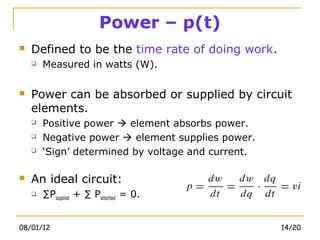
Power – p(t)
   Defined to be the time rate of doing work.
       Measured in watts (W).

   Power can be absorbed or supplied by circuit
    elements.
       Positive power  element absorbs power.
       Negative power  element supplies power.
       ‘Sign’ determined by voltage and current.

   An ideal circuit:
       ∑Psupplied + ∑ Pabsorbed = 0.


08/01/12                                            14/20
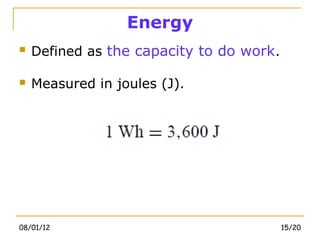
Energy
   Defined as the capacity to do work.

   Measured in joules (J).


08/01/12                                  15/20
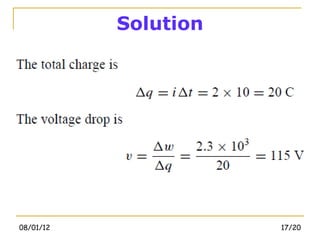
Example:
   An energy source forces a constant
    current of 2 A for 10 s to flow through
    a lightbulb. If 2.3 kJ is given off in the
    form of light and heat energy, calculate
    the voltage drop across the bulb.


08/01/12                                   16/20
Solution


08/01/12              17/20
Circuit Elements
   An element is the basic building block of a
    circuit.

   Electric circuit is interconnecting of the
    elements.

   Types of elements:
       Active elements Capable of generating energy
        (i.e. batteries, generators).
       Passive elements  Absorbs energy (i.e. resistors,
        capacitors and inductors).
       Voltage and current sources  the most important
        active elements.


08/01/12                                               18/20
Source
   Divided into:
       Independent source  Does not depend to
        other elements to supply voltage or
        current.
       Dependent source  Reverse of
        independent.

   Constant voltage source:
       Voltage same for all elements.

   Constant current source:
       Current same throughout the circuits.
08/01/12                                        19/20
Examples


   Calculate the amount of charge represented
    by two million protons.

   Answer: +3.204 × 10⁻¹³ C.


08/01/12                                 20/20

Electric circuits-chapter-1 Basic Concept

  • 1.
    08/01/12 Chapter1 Basic Concept DKS1113 Electric Circuits
  • 2.
    Electrical Safety  “Danger—High Voltage.” 08/01/12 2/20
  • 3.
  • 4.
    International Systems ofUnits  The following are expressions of the same distance in meters (m):  600, 000, 000 mm  600, 000 m  600 km 08/01/12 4/20
  • 5.
    International Systems ofUnits 08/01/12 5/20
  • 6.
    Introduction to ElectricCircuits  An electric circuit is an interconnection of electrical elements.  Functions:  To transfer energy from one point to another.  Basic concepts:  Charge.  Current.  Voltage.  Power.  Circuit elements.  Energy. 08/01/12 6/20
  • 7.
    Charge – q(t)  Basic quantity in an electric circuit.  Defined as an electrical property of materials.  Exist as negative (electron) and positive (proton) charges.  Measured in Coulombs (C).  1 electron = -1.602*10-19C.  Positive and negative charges move in different direction.  Creates electric current.  Consider electric current as movement of positive charge.  Charge may be constant/varying. 08/01/12 7/20
  • 8.
    Charge – q(t) Question:  How much charge is represented by 4,600 electrons? 08/01/12 8/20
  • 9.
    Charge – q(t) Solution: Eachelectron has −1.602 × 10⁻¹⁹ C. Hence 4,600 electrons will have −1.602 × 10⁻¹⁹ C/electron × 4,600 electrons = −7.369 × 10⁻¹⁶ C. 08/01/12 9/20
  • 10.
    Current – i(t)  Defined as the charge flow rate.  Measured in Ampere (A).  Current may be constant/varying. 08/01/12 10/20
  • 11.
  • 12.
    Voltage – v(t)  Defined to be the charge rate of doing work.  Energy required to move a unit charge through an element.  Measured in volts (V).  Voltage may be constant/varying.  1 volt = 1 joule/coulomb = 1 newton meter/coulomb  Voltage, , 08/01/12 12/20
  • 13.
  • 14.
    Power – p(t)  Defined to be the time rate of doing work.  Measured in watts (W).  Power can be absorbed or supplied by circuit elements.  Positive power  element absorbs power.  Negative power  element supplies power.  ‘Sign’ determined by voltage and current.  An ideal circuit:  ∑Psupplied + ∑ Pabsorbed = 0. 08/01/12 14/20
  • 15.
    Energy  Defined as the capacity to do work.  Measured in joules (J). 08/01/12 15/20
  • 16.
    Example:  An energy source forces a constant current of 2 A for 10 s to flow through a lightbulb. If 2.3 kJ is given off in the form of light and heat energy, calculate the voltage drop across the bulb. 08/01/12 16/20
  • 17.
  • 18.
    Circuit Elements  An element is the basic building block of a circuit.  Electric circuit is interconnecting of the elements.  Types of elements:  Active elements Capable of generating energy (i.e. batteries, generators).  Passive elements  Absorbs energy (i.e. resistors, capacitors and inductors).  Voltage and current sources  the most important active elements. 08/01/12 18/20
  • 19.
    Source  Divided into:  Independent source  Does not depend to other elements to supply voltage or current.  Dependent source  Reverse of independent.  Constant voltage source:  Voltage same for all elements.  Constant current source:  Current same throughout the circuits. 08/01/12 19/20
  • 20.
    Examples  Calculate the amount of charge represented by two million protons.  Answer: +3.204 × 10⁻¹³ C. 08/01/12 20/20