CONCEPT DEFINITION
THE STATEMENT
Anylinear, bilateral DC network containing
independent or dependent sources can be
replaced by an equivalent circuit consisting of a
single current source in parallel with a single
resistor.
KEY CONDITIONS
Linear: The circuit components R, L, C) must
have constant parameters regardless of voltage
or current levels.
Bilateral: Current flows equally well in both
directions (e.g., standard resistors).
3.
THE NORTON EQUIVALENTCIRCUIT
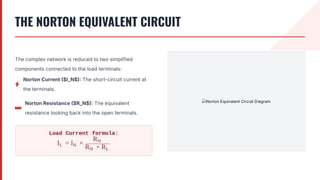
The complex network is reduced to two simplified
components connected to the load terminals:
Norton Current $I_N$ The short-circuit current at
the terminals.
Norton Resistance $R_N$ The equivalent
resistance looking back into the open terminals.
4.
STEP-BY-STEP ANALYSIS
1. RemoveLoad
Disconnect the load resistor
$R_L$) from the output
terminals to create an open
circuit.
2. Find $R_N$
Turn off all independent
sources Voltage sources
Shorted, Current sources
Opened) and calculate
equivalent resistance.
3. Find $I_N$
Place a short circuit wire across
the output terminals. Calculate
the current flowing through this
short wire.
5.
NORTON VS. THEVENIN
SOURCETRANSFORMATION
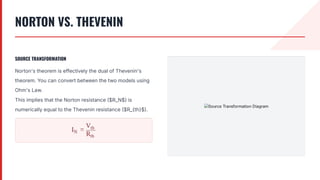
Norton's theorem is effectively the dual of Thevenin's
theorem. You can convert between the two models using
Ohm's Law.
This implies that the Norton resistance $R_N$) is
numerically equal to the Thevenin resistance $R_{th}$.
6.
APPLICATIONS
1. Simplifying ComplexNetworks: Reduces a large
section of a circuit into a simple two-component
model, making calculations manageable.
2. Variable Load Analysis: If the load resistor $R_L$
changes frequently, re-calculating the entire circuit is
tedious. With Norton's, you calculate the equivalent
circuit once, then simply apply the current divider
formula for each new load value.
3. Parallel Circuit Analysis: Often more convenient
than Thevenin's for circuits with many parallel
branches.






![NT PPT[Norton’s Theorem].pdf](https://cdn.slidesharecdn.com/ss_thumbnails/ntpptnortonstheorem-230903030724-e12d6d74-thumbnail.jpg?width=640&height=640&fit=bounds)


