‫د‬
.
‫عبدهللا‬ ‫سليمان‬ ‫احمد‬
By Dr. Ahmed S. Abdullah
Norton’s Theorem
DC Circuits
Norton’s Theorem
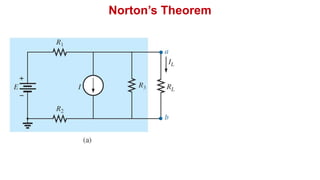
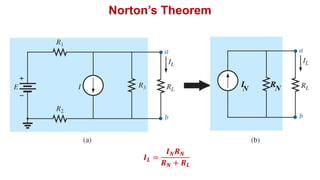
Norton’s theorem states that a linear two-terminal circuit can be replaced by
an equivalent circuit consisting of a current source IN in parallel with a
resistor RN, where IN is the short-circuit current through the terminals and RN
is the input or equivalent resistance at the terminals when the independent
sources are turned off.
Norton’s Theorem
𝑰𝑳 =
𝑰𝑵𝑹𝑵
𝑹𝑵 + 𝑹𝑳
Norton’s Theorem
Norton’s Theorem Procedure
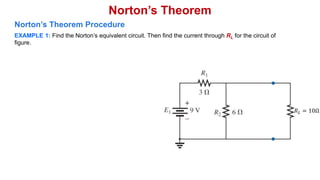
EXAMPLE 1: Find the Norton’s equivalent circuit. Then find the current through RL for the circuit of
figure.
𝑅𝐿 = 10Ω
Norton’s Theorem
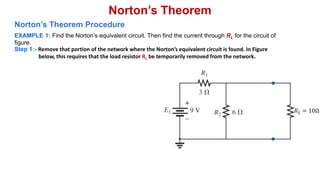
Step 1:- Remove that portion of the network where the Norton’s equivalent circuit is found. In Figure
below, this requires that the load resistor RL be temporarily removed from the network.
𝑅𝐿 = 10Ω
Norton’s Theorem
EXAMPLE 1: Find the Norton’s equivalent circuit. Then find the current through RL for the circuit of
figure.
Norton’s Theorem Procedure
Norton’s Theorem
EXAMPLE 1: Find the Norton’s equivalent circuit. Then find the current through RL for the circuit of
figure.
Step 1:- Remove that portion of the network where the Norton’s equivalent circuit is found. In Figure
below, this requires that the load resistor RL be temporarily removed from the network.
Norton’s Theorem Procedure
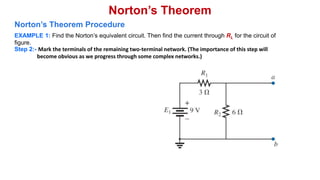
Step 2:- Mark the terminals of the remaining two-terminal network. (The importance of this step will
become obvious as we progress through some complex networks.)
Norton’s Theorem
EXAMPLE 1: Find the Norton’s equivalent circuit. Then find the current through RL for the circuit of
figure.
Norton’s Theorem Procedure
Step 3:-Calculate RN by first setting all sources to zero (voltage sources are replaced by short circuits, and
current sources by open circuits) and then finding the resultant resistance between the two
marked terminals.
Norton’s Theorem
EXAMPLE 1: Find the Norton’s equivalent circuit. Then find the current through RL for the circuit of
figure.
Norton’s Theorem Procedure
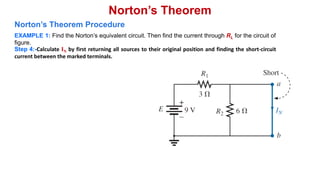
Step 4:-Calculate IN by first returning all sources to their original position and finding the short-circuit
current between the marked terminals.
Norton’s Theorem
EXAMPLE 1: Find the Norton’s equivalent circuit. Then find the current through RL for the circuit of
figure.
Norton’s Theorem Procedure
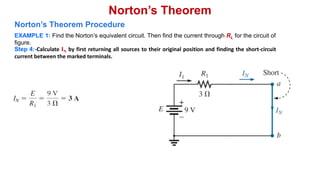
Step 4:-Calculate IN by first returning all sources to their original position and finding the short-circuit
current between the marked terminals.
Norton’s Theorem
EXAMPLE 1: Find the Norton’s equivalent circuit. Then find the current through RL for the circuit of
figure.
Norton’s Theorem Procedure
Step 4:-Calculate IN by first returning all sources to their original position and finding the short-circuit
current between the marked terminals.
Norton’s Theorem
EXAMPLE 1: Find the Norton’s equivalent circuit. Then find the current through RL for the circuit of
figure.
Norton’s Theorem Procedure
Step 4:-Calculate IN by first returning all sources to their original position and finding the short-circuit
current between the marked terminals.
Norton’s Theorem
EXAMPLE 1: Find the Norton’s equivalent circuit. Then find the current through RL for the circuit of
figure.
Norton’s Theorem Procedure
Step 5:-Draw the Norton’s equivalent circuit with the portion of the circuit previously removed replaced
between the terminals of the equivalent circuit.
Norton’s Theorem
EXAMPLE 1: Find the Norton’s equivalent circuit. Then find the current through RL for the circuit of
figure.
Norton’s Theorem Procedure
𝑰𝑵 = 𝟑𝑨
𝑹𝑵 = 𝟐Ω
= 10Ω
𝑰𝑳 =
𝑰𝑵𝑹𝑵
𝑹𝑵 + 𝑹𝑳
=
(𝟑𝑨)(𝟐Ω)
𝟐Ω + 𝟏𝟎Ω
=
𝟔
𝟏𝟐
= 𝟎. 𝟓 𝑨
Norton’s Theorem
EXAMPLE 1: Find the Norton’s equivalent circuit. Then find the current through RL for the circuit of
figure.
Converting the Norton equivalent circuit to a Thévenin equivalent circuit.
Norton’s Theorem
EXAMPLE 1: Find the Norton’s equivalent circuit. Then find the current through RL for the circuit of
figure.
Converting the Norton equivalent circuit to a Thévenin equivalent circuit.
𝑰𝑵 = 𝟑𝑨
𝑹𝑵 = 𝟐Ω
= 10Ω = 10Ω
= 𝑹𝑵= 𝟐Ω
𝑬𝑻𝒉 = 𝑰𝑵𝑹𝑵 = 𝟑𝑨 𝟐Ω = 𝟔𝑽
𝟔 𝑽
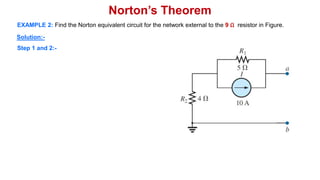
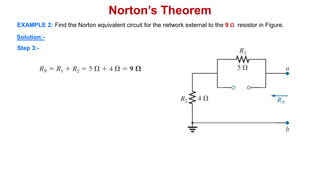
EXAMPLE 2: Find the Norton equivalent circuit for the network external to the 9 Ω resistor in Figure.
Norton’s Theorem
Step 1 and 2:-
Solution:-
Norton’s Theorem
EXAMPLE 2: Find the Norton equivalent circuit for the network external to the 9 Ω resistor in Figure.
Solution:-
Step 3:-
Norton’s Theorem
EXAMPLE 2: Find the Norton equivalent circuit for the network external to the 9 Ω resistor in Figure.
Solution:-
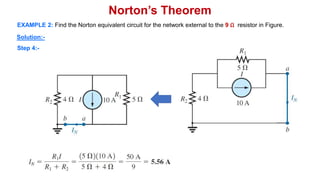
Step 4:-
Norton’s Theorem
EXAMPLE 2: Find the Norton equivalent circuit for the network external to the 9 Ω resistor in Figure.
Solution:-
Step 4:-
Norton’s Theorem
EXAMPLE 2: Find the Norton equivalent circuit for the network external to the 9 Ω resistor in Figure.
Solution:-
Step 4:-
Norton’s Theorem
EXAMPLE 2: Find the Norton equivalent circuit for the network external to the 9 Ω resistor in Figure.
Norton’s Theorem
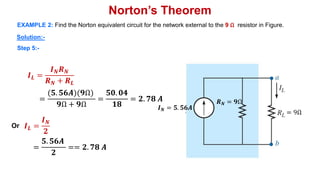
𝑰𝑵 = 𝟓. 𝟓𝟔𝑨
𝑹𝑵 = 𝟗Ω
= 9Ω
𝑰𝑳 =
𝑰𝑵𝑹𝑵
𝑹𝑵 + 𝑹𝑳
=
(𝟓. 𝟓𝟔𝑨)(𝟗Ω)
𝟗Ω + 𝟗Ω
=
𝟓𝟎. 𝟎𝟒
𝟏𝟖
= 𝟐. 𝟕𝟖 𝑨
EXAMPLE 2: Find the Norton equivalent circuit for the network external to the 9 Ω resistor in Figure.
Solution:-
Step 5:-
Or 𝑰𝑳 =
𝑰𝑵
𝟐
=
𝟓. 𝟓𝟔𝑨
𝟐
== 𝟐. 𝟕𝟖 𝑨
References
 Boylestad, Robert L. Introductory circuit analysis. Pearson Education, 2010.
 Robbins, Allan H., and Wilhelm C. Miller. Circuit analysis: Theory and
practice. Cengage Learning, 2012.
 Sadiku, Matthew NO, and Chales K. Alexander. Fundamentals of electric
circuits. McGraw-Hill Higher Education, 2007.

Norton’s Theorem.pptx

  • 1.
    ‫د‬ . ‫عبدهللا‬ ‫سليمان‬ ‫احمد‬ ByDr. Ahmed S. Abdullah Norton’s Theorem DC Circuits
  • 2.
    Norton’s Theorem Norton’s theoremstates that a linear two-terminal circuit can be replaced by an equivalent circuit consisting of a current source IN in parallel with a resistor RN, where IN is the short-circuit current through the terminals and RN is the input or equivalent resistance at the terminals when the independent sources are turned off.
  • 3.
  • 4.
    𝑰𝑳 = 𝑰𝑵𝑹𝑵 𝑹𝑵 +𝑹𝑳 Norton’s Theorem
  • 5.
    Norton’s Theorem Procedure EXAMPLE1: Find the Norton’s equivalent circuit. Then find the current through RL for the circuit of figure. 𝑅𝐿 = 10Ω Norton’s Theorem
  • 6.
    Step 1:- Removethat portion of the network where the Norton’s equivalent circuit is found. In Figure below, this requires that the load resistor RL be temporarily removed from the network. 𝑅𝐿 = 10Ω Norton’s Theorem EXAMPLE 1: Find the Norton’s equivalent circuit. Then find the current through RL for the circuit of figure. Norton’s Theorem Procedure
  • 7.
    Norton’s Theorem EXAMPLE 1:Find the Norton’s equivalent circuit. Then find the current through RL for the circuit of figure. Step 1:- Remove that portion of the network where the Norton’s equivalent circuit is found. In Figure below, this requires that the load resistor RL be temporarily removed from the network. Norton’s Theorem Procedure
  • 8.
    Step 2:- Markthe terminals of the remaining two-terminal network. (The importance of this step will become obvious as we progress through some complex networks.) Norton’s Theorem EXAMPLE 1: Find the Norton’s equivalent circuit. Then find the current through RL for the circuit of figure. Norton’s Theorem Procedure
  • 9.
    Step 3:-Calculate RNby first setting all sources to zero (voltage sources are replaced by short circuits, and current sources by open circuits) and then finding the resultant resistance between the two marked terminals. Norton’s Theorem EXAMPLE 1: Find the Norton’s equivalent circuit. Then find the current through RL for the circuit of figure. Norton’s Theorem Procedure
  • 10.
    Step 4:-Calculate INby first returning all sources to their original position and finding the short-circuit current between the marked terminals. Norton’s Theorem EXAMPLE 1: Find the Norton’s equivalent circuit. Then find the current through RL for the circuit of figure. Norton’s Theorem Procedure
  • 11.
    Step 4:-Calculate INby first returning all sources to their original position and finding the short-circuit current between the marked terminals. Norton’s Theorem EXAMPLE 1: Find the Norton’s equivalent circuit. Then find the current through RL for the circuit of figure. Norton’s Theorem Procedure
  • 12.
    Step 4:-Calculate INby first returning all sources to their original position and finding the short-circuit current between the marked terminals. Norton’s Theorem EXAMPLE 1: Find the Norton’s equivalent circuit. Then find the current through RL for the circuit of figure. Norton’s Theorem Procedure
  • 13.
    Step 4:-Calculate INby first returning all sources to their original position and finding the short-circuit current between the marked terminals. Norton’s Theorem EXAMPLE 1: Find the Norton’s equivalent circuit. Then find the current through RL for the circuit of figure. Norton’s Theorem Procedure
  • 14.
    Step 5:-Draw theNorton’s equivalent circuit with the portion of the circuit previously removed replaced between the terminals of the equivalent circuit. Norton’s Theorem EXAMPLE 1: Find the Norton’s equivalent circuit. Then find the current through RL for the circuit of figure. Norton’s Theorem Procedure 𝑰𝑵 = 𝟑𝑨 𝑹𝑵 = 𝟐Ω = 10Ω 𝑰𝑳 = 𝑰𝑵𝑹𝑵 𝑹𝑵 + 𝑹𝑳 = (𝟑𝑨)(𝟐Ω) 𝟐Ω + 𝟏𝟎Ω = 𝟔 𝟏𝟐 = 𝟎. 𝟓 𝑨
  • 15.
    Norton’s Theorem EXAMPLE 1:Find the Norton’s equivalent circuit. Then find the current through RL for the circuit of figure. Converting the Norton equivalent circuit to a Thévenin equivalent circuit.
  • 16.
    Norton’s Theorem EXAMPLE 1:Find the Norton’s equivalent circuit. Then find the current through RL for the circuit of figure. Converting the Norton equivalent circuit to a Thévenin equivalent circuit. 𝑰𝑵 = 𝟑𝑨 𝑹𝑵 = 𝟐Ω = 10Ω = 10Ω = 𝑹𝑵= 𝟐Ω 𝑬𝑻𝒉 = 𝑰𝑵𝑹𝑵 = 𝟑𝑨 𝟐Ω = 𝟔𝑽 𝟔 𝑽
  • 17.
    EXAMPLE 2: Findthe Norton equivalent circuit for the network external to the 9 Ω resistor in Figure. Norton’s Theorem
  • 18.
    Step 1 and2:- Solution:- Norton’s Theorem EXAMPLE 2: Find the Norton equivalent circuit for the network external to the 9 Ω resistor in Figure.
  • 19.
    Solution:- Step 3:- Norton’s Theorem EXAMPLE2: Find the Norton equivalent circuit for the network external to the 9 Ω resistor in Figure.
  • 20.
    Solution:- Step 4:- Norton’s Theorem EXAMPLE2: Find the Norton equivalent circuit for the network external to the 9 Ω resistor in Figure.
  • 21.
    Solution:- Step 4:- Norton’s Theorem EXAMPLE2: Find the Norton equivalent circuit for the network external to the 9 Ω resistor in Figure.
  • 22.
    Solution:- Step 4:- Norton’s Theorem EXAMPLE2: Find the Norton equivalent circuit for the network external to the 9 Ω resistor in Figure.
  • 23.
    Norton’s Theorem 𝑰𝑵 =𝟓. 𝟓𝟔𝑨 𝑹𝑵 = 𝟗Ω = 9Ω 𝑰𝑳 = 𝑰𝑵𝑹𝑵 𝑹𝑵 + 𝑹𝑳 = (𝟓. 𝟓𝟔𝑨)(𝟗Ω) 𝟗Ω + 𝟗Ω = 𝟓𝟎. 𝟎𝟒 𝟏𝟖 = 𝟐. 𝟕𝟖 𝑨 EXAMPLE 2: Find the Norton equivalent circuit for the network external to the 9 Ω resistor in Figure. Solution:- Step 5:- Or 𝑰𝑳 = 𝑰𝑵 𝟐 = 𝟓. 𝟓𝟔𝑨 𝟐 == 𝟐. 𝟕𝟖 𝑨
  • 24.
    References  Boylestad, RobertL. Introductory circuit analysis. Pearson Education, 2010.  Robbins, Allan H., and Wilhelm C. Miller. Circuit analysis: Theory and practice. Cengage Learning, 2012.  Sadiku, Matthew NO, and Chales K. Alexander. Fundamentals of electric circuits. McGraw-Hill Higher Education, 2007.