Cutesy :

Name

ID



Saleh Akram

2009200400006



A. B. M. Golam Kibria

2009200400007



Ahmed Mostofa Sheikh

2009200400008



Md. Atikuir Rahman

2009200400009



Md. Hasanuzzaman

2009200400024
12th Batch

Southeast University
Department Of Textile Engineering
I/A 251,252 Tejgaon Dhaka Bangladesh
Prepared By :

Prepared By : Mazadul Hasan sheshir
ID: 2010000400008
13th Batch
Wet Processing Technology
Email: mazadulhasan@yahoo.com

Southeast University
Department Of Textile Engineering
I/A 251,252 Tejgaon Dhaka Bangladesh
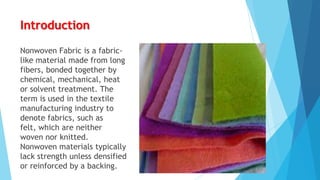
Introduction
Nonwoven Fabric is a fabriclike material made from long
fibers, bonded together by
chemical, mechanical, heat
or solvent treatment. The
term is used in the textile
manufacturing industry to
denote fabrics, such as
felt, which are neither
woven nor knitted.
Nonwoven materials typically
lack strength unless densified
or reinforced by a backing.
Definition
 Nonwoven

stuffs are largely described
as piece or web structures, bonded
simultaneously by entangling fibre or
filaments mechanically, thermally or
chemically.
Definition of Nonwoven by EDANA
A

nonwoven is a sheet of fibres, continuous
filaments or chopped yarns of any
origin, that have been formed into a web
by any means, and bonded together by any
means with the exception of weaving or
knitting.
History of Non-Woven


The nonwoven textile fabric industry had an exploratory beginning in the late 1940s
which entered into a development phase in the 1950s followed by commercial
expansion in the 1960s.



In the 19th century when England was the leading textile producing country,
realizing that large amounts of fiber were wasted as trim a textile engineer named
Garnett developed a special carding device to shred this waste material back to
fibrous form. This fiber was used as filling material for pillows. The Garnett Machine
though greatly modified, today still retains his name and is a major component in
the non-woven industry. Later on manufacturers in Northern England began
binding these fibers mechanically (using needles) and chemically (using glue) into
batts. These were the precursors of today's non-woven.
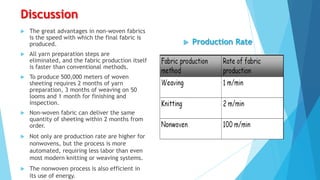
Discussion


The great advantages in non-woven fabrics
is the speed with which the final fabric is
produced.



All yarn preparation steps are
eliminated, and the fabric production itself
is faster than conventional methods.



To produce 500,000 meters of woven
sheeting requires 2 months of yarn
preparation, 3 months of weaving on 50
looms and 1 month for finishing and
inspection.



Non-woven fabric can deliver the same
quantity of sheeting within 2 months from
order.



Not only are production rate are higher for
nonwovens, but the process is more
automated, requiring less labor than even
most modern knitting or weaving systems.



The nonwoven process is also efficient in
its use of energy.



Production Rate
Characteristics


Nonwovens have specific characteristics that allow them to

deliver high-performance across a wide range of applications.
Specific functions include:

-

Absorbency

-

liquid repellency

-

Resilience

-

stretch

-

Softness

-

strength

-

flame retardancy

-

wash ability (selective products),

-

Cushioning

-

filtering

-

bacterial barrier and sterility
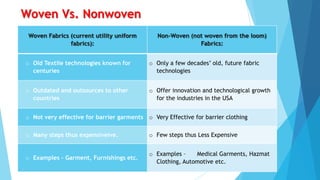
Woven Vs. Nonwoven
Woven Fabrics (current utility uniform
fabrics):

Non-Woven (not woven from the loom)
Fabrics:

o Old Textile technologies known for
centuries

o Only a few decades’ old, future fabric
technologies

o Outdated and outsources to other
countries

o Offer innovation and technological growth
for the industries in the USA

o Not very effective for barrier garments o Very Effective for barrier clothing
o Many steps thus expensiveive.

o Few steps thus Less Expensive

o Examples – Garment, Furnishings etc.

o Examples –
Medical Garments, Hazmat
Clothing, Automotive etc.
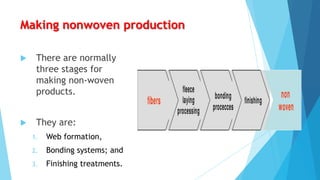
Making nonwoven production


There are normally
three stages for
making non-woven
products.



They are:
1.

Web formation,

2.

Bonding systems; and

3.

Finishing treatments.
Raw Materials
Cellulosic fibers


The volume of bleached cotton used in nonwoven fabrics has
been steadily increasing and cotton-polyester and rayonpolyester blends in nonwoven fabrics bonded by hydro
entangling have become attractive combinations for medical
and feminine hygiene applications. There has been an interest
in using unbleached cotton in nonwoven processes and some
attractive experimental fabrics have been produced through
the use of the hydro entangling process.
Raw Materials
Synthetic fibers


The two most popular polyolefin fibers are
polyethylene and polypropylene. These polymers
are either converted into staple-length fibers which
are subsequently converted into nonwoven fabrics
or else converted into spun bonded nonwoven
fabrics by extruding the polymers to form filaments
which are formed into webs and bonded by thermal
processes.
Uses of Non-Woven
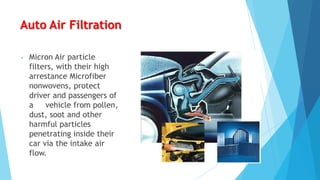
Auto Air Filtration
•

Micron Air particle
filters, with their high
arrestance Microfiber
nonwovens, protect
driver and passengers of
a
vehicle from pollen,
dust, soot and other
harmful particles
penetrating inside their
car via the intake air
flow.
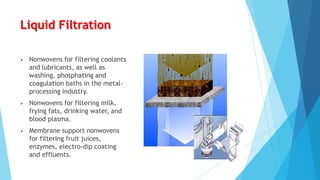
Liquid Filtration
•

Nonwovens for filtering coolants
and lubricants, as well as
washing, phosphating and
coagulation baths in the metalprocessing industry.

•

Nonwovens for filtering milk,
frying fats, drinking water, and
blood plasma.

•

Membrane support nonwovens
for filtering fruit juices,
enzymes, electro-dip coating
and effluents.
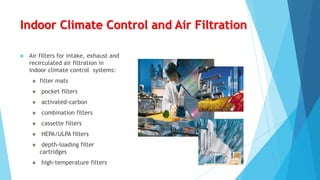
Indoor Climate Control and Air Filtration


Air filters for intake, exhaust and
recirculated air filtration in
indoor climate control systems:
filter mats

pocket filters
activated-carbon
combination filters
cassette filters
HEPA/ULPA filters
depth-loading filter
cartridges
high-temperature filters
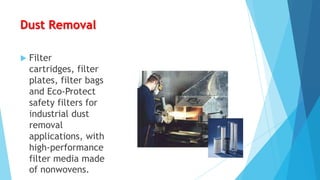
Dust Removal


Filter
cartridges, filter
plates, filter bags
and Eco-Protect
safety filters for
industrial dust
removal
applications, with
high-performance
filter media made
of nonwovens.
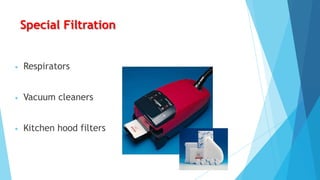
Special Filtration

•

Respirators

•

Vacuum cleaners

•

Kitchen hood filters
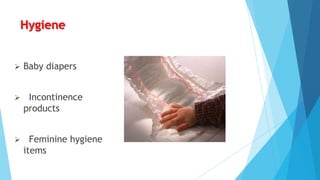
Hygiene



Baby diapers



Incontinence
products



Feminine hygiene
items
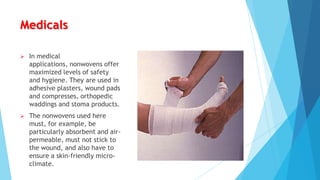
Medicals


In medical
applications, nonwovens offer
maximized levels of safety
and hygiene. They are used in
adhesive plasters, wound pads
and compresses, orthopedic
waddings and stoma products.



The nonwovens used here
must, for example, be
particularly absorbent and airpermeable, must not stick to
the wound, and also have to
ensure a skin-friendly microclimate.
Furniture/Textile Application


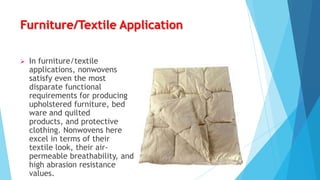
In furniture/textile
applications, nonwovens
satisfy even the most
disparate functional
requirements for producing
upholstered furniture, bed
ware and quilted
products, and protective
clothing. Nonwovens here
excel in terms of their
textile look, their airpermeable breathability, and
high abrasion resistance
values.
Horticulture


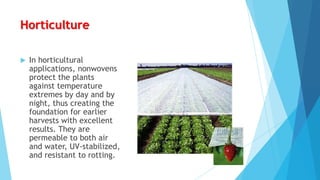
In horticultural
applications, nonwovens
protect the plants
against temperature
extremes by day and by
night, thus creating the
foundation for earlier
harvests with excellent
results. They are
permeable to both air
and water, UV-stabilized,
and resistant to rotting.
Automotive Interiors


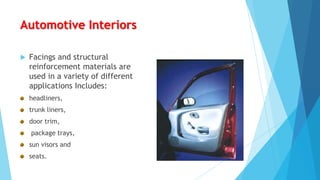
Facings and structural
reinforcement materials are
used in a variety of different
applications Includes:
headliners,
trunk liners,
door trim,

package trays,
sun visors and
seats.
In Shoes

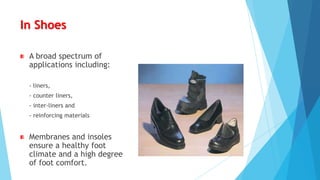
A broad spectrum of
applications including:
- liners,
- counter liners,
- inter-liners and
- reinforcing materials

Membranes and insoles
ensure a healthy foot
climate and a high degree
of foot comfort.
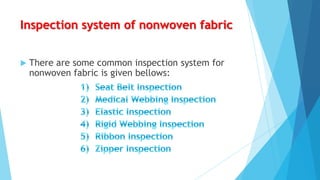
Inspection system of nonwoven fabric


There are some common inspection system for
nonwoven fabric is given bellows:
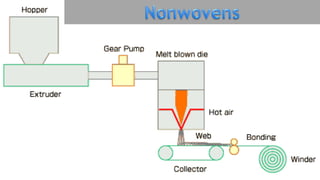
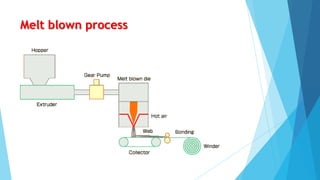
Melt blown process
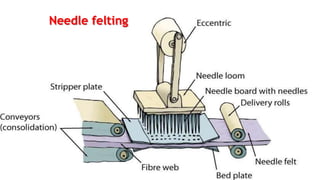
Needle felting
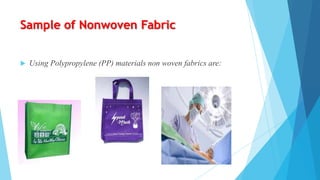
Sample of Nonwoven Fabric


Using Polypropylene (PP) materials non woven fabrics are:
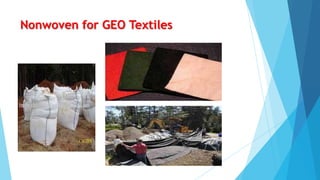
Nonwoven for GEO Textiles
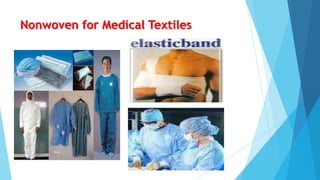
Nonwoven for Medical Textiles
Association Takes role for Development of
Nonwoven:
1)

2)
3)
4)

Association of the Nonwoven Fabrics Industry (INDA) which is research for
total improvement of nonwoven fabric since 1968 to still now. Their
conferences and action-oriented committees bring industry professionals
together to explore the most pressing trends and issues in the areas of
government relations, technology, marketing and international commerce.
In 1991 The Nonwovens Cooperative Research Center (NCRC) was established
as a State/Industry-University Cooperative Research Center (State/IUCRC).
Asian Nonwovens Fabric Association (ANFA) opens membership for the Asian
countries for expending the business of nonwoven.
EDANA is the international association serving the nonwovens and related
industries. EDANA provides a comprehensive range of services and supplies
its members with the information and data necessary for them to enhance
the industry goals and performance.
Conclusion


Nonwoven fabrics are engineered fabrics that may be a limited life,
single-use fabric or a very durable fabric. Nonwoven fabrics provide
specific functions such as absorbency, liquid repellency, resilience,
stretch, softness, strength, flame retardancy, wash ability, cushioning,
filtering, bacterial barrier and sterility. These properties are often
combined to create fabrics suited for specific jobs while achieving a good
balance between product use-life and cost. In combination with other
materials they provide a spectrum of products with diverse properties and
are used alone or as components of apparel, home furnishings, health
care, engineering, industrial and consumer goods.
 In this assignment we discussed what non-woven is and their
applications in textile.
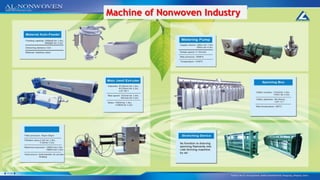
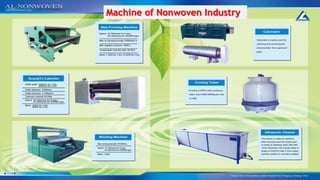
Machine of Nonwoven Industry
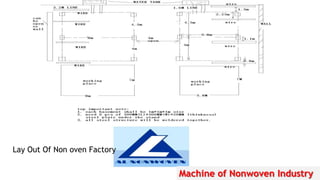
Lay Out Of Non oven Factory

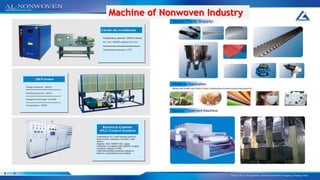
Machine of Nonwoven Industry
Thank You!

Nonwoven

  • 2.
    Cutesy : Name ID  Saleh Akram 2009200400006  A.B. M. Golam Kibria 2009200400007  Ahmed Mostofa Sheikh 2009200400008  Md. Atikuir Rahman 2009200400009  Md. Hasanuzzaman 2009200400024 12th Batch Southeast University Department Of Textile Engineering I/A 251,252 Tejgaon Dhaka Bangladesh
  • 3.
    Prepared By : PreparedBy : Mazadul Hasan sheshir ID: 2010000400008 13th Batch Wet Processing Technology Email: mazadulhasan@yahoo.com Southeast University Department Of Textile Engineering I/A 251,252 Tejgaon Dhaka Bangladesh
  • 4.
    Introduction Nonwoven Fabric isa fabriclike material made from long fibers, bonded together by chemical, mechanical, heat or solvent treatment. The term is used in the textile manufacturing industry to denote fabrics, such as felt, which are neither woven nor knitted. Nonwoven materials typically lack strength unless densified or reinforced by a backing.
  • 5.
    Definition  Nonwoven stuffs arelargely described as piece or web structures, bonded simultaneously by entangling fibre or filaments mechanically, thermally or chemically.
  • 6.
    Definition of Nonwovenby EDANA A nonwoven is a sheet of fibres, continuous filaments or chopped yarns of any origin, that have been formed into a web by any means, and bonded together by any means with the exception of weaving or knitting.
  • 7.
    History of Non-Woven  Thenonwoven textile fabric industry had an exploratory beginning in the late 1940s which entered into a development phase in the 1950s followed by commercial expansion in the 1960s.  In the 19th century when England was the leading textile producing country, realizing that large amounts of fiber were wasted as trim a textile engineer named Garnett developed a special carding device to shred this waste material back to fibrous form. This fiber was used as filling material for pillows. The Garnett Machine though greatly modified, today still retains his name and is a major component in the non-woven industry. Later on manufacturers in Northern England began binding these fibers mechanically (using needles) and chemically (using glue) into batts. These were the precursors of today's non-woven.
  • 8.
    Discussion  The great advantagesin non-woven fabrics is the speed with which the final fabric is produced.  All yarn preparation steps are eliminated, and the fabric production itself is faster than conventional methods.  To produce 500,000 meters of woven sheeting requires 2 months of yarn preparation, 3 months of weaving on 50 looms and 1 month for finishing and inspection.  Non-woven fabric can deliver the same quantity of sheeting within 2 months from order.  Not only are production rate are higher for nonwovens, but the process is more automated, requiring less labor than even most modern knitting or weaving systems.  The nonwoven process is also efficient in its use of energy.  Production Rate
  • 9.
    Characteristics  Nonwovens have specificcharacteristics that allow them to deliver high-performance across a wide range of applications. Specific functions include: - Absorbency - liquid repellency - Resilience - stretch - Softness - strength - flame retardancy - wash ability (selective products), - Cushioning - filtering - bacterial barrier and sterility
  • 10.
    Woven Vs. Nonwoven WovenFabrics (current utility uniform fabrics): Non-Woven (not woven from the loom) Fabrics: o Old Textile technologies known for centuries o Only a few decades’ old, future fabric technologies o Outdated and outsources to other countries o Offer innovation and technological growth for the industries in the USA o Not very effective for barrier garments o Very Effective for barrier clothing o Many steps thus expensiveive. o Few steps thus Less Expensive o Examples – Garment, Furnishings etc. o Examples – Medical Garments, Hazmat Clothing, Automotive etc.
  • 11.
    Making nonwoven production  Thereare normally three stages for making non-woven products.  They are: 1. Web formation, 2. Bonding systems; and 3. Finishing treatments.
  • 12.
    Raw Materials Cellulosic fibers  Thevolume of bleached cotton used in nonwoven fabrics has been steadily increasing and cotton-polyester and rayonpolyester blends in nonwoven fabrics bonded by hydro entangling have become attractive combinations for medical and feminine hygiene applications. There has been an interest in using unbleached cotton in nonwoven processes and some attractive experimental fabrics have been produced through the use of the hydro entangling process.
  • 13.
    Raw Materials Synthetic fibers  Thetwo most popular polyolefin fibers are polyethylene and polypropylene. These polymers are either converted into staple-length fibers which are subsequently converted into nonwoven fabrics or else converted into spun bonded nonwoven fabrics by extruding the polymers to form filaments which are formed into webs and bonded by thermal processes.
  • 14.
  • 15.
    Auto Air Filtration • MicronAir particle filters, with their high arrestance Microfiber nonwovens, protect driver and passengers of a vehicle from pollen, dust, soot and other harmful particles penetrating inside their car via the intake air flow.
  • 16.
    Liquid Filtration • Nonwovens forfiltering coolants and lubricants, as well as washing, phosphating and coagulation baths in the metalprocessing industry. • Nonwovens for filtering milk, frying fats, drinking water, and blood plasma. • Membrane support nonwovens for filtering fruit juices, enzymes, electro-dip coating and effluents.
  • 17.
    Indoor Climate Controland Air Filtration  Air filters for intake, exhaust and recirculated air filtration in indoor climate control systems: filter mats pocket filters activated-carbon combination filters cassette filters HEPA/ULPA filters depth-loading filter cartridges high-temperature filters
  • 18.
    Dust Removal  Filter cartridges, filter plates,filter bags and Eco-Protect safety filters for industrial dust removal applications, with high-performance filter media made of nonwovens.
  • 19.
  • 20.
  • 21.
    Medicals  In medical applications, nonwovensoffer maximized levels of safety and hygiene. They are used in adhesive plasters, wound pads and compresses, orthopedic waddings and stoma products.  The nonwovens used here must, for example, be particularly absorbent and airpermeable, must not stick to the wound, and also have to ensure a skin-friendly microclimate.
  • 22.
    Furniture/Textile Application  In furniture/textile applications,nonwovens satisfy even the most disparate functional requirements for producing upholstered furniture, bed ware and quilted products, and protective clothing. Nonwovens here excel in terms of their textile look, their airpermeable breathability, and high abrasion resistance values.
  • 23.
    Horticulture  In horticultural applications, nonwovens protectthe plants against temperature extremes by day and by night, thus creating the foundation for earlier harvests with excellent results. They are permeable to both air and water, UV-stabilized, and resistant to rotting.
  • 24.
    Automotive Interiors  Facings andstructural reinforcement materials are used in a variety of different applications Includes: headliners, trunk liners, door trim, package trays, sun visors and seats.
  • 25.
    In Shoes A broadspectrum of applications including: - liners, - counter liners, - inter-liners and - reinforcing materials Membranes and insoles ensure a healthy foot climate and a high degree of foot comfort.
  • 26.
    Inspection system ofnonwoven fabric  There are some common inspection system for nonwoven fabric is given bellows:
  • 27.
  • 28.
  • 29.
    Sample of NonwovenFabric  Using Polypropylene (PP) materials non woven fabrics are:
  • 30.
  • 31.
  • 32.
    Association Takes rolefor Development of Nonwoven: 1) 2) 3) 4) Association of the Nonwoven Fabrics Industry (INDA) which is research for total improvement of nonwoven fabric since 1968 to still now. Their conferences and action-oriented committees bring industry professionals together to explore the most pressing trends and issues in the areas of government relations, technology, marketing and international commerce. In 1991 The Nonwovens Cooperative Research Center (NCRC) was established as a State/Industry-University Cooperative Research Center (State/IUCRC). Asian Nonwovens Fabric Association (ANFA) opens membership for the Asian countries for expending the business of nonwoven. EDANA is the international association serving the nonwovens and related industries. EDANA provides a comprehensive range of services and supplies its members with the information and data necessary for them to enhance the industry goals and performance.
  • 33.
    Conclusion  Nonwoven fabrics areengineered fabrics that may be a limited life, single-use fabric or a very durable fabric. Nonwoven fabrics provide specific functions such as absorbency, liquid repellency, resilience, stretch, softness, strength, flame retardancy, wash ability, cushioning, filtering, bacterial barrier and sterility. These properties are often combined to create fabrics suited for specific jobs while achieving a good balance between product use-life and cost. In combination with other materials they provide a spectrum of products with diverse properties and are used alone or as components of apparel, home furnishings, health care, engineering, industrial and consumer goods.  In this assignment we discussed what non-woven is and their applications in textile.
  • 34.
  • 35.
  • 36.
  • 37.
    Lay Out OfNon oven Factory Machine of Nonwoven Industry
  • 38.