PROTECTIVE TEXTILES
By :- Ojas Jain
Payal Juneja
Protection from extreme environmental conditions has always
been a critical requirement of textile products.
Protective textiles are a part of technical textiles that are used
principally for their performance or functional characteristics
rather than their aesthetic or decorative characteristics.
• As the name suggests, protective clothing and other textile
materials are used to protect human beings/atmosphere from
various natural/industrial hazards. Some the possible
environmental hazards are heat, cold, rain, snow, wind,
ultraviolet radiations, abrasion, dust, micro organisms,
radioactive radiations, static electricity etc. Some prominent
human/industrial hazards are fire, flash, industrial chemicals,
biohazards, high velocity projectiles, cutting/slashing by sharp
objects etc. We need optimum safety from all these hazards
when we are in the vicinity of one or more of them. Thus the
need of protective textiles is there to safe guard us.
Light Weight And Low Bulk
High Durability And Dimensional Stability
Good Handle And Drape
Low Noise Emission
Water Repellant
Wind Proof And Snow Shedding
Thermal Insulating
UV Resistant
Air Permeable
Flame Retardant
Heat And Melt Resistance/Low Smoke Emission
Safety From Radar Spectrum
Fibre Uses
Meta aramid
Filter bags for hot gas, Industrial protective clothing, Racing
driver’s suit, Cargo covers, Boat covers, Fire hose
reinforcement.
Para aramid
Body armour, Tyre cords, Radiator hose and brake shoes of
racing cars, Reinforced composites for aircraft, High speed
boat components
Carbon
Aircraft and Space shuttle, Automotive, Medical Implants,
Marine
Glass
Aircraft and aerospace, Consumer goods, Roofing Tiles,
Corrosion resistant products used in highway overlay
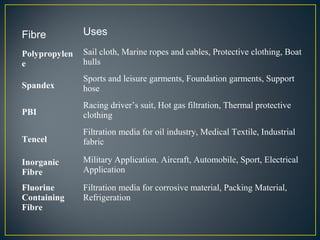
Fibre Uses
Polypropylen
e
Sail cloth, Marine ropes and cables, Protective clothing, Boat
hulls
Spandex
Sports and leisure garments, Foundation garments, Support
hose
PBI
Racing driver’s suit, Hot gas filtration, Thermal protective
clothing
Tencel
Filtration media for oil industry, Medical Textile, Industrial
fabric
Inorganic
Fibre
Military Application. Aircraft, Automobile, Sport, Electrical
Application
Fluorine
Containing
Fibre
Filtration media for corrosive material, Packing Material,
Refrigeration
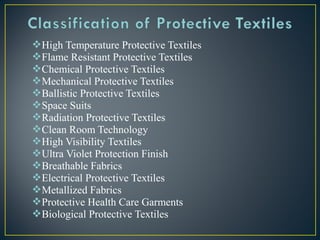
High Temperature Protective Textiles
Flame Resistant Protective Textiles
Chemical Protective Textiles
Mechanical Protective Textiles
Ballistic Protective Textiles
Space Suits
Radiation Protective Textiles
Clean Room Technology
High Visibility Textiles
Ultra Violet Protection Finish
Breathable Fabrics
Electrical Protective Textiles
Metallized Fabrics
Protective Health Care Garments
Biological Protective Textiles
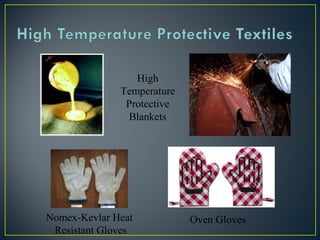
High
Temperature
Protective
Blankets
Oven GlovesNomex-Kevlar Heat
Resistant Gloves
• A high temperature textile material is defined as a material,
which can be used above 200 o
C without decomposition
and without losing its major physical properties. Although
some fibres can be used for insulation and retain some
strength even above 2000 o
F, they lose their textile
characteristics at that temperature range. The thermal
insulation provided by fibrous material is mainly due to
the low thermal conductivity of the air entrapped in the
fibre web. Thus fibres, which are fine and dimensionally
stable at working temperatures, are used in thermal
protective clothing. Resistance to both flame and
associated heat transfer through the garment is defined as
thermal protection.
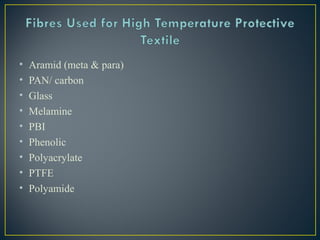
• Aramid (meta & para)
• PAN/ carbon
• Glass
• Melamine
• PBI
• Phenolic
• Polyacrylate
• PTFE
• Polyamide
Fireguard Fire Entry Suit, Kiln Suit, Proximity Suit & Approach
Suit
Flame resistant fabrics are designed to resist ignition and
self-extinguish when ignited. It should also extinguish as
soon as the ignition source is removed.
Naturally thermo stable or fire retardant agent treated
fibres are used for obtaining fire protective function in
textiles. Flame resistance in fabrics can be developed by
two ways:
1.By using inherent flame resistant materials and fibers
2.By giving FR treatments to fibers and fabrics
• Meta aramid
• Para aramid
• Modacrylic
• Polybenzimidazole (PBI)
• Carbon
• Polyimide
• FR viscose
• FR cotton
• FR polyester
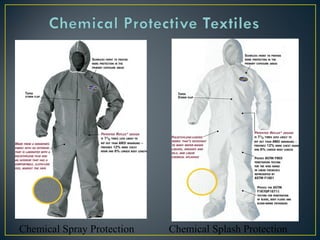
Chemical Spray Protection Chemical Splash Protection
• The purpose of chemical protective clothing and
equipment is to shield or isolate individuals from the
chemical, physical, and biological hazards that may be
encountered during hazardous materials operations.
During chemical operations, it is not always apparent
when exposure occurs. Chemical Protective Clothing is
used mainly to prevent exposure during hazardous
activities. These hazards can be grouped into categories
such as chemical, thermal, nuclear, radiation (X-rays,
UV) and biological hazards.
A
Vapour
Protective Suit
Liquid Splash
Protective Suit
Support Function
Protective Garment
Coveralls,
Safety boots/shoes,
etc.
B
C
D
Cut Resistant
Gloves
Puncture Resistant
Gloves
Chain Saw
Clothing
• The mechanical performance of fabrics is due to hybrid
yarns in their interlacing. Textiles for mechanical
protection can be manufactured from high strength
textile fibres used alone or along with metallic fibres.
MPT’s have a personal protective function against
different risk such as ballistic, blade cuts, fabric
puncture, projection of fragments, knives, slashing etc
besides combined use of high performance material such
as glass fibre, HT Polyethylene or steel.
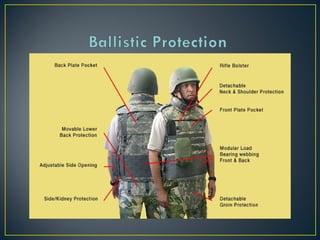
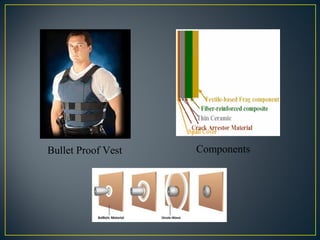
• Ballistic protection is a class of protective clothing,
which aims at protecting the individuals from the bullets
and steel fragments from hand-held weapons and
exploding ammunitions. The basic idea of spreading the
load over a large area is still applied. It is better to
dissipate the energy of impact by deformation and
breaking the protective material. Ballistic protection
process is a complex phenomenon involving the
transverse velocity propagation, tensile properties and
the fine structure. In the recent years, use of ultra-high
modulus polyethylene (UHMPE) fibres produced by gel
spinning has been started in manufacturing of ballistic
protective fabrics.
Bullet Proof Vest Components
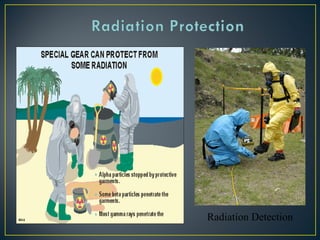
Radiation Detection
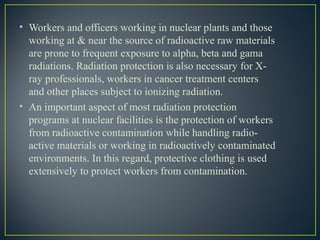
• Workers and officers working in nuclear plants and those
working at & near the source of radioactive raw materials
are prone to frequent exposure to alpha, beta and gama
radiations. Radiation protection is also necessary for X-
ray professionals, workers in cancer treatment centers
and other places subject to ionizing radiation.
• An important aspect of most radiation protection
programs at nuclear facilities is the protection of workers
from radioactive contamination while handling radio-
active materials or working in radioactively contaminated
environments. In this regard, protective clothing is used
extensively to protect workers from contamination.
SunburnUV Protective Garments
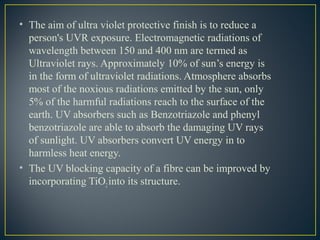
• The aim of ultra violet protective finish is to reduce a
person's UVR exposure. Electromagnetic radiations of
wavelength between 150 and 400 nm are termed as
Ultraviolet rays. Approximately 10% of sun’s energy is
in the form of ultraviolet radiations. Atmosphere absorbs
most of the noxious radiations emitted by the sun, only
5% of the harmful radiations reach to the surface of the
earth. UV absorbers such as Benzotriazole and phenyl
benzotriazole are able to absorb the damaging UV rays
of sunlight. UV absorbers convert UV energy in to
harmless heat energy.
• The UV blocking capacity of a fibre can be improved by
incorporating TiO2into its structure.
Clean Room Garments
Anticontaminant Mask & Dress
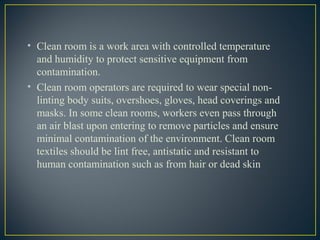
• Clean room is a work area with controlled temperature
and humidity to protect sensitive equipment from
contamination.
• Clean room operators are required to wear special non-
linting body suits, overshoes, gloves, head coverings and
masks. In some clean rooms, workers even pass through
an air blast upon entering to remove particles and ensure
minimal contamination of the environment. Clean room
textiles should be lint free, antistatic and resistant to
human contamination such as from hair or dead skin
High Visibility Jackets
• High visibility materials have changed the appearance of
clothes worn for both work and leisure pursuits. Today,
there are more technologies on offer than in the past,
which are able to make people and objects more visible.
Also, a wider availability of fabrics, materials, designs
and colours has led to greater choice.
• With advances in technology, designers and
manufacturers of this type of apparel have been able to
make safety features fashionable. Modern manufacturing
techniques allow the use of colour to disguise reflective
material so that it can not be seen during normal
daylight.
Applications:-
Conductive Textiles
Cut Resistant Fabrics
Nonwoven Textiles
Metallized products are used in various industrial,
speciality and protective clothing applications. Metallized
fabrics provide good abrasion resistance, reflectivity over
extended time, wear resistance and molten splash
resistance. Some applications of metallized fabrics in
textiles are mentioned below
1.Coating /laminating fabric with metal surfaces for better
heat reflection.
2.Blending metal sliver with natural/synthetic fibres to
produce conductive textiles.
3.Composite yarns made of metal fibres yarns and textile
yarns are suitable for cut resistant fabrics
4.Chopped metal fibres can be air or wet layered with
textile fibres to form nonwoven textiles
Aluminized Fabrics
Advanced Protection system
High Performance Fibres
Electro-conductive Fibres
Novel Yarn Spinning Technology
Challenges in Protective Textiles
 Optimization of important properties.
 Establish fibre properties according to end use.
The technical textile consumption under protech is estimated at
around Rs 1,387 crore which is expected to increase to around
Rs 2,386 crore by 2012-13.
The key Protech products are high altitude clothing, bullet-
proof jackets and fire retardant fabrics.
In the medium term (next 5 years), the protective textiles
industry is expected to achieve growth at the rate of 11-12%
year on year.
The demand for the protech products is dependent on the
improvements in worker safety practices, fire protective
standards for construction and the defense sector.
Continuous innovations & better understanding of the consumer
requirements is the need of the hour.
The technological trends and challenges ahead will be
determined by market pull demands, increasing environmental
awareness, personal safety and comfort, and performance
requirements.
Due to the increasing health and safety issues at work,
protective textiles are the most essential and attractive segment
of textile market and will continue to do so.
Protective Textile

Protective Textile

  • 1.
    PROTECTIVE TEXTILES By :-Ojas Jain Payal Juneja
  • 2.
    Protection from extremeenvironmental conditions has always been a critical requirement of textile products. Protective textiles are a part of technical textiles that are used principally for their performance or functional characteristics rather than their aesthetic or decorative characteristics.
  • 3.
    • As thename suggests, protective clothing and other textile materials are used to protect human beings/atmosphere from various natural/industrial hazards. Some the possible environmental hazards are heat, cold, rain, snow, wind, ultraviolet radiations, abrasion, dust, micro organisms, radioactive radiations, static electricity etc. Some prominent human/industrial hazards are fire, flash, industrial chemicals, biohazards, high velocity projectiles, cutting/slashing by sharp objects etc. We need optimum safety from all these hazards when we are in the vicinity of one or more of them. Thus the need of protective textiles is there to safe guard us.
  • 4.
    Light Weight AndLow Bulk High Durability And Dimensional Stability Good Handle And Drape Low Noise Emission Water Repellant Wind Proof And Snow Shedding Thermal Insulating UV Resistant Air Permeable Flame Retardant Heat And Melt Resistance/Low Smoke Emission Safety From Radar Spectrum
  • 5.
    Fibre Uses Meta aramid Filterbags for hot gas, Industrial protective clothing, Racing driver’s suit, Cargo covers, Boat covers, Fire hose reinforcement. Para aramid Body armour, Tyre cords, Radiator hose and brake shoes of racing cars, Reinforced composites for aircraft, High speed boat components Carbon Aircraft and Space shuttle, Automotive, Medical Implants, Marine Glass Aircraft and aerospace, Consumer goods, Roofing Tiles, Corrosion resistant products used in highway overlay
  • 6.
    Fibre Uses Polypropylen e Sail cloth,Marine ropes and cables, Protective clothing, Boat hulls Spandex Sports and leisure garments, Foundation garments, Support hose PBI Racing driver’s suit, Hot gas filtration, Thermal protective clothing Tencel Filtration media for oil industry, Medical Textile, Industrial fabric Inorganic Fibre Military Application. Aircraft, Automobile, Sport, Electrical Application Fluorine Containing Fibre Filtration media for corrosive material, Packing Material, Refrigeration
  • 7.
    High Temperature ProtectiveTextiles Flame Resistant Protective Textiles Chemical Protective Textiles Mechanical Protective Textiles Ballistic Protective Textiles Space Suits Radiation Protective Textiles Clean Room Technology High Visibility Textiles Ultra Violet Protection Finish Breathable Fabrics Electrical Protective Textiles Metallized Fabrics Protective Health Care Garments Biological Protective Textiles
  • 8.
  • 9.
    • A hightemperature textile material is defined as a material, which can be used above 200 o C without decomposition and without losing its major physical properties. Although some fibres can be used for insulation and retain some strength even above 2000 o F, they lose their textile characteristics at that temperature range. The thermal insulation provided by fibrous material is mainly due to the low thermal conductivity of the air entrapped in the fibre web. Thus fibres, which are fine and dimensionally stable at working temperatures, are used in thermal protective clothing. Resistance to both flame and associated heat transfer through the garment is defined as thermal protection.
  • 10.
    • Aramid (meta& para) • PAN/ carbon • Glass • Melamine • PBI • Phenolic • Polyacrylate • PTFE • Polyamide
  • 11.
    Fireguard Fire EntrySuit, Kiln Suit, Proximity Suit & Approach Suit
  • 12.
    Flame resistant fabricsare designed to resist ignition and self-extinguish when ignited. It should also extinguish as soon as the ignition source is removed. Naturally thermo stable or fire retardant agent treated fibres are used for obtaining fire protective function in textiles. Flame resistance in fabrics can be developed by two ways: 1.By using inherent flame resistant materials and fibers 2.By giving FR treatments to fibers and fabrics
  • 13.
    • Meta aramid •Para aramid • Modacrylic • Polybenzimidazole (PBI) • Carbon • Polyimide • FR viscose • FR cotton • FR polyester
  • 14.
    Chemical Spray ProtectionChemical Splash Protection
  • 15.
    • The purposeof chemical protective clothing and equipment is to shield or isolate individuals from the chemical, physical, and biological hazards that may be encountered during hazardous materials operations. During chemical operations, it is not always apparent when exposure occurs. Chemical Protective Clothing is used mainly to prevent exposure during hazardous activities. These hazards can be grouped into categories such as chemical, thermal, nuclear, radiation (X-rays, UV) and biological hazards.
  • 16.
    A Vapour Protective Suit Liquid Splash ProtectiveSuit Support Function Protective Garment Coveralls, Safety boots/shoes, etc. B C D
  • 17.
  • 18.
    • The mechanicalperformance of fabrics is due to hybrid yarns in their interlacing. Textiles for mechanical protection can be manufactured from high strength textile fibres used alone or along with metallic fibres. MPT’s have a personal protective function against different risk such as ballistic, blade cuts, fabric puncture, projection of fragments, knives, slashing etc besides combined use of high performance material such as glass fibre, HT Polyethylene or steel.
  • 20.
    • Ballistic protectionis a class of protective clothing, which aims at protecting the individuals from the bullets and steel fragments from hand-held weapons and exploding ammunitions. The basic idea of spreading the load over a large area is still applied. It is better to dissipate the energy of impact by deformation and breaking the protective material. Ballistic protection process is a complex phenomenon involving the transverse velocity propagation, tensile properties and the fine structure. In the recent years, use of ultra-high modulus polyethylene (UHMPE) fibres produced by gel spinning has been started in manufacturing of ballistic protective fabrics.
  • 21.
  • 22.
  • 23.
    • Workers andofficers working in nuclear plants and those working at & near the source of radioactive raw materials are prone to frequent exposure to alpha, beta and gama radiations. Radiation protection is also necessary for X- ray professionals, workers in cancer treatment centers and other places subject to ionizing radiation. • An important aspect of most radiation protection programs at nuclear facilities is the protection of workers from radioactive contamination while handling radio- active materials or working in radioactively contaminated environments. In this regard, protective clothing is used extensively to protect workers from contamination.
  • 24.
  • 25.
    • The aimof ultra violet protective finish is to reduce a person's UVR exposure. Electromagnetic radiations of wavelength between 150 and 400 nm are termed as Ultraviolet rays. Approximately 10% of sun’s energy is in the form of ultraviolet radiations. Atmosphere absorbs most of the noxious radiations emitted by the sun, only 5% of the harmful radiations reach to the surface of the earth. UV absorbers such as Benzotriazole and phenyl benzotriazole are able to absorb the damaging UV rays of sunlight. UV absorbers convert UV energy in to harmless heat energy. • The UV blocking capacity of a fibre can be improved by incorporating TiO2into its structure.
  • 26.
  • 27.
    • Clean roomis a work area with controlled temperature and humidity to protect sensitive equipment from contamination. • Clean room operators are required to wear special non- linting body suits, overshoes, gloves, head coverings and masks. In some clean rooms, workers even pass through an air blast upon entering to remove particles and ensure minimal contamination of the environment. Clean room textiles should be lint free, antistatic and resistant to human contamination such as from hair or dead skin
  • 28.
  • 29.
    • High visibilitymaterials have changed the appearance of clothes worn for both work and leisure pursuits. Today, there are more technologies on offer than in the past, which are able to make people and objects more visible. Also, a wider availability of fabrics, materials, designs and colours has led to greater choice. • With advances in technology, designers and manufacturers of this type of apparel have been able to make safety features fashionable. Modern manufacturing techniques allow the use of colour to disguise reflective material so that it can not be seen during normal daylight.
  • 30.
  • 31.
    Metallized products areused in various industrial, speciality and protective clothing applications. Metallized fabrics provide good abrasion resistance, reflectivity over extended time, wear resistance and molten splash resistance. Some applications of metallized fabrics in textiles are mentioned below 1.Coating /laminating fabric with metal surfaces for better heat reflection. 2.Blending metal sliver with natural/synthetic fibres to produce conductive textiles. 3.Composite yarns made of metal fibres yarns and textile yarns are suitable for cut resistant fabrics 4.Chopped metal fibres can be air or wet layered with textile fibres to form nonwoven textiles
  • 32.
    Aluminized Fabrics Advanced Protectionsystem High Performance Fibres Electro-conductive Fibres Novel Yarn Spinning Technology Challenges in Protective Textiles  Optimization of important properties.  Establish fibre properties according to end use.
  • 33.
    The technical textileconsumption under protech is estimated at around Rs 1,387 crore which is expected to increase to around Rs 2,386 crore by 2012-13. The key Protech products are high altitude clothing, bullet- proof jackets and fire retardant fabrics. In the medium term (next 5 years), the protective textiles industry is expected to achieve growth at the rate of 11-12% year on year. The demand for the protech products is dependent on the improvements in worker safety practices, fire protective standards for construction and the defense sector.
  • 34.
    Continuous innovations &better understanding of the consumer requirements is the need of the hour. The technological trends and challenges ahead will be determined by market pull demands, increasing environmental awareness, personal safety and comfort, and performance requirements. Due to the increasing health and safety issues at work, protective textiles are the most essential and attractive segment of textile market and will continue to do so.