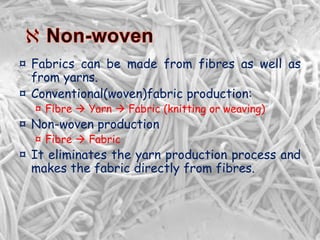
¤ Fabrics can be made from fibres as well as
from yarns.
¤ Conventional(woven)fabric production:
¤ Fibre  Yarn  Fabric (knitting or weaving)
¤ Non-woven production
¤ Fibre  Fabric
¤ It eliminates the yarn production process and
makes the fabric directly from fibres.
.
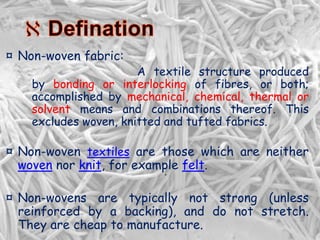
¤ Non-woven fabric:
A textile structure produced
by bonding or interlocking of fibres, or both;
accomplished by mechanical, chemical, thermal or
solvent means and combinations thereof. This
excludes woven, knitted and tufted fabrics.
¤ Non-woven textiles are those which are neither
woven nor knit, for example felt.
¤ Non-wovens are typically not strong (unless
reinforced by a backing), and do not stretch.
They are cheap to manufacture.
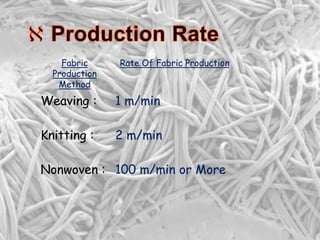
Fabric
Production
Method
Rate Of Fabric Production
Weaving : 1 m/min
Knitting : 2 m/min
Nonwoven : 100 m/min or More
¤ Nonwoven fabrics can be engineered to give a
wide variety of properties.
¤ Nevertheless, their aesthetic properties
(handle, drape, appearance) are such that they
are not in direct competition with conventional
fabrics in the outerwear market.
¤ Woven and knitted fabrics will not be replaced
by nonwovens in the near futrue.
¤ Currently, the main areas of growth in
nonwovens are in geotextiles, medical and
hospital uses, disposable products and filters.
¤ There are normally two steps for
making non-woven products.
¤ They are:
¤ Web formation; and
¤ Bonding systems.
• A nonwoven fabric is basically a web of
fibres held together in some way.
• The web may be made of staple fibres
or filaments, or from portions of
polymer film.
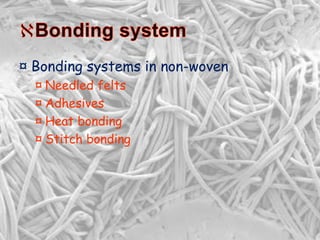
¤ Bonding systems in non-woven
¤ Needled felts
¤ Adhesives
¤ Heat bonding
¤ Stitch bonding
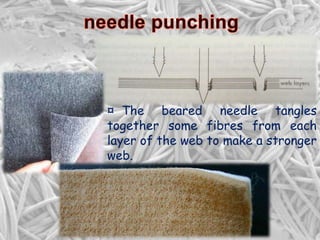
¤ The beared needle tangles
together some fibres from each
layer of the web to make a stronger
web.
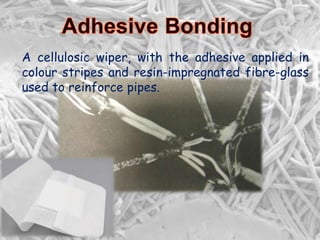
A cellulosic wiper, with the adhesive applied in
colour stripes and resin-impregnated fibre-glass
used to reinforce pipes.
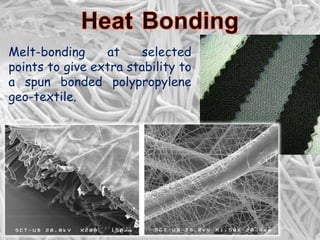
Melt-bonding at selected
points to give extra stability to
a spun bonded polypropylene
geo-textile.
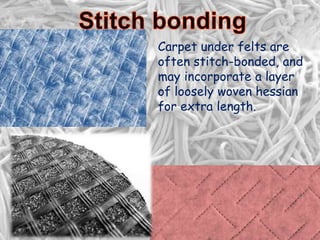
Carpet under felts are
often stitch-bonded, and
may incorporate a layer
of loosely woven hessian
for extra length.
Synthetic Fibres
¤Polyester
¤Poly propylene
¤Polyamide
¤Glass
¤Carbon
¤Viscose
¤Aramide
¤Many others.
Natural Fibres
¤ jute
¤Cotton
¤Wool
¤others
¤ Non-woven materials are used in numerous
applications, including:
¤ Hygiene
¤ Baby diapers
¤ Feminine hygiene
¤ Adult incontinence products
¤ Wipes
¤ Domestic
¤ Technical
¤ Filters
¤ Geotextiles
¤ Carpet backing
¤ Composites
¤ Staple non-wovens
Staple non-wovens are made in two steps. Fibers are
first spun, cut to a few centimeters length, and put into
bales. These bales are then dispersed on a conveyor
belt, and the fibers are spread in a uniform web by a
wetlaid process or by carding.
¤ Spun laid non-wovens
Spunlaid non-wovens are made in one continuous
process. Fibers are spun and then directly dispersed in a
web by deflectors. This technique leads to faster belt
speeds, and cheaper costs. Several variants of this
concept are available, but the leading technology is the
Reicofil machinery, manufactured by Reifenhaüser
(Germany).
 The Association of the Nonwovens Fabrics
Industry
 Nonwoven Industry News, Conference Reports
and Consulting
 HANDBOOK OF TECHNICAL TEXTILES BY,
HORROCKS & ANAND
Non woven

Non woven

  • 3.
    ¤ Fabrics canbe made from fibres as well as from yarns. ¤ Conventional(woven)fabric production: ¤ Fibre  Yarn  Fabric (knitting or weaving) ¤ Non-woven production ¤ Fibre  Fabric ¤ It eliminates the yarn production process and makes the fabric directly from fibres.
  • 4.
    . ¤ Non-woven fabric: Atextile structure produced by bonding or interlocking of fibres, or both; accomplished by mechanical, chemical, thermal or solvent means and combinations thereof. This excludes woven, knitted and tufted fabrics. ¤ Non-woven textiles are those which are neither woven nor knit, for example felt. ¤ Non-wovens are typically not strong (unless reinforced by a backing), and do not stretch. They are cheap to manufacture.
  • 5.
    Fabric Production Method Rate Of FabricProduction Weaving : 1 m/min Knitting : 2 m/min Nonwoven : 100 m/min or More
  • 6.
    ¤ Nonwoven fabricscan be engineered to give a wide variety of properties. ¤ Nevertheless, their aesthetic properties (handle, drape, appearance) are such that they are not in direct competition with conventional fabrics in the outerwear market. ¤ Woven and knitted fabrics will not be replaced by nonwovens in the near futrue. ¤ Currently, the main areas of growth in nonwovens are in geotextiles, medical and hospital uses, disposable products and filters.
  • 7.
    ¤ There arenormally two steps for making non-woven products. ¤ They are: ¤ Web formation; and ¤ Bonding systems.
  • 8.
    • A nonwovenfabric is basically a web of fibres held together in some way. • The web may be made of staple fibres or filaments, or from portions of polymer film.
  • 9.
    ¤ Bonding systemsin non-woven ¤ Needled felts ¤ Adhesives ¤ Heat bonding ¤ Stitch bonding
  • 10.
    ¤ The bearedneedle tangles together some fibres from each layer of the web to make a stronger web.
  • 11.
    A cellulosic wiper,with the adhesive applied in colour stripes and resin-impregnated fibre-glass used to reinforce pipes.
  • 12.
    Melt-bonding at selected pointsto give extra stability to a spun bonded polypropylene geo-textile.
  • 13.
    Carpet under feltsare often stitch-bonded, and may incorporate a layer of loosely woven hessian for extra length.
  • 14.
  • 15.
    ¤ Non-woven materialsare used in numerous applications, including: ¤ Hygiene ¤ Baby diapers ¤ Feminine hygiene ¤ Adult incontinence products ¤ Wipes ¤ Domestic ¤ Technical ¤ Filters ¤ Geotextiles ¤ Carpet backing ¤ Composites
  • 16.
    ¤ Staple non-wovens Staplenon-wovens are made in two steps. Fibers are first spun, cut to a few centimeters length, and put into bales. These bales are then dispersed on a conveyor belt, and the fibers are spread in a uniform web by a wetlaid process or by carding. ¤ Spun laid non-wovens Spunlaid non-wovens are made in one continuous process. Fibers are spun and then directly dispersed in a web by deflectors. This technique leads to faster belt speeds, and cheaper costs. Several variants of this concept are available, but the leading technology is the Reicofil machinery, manufactured by Reifenhaüser (Germany).
  • 17.
     The Associationof the Nonwovens Fabrics Industry  Nonwoven Industry News, Conference Reports and Consulting  HANDBOOK OF TECHNICAL TEXTILES BY, HORROCKS & ANAND