TECHNICAL TEXTILES AND ITS
APPLICATIONS
GUIDED BY PREPARED BY
DR. KAVITA PATIL SAYALI S. BHAMARE
VICE PRINCIPAL AND T.Y. B.SC
HOD Of TSAD
INTRODUCTION :
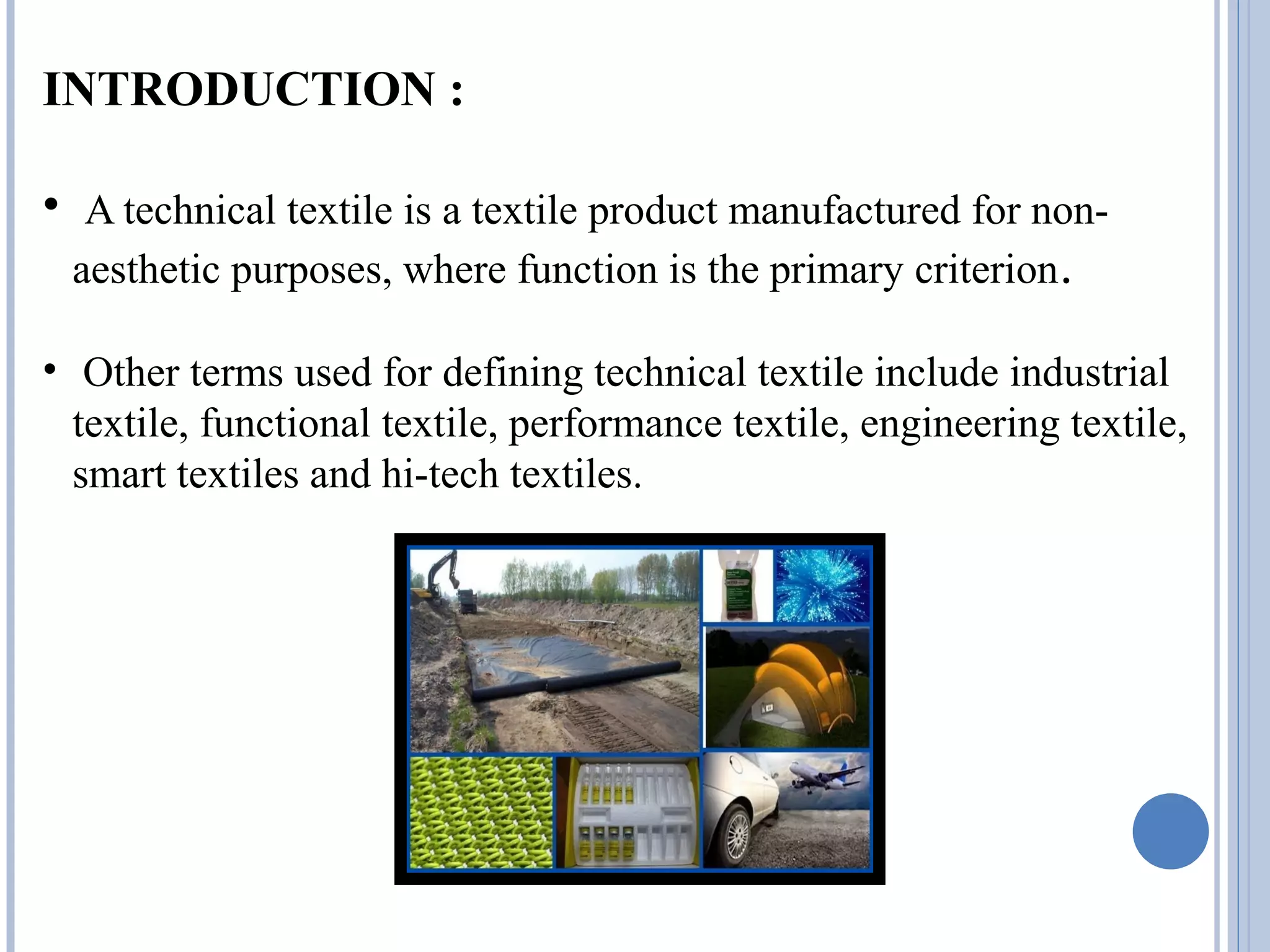
• A technical textile is a textile product manufactured for non-
aesthetic purposes, where function is the primary criterion.
• Other terms used for defining technical textile include industrial
textile, functional textile, performance textile, engineering textile,
smart textiles and hi-tech textiles.
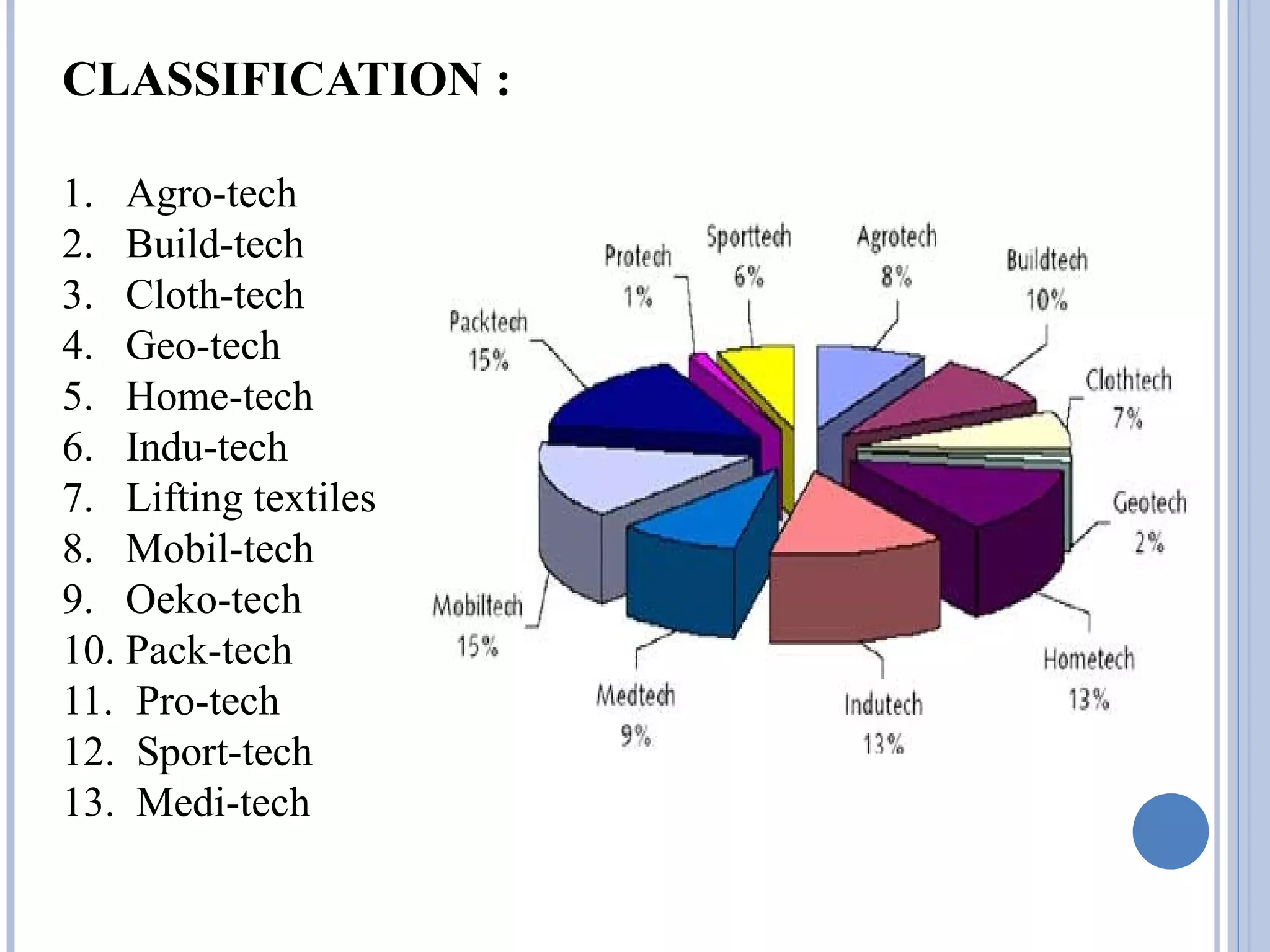
CLASSIFICATION :
1. Agro-tech
2. Build-tech
3. Cloth-tech
4. Geo-tech
5. Home-tech
6. Indu-tech
7. Lifting textiles
8. Mobil-tech
9. Oeko-tech
10. Pack-tech
11. Pro-tech
12. Sport-tech
13. Medi-tech
1) AGRO-TECH
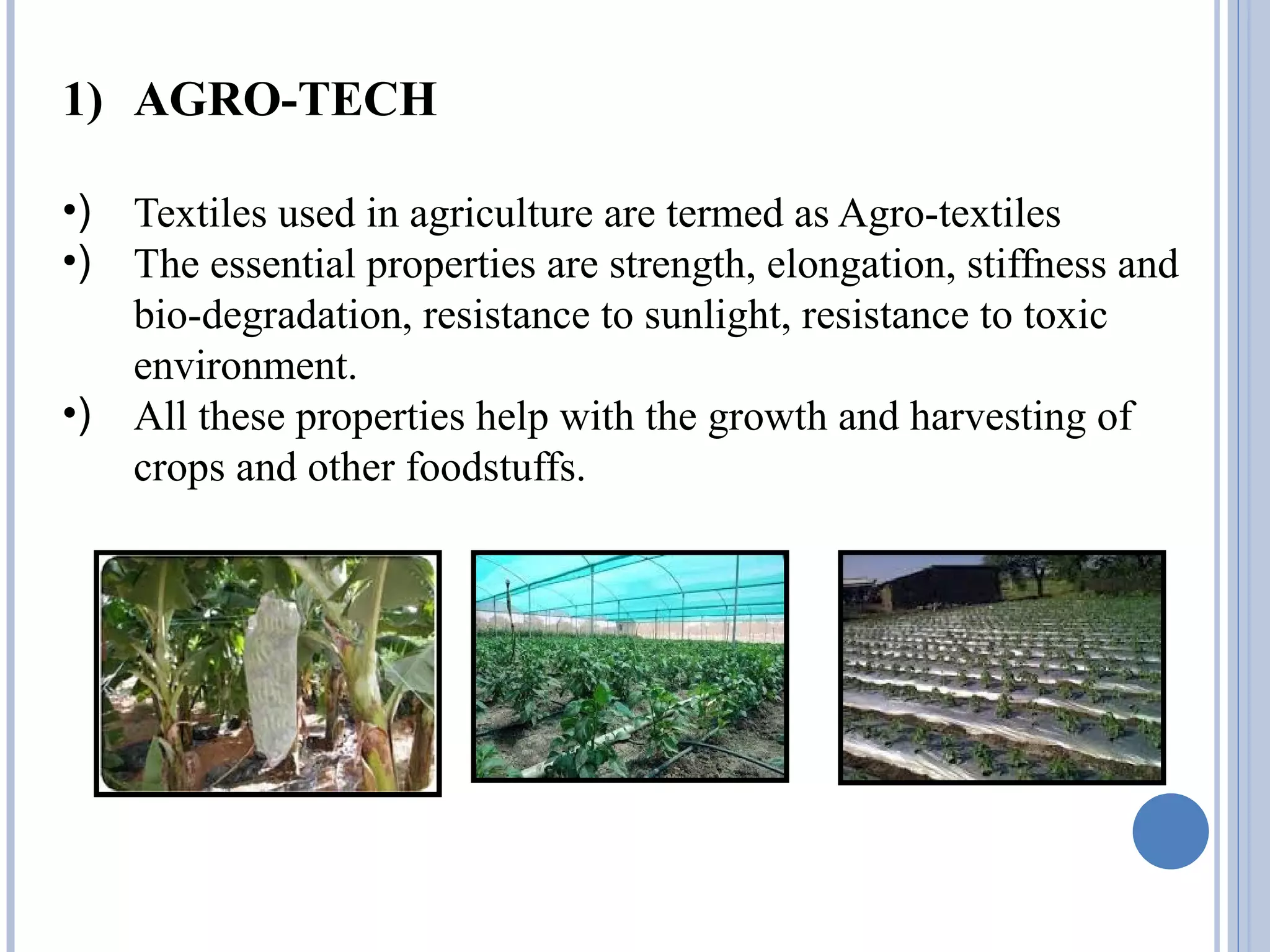
•) Textiles used in agriculture are termed as Agro-textiles
•) The essential properties are strength, elongation, stiffness and
bio-degradation, resistance to sunlight, resistance to toxic
environment.
•) All these properties help with the growth and harvesting of
crops and other foodstuffs.
2) BUILD-TECH
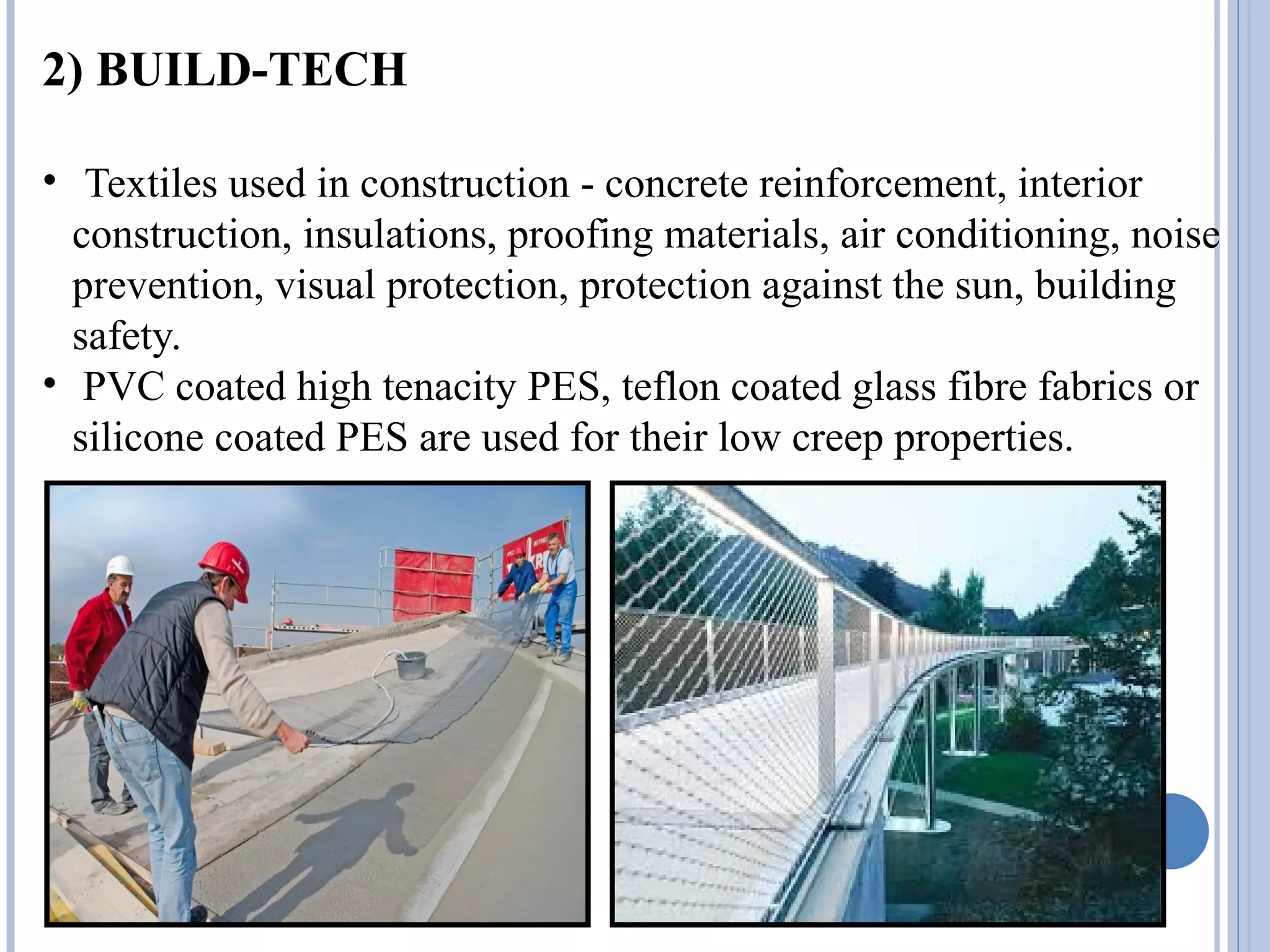
• Textiles used in construction - concrete reinforcement, interior
construction, insulations, proofing materials, air conditioning, noise
prevention, visual protection, protection against the sun, building
safety.
• PVC coated high tenacity PES, teflon coated glass fibre fabrics or
silicone coated PES are used for their low creep properties.
3) CLOTH-TECH
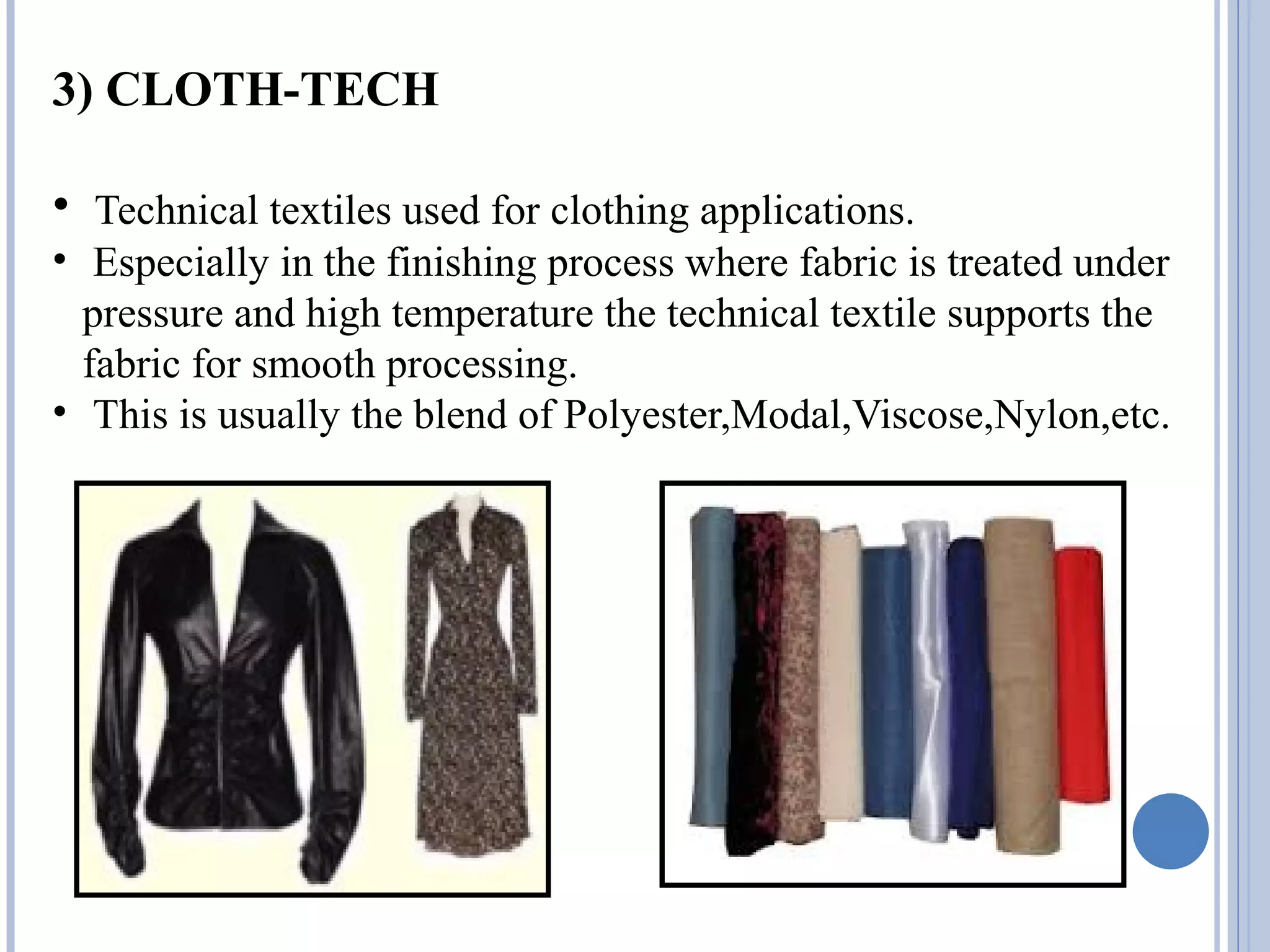
• Technical textiles used for clothing applications.
• Especially in the finishing process where fabric is treated under
pressure and high temperature the technical textile supports the
fabric for smooth processing.
• This is usually the blend of Polyester,Modal,Viscose,Nylon,etc.
4) GEO-TECH
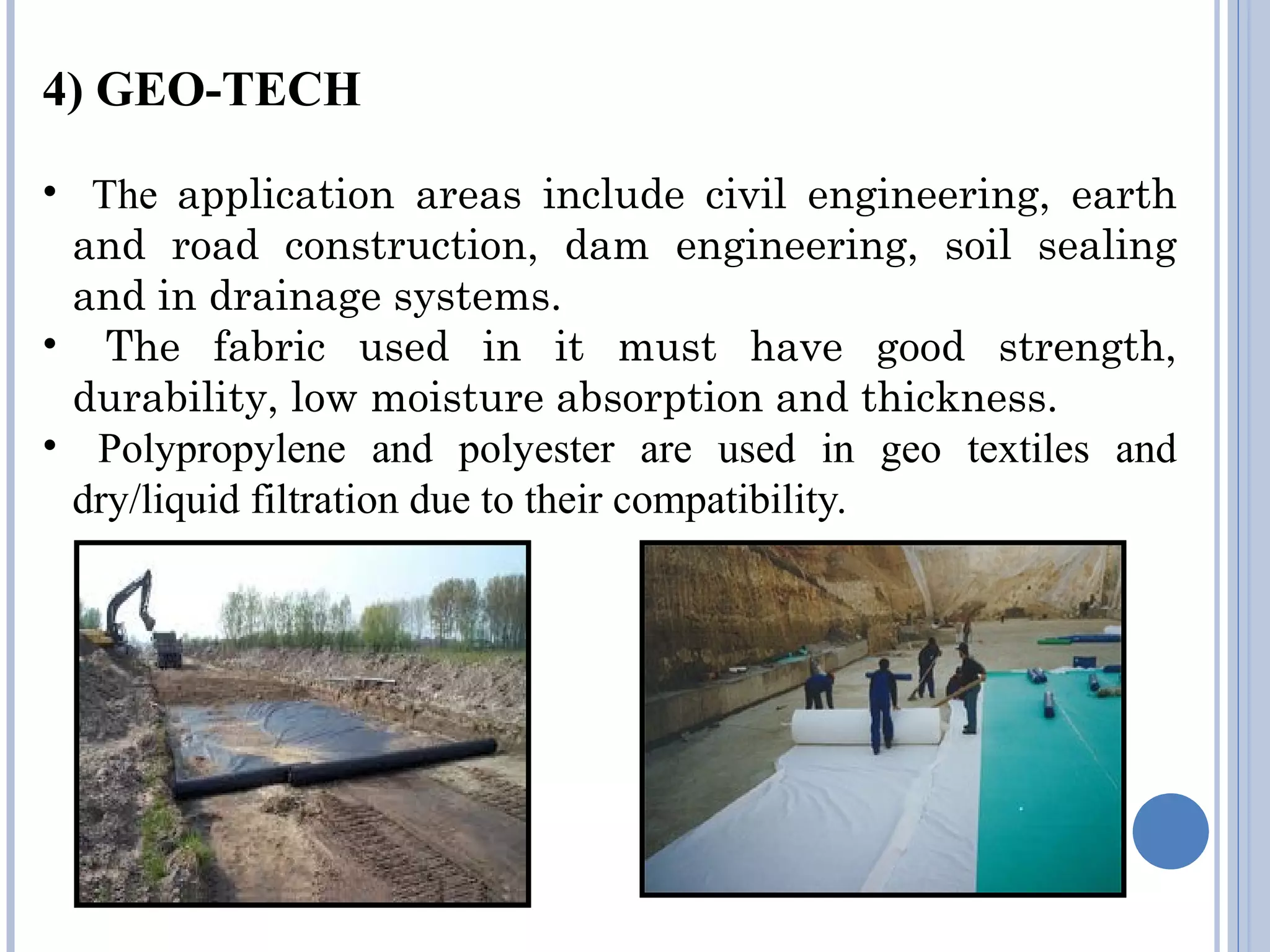
• The application areas include civil engineering, earth
and road construction, dam engineering, soil sealing
and in drainage systems.
• The fabric used in it must have good strength,
durability, low moisture absorption and thickness.
• Polypropylene and polyester are used in geo textiles and
dry/liquid filtration due to their compatibility.
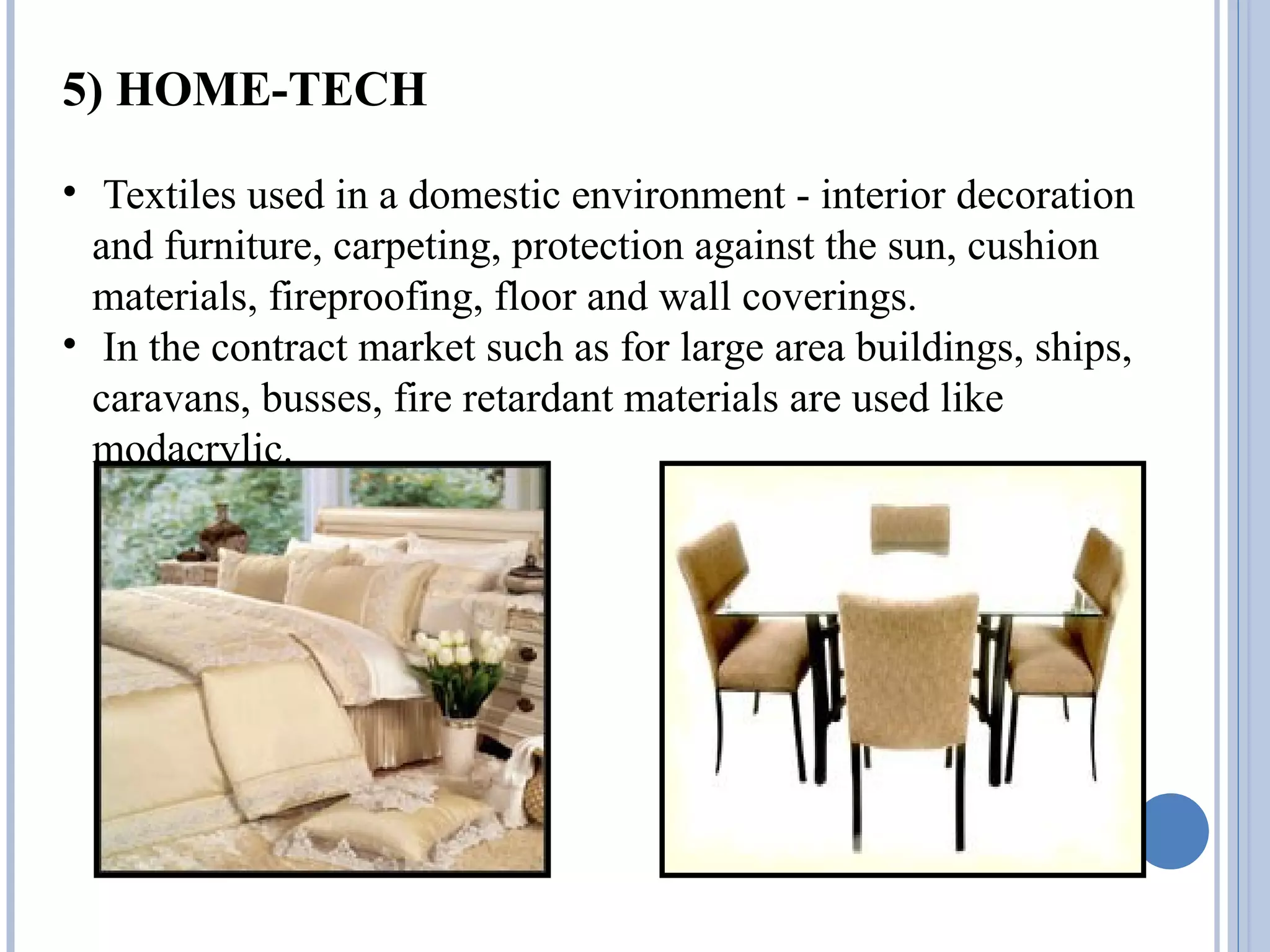
5) HOME-TECH
• Textiles used in a domestic environment - interior decoration
and furniture, carpeting, protection against the sun, cushion
materials, fireproofing, floor and wall coverings.
• In the contract market such as for large area buildings, ships,
caravans, busses, fire retardant materials are used like
modacrylic.
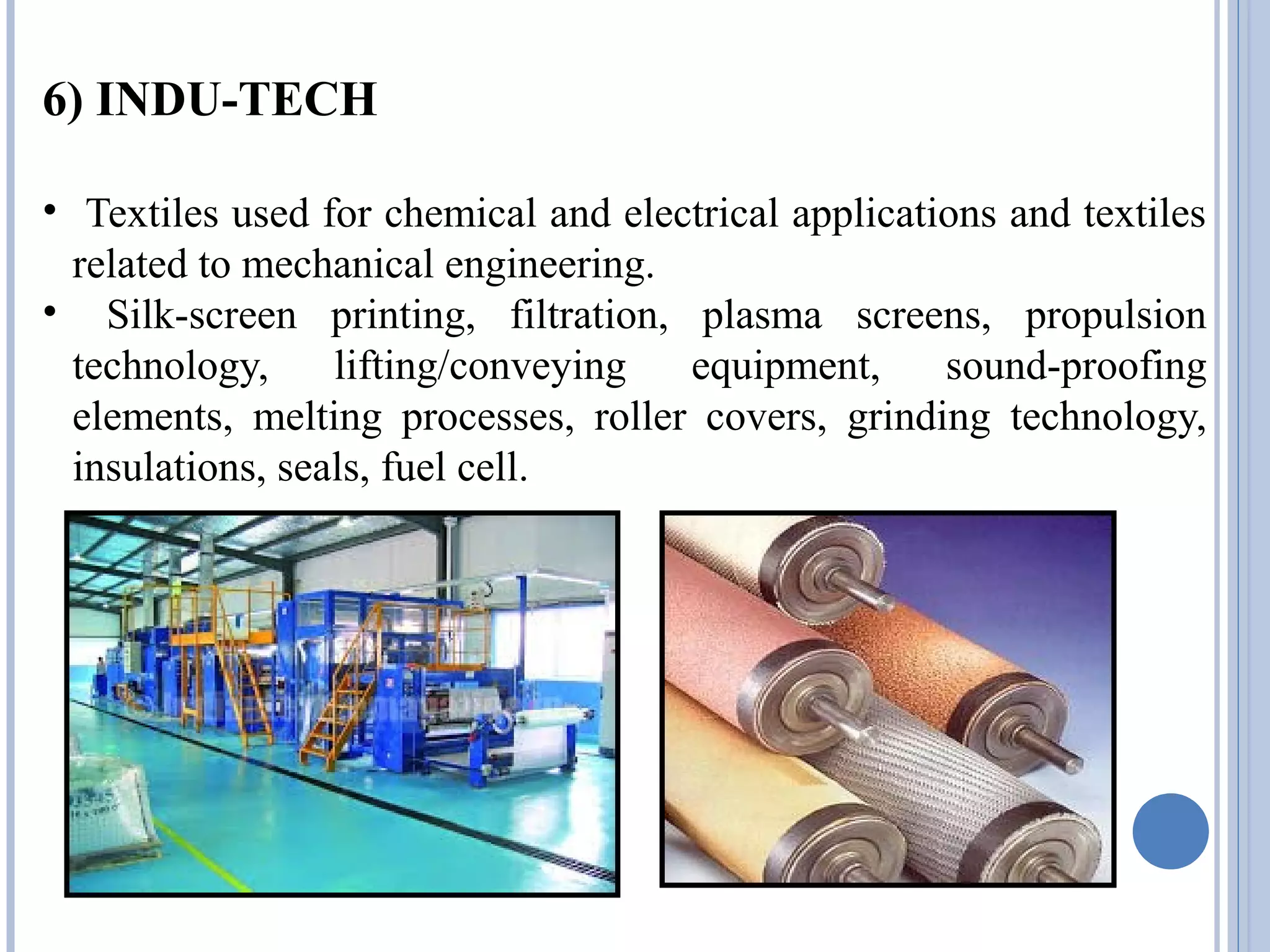
6) INDU-TECH
• Textiles used for chemical and electrical applications and textiles
related to mechanical engineering.
• Silk-screen printing, filtration, plasma screens, propulsion
technology, lifting/conveying equipment, sound-proofing
elements, melting processes, roller covers, grinding technology,
insulations, seals, fuel cell.
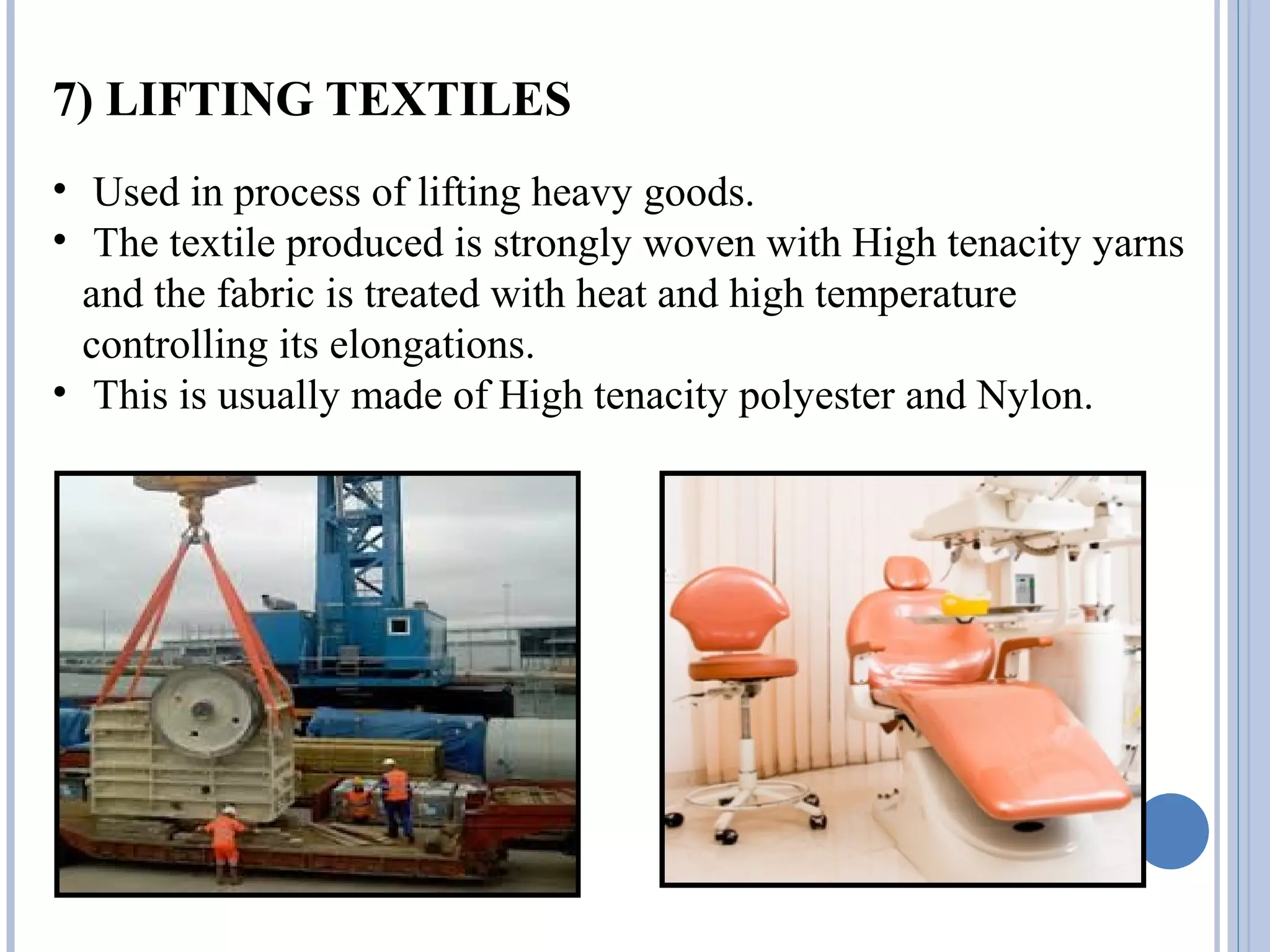
7) LIFTING TEXTILES
• Used in process of lifting heavy goods.
• The textile produced is strongly woven with High tenacity yarns
and the fabric is treated with heat and high temperature
controlling its elongations.
• This is usually made of High tenacity polyester and Nylon.
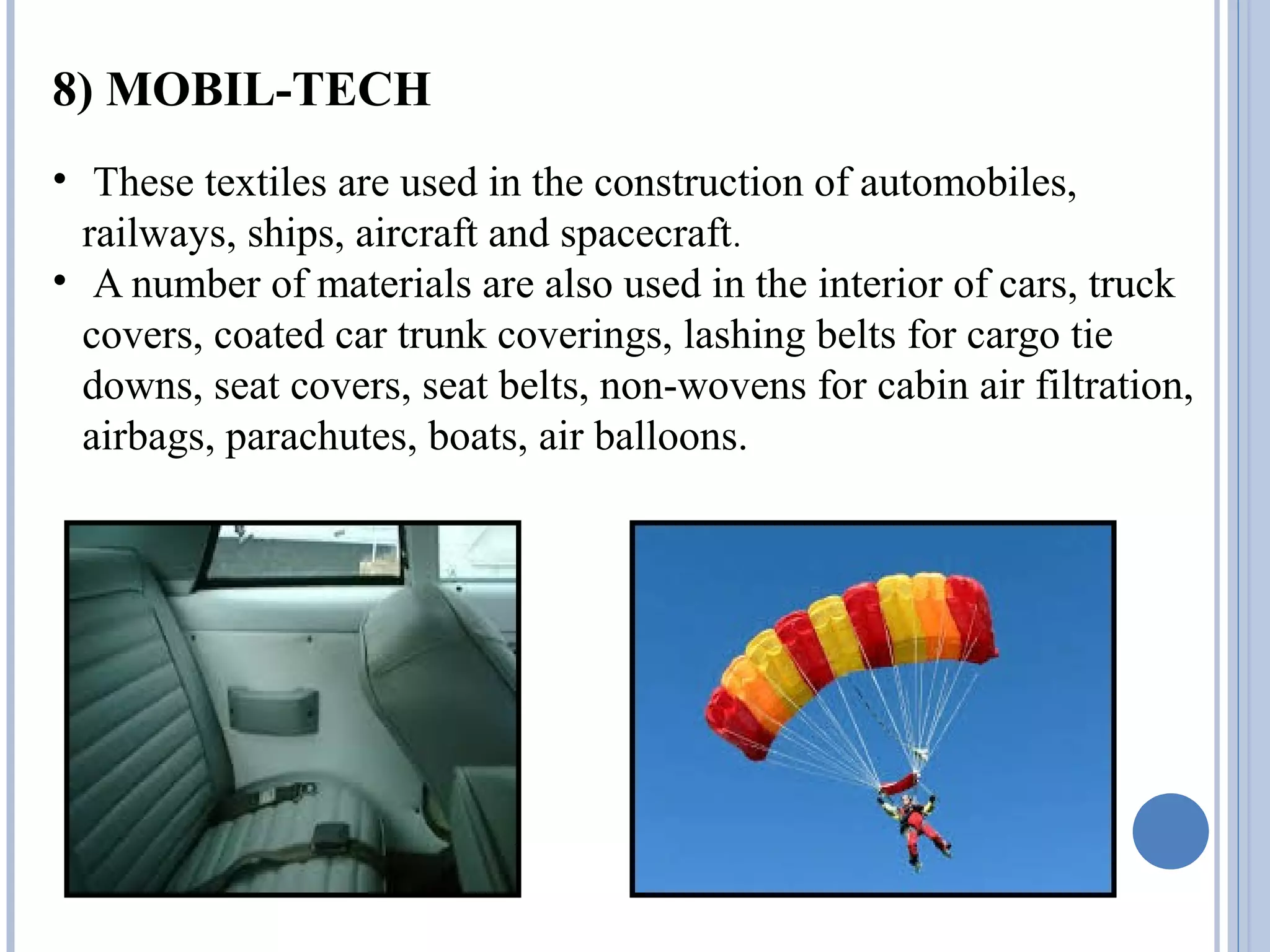
8) MOBIL-TECH
• These textiles are used in the construction of automobiles,
railways, ships, aircraft and spacecraft.
• A number of materials are also used in the interior of cars, truck
covers, coated car trunk coverings, lashing belts for cargo tie
downs, seat covers, seat belts, non-wovens for cabin air filtration,
airbags, parachutes, boats, air balloons.
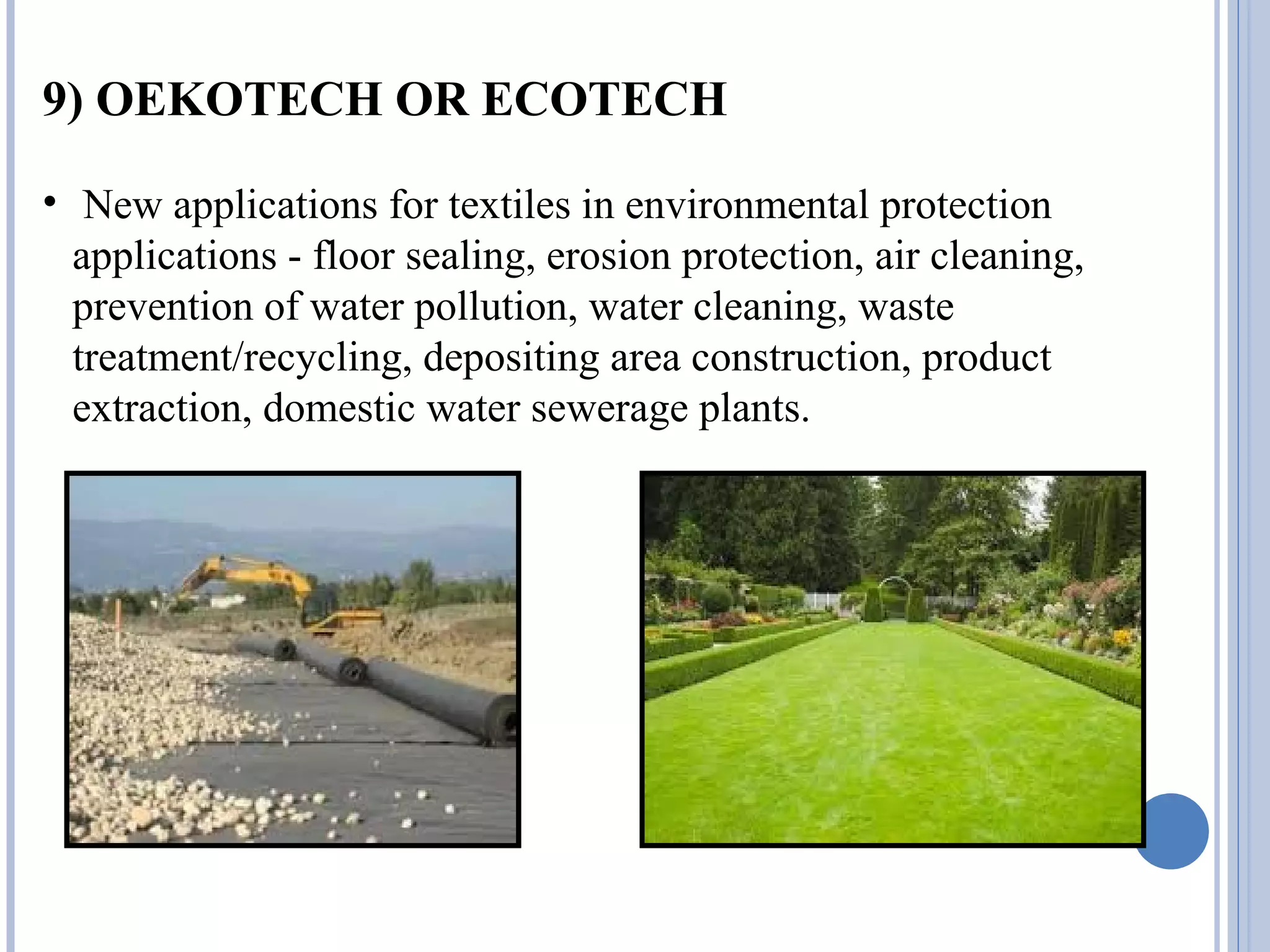
9) OEKOTECH OR ECOTECH
• New applications for textiles in environmental protection
applications - floor sealing, erosion protection, air cleaning,
prevention of water pollution, water cleaning, waste
treatment/recycling, depositing area construction, product
extraction, domestic water sewerage plants.
10) PACK-TECH
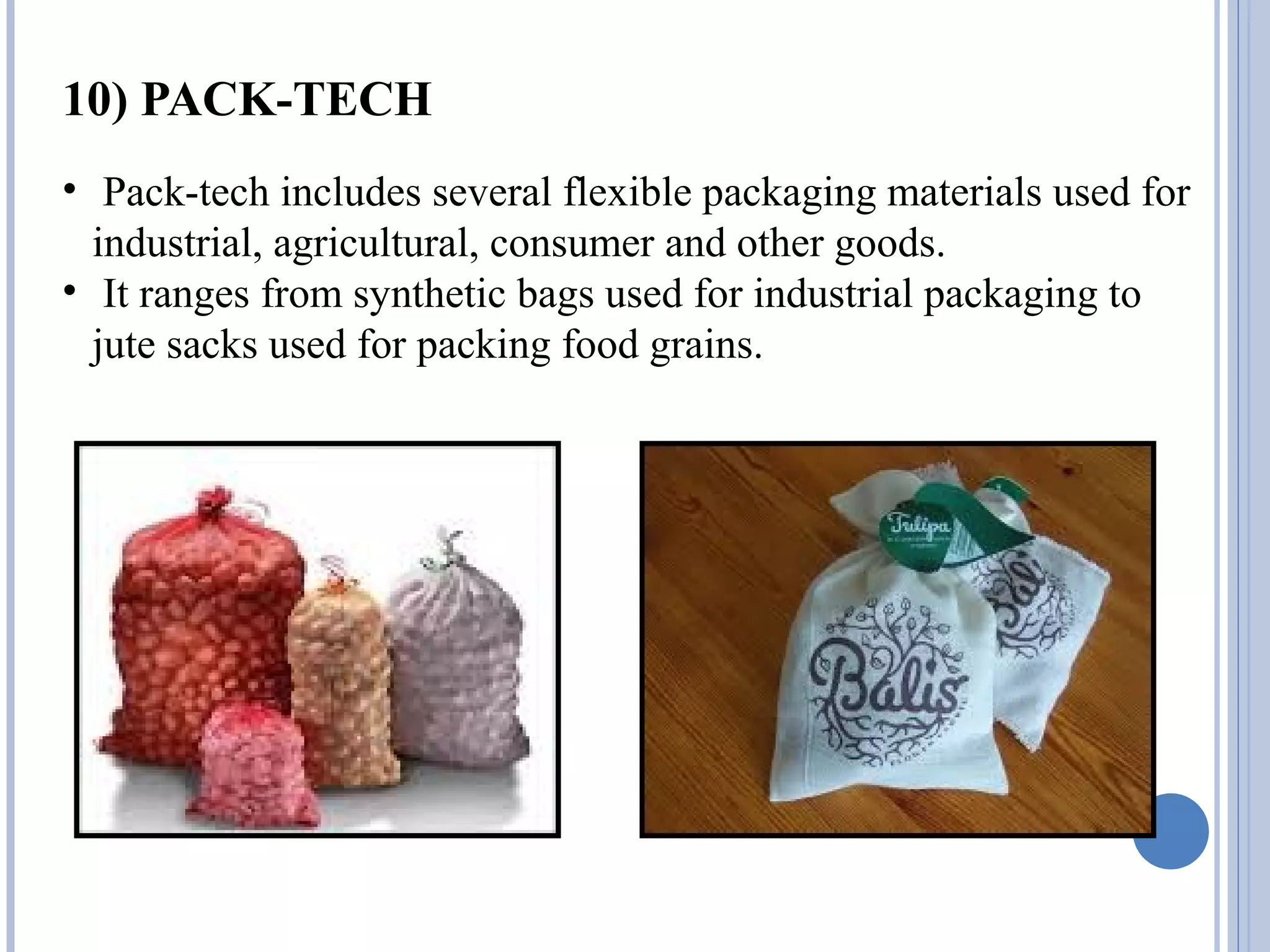
• Pack-tech includes several flexible packaging materials used for
industrial, agricultural, consumer and other goods.
• It ranges from synthetic bags used for industrial packaging to
jute sacks used for packing food grains.
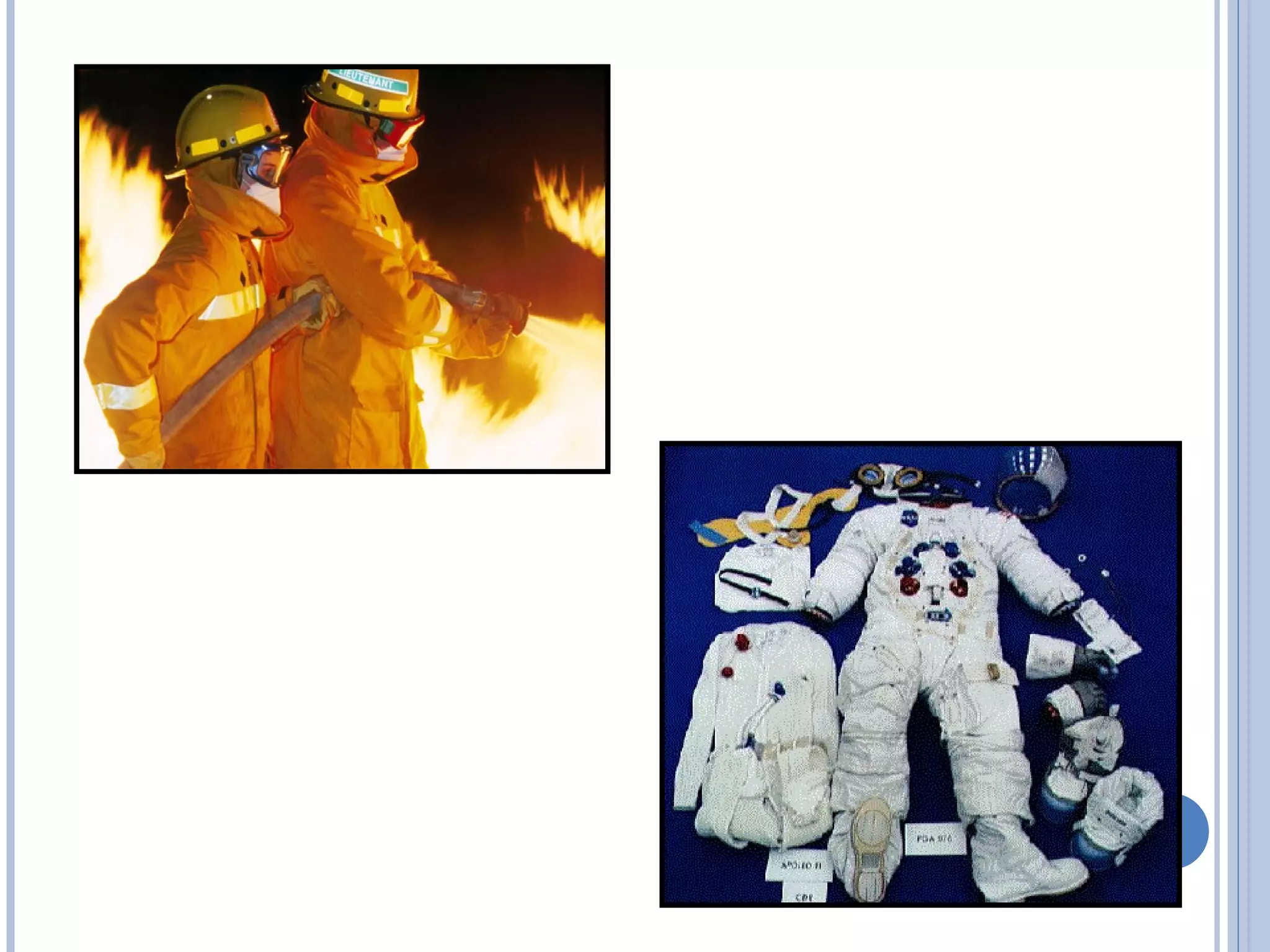
11) PRO-TECH ( PROTECTIVE TEXTILES ) :
• The main target of the technical protective fabrics is to improve
people safety in their workplaces.
• The aim of a technical protective fabric isn't fashion, they are
designed to have extra values in protection, against some hazards.
• Nowadays it can be found in the market, technical fabrics which
protect of :
- High temperatures (insulating, firefighters)
- Burns (flame, convective and radiant heat, firefighters, ATEX
area)
- Metal sparks (welding)
- Acid environment (petrochemical, gas, refineries, chemical)
- Bullet impact (military, security)
- Cut resistant (gloves, glass industry)
- Astronaut's suits
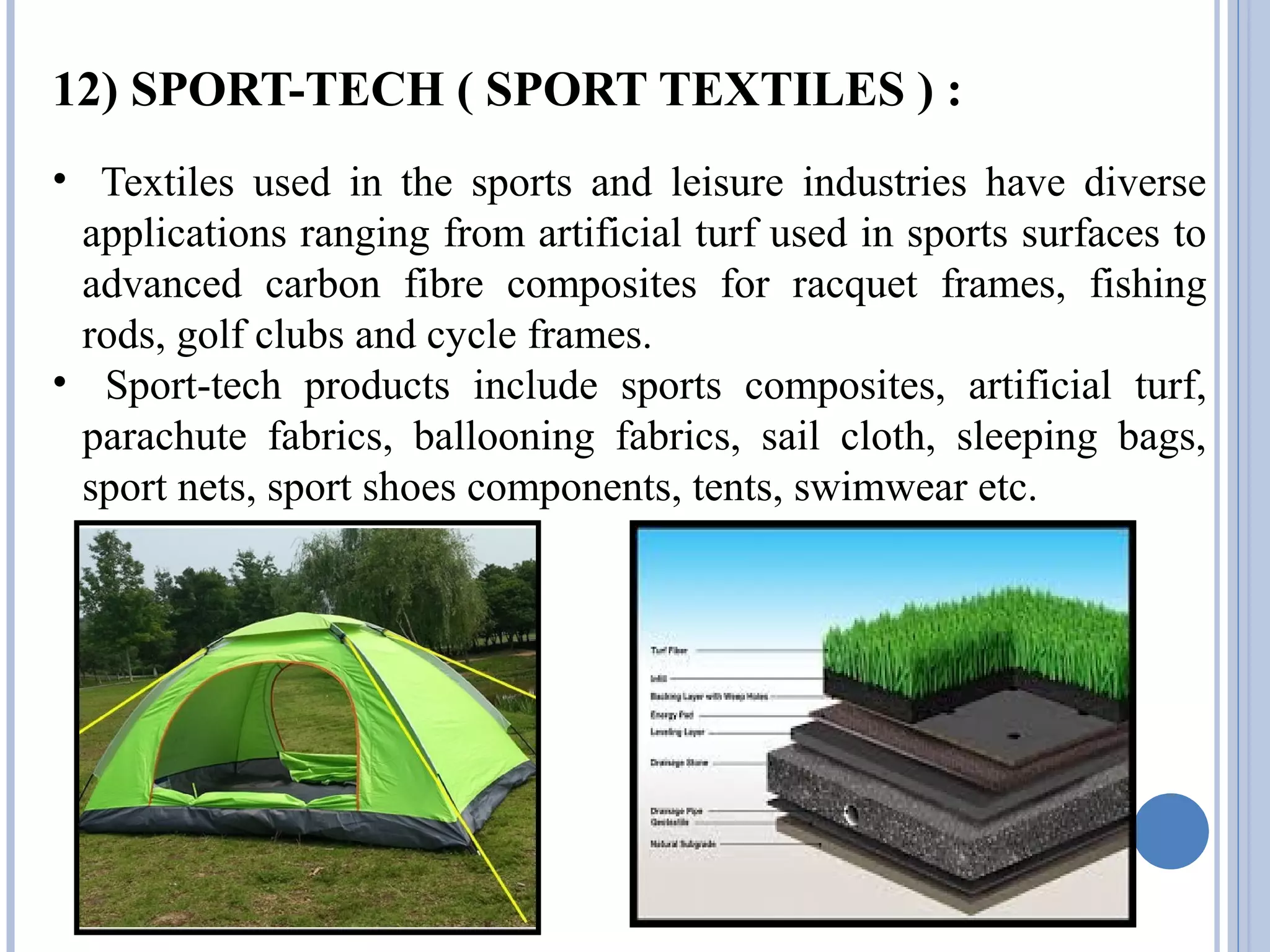
12) SPORT-TECH ( SPORT TEXTILES ) :
• Textiles used in the sports and leisure industries have diverse
applications ranging from artificial turf used in sports surfaces to
advanced carbon fibre composites for racquet frames, fishing
rods, golf clubs and cycle frames.
• Sport-tech products include sports composites, artificial turf,
parachute fabrics, ballooning fabrics, sail cloth, sleeping bags,
sport nets, sport shoes components, tents, swimwear etc.
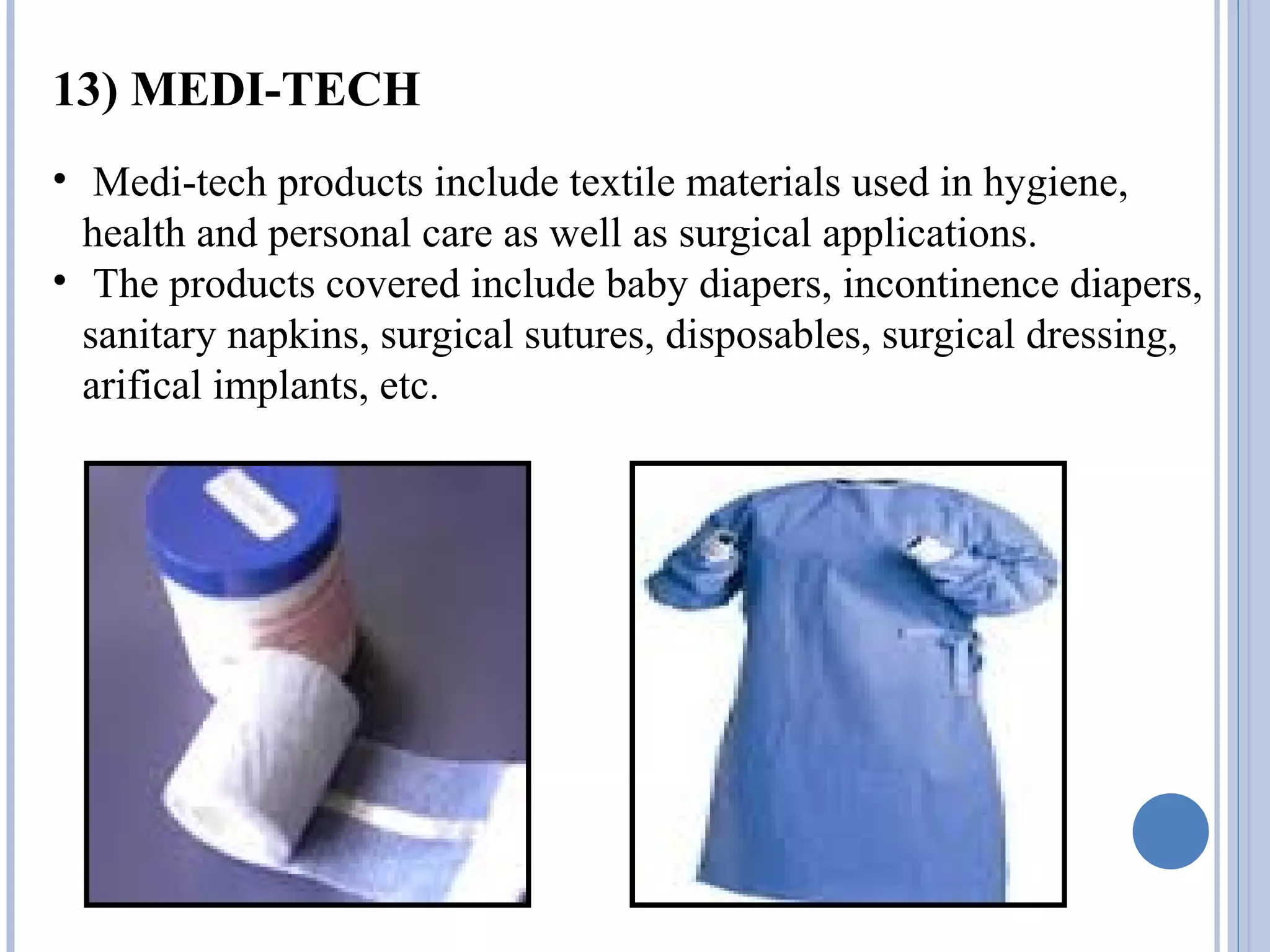
13) MEDI-TECH
• Medi-tech products include textile materials used in hygiene,
health and personal care as well as surgical applications.
• The products covered include baby diapers, incontinence diapers,
sanitary napkins, surgical sutures, disposables, surgical dressing,
arifical implants, etc.
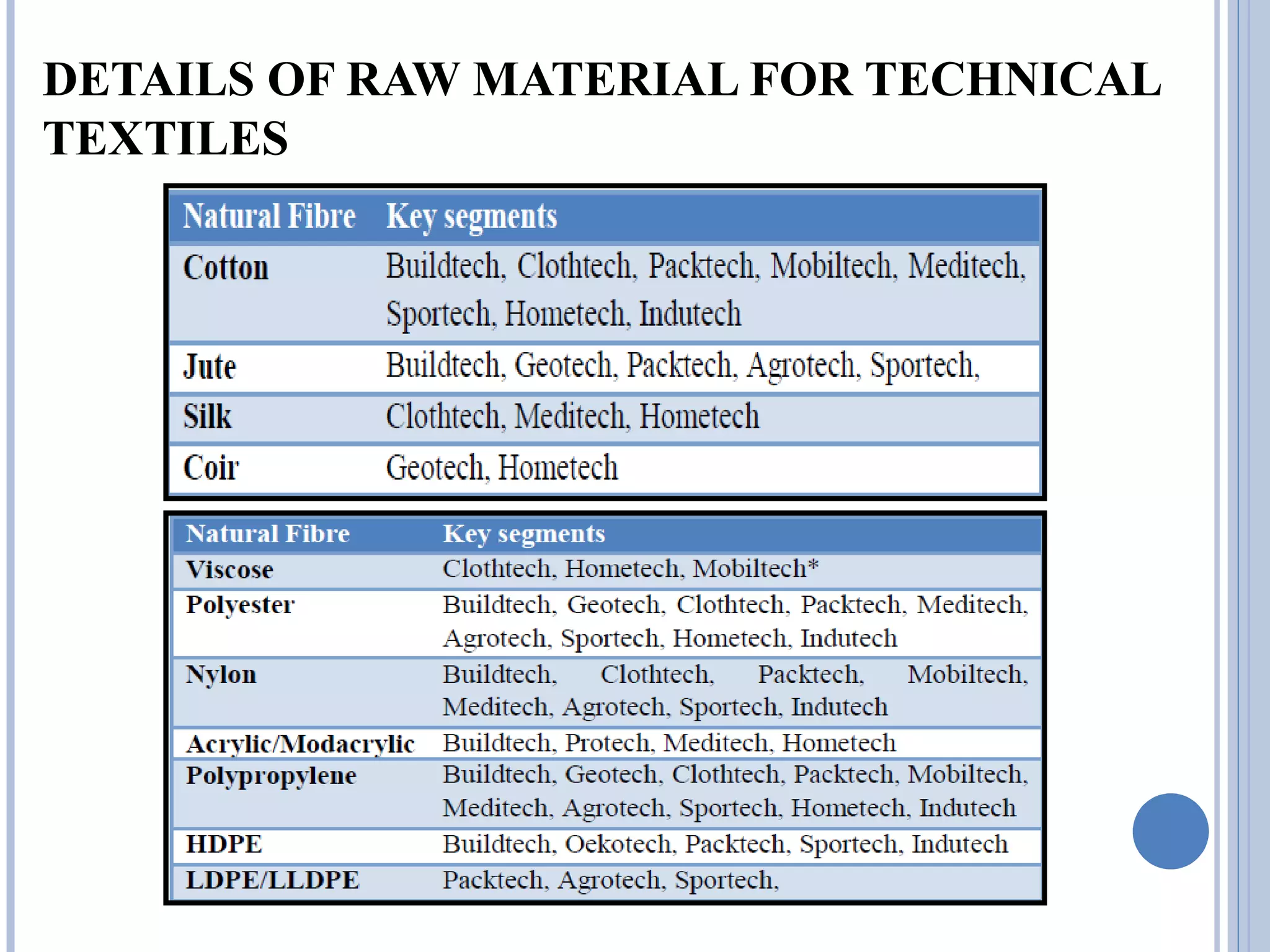
DETAILS OF RAW MATERIAL FOR TECHNICAL
TEXTILES
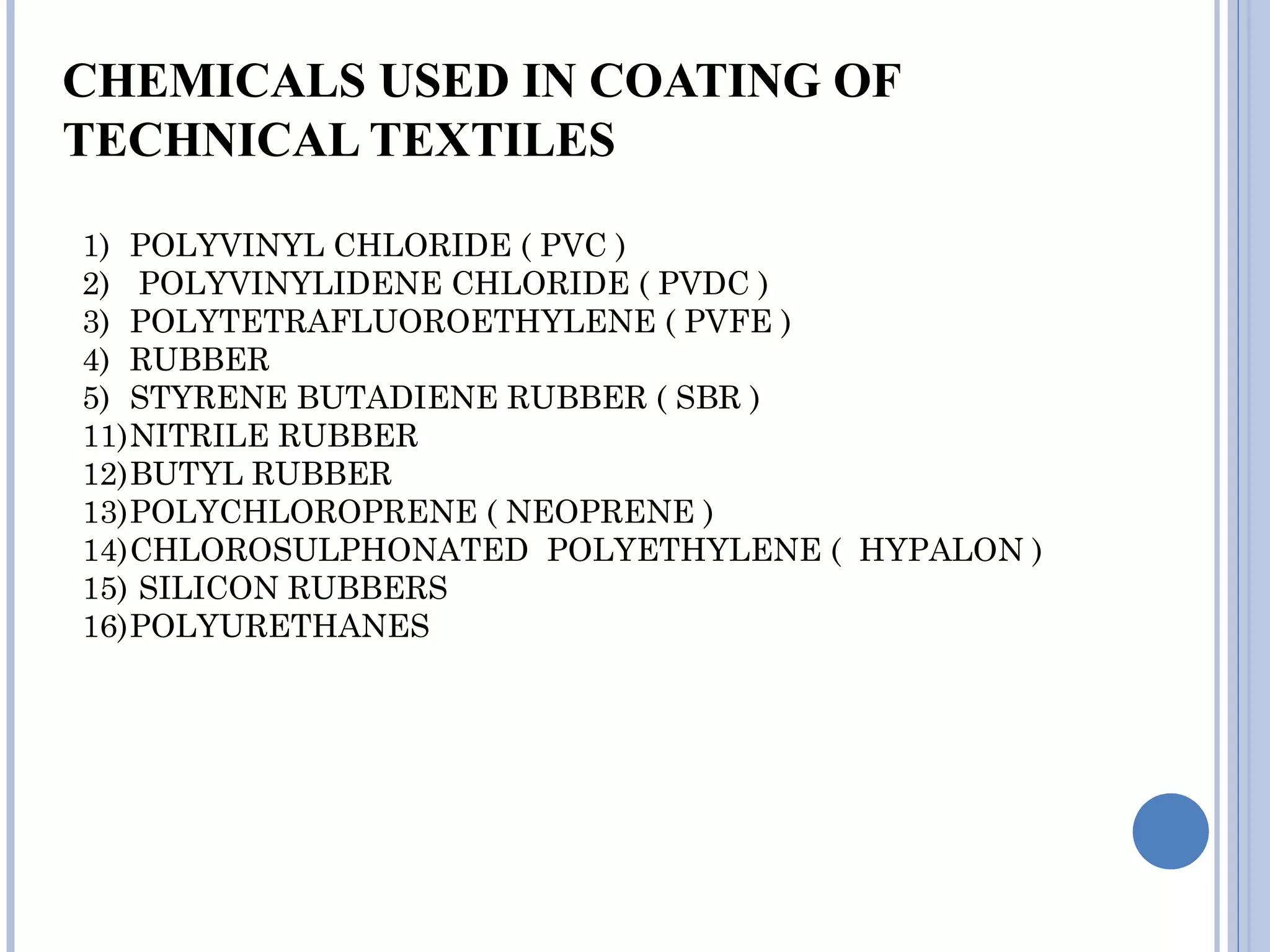
CHEMICALS USED IN COATING OF
TECHNICAL TEXTILES
1) POLYVINYL CHLORIDE ( PVC )
2) POLYVINYLIDENE CHLORIDE ( PVDC )
3) POLYTETRAFLUOROETHYLENE ( PVFE )
4) RUBBER
5) STYRENE BUTADIENE RUBBER ( SBR )
11)NITRILE RUBBER
12)BUTYL RUBBER
13)POLYCHLOROPRENE ( NEOPRENE )
14)CHLOROSULPHONATED POLYETHYLENE ( HYPALON )
15) SILICON RUBBERS
16)POLYURETHANES
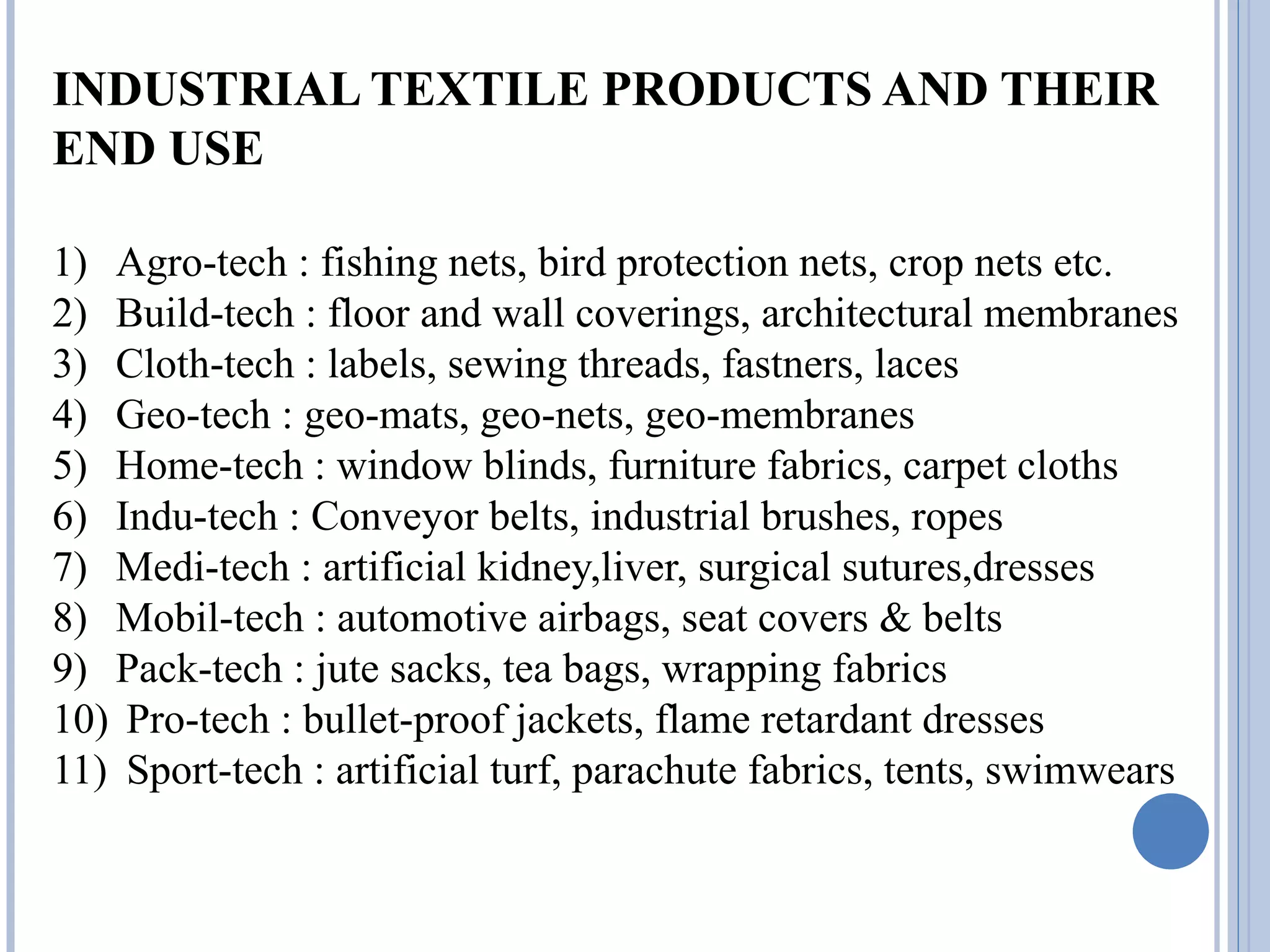
INDUSTRIAL TEXTILE PRODUCTS AND THEIR
END USE
1) Agro-tech : fishing nets, bird protection nets, crop nets etc.
2) Build-tech : floor and wall coverings, architectural membranes
3) Cloth-tech : labels, sewing threads, fastners, laces
4) Geo-tech : geo-mats, geo-nets, geo-membranes
5) Home-tech : window blinds, furniture fabrics, carpet cloths
6) Indu-tech : Conveyor belts, industrial brushes, ropes
7) Medi-tech : artificial kidney,liver, surgical sutures,dresses
8) Mobil-tech : automotive airbags, seat covers & belts
9) Pack-tech : jute sacks, tea bags, wrapping fabrics
10) Pro-tech : bullet-proof jackets, flame retardant dresses
11) Sport-tech : artificial turf, parachute fabrics, tents, swimwears
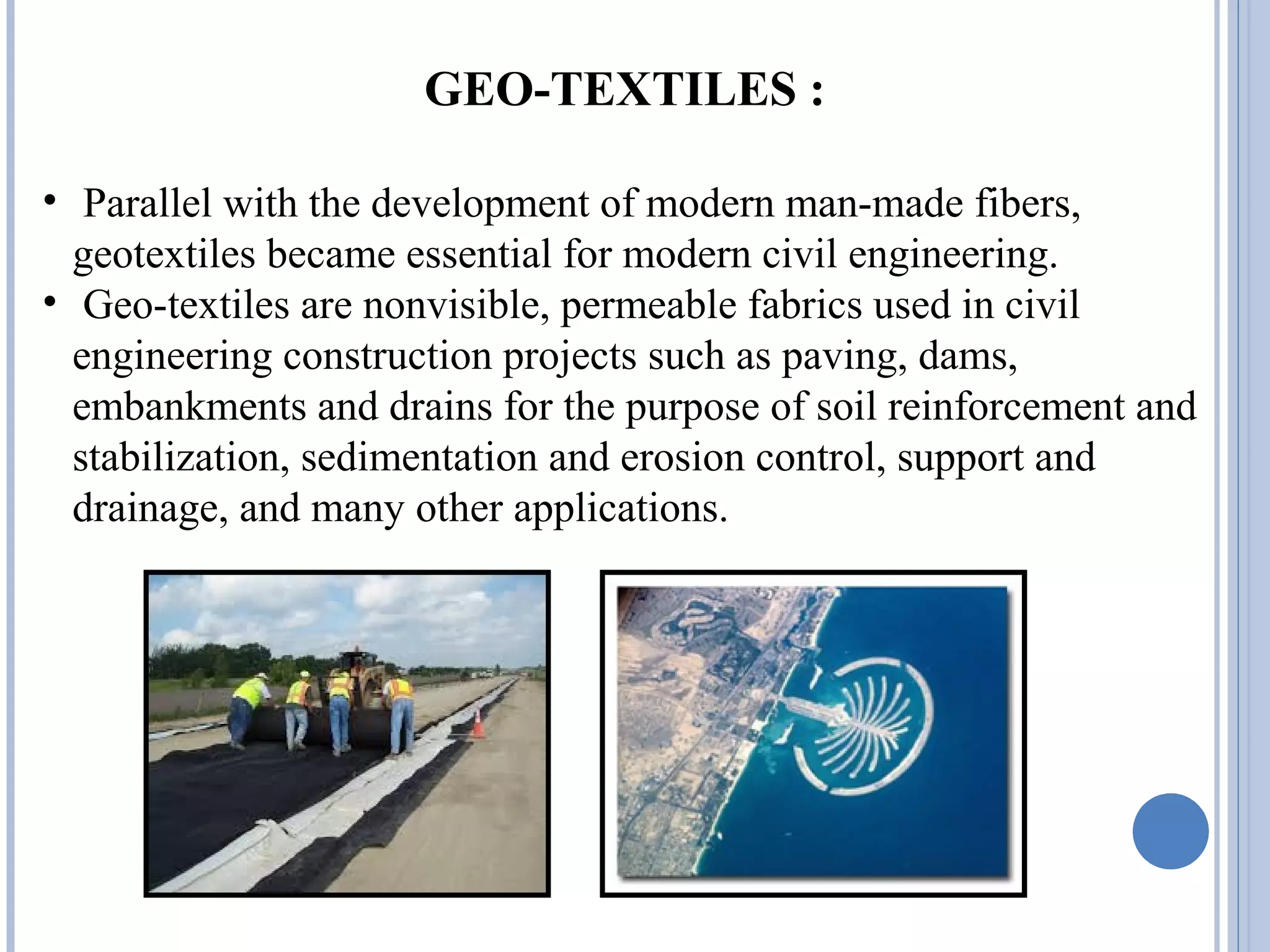
GEO-TEXTILES :
• Parallel with the development of modern man-made fibers,
geotextiles became essential for modern civil engineering.
• Geo-textiles are nonvisible, permeable fabrics used in civil
engineering construction projects such as paving, dams,
embankments and drains for the purpose of soil reinforcement and
stabilization, sedimentation and erosion control, support and
drainage, and many other applications.
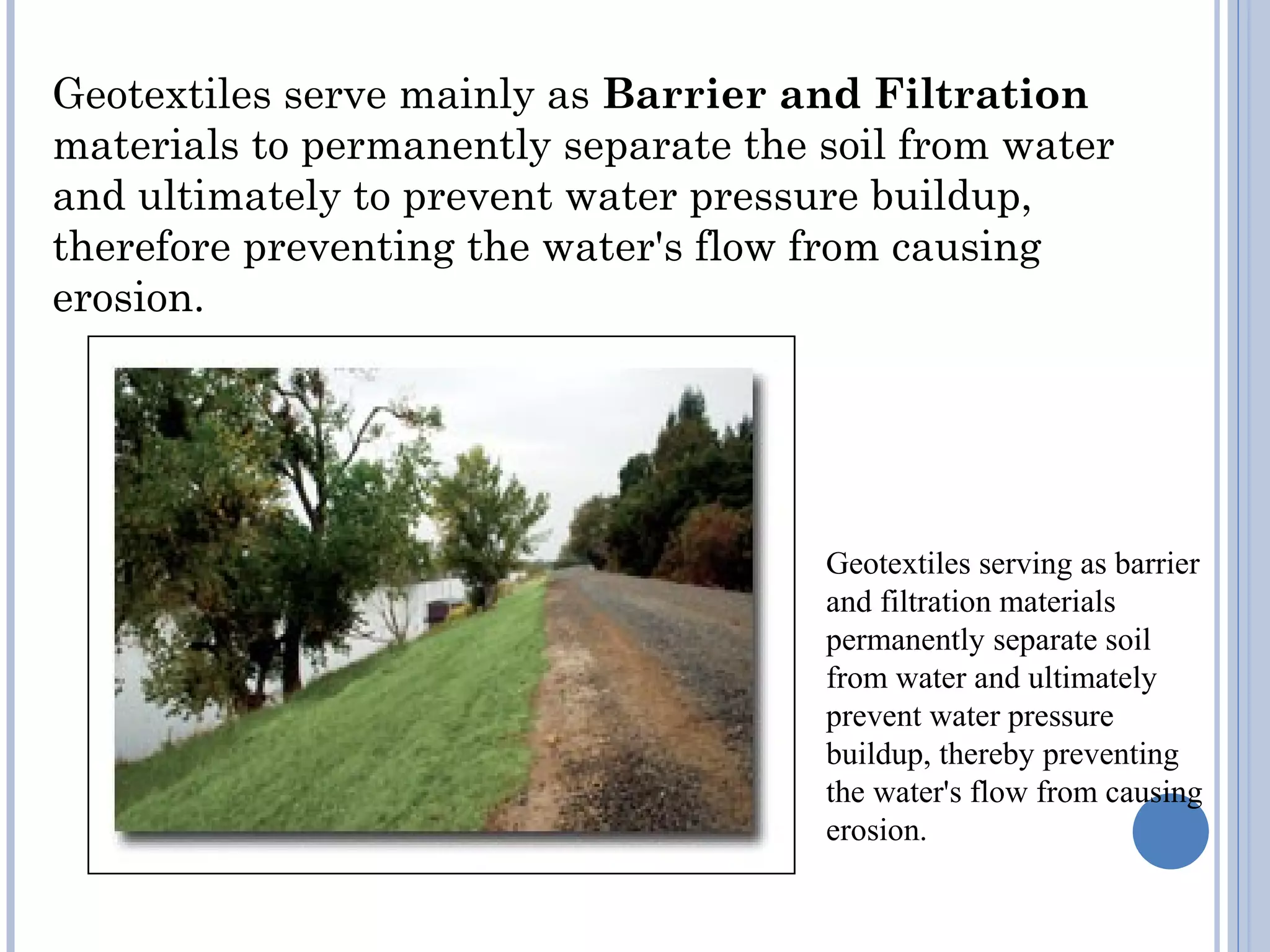
Geotextiles serve mainly as Barrier and Filtration
materials to permanently separate the soil from water
and ultimately to prevent water pressure buildup,
therefore preventing the water's flow from causing
erosion.
Geotextiles serving as barrier
and filtration materials
permanently separate soil
from water and ultimately
prevent water pressure
buildup, thereby preventing
the water's flow from causing
erosion.
Geotextiles may be used in place of soil nailing as an
effective and less expensive Reinforcement of slopes,
retaining walls or excavated areas. Such reinforcement
allows for landscaping of steep slopes, for example, to
enhance aesthetic value.
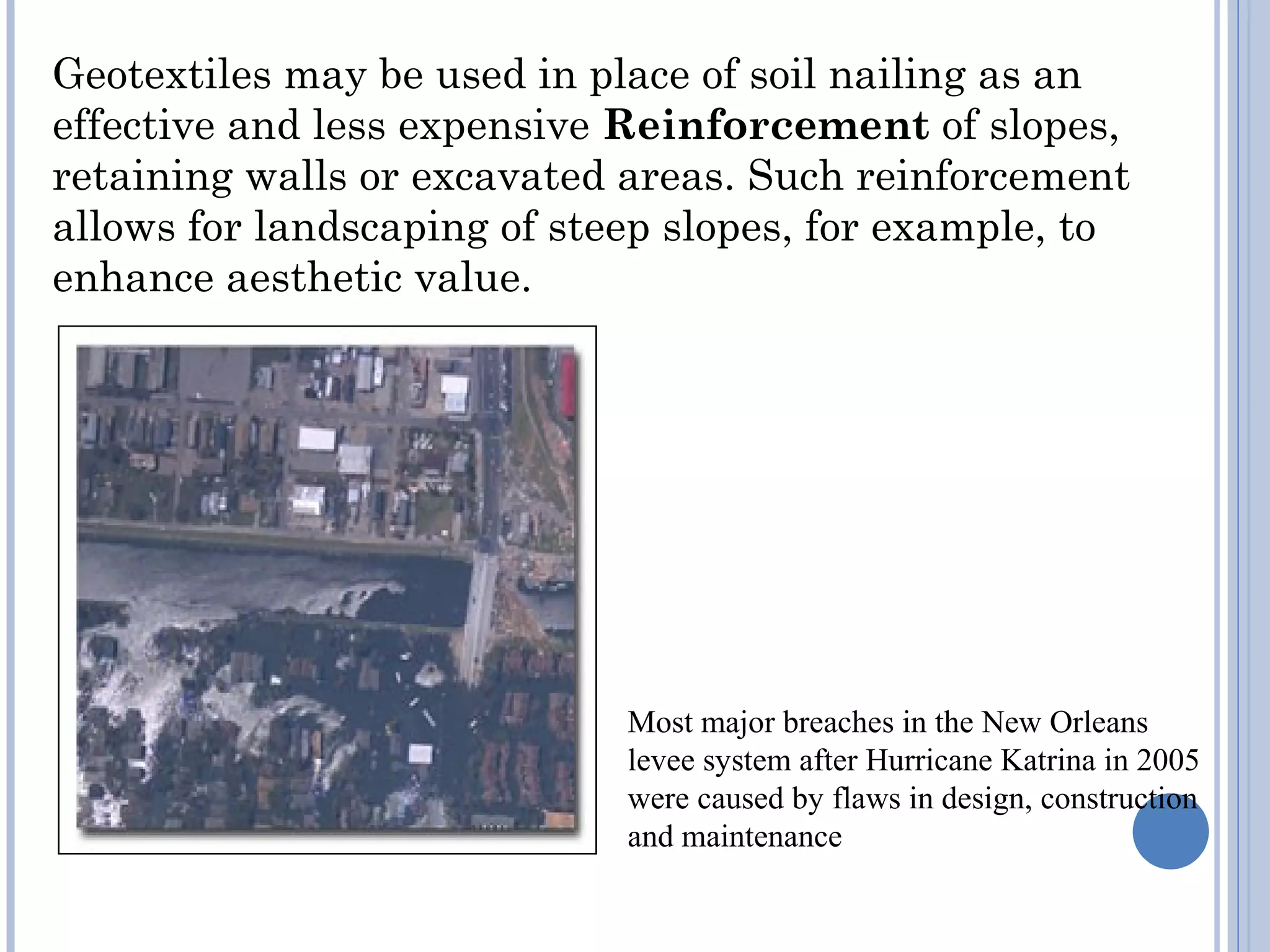
Most major breaches in the New Orleans
levee system after Hurricane Katrina in 2005
were caused by flaws in design, construction
and maintenance
The main man-made polymer materials used to make geotextiles
are polypropylene and polyester, but for some applications, natural
fibers such as coir or jute are used.
Ideally, vegetation can provide the best erosion control, but this
may be difficult to establish. The use of hydroseeding or seed-
impregnated fabric can be an effective method to establish
vegetation.
Different fibers will degrade at different rates - for example, coir
geotextiles degrade in two to three years, and jute in one to two
years. Coir is therefore useful in situations where vegetation will
take longer to establish, and jute is useful in low-rainfall areas
because it absorbs more moisture.
AGRICULTURALAPPLICATIONS OF GEO-
TEXTILES
Geotextiles are tailor-made products, and the list of applications is
never-ending. Here are some examples in which geotextiles are in
use for agricultural purposes:
• crop covers;
• plant protection;
• seed blankets;
• weed-control fabrics;
• biodegradable plant pots;
• capillary matting;
• landscape fabric; and
• protection from frost and insects.
NANO-TEXTILES
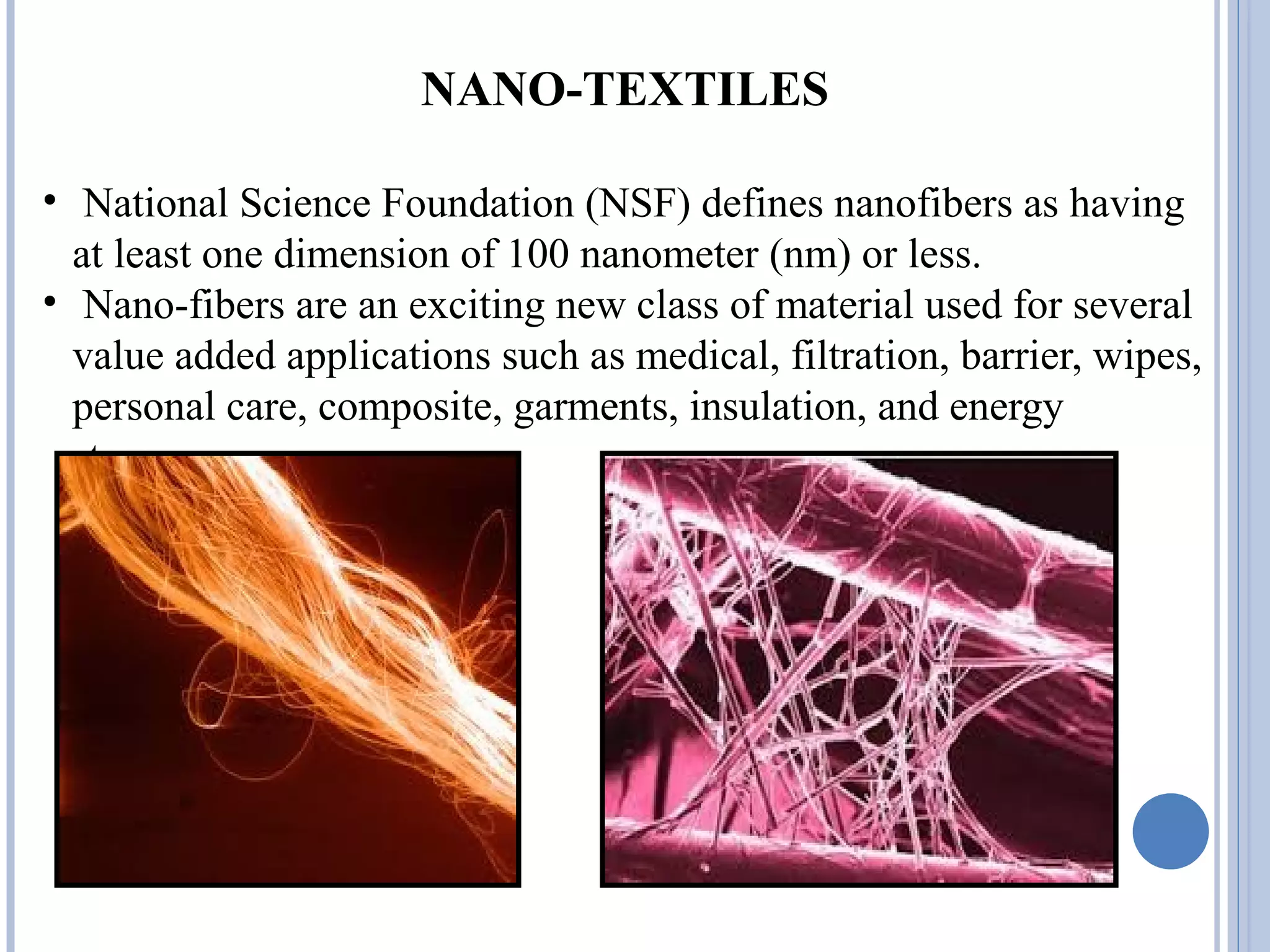
• National Science Foundation (NSF) defines nanofibers as having
at least one dimension of 100 nanometer (nm) or less.
• Nano-fibers are an exciting new class of material used for several
value added applications such as medical, filtration, barrier, wipes,
personal care, composite, garments, insulation, and energy
storage.
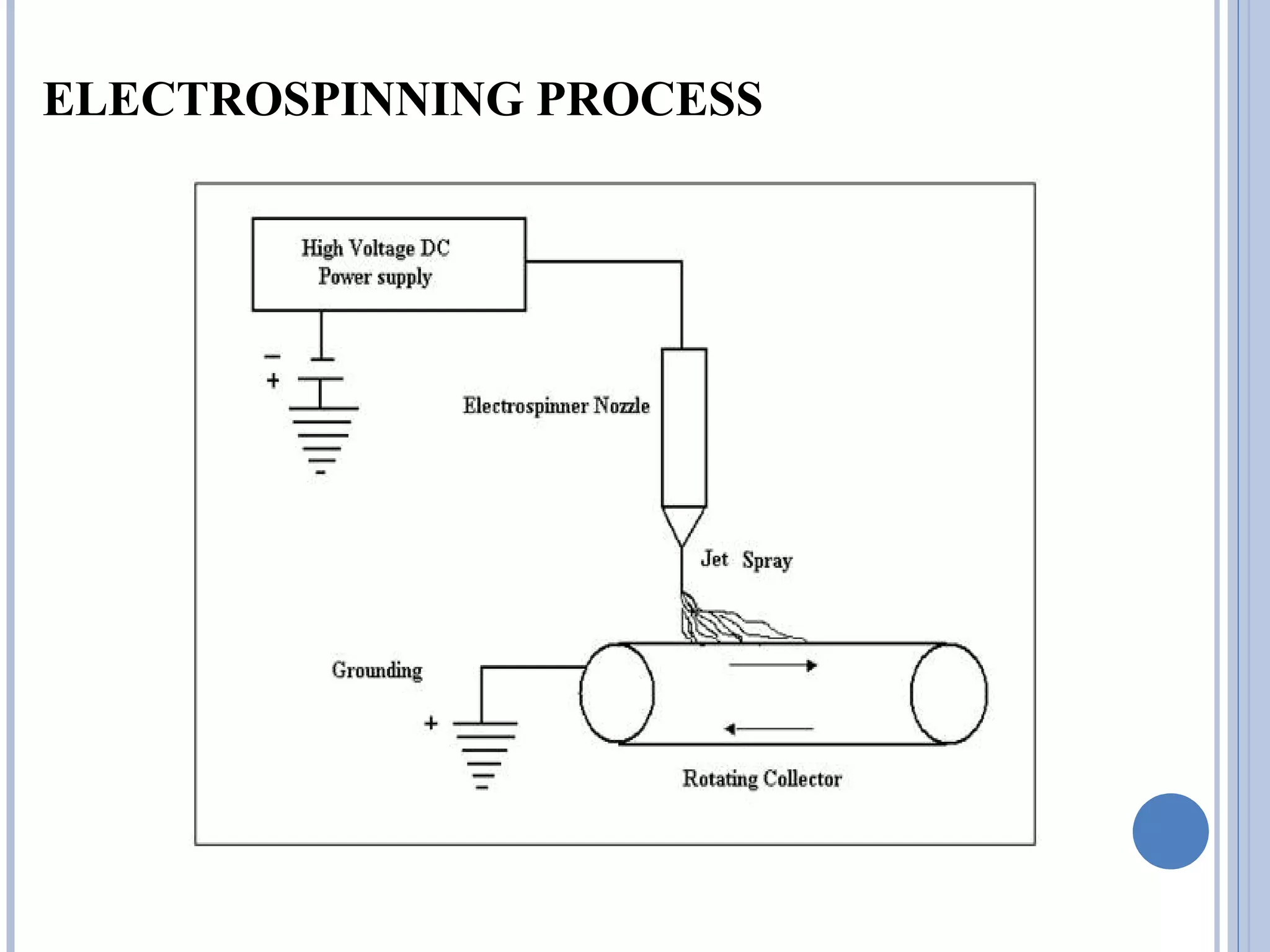
ELECTROSPINNING PROCESS
PROPERTIES OF NANO FIBERS
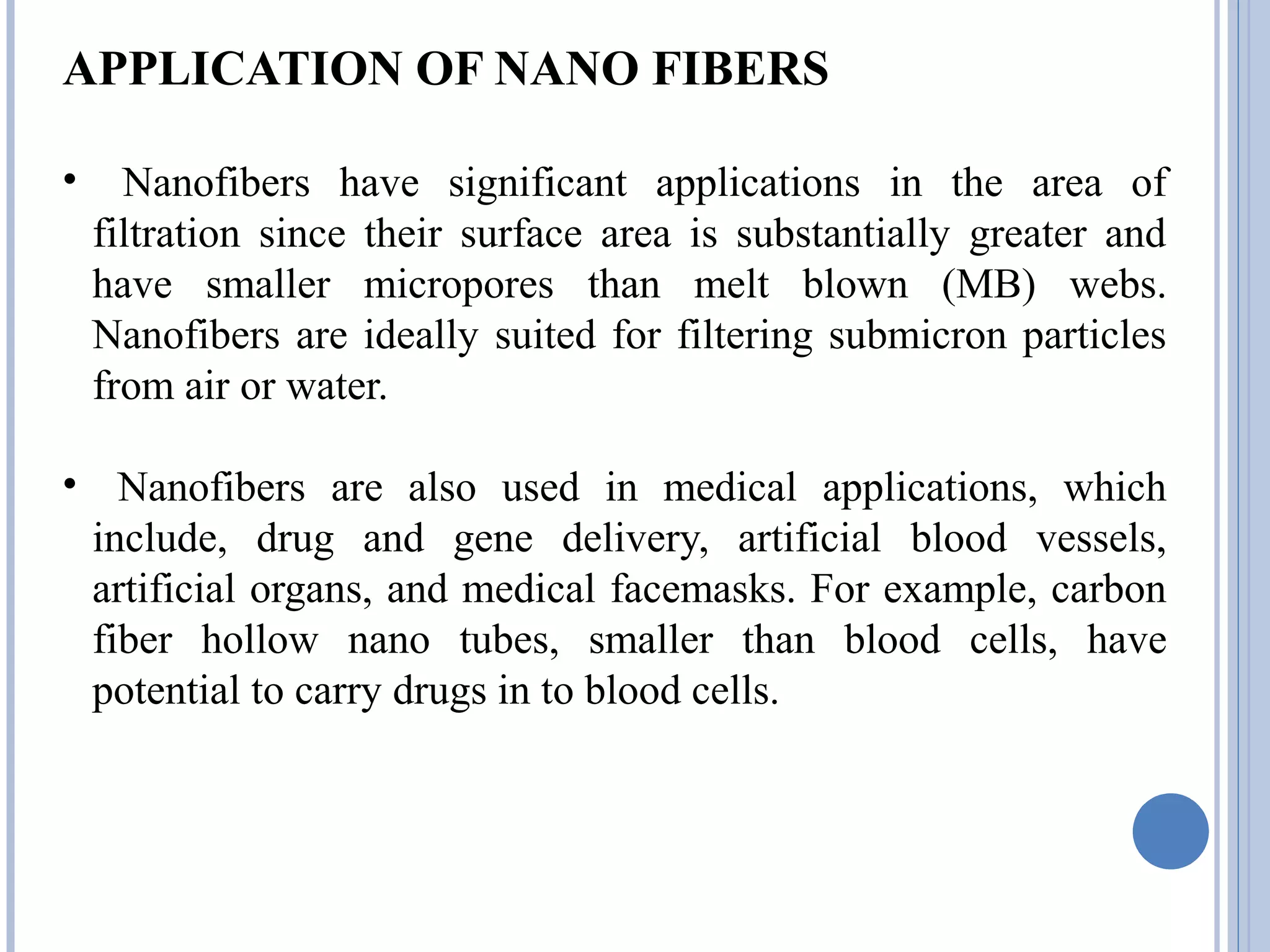
1. Nanofibers exhibit special properties mainly due to extremely
high surface to weight ratio compared to conventional nonwovens.
2. Low density, large surface area to mass, high pore volume, and
tight pore size make the nanofiber nonwoven appropriate for a wide
range of filtration applications
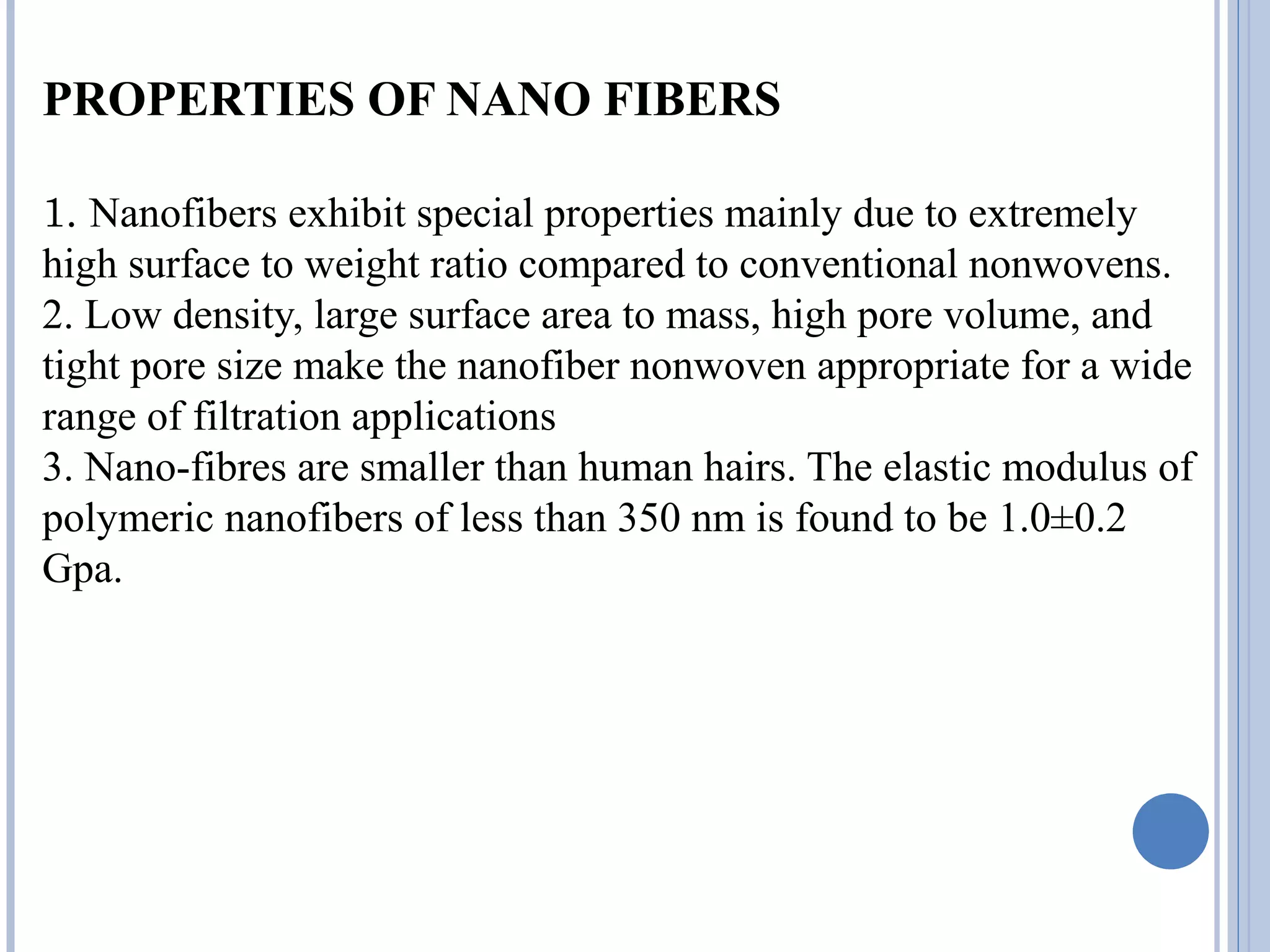
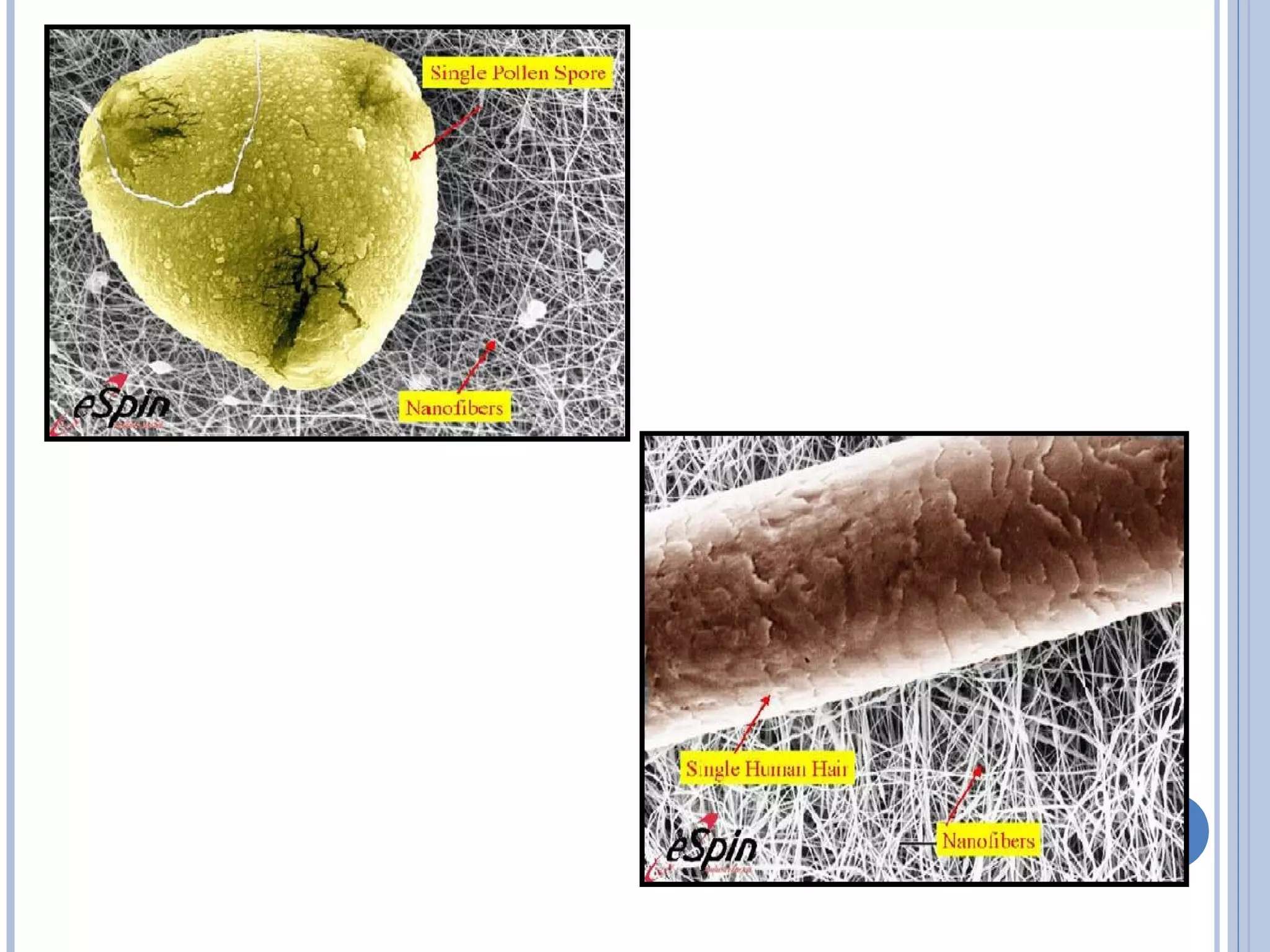
3. Nano-fibres are smaller than human hairs. The elastic modulus of
polymeric nanofibers of less than 350 nm is found to be 1.0±0.2
Gpa.
APPLICATION OF NANO FIBERS
• Nanofibers have significant applications in the area of
filtration since their surface area is substantially greater and
have smaller micropores than melt blown (MB) webs.
Nanofibers are ideally suited for filtering submicron particles
from air or water.
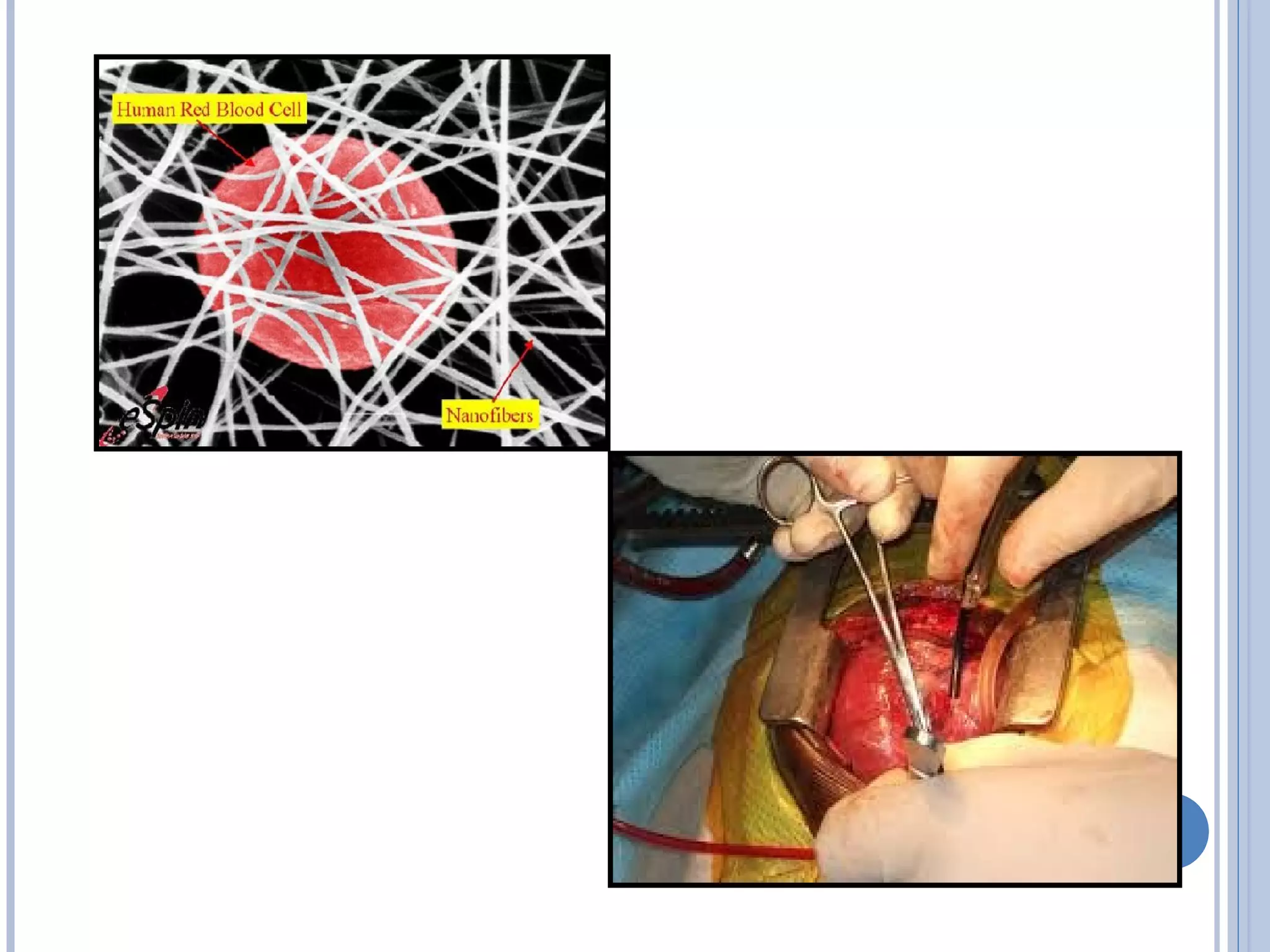
• Nanofibers are also used in medical applications, which
include, drug and gene delivery, artificial blood vessels,
artificial organs, and medical facemasks. For example, carbon
fiber hollow nano tubes, smaller than blood cells, have
potential to carry drugs in to blood cells.
CHALLENGES IN NANO FIBERS
• Economics
• Health hazards
• Solvent vapor
• Packaging shipping handling
3D BRAIDED FABRICS
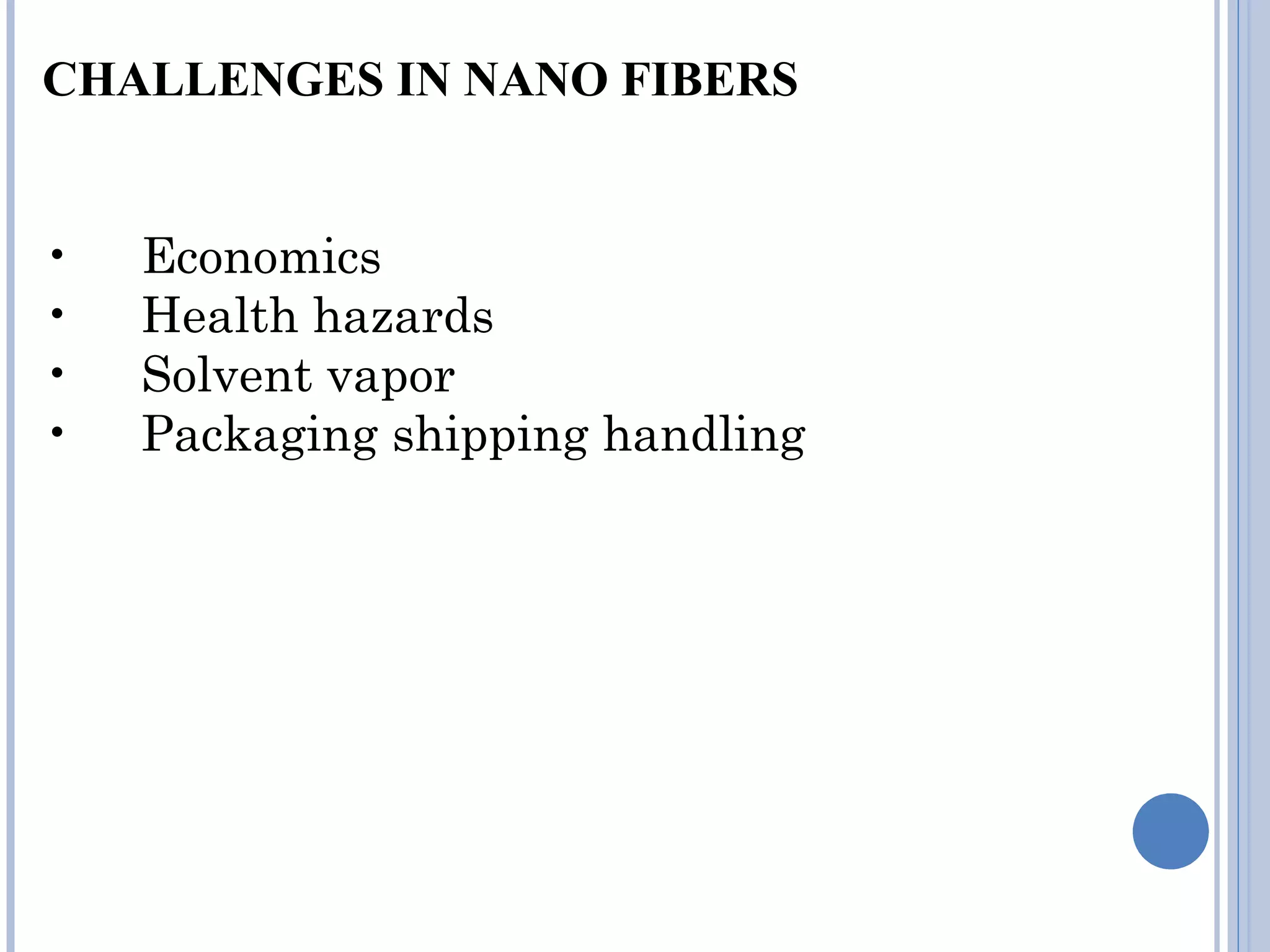
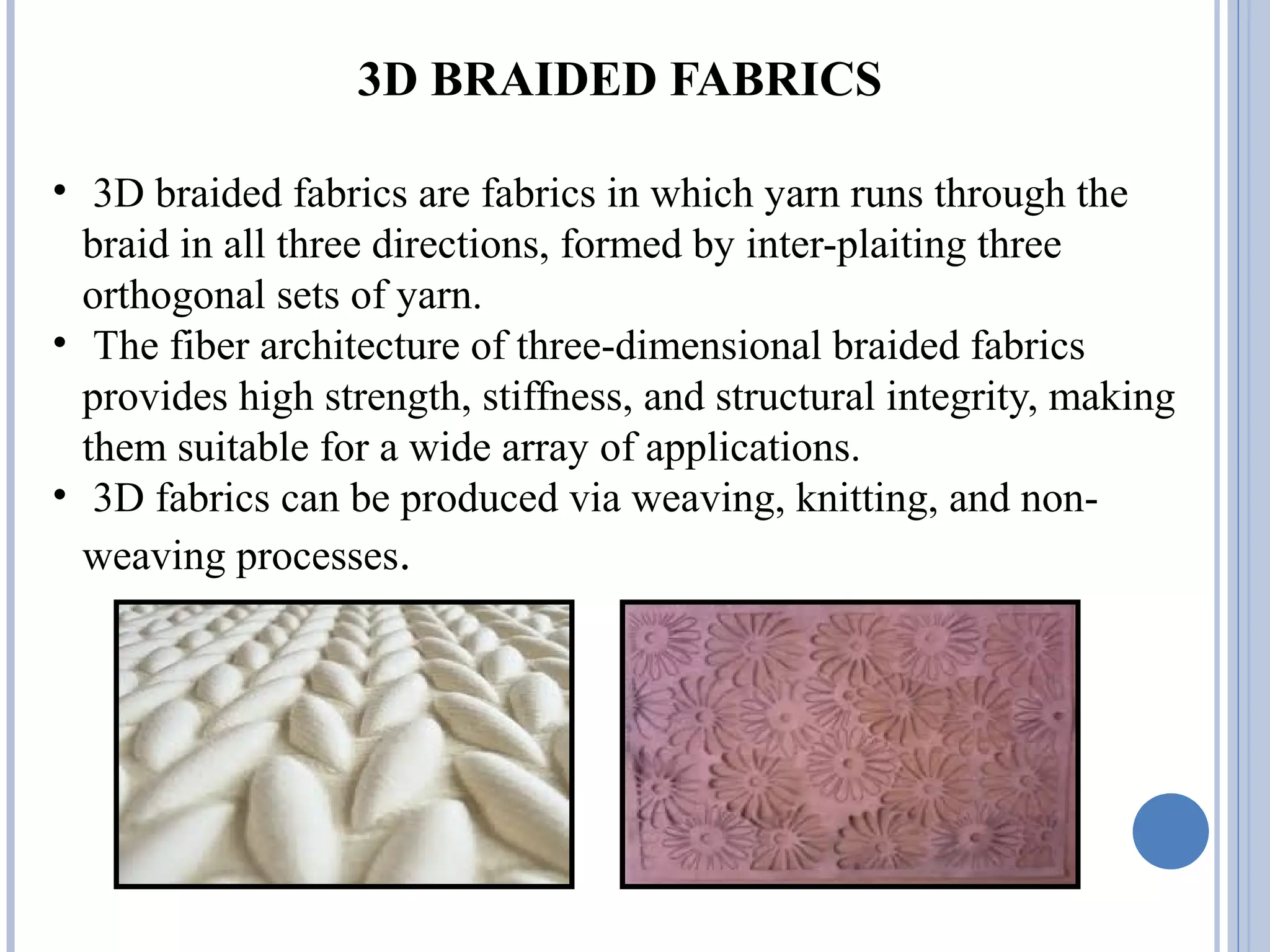
• 3D braided fabrics are fabrics in which yarn runs through the
braid in all three directions, formed by inter-plaiting three
orthogonal sets of yarn.
• The fiber architecture of three-dimensional braided fabrics
provides high strength, stiffness, and structural integrity, making
them suitable for a wide array of applications.
• 3D fabrics can be produced via weaving, knitting, and non-
weaving processes.
MANUFACTURING PROCESS
• A track plate is kept at the bottom of the machine.
• Packages, which supply axial yarns, are kept beneath the track
plate.
• Bobbins are mounted on the carrier, which moves over the track
plate.
• Braiding yarns are fed from these bobbins.
• The relative motion of the braiding yarns and the axial yarn
determines the pattern and the micro-structure of the braid.
• The 3D braiding process is a minor modification of 2D braiding
process in which the standing ends are added to the braiding
yarns that are moving.
PROPERTIES :
• 3D braids show improved mechanical and structural properties.
• An important characteristic of 3D braids is their ability to form
a variety of complex shapes
• 3D braided fabrics have high torsional stability and structural
integrity.
APPLICATION OF 3D FIBRICS :
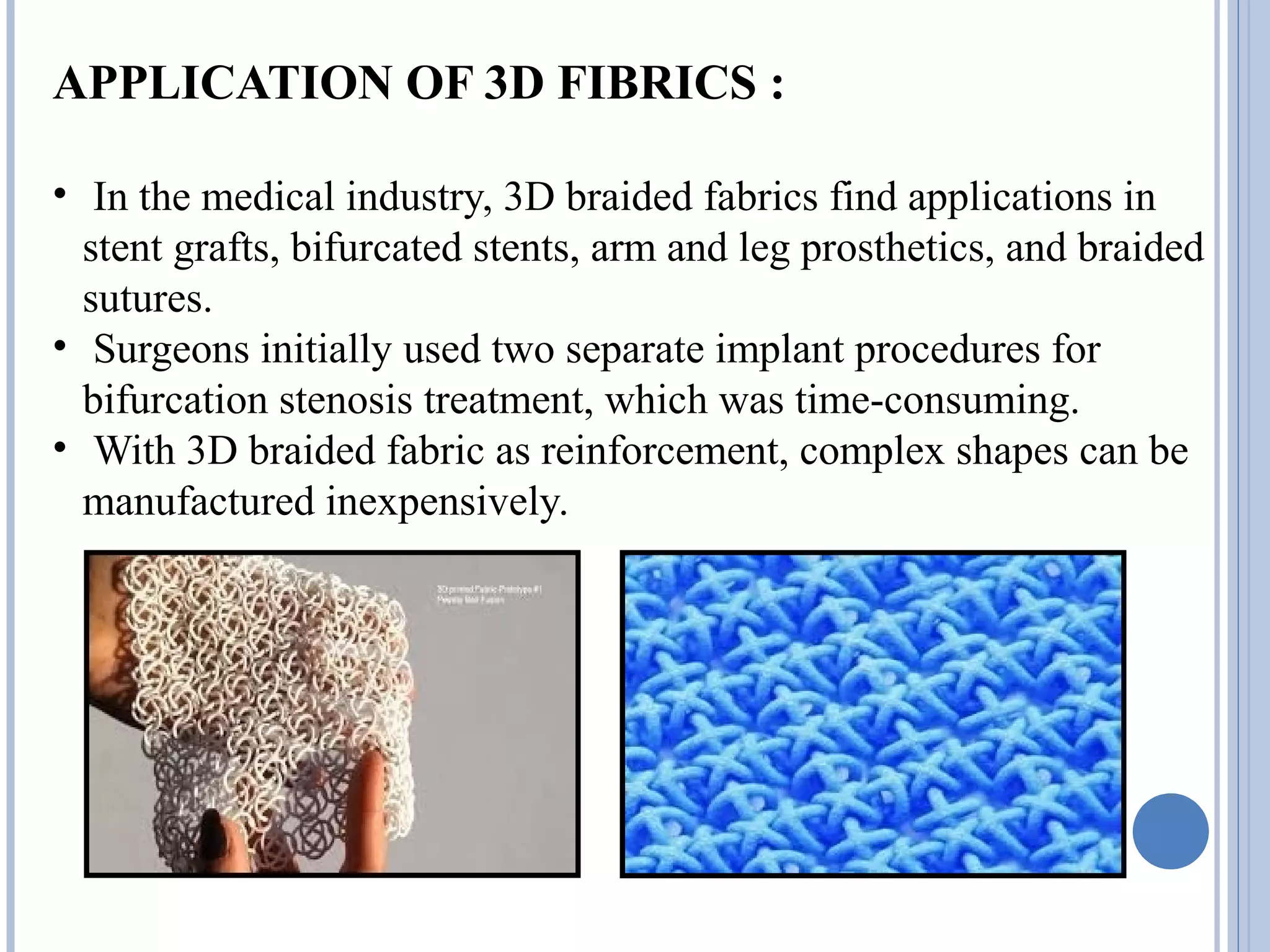
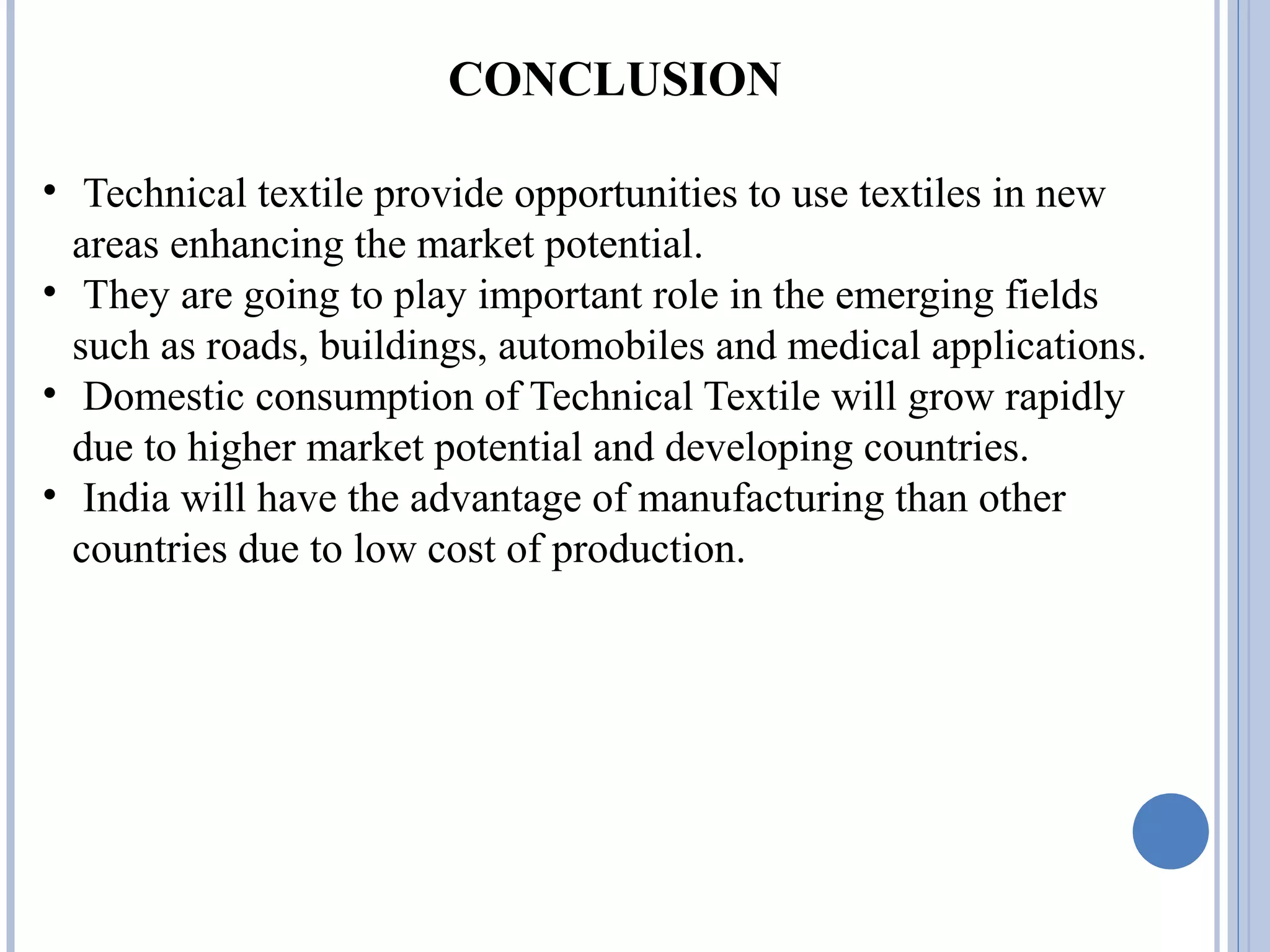
• In the medical industry, 3D braided fabrics find applications in
stent grafts, bifurcated stents, arm and leg prosthetics, and braided
sutures.
• Surgeons initially used two separate implant procedures for
bifurcation stenosis treatment, which was time-consuming.
• With 3D braided fabric as reinforcement, complex shapes can be
manufactured inexpensively.
CONCLUSION
• Technical textile provide opportunities to use textiles in new
areas enhancing the market potential.
• They are going to play important role in the emerging fields
such as roads, buildings, automobiles and medical applications.
• Domestic consumption of Technical Textile will grow rapidly
due to higher market potential and developing countries.
• India will have the advantage of manufacturing than other
countries due to low cost of production.
THANK YOU !

Technical textiles and their applications

  • 1.
    TECHNICAL TEXTILES ANDITS APPLICATIONS GUIDED BY PREPARED BY DR. KAVITA PATIL SAYALI S. BHAMARE VICE PRINCIPAL AND T.Y. B.SC HOD Of TSAD
  • 2.
    INTRODUCTION : • Atechnical textile is a textile product manufactured for non- aesthetic purposes, where function is the primary criterion. • Other terms used for defining technical textile include industrial textile, functional textile, performance textile, engineering textile, smart textiles and hi-tech textiles.
  • 4.
    CLASSIFICATION : 1. Agro-tech 2.Build-tech 3. Cloth-tech 4. Geo-tech 5. Home-tech 6. Indu-tech 7. Lifting textiles 8. Mobil-tech 9. Oeko-tech 10. Pack-tech 11. Pro-tech 12. Sport-tech 13. Medi-tech
  • 5.
    1) AGRO-TECH •) Textilesused in agriculture are termed as Agro-textiles •) The essential properties are strength, elongation, stiffness and bio-degradation, resistance to sunlight, resistance to toxic environment. •) All these properties help with the growth and harvesting of crops and other foodstuffs.
  • 6.
    2) BUILD-TECH • Textilesused in construction - concrete reinforcement, interior construction, insulations, proofing materials, air conditioning, noise prevention, visual protection, protection against the sun, building safety. • PVC coated high tenacity PES, teflon coated glass fibre fabrics or silicone coated PES are used for their low creep properties.
  • 7.
    3) CLOTH-TECH • Technicaltextiles used for clothing applications. • Especially in the finishing process where fabric is treated under pressure and high temperature the technical textile supports the fabric for smooth processing. • This is usually the blend of Polyester,Modal,Viscose,Nylon,etc.
  • 8.
    4) GEO-TECH • Theapplication areas include civil engineering, earth and road construction, dam engineering, soil sealing and in drainage systems. • The fabric used in it must have good strength, durability, low moisture absorption and thickness. • Polypropylene and polyester are used in geo textiles and dry/liquid filtration due to their compatibility.
  • 9.
    5) HOME-TECH • Textilesused in a domestic environment - interior decoration and furniture, carpeting, protection against the sun, cushion materials, fireproofing, floor and wall coverings. • In the contract market such as for large area buildings, ships, caravans, busses, fire retardant materials are used like modacrylic.
  • 10.
    6) INDU-TECH • Textilesused for chemical and electrical applications and textiles related to mechanical engineering. • Silk-screen printing, filtration, plasma screens, propulsion technology, lifting/conveying equipment, sound-proofing elements, melting processes, roller covers, grinding technology, insulations, seals, fuel cell.
  • 11.
    7) LIFTING TEXTILES •Used in process of lifting heavy goods. • The textile produced is strongly woven with High tenacity yarns and the fabric is treated with heat and high temperature controlling its elongations. • This is usually made of High tenacity polyester and Nylon.
  • 12.
    8) MOBIL-TECH • Thesetextiles are used in the construction of automobiles, railways, ships, aircraft and spacecraft. • A number of materials are also used in the interior of cars, truck covers, coated car trunk coverings, lashing belts for cargo tie downs, seat covers, seat belts, non-wovens for cabin air filtration, airbags, parachutes, boats, air balloons.
  • 13.
    9) OEKOTECH ORECOTECH • New applications for textiles in environmental protection applications - floor sealing, erosion protection, air cleaning, prevention of water pollution, water cleaning, waste treatment/recycling, depositing area construction, product extraction, domestic water sewerage plants.
  • 14.
    10) PACK-TECH • Pack-techincludes several flexible packaging materials used for industrial, agricultural, consumer and other goods. • It ranges from synthetic bags used for industrial packaging to jute sacks used for packing food grains.
  • 15.
    11) PRO-TECH (PROTECTIVE TEXTILES ) : • The main target of the technical protective fabrics is to improve people safety in their workplaces. • The aim of a technical protective fabric isn't fashion, they are designed to have extra values in protection, against some hazards. • Nowadays it can be found in the market, technical fabrics which protect of : - High temperatures (insulating, firefighters) - Burns (flame, convective and radiant heat, firefighters, ATEX area) - Metal sparks (welding) - Acid environment (petrochemical, gas, refineries, chemical) - Bullet impact (military, security) - Cut resistant (gloves, glass industry) - Astronaut's suits
  • 17.
    12) SPORT-TECH (SPORT TEXTILES ) : • Textiles used in the sports and leisure industries have diverse applications ranging from artificial turf used in sports surfaces to advanced carbon fibre composites for racquet frames, fishing rods, golf clubs and cycle frames. • Sport-tech products include sports composites, artificial turf, parachute fabrics, ballooning fabrics, sail cloth, sleeping bags, sport nets, sport shoes components, tents, swimwear etc.
  • 18.
    13) MEDI-TECH • Medi-techproducts include textile materials used in hygiene, health and personal care as well as surgical applications. • The products covered include baby diapers, incontinence diapers, sanitary napkins, surgical sutures, disposables, surgical dressing, arifical implants, etc.
  • 19.
    DETAILS OF RAWMATERIAL FOR TECHNICAL TEXTILES
  • 20.
    CHEMICALS USED INCOATING OF TECHNICAL TEXTILES 1) POLYVINYL CHLORIDE ( PVC ) 2) POLYVINYLIDENE CHLORIDE ( PVDC ) 3) POLYTETRAFLUOROETHYLENE ( PVFE ) 4) RUBBER 5) STYRENE BUTADIENE RUBBER ( SBR ) 11)NITRILE RUBBER 12)BUTYL RUBBER 13)POLYCHLOROPRENE ( NEOPRENE ) 14)CHLOROSULPHONATED POLYETHYLENE ( HYPALON ) 15) SILICON RUBBERS 16)POLYURETHANES
  • 21.
    INDUSTRIAL TEXTILE PRODUCTSAND THEIR END USE 1) Agro-tech : fishing nets, bird protection nets, crop nets etc. 2) Build-tech : floor and wall coverings, architectural membranes 3) Cloth-tech : labels, sewing threads, fastners, laces 4) Geo-tech : geo-mats, geo-nets, geo-membranes 5) Home-tech : window blinds, furniture fabrics, carpet cloths 6) Indu-tech : Conveyor belts, industrial brushes, ropes 7) Medi-tech : artificial kidney,liver, surgical sutures,dresses 8) Mobil-tech : automotive airbags, seat covers & belts 9) Pack-tech : jute sacks, tea bags, wrapping fabrics 10) Pro-tech : bullet-proof jackets, flame retardant dresses 11) Sport-tech : artificial turf, parachute fabrics, tents, swimwears
  • 22.
    GEO-TEXTILES : • Parallelwith the development of modern man-made fibers, geotextiles became essential for modern civil engineering. • Geo-textiles are nonvisible, permeable fabrics used in civil engineering construction projects such as paving, dams, embankments and drains for the purpose of soil reinforcement and stabilization, sedimentation and erosion control, support and drainage, and many other applications.
  • 23.
    Geotextiles serve mainlyas Barrier and Filtration materials to permanently separate the soil from water and ultimately to prevent water pressure buildup, therefore preventing the water's flow from causing erosion. Geotextiles serving as barrier and filtration materials permanently separate soil from water and ultimately prevent water pressure buildup, thereby preventing the water's flow from causing erosion.
  • 24.
    Geotextiles may beused in place of soil nailing as an effective and less expensive Reinforcement of slopes, retaining walls or excavated areas. Such reinforcement allows for landscaping of steep slopes, for example, to enhance aesthetic value. Most major breaches in the New Orleans levee system after Hurricane Katrina in 2005 were caused by flaws in design, construction and maintenance
  • 25.
    The main man-madepolymer materials used to make geotextiles are polypropylene and polyester, but for some applications, natural fibers such as coir or jute are used. Ideally, vegetation can provide the best erosion control, but this may be difficult to establish. The use of hydroseeding or seed- impregnated fabric can be an effective method to establish vegetation. Different fibers will degrade at different rates - for example, coir geotextiles degrade in two to three years, and jute in one to two years. Coir is therefore useful in situations where vegetation will take longer to establish, and jute is useful in low-rainfall areas because it absorbs more moisture.
  • 26.
    AGRICULTURALAPPLICATIONS OF GEO- TEXTILES Geotextilesare tailor-made products, and the list of applications is never-ending. Here are some examples in which geotextiles are in use for agricultural purposes: • crop covers; • plant protection; • seed blankets; • weed-control fabrics; • biodegradable plant pots; • capillary matting; • landscape fabric; and • protection from frost and insects.
  • 27.
    NANO-TEXTILES • National ScienceFoundation (NSF) defines nanofibers as having at least one dimension of 100 nanometer (nm) or less. • Nano-fibers are an exciting new class of material used for several value added applications such as medical, filtration, barrier, wipes, personal care, composite, garments, insulation, and energy storage.
  • 28.
  • 29.
    PROPERTIES OF NANOFIBERS 1. Nanofibers exhibit special properties mainly due to extremely high surface to weight ratio compared to conventional nonwovens. 2. Low density, large surface area to mass, high pore volume, and tight pore size make the nanofiber nonwoven appropriate for a wide range of filtration applications 3. Nano-fibres are smaller than human hairs. The elastic modulus of polymeric nanofibers of less than 350 nm is found to be 1.0±0.2 Gpa.
  • 31.
    APPLICATION OF NANOFIBERS • Nanofibers have significant applications in the area of filtration since their surface area is substantially greater and have smaller micropores than melt blown (MB) webs. Nanofibers are ideally suited for filtering submicron particles from air or water. • Nanofibers are also used in medical applications, which include, drug and gene delivery, artificial blood vessels, artificial organs, and medical facemasks. For example, carbon fiber hollow nano tubes, smaller than blood cells, have potential to carry drugs in to blood cells.
  • 33.
    CHALLENGES IN NANOFIBERS • Economics • Health hazards • Solvent vapor • Packaging shipping handling
  • 34.
    3D BRAIDED FABRICS •3D braided fabrics are fabrics in which yarn runs through the braid in all three directions, formed by inter-plaiting three orthogonal sets of yarn. • The fiber architecture of three-dimensional braided fabrics provides high strength, stiffness, and structural integrity, making them suitable for a wide array of applications. • 3D fabrics can be produced via weaving, knitting, and non- weaving processes.
  • 35.
    MANUFACTURING PROCESS • Atrack plate is kept at the bottom of the machine. • Packages, which supply axial yarns, are kept beneath the track plate. • Bobbins are mounted on the carrier, which moves over the track plate. • Braiding yarns are fed from these bobbins. • The relative motion of the braiding yarns and the axial yarn determines the pattern and the micro-structure of the braid. • The 3D braiding process is a minor modification of 2D braiding process in which the standing ends are added to the braiding yarns that are moving.
  • 37.
    PROPERTIES : • 3Dbraids show improved mechanical and structural properties. • An important characteristic of 3D braids is their ability to form a variety of complex shapes • 3D braided fabrics have high torsional stability and structural integrity.
  • 38.
    APPLICATION OF 3DFIBRICS : • In the medical industry, 3D braided fabrics find applications in stent grafts, bifurcated stents, arm and leg prosthetics, and braided sutures. • Surgeons initially used two separate implant procedures for bifurcation stenosis treatment, which was time-consuming. • With 3D braided fabric as reinforcement, complex shapes can be manufactured inexpensively.
  • 39.
    CONCLUSION • Technical textileprovide opportunities to use textiles in new areas enhancing the market potential. • They are going to play important role in the emerging fields such as roads, buildings, automobiles and medical applications. • Domestic consumption of Technical Textile will grow rapidly due to higher market potential and developing countries. • India will have the advantage of manufacturing than other countries due to low cost of production.
  • 40.