Prepared By : Mazadul Hasan sheshir
ID: 2010000400008
13th Batch (session 2009-2013)
Department : Wet Processing Technology
Email: mazadulhasan@yahoo.com
Blog : www. Textilelab.blogspot.com (visit)
Southeast University
Department Of Textile Engineering
I/A 251,252 Tejgaon Dhaka Bangladesh
Prepared By :
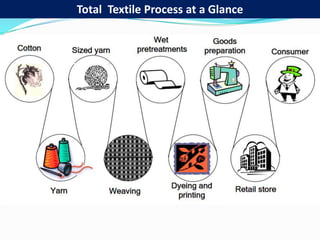
Total Textile Process at a Glance
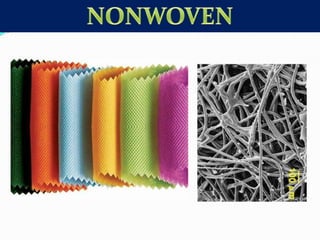
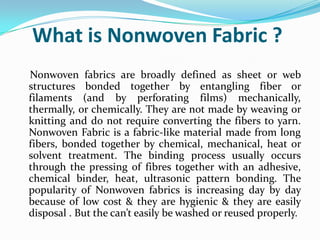
What is Nonwoven Fabric ?
Nonwoven fabrics are broadly defined as sheet or web
structures bonded together by entangling fiber or
filaments (and by perforating films) mechanically,
thermally, or chemically. They are not made by weaving or
knitting and do not require converting the fibers to yarn.
Nonwoven Fabric is a fabric-like material made from long
fibers, bonded together by chemical, mechanical, heat or
solvent treatment. The binding process usually occurs
through the pressing of fibres together with an adhesive,
chemical binder, heat, ultrasonic pattern bonding. The
popularity of Nonwoven fabrics is increasing day by day
because of low cost & they are hygienic & they are easily
disposal . But the can’t easily be washed or reused properly.
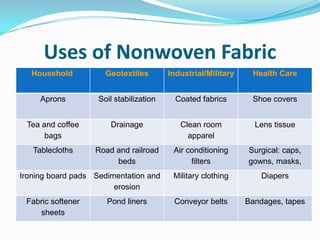
Uses of Nonwoven Fabric
Household Geotextiles Industrial/Military Health Care
Aprons Soil stabilization Coated fabrics Shoe covers
Tea and coffee
bags
Drainage Clean room
apparel
Lens tissue
Tablecloths Road and railroad
beds
Air conditioning
filters
Surgical: caps,
gowns, masks,
Ironing board pads Sedimentation and
erosion
Military clothing Diapers
Fabric softener
sheets
Pond liners Conveyor belts Bandages, tapes
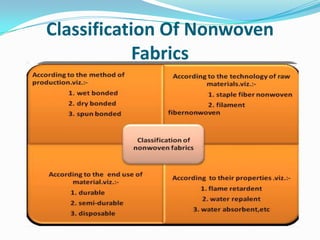
Classification Of Nonwoven
Fabrics
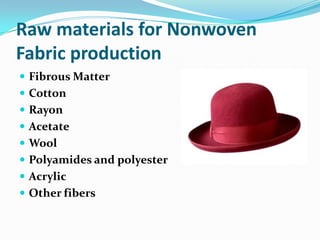
Raw materials for Nonwoven
Fabric production
 Fibrous Matter
 Cotton
 Rayon
 Acetate
 Wool
 Polyamides and polyester
 Acrylic
 Other fibers
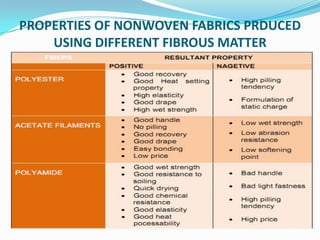
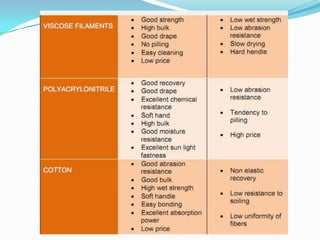
PROPERTIES OF NONWOVEN FABRICS PRDUCED
USING DIFFERENT FIBROUS MATTER
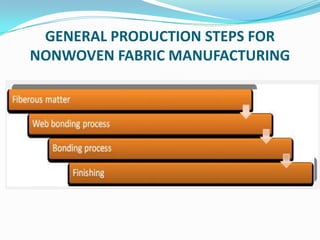
GENERAL PRODUCTION STEPS FOR
NONWOVEN FABRIC MANUFACTURING
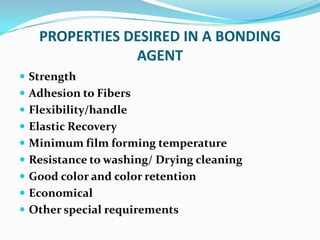
PROPERTIES DESIRED IN A BONDING
AGENT
 Strength
 Adhesion to Fibers
 Flexibility/handle
 Elastic Recovery
 Minimum film forming temperature
 Resistance to washing/ Drying cleaning
 Good color and color retention
 Economical
 Other special requirements
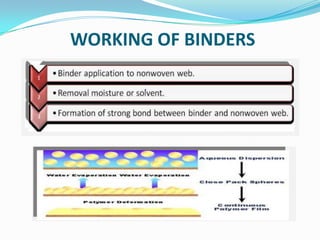
WORKING OF BINDERS
Types Of Binder
 Acrylic
 Styrenated acrylic
 Vinyl Acetate (VAC)
 Vinyl Acrylics
 Ethylene Vinyl Acetate (EVA)
 Polyvinyl Chloride (PVC)
 Ethylene/Vinyl Chloride
 Polyvinly alcohol (PVA)
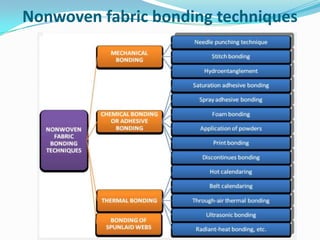
Nonwoven fabric bonding techniques
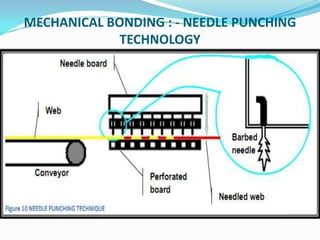
MECHANICAL BONDING : - NEEDLE PUNCHING
TECHNOLOGY
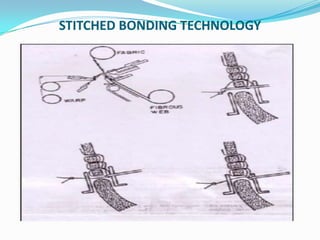
STITCHED BONDING TECHNOLOGY
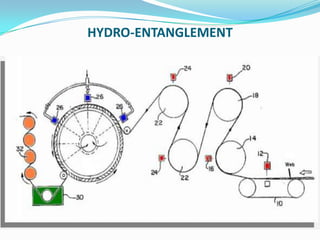
HYDRO-ENTANGLEMENT
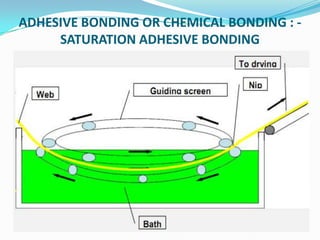
ADHESIVE BONDING OR CHEMICAL BONDING : -
SATURATION ADHESIVE BONDING
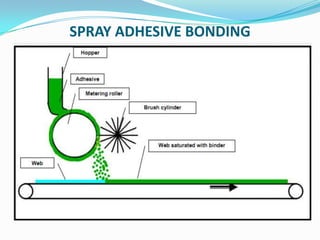
SPRAY ADHESIVE BONDING
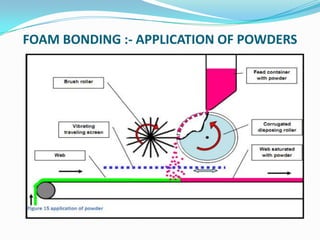
FOAM BONDING :- APPLICATION OF POWDERS
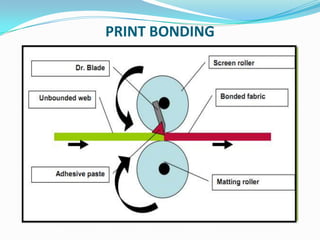
PRINT BONDING
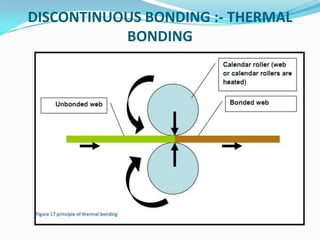
DISCONTINUOUS BONDING :- THERMAL
BONDING
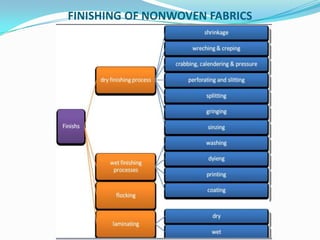
FINISHING OF NONWOVEN FABRICS
1. Yarn Manufacturing Technology
Link : http://www.facebook.com/pages/Yarn-Manufacturing-
Technology/485014954866808
2. Fabric Manufacturing Technology
Link : http://www.facebook.com/pages/Fabric-Manufacturing-
Technology/459520217425605
3. Garments Manufacturing Technology
Link : http://www.facebook.com/pages/Garments-Manufacturing-
Technology/472364799463126
3. Wet processing Technology
Link : http://www.facebook.com/pages/Wet-Processing-Technology-Dyeing-
/468645219825404
4. Fashion-Design-and-Technology
Link : http://www.facebook.com/pages/Fashion-Design-and-
My Facebook Textile related Pages
http://www.textilelab.blogspot.com (Visit )

Nonwoven FABRICS

  • 2.
    Prepared By :Mazadul Hasan sheshir ID: 2010000400008 13th Batch (session 2009-2013) Department : Wet Processing Technology Email: mazadulhasan@yahoo.com Blog : www. Textilelab.blogspot.com (visit) Southeast University Department Of Textile Engineering I/A 251,252 Tejgaon Dhaka Bangladesh Prepared By :
  • 3.
  • 4.
    What is NonwovenFabric ? Nonwoven fabrics are broadly defined as sheet or web structures bonded together by entangling fiber or filaments (and by perforating films) mechanically, thermally, or chemically. They are not made by weaving or knitting and do not require converting the fibers to yarn. Nonwoven Fabric is a fabric-like material made from long fibers, bonded together by chemical, mechanical, heat or solvent treatment. The binding process usually occurs through the pressing of fibres together with an adhesive, chemical binder, heat, ultrasonic pattern bonding. The popularity of Nonwoven fabrics is increasing day by day because of low cost & they are hygienic & they are easily disposal . But the can’t easily be washed or reused properly.
  • 5.
    Uses of NonwovenFabric Household Geotextiles Industrial/Military Health Care Aprons Soil stabilization Coated fabrics Shoe covers Tea and coffee bags Drainage Clean room apparel Lens tissue Tablecloths Road and railroad beds Air conditioning filters Surgical: caps, gowns, masks, Ironing board pads Sedimentation and erosion Military clothing Diapers Fabric softener sheets Pond liners Conveyor belts Bandages, tapes
  • 6.
  • 7.
    Raw materials forNonwoven Fabric production  Fibrous Matter  Cotton  Rayon  Acetate  Wool  Polyamides and polyester  Acrylic  Other fibers
  • 8.
    PROPERTIES OF NONWOVENFABRICS PRDUCED USING DIFFERENT FIBROUS MATTER
  • 10.
    GENERAL PRODUCTION STEPSFOR NONWOVEN FABRIC MANUFACTURING
  • 11.
    PROPERTIES DESIRED INA BONDING AGENT  Strength  Adhesion to Fibers  Flexibility/handle  Elastic Recovery  Minimum film forming temperature  Resistance to washing/ Drying cleaning  Good color and color retention  Economical  Other special requirements
  • 12.
  • 13.
    Types Of Binder Acrylic  Styrenated acrylic  Vinyl Acetate (VAC)  Vinyl Acrylics  Ethylene Vinyl Acetate (EVA)  Polyvinyl Chloride (PVC)  Ethylene/Vinyl Chloride  Polyvinly alcohol (PVA)
  • 14.
  • 15.
    MECHANICAL BONDING :- NEEDLE PUNCHING TECHNOLOGY
  • 16.
  • 17.
  • 18.
    ADHESIVE BONDING ORCHEMICAL BONDING : - SATURATION ADHESIVE BONDING
  • 19.
  • 20.
    FOAM BONDING :-APPLICATION OF POWDERS
  • 21.
  • 22.
    DISCONTINUOUS BONDING :-THERMAL BONDING
  • 23.
  • 27.
    1. Yarn ManufacturingTechnology Link : http://www.facebook.com/pages/Yarn-Manufacturing- Technology/485014954866808 2. Fabric Manufacturing Technology Link : http://www.facebook.com/pages/Fabric-Manufacturing- Technology/459520217425605 3. Garments Manufacturing Technology Link : http://www.facebook.com/pages/Garments-Manufacturing- Technology/472364799463126 3. Wet processing Technology Link : http://www.facebook.com/pages/Wet-Processing-Technology-Dyeing- /468645219825404 4. Fashion-Design-and-Technology Link : http://www.facebook.com/pages/Fashion-Design-and- My Facebook Textile related Pages http://www.textilelab.blogspot.com (Visit )