Non-Woven
Prepared By : Mazadul Hasan sheshir
ID: 2010000400008
13th Batch (session 2009-2013)
Department : Wet Processing Technology
Email: mazadulhasan@yahoo.com
Blog : www. Textilelab.blogspot.com (visit)
Southeast University
Department Of Textile Engineering
I/A 251,252 Tejgaon Dhaka Bangladesh
Prepared By :
Total Textile Process at a Glance
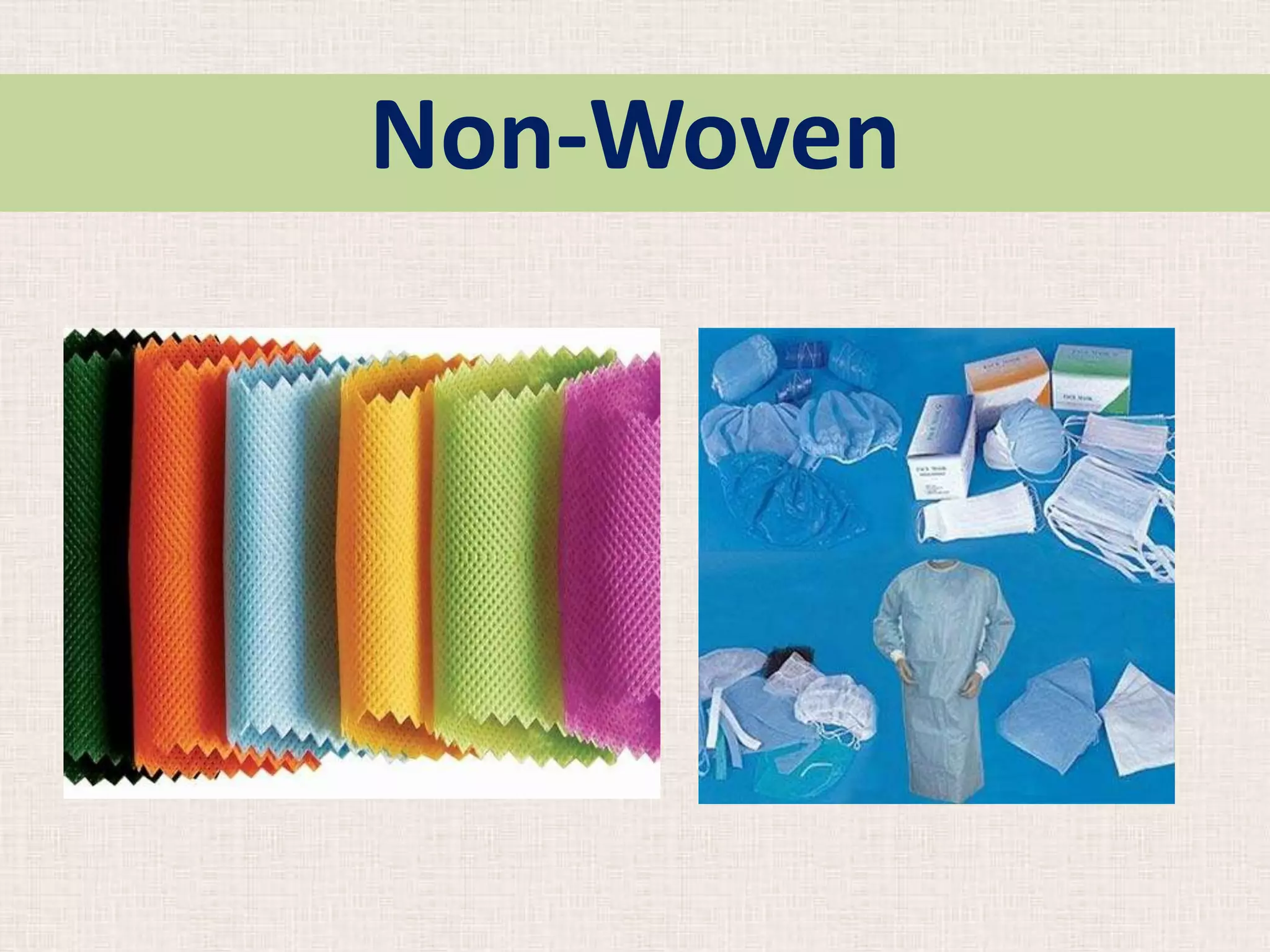
Nonwoven is one type of fabric that is not made by weaving or knitting or
interlacing of yarn. Nonwoven fabrics are broadly defined as sheet or web
structures bonded together by entangling fibre or filaments (and by perforating
films) mechanically, thermally, solvent treatment or chemically. They are flat,
porous sheets that are made directly from separate fibres or from molten plastic
or plastic film.
"Non-woven fabrics are fibrous sheet or web structures
produced by bonding or interlocking fibers by
mechanical, thermal or chemical means."
In the 19th century, (when England was the leading textile
producing country), realizing that large amounts of fiber were
wasted as trim, a textile engineer named Garnett developed a
special carding device to shred this waste material back to fibrous
form. This fiber was used as filling material for pillows. The Garnett
Machine, though greatly modified, today still retains his name and
is a major component in the non-woven industry.
Later on, manufacturers in Northern England began binding
these fibers mechanically (using needles) and chemically (using
glue) into butts. These were the precursors of today's non-wovens.
1. PLA(Polymer Lactic Acid Nonwoven Fabric)
2. Blac
3. Flame retardant
4. PTFE-coated (Polytetrafluoroethylene)
5. Anti-static
6. Anti-bacteria
 Absorbency
 Bacterial barrier
 Cushioning
 Filtering
 Flame retardancy
 Liquid repellency
 Resilience
 Softness
 Sterility
 Strength
 Stretch
 Wash ability
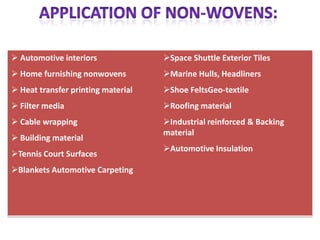
 Automotive interiors
 Home furnishing nonwovens
 Heat transfer printing material
 Filter media
 Cable wrapping
 Building material
Tennis Court Surfaces
Blankets Automotive Carpeting
Space Shuttle Exterior Tiles
Marine Hulls, Headliners
Shoe FeltsGeo-textile
Roofing material
Industrial reinforced & Backing
material
Automotive Insulation
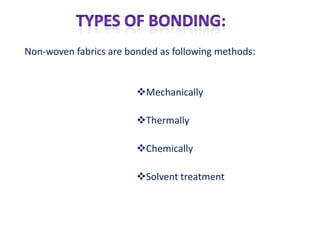
Non-woven fabrics are bonded as following methods:
Mechanically
Thermally
Chemically
Solvent treatment
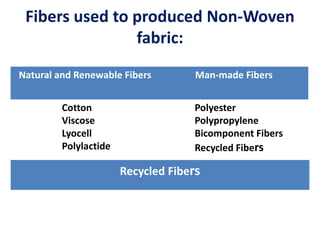
Fibers used to produced Non-Woven
fabric:
Natural and Renewable Fibers Man-made Fibers
Cotton
Viscose
Lyocell
Polylactide
Polyester
Polypropylene
Bicomponent Fibers
Recycled Fibers
Recycled Fibers
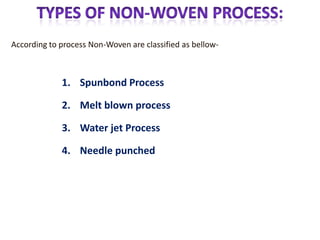
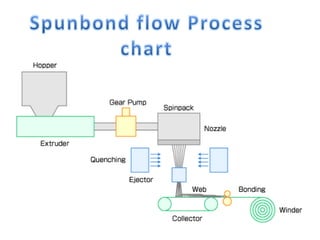
1. Spunbond Process
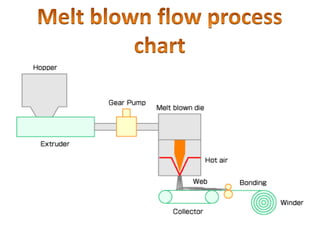
2. Melt blown process
3. Water jet Process
4. Needle punched
According to process Non-Woven are classified as bellow-
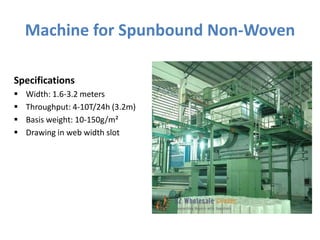
Machine for Spunbound Non-Woven
Specifications
 Width: 1.6-3.2 meters
 Throughput: 4-10T/24h (3.2m)
 Basis weight: 10-150g/m²
 Drawing in web width slot
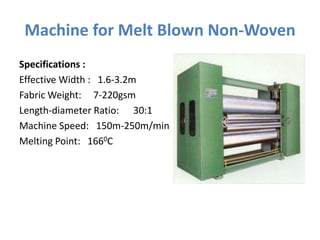
Machine for Melt Blown Non-Woven
Specifications :
Effective Width : 1.6-3.2m
Fabric Weight: 7-220gsm
Length-diameter Ratio: 30:1
Machine Speed: 150m-250m/min
Melting Point: 1660C
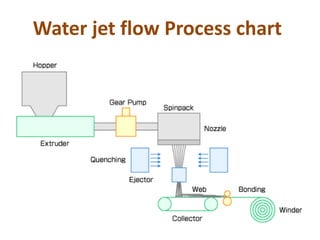
Water jet flow Process chart
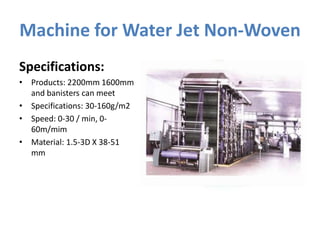
Machine for Water Jet Non-Woven
Specifications:
• Products: 2200mm 1600mm
and banisters can meet
• Specifications: 30-160g/m2
• Speed: 0-30 / min, 0-
60m/mim
• Material: 1.5-3D X 38-51
mm
Needle Punched flow Process chart
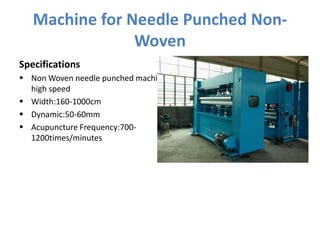
Machine for Needle Punched Non-
Woven
Specifications
 Non Woven needle punched machine
high speed
 Width:160-1000cm
 Dynamic:50-60mm
 Acupuncture Frequency:700-
1200times/minutes
Medical
Isolation gowns
Surgical gowns
Surgical drapes and covers
Surgical scrub suits
Caps
Medical packaging: porosity allows gas
sterilization
baby diapers or nappies
Feminine hygiene
Adult incontinence products
Wet wipes
Bandages and wound dressings
Disposable bath and face towels
Disposable slippers and footwear
Gasoline, oil and air - including HEPA
filtration
Water, coffee, tea bags
Pharmaceutical industry
Mineral processing
Liquid cartridge and bag filters
Vacuum bags
Allergen membranes or laminates with non
woven Layers
Soil stabilizers and roadway underlayment
Foundation stabilizers
Erosion control
Canals construction
Drainage systems
Geomembrane protection
Frost protection
Agriculture mulch
Pond and canal water barriers
Sand infiltration barrier for drainage tile
Landfill liners
Agricultural coverings
Agricultural seed strips
Apparel linings
Automotive headliners
Automotive upholstery
Carpeting
Civil engineering fabrics
Civil engineering
Geo textiles
Disposable diapers
Envelopes
Filters
House wraps
Household & personal
wipes
Hygiene products
Insulation
Labels
Laundry aids
Roofing
Sterile medical-use products
Tags
Upholstery
Wall coverings
1. Yarn Manufacturing Technology
Link : http://www.facebook.com/pages/Yarn-Manufacturing-Technology/485014954866808
2. Fabric Manufacturing Technology
Link : http://www.facebook.com/pages/Fabric-Manufacturing-Technology/459520217425605
3. Garments Manufacturing Technology
Link : http://www.facebook.com/pages/Garments-Manufacturing-
Technology/472364799463126
3. Wet processing Technology
Link : http://www.facebook.com/pages/Wet-Processing-Technology-Dyeing-/468645219825404
4. Fashion-Design-and-Technology
Link : http://www.facebook.com/pages/Fashion-Design-and-
Technology/587655294583875?ref=ts&fref=ts
My Facebook Textile related Pages
http://www.textilelab.blogspot.com (Visit )

Non woven Fabrics

  • 1.
  • 2.
    Prepared By :Mazadul Hasan sheshir ID: 2010000400008 13th Batch (session 2009-2013) Department : Wet Processing Technology Email: mazadulhasan@yahoo.com Blog : www. Textilelab.blogspot.com (visit) Southeast University Department Of Textile Engineering I/A 251,252 Tejgaon Dhaka Bangladesh Prepared By :
  • 3.
  • 4.
    Nonwoven is onetype of fabric that is not made by weaving or knitting or interlacing of yarn. Nonwoven fabrics are broadly defined as sheet or web structures bonded together by entangling fibre or filaments (and by perforating films) mechanically, thermally, solvent treatment or chemically. They are flat, porous sheets that are made directly from separate fibres or from molten plastic or plastic film. "Non-woven fabrics are fibrous sheet or web structures produced by bonding or interlocking fibers by mechanical, thermal or chemical means."
  • 5.
    In the 19thcentury, (when England was the leading textile producing country), realizing that large amounts of fiber were wasted as trim, a textile engineer named Garnett developed a special carding device to shred this waste material back to fibrous form. This fiber was used as filling material for pillows. The Garnett Machine, though greatly modified, today still retains his name and is a major component in the non-woven industry. Later on, manufacturers in Northern England began binding these fibers mechanically (using needles) and chemically (using glue) into butts. These were the precursors of today's non-wovens.
  • 6.
    1. PLA(Polymer LacticAcid Nonwoven Fabric) 2. Blac 3. Flame retardant 4. PTFE-coated (Polytetrafluoroethylene) 5. Anti-static 6. Anti-bacteria
  • 7.
     Absorbency  Bacterialbarrier  Cushioning  Filtering  Flame retardancy  Liquid repellency  Resilience  Softness  Sterility  Strength  Stretch  Wash ability
  • 8.
     Automotive interiors Home furnishing nonwovens  Heat transfer printing material  Filter media  Cable wrapping  Building material Tennis Court Surfaces Blankets Automotive Carpeting Space Shuttle Exterior Tiles Marine Hulls, Headliners Shoe FeltsGeo-textile Roofing material Industrial reinforced & Backing material Automotive Insulation
  • 9.
    Non-woven fabrics arebonded as following methods: Mechanically Thermally Chemically Solvent treatment
  • 10.
    Fibers used toproduced Non-Woven fabric: Natural and Renewable Fibers Man-made Fibers Cotton Viscose Lyocell Polylactide Polyester Polypropylene Bicomponent Fibers Recycled Fibers Recycled Fibers
  • 11.
    1. Spunbond Process 2.Melt blown process 3. Water jet Process 4. Needle punched According to process Non-Woven are classified as bellow-
  • 13.
    Machine for SpunboundNon-Woven Specifications  Width: 1.6-3.2 meters  Throughput: 4-10T/24h (3.2m)  Basis weight: 10-150g/m²  Drawing in web width slot
  • 15.
    Machine for MeltBlown Non-Woven Specifications : Effective Width : 1.6-3.2m Fabric Weight: 7-220gsm Length-diameter Ratio: 30:1 Machine Speed: 150m-250m/min Melting Point: 1660C
  • 16.
    Water jet flowProcess chart
  • 17.
    Machine for WaterJet Non-Woven Specifications: • Products: 2200mm 1600mm and banisters can meet • Specifications: 30-160g/m2 • Speed: 0-30 / min, 0- 60m/mim • Material: 1.5-3D X 38-51 mm
  • 18.
    Needle Punched flowProcess chart
  • 19.
    Machine for NeedlePunched Non- Woven Specifications  Non Woven needle punched machine high speed  Width:160-1000cm  Dynamic:50-60mm  Acupuncture Frequency:700- 1200times/minutes
  • 20.
    Medical Isolation gowns Surgical gowns Surgicaldrapes and covers Surgical scrub suits Caps Medical packaging: porosity allows gas sterilization
  • 21.
    baby diapers ornappies Feminine hygiene Adult incontinence products Wet wipes Bandages and wound dressings Disposable bath and face towels Disposable slippers and footwear
  • 22.
    Gasoline, oil andair - including HEPA filtration Water, coffee, tea bags Pharmaceutical industry Mineral processing Liquid cartridge and bag filters Vacuum bags Allergen membranes or laminates with non woven Layers
  • 23.
    Soil stabilizers androadway underlayment Foundation stabilizers Erosion control Canals construction Drainage systems Geomembrane protection Frost protection Agriculture mulch Pond and canal water barriers Sand infiltration barrier for drainage tile Landfill liners
  • 24.
    Agricultural coverings Agricultural seedstrips Apparel linings Automotive headliners Automotive upholstery Carpeting Civil engineering fabrics Civil engineering Geo textiles Disposable diapers Envelopes Filters House wraps Household & personal wipes Hygiene products Insulation Labels Laundry aids Roofing Sterile medical-use products Tags Upholstery Wall coverings
  • 27.
    1. Yarn ManufacturingTechnology Link : http://www.facebook.com/pages/Yarn-Manufacturing-Technology/485014954866808 2. Fabric Manufacturing Technology Link : http://www.facebook.com/pages/Fabric-Manufacturing-Technology/459520217425605 3. Garments Manufacturing Technology Link : http://www.facebook.com/pages/Garments-Manufacturing- Technology/472364799463126 3. Wet processing Technology Link : http://www.facebook.com/pages/Wet-Processing-Technology-Dyeing-/468645219825404 4. Fashion-Design-and-Technology Link : http://www.facebook.com/pages/Fashion-Design-and- Technology/587655294583875?ref=ts&fref=ts My Facebook Textile related Pages http://www.textilelab.blogspot.com (Visit )