By: Granch Berhe
2015
Textile Reinforced Composites
1
Textile-Reinforced Composite Materials
Composite materials, Textile reinforcement, Woven
fabric-reinforced composites, Braided reinforcement,
Knitted reinforcement, Stitched fabrics;
Textiles in Filtration: Introduction, Dust collection,
Fabric construction, Finishing treatments, Yarn types
and fabric constructions, Fabric constructions and
properties, Production equipment, Finishing
treatments, Fabric test procedures;
Introduction to composites
What is a composite Material ?
Two or more chemically distinct materials which when
combined have improved properties over the individual
materials.
Example: Wood, Bamboo, Bricks.
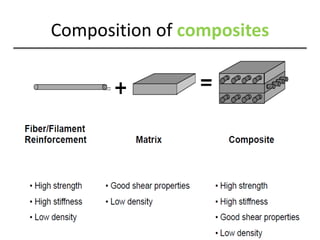
Composites are combinations of two materials in which one
of the material is called the reinforcing phase, is in the form
of fibers, sheets, or particles, and is embedded in the other
material called the matrix phase. It is the main constituent of
composites materials mainly responsible for its mechanical
properties. Its percentage in the composite may be up to 70%
by volume.
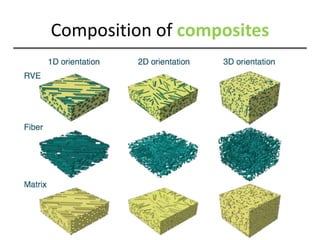
Composition of composites
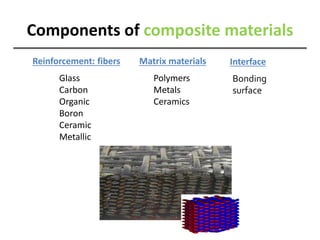
Components of composite materials
Reinforcement: fibers
Glass
Carbon
Organic
Boron
Ceramic
Metallic
Matrix materials
Polymers
Metals
Ceramics
Interface
Bonding
surface
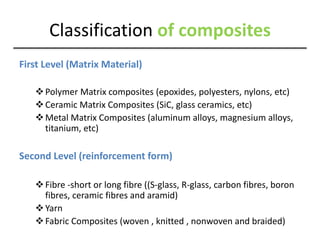
Classification of composites
First Level (Matrix Material)
Polymer Matrix composites (epoxides, polyesters, nylons, etc)
Ceramic Matrix Composites (SiC, glass ceramics, etc)
Metal Matrix Composites (aluminum alloys, magnesium alloys,
titanium, etc)
Second Level (reinforcement form)
Fibre -short or long fibre ((S-glass, R-glass, carbon fibres, boron
fibres, ceramic fibres and aramid)
Yarn
Fabric Composites (woven , knitted , nonwoven and braided)
Polymer Matrix Composites
On the basis of type of polymer resin used, composite materials can be
classified into two categories.
• Thermoplastic Composites
• Thermo-set Composites
Thermoplastic Composites:
This is type of composite material with thermoplastic resin like polyester,
HDPE etc. They are lesser used as high-tech materials due to their higher
viscosity which cause problem during their penetration into the
reinforcement.
Thermo-set Composites:
In these composites thermo-set polymers like epoxy, unsaturated polyester
and vinyl-ester are used as resin. They are most used type of composites
materials in automotive, naval, aeronautical and aerospace applications.
Polymer Matrix Composites
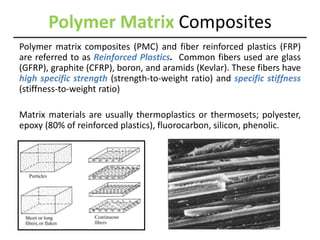
Polymer matrix composites (PMC) and fiber reinforced plastics (FRP)
are referred to as Reinforced Plastics. Common fibers used are glass
(GFRP), graphite (CFRP), boron, and aramids (Kevlar). These fibers have
high specific strength (strength-to-weight ratio) and specific stiffness
(stiffness-to-weight ratio)
Matrix materials are usually thermoplastics or thermosets; polyester,
epoxy (80% of reinforced plastics), fluorocarbon, silicon, phenolic.
Ceramic Matrix Composites
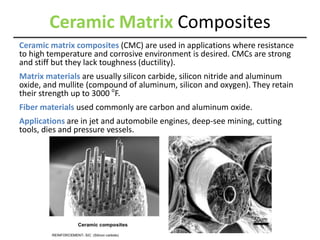
Ceramic matrix composites (CMC) are used in applications where resistance
to high temperature and corrosive environment is desired. CMCs are strong
and stiff but they lack toughness (ductility).
Matrix materials are usually silicon carbide, silicon nitride and aluminum
oxide, and mullite (compound of aluminum, silicon and oxygen). They retain
their strength up to 3000 o
F.
Fiber materials used commonly are carbon and aluminum oxide.
Applications are in jet and automobile engines, deep-see mining, cutting
tools, dies and pressure vessels.
Metal Matrix Composites
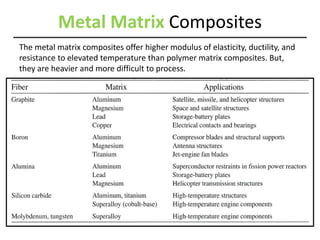
The metal matrix composites offer higher modulus of elasticity, ductility, and
resistance to elevated temperature than polymer matrix composites. But,
they are heavier and more difficult to process.
Classification on the Basis of
Reinforcements
The reinforcements used during manufacturing may be in form of laminates which are
combined to get certain thickness or in the form of thick woven cloth. So on the basis
of reinforcement composites can be categorized in two categories :
1. Laminated Composites
2. 3-D woven Composites
Laminated Composites:
In laminar composites the layers of reinforcement are stacked in a specific pattern to
obtain required properties in the resulting composite piece . These layers are called
plies or laminates. Laminates can be composed of reinforcement material which may
be
• Woven
• Knitted
• Non woven
• Braided
• Fiber reinforced
• Matt
• Uni-directional fibers or UDs
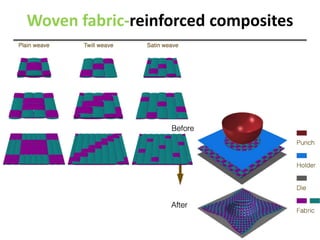
Woven fabric-reinforced composites
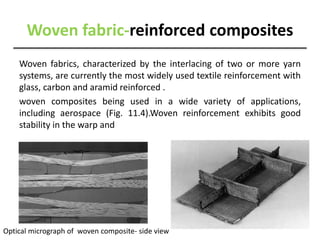
Woven fabrics, characterized by the interlacing of two or more yarn
systems, are currently the most widely used textile reinforcement with
glass, carbon and aramid reinforced .
woven composites being used in a wide variety of applications,
including aerospace (Fig. 11.4).Woven reinforcement exhibits good
stability in the warp and
Optical micrograph of woven composite- side view
Woven fabric-reinforced composites
The mechanical properties of woven fabric-reinforced composites are
dominated by the type of fibre used, the weaving parameters and the
stacking and orientation of the various layers.
Woven reinforcement exhibits good stability in the warp and weft
directions and offers the highest cover or yarn packing density in
relation to fabric thickness. Glass-reinforced woven fabrics give rise
naturally to composites with lower mechanical properties because of
the much lower value of the glass fibre modulus compared to carbon.
Prepreg manufacturers were able, by the early 1980s, to supply woven
fabrics in the prepreg form familiar to users of nonwoven material.
Woven fabric-reinforced composites
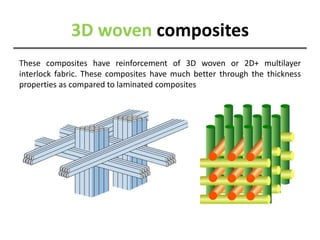
3D woven composites
These composites have reinforcement of 3D woven or 2D+ multilayer
interlock fabric. These composites have much better through the thickness
properties as compared to laminated composites
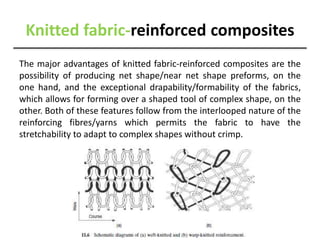
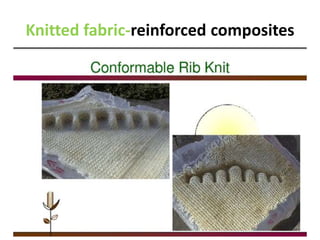
Knitted fabric-reinforced composites
The major advantages of knitted fabric-reinforced composites are the
possibility of producing net shape/near net shape preforms, on the
one hand, and the exceptional drapability/formability of the fabrics,
which allows for forming over a shaped tool of complex shape, on the
other. Both of these features follow from the interlooped nature of the
reinforcing fibres/yarns which permits the fabric to have the
stretchability to adapt to complex shapes without crimp.
Knitted fabric-reinforced composites
However, the advantages which the knitted fibre architecture
brings also lead to the disadvantages, which are the reduced in-
plane stiffness and strength of the composites caused by the
relatively poor use of the mechanical properties of the fibre
(glass, carbon or aramid).
The tensile and compressive properties of the knitted fabrics are
poor in comparison with the other types of fabric. Hence both
warp-knitted and weft-knitted reinforcements are under
investigation.
Knitted fabric-reinforced composites
Braided- reinforcement composites
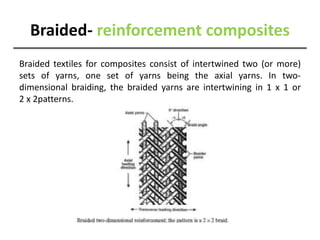
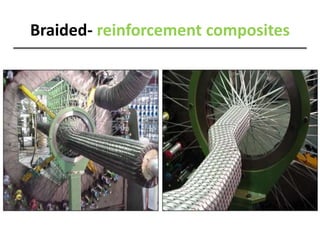
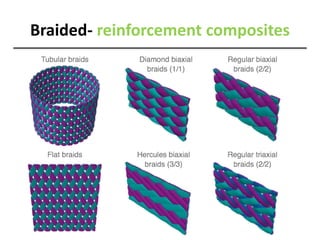
Braided textiles for composites consist of intertwined two (or more)
sets of yarns, one set of yarns being the axial yarns. In two-
dimensional braiding, the braided yarns are intertwining in 1 x 1 or
2 x 2patterns.
Braided- reinforcement composites
The braided architecture enables the composite to endure
twisting, shearing and impact better than woven fabrics.
Combined with low cost fabrication routes, such as resin
transfer moulding, braided reinforcements are expected to
become competitor materials for many aerospace applications
or automobile applications.
A variety of shapes can be fabricated for composite applications
from hollow tubular to solid sections. The mechanical properties
of composites fabricated using braided reinforcement depend on
the braid parameters (braid architecture, yarn size and spacing,
fibre volume fraction) and the mechanical properties of fibre and
matrix.
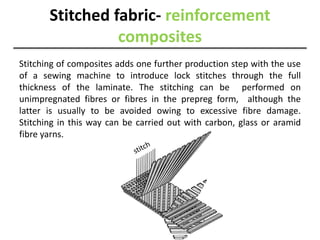
Stitched fabric- reinforcement
composites
Stitching of composites adds one further production step with the use
of a sewing machine to introduce lock stitches through the full
thickness of the laminate. The stitching can be performed on
unimpregnated fibres or fibres in the prepreg form, although the
latter is usually to be avoided owing to excessive fibre damage.
Stitching in this way can be carried out with carbon, glass or aramid
fibre yarns.
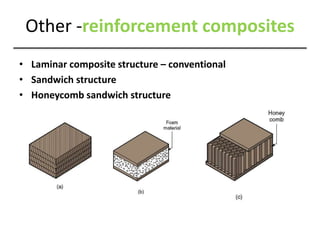
Other -reinforcement composites
• Laminar composite structure – conventional
• Sandwich structure
• Honeycomb sandwich structure
Composites manufacturing process
• Pultrusion
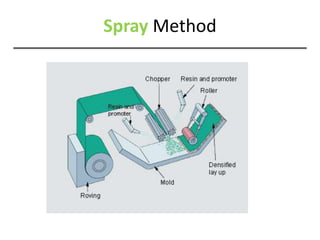
• Spray method
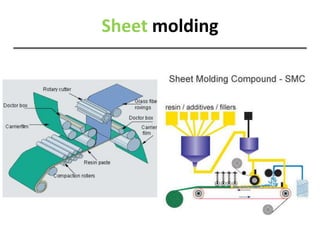
• Sheet molding
• Bulk molding
• Resin transfer molding
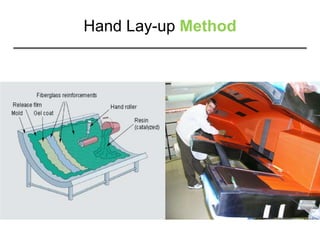
• Hand Lay-up
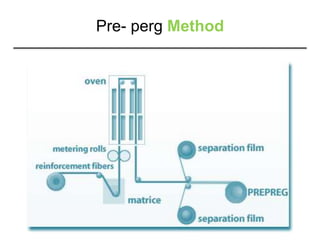
• Pre-preg forming
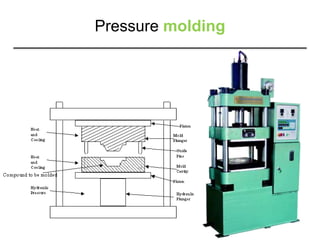
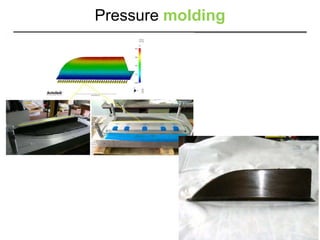
• Pressure molding
• Vacuum bagging
• Filament winding
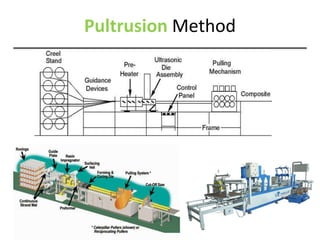
Pultrusion Method
Spray Method
Sheet molding
Hand Lay-up Method
Pre- perg Method
Pressure molding
Pressure molding
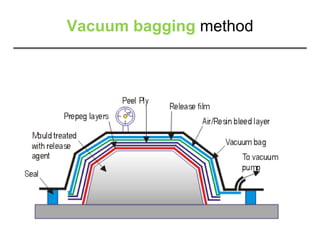
Vacuum bagging method
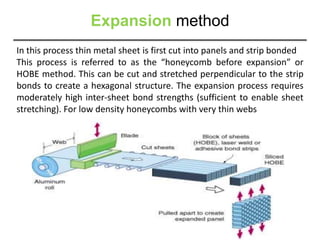
Expansion method
In this process thin metal sheet is first cut into panels and strip bonded
This process is referred to as the “honeycomb before expansion” or
HOBE method. This can be cut and stretched perpendicular to the strip
bonds to create a hexagonal structure. The expansion process requires
moderately high inter-sheet bond strengths (sufficient to enable sheet
stretching). For low density honeycombs with very thin webs
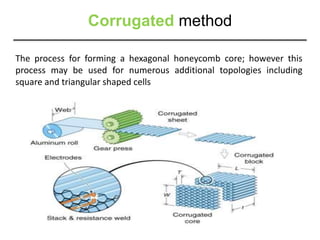
Corrugated method
The process for forming a hexagonal honeycomb core; however this
process may be used for numerous additional topologies including
square and triangular shaped cells
Other methods
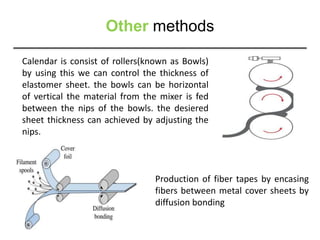
Calendar is consist of rollers(known as Bowls)
by using this we can control the thickness of
elastomer sheet. the bowls can be horizontal
of vertical the material from the mixer is fed
between the nips of the bowls. the desiered
sheet thickness can achieved by adjusting the
nips.
Production of fiber tapes by encasing
fibers between metal cover sheets by
diffusion bonding
Nano composites
Nanoparticulates (filler) introduced into a macroscopic sample material
(matrix). Percentage by weight (mass fraction) of the nanoparticulates
can remain very low on the order of 0.5% to 5%.
Nanocomposite may exhibit enhanced properties
• electrical and thermal conductivity
• optical properties
• dielectric properties
• mechanical properties
• stiffness
• Strength
…Or nanoparticles can impart new physical properties and behaviors to
matrix (genuine nanocomposites or hybrids)
• flame retardancy
• accelerated biodegradability
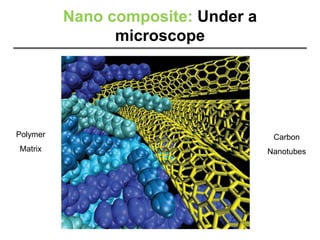
Nano composite: Under a
microscope
Carbon
Nanotubes
Polymer
Matrix
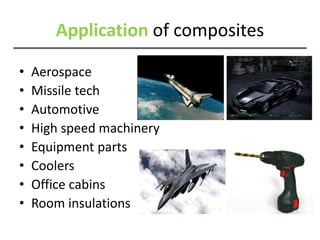
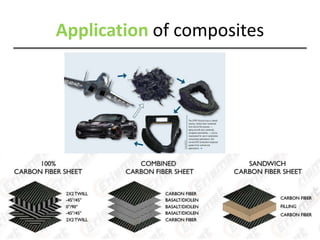
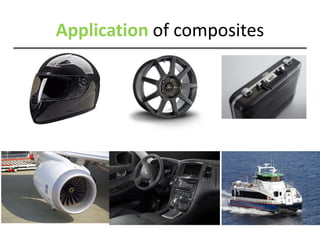
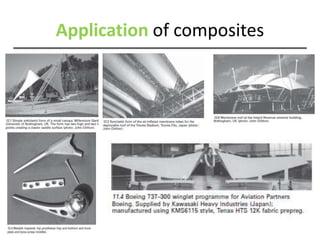
Application of composites
• Aerospace
• Missile tech
• Automotive
• High speed machinery
• Equipment parts
• Coolers
• Office cabins
• Room insulations
Application of composites
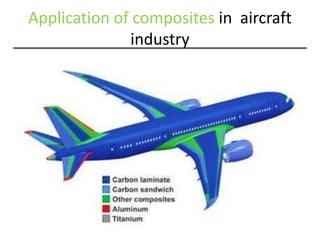
Application of composites in aircraft
industry
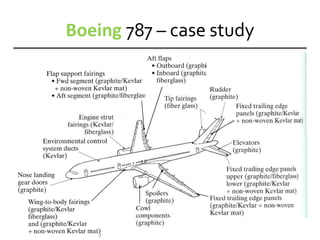
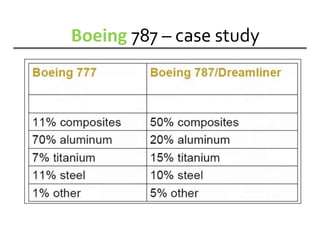
Boeing 787 – case study
Boeing 787
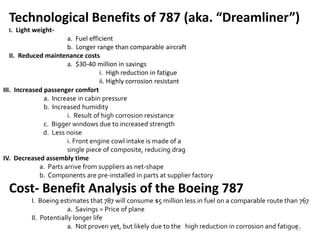
Technological Benefits of 787 (aka. “Dreamliner”)
I. Light weight-
a. Fuel efficient
b. Longer range than comparable aircraft
II. Reduced maintenance costs
a. $30-40 million in savings
i. High reduction in fatigue
ii. Highly corrosion resistant
III. Increased passenger comfort
a. Increase in cabin pressure
b. Increased humidity
i. Result of high corrosion resistance
c. Bigger windows due to increased strength
d. Less noise
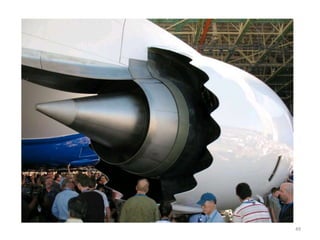
i. Front engine cowl intake is made of a
single piece of composite, reducing drag
IV. Decreased assembly time
a. Parts arrive from suppliers as net-shape
b. Components are pre-installed in parts at supplier factory
Cost- Benefit Analysis of the Boeing 787
I. Boeing estimates that 787 will consume $5 million less in fuel on a comparable route than 767
a. Savings = Price of plane
II. Potentially longer life
a. Not proven yet, but likely due to the high reduction in corrosion and fatigue47
Boeing 787
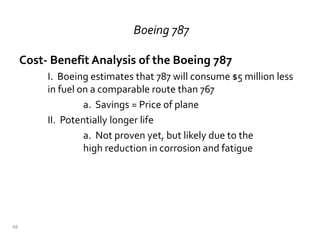
Cost- Benefit Analysis of the Boeing 787
I. Boeing estimates that 787 will consume $5 million less
in fuel on a comparable route than 767
a. Savings = Price of plane
II. Potentially longer life
a. Not proven yet, but likely due to the
high reduction in corrosion and fatigue
48
49

2. textile reinforced composites

  • 1.
    By: Granch Berhe 2015 TextileReinforced Composites 1
  • 2.
    Textile-Reinforced Composite Materials Compositematerials, Textile reinforcement, Woven fabric-reinforced composites, Braided reinforcement, Knitted reinforcement, Stitched fabrics; Textiles in Filtration: Introduction, Dust collection, Fabric construction, Finishing treatments, Yarn types and fabric constructions, Fabric constructions and properties, Production equipment, Finishing treatments, Fabric test procedures;
  • 3.
    Introduction to composites Whatis a composite Material ? Two or more chemically distinct materials which when combined have improved properties over the individual materials. Example: Wood, Bamboo, Bricks. Composites are combinations of two materials in which one of the material is called the reinforcing phase, is in the form of fibers, sheets, or particles, and is embedded in the other material called the matrix phase. It is the main constituent of composites materials mainly responsible for its mechanical properties. Its percentage in the composite may be up to 70% by volume.
  • 4.
  • 5.
  • 6.
    Components of compositematerials Reinforcement: fibers Glass Carbon Organic Boron Ceramic Metallic Matrix materials Polymers Metals Ceramics Interface Bonding surface
  • 7.
    Classification of composites FirstLevel (Matrix Material) Polymer Matrix composites (epoxides, polyesters, nylons, etc) Ceramic Matrix Composites (SiC, glass ceramics, etc) Metal Matrix Composites (aluminum alloys, magnesium alloys, titanium, etc) Second Level (reinforcement form) Fibre -short or long fibre ((S-glass, R-glass, carbon fibres, boron fibres, ceramic fibres and aramid) Yarn Fabric Composites (woven , knitted , nonwoven and braided)
  • 8.
    Polymer Matrix Composites Onthe basis of type of polymer resin used, composite materials can be classified into two categories. • Thermoplastic Composites • Thermo-set Composites Thermoplastic Composites: This is type of composite material with thermoplastic resin like polyester, HDPE etc. They are lesser used as high-tech materials due to their higher viscosity which cause problem during their penetration into the reinforcement. Thermo-set Composites: In these composites thermo-set polymers like epoxy, unsaturated polyester and vinyl-ester are used as resin. They are most used type of composites materials in automotive, naval, aeronautical and aerospace applications.
  • 9.
    Polymer Matrix Composites Polymermatrix composites (PMC) and fiber reinforced plastics (FRP) are referred to as Reinforced Plastics. Common fibers used are glass (GFRP), graphite (CFRP), boron, and aramids (Kevlar). These fibers have high specific strength (strength-to-weight ratio) and specific stiffness (stiffness-to-weight ratio) Matrix materials are usually thermoplastics or thermosets; polyester, epoxy (80% of reinforced plastics), fluorocarbon, silicon, phenolic.
  • 10.
    Ceramic Matrix Composites Ceramicmatrix composites (CMC) are used in applications where resistance to high temperature and corrosive environment is desired. CMCs are strong and stiff but they lack toughness (ductility). Matrix materials are usually silicon carbide, silicon nitride and aluminum oxide, and mullite (compound of aluminum, silicon and oxygen). They retain their strength up to 3000 o F. Fiber materials used commonly are carbon and aluminum oxide. Applications are in jet and automobile engines, deep-see mining, cutting tools, dies and pressure vessels.
  • 11.
    Metal Matrix Composites Themetal matrix composites offer higher modulus of elasticity, ductility, and resistance to elevated temperature than polymer matrix composites. But, they are heavier and more difficult to process.
  • 12.
    Classification on theBasis of Reinforcements The reinforcements used during manufacturing may be in form of laminates which are combined to get certain thickness or in the form of thick woven cloth. So on the basis of reinforcement composites can be categorized in two categories : 1. Laminated Composites 2. 3-D woven Composites Laminated Composites: In laminar composites the layers of reinforcement are stacked in a specific pattern to obtain required properties in the resulting composite piece . These layers are called plies or laminates. Laminates can be composed of reinforcement material which may be • Woven • Knitted • Non woven • Braided • Fiber reinforced • Matt • Uni-directional fibers or UDs
  • 13.
    Woven fabric-reinforced composites Wovenfabrics, characterized by the interlacing of two or more yarn systems, are currently the most widely used textile reinforcement with glass, carbon and aramid reinforced . woven composites being used in a wide variety of applications, including aerospace (Fig. 11.4).Woven reinforcement exhibits good stability in the warp and Optical micrograph of woven composite- side view
  • 14.
    Woven fabric-reinforced composites Themechanical properties of woven fabric-reinforced composites are dominated by the type of fibre used, the weaving parameters and the stacking and orientation of the various layers. Woven reinforcement exhibits good stability in the warp and weft directions and offers the highest cover or yarn packing density in relation to fabric thickness. Glass-reinforced woven fabrics give rise naturally to composites with lower mechanical properties because of the much lower value of the glass fibre modulus compared to carbon. Prepreg manufacturers were able, by the early 1980s, to supply woven fabrics in the prepreg form familiar to users of nonwoven material.
  • 15.
  • 16.
    3D woven composites Thesecomposites have reinforcement of 3D woven or 2D+ multilayer interlock fabric. These composites have much better through the thickness properties as compared to laminated composites
  • 17.
    Knitted fabric-reinforced composites Themajor advantages of knitted fabric-reinforced composites are the possibility of producing net shape/near net shape preforms, on the one hand, and the exceptional drapability/formability of the fabrics, which allows for forming over a shaped tool of complex shape, on the other. Both of these features follow from the interlooped nature of the reinforcing fibres/yarns which permits the fabric to have the stretchability to adapt to complex shapes without crimp.
  • 18.
    Knitted fabric-reinforced composites However,the advantages which the knitted fibre architecture brings also lead to the disadvantages, which are the reduced in- plane stiffness and strength of the composites caused by the relatively poor use of the mechanical properties of the fibre (glass, carbon or aramid). The tensile and compressive properties of the knitted fabrics are poor in comparison with the other types of fabric. Hence both warp-knitted and weft-knitted reinforcements are under investigation.
  • 19.
  • 20.
    Braided- reinforcement composites Braidedtextiles for composites consist of intertwined two (or more) sets of yarns, one set of yarns being the axial yarns. In two- dimensional braiding, the braided yarns are intertwining in 1 x 1 or 2 x 2patterns.
  • 21.
  • 22.
  • 23.
    Braided- reinforcement composites Thebraided architecture enables the composite to endure twisting, shearing and impact better than woven fabrics. Combined with low cost fabrication routes, such as resin transfer moulding, braided reinforcements are expected to become competitor materials for many aerospace applications or automobile applications. A variety of shapes can be fabricated for composite applications from hollow tubular to solid sections. The mechanical properties of composites fabricated using braided reinforcement depend on the braid parameters (braid architecture, yarn size and spacing, fibre volume fraction) and the mechanical properties of fibre and matrix.
  • 24.
    Stitched fabric- reinforcement composites Stitchingof composites adds one further production step with the use of a sewing machine to introduce lock stitches through the full thickness of the laminate. The stitching can be performed on unimpregnated fibres or fibres in the prepreg form, although the latter is usually to be avoided owing to excessive fibre damage. Stitching in this way can be carried out with carbon, glass or aramid fibre yarns.
  • 25.
    Other -reinforcement composites •Laminar composite structure – conventional • Sandwich structure • Honeycomb sandwich structure
  • 26.
    Composites manufacturing process •Pultrusion • Spray method • Sheet molding • Bulk molding • Resin transfer molding • Hand Lay-up • Pre-preg forming • Pressure molding • Vacuum bagging • Filament winding
  • 27.
  • 28.
  • 29.
  • 30.
  • 31.
  • 32.
  • 33.
  • 34.
  • 35.
    Expansion method In thisprocess thin metal sheet is first cut into panels and strip bonded This process is referred to as the “honeycomb before expansion” or HOBE method. This can be cut and stretched perpendicular to the strip bonds to create a hexagonal structure. The expansion process requires moderately high inter-sheet bond strengths (sufficient to enable sheet stretching). For low density honeycombs with very thin webs
  • 36.
    Corrugated method The processfor forming a hexagonal honeycomb core; however this process may be used for numerous additional topologies including square and triangular shaped cells
  • 37.
    Other methods Calendar isconsist of rollers(known as Bowls) by using this we can control the thickness of elastomer sheet. the bowls can be horizontal of vertical the material from the mixer is fed between the nips of the bowls. the desiered sheet thickness can achieved by adjusting the nips. Production of fiber tapes by encasing fibers between metal cover sheets by diffusion bonding
  • 38.
    Nano composites Nanoparticulates (filler)introduced into a macroscopic sample material (matrix). Percentage by weight (mass fraction) of the nanoparticulates can remain very low on the order of 0.5% to 5%. Nanocomposite may exhibit enhanced properties • electrical and thermal conductivity • optical properties • dielectric properties • mechanical properties • stiffness • Strength …Or nanoparticles can impart new physical properties and behaviors to matrix (genuine nanocomposites or hybrids) • flame retardancy • accelerated biodegradability
  • 39.
    Nano composite: Undera microscope Carbon Nanotubes Polymer Matrix
  • 40.
    Application of composites •Aerospace • Missile tech • Automotive • High speed machinery • Equipment parts • Coolers • Office cabins • Room insulations
  • 41.
  • 42.
  • 43.
  • 44.
    Application of compositesin aircraft industry
  • 45.
    Boeing 787 –case study
  • 46.
    Boeing 787 –case study
  • 47.
    Boeing 787 Technological Benefitsof 787 (aka. “Dreamliner”) I. Light weight- a. Fuel efficient b. Longer range than comparable aircraft II. Reduced maintenance costs a. $30-40 million in savings i. High reduction in fatigue ii. Highly corrosion resistant III. Increased passenger comfort a. Increase in cabin pressure b. Increased humidity i. Result of high corrosion resistance c. Bigger windows due to increased strength d. Less noise i. Front engine cowl intake is made of a single piece of composite, reducing drag IV. Decreased assembly time a. Parts arrive from suppliers as net-shape b. Components are pre-installed in parts at supplier factory Cost- Benefit Analysis of the Boeing 787 I. Boeing estimates that 787 will consume $5 million less in fuel on a comparable route than 767 a. Savings = Price of plane II. Potentially longer life a. Not proven yet, but likely due to the high reduction in corrosion and fatigue47
  • 48.
    Boeing 787 Cost- BenefitAnalysis of the Boeing 787 I. Boeing estimates that 787 will consume $5 million less in fuel on a comparable route than 767 a. Savings = Price of plane II. Potentially longer life a. Not proven yet, but likely due to the high reduction in corrosion and fatigue 48
  • 49.