Indian Nonwoven Industry-Present Scenario &
Future Prospects
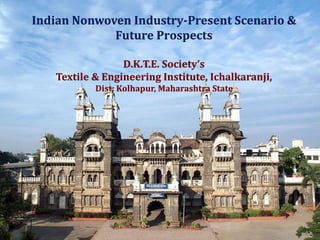
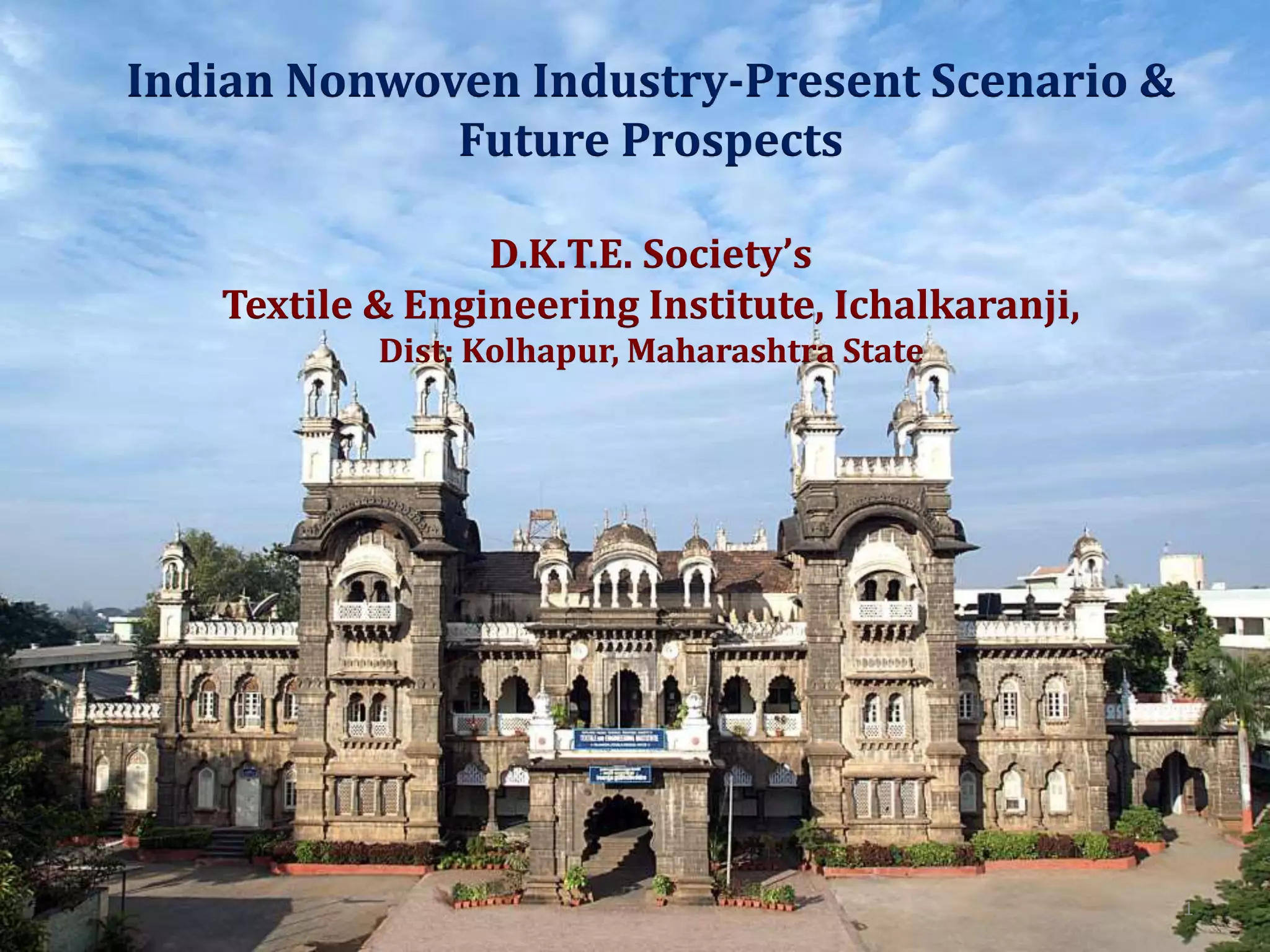
D.K.T.E. Society’s
Textile & Engineering Institute, Ichalkaranji,
Dist: Kolhapur, Maharashtra State
1
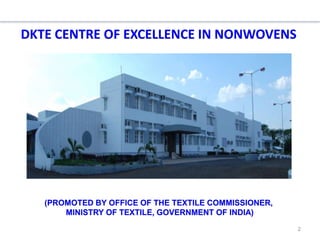
DKTE CENTRE OF EXCELLENCE IN NONWOVENS
2
(PROMOTED BY OFFICE OF THE TEXTILE COMMISSIONER,
MINISTRY OF TEXTILE, GOVERNMENT OF INDIA)
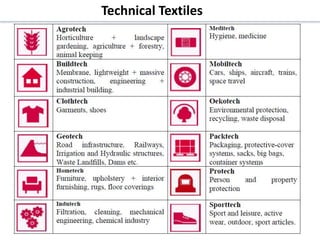
Technical Textiles
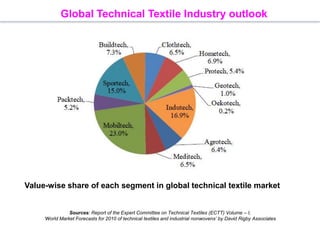
Global Technical Textile Industry outlook
Value-wise share of each segment in global technical textile market
Sources: Report of the Expert Committee on Technical Textiles (ECTT) Volume – I,
‘World Market Forecasts for 2010 of technical textiles and industrial nonwovens’ by David Rigby Associates
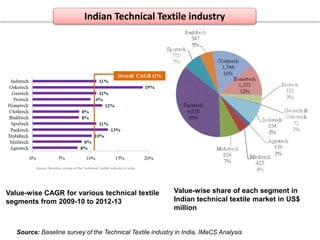
Source: Baseline survey of the Technical Textile industry in India, IMaCS Analysis
Value-wise CAGR for various technical textile
segments from 2009-10 to 2012-13
Value-wise share of each segment in
Indian technical textile market in US$
million
Indian Technical Textile industry
6
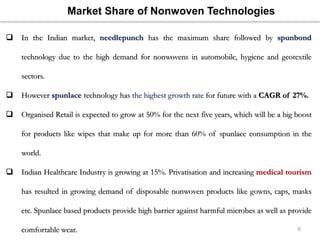
 In the Indian market, needlepunch has the maximum share followed by spunbond
technology due to the high demand for nonwovens in automobile, hygiene and geotextile
sectors.
 However spunlace technology has the highest growth rate for future with a CAGR of 27%.
 Organised Retail is expected to grow at 50% for the next five years, which will be a big boost
for products like wipes that make up for more than 60% of spunlace consumption in the
world.
 Indian Healthcare Industry is growing at 15%. Privatisation and increasing medical tourism
has resulted in growing demand of disposable nonwoven products like gowns, caps, masks
etc. Spunlace based products provide high barrier against harmful microbes as well as provide
comfortable wear.
Market Share of Nonwoven Technologies
7
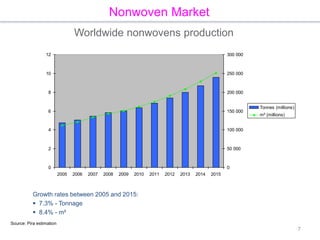
Worldwide nonwovens production
Nonwoven Market
Growth rates between 2005 and 2015:
 7.3% - Tonnage
 8.4% - m²
0
2
4
6
8
10
12
2005 2006 2007 2008 2009 2010 2011 2012 2013 2014 2015
0
50 000
100 000
150 000
200 000
250 000
300 000
Tonnes (millions)
m² (millions)
Source: Pira estimation
8
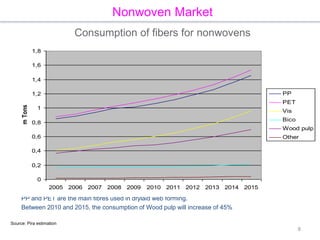
Consumption of fibers for nonwovens
PP and PET are the main fibres used in drylaid web forming.
Between 2010 and 2015, the consumption of Wood pulp will increase of 45%
0
0,2
0,4
0,6
0,8
1
1,2
1,4
1,6
1,8
2005 2006 2007 2008 2009 2010 2011 2012 2013 2014 2015
mTons
PP
PET
Vis
Bico
Wood pulp
Other
Source: Pira estimation
Nonwoven Market
Nonwoven Market
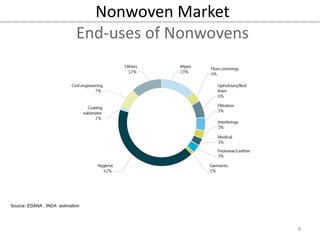
End-uses of Nonwovens
9
Source: EDANA , INDA estimation
Nonwoven Market
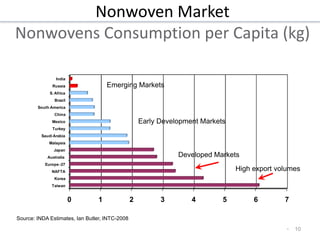
Nonwovens Consumption per Capita (kg)
10
Source: INDA Estimates, Ian Butler, INTC-2008
0 1 2 3 4 5 6 7
Taiwan
Korea
NAFTA
Europe -27
Australia
Japan
Malaysia
Saudi Arabia
Turkey
Mexico
China
South America
Brazil
S. Africa
Russia
India
kg
Developed Markets
Early Development Markets
Emerging Markets
High export volumes
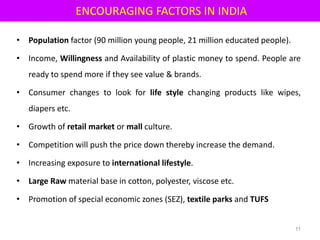
ENCOURAGING FACTORS IN INDIA
• Population factor (90 million young people, 21 million educated people).
• Income, Willingness and Availability of plastic money to spend. People are
ready to spend more if they see value & brands.
• Consumer changes to look for life style changing products like wipes,
diapers etc.
• Growth of retail market or mall culture.
• Competition will push the price down thereby increase the demand.
• Increasing exposure to international lifestyle.
• Large Raw material base in cotton, polyester, viscose etc.
• Promotion of special economic zones (SEZ), textile parks and TUFS
11
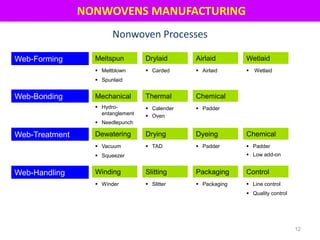
Nonwoven Processes
12
Web-Forming Meltspun Drylaid Airlaid Wetlaid
 Meltblown  Carded  Airlaid  Wetlaid
 Spunlaid
Web-Treatment Dewatering Drying Dyeing Chemical
 Vacuum  TAD  Padder  Padder
 Squeezer  Low add-on
Web-Bonding Thermal Chemical
 Hydro-
entanglement
 Calender  Padder
 Needlepunch
 Oven
Mechanical
Web-Handling Winding Slitting Packaging Control
 Winder  Slitter  Packaging  Line control
 Quality control
NONWOVENS MANUFACTURING
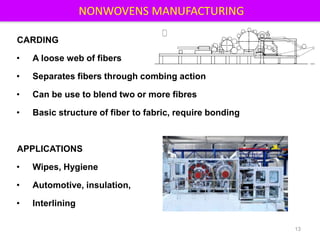
CARDING
• A loose web of fibers
• Separates fibers through combing action
• Can be use to blend two or more fibres
• Basic structure of fiber to fabric, require bonding
APPLICATIONS
• Wipes, Hygiene
• Automotive, insulation,
• Interlining
13
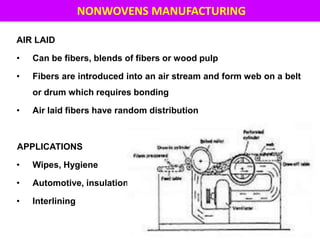
AIR LAID
• Can be fibers, blends of fibers or wood pulp
• Fibers are introduced into an air stream and form web on a belt
or drum which requires bonding
• Air laid fibers have random distribution
APPLICATIONS
• Wipes, Hygiene
• Automotive, insulation,
• Interlining
14
NONWOVENS MANUFACTURING
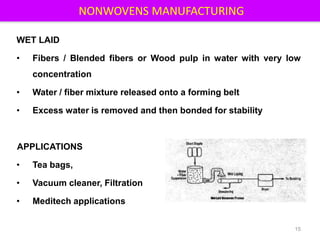
WET LAID
• Fibers / Blended fibers or Wood pulp in water with very low
concentration
• Water / fiber mixture released onto a forming belt
• Excess water is removed and then bonded for stability
APPLICATIONS
• Tea bags,
• Vacuum cleaner, Filtration
• Meditech applications
15
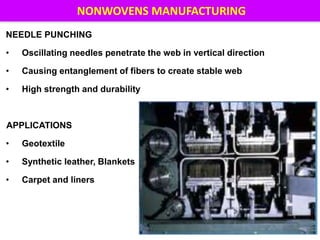
NEEDLE PUNCHING
• Oscillating needles penetrate the web in vertical direction
• Causing entanglement of fibers to create stable web
• High strength and durability
APPLICATIONS
• Geotextile
• Synthetic leather, Blankets
• Carpet and liners
16
NONWOVENS MANUFACTURING
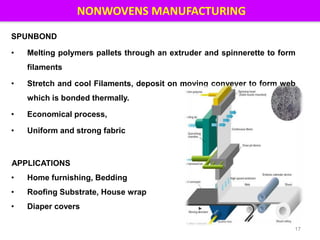
SPUNBOND
• Melting polymers pallets through an extruder and spinnerette to form
filaments
• Stretch and cool Filaments, deposit on moving conveyer to form web
which is bonded thermally.
• Economical process,
• Uniform and strong fabric
APPLICATIONS
• Home furnishing, Bedding
• Roofing Substrate, House wrap
• Diaper covers
17
NONWOVENS MANUFACTURING
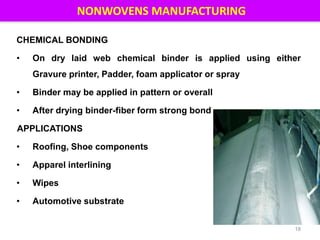
CHEMICAL BONDING
• On dry laid web chemical binder is applied using either
Gravure printer, Padder, foam applicator or spray
• Binder may be applied in pattern or overall
• After drying binder-fiber form strong bond
APPLICATIONS
• Roofing, Shoe components
• Apparel interlining
• Wipes
• Automotive substrate
18
NONWOVENS MANUFACTURING
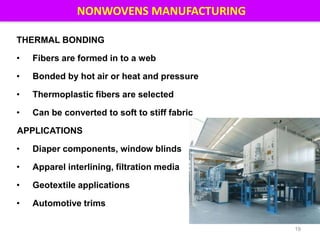
THERMAL BONDING
• Fibers are formed in to a web
• Bonded by hot air or heat and pressure
• Thermoplastic fibers are selected
• Can be converted to soft to stiff fabric
APPLICATIONS
• Diaper components, window blinds
• Apparel interlining, filtration media
• Geotextile applications
• Automotive trims
19
NONWOVENS MANUFACTURING
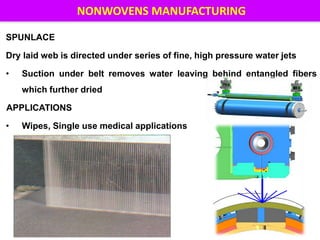
SPUNLACE
Dry laid web is directed under series of fine, high pressure water jets
• Suction under belt removes water leaving behind entangled fibers
which further dried
APPLICATIONS
• Wipes, Single use medical applications
20
NONWOVENS MANUFACTURING
21
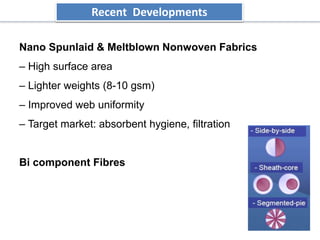
Nano Spunlaid & Meltblown Nonwoven Fabrics
– High surface area
– Lighter weights (8-10 gsm)
– Improved web uniformity
– Target market: absorbent hygiene, filtration
Bi component Fibres
Recent Developments
Finishing of Nonwovens
• Hydrophilic
• Hydrophobic
• Repellent
• Flame Retardant
• Coating
• Anitmicrobial
• Dye
• Finishing
• Print
• Corrugate
• Emboss
• Compact
• Crepe
• Flock
• Plasma
• Encapsulate
22
APPLICATIONS OF NONWOVENS
DISPOSABLE APPLICATIONS
Medical
• Drapes
• Surgical / Isolation gowns
• CSR Wraps
• Caps ,Facemasks ,shoe covers
Hygiene
• Baby Diapers, Training pants
• Feminine Hygiene products
• Adult Incontinence products
Wipes
• Baby
• Household
• Industrial
23
DURABLE APPLICATIONS
Geotextiles
• Soil Stabilization, Drainage
• Road and Rail construction
Filtration
• Air, gas, liquid
Agriculture
• Crop covers, Greenhouse shades
• Mulches
Home Furnishing
• Carpet backing
• Furniture Construction
Building and Construction
• Insulation, Roofing
Automotives
• Carpets & Headliner.
• Door panel insulation, Carpet
backing.
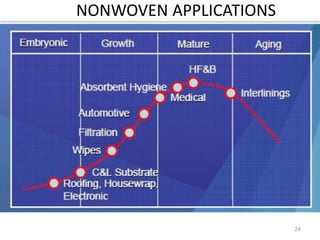
NONWOVEN APPLICATIONS
24
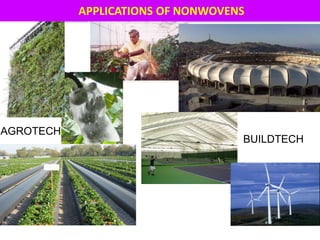
APPLICATIONS OF NONWOVENS
AGROTECH
BUILDTECH
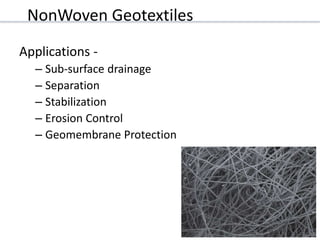
NonWoven Geotextiles
Applications -
– Sub-surface drainage
– Separation
– Stabilization
– Erosion Control
– Geomembrane Protection
Uses of Non-Woven Geotextiles
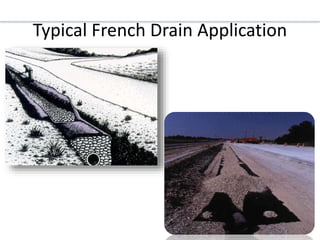
• Non-wovens
– Drainage application
• French drains, pipe sock
• MSE walls
– Separation application
• Remediation projects, waste containment
• Road building
• Parking lots
• Weed barrier
Typical French Drain Application
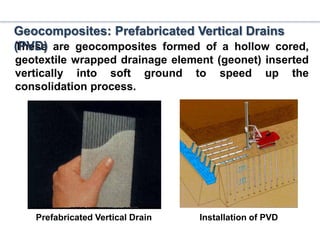
These are geocomposites formed of a hollow cored,
geotextile wrapped drainage element (geonet) inserted
vertically into soft ground to speed up the
consolidation process.
Prefabricated Vertical Drain Installation of PVD
Geocomposites: Prefabricated Vertical Drains
(PVD)
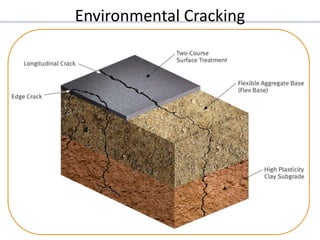
Environmental Cracking
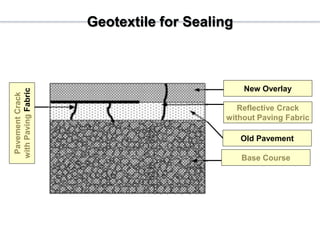
Geotextile for Sealing
New Overlay
Reflective Crack
without Paving Fabric
Old Pavement
Base Course
PavementCrack
withPavingFabric
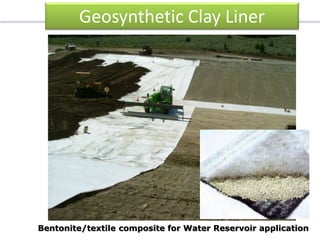
Geosynthetic Clay Liner
Bentonite/textile composite for Water Reservoir application
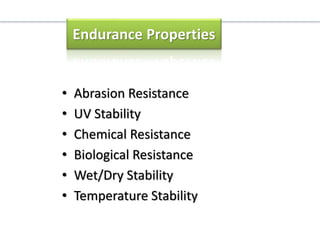
Endurance Properties
• Abrasion Resistance
• UV Stability
• Chemical Resistance
• Biological Resistance
• Wet/Dry Stability
• Temperature Stability
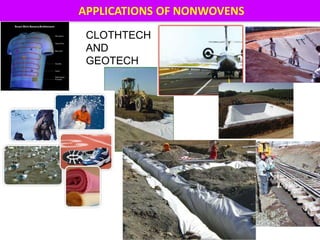
CLOTHTECH
AND
GEOTECH
APPLICATIONS OF NONWOVENS
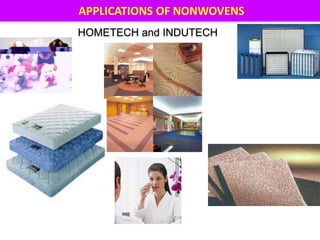
HOMETECH and INDUTECH
APPLICATIONS OF NONWOVENS
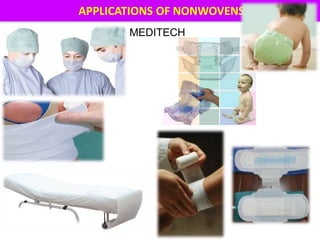
MEDITECH
APPLICATIONS OF NONWOVENS
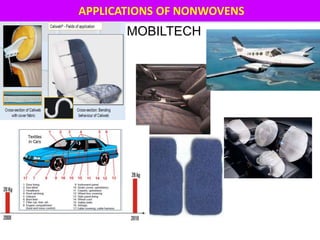
MOBILTECH
APPLICATIONS OF NONWOVENS
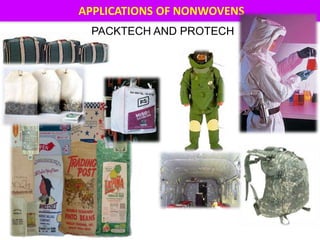
PACKTECH AND PROTECH
APPLICATIONS OF NONWOVENS
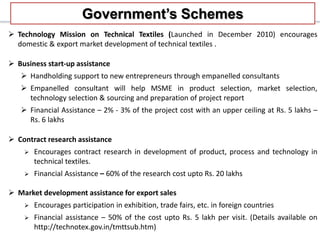
Government’s Schemes
 Technology Mission on Technical Textiles (Launched in December 2010) encourages
domestic & export market development of technical textiles .
 Business start-up assistance
 Handholding support to new entrepreneurs through empanelled consultants
 Empanelled consultant will help MSME in product selection, market selection,
technology selection & sourcing and preparation of project report
 Financial Assistance – 2% - 3% of the project cost with an upper ceiling at Rs. 5 lakhs –
Rs. 6 lakhs
 Contract research assistance
 Encourages contract research in development of product, process and technology in
technical textiles.
 Financial Assistance – 60% of the research cost upto Rs. 20 lakhs
 Market development assistance for export sales
 Encourages participation in exhibition, trade fairs, etc. in foreign countries
 Financial assistance – 50% of the cost upto Rs. 5 lakh per visit. (Details available on
http://technotex.gov.in/tmttsub.htm)
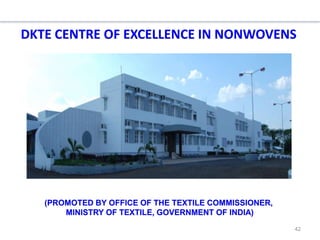
DKTE CENTRE OF EXCELLENCE IN NONWOVENS
42
(PROMOTED BY OFFICE OF THE TEXTILE COMMISSIONER,
MINISTRY OF TEXTILE, GOVERNMENT OF INDIA)
Centre of Excellence
 The Centre of Excellence offers its facilities, knowledge, research support,
HRD, Technical consultancy, etc to serious entrepreneurs.
 Provides facilities like
– Testing facilities,
– Product, process & prototype development facilities,
– Sample Bank, competent manpower,
– Training facilities and incubation centre.
 Provides facilities to the entrepreneurs in one hand and suitable products
to the users on the other.
 Incubation of new ideas into practical tradable products and
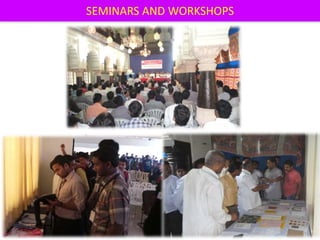
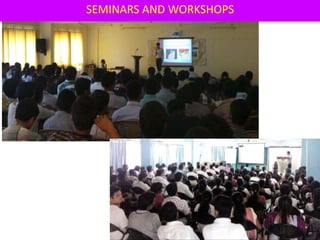
 Dissemination of information through workshop & seminar.
 The CoE provides infrastructure at one place for the convenience of the
manufacturers of technical textiles in India. 43
44
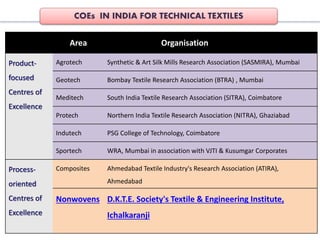
Area Organisation
Product-
focused
Centres of
Excellence
Agrotech Synthetic & Art Silk Mills Research Association (SASMIRA), Mumbai
Geotech Bombay Textile Research Association (BTRA) , Mumbai
Meditech South India Textile Research Association (SITRA), Coimbatore
Protech Northern India Textile Research Association (NITRA), Ghaziabad
Indutech PSG College of Technology, Coimbatore
Sportech WRA, Mumbai in association with VJTI & Kusumgar Corporates
Process-
oriented
Centres of
Excellence
Composites Ahmedabad Textile Industry's Research Association (ATIRA),
Ahmedabad
Nonwovens D.K.T.E. Society's Textile & Engineering Institute,
Ichalkaranji
COEs IN INDIA FOR TECHNICAL TEXTILES
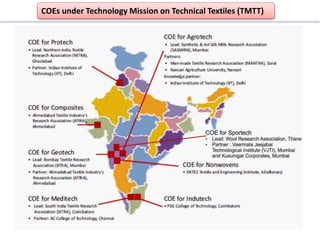
COEs under Technology Mission on Technical Textiles (TMTT)
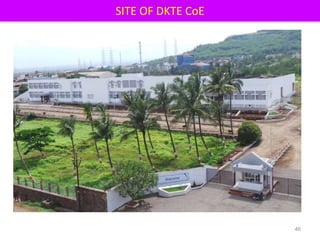
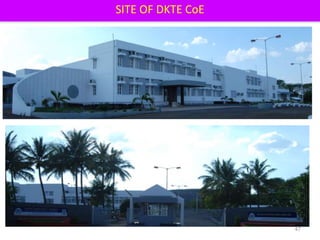
SITE OF DKTE CoE
46
47
SITE OF DKTE CoE
OBJECTIVE: CENTRE OF EXCELLENCE
1. Facilities for testing and evaluation of products in Nonwovens
2. Resource centre with IT infrastructure that provides knowledge and information on
Nonwovens & technical textiles.
3. Facilities for indigenous development of prototypes.
4. Pilot plant facilities are being created for development of prototypes / technology
which shall be transferred to the industry after standardization and optimization of
the production process.
4. Facilities for training of personnel
5. Knowledge sharing with stakeholders by arranging seminars and awareness
programmes
6. Incubation centers where each of the COEs will provide necessary facilities to
entrepreneurs for testing new ideas and technologies.
7. Setting up standards that are at par with global level.
48
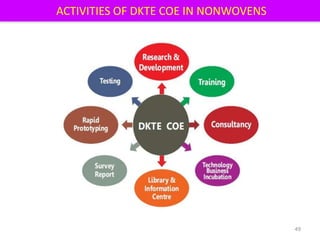
ACTIVITIES OF DKTE COE IN NONWOVENS
49
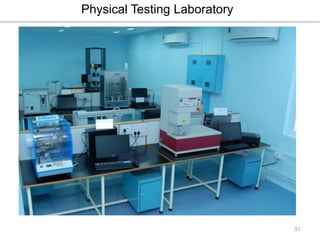
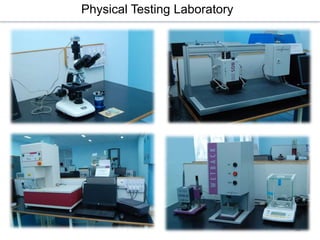
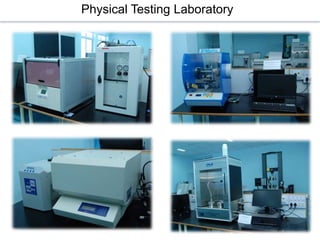
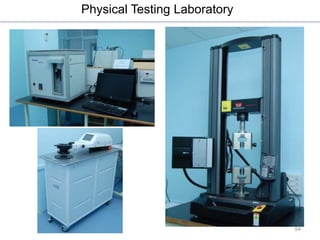
Testing Facilities
50
• GSM Tester
• Digital Bursting Strength Tester
• Digital Thickness Tester
• Water Repellency Tester
• Microscope With Microtome
• LOI Tester
• Pore Size Analyser
• UV Accelerated Weathering Tester
• Linear Density & Fibre Crimp
• Air Permeability Tester
• Water Vapour Transmitivity Tester
• Non Woven Orientation
• Liquid Strike Through & Wet Back
• Thermal Conductivity Tester
• Digital Tearing Strength Tester
• Hydrostatic Water Head Tester
• Gradient Ratio Test Apparatus
• Water Transmittivity Tester
• Tensile Testing Instrument
• Direct Shear Box
• Digital pH Meter
• Viscometer
• Shaking Water Bath
51
Physical Testing Laboratory
52
Physical Testing Laboratory
53
Physical Testing Laboratory
54
Physical Testing Laboratory
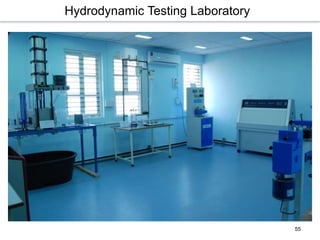
Hydrodynamic Testing Laboratory
55
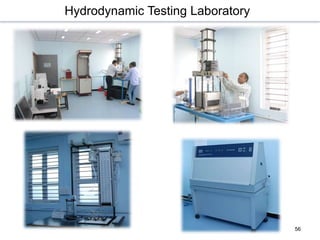
Hydrodynamic Testing Laboratory
56
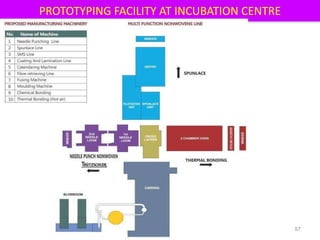
PROTOTYPING FACILITY AT INCUBATION CENTRE
57
58
Training Activities
• Training programme and workshop on “Applications of textiles in agriculture”
• Training programme on Solution Spinning technology and its applications
• Training Cum Workshop on Applications of Geo Synthetics & Geo-textiles in Civil
Engineering
• Training programme on Nonwoven technology: Manufacturing, Hands-on Testing of
Nonwovens and Nonwoven Sector Market Overview
• Workshop on Role of Technical Textiles & Nonwovens in Civil Engineering
• Training Programme on Applications of Geo-synthetics in Civil Engineering and Road
Construction
• Training programme on “Nonwovens in Indutech and Buildtech Sectors”
• Training programme on “Technical Textiles in Mobiltech and Buildtech Sectors”
• Training programme on “Nonwovens in Oekotech applications”
59
SEMINARS AND WORKSHOPS
60
SEMINARS AND WORKSHOPS
61
• Super absorbent polymers based nonwovens
• Chicken Feather BASED Nonwoven composite acoustic material
• Development of fiber Reinforced Concrete
• Antimicrobial cum antistatic surgical gown
• PU coated artificial leather from nonwovens
• Nonwoven fabrics for reinforcing unpaved roads
• Reflective crack resistant nonwoven for paved roads
• Static dissipating nonwovens (automobiles, home furnishing carpets etc.)
R&D Activities
• Nonwovens are widely used in different areas of Technical Textiles and are
rapidly replacing and/or providing cost-effective alternative to the traditional
woven and knitted fabrics.
• Composites of nonwovens with woven/knitted fabrics provides another
avenue to the technical textiles industry in India to explore new market
segments.
• India with an excellent background of textile manufacturing industry, is rapidly
emerging as a major player in the world nonwoven and technical textile
industry. 62
Conclusion
• Needle punching and Spunbonding technologies are being used for the
production of nonwovens in India.
• However, the industry has to upgrade itself with latest technologies like
Meltblown technology, bicomponent spinning as well as latest coating and
finishing technologies to be at par with the global entities.
• DKTE Centre of Excellence in Nonwovens is actively engaged promoting
nonwoven industry and closely working with the nonwovens and technical
industry .
63
Conclusion
CONTACT
64
DKTE CoE in Nonwovens,
DKTE Textile and Engineering Institute, ‘Rajwada’, P B No 130,
ICHALKARANJI. Dt. Kolhapur – 416115 (MS) India
Phone: +91 230 2421300
Fax: +91 230 2432329
Email : dktestextile@gmail.com
www.dktes.com
ANIKET BHUTE
Scientist,
DKTE COE in Nonwovens
Mobile: 9975437345
Email : abhute@gmail.com
VARUN GOUD
Scientist,
DKTE COE in Nonwovens
Mobile: 8652752540
Email : varun.s.goud@gmail.com
Thank You
D.K.T.E. Society’s
Textile & Engineering Institute, Ichalkaranji
DKTE Center of Excellence in Nonwovens
Promoted by Ministry of Textiles, Govt. of India
Plot No. 1, 2 and 3, Shri. Lakshmi Co-Operative
Industrial Estate, Hatkanangle – Ichalkaranji
Dt. Kolhapur – 416109 (MS) India
Tel: +91 230 2366354 Email: dktecoe@gmail.com,
Web: www.dktecoenonwovens.in
‘Rajwada', P Box No. 130, Ichalkaranji
Tal: Hatkanangle, Dt. Kolhapur – 416 115 (MS) India
Tel: +91 230 2421300, 2437316, 2437317
Email: dktestextile@gmail.com ; Web: www.dktes.com

SPUNBOND NONWOVENS - NEW IDEAS

  • 1.
    Indian Nonwoven Industry-PresentScenario & Future Prospects D.K.T.E. Society’s Textile & Engineering Institute, Ichalkaranji, Dist: Kolhapur, Maharashtra State 1
  • 2.
    DKTE CENTRE OFEXCELLENCE IN NONWOVENS 2 (PROMOTED BY OFFICE OF THE TEXTILE COMMISSIONER, MINISTRY OF TEXTILE, GOVERNMENT OF INDIA)
  • 3.
  • 4.
    Global Technical TextileIndustry outlook Value-wise share of each segment in global technical textile market Sources: Report of the Expert Committee on Technical Textiles (ECTT) Volume – I, ‘World Market Forecasts for 2010 of technical textiles and industrial nonwovens’ by David Rigby Associates
  • 5.
    Source: Baseline surveyof the Technical Textile industry in India, IMaCS Analysis Value-wise CAGR for various technical textile segments from 2009-10 to 2012-13 Value-wise share of each segment in Indian technical textile market in US$ million Indian Technical Textile industry
  • 6.
    6  In theIndian market, needlepunch has the maximum share followed by spunbond technology due to the high demand for nonwovens in automobile, hygiene and geotextile sectors.  However spunlace technology has the highest growth rate for future with a CAGR of 27%.  Organised Retail is expected to grow at 50% for the next five years, which will be a big boost for products like wipes that make up for more than 60% of spunlace consumption in the world.  Indian Healthcare Industry is growing at 15%. Privatisation and increasing medical tourism has resulted in growing demand of disposable nonwoven products like gowns, caps, masks etc. Spunlace based products provide high barrier against harmful microbes as well as provide comfortable wear. Market Share of Nonwoven Technologies
  • 7.
    7 Worldwide nonwovens production NonwovenMarket Growth rates between 2005 and 2015:  7.3% - Tonnage  8.4% - m² 0 2 4 6 8 10 12 2005 2006 2007 2008 2009 2010 2011 2012 2013 2014 2015 0 50 000 100 000 150 000 200 000 250 000 300 000 Tonnes (millions) m² (millions) Source: Pira estimation
  • 8.
    8 Consumption of fibersfor nonwovens PP and PET are the main fibres used in drylaid web forming. Between 2010 and 2015, the consumption of Wood pulp will increase of 45% 0 0,2 0,4 0,6 0,8 1 1,2 1,4 1,6 1,8 2005 2006 2007 2008 2009 2010 2011 2012 2013 2014 2015 mTons PP PET Vis Bico Wood pulp Other Source: Pira estimation Nonwoven Market
  • 9.
    Nonwoven Market End-uses ofNonwovens 9 Source: EDANA , INDA estimation
  • 10.
    Nonwoven Market Nonwovens Consumptionper Capita (kg) 10 Source: INDA Estimates, Ian Butler, INTC-2008 0 1 2 3 4 5 6 7 Taiwan Korea NAFTA Europe -27 Australia Japan Malaysia Saudi Arabia Turkey Mexico China South America Brazil S. Africa Russia India kg Developed Markets Early Development Markets Emerging Markets High export volumes
  • 11.
    ENCOURAGING FACTORS ININDIA • Population factor (90 million young people, 21 million educated people). • Income, Willingness and Availability of plastic money to spend. People are ready to spend more if they see value & brands. • Consumer changes to look for life style changing products like wipes, diapers etc. • Growth of retail market or mall culture. • Competition will push the price down thereby increase the demand. • Increasing exposure to international lifestyle. • Large Raw material base in cotton, polyester, viscose etc. • Promotion of special economic zones (SEZ), textile parks and TUFS 11
  • 12.
    Nonwoven Processes 12 Web-Forming MeltspunDrylaid Airlaid Wetlaid  Meltblown  Carded  Airlaid  Wetlaid  Spunlaid Web-Treatment Dewatering Drying Dyeing Chemical  Vacuum  TAD  Padder  Padder  Squeezer  Low add-on Web-Bonding Thermal Chemical  Hydro- entanglement  Calender  Padder  Needlepunch  Oven Mechanical Web-Handling Winding Slitting Packaging Control  Winder  Slitter  Packaging  Line control  Quality control NONWOVENS MANUFACTURING
  • 13.
    NONWOVENS MANUFACTURING CARDING • Aloose web of fibers • Separates fibers through combing action • Can be use to blend two or more fibres • Basic structure of fiber to fabric, require bonding APPLICATIONS • Wipes, Hygiene • Automotive, insulation, • Interlining 13
  • 14.
    AIR LAID • Canbe fibers, blends of fibers or wood pulp • Fibers are introduced into an air stream and form web on a belt or drum which requires bonding • Air laid fibers have random distribution APPLICATIONS • Wipes, Hygiene • Automotive, insulation, • Interlining 14 NONWOVENS MANUFACTURING
  • 15.
    NONWOVENS MANUFACTURING WET LAID •Fibers / Blended fibers or Wood pulp in water with very low concentration • Water / fiber mixture released onto a forming belt • Excess water is removed and then bonded for stability APPLICATIONS • Tea bags, • Vacuum cleaner, Filtration • Meditech applications 15
  • 16.
    NEEDLE PUNCHING • Oscillatingneedles penetrate the web in vertical direction • Causing entanglement of fibers to create stable web • High strength and durability APPLICATIONS • Geotextile • Synthetic leather, Blankets • Carpet and liners 16 NONWOVENS MANUFACTURING
  • 17.
    SPUNBOND • Melting polymerspallets through an extruder and spinnerette to form filaments • Stretch and cool Filaments, deposit on moving conveyer to form web which is bonded thermally. • Economical process, • Uniform and strong fabric APPLICATIONS • Home furnishing, Bedding • Roofing Substrate, House wrap • Diaper covers 17 NONWOVENS MANUFACTURING
  • 18.
    CHEMICAL BONDING • Ondry laid web chemical binder is applied using either Gravure printer, Padder, foam applicator or spray • Binder may be applied in pattern or overall • After drying binder-fiber form strong bond APPLICATIONS • Roofing, Shoe components • Apparel interlining • Wipes • Automotive substrate 18 NONWOVENS MANUFACTURING
  • 19.
    THERMAL BONDING • Fibersare formed in to a web • Bonded by hot air or heat and pressure • Thermoplastic fibers are selected • Can be converted to soft to stiff fabric APPLICATIONS • Diaper components, window blinds • Apparel interlining, filtration media • Geotextile applications • Automotive trims 19 NONWOVENS MANUFACTURING
  • 20.
    SPUNLACE Dry laid webis directed under series of fine, high pressure water jets • Suction under belt removes water leaving behind entangled fibers which further dried APPLICATIONS • Wipes, Single use medical applications 20 NONWOVENS MANUFACTURING
  • 21.
    21 Nano Spunlaid &Meltblown Nonwoven Fabrics – High surface area – Lighter weights (8-10 gsm) – Improved web uniformity – Target market: absorbent hygiene, filtration Bi component Fibres Recent Developments
  • 22.
    Finishing of Nonwovens •Hydrophilic • Hydrophobic • Repellent • Flame Retardant • Coating • Anitmicrobial • Dye • Finishing • Print • Corrugate • Emboss • Compact • Crepe • Flock • Plasma • Encapsulate 22
  • 23.
    APPLICATIONS OF NONWOVENS DISPOSABLEAPPLICATIONS Medical • Drapes • Surgical / Isolation gowns • CSR Wraps • Caps ,Facemasks ,shoe covers Hygiene • Baby Diapers, Training pants • Feminine Hygiene products • Adult Incontinence products Wipes • Baby • Household • Industrial 23 DURABLE APPLICATIONS Geotextiles • Soil Stabilization, Drainage • Road and Rail construction Filtration • Air, gas, liquid Agriculture • Crop covers, Greenhouse shades • Mulches Home Furnishing • Carpet backing • Furniture Construction Building and Construction • Insulation, Roofing Automotives • Carpets & Headliner. • Door panel insulation, Carpet backing.
  • 24.
  • 25.
  • 26.
    NonWoven Geotextiles Applications - –Sub-surface drainage – Separation – Stabilization – Erosion Control – Geomembrane Protection
  • 27.
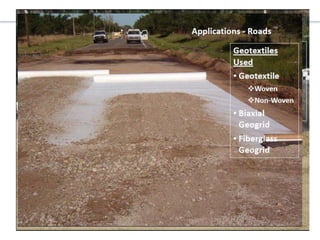
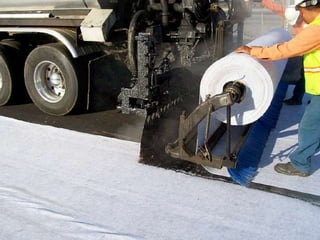
    Uses of Non-WovenGeotextiles • Non-wovens – Drainage application • French drains, pipe sock • MSE walls – Separation application • Remediation projects, waste containment • Road building • Parking lots • Weed barrier
  • 29.
  • 30.
    These are geocompositesformed of a hollow cored, geotextile wrapped drainage element (geonet) inserted vertically into soft ground to speed up the consolidation process. Prefabricated Vertical Drain Installation of PVD Geocomposites: Prefabricated Vertical Drains (PVD)
  • 32.
  • 33.
    Geotextile for Sealing NewOverlay Reflective Crack without Paving Fabric Old Pavement Base Course PavementCrack withPavingFabric
  • 34.
    Geosynthetic Clay Liner Bentonite/textilecomposite for Water Reservoir application
  • 35.
    Endurance Properties • AbrasionResistance • UV Stability • Chemical Resistance • Biological Resistance • Wet/Dry Stability • Temperature Stability
  • 36.
  • 37.
  • 38.
  • 39.
  • 40.
  • 41.
    Government’s Schemes  TechnologyMission on Technical Textiles (Launched in December 2010) encourages domestic & export market development of technical textiles .  Business start-up assistance  Handholding support to new entrepreneurs through empanelled consultants  Empanelled consultant will help MSME in product selection, market selection, technology selection & sourcing and preparation of project report  Financial Assistance – 2% - 3% of the project cost with an upper ceiling at Rs. 5 lakhs – Rs. 6 lakhs  Contract research assistance  Encourages contract research in development of product, process and technology in technical textiles.  Financial Assistance – 60% of the research cost upto Rs. 20 lakhs  Market development assistance for export sales  Encourages participation in exhibition, trade fairs, etc. in foreign countries  Financial assistance – 50% of the cost upto Rs. 5 lakh per visit. (Details available on http://technotex.gov.in/tmttsub.htm)
  • 42.
    DKTE CENTRE OFEXCELLENCE IN NONWOVENS 42 (PROMOTED BY OFFICE OF THE TEXTILE COMMISSIONER, MINISTRY OF TEXTILE, GOVERNMENT OF INDIA)
  • 43.
    Centre of Excellence The Centre of Excellence offers its facilities, knowledge, research support, HRD, Technical consultancy, etc to serious entrepreneurs.  Provides facilities like – Testing facilities, – Product, process & prototype development facilities, – Sample Bank, competent manpower, – Training facilities and incubation centre.  Provides facilities to the entrepreneurs in one hand and suitable products to the users on the other.  Incubation of new ideas into practical tradable products and  Dissemination of information through workshop & seminar.  The CoE provides infrastructure at one place for the convenience of the manufacturers of technical textiles in India. 43
  • 44.
    44 Area Organisation Product- focused Centres of Excellence AgrotechSynthetic & Art Silk Mills Research Association (SASMIRA), Mumbai Geotech Bombay Textile Research Association (BTRA) , Mumbai Meditech South India Textile Research Association (SITRA), Coimbatore Protech Northern India Textile Research Association (NITRA), Ghaziabad Indutech PSG College of Technology, Coimbatore Sportech WRA, Mumbai in association with VJTI & Kusumgar Corporates Process- oriented Centres of Excellence Composites Ahmedabad Textile Industry's Research Association (ATIRA), Ahmedabad Nonwovens D.K.T.E. Society's Textile & Engineering Institute, Ichalkaranji COEs IN INDIA FOR TECHNICAL TEXTILES
  • 45.
    COEs under TechnologyMission on Technical Textiles (TMTT)
  • 46.
  • 47.
  • 48.
    OBJECTIVE: CENTRE OFEXCELLENCE 1. Facilities for testing and evaluation of products in Nonwovens 2. Resource centre with IT infrastructure that provides knowledge and information on Nonwovens & technical textiles. 3. Facilities for indigenous development of prototypes. 4. Pilot plant facilities are being created for development of prototypes / technology which shall be transferred to the industry after standardization and optimization of the production process. 4. Facilities for training of personnel 5. Knowledge sharing with stakeholders by arranging seminars and awareness programmes 6. Incubation centers where each of the COEs will provide necessary facilities to entrepreneurs for testing new ideas and technologies. 7. Setting up standards that are at par with global level. 48
  • 49.
    ACTIVITIES OF DKTECOE IN NONWOVENS 49
  • 50.
    Testing Facilities 50 • GSMTester • Digital Bursting Strength Tester • Digital Thickness Tester • Water Repellency Tester • Microscope With Microtome • LOI Tester • Pore Size Analyser • UV Accelerated Weathering Tester • Linear Density & Fibre Crimp • Air Permeability Tester • Water Vapour Transmitivity Tester • Non Woven Orientation • Liquid Strike Through & Wet Back • Thermal Conductivity Tester • Digital Tearing Strength Tester • Hydrostatic Water Head Tester • Gradient Ratio Test Apparatus • Water Transmittivity Tester • Tensile Testing Instrument • Direct Shear Box • Digital pH Meter • Viscometer • Shaking Water Bath
  • 51.
  • 52.
  • 53.
  • 54.
  • 55.
  • 56.
  • 57.
    PROTOTYPING FACILITY ATINCUBATION CENTRE 57
  • 58.
    58 Training Activities • Trainingprogramme and workshop on “Applications of textiles in agriculture” • Training programme on Solution Spinning technology and its applications • Training Cum Workshop on Applications of Geo Synthetics & Geo-textiles in Civil Engineering • Training programme on Nonwoven technology: Manufacturing, Hands-on Testing of Nonwovens and Nonwoven Sector Market Overview • Workshop on Role of Technical Textiles & Nonwovens in Civil Engineering • Training Programme on Applications of Geo-synthetics in Civil Engineering and Road Construction • Training programme on “Nonwovens in Indutech and Buildtech Sectors” • Training programme on “Technical Textiles in Mobiltech and Buildtech Sectors” • Training programme on “Nonwovens in Oekotech applications”
  • 59.
  • 60.
  • 61.
    61 • Super absorbentpolymers based nonwovens • Chicken Feather BASED Nonwoven composite acoustic material • Development of fiber Reinforced Concrete • Antimicrobial cum antistatic surgical gown • PU coated artificial leather from nonwovens • Nonwoven fabrics for reinforcing unpaved roads • Reflective crack resistant nonwoven for paved roads • Static dissipating nonwovens (automobiles, home furnishing carpets etc.) R&D Activities
  • 62.
    • Nonwovens arewidely used in different areas of Technical Textiles and are rapidly replacing and/or providing cost-effective alternative to the traditional woven and knitted fabrics. • Composites of nonwovens with woven/knitted fabrics provides another avenue to the technical textiles industry in India to explore new market segments. • India with an excellent background of textile manufacturing industry, is rapidly emerging as a major player in the world nonwoven and technical textile industry. 62 Conclusion
  • 63.
    • Needle punchingand Spunbonding technologies are being used for the production of nonwovens in India. • However, the industry has to upgrade itself with latest technologies like Meltblown technology, bicomponent spinning as well as latest coating and finishing technologies to be at par with the global entities. • DKTE Centre of Excellence in Nonwovens is actively engaged promoting nonwoven industry and closely working with the nonwovens and technical industry . 63 Conclusion
  • 64.
    CONTACT 64 DKTE CoE inNonwovens, DKTE Textile and Engineering Institute, ‘Rajwada’, P B No 130, ICHALKARANJI. Dt. Kolhapur – 416115 (MS) India Phone: +91 230 2421300 Fax: +91 230 2432329 Email : dktestextile@gmail.com www.dktes.com ANIKET BHUTE Scientist, DKTE COE in Nonwovens Mobile: 9975437345 Email : abhute@gmail.com VARUN GOUD Scientist, DKTE COE in Nonwovens Mobile: 8652752540 Email : varun.s.goud@gmail.com
  • 65.
    Thank You D.K.T.E. Society’s Textile& Engineering Institute, Ichalkaranji DKTE Center of Excellence in Nonwovens Promoted by Ministry of Textiles, Govt. of India Plot No. 1, 2 and 3, Shri. Lakshmi Co-Operative Industrial Estate, Hatkanangle – Ichalkaranji Dt. Kolhapur – 416109 (MS) India Tel: +91 230 2366354 Email: dktecoe@gmail.com, Web: www.dktecoenonwovens.in ‘Rajwada', P Box No. 130, Ichalkaranji Tal: Hatkanangle, Dt. Kolhapur – 416 115 (MS) India Tel: +91 230 2421300, 2437316, 2437317 Email: dktestextile@gmail.com ; Web: www.dktes.com

Editor's Notes